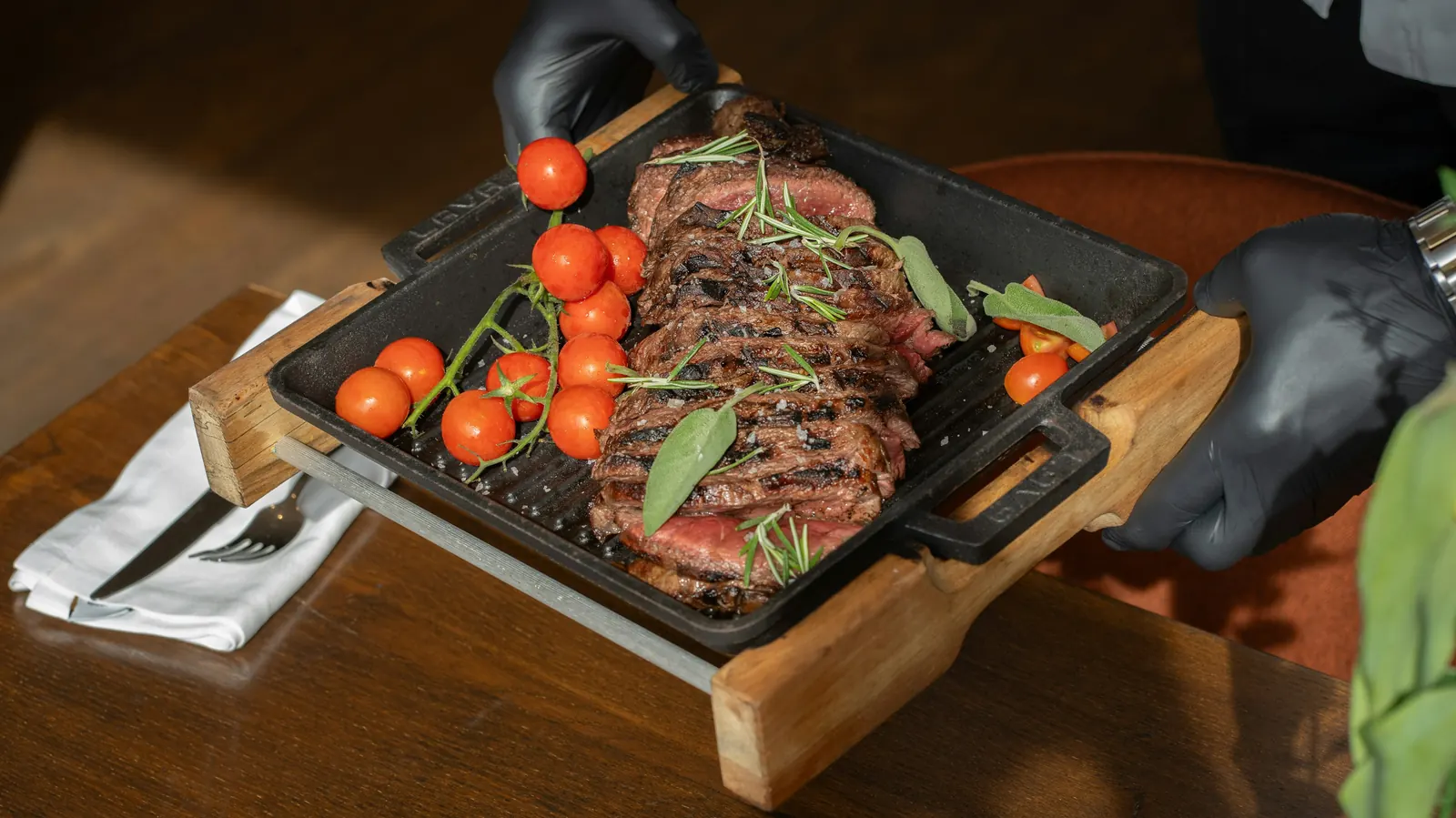
When the patio grill is out of reach, because of rain, a Houston August or an apartment lease, there are two ways to get grill marks on chicken and steak indoors. A grill pan is a heavy ridged pan that sits on a burner. An indoor grill is an electric appliance with ridged plates, usually nonstick, that plugs into the wall; many close like a press and cook both sides at once. They overlap, but they cook differently, take up different space and suit different cooks.
This guide compares them on heat, browning, smoke, capacity, cleanup and storage, says who should buy which, and ends with one example of each. For the full range of each, see our guides to the best grill pan and the best indoor grill.
Julia’s earns a commission on purchases made through links on this page, at no cost to you. Recommendations are based on what a restaurant kitchen looks for, product specifications and verified buyer reports.
Quick verdict: grill pan or indoor grill?
Buy a grill pan if you have a decent stove and a hood fan, want the hardest sear and darkest marks, and would rather keep the counter clear: it’s simpler, has nothing to break and lasts for decades. Buy an indoor grill if your burners are weak or you have none to spare, you want set-it-and-walk-away temperature control, or you’d use a contact grill for tortas, paninis and quesadillas as well as meat.
The table sums up the differences; the sections after it explain each one.
Grill pan vs indoor grill, side by side
| Grill pan | Indoor electric grill | |
|---|---|---|
| Heat source | Your stove burner | Built-in heating elements, wall outlet |
| Temperature control | Burner knob; you judge the heat | Thermostat dial or presets |
| Cooking surface | Cast iron, carbon steel, enamel or nonstick ridges | Usually nonstick-coated plates |
| Sides cooked at once | One; flip by hand | Both, on a closing contact grill |
| Fat | Collects in the channels | Runs to a drip tray |
| Smoke | Can be heavy at high heat; needs the hood | Some; varies by model and food |
| Storage | Hangs or stacks with pans | Countertop or cupboard space |
| Lifespan | Decades for bare iron or steel | As long as the coating and electronics last |
| Best jobs | Steak, skirt steak, chicken thighs, nopales, onions | Chicken breasts, burgers, tortas, paninis, quesadillas |
Heat and control: a burner or a thermostat
A grill pan is only as hot as the burner under it, and it has no thermostat: you turn the knob and judge by the sizzle. On a strong gas burner, a heavy cast iron or steel grill pan will get hotter than most plates on an electric grill, which is why it can mark a skirt steak fast. On a weak electric coil, it takes a long preheat. America’s Test Kitchen’s grill pan review notes that “the taller the ridges, the more deeply they mark food,” and taller ridges need a properly hot pan to work.
An indoor grill brings its own heat. You set a temperature and the thermostat holds it, whatever your stove is like. That is a real advantage for a cook with a small range, a dorm or office kitchenette, or one burner already busy with rice and beans. The limit is power: a plug-in appliance has a fixed wattage (the Cuisinart Griddler Deluxe below is rated at 1,800 watts), and the plates can take time to recover after a load of cold meat goes on.
Browning and grill marks
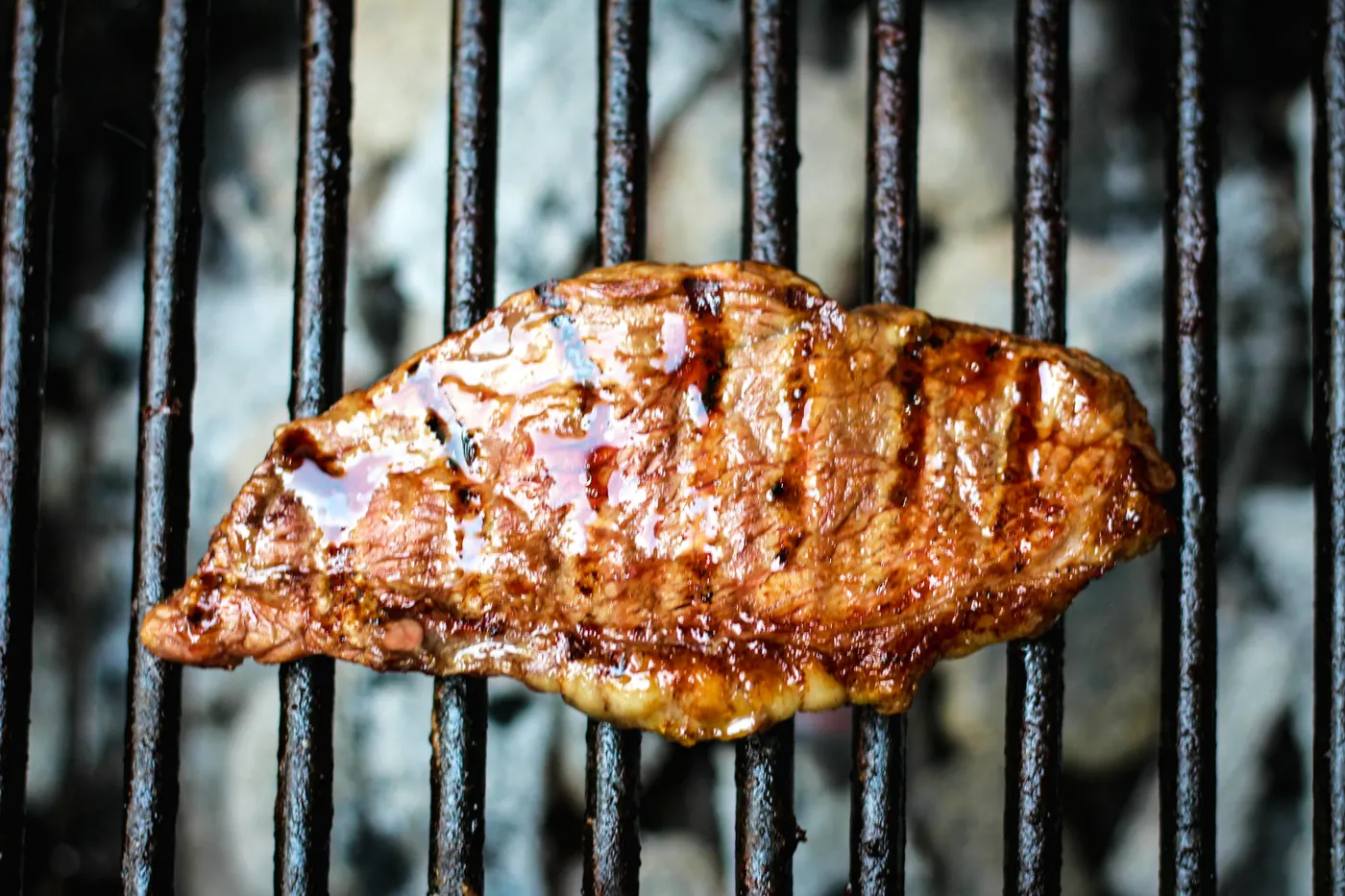
Both cook on ridges, so both give stripes rather than an edge-to-edge crust; that is the shared trade-off with a flat pan, which we cover in grill pan vs skillet. The difference is how much heat the ridges hold. A thick iron or steel grill pan stores a lot of heat, so the marks keep forming when the food hits it. Coated aluminum plates in an indoor grill hold less, and the thermostat has to catch up.
A contact grill makes up for it another way: the lid presses the top plate onto the food, so both sides cook and mark at once. A chicken breast or a burger cooks without flipping and comes out marked on top and bottom. For thin cuts, sandwiches and quesadillas, that is hard to beat. For a thick steak where you want a deep crust, the open, heavy grill pan wins.
Smoke, fat and the kitchen
Any high-heat grilling indoors makes smoke; what changes is where the fat goes. In a grill pan, fat collects in the channels between the ridges, close to the heat, and it smokes. Pour it off as you go, use a high smoke-point oil sparingly, and run the hood fan. Our grill pan for glass top stove guide also covers lifting rather than sliding heavy pans on smooth tops.
Indoor grills tilt or channel fat away from the plates into a drip tray, out of the hottest zone; the Griddler below has an integrated drip tray, per Cuisinart’s listing. Some models add fans or water trays to cut smoke further. You will still smell carne asada, but the counter is often a better place for it than a burner without a good hood.
Capacity and what fits
A 10 to 12-inch grill pan holds two steaks or four burgers. Bigger cast iron grill pans exist, but anything that spans two burners gets heavy fast. Indoor grills vary more: compact two-serving presses, mid-size open grills and contact grills whose plates open flat. The Griddler Deluxe below lists 240 square inches of grilling surface. If you regularly feed four or more, an indoor grill that opens flat usually gives more room than one grill pan, without tying up two burners.
Cleanup and care
A bare cast iron or carbon steel grill pan is scraped while warm, rinsed, dried and oiled, the same routine as a skillet. The grooves take some work, which is why ATK liked widely spaced ridges as being easy to scrub. Enameled and nonstick grill pans clean more easily but ask for gentler heat.
Indoor grills with removable plates are much easier: the Griddler’s plates come out and go in the dishwasher, per the listing. Fixed-plate grills are harder, since you can’t put the appliance in water and have to wipe the plates in place. Nonstick plates also need plastic or wooden tools; a metal spatula will wear the coating.
Space, storage and lifespan
A grill pan stores with your other pans and, in bare iron or steel, lasts for decades; there is no coating to wear out and nothing electrical to fail. An indoor grill needs cupboard or counter space and lasts as long as its coating and controls do. In return it does more than grill: many contact grills also work as a panini press, and the Griddler’s reversible plates turn it into a flat griddle for eggs and pancakes.
Grill pan vs indoor grill for Mexican cooking
The grill pan is the better stand-in for charcoal on the dishes where char matters: skirt or flank steak for carne asada, chicken thighs in an adobo or achiote marinade, whole green onions and jalapeños, nopal paddles brushed with oil, and thick slices of onion and pineapple for al pastor-style tacos. The heavy iron holds the heat these need.
The indoor grill shines with tortas and quesadillas, which a contact grill presses and toasts in one go, with chicken breasts for tinga or salads, and with weeknight burgers. For a griddle that also does tortillas, see our guide to the best quesadilla maker, and for how grilled meat and vegetables come together at the table, how to eat fajitas.
Choose a grill pan if… / Choose an indoor grill if…
Choose a grill pan if…
- You have a good burner and a hood fan.
- You want the darkest marks on steak, thighs and vegetables.
- You’re short on counter and cupboard space.
- You want something that lasts for decades without electronics.
Choose an indoor grill if…
- Your stove is weak, small or always busy.
- You want a set temperature and less watching.
- You’d use a contact grill for tortas, paninis and quesadillas.
- You want plates that go in the dishwasher.
Our pick on each side of the grill pan vs indoor grill question
Both picks were in stock when we checked. For more choices on either side, our best grill pan guide compares cast iron, enameled and nonstick pans, and our best indoor grill and best small indoor grill guides cover contact, open and smokeless grills. The two below are different from the picks on those pages.
1. Merten & Storck 11-inch Carbon Steel Square Grill Pan – Iron-Style Marks, Lighter Pan

Merten & Storck’s grill pan is carbon steel rather than cast iron, which answers the usual complaint about grill pans: weight. Kohl’s lists it at 3.5 pounds; Lodge’s 10.5-inch cast iron square grill pan is 6.68 pounds in Lodge’s catalog. The listing describes deep ridges for grill marks that drain fat, a pour spout for tipping out that fat, and a triple-riveted steel handle.
It arrives pre-seasoned with natural oils, per the listing, and works on induction, gas, electric and ceramic tops, in the oven and on a grill or campfire. That last part matters for a grill pan: you can put it on the outdoor grill for shrimp or vegetables that would fall through the grates. Care is the carbon steel routine: hand wash, dry promptly and oil lightly.
Being steel, it heats faster than cast iron and stores a little less heat, so preheat it fully before the steak goes on.
Why we like it
- 3.5 lb, per Kohl’s listing
- Pour spout for fat
- Works on induction
- Grill and campfire safe
Key specifications
| Model | CC007333-001 |
|---|---|
| Type | Ridged square grill pan |
| Cooking area | 11-inch square |
| Heat | Your stove; oven, grill, campfire |
| Surface | Pre-seasoned carbon steel |
| Weight | 3.5 lb (Kohl’s) |
| Cleaning | Hand wash, dry, oil |
| Warranty | 2 years (Kohl’s listing) |
Why we recommend it
It suits a cook with a good stove who wants grill marks indoors without lifting a 7-pound iron pan.
Skip it if you want a pan you can soak or put in the dishwasher; bare steel will rust.
Pros and cons
Pros
- Light for a grill pan
- Goes on the outdoor grill too
- No coating to wear
Cons
- Needs seasoning care
- Holds less heat than cast iron
- One handle only
2. Cuisinart Griddler Deluxe – Contact Grill, Open Grill and Griddle in One

The Griddler Deluxe is the indoor grill for a cook who wants more than grill marks. The listing names six ways to use it: contact grill, panini press, full grill, full griddle, half grill and half griddle, and top melt. Its removable plates are reversible, ridged on one side and flat on the other, nonstick and dishwasher safe.
It is rated at 1,800 watts with 240 square inches of grilling surface when opened flat, per the listing, and has dual-zone temperature control, so one plate can grill chicken while the other holds a lower heat for tortillas or onions. A sear function runs at 500°F for up to two minutes at a time, and an integrated drip tray catches fat. Cuisinart gives it a limited three-year warranty.
It is a big appliance, so plan where it lives. The nonstick plates need plastic or wooden tools; the included scraping tool is for cleanup.
Why we like it
- Six cooking modes
- Dual-zone temperature control
- Dishwasher-safe plates
- Three-year limited warranty
Key specifications
| Model | GR-150 |
|---|---|
| Type | Contact grill and griddle |
| Cooking area | 240 sq in opened flat |
| Heat | 1,800 W; sear to 500°F for up to 2 min |
| Surface | Reversible nonstick plates (grill/griddle) |
| Weight | Not stated |
| Cleaning | Removable dishwasher-safe plates, drip tray |
| Warranty | Limited 3 years |
Why we recommend it
It suits a household that would use a contact grill several times a week for chicken, burgers, tortas and quesadillas, and wants easy cleanup.
Skip it if counter space is tight; a grill pan hangs on a hook instead.
Pros and cons
Pros
- Cooks both sides at once
- Flat griddle plates included
- Thermostat, not guesswork
Cons
- Bulky to store
- Nonstick plates wear over time
- Less stored heat than iron
Grill pan and indoor grill questions, answered
Indoor grill vs grill pan: which is healthier?
Neither is healthier by itself. Both let fat drain away from the food, into the pan’s channels or the grill’s drip tray. What you cook and how much oil you add matter far more.
Which makes less smoke?
Usually the indoor grill, because fat runs off to a drip tray instead of sitting in hot grooves, but any high-heat grilling indoors smokes. With a grill pan, pour off fat as it collects and run the hood fan.
Can a grill pan replace an indoor grill?
For grilling meat and vegetables, yes, and with more sear. It can’t press a torta or cook both sides at once, and it needs a burner.
Do indoor grills get hot enough to sear?
Some do for short bursts; the Griddler Deluxe’s sear function reaches 500°F for up to two minutes, per Cuisinart. A preheated heavy grill pan on a strong gas burner holds high heat longer, which is better for a thick steak.
Is a grill pan or an indoor grill better for an apartment?
If the range hood is weak, an indoor grill with a drip tray is easier on the smoke alarm. If counter space is the problem, a grill pan stores with the pans.
Which one belongs in your kitchen
For most cooks with a decent stove, the grill pan is the better first buy: it sears harder, needs no counter space and lasts. The indoor grill earns its counter space for a cook with weak burners, a busy stove or a taste for tortas and quesadillas pressed on the same machine as the chicken. Our guide to Mexican cooking methods shows where grilling fits alongside the comal and the pot. And when you’d rather someone else did the grilling, see the menu or call to order.