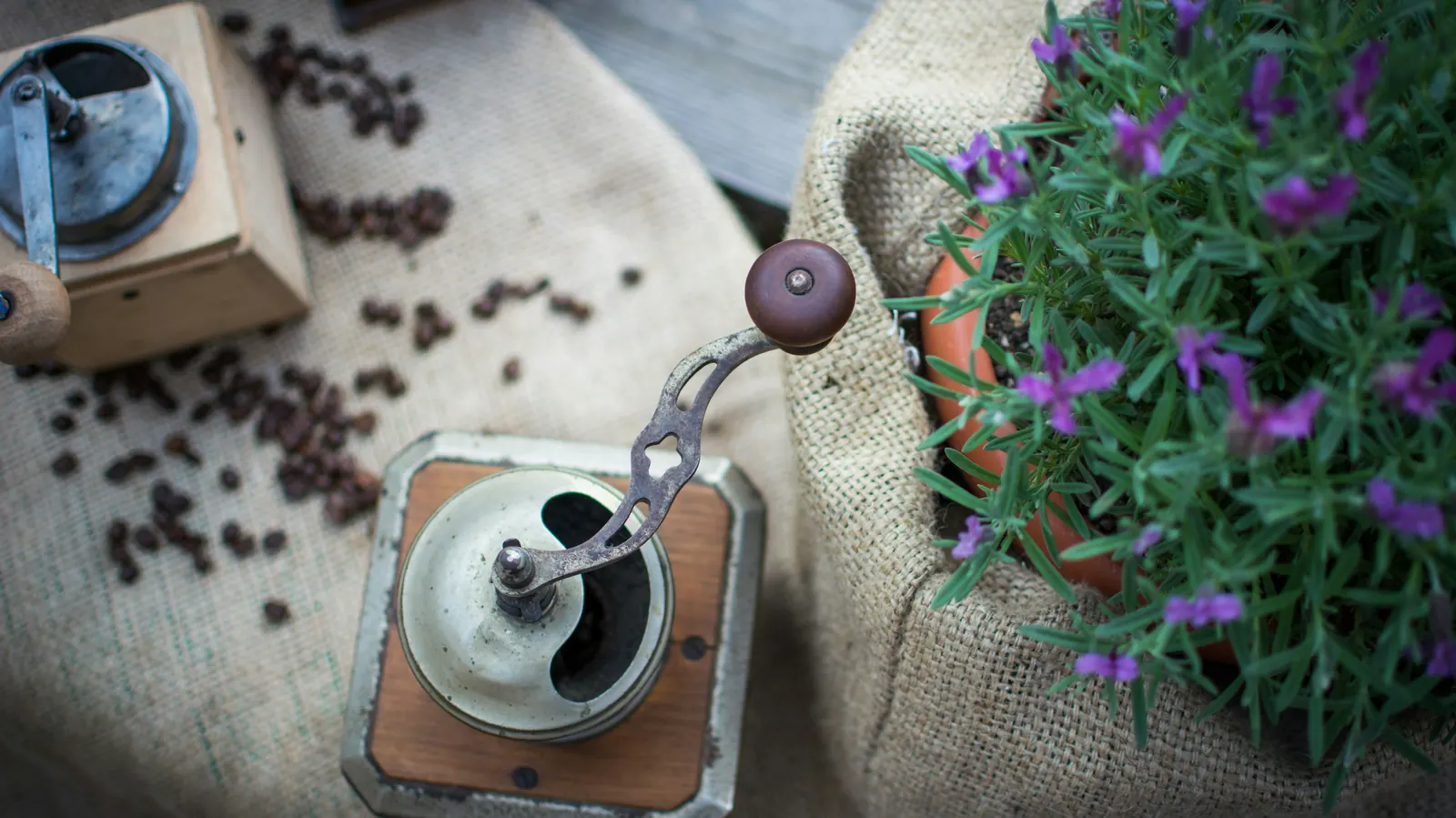
Once you have decided on a burr grinder, the next choice is who turns the burrs: you or a motor. A hand grinder is a metal or plastic cylinder with a crank on top, a set of conical burrs inside and a small cup that catches the grounds. An electric grinder puts burrs of the same kind behind a motor, a bean hopper and a switch or timer. Both crush beans to a set size. They differ in how long that takes, how much they hold, where they can go and what the money buys.
A restaurant kitchen thinks about tools the same way. The molcajete and the blender both make salsa; the question is how much you are making, how often, and whether you mind doing the work. This guide compares hand and electric burr grinders on grind time, grind evenness, espresso, batch size, effort, noise and cost class, using the makers’ own figures where they publish them, then names one grinder on each side.
Julia’s earns a commission on purchases made through links on this page, at no cost to you. Recommendations are based on what a restaurant kitchen looks for, product specifications and verified buyer reports.
Quick verdict: crank or motor?
If you brew one or two cups a day and want the best grind for the money, buy a hand grinder. With no motor to pay for, the money goes into the burrs, and it is quiet, compact and works anywhere. If you grind for a household pot, brew several times a day or simply won’t crank for a minute every morning, buy an electric grinder. It does the job in seconds and doses for you. For most single coffee drinkers the hand grinder is the better value; for most families the electric one is the one that will actually get used.
The table sums up the differences; the sections after it explain each one and where the figures come from.
Hand vs electric coffee grinder, side by side
| Hand burr grinder | Electric burr grinder | |
|---|---|---|
| Grind time, one large cup | About a minute (Timemore, for its C2S) | Roughly 20 to 25 seconds for 20 g at 0.8 to 1.1 g per second (Baratza Encore) |
| What sets evenness | Burrs, bearings and alignment | Burrs, bearings and alignment |
| Typical batch | 20 to 40 g; 30 g on the Timemore C5 Pro | A full hopper; one Cuisinart burr mill grinds for up to 18 cups |
| Dosing | Weigh the beans first | Timers or programmed doses on many models |
| Espresso | Possible on models with fine steps | Needs an espresso-rated model |
| Power and space | No outlet; fits a drawer or bag | Needs an outlet and counter space |
| Noise | Only the sound of crushing beans | Motor noise; varies by model |
| Cost class | Good burrs for less | Higher for the same burr quality |
Grind time: where the motor earns its keep
Speed is the clearest difference, and the makers’ own numbers show it. Baratza’s point-of-sale sheet gives the Encore, its entry electric grinder for filter coffee, a speed to grind of 0.8 to 1.1 grams per second. That works out to roughly 20 to 25 seconds for a 20-gram dose, the beans for a large mug. Its Encore ESP, built for espresso, runs at 1.5 to 2.4 grams per second, and the Sette 270 listing claims up to 5 grams per second. At that end of the range, an espresso dose takes a few seconds.
Hand grinders are slower. Timemore says its Chestnut C2S grinds enough for a big cup in about a minute, and its 25-gram capacity is a fair guide to what it means by a big cup. Other hand grinders are faster or slower depending on burr size, how fine you go and how hard you crank. Kitchen sense says to expect the same pattern from any of them: coarse grinds go quickly, fine espresso grinds take noticeably longer, and light roasts are harder work than dark ones.
For one cup, the difference between 25 seconds and a minute is small. For a household pot of 50 or 60 grams, the hand grinder needs two fills and a few minutes of cranking, while the electric one runs while you fill the kettle. That is the practical line between them.
Grind evenness: the burrs decide, not the power
Both sides of this comparison are burr grinders, so the gap between them is much smaller than the gap between burr and blade. Our burr vs blade coffee grinder guide explains why an even grind matters. Within burr grinders, evenness comes from the quality of the burrs and from how steadily they turn, not from whether a hand or a motor turns them.
The makers point at the same parts. Timemore says the double bearings on its C5 Pro keep the central shaft in position for uniform particles. KitchenAid says the stainless conical burrs in its KCG8433 produce uniformly sized grounds. Baratza credits the new metal internals of the Encore ESP for highly consistent grinds. Those are makers’ claims, not independent measurements, but they agree on what matters: good burrs, held true.
Here is where the hand grinder’s value comes from. It has no motor, gearbox or electronics to pay for, so at the same cost class more of the money can go into the burrs and bearings. Our best coffee grinder hand guide makes the same point: a decent hand burr grinder usually costs less than a good electric one. The flip side is that a very low-cost hand grinder with loose bearings will grind unevenly too. Judge either type by its burrs and how they are supported.
Espresso: fine steps on either side
Espresso asks for a fine grind that can be moved in very small steps, and both types can do it if they are built for it. On the hand side, Timemore lists 0.031 mm per click on the C5 Pro and calls it suitable from French press to espresso, and its C3 ESP goes finer still at 0.0233 mm per click. Our best handheld espresso grinder guide covers hand grinders made with espresso in mind.
On the electric side, the line is drawn by model. Baratza recommends its Encore for filter brewing and the Encore ESP for espresso, and gives the ESP 20 micro steps for fine-tuning that the Encore lacks. An espresso-capable electric grinder sits in a higher cost class than a filter-only one. If espresso is your main drink and the budget is tight, a hand grinder is often the lower-cost way to get there; if you pull several shots a day, the cranking adds up fast. Our best espresso grinder guide covers both.
Batch size and dosing
A hand grinder holds a dose, not a supply. Most take 20 to 40 grams; Timemore lists 30 grams for the C5 Pro. You weigh the beans on a kitchen scale, pour them in and grind exactly that amount, which suits single-dose brewing and keeps the rest of the bag sealed.
Electric grinders hold more and measure for you. The Cuisinart one-touch burr mill lists an 8-ounce hopper and a grind chamber that holds enough for 32 cups, with a cup selector from 4 to 18. KitchenAid says its Smart Dosing produces the right amount for each drink you select, and the Baratza Sette 270 listing describes three programmable dose buttons accurate to a tenth of a second. For a café de olla pot on a Sunday morning, that convenience is the whole reason to own one.
Effort, noise and where it lives
A hand grinder asks for a minute or so of steady turning. Makers work to make that easier. Timemore says the C5 Pro’s bearing keeps the handle turning briefly after you let go and lets it grind with very little force, and the body is 53 mm across, sized for smaller hands. Even so, kitchen sense says anyone with sore wrists or arthritis should think twice about cranking a fine grind every day.
Noise favors the hand grinder. With no motor, the only sound is the beans being crushed, which matters in a small apartment or a house where someone sleeps late. That is kitchen sense rather than a measured figure; electric grinders vary widely in volume, and makers rarely publish decibels.
Space and power favor the hand grinder too. It needs no outlet, the C5 Pro’s handle folds for carrying, and it fits a drawer, a camping box or a travel bag. An electric grinder needs a permanent spot on the counter near an outlet, but it is always ready, and you can walk away while it runs.
Cleaning and upkeep
Both are cleaned dry, with a brush. Timemore says the C5 Pro comes apart easily and is cleaned with a brush; one is included. The KitchenAid hopper twists off so you can empty or swap beans without turning the machine over, and a cleaning brush is in the box. Kitchen sense applies to both: keep water off steel burrs unless the maker says otherwise, and keep a coffee grinder for coffee, because spice oils carry into the next cup.
Long term, a hand grinder has fewer parts that can fail. An electric grinder adds a motor, switches and, on many models, electronics; check the warranty before you buy. KitchenAid’s listing gives one year on the KCG8433; Timemore’s listing for the C5 Pro does not state one.
Cost class
We don’t quote prices because they change. As a rule, the same burr quality costs less in a hand grinder, because you are not paying for a motor. Electric burr grinders start higher and climb steeply for espresso models. The cheapest electric burr grinders can cost less than a premium hand grinder, so compare like with like: burr size and material, bearings, adjustment steps and warranty. Our best coffee grinder guide covers electric models across the range.
Choose a hand grinder if… / Choose an electric grinder if…
Choose a hand grinder if…
- You brew one or two cups at a time.
- You want the best burrs your budget can buy.
- You value quiet mornings or have no spare outlet or counter space.
- You travel or camp and want good coffee there too.
- You want to try espresso without buying an espresso grinder.
Choose an electric grinder if…
- You grind for a household pot or brew several times a day.
- You want the grinder to measure the dose for you.
- Cranking for a minute or more is a chore, or hard on your hands.
- You want to switch between brew methods with a dial and a button.
Our pick on each side of the hand vs electric coffee grinder question
One grinder per side, both in stock when we checked, and both covering French press to espresso so the comparison is fair. Neither listing appears on our other pages, but both are models we have picked before, and we chose them again for a stated reason. The Timemore C5 Pro is a different listing of the grinder in our best conical burr grinder for pour over guide; it is here because it publishes its burr size, click size, capacity and weight, which makes it a clear example of what a hand grinder offers. The KitchenAid KCG8433 is a different color of the grinder in our best coffee grinder for French press and best burr grinder for drip coffee guides; it is here because its automatic dosing shows what a motor adds beyond speed.
1. Timemore C5 Pro Manual Coffee Grinder – 42 mm Burrs in an All-Metal Body
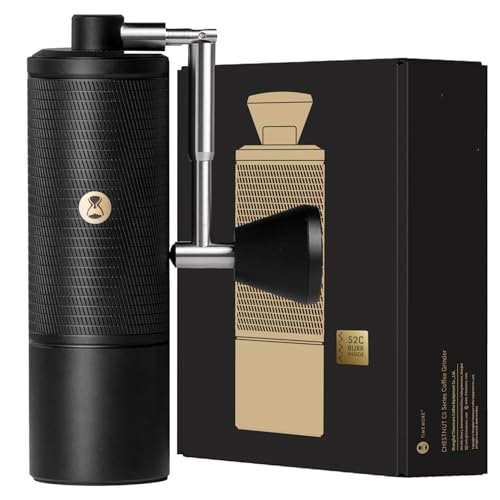
The C5 Pro is a mid-size hand grinder that shows the type at its best. The listing describes 42 mm stainless steel conical burrs, Timemore’s S2C-042-III design, which is large for a hand grinder and means more coffee per turn. Adjustment is by a nut under the burr, about 48 steps from fine to coarse at 0.031 mm per click, and Timemore says it covers French press through espresso.
The body is a single piece of metal with double bearings that Timemore says keep the shaft centered for uniform particles. Another Timemore listing for the C5 Pro gives the capacity as 30 grams and the weight as 663 grams, which is enough for a large mug or two small cups. The handle folds for carrying, and Timemore says the built-in bearing keeps it turning briefly after you let go, so grinding takes little force.
It comes apart for cleaning with the included brush. The adjustment nut is inside, so changing between espresso and pour-over means taking off the catch cup and counting clicks. If you switch methods often, an external dial is easier; if you mostly brew one way, it is no trouble.
Why we like it
- 42 mm stainless conical burrs (listing)
- 0.031 mm per click, about 48 steps (listing)
- Double bearings for a steady shaft (Timemore)
- Folding handle, no outlet needed
Key specifications
| Model | C5 Pro (black) |
|---|---|
| Power | Hand crank |
| Burrs | 42 mm stainless steel conical |
| Grind settings | About 48; 0.031 mm per click |
| Capacity | 30 g (Timemore listing) |
| Weight | 663 g (Timemore listing) |
| Cleaning | Comes apart; brush included |
| Warranty | Not stated in the listing |
Why we recommend it
It suits a one- or two-cup household that wants an even grind for pour-over or French press, with room to try espresso, from a grinder that also travels.
Skip it if you grind for a family pot every morning; 30 grams per fill means two or three rounds of cranking.
Pros and cons
Pros
- Large burrs for a hand grinder
- Fine steps for every brew method
- Quiet and portable
Cons
- Internal adjustment
- One or two cups per fill
- No warranty stated
2. KitchenAid Burr Coffee Grinder – 70 Settings With Automatic Dosing

The KCG8433 shows what an electric grinder adds beyond speed. KitchenAid says its Smart Dosing Technology produces the right amount of grounds for each drink you select, so there is no weighing and no counting. It has 70 settings, from coarse for cold brew and French press to fine for espresso, according to the listing.
The burrs are stainless steel conical burrs, which KitchenAid calls commercial-grade and says produce uniformly sized grounds. A portafilter holder comes in the box alongside the grounds tray, so it can grind straight into an espresso basket. The bean hopper twists off to empty or swap beans without tipping the machine over, and a cleaning brush is included.
The listing gives a one-year warranty. It does not state the burr size, motor power, grind speed or hopper capacity, so we can’t compare it with Baratza’s published figures; expect it to be far quicker than any hand grinder, as every motor-driven burr grinder is. This is the Charcoal Grey finish; the grinder is the same in other colors.
Why we like it
- Smart Dosing by drink selection (KitchenAid)
- 70 grind settings, cold brew to espresso (listing)
- Portafilter holder included (listing)
- Removable hopper; one-year warranty (listing)
Key specifications
| Model | KCG8433DG |
|---|---|
| Power | Electric (wattage not stated) |
| Burrs | Stainless steel conical (size not stated) |
| Grind settings | 70 |
| Capacity | Not stated |
| Weight | Not stated |
| Cleaning | Removable hopper; brush included |
| Warranty | 1 year |
Why we recommend it
It suits a household that brews several ways, from a French press pot to espresso, and wants the grinder to handle the measuring.
Skip it if you want published burr and speed figures; Baratza’s grinders in our best coffee grinder guide publish more.
Pros and cons
Pros
- Doses for you
- Wide range of settings
- Grinds into a portafilter
Cons
- Few published specifications
- Needs counter space and an outlet
- Higher cost class than a hand grinder
Hand and electric grinder questions, answered
Is a hand grinder as good as an electric one?
For grind quality, a good hand burr grinder can match or beat an electric grinder in the same cost class, because the money goes into the burrs rather than a motor. It is slower and holds less, so it suits one or two cups better than a family pot.
How long does it take to grind coffee by hand?
Timemore says its C2S grinds enough for a big cup in about a minute. Fine grinds for espresso and light roasts take longer. An entry electric grinder such as the Baratza Encore does a 20-gram dose in roughly 20 to 25 seconds, by Baratza’s figures.
Manual or electric burr grinder for French press?
Either works, since both burr types give an even coarse grind. A French press pot often takes more coffee than one hand-grinder fill, so for a large press an electric grinder saves a second round of cranking. Our best French press guide covers the brewer itself.
Can a hand grinder make espresso?
Yes, if it has small adjustment steps. The Timemore C5 Pro lists 0.031 mm per click and covers espresso; grinders built for it go finer. Expect more turns and more time than for filter coffee.
Do electric grinders heat the coffee?
None of the maker sheets and listings we read for this page gives a measured figure, so we make no claim either way. At home doses, grind evenness and freshness matter more than any heat difference.
Which grinder belongs in your kitchen
For one person or a couple, buy the hand grinder: better burrs for the money, no noise, and coffee anywhere. For a household that brews a pot, several cups a day or several methods, buy the electric grinder and let the motor and the dosing do the work. If you start with a hand grinder and find yourself cranking twice every morning, that is the time to add an electric one, and the hand grinder still earns its place in a travel bag.
For more choices, see our best coffee grinder hand guide for manual grinders and our best coffee grinder guide for electric ones. And when you would rather someone else made the coffee and the food, see the menu or call to order.