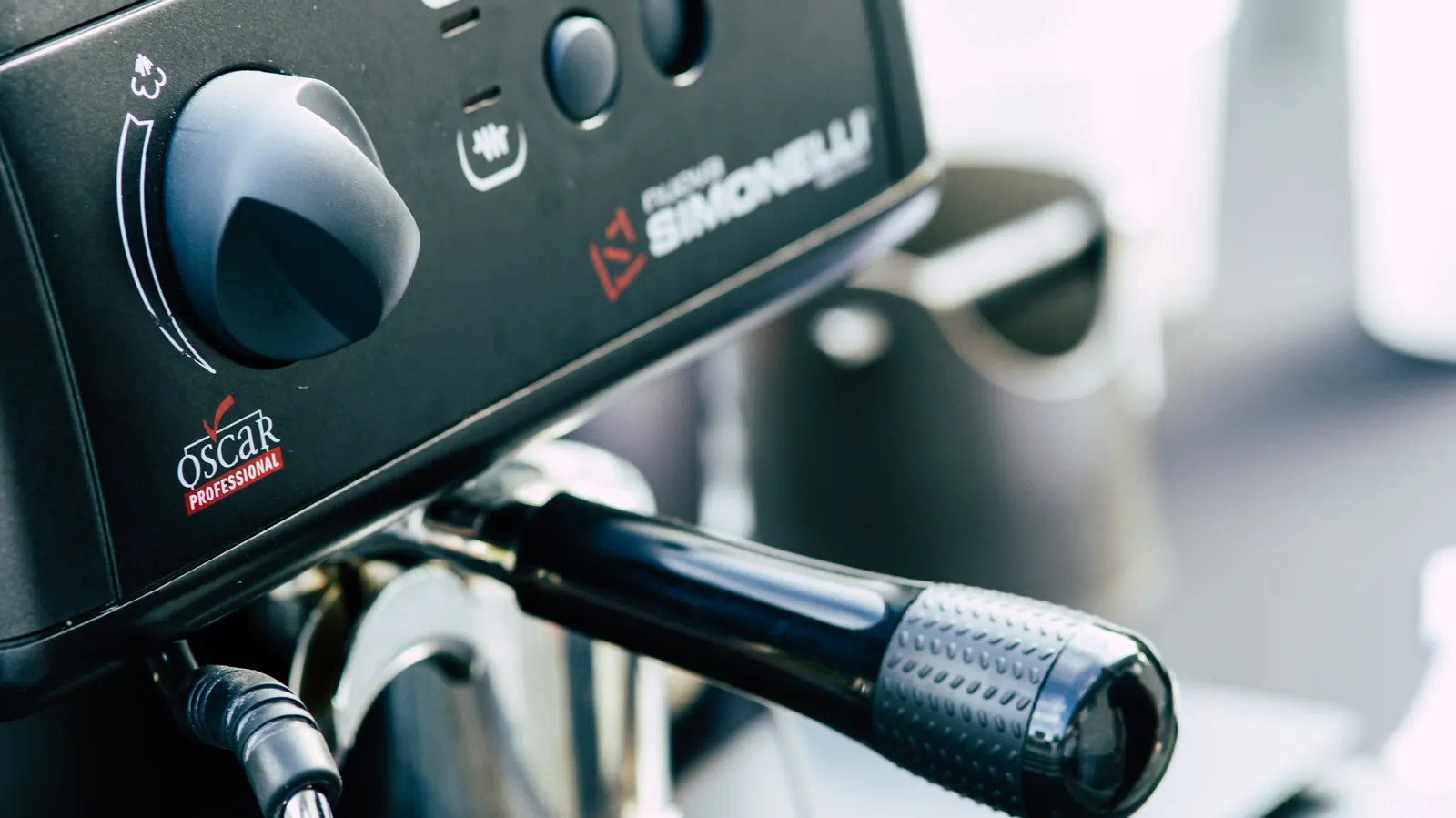
An espresso machine and a drip coffee maker both turn ground coffee and hot water into your morning cup, and they sit side by side in plenty of kitchens. They answer different questions, though. A drip coffee maker lets water fall through a basket of medium-ground coffee and fills a pot for the household. An espresso machine forces hot water through a small, tightly packed puck of fine coffee under pressure and gives you one or two concentrated shots at a time.
In a restaurant you see both at work: a big brewer for the coffee that goes out with breakfast, and an espresso machine for the drinks someone orders by name. This guide compares the two on the drinks they make, how much they make, skill, time, upkeep and cost class, then names two picks on each side.
Julia’s earns a commission on purchases made through links on this page, at no cost to you. Recommendations are based on what a restaurant kitchen looks for, product specifications and verified buyer reports.
Quick verdict: espresso machine or drip coffee maker?
Most households should buy a drip coffee maker. It makes a full pot with one button, needs no barista skill, works with pre-ground coffee and costs far less to own. Buy an espresso machine if the drinks you actually want are espresso, lattes, cappuccinos or iced espresso drinks, and you will spend a few minutes per drink making them. If you want espresso drinks with almost no technique, a fully automatic machine with a built-in grinder sits in between, at a much higher cost class.
The table sums up the differences. The sections after it explain each one and where the figures come from.
Espresso machine vs coffee maker, side by side
| Espresso machine | Drip coffee maker | |
|---|---|---|
| How it brews | High pressure forces water through fine coffee (NCA) | Hot water drips over ground coffee in a filter (NCA) |
| Brew time | About 20 to 30 seconds per shot (NCA) | About 5 minutes of contact (NCA) |
| Grind | Fine, like table salt (NCA) | Medium, like kosher salt (NCA) |
| Serving | About 1 ounce per shot (NCA) | A carafe; 4 to 12 cups is common |
| Drinks | Espresso, lattes, cappuccinos, iced espresso drinks | Brewed coffee, black or with milk |
| Skill | Low (automatic) to high (manual) (NCA) | Low |
| Extra gear | Burr grinder preferred, plus a scale (NCA) | None needed; pre-ground works |
| Cost class | Moderate to high | Low to moderate |
What each machine actually makes
This is the question that decides it. The National Coffee Association describes espresso as a method that uses high pressure to force nearly boiling water through finely ground coffee in about 20 to 30 seconds, and says a shot is the base for drinks such as cappuccinos and lattes. Wikipedia’s espresso entry gives the certified Italian standard as 9 bar of water pressure, plus or minus 1, and a cup of about 25 milliliters including crema, the dense foam that it calls unique to espresso.
A drip machine makes something else: a full-strength brewed coffee meant to be drunk by the mug. The NCA describes it as an automatic machine that slowly drips hot water over ground coffee in a filter, extracting flavor as it passes into a glass pot or carafe. You can add milk, but you cannot make a true latte from it, because there is no concentrated shot and no steam to texture the milk.
So start with the drinks. If your household drinks plain coffee, black or with a splash of milk, a drip maker does that job better and faster. If the coffee you buy out is a latte, a cortado or an iced espresso drink, a drip maker will not replace it, and an espresso machine is the tool for that.
Strength and caffeine are not the same thing
Espresso tastes much stronger, and it is: Wikipedia notes that espresso has a higher concentration of dissolved and suspended solids than drip coffee, which gives it its body. But the serving is small. The same entry puts a 30-milliliter shot at about 65 milligrams of caffeine and a 240-milliliter cup of drip coffee at about 95 milligrams. Ounce for ounce espresso has more caffeine, but a single shot usually has less than a mug of drip. If you want caffeine for a long morning, a pot of drip coffee covers more people for longer.
How much you make at once
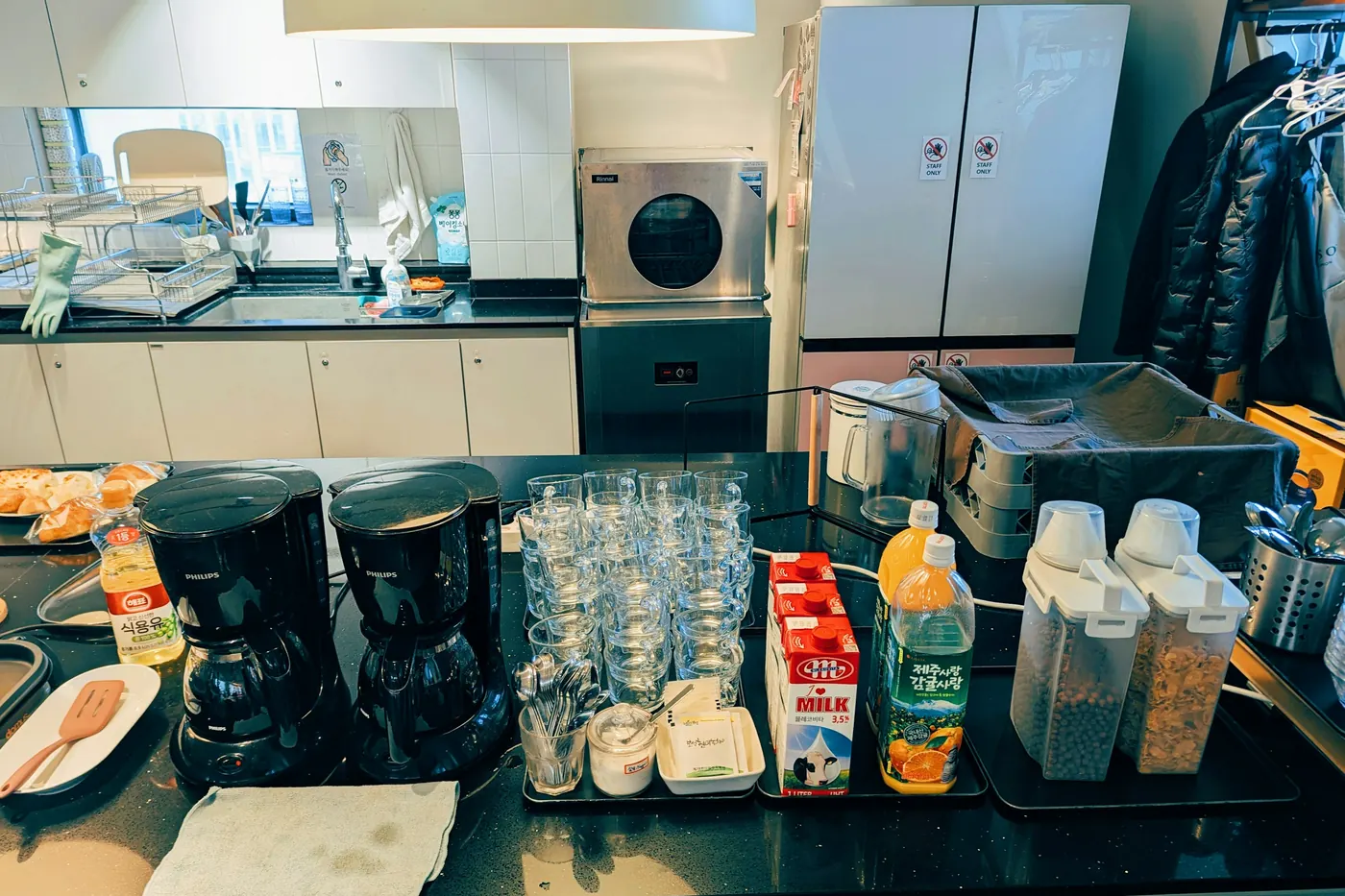
A drip machine is built for volume. The NCA’s golden ratio for drip is 1 to 2 tablespoons of ground coffee for every 6 ounces of water, and a single brew cycle fills the whole carafe. Both drip picks below make 10 cups in one go. That matters for a family breakfast, for guests, or for a pot that lasts the morning.
An espresso machine works one drink at a time. The NCA gives a shot as 1 ounce, brewed at about 1 gram of dry coffee to 2 grams of espresso. Making four lattes means four rounds of grinding, dosing, pulling and steaming. For one or two drinkers that is no burden. For a household of five who all want coffee at 7 a.m., it becomes a queue at the counter. Kitchen sense says to count the drinkers before you count the features.
Skill and daily routine
Drip is the easy habit. Medium grind, the NCA’s ratio, a paper filter and the button. Many machines can be set the night before; the GE pick below has a 24-hour timer. There is little to get wrong once the dose suits your taste.
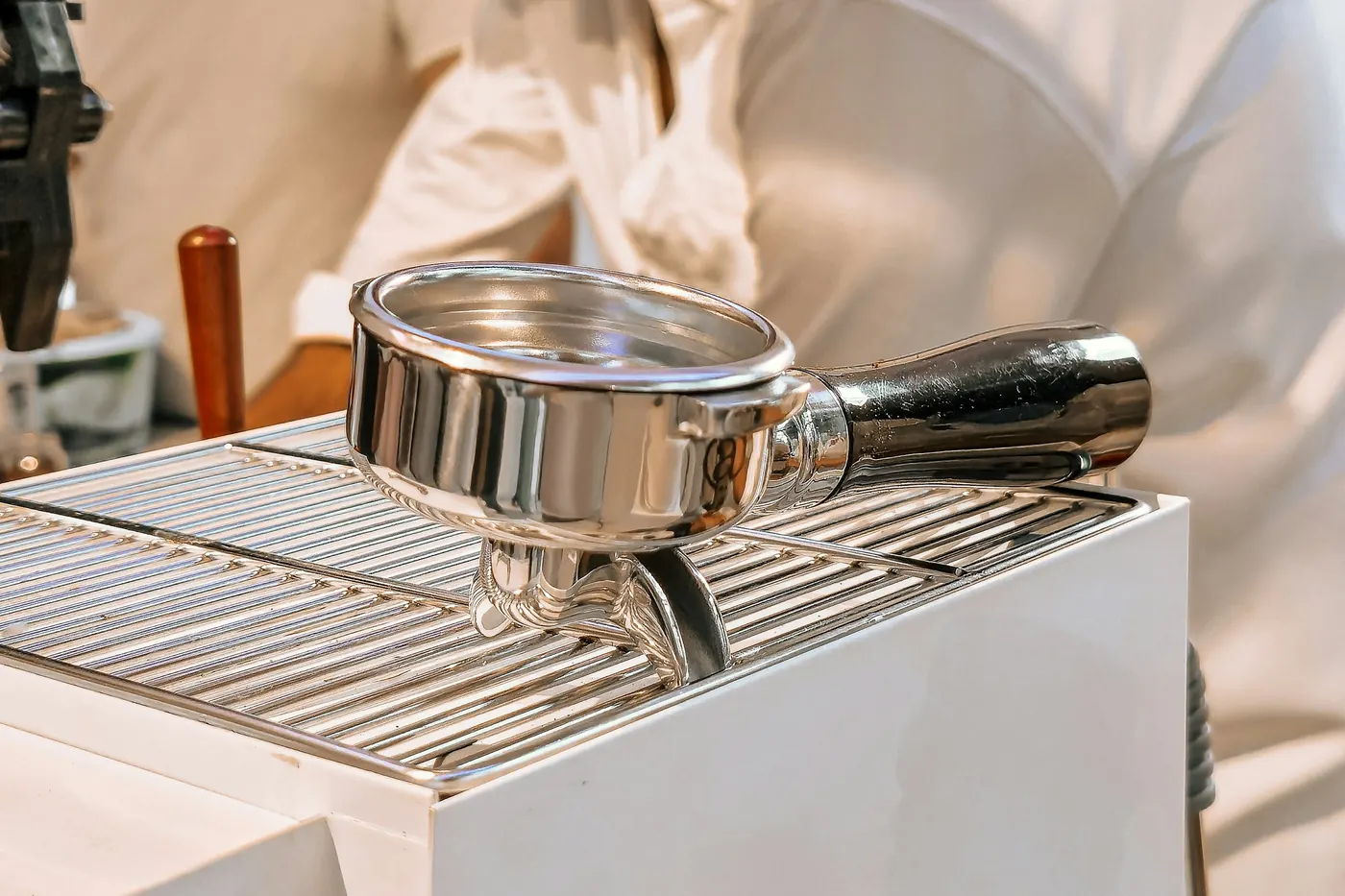
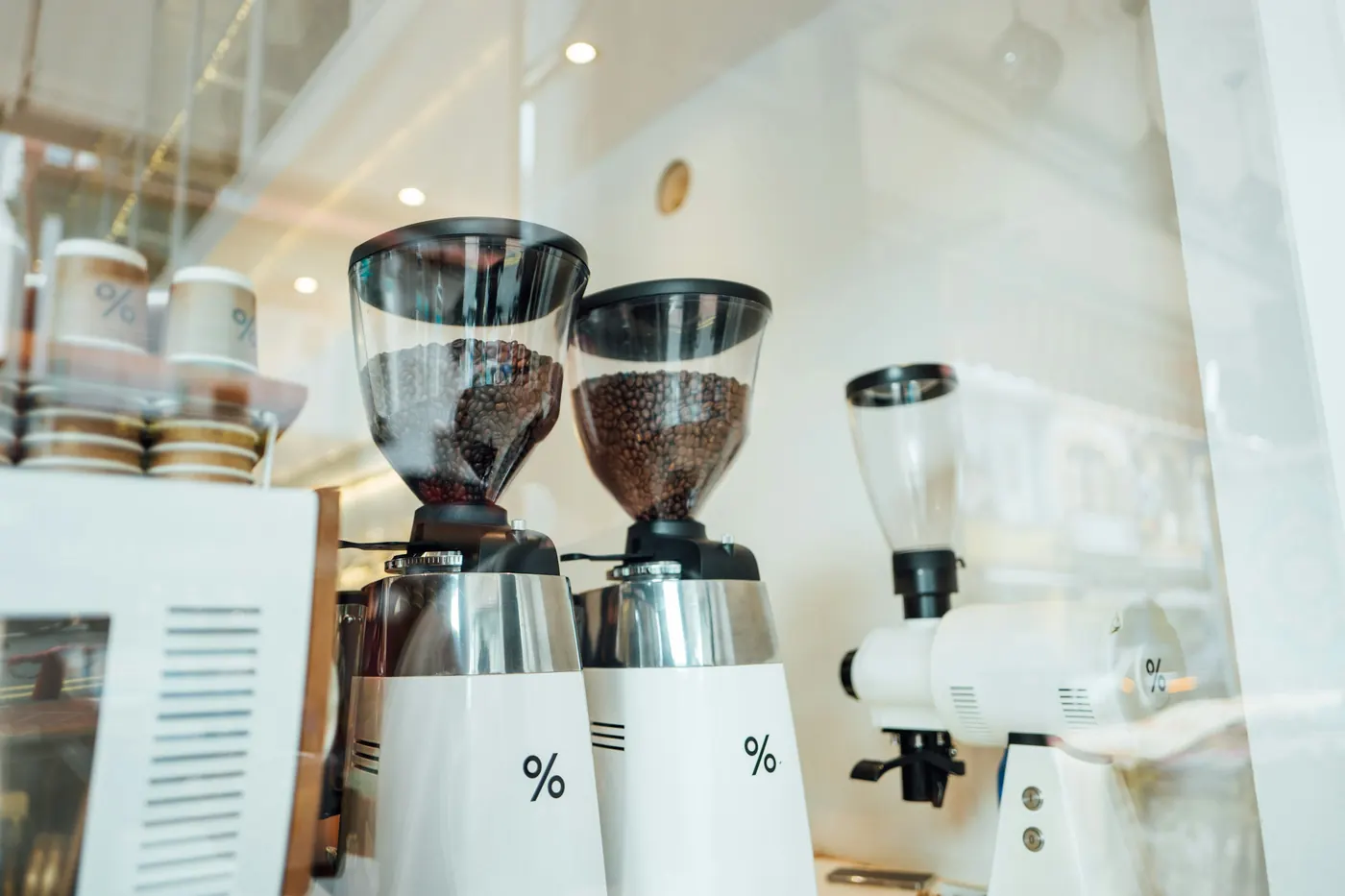
Espresso asks more, but how much depends on the machine type. The NCA lists four kinds of espresso machine: manual, semi-automatic, automatic and super-automatic. It calls automatic machines beginner-friendly and manual ones a match for advanced brewers. On a semi-automatic machine you grind, fill and tamp the portafilter, start the shot, and steam your own milk. Small changes in grind change the shot, which is why the NCA prefers a burr grinder to a blade grinder and lists a scale among the tools. A super-automatic, or fully automatic, machine grinds, doses and brews on its own, and some froth milk too. That removes most of the skill, at a much higher cost class.
Time per cup
Brew time favors espresso on paper: 20 to 30 seconds per shot, against about 5 minutes of contact for drip, by the NCA’s figures. In practice the full routine evens out. An espresso drink includes grinding, tamping and, for milk drinks, steaming and cleaning the wand. A drip pot takes a few minutes to brew but needs no attention while it does, and some machines are faster still: Bunn says its Velocity Brew fills a carafe in a few minutes because it keeps a tank of water hot. For one drink, the two are close. For several, drip wins easily.
Upkeep and cleaning
Both need regular care, but espresso needs more of it. The NCA says to clean espresso equipment after each use following the machine’s instructions: discard the used grounds, then clean and rinse the portafilter and group head. Milk drinks add a steam wand or frother to wipe or wash every time, and a drip tray to empty.
For drip, the NCA says to rinse the brew basket and filter after each use with clear, hot water, wash them now and then in hot, soapy water, and descale; it notes that major manufacturers recommend descaling at least every 3 to 6 months. If the machine has a hot plate, wipe spills once it has cooled. A thermal carafe skips the hot plate entirely, and kitchen sense says coffee left on a hot plate tastes cooked after an hour or so.
Counter space and cost class
We don’t quote prices because they change, but the classes are clear. A good drip coffee maker sits in the low to moderate class. An entry semi-automatic espresso machine costs more, and the NCA’s preference for a burr grinder adds a similar amount again unless the machine has one built in. Fully automatic machines with grinders sit in the high class. Running costs are close on both sides: beans, filters for drip, water and descaler.
Space is closer than you might expect. A compact espresso machine can take up less counter than a 12-cup drip maker, but add a separate grinder and the espresso setup grows. If you want both kinds of coffee from one appliance, our best coffee maker and espresso combo guide covers machines that do both.
Choose an espresso machine if… / Choose a coffee maker if…
Choose an espresso machine if…
- The drinks you want are espresso, lattes, cappuccinos or iced espresso drinks.
- You make one or two drinks at a time.
- You will buy a burr grinder too, or pay for a machine with one built in.
- You enjoy the routine, or will pay for a fully automatic machine to skip it.
Choose a coffee maker if…
- You drink brewed coffee by the mug, black or with milk.
- You make coffee for three or more people at once.
- You want a timer and a one-button morning.
- You want the lower cost class and less daily cleaning.
Our picks for each side of the espresso machine vs coffee maker choice
Two espresso machines, one semi-automatic and one fully automatic, and two drip coffee makers, one fast with a warmer plate and one with a thermal carafe and a timer. All four were in stock when we checked, and none appears as a pick on our other pages. Each is described from its Amazon listing; we name that as the source.
1. De’Longhi Classic Espresso Machine – Simple Shots and Milk

This is a compact semi-automatic machine from De’Longhi, model EM400M, for someone moving from drip to espresso who wants to learn the basics without a lot of settings. The listing describes 9-bar extraction, which matches the espresso standard, and a Thermoblock heater that reaches brewing temperature quickly.
Two features take some guesswork out of the first weeks. Preset single and double espresso buttons brew a set dose, and an auto-stop ends the shot on its own, so you are not timing it by eye. A dual-mode frother handles dairy or plant-based milk for lattes and cappuccinos, according to the listing. The drip tray has two heights, so a small espresso cup or a taller latte glass both fit.
There is no grinder, so pair it with a burr grinder or buy coffee ground for espresso. The listing gives a 1-year warranty and does not state the water tank size.
Why we like it
- 9-bar extraction (listing)
- Single and double presets with auto-stop (listing)
- Frother for dairy or plant-based milk (listing)
- Two-height drip tray for cups or glasses (listing)
Key specifications
| Model | EM400M |
|---|---|
| Type | Semi-automatic espresso machine |
| Drinks | Single or double espresso; milk drinks with the frother |
| Capacity | Not stated |
| Grinder | None |
| Milk | Dual-mode frother |
| Care | Portafilter, frother and drip tray after use |
| Warranty | 1 year (listing) |
Why we recommend it
It suits a one- or two-person household that wants real espresso and lattes, is happy to learn a short routine, and has a grinder or will buy one.
Skip it if you want espresso drinks at the touch of a button; the Magnifica Duo below grinds and brews on its own.
Pros and cons
Pros
- Presets and auto-stop for easier shots
- Quick heat-up (listing)
- Compact footprint
Cons
- Needs a separate grinder
- Tank size not stated
- One drink at a time
2. De’Longhi Magnifica Duo Automatic Espresso Machine – Grinds, Brews and Froths

The Magnifica Duo, model ECAM33080SXB, is the answer for someone who wants espresso drinks without learning to make them. The listing describes an integrated conical burr grinder and a touchscreen menu of 20 preset hot and iced recipes, so the machine grinds, doses and brews each drink itself. This is the beginner-friendly automatic end of the NCA’s range of machine types.
It also narrows the gap with a drip maker. The listing says it uses three brewing technologies, for espresso, drip coffee and cold brew, and that its Cold Extraction Technology makes cold brew in under 3 minutes. For milk, the LatteCrema Hot and Cool system froths dairy or plant-based milk into hot or cold foam, and the listing says the frother is removable and dishwasher safe.
It is still a one-drink-at-a-time machine, and it sits in the high cost class. The listing gives a 2-year warranty, plus one more year with product registration.
Why we like it
- Built-in conical burr grinder (listing)
- 20 preset hot and iced recipes, including drip-style coffee (listing)
- Hot or cold milk foam; removable, dishwasher-safe frother (listing)
- 2-year warranty plus 1 with registration (listing)
Key specifications
| Model | ECAM33080SXB |
|---|---|
| Type | Fully automatic espresso machine |
| Drinks | 20 presets: espresso, drip coffee, cold brew, iced lattes and more |
| Capacity | Not stated |
| Grinder | Integrated conical burr |
| Milk | LatteCrema Hot and Cool frother |
| Care | Frother removable and dishwasher safe (listing) |
| Warranty | 2 years, plus 1 with registration (listing) |
Why we recommend it
It suits a coffee-shop regular who wants lattes and iced drinks at home with one touch, and who still wants a plain coffee option from the same machine.
Skip it if you mostly drink a pot of plain coffee; a drip maker below does that for a fraction of the cost.
Pros and cons
Pros
- No grinding or tamping skill needed
- Hot and iced drinks from one machine
- Longer stated warranty
Cons
- High cost class
- Still brews one drink at a time
- Tank and bean hopper sizes not stated
3. BUNN Velocity Brew 10-Cup Coffee Brewer – A Full Pot in Minutes

BUNN is best known for commercial brewers, and the Velocity Brew GRB brings that design home. The listing explains that an internal stainless steel tank keeps about 70 ounces of water hot, so when you pour in cold water it pushes hot water straight over the grounds. BUNN says that makes a full 50-ounce carafe in about four minutes, and a 20-ounce travel mug in about two. The figures are the maker’s own.
The brewing parts follow commercial practice: a multi-stream sprayhead showers water evenly over the grounds, and a large flat-bottom filter and funnel spread the coffee out. The NCA notes that flat-bottom baskets give a faster flow and a milder cup than cones. BUNN also describes a drip-free carafe spout and a switch-activated warmer plate.
The listing says it is designed and assembled in the USA and carries a 3-year warranty. The trade for speed is that the tank stays hot between brews, and coffee on a warmer plate is best drunk within the hour.
Why we like it
- Full carafe in about four minutes, by BUNN’s figures (listing)
- Brews 4 to 10 cups, 20 to 50 ounces (listing)
- Commercial-style sprayhead and flat-bottom basket (listing)
- 3-year warranty; designed and assembled in the USA (listing)
Key specifications
| Model | GRB Velocity Brew (38300.0063) |
|---|---|
| Type | Drip coffee maker, hot-water tank |
| Drinks | Brewed coffee |
| Capacity | 4 to 10 cups, 20 to 50 oz |
| Grinder | None |
| Milk | None |
| Care | Rinse funnel and carafe; descale (listing) |
| Warranty | 3 years (listing) |
Why we recommend it
It suits a busy household that drinks plain coffee and wants a full pot fast, from a maker with deep commercial experience.
Skip it if you want a timer to brew before you wake; the GE below is programmable.
Pros and cons
Pros
- Very fast brewing
- Commercial maker
- Long stated warranty
Cons
- No programmable timer
- Glass carafe on a warmer plate
- Tank keeps water hot between brews
4. GE 10-Cup Programmable Coffee Maker with Thermal Carafe – Set It the Night Before
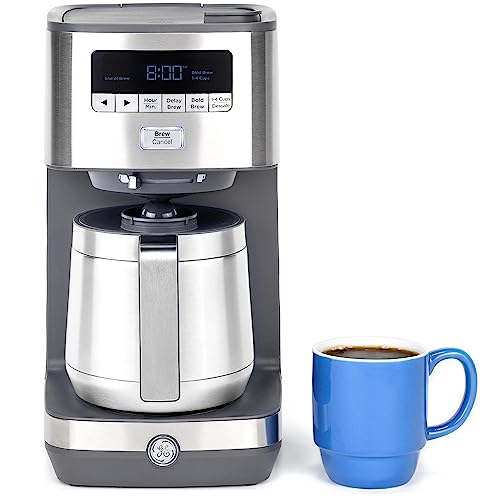
This GE drip machine, model G7CDABSSTSS, is the set-and-forget option. The listing describes a 24-hour programmable auto brew, a 10-cup double-walled, vacuum-insulated stainless steel carafe that keeps coffee hot for up to 2 hours, and adjustable brew strength.
It handles small batches too. A 1 to 4 cup setting adjusts the brew cycle for a smaller pot, and the listing says you can brew straight into a travel mug. A mid-brew pour lets you take a cup before the cycle ends. GE suggests preheating the carafe with hot water, using the included carbon water filter and descaling regularly, which matches the NCA’s descaling advice.
Because the carafe is insulated, there is no hot plate cooking the coffee as it sits. The listing does not state a warranty or wattage.
Why we like it
- 24-hour programmable auto brew (listing)
- Thermal carafe keeps coffee hot up to 2 hours (listing)
- 1 to 4 cup setting and travel-mug brewing (listing)
- Adjustable brew strength and mid-brew pour (listing)
Key specifications
| Model | G7CDABSSTSS |
|---|---|
| Type | Programmable drip coffee maker |
| Drinks | Brewed coffee |
| Capacity | 10 cups |
| Grinder | None |
| Milk | None |
| Care | Carbon water filter; descale regularly (listing) |
| Warranty | Not stated |
Why we recommend it
It suits a household that wants coffee ready on waking and a pot that stays hot through breakfast without a warmer plate.
Skip it if speed matters most; the BUNN above brews a full pot faster.
Pros and cons
Pros
- Timer for a ready pot
- Thermal carafe, no hot plate
- Small-batch setting
Cons
- Warranty not stated
- Coffee holds heat about 2 hours, by GE’s figure
- Listing is the only source
Espresso and drip coffee questions, answered
Can an espresso machine make regular coffee?
A standard espresso machine makes shots; you can add hot water to make an Americano, which is close to a mug of brewed coffee but not the same. Some fully automatic machines, like the Magnifica Duo above, also have a drip-style coffee setting, according to the listing.
Is espresso stronger than drip coffee?
Per ounce, yes. Per serving, usually not in caffeine. Wikipedia puts a 30-milliliter shot at about 65 milligrams of caffeine and a 240-milliliter cup of drip at about 95.
Can a drip coffee maker make a latte?
Not a true one. A latte needs an espresso shot and steamed milk. You can make a milky coffee from drip with frothed milk, which is pleasant, but it will taste like coffee with milk rather than a latte.
Do I need a grinder for an espresso machine?
The NCA calls a grinder optional but preferred, and recommends a burr grinder. Espresso is sensitive to grind size, so fresh, even grinding helps more there than with drip. Machines with a built-in grinder solve this in one box.
Which is easier to clean?
Drip. The NCA’s routine is a rinse of the basket and filter after each use and descaling every few months. Espresso adds the portafilter and group head after each session, plus the steam wand or frother after every milk drink.
Our final word on the morning machine
For most kitchens, the drip coffee maker is the right first machine: a full pot, no skill, a lower cost class. Buy an espresso machine when the drinks you love are espresso-based, and choose semi-automatic if you want to learn the craft or fully automatic if you just want the drink. Plenty of homes end up with both, and that is a reasonable place to land.
For more choices, see our best espresso machine guide, our best coffee maker guide and our best espresso machine for beginners. If you are weighing stovetop coffee instead, read moka pot vs espresso machine, or pour over vs drip coffee for the hand-brewed route. And when you’d rather someone else made breakfast, see the menu or call to order.