A blender can only take a guajillo sauce so far. It chops the chile skins into smaller flecks, and those flecks are what you feel on your tongue. A chinois gets them out. Pour the blended sauce into the cone, work a ladle around the inside, and what drips from the tip is smooth enough to coat a tortilla evenly. Our explainer on what mole is describes the same step: everything is ground, then pushed through a sieve before it goes into the pot.
The trouble is the word itself. Sellers use chinois, china cap, bouillon strainer and cone sieve almost interchangeably, yet a fine woven cone and a punched steel cone do different jobs. This guide sorts eight cone strainers by the thing that decides how they work, the mesh or holes, and says plainly when a listing leaves that out.
Julia’s earns a commission on purchases made through links on this page, at no cost to you. Recommendations are based on what a restaurant kitchen looks for in a cone strainer, the makers’ own specifications and the details on each Amazon listing.
Quick verdict: which chinois to buy
For most home kitchens, the best chinois strainer is the Thunder Group 8-Inch Reinforced Bouillon Strainer: fine stainless mesh, a reinforced frame that stands up to a ladle, a pan hook, and a size that fits an ordinary pot. If you want published measurements and a larger basket, buy the Rösle 25 cm Hotel Chinois Strainer. If you press thick purées hard, choose the rigid de Buyer 20 cm Stainless Steel Conical Strainer, and pair it with a finer strainer when you want a glossy finish.
The table below compares our five standouts. All eight are reviewed in full after it, followed by how to choose one and answers to common questions.
Five cone strainers side by side
One pick for each kind of cook, with the size and mesh each maker or listing states.
| Strainer | Best for | Size | Mesh or holes | Buy on Amazon |
|---|---|---|---|---|
| Smooth chile sauces and stock at home | 8 in; 1.5 qt | Fine woven mesh, reinforced | View on Amazon | |

Rösle 25 cm Hotel Chinois StrainerBest premium
|
Large batches, and a stated mesh size | 9.8 in; 2.8 L | 0.11 cm mesh, per Rösle | View on Amazon |

de Buyer 20 cm Stainless Steel Conical StrainerBest perforated cone
|
Pressing thick purées hard | 20 cm (7.9 in); 16 cm high | 1.5 mm holes (retailers) | View on Amazon |

Fox Run Farm to Table 3-Piece Chinois SetBest set with stand
|
A full kit, ready to use | 7 in wide; about 7.5 in deep | Listing says fine mesh and perforated | View on Amazon |

Vollrath 12-Inch Fine China Cap StrainerBest for big batches
|
Tamale-party quantities of sauce | 12 in; about 12 in deep | 1/16 in perforations (listing) | View on Amazon |
Product images from Amazon. Sizes and mesh descriptions are as stated by each maker, listing or foodservice retailer; few makers give a mesh count, so check the listing before you buy.
Our picks for the best chinois strainer
The first thing to decide is mesh or holes. Woven mesh cones give the smoothest result but need a gentle hand. Punched steel cones, which kitchens call china caps, take a pestle and rinse clean more easily, but they let more fine pulp through. Each pick below says which it is, what the maker states, and one honest reason to skip it.
1. Thunder Group 8-Inch Reinforced Bouillon Strainer – Fine Mesh With a Frame Behind It
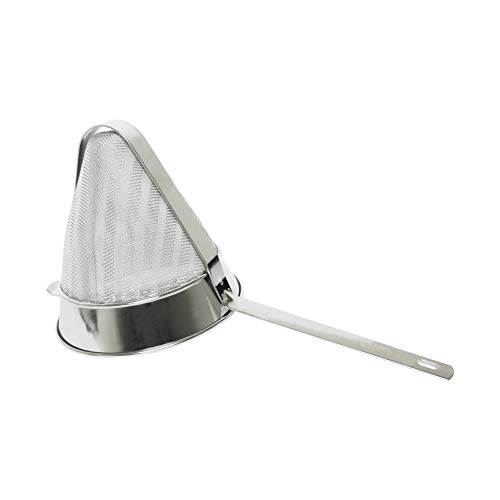
Thunder Group sells to restaurants, and this is the plain working version of the tool: an 8-inch cone of fine stainless mesh with a reinforced frame and a pan hook. Restaurant-supply listings give it a capacity of 1.5 quarts and a height of 8.5 inches, which is a sensible size for a home stockpot and for the batch of guajillo sauce that comes out of one blender jar.
The reinforcement is the reason to choose this one over a bare mesh cone. Woven mesh is at its weakest when a ladle is pushing a thick purée against it, and the frame gives it something to bear on. The pan hook sits on the cone so it can rest across a pot or a deep bowl while it drains, which leaves a hand free for the ladle.
Amazon’s listing says it is dishwasher safe and suits soups, purées, bisques and sauces. Thunder Group does not publish a mesh count here, so treat “fine” as a description and not a measurement. Rinse it straight away, because dried chile pulp is hard to shift from woven mesh.
Why we like it
- Reinforced fine mesh for pressing purées
- Pan hook rests it across a pot
- Stated as dishwasher safe
- Comes from a restaurant supplier
Key specifications
| Model | SLKCP208R |
|---|---|
| Diameter | 8 in |
| Depth or capacity | 1.5 qt; 8.5 in high (retailer listings) |
| Mesh or holes | Fine woven mesh; count not stated |
| Material | 18/8 stainless steel (retailer listings) |
| Resting hook | Pan hook |
| Handle | Not stated |
| Dishwasher-safe | Yes |
Why we recommend it
It suits cooks who make chile sauces, mole or stock from scratch and want one proper cone that fits a normal pot.
Skip it if you want to press hard with a pestle; a perforated cone takes that better than woven mesh.
Pros and cons
Pros
- Fine straining with a stronger frame
- Size that fits home pots
- Dishwasher safe
Cons
- Mesh count not stated
- Pestle and stand not included
2. Rösle 25 cm Hotel Chinois Strainer – A Stated Mesh and a Big Basket
Rösle, the German kitchen tool maker, calls this its Hotel Chinois, and it is a rare strainer whose maker publishes real numbers: 25 cm (9.8 inches) across, a 2.8-liter filling quantity and a mesh size of 0.11 cm. That makes it one of the few picks here you can compare by measurement rather than by the word “fine”.
It is built in 18/10 stainless steel and weighs 0.63 kg, according to Rösle, with hooks that let it sit on a range of pots while you press food through. Rösle lists broth, soups, sauces, fruit juice and jam among its jobs and says the mesh holds back pulp, skin, seeds and coarse pieces. For a Mexican kitchen that reads like a list of what goes wrong in a red sauce, and 2.8 liters takes a large pot of consommé in far fewer rounds than an 8-inch cone.
Two honest cautions. Rösle says its size means it is mostly used in the catering industry, so check that you have the storage for a strainer about 19 inches long. At 25 cm wide and about 18 cm deep it is also a broader shape than a classic narrow cone, so expect a less tight stream at the bottom. The Amazon listing mentions a ten-year Rösle warranty; Rösle’s own product page does not state one, so confirm it when you buy.
Why we like it
- Mesh size published by the maker
- 2.8-liter filling quantity
- 18/10 stainless steel
- Hooks rest it on pots
- Dishwasher safe
Key specifications
| Model | 24100 (now 161100) |
|---|---|
| Diameter | 25 cm (9.8 in) |
| Depth or capacity | 2.8 L; about 18 cm (7 in) deep |
| Mesh or holes | 0.11 cm mesh, per Rösle |
| Material | 18/10 stainless steel |
| Resting hook | Hooks |
| Handle | Side handle |
| Dishwasher-safe | Yes |
Why we recommend it
It suits cooks who strain big pots of stock or consommé and want a well-made strainer with stated measurements.
Skip it if your storage is tight; Rösle itself describes this as a size mostly used in catering.
Pros and cons
Pros
- Real measurements from the maker
- Large capacity
- 18/10 steel throughout
Cons
- Long and bulky to store
- Broader shape than a classic cone
- Warranty stated on the listing only
3. de Buyer 20 cm Stainless Steel Conical Strainer – Rigid Steel That Takes a Pestle
de Buyer is a French cookware maker, and this cone is sheet steel with punched holes rather than woven mesh. In kitchen terms that makes it closer to a china cap than a true fine chinois, whatever the name on the box. Retailers that stock the 3350 series list its holes at 1.5 mm, so it will pass more fine pulp than the mesh cones here.
What you get in return is stiffness. The Amazon listing describes heavy, extra-wear-resistant stainless steel, and a retailer that stocks it points out that the cone is rigid steel rather than mesh, which resists deforming. That suits leaning on a pestle to force cooked tomato, tomatillo or dried-chile paste through it. It is the shape to choose when you care more about getting all the flavor out of a pot of solids than about a glassy finish.
A hook opposite the handle fits it inside a pan, and the listing says it can sit on the stand of a piston funnel so nothing spills. It measures 20 cm across and 16 cm high. One retailer lists the series as dishwasher safe, while the Amazon listing is silent on it. If you want a finer finish, pass the sauce through a mesh strainer afterward.
Why we like it
- Heavy, rigid stainless steel
- Hook fits it inside a pan
- Fits a piston funnel stand
- Suited to pestle work
Key specifications
| Model | 3350.20 |
|---|---|
| Diameter | 20 cm (7.9 in) |
| Depth or capacity | 16 cm (6.3 in) high |
| Mesh or holes | Punched; 1.5 mm holes (retailers) |
| Material | Stainless steel |
| Resting hook | Hook opposite handle |
| Handle | Not stated |
| Dishwasher-safe | Yes, per one retailer; not on the Amazon listing |
Why we recommend it
It suits cooks who press thick purées by hand and want a cone built for heavy use.
Skip it if you want a silky consommé; 1.5 mm holes are too open for that on their own.
Pros and cons
Pros
- Very stiff by description
- Good for pestle work
- Punched steel is simple to rinse
Cons
- Holes too large for the finest sauces
- Pestle not included
- Few maker specifications on the listing
4. Fox Run Farm to Table 3-Piece Chinois Set – Cone, Stand and Pestle in One Box
This is the classic home set, and its appeal is that it solves the awkward part of using a cone. You get an 18/8 stainless steel strainer, a wooden pestle and a chrome stand, so the cone stands upright over a bowl while you work the pestle. Without a stand, a cone has to be propped across a pot, and that is much less steady.
Fox Run says it can be used for sieving stocks and broths, mashing berries for compotes, and pressing water out of squash. For our purposes it also fits cooked tomato and soaked chiles, or a pot of beans you want smooth for a soup. An assist handle lets the strainer rest in pots and large bowls instead of the stand.
One point to check: the listing calls the strainer fine mesh in one place and perforated metal in another, and says it can serve as “a china cap or chinois set”. Read that as a perforated cone doing a chinois job, not a true extra-fine mesh. The listing does not give a hole size or a dishwasher statement, and it does not say whether the stand folds away.
Why we like it
- Stand, pestle and strainer included
- 18/8 stainless steel strainer
- Assist handle rests on pots and bowls
- Stand frees a hand for the pestle
Key specifications
| Model | 5292 |
|---|---|
| Diameter | 7 in |
| Depth or capacity | About 7.5 in deep (listing) |
| Mesh or holes | Not stated; listing says fine mesh and perforated |
| Material | 18/8 stainless steel; chrome stand; wooden pestle |
| Resting hook | Assist handle |
| Handle | 17 in long overall (listing) |
| Dishwasher-safe | Not stated |
Why we recommend it
It suits home cooks who want to buy once and have everything, especially for fruit, tomato and soft cooked vegetables.
Skip it if smooth stock is the goal; the mesh description is unclear and a woven cone is the safer choice.
Pros and cons
Pros
- Complete kit
- Stand holds it upright
- Good for pestle work
Cons
- Listing is unclear on mesh
- Care not stated
- Three pieces to store
5. Vollrath 12-Inch Fine China Cap Strainer – A Restaurant Cone for Large Pots
Vollrath is a long-established American foodservice maker, and this is a full-size restaurant cone: 12 inches across and 22 inches wide including its handle, on Vollrath’s figures. If you make red chile sauce for dozens of tamales or a stockpot of birria, this is the size that takes a whole batch without stopping every few ladles.
It is a true china cap, stainless steel with 1/16-inch perforations on the Amazon listing, and Vollrath describes its fine version as producing lump-free results. The handle is welded and a bowl clip hooks it onto a bowl or pot, which matters more at this size, because a full 12-inch cone is heavy when it is loaded with wet solids.
Be realistic about the size. It needs a tall pot or a deep container underneath it and it will not fit in most kitchen drawers. There is also a warranty catch worth reading: the Amazon listing says the warranty does not apply to products bought for personal, family or household use. Vollrath’s page does not give a care instruction, so we list dishwasher care as not stated.
Why we like it
- Large 12-inch cone
- 1/16-inch perforations, as listed
- Welded handle
- Bowl clip for hands-free draining
Key specifications
| Model | 47168 |
|---|---|
| Diameter | 12 in |
| Depth or capacity | About 12 in deep (retailers) |
| Mesh or holes | 1/16 in perforations (listing) |
| Material | Stainless steel |
| Resting hook | Bowl clip |
| Handle | Welded handle |
| Dishwasher-safe | Not stated |
Why we recommend it
It suits people who cook in quantity, for parties, church dinners or a big tamalada, and have the pots to match.
Skip it if you cook for four; an 8-inch cone will be far easier to use and to store.
Pros and cons
Pros
- Takes a whole batch
- Welded handle
- Clips onto a pot
Cons
- Very large to store
- Warranty excludes household use
- Perforated, so not the finest finish
6. Norpro 7.75-Inch Stainless Steel Chinois – A Modest Cone With Clear Specs

Norpro is a familiar name in home kitchen gadgets, and this is a chinois sized for one household: 7.75 inches wide at the top, 8.5 inches deep, narrowing to a 1-inch tip, with an 8.75-inch handle. Those measurements come straight from the listing, and they are more than most cones give you.
The frame and the fine mesh are both stainless steel, and a hook steadies it on a bowl or pot. Norpro lists soups, stocks, sauces, bouillon, jelly, jams, desserts, ice cream bases and baby food among its uses, and it also suggests using it as a colander. The narrow 1-inch tip is useful for the same reason a funnel is: strained liquid goes neatly into a jar.
Norpro says it is dishwasher safe. Unlike our top pick, the listing does not describe a reinforced frame, so go gently with a thick purée and use the back of a ladle rather than a heavy pestle. Norpro’s better-known set with stand and pestle was nearly sold out when we checked, which is why this simpler cone is the one listed here.
Why we like it
- Full measurements on the listing
- Stainless mesh and frame
- Hook to steady it on a bowl
- Dishwasher safe
Key specifications
| Model | 6002 |
|---|---|
| Diameter | 7.75 in |
| Depth or capacity | 8.5 in deep |
| Mesh or holes | Fine mesh; count not stated |
| Material | Stainless steel |
| Resting hook | Hook |
| Handle | 8.75 in handle |
| Dishwasher-safe | Yes |
Why we recommend it
It suits home cooks who make jelly, custard or a smooth sauce now and then, and want a cone that is easy to store.
Skip it if you press heavy purées often; a reinforced cone is built for that.
Pros and cons
Pros
- Sensible home size
- Clear measurements
- Dishwasher safe
Cons
- No reinforcement described
- Mesh count not stated
7. Weston 2-Quart Cone and Pestle Set – Built for Pressing Soft Fruit

Weston’s set comes from the food-preserving side of the kitchen. You get a stainless steel cone, a support stand and a solid-wood pestle, with a stated capacity of 2 quarts. Weston’s own suggestions are applesauce, berry jams, tomato purée and mashed potatoes, plus straining soups, stock and sauces.
The design is simple: you ladle cooked tomatoes into the cone on its stand, press and turn the pestle, and pulp runs through while skins and seeds stay behind. That is useful when you have a glut of tomatoes for a salsa roja or are putting up jars for the winter. The cone’s perforations also let a thicker purée through than a fine mesh would.
The listing is inconsistent on the hole size, giving 1.5 mm in one line and 2 mm in another, so expect a perforated cone in that range, not a fine strainer. The cone and stand are stated as dishwasher safe; the wood pestle is not, so wash it by hand. The listing also shows a one-year warranty.
Why we like it
- Stand and solid-wood pestle included
- 2-quart stated capacity
- Cone and stand are dishwasher safe
- One-year warranty on the listing
Key specifications
| Model | 83-3030-W |
|---|---|
| Diameter | Not stated |
| Depth or capacity | 2 qt (1.9 L) |
| Mesh or holes | Perforated; 1.5 mm or 2 mm (listing gives both) |
| Material | Stainless steel cone; chrome-plated stand; wood pestle |
| Resting hook | Stands on its support |
| Handle | Not stated |
| Dishwasher-safe | Cone and stand yes; pestle not stated |
Why we recommend it
It suits gardeners and home canners who press tomatoes, apples or berries in batches.
Skip it if you want smooth stock; perforations of that size let fine solids through.
Pros and cons
Pros
- Complete pressing kit
- Stated capacity
- Mostly dishwasher safe
Cons
- Listing gives two hole sizes
- Too open for fine straining
- Pestle needs hand care
8. Winco 8-Inch Fine China Cap Strainer – A Plain Foodservice Cone

Winco is a foodservice supplier, and this is its plain 8-inch china cap, a different tool from the reinforced bouillon cone we cover in our fine mesh strainer guide. The tapered stainless steel shape moves liquid down toward the tip, and the listing notes reinforced welds for high-volume use.
A china cap earns its place as the first step. Pass a pot of stock or a thin chile sauce through it to take out the big pieces, then finish with a finer strainer if you want a polished result. That order keeps a fine mesh from clogging straight away.
The listing is short. It calls the strainer fine but gives no hole size, and it says nothing about a resting hook or dishwasher care, so check the photos on the listing if those matter to you. For a straightforward cone from an established foodservice name, that is a fair trade, as long as you do not expect it to do the job of an extra-fine chinois.
Why we like it
- Tapered shape for steady flow
- Reinforced welds, per the listing
- Stainless steel
- From a foodservice maker
Key specifications
| Model | CCS-8F |
|---|---|
| Diameter | 8 in |
| Depth or capacity | Not stated |
| Mesh or holes | Listed as fine; size not stated |
| Material | Stainless steel |
| Resting hook | Not stated |
| Handle | Not stated |
| Dishwasher-safe | Not stated |
Why we recommend it
It suits cooks who want a basic cone for rough straining and do not mind a few unknowns.
Skip it if you want full specifications before buying; this listing gives very few.
Pros and cons
Pros
- Simple design
- Useful first-pass strainer
- Standard 8-inch size
Cons
- Sparse listing
- Hook and care not stated
- Hole size not stated
How to pass a chile sauce through a cone
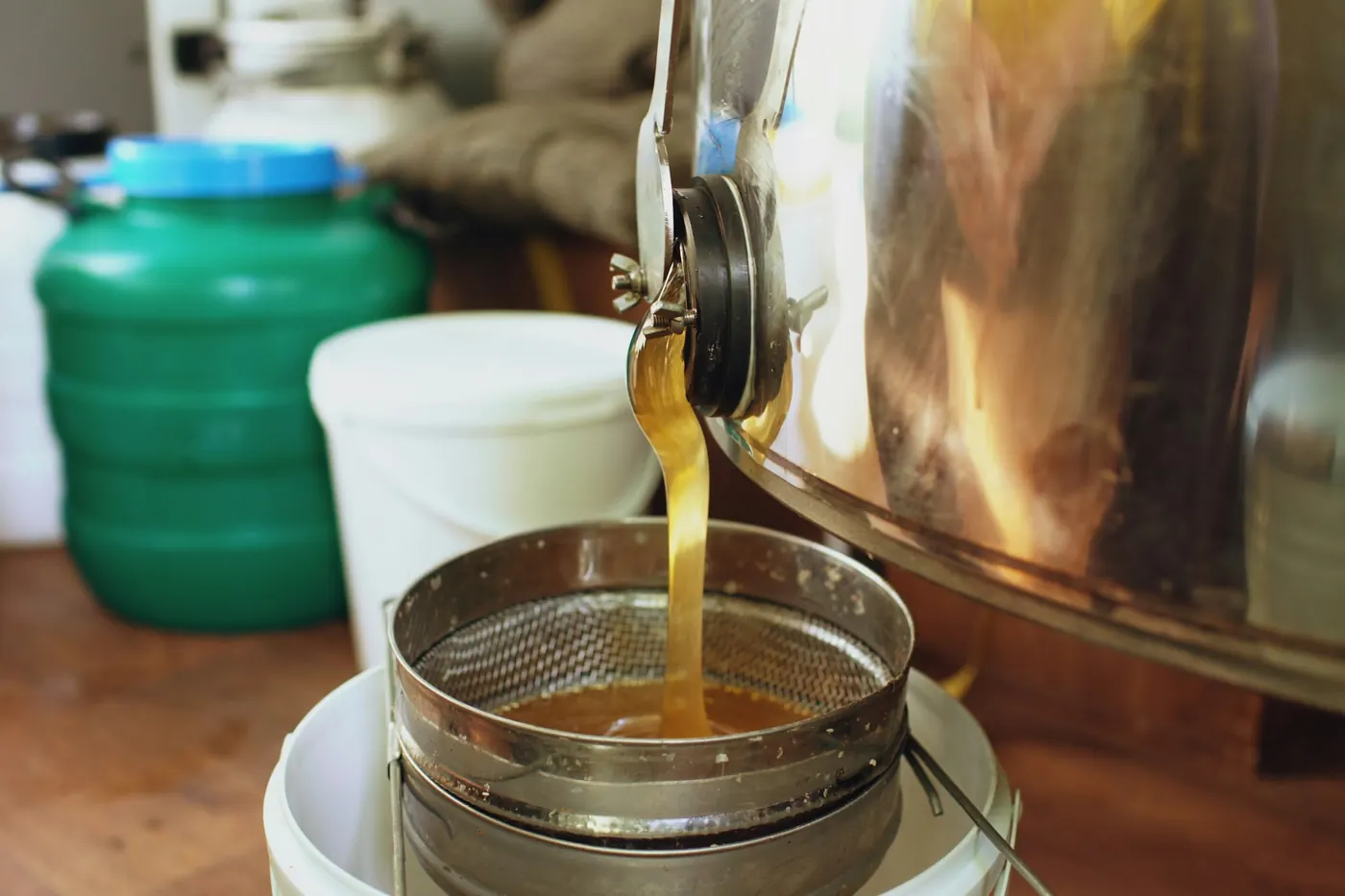
Soak and blend the chiles as usual, with enough liquid that the purée pours from the jar. Set the cone over a deep pot or bowl with the hook or stand holding it steady, and leave a gap under the tip so the sauce can run out freely. Add a ladleful at a time rather than filling the cone, then work the back of the ladle around the wall in small circles. Press toward the sides, not straight down into the tip, where the solids pack in.
When the flow slows, scrape the outside of the cone into the bowl, because some of the best sauce clings there. Discard the dry skins and seeds in the cone, and rinse before the next batch if the mesh has clogged. If the sauce is too thick to pass, loosen it with a splash of the soaking liquid or stock. A tall soup pot or one of our stainless steel mixing bowls gives the cone a stable place to sit.
How to choose a chinois
Mesh or holes. This matters more than anything else. Woven mesh is the true chinois and the one for stock, custard and silky sauces. A punched cone is a china cap and is better for pressing. Listings blur the two, so read the description, and treat a stated hole size as better evidence than the word in the title. For comparison, Rösle publishes 0.11 cm for its mesh, and de Buyer’s perforated cones are listed at 1.5 mm.
Reinforcement. Woven cones with reinforcing bars or frames resist denting when a ladle presses on them, and when the tip touches the bottom of a pot. If you only strain thin stock, a bare cone is fine. If you push purées through, buy the frame.
Size. Eight inches across fits most home pots and handles a blender jar of sauce in a couple of rounds. Go to 10 or 12 inches only if you cook in quantity and have somewhere to keep it. Capacity is rarely stated, so measure your pot before you buy.
Hook, clip or stand. A cone cannot sit on its own, so it has to rest on something. A pan hook or a bowl clip suits a pot, while a stand is the steadiest choice for pestle work. Check that the hook will reach across the pot you actually own.
Handle. Long handles keep your hand away from steam, and a hollow handle stays more comfortable than solid steel. On a big cone, the handle also has to carry real weight, so look for a welded joint.
Cleaning. Woven mesh traps pulp and dried starch. Rinse from the outside in, straight after use, and use a soft brush. Several picks here are stated as dishwasher safe, but rinse first so food does not bake into the holes.
How we chose these eight cone strainers
We started from what a Mexican kitchen pushes through a cone: dried-chile sauces and mole, tomato and tomatillo purées, stock and consommé. We then looked for cone-shaped strainers sold on Amazon in the United States from established kitchen and foodservice makers, checked each one’s stock with Amazon’s product data, and read the maker’s page where we could reach one. Measurements and materials come from the makers, the Amazon listings or foodservice retailer listings, and we say which; where a listing leaves something out we write “not stated”. We have not used these products ourselves.
We did not find a current independent head-to-head of these cones. America’s Test Kitchen’s review of 8-inch fine-mesh strainers favors stiff mesh and wide, curved pot hooks, and we borrowed those priorities, but it covers bowl strainers rather than cones, so its results say nothing about these picks. The ranking here is our reading of the specifications. We left out low-profile Amazon sellers with no independent review, because these strainers touch your food and we want to be able to say who made them. We also left out a tin-plated bouillon strainer so that every pick here is stainless steel, and strainers that were nearly sold out when we checked. We do not cover Matfer Bourgeat products on this site. The Winco, HIC, New Star and RSVP cones in our fine mesh strainer guide are not repeated here.
Chinois questions, answered
What is a chinois?
A chinois is a cone-shaped strainer, traditionally of very fine woven mesh, used to make stocks, sauces and custards smooth. The cone funnels liquid to the tip and gives you a wall to press against with a ladle or pestle. The name is French for “Chinese”.
What is the difference between a chinois and a china cap?
In kitchen usage, a chinois has fine mesh and a china cap is a perforated metal cone with larger holes, so a china cap gives a coarser result. Sellers often use the names interchangeably, so go by the stated mesh or hole size.
Is a bouillon strainer the same as a chinois?
In practice, yes. Foodservice sellers often call a fine woven mesh cone a bouillon strainer, and the Thunder Group pick here is one. It does the job a chinois does, and retailers list it under both names.
Do I need a pestle?
Not for woven mesh, where a ladle is gentler and works well. A wooden pestle suits perforated cones, where you press soft cooked food through the holes. The Fox Run and Weston sets include one.
Can a blender replace a chinois?
Not fully. A strong blender makes a smoother sauce, as our guide to the best blender for salsa explains, but it breaks skins and seeds up rather than removing them. An immersion blender is handy for soups, and straining still matters for a fine sauce.
What size chinois should I buy?
Eight inches if you are buying one, because it suits most home pots and sauce batches. Choose a larger cone only if you regularly make stock or sauce in quantity.
Our final pick for silky sauces
Buy the Thunder Group 8-Inch Reinforced Bouillon Strainer if you want one fine cone for chile sauces and stock. Choose the Rösle Hotel Chinois for published measurements and a larger basket, the de Buyer for hard pressing, the Fox Run set for a complete kit, and the Vollrath if you cook for a crowd.
If you are making sauce to strain, our guide to enchilada sauces explains the main styles, and a good ladle does most of the pressing. For a bowl-shaped strainer to rinse and sift with, see our best fine mesh strainer guide.
And if you would rather someone else strained the sauce tonight, see the menu or call to order.