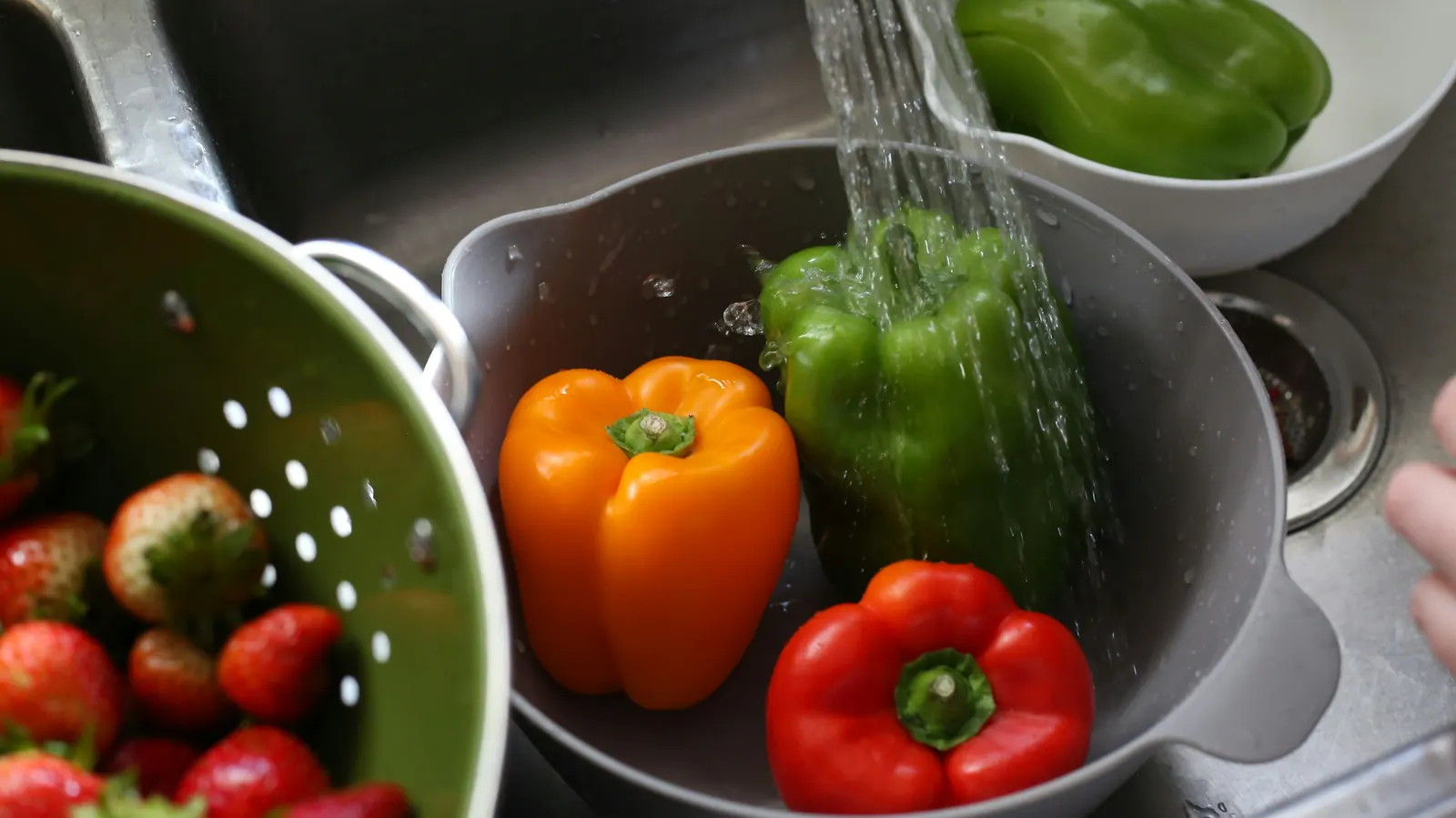
In a Mexican restaurant kitchen the colander never really gets put away. It drains the pinto beans that soaked overnight before they go into the pot for charros, rinses tomatillos after their husks come off, holds a sink-load of cilantro and lettuce, and catches the rice after it has been washed for arroz rojo. It is one of the least glamorous tools in the room and one of the most used.
That is why the details matter more than people expect. A colander that tips over in the sink, holes big enough to lose rice, handles that burn or slip, or a bowl too small for a pound of cooked beans all make an everyday job slower. This guide compares nine colanders across the main types, stainless steel, micro-perforated, mesh, plastic, collapsible silicone and over-the-sink, and explains which one suits the way you cook.
Julia’s earns a commission on purchases made through links on this page, at no cost to you. Recommendations are based on what a restaurant kitchen looks for in a colander, the makers’ own specifications and the details on each Amazon listing.
Quick verdict: which colander to buy
For most home kitchens, the best colander is the OXO Good Grips 5-Quart Stainless Steel Colander: a stainless bowl perforated all over so water leaves quickly, three raised feet that keep it standing in the sink, non-slip handles you can hold with wet hands, and a shape OXO says nests inside mixing bowls. If you rinse rice, quinoa or small lentils, choose the micro-perforated Bellemain 5-Quart Stainless Steel Colander. For big batches of beans or a whole box of pasta, the restaurant-supply Vollrath 8-Quart Stainless Steel Colander has the room.
The table below compares our five standout colanders, one for each kind of kitchen. All nine are reviewed in full after it, followed by what to look for and answers to common questions.
Five colanders side by side
One pick for each kind of cook, with the material and capacity each maker or listing states.
| Colander | Best for | Material | Capacity | Buy on Amazon |
|---|---|---|---|---|
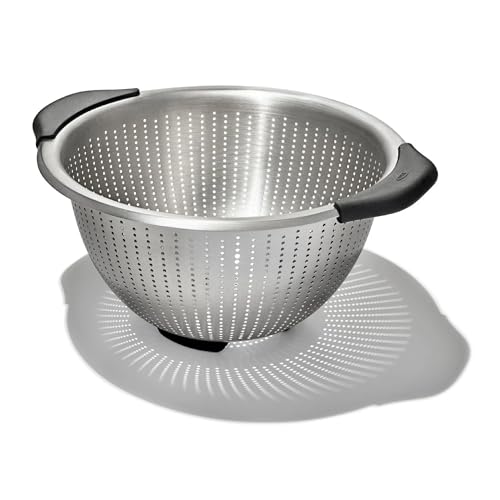
OXO Good Grips 5-Quart Stainless Steel ColanderBest overall
|
Everyday pasta, beans and produce | Stainless steel | 5 qt | View on Amazon |

Bellemain 5-Quart Stainless Steel ColanderBest for rice and grains
|
Rinsing rice, quinoa and small lentils | Micro-perforated stainless steel | 5 qt | View on Amazon |

Vollrath 8-Quart Stainless Steel ColanderBest for big batches
|
Large pots of beans, pasta for a crowd | All-welded stainless steel | 8 qt | View on Amazon |

OXO Good Grips 3.5-Quart Collapsible ColanderBest collapsible
|
Small kitchens and tight drawers | Silicone and nylon | 3.5 qt | View on Amazon |
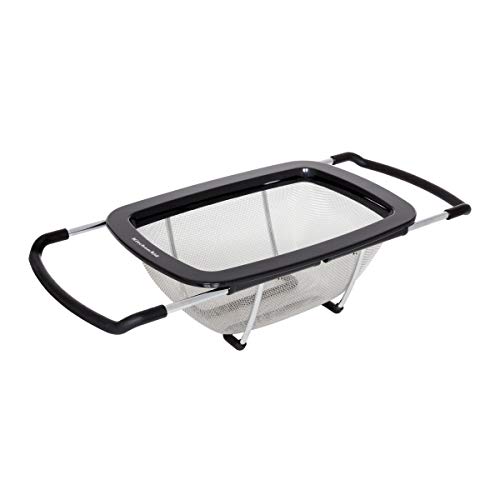
KitchenAid Expandable Over-the-Sink ColanderBest over the sink
|
Rinsing produce with both hands free | Stainless steel, plastic trim | Not stated; 16 in, expands to 22 in | View on Amazon |
Product images from Amazon. Materials and capacities are as stated by each maker or listing; check the listing before you buy.
Our picks for the best colander
These nine colanders cover the jobs a colander actually does: draining hot pasta and beans, rinsing grains that would slip through big holes, washing produce, and handling batches too big for a standard bowl. Each pick says who it suits, what the maker or listing states, and one honest reason to skip it.
1. OXO Good Grips 5-Quart Stainless Steel Colander – Steady Feet, Fast Draining
OXO’s 5-quart stainless colander gets the basics right. The bowl is perforated all over rather than only on the bottom, which OXO says lets water flow out quickly and evenly, so a pot of pasta or a batch of cooked pinto beans does not sit in its own cooking water. Five quarts is a practical home size: enough for a pound of pasta or a full pot of beans drained before they are seasoned.
Two details make it easy to live with. Three raised feet keep it standing steady in the sink or on the counter, and the elevated handles are non-slip, which matters when you are lifting a hot, wet colander and shaking it. OXO also designed it to nest inside mixing bowls, so you can rinse produce in the colander and set it straight into a bowl to drain.
The listing says it is dishwasher safe, and it comes in a 3-quart size as well if your kitchen is smaller.
Why we like it
- All-over perforations for fast draining
- Three raised feet keep it upright
- Non-slip handles, even with wet hands
- Nests inside mixing bowls
Key specifications
| Model | 11330900 |
|---|---|
| Material | Stainless steel |
| Capacity | 5 qt (3 qt also sold) |
| Hole type | All-over perforations |
| Base/feet | Three raised feet |
| Handles | Two elevated non-slip handles |
| Dishwasher-safe | Yes |
Why we recommend it
It suits most home cooks who want one sturdy colander for pasta, beans, rice that has already cooked, and everyday produce, and who value a grip that does not slip.
Skip it if you mostly rinse raw rice or quinoa; standard perforations can let small grains through, and a micro-perforated colander is the better tool.
Pros and cons
Pros
- Drains through sides as well as base
- Stable on three feet
- Comfortable non-slip handles
Cons
- Hole size not stated
- Five quarts is tight for big batches
2. Bellemain 5-Quart Stainless Steel Colander – Tiny Holes for Small Grains
The Bellemain colander is covered in micro-perforations instead of the usual round holes. The listing says that lets water drain quickly without losing grains, and names rice, quinoa, pasta and produce as its jobs. That makes it the colander to reach for when you rinse long-grain rice before toasting it for Mexican red rice, or wash small lentils and chia, which would slip through a standard colander.
It sits on a solid ring base rather than feet, which the listing says keeps it from wobbling or tipping, and it has riveted, looped handles. Bellemain says the steel resists rust, dents and warping and copes with boiling water poured straight in. At 5 quarts it handles a family meal, and a set with a 3-quart bowl is also sold.
The listing says it is dishwasher safe. Very fine holes can trap starch and bits of grain, so rinse it right after use and give the outside a quick brush.
Why we like it
- Micro-perforations hold back small grains
- Solid ring base for hands-free draining
- Riveted handles
- Dishwasher safe
Key specifications
| Model | Not stated |
|---|---|
| Material | Stainless steel |
| Capacity | 5 qt |
| Hole type | Micro-perforated |
| Base/feet | Solid ring base |
| Handles | Two riveted loop handles |
| Dishwasher-safe | Yes |
Why we recommend it
It suits cooks who rinse rice, quinoa or lentils often and want one metal colander that also drains pasta and vegetables.
Skip it if you mostly drain large pasta shapes; smaller holes drain a big pot more slowly than wide perforations.
Pros and cons
Pros
- Keeps rice in the bowl
- Stable ring base
- Steel takes boiling water
Cons
- Fine holes need prompt cleaning
- Model number not clearly listed
3. Vollrath 8-Quart Stainless Steel Colander – Restaurant Size and Build
Vollrath makes equipment for commercial kitchens, and this colander is built the way restaurant smallwares are: all-welded stainless steel construction, strong side handles and a full-ring base, according to the listing. At 8 quarts and a little over 13 inches across, it takes a big stockpot of cooked beans, two pounds of pasta or a whole bag of potatoes for papas con chorizo without spilling over the rim.
Welded handles have no rivets for food to lodge around, which makes the colander easier to keep clean. The full ring base lets the colander stand on its own in a sink or on a sheet pan while hot food drains.
The listing does not describe the hole pattern or say whether it is dishwasher safe; stainless steel generally handles a dishwasher, but check Vollrath’s care advice if that matters to you. It is a large, hard-wearing tool, and it takes up room to match.
Why we like it
- 8-quart capacity for batch cooking
- All-welded stainless construction
- Strong side handles
- Full-ring base
Key specifications
| Model | 47969 |
|---|---|
| Material | Stainless steel, all-welded |
| Capacity | 8 qt; 13 5/16 in diameter |
| Hole type | Not stated |
| Base/feet | Full-ring base |
| Handles | Two side handles |
| Dishwasher-safe | Not stated |
Why we recommend it
It suits cooks who make beans, pasta or vegetables for a crowd and want a colander built like the ones in restaurant kitchens.
Skip it if your sink or cupboard is small; an 8-quart colander is bulky to wash and store.
Pros and cons
Pros
- Room for big batches
- Welded handles, no rivets
- Stands on a full ring
Cons
- Bulky to store
- Hole pattern and care not stated
4. OXO Good Grips 3.5-Quart Collapsible Colander – Folds Flat for Storage
A collapsible colander solves the storage problem: a full-size bowl that folds down to a flat disc when you are done. OXO’s version is made of flexible silicone with nylon, which OXO says makes it heat resistant, so it can take hot pasta water. It opens easily for use and closes flat to slide into a drawer.
The holes are small enough to hold pasta but spaced so water drains quickly, according to OXO, and there are two non-slip handles for lifting. At 3.5 quarts it suits a pound of pasta, a few cups of rinsed beans or a bunch of washed greens. OXO also sells a smaller 2-quart collapsible strainer.
Silicone is easy to clean and the colander is dishwasher safe. The trade-off is rigidity: a folding colander is not as solid as steel when it is loaded with something heavy, so support it with one hand when you lift a full bowl.
Why we like it
- Folds flat for drawer storage
- Silicone and nylon resist heat
- Small holes hold pasta
- Two non-slip handles
Key specifications
| Model | 11208200 |
|---|---|
| Material | Silicone and nylon |
| Capacity | 3.5 qt |
| Hole type | Small holes, spaced for draining |
| Base/feet | Not stated |
| Handles | Two non-slip handles |
| Dishwasher-safe | Yes |
Why we recommend it
It suits apartment kitchens, RVs and anyone short on cupboard space who still needs a real colander for weeknight pasta and produce.
Skip it if you often drain heavy loads; a steel colander feels more secure with a full pot of beans.
Pros and cons
Pros
- Stores flat
- Heat resistant
- Easy to clean
Cons
- Less rigid when full
- Smaller than a standard 5-quart
5. KitchenAid Expandable Over-the-Sink Colander – Spans the Sink
An over-the-sink colander rests across the basin, so you can rinse produce or drain pasta without holding anything. KitchenAid’s version is stainless steel with plastic trim and rubber-encased handles that slide out to fit across almost any sink, the listing says. It measures 16 inches closed and 22 inches fully extended.
That long shape is handy for jobs that do not fit a round bowl: a pile of romaine, a few pounds of tomatoes and tomatillos, or jalapeños washed before they go on the grill. The rubber-encased feet also let it sit inside the sink or on the counter without slipping or scratching.
KitchenAid does not state a capacity, so measure your sink first to make sure the extended handles reach both edges. The listing says it is dishwasher safe, though a 16-inch colander takes up a lot of rack space.
Why we like it
- Handles extend to span the sink
- Rubber-encased feet for counter use
- Long shape suits bulky produce
- Dishwasher safe
Key specifications
| Model | KE867OSOBA |
|---|---|
| Material | Stainless steel, plastic trim |
| Capacity | Not stated; 16 in long, 22 in extended |
| Hole type | Not stated |
| Base/feet | Rubber-encased feet |
| Handles | Expandable, rubber-encased |
| Dishwasher-safe | Yes |
Why we recommend it
It suits cooks who wash a lot of produce and want both hands free, or who drain big pots straight into the sink.
Skip it if your sink is very wide or a farmhouse style; check that 22 inches is enough to bridge it.
Pros and cons
Pros
- Hands-free rinsing
- Works in or over the sink
- Non-slip feet
Cons
- Capacity not stated
- Long shape is awkward to store
6. Cuisinart 5-Quart Mesh Colander – Mesh Bowl, Soft Handles

Cuisinart’s colander uses a heavy-duty stainless steel mesh bowl instead of a perforated sheet. Mesh has far more openings than a pierced bowl, so water runs out quickly, and the openings are small enough that rice and small pasta stay put. It sits between a standard colander and a fine-mesh strainer.
The handles are soft-grip, and the listing says it is dishwasher safe and covered by a lifetime limited warranty. Five quarts is a full-size home colander, enough for a pot of beans or a pound of pasta.
Mesh has two drawbacks worth knowing. It can dent if it is knocked around in a crowded sink, and starchy water and bits of food can lodge in the weave, so a brush helps. The listing does not describe the base.
Why we like it
- Mesh drains fast and holds small food
- Heavy-duty stainless steel mesh
- Soft-grip handles
- Lifetime limited warranty
Key specifications
| Model | CTG-00-CLD |
|---|---|
| Material | Stainless steel mesh |
| Capacity | 5 qt |
| Hole type | Woven mesh |
| Base/feet | Not stated |
| Handles | Two soft-grip handles |
| Dishwasher-safe | Yes |
Why we recommend it
It suits cooks who want one colander that handles both pasta and rice, and like a soft grip.
Skip it if you want a colander that shrugs off knocks; a solid perforated bowl is harder to dent.
Pros and cons
Pros
- Fast draining mesh
- Holds small grains
- Lifetime limited warranty
Cons
- Mesh can dent
- Food lodges in the weave
7. Winco 5-Quart Stainless Steel Colander with Base – Plain Foodservice Workhorse

Winco supplies restaurants and caterers, and its 5-quart colander is the plain stainless bowl you find in many commercial kitchens. The listing describes it as made for the demands of a kitchen; restaurant suppliers that sell it list it as roughly 12 inches across, with two riveted side handles and a footed base that keeps it standing.
There is nothing clever about it, and that is the appeal. It drains pasta, beans and vegetables, goes from sink to counter and back, and is the kind of tool you can buy two of. Five quarts covers most family cooking.
The Amazon listing itself is thin on details: it does not state a hole pattern or dishwasher care. Riveted handles leave small gaps where food can collect, so give them a scrub now and then.
Why we like it
- Foodservice maker
- Footed base stands on its own
- Riveted side handles, per suppliers
- Simple stainless bowl
Key specifications
| Model | COD-5 |
|---|---|
| Material | Stainless steel |
| Capacity | 5 qt; about 12 in diameter (suppliers) |
| Hole type | Not stated |
| Base/feet | Footed base |
| Handles | Two side handles, riveted (suppliers) |
| Dishwasher-safe | Not stated |
Why we recommend it
It suits cooks who want a no-frills stainless colander from a restaurant supplier, with a base that lets it drain hands free.
Skip it if you want comfortable, non-slip handles; bare steel handles get hot and slippery.
Pros and cons
Pros
- Restaurant-supply build
- Stands on its base
- Easy to buy in pairs
Cons
- Sparse Amazon listing
- Bare steel handles
8. Joseph Joseph Square Colander, Medium – Color on the Counter

This is the colander that can sit out on the counter full of limes, chiles or tomatillos. Joseph Joseph’s medium Square Colander comes in bright green (plus other colors), with a square bowl and a single upright handle rather than two side handles.
The shape does the work, according to the listing: square corners pour cleanly, the vertical handle is easy to grab, the design is stable and non-tip when you set it down, and large vertical draining holes run up the sides. Joseph Joseph’s own product page lists it as dishwasher safe and BPA free, and retailers give the material as polypropylene.
It is a small colander. Joseph Joseph lists it at about 19 by 20.5 centimeters (roughly 7.5 by 8 inches) and 11.4 centimeters tall, and does not give a capacity in quarts, so treat it as a rinsing and herb colander rather than one for a full pot of beans. The listing gives a one-year guarantee.
Why we like it
- Bright color that looks good left out
- Square corners for clean pouring
- Upright handle, stable non-tip shape
- Dishwasher safe
Key specifications
| Model | 40088 (green) |
|---|---|
| Material | Polypropylene (retailer listings); BPA free per Joseph Joseph |
| Capacity | Not stated; about 19 x 20.5 x 11.4 cm |
| Hole type | Large vertical draining holes |
| Base/feet | Stable, non-tip design |
| Handles | One vertical handle |
| Dishwasher-safe | Yes |
Why we recommend it
It suits cooks who want a small, cheerful colander for rinsing herbs, chiles, limes and berries that can live on the counter and go in the dishwasher.
Skip it if you need to drain a full pot of pasta or beans; choose a 5-quart steel colander for that.
Pros and cons
Pros
- Looks good out on the counter
- Pours cleanly from the corners
- Dishwasher safe
Cons
- Small; capacity not stated
- Plastic is less rigid than steel
9. OXO Good Grips 3-Quart Plastic Colander – Light and Easy to Grip

A plastic colander is light, quiet in the sink and never dents. OXO’s 3-quart version has elongated holes, which the listing says let water flow fast, and contoured feet that keep it stable in the sink even with heavy food in it. The bowl is tall enough that water does not pool around what you are draining.
The non-slip handles stay secure with wet hands, and it is dishwasher safe. At 3 quarts it is a good second colander: berries, a bunch of cilantro, a can of beans rinsed before it goes into a salad, or a small batch of pasta.
OXO does not state the plastic type or a maximum temperature on the listing. For draining a big pot of boiling water, a steel colander is the safer choice.
Why we like it
- Elongated holes for fast draining
- Contoured feet for in-sink stability
- Non-slip handles
- Light and dishwasher safe
Key specifications
| Model | 11331000 |
|---|---|
| Material | Plastic (type not stated) |
| Capacity | 3 qt |
| Hole type | Elongated slots |
| Base/feet | Contoured feet |
| Handles | Two non-slip handles |
| Dishwasher-safe | Yes |
Why we recommend it
It suits anyone who wants a light second colander for rinsing produce and canned beans next to a larger steel one.
Skip it if it will be your only colander; 3 quarts is small for a full pot of pasta.
Pros and cons
Pros
- Light and dent-proof
- Stable feet
- Comfortable handles
Cons
- Small capacity
- Plastic type and heat limit not stated
Which type of colander suits your kitchen
Most kitchens need one good general colander and, at most, one specialist. Here is how the types differ.
Perforated stainless steel is the all-rounder: it takes boiling water, does not stain, and lasts for years. Look at the hole size. Standard holes drain fast but lose rice; micro-perforated bowls like the Bellemain hold small grains but drain a big pot more slowly.
Mesh drains fastest and holds small food, but it can dent and is harder to scrub. If you want a mesh bowl with a handle for sauces and purées, that is a fine-mesh strainer, a different tool with its own guide.
Plastic and silicone are light and cheap. Collapsible silicone saves storage space. Neither feels as solid as steel under a heavy load of hot food.
Over-the-sink colanders free both hands for washing produce. Measure your sink before you buy one.
How to choose a colander
Capacity. Size up, not down. A colander should hold everything in the pot with room to toss. Three quarts suits rinsing; 5 quarts suits a pound of pasta or a pot of beans; 8 quarts is for batch cooking.
Holes. Holes on the sides as well as the base drain faster and stop water pooling. If you rinse rice or quinoa, choose micro-perforations or mesh.
Base. A ring base or raised feet keeps the bowl above the water draining into the sink, and lets it stand while you pour. Feet with rubber or a contoured shape slip less.
Handles. You will lift it full, hot and wet. Look for handles you can grip securely; non-slip coatings help, and welded handles are easier to clean than riveted ones.
Storage. A colander that nests in your mixing bowls, or folds flat, is easier to keep. Our guide to the best stainless steel mixing bowls covers bowls that pair well with a colander.
Care. Most stainless and plastic colanders go in the dishwasher. Enamel usually does not. Fine holes and mesh need a brush to stay clear.
How we chose these nine colanders
We started from the jobs a working Mexican kitchen gives a colander: draining beans and pasta, rinsing rice before it is toasted, and washing tomatoes, tomatillos, chiles and herbs. We then looked for colanders sold on Amazon in the United States from identifiable makers, across stainless steel, mesh, plastic, silicone and over-the-sink designs, and checked each one’s stock with Amazon’s product data before writing. Capacities, materials and care instructions come from each listing, and for the Vollrath and Winco models, which have sparse listings, from restaurant-supply retailers that sell them; where no source states a figure, we say “not stated”. We left out colanders that were nearly sold out or unavailable when we checked, including Le Creuset’s stackable colander set and All-Clad’s stainless colanders, and we avoided unbranded listings. We also left out enameled or glazed colanders whose makers give no lead-free statement. We did not use these colanders for this guide, and we have not cited published equipment reviews from America’s Test Kitchen, Serious Eats, Wirecutter or the New York Times, because we did not read them for this page.
Colander questions, answered
What is the best type of colander?
For most kitchens, a perforated stainless steel colander with holes on the sides, a stable base and grippy handles, such as the OXO 5-quart. It takes boiling water, lasts for years and goes in the dishwasher.
Which colander brand is best?
No single brand wins every category. OXO makes well-thought-out home colanders, Vollrath and Winco make restaurant-supply ones, and Bellemain’s micro-perforated bowl is the one to pick for rice. Choose by type and size first, then brand.
What size colander should I buy?
Five quarts suits most home cooking. Add a 3-quart for rinsing small amounts, or choose 8 quarts if you cook beans or pasta for a crowd.
Is a stainless steel or plastic colander better?
Stainless steel is sturdier, takes boiling water without concern and does not stain. Plastic is lighter and cheaper but less rigid, and listings do not always state a heat limit. If you only buy one, buy steel.
Can I rinse rice in a regular colander?
Only if the holes are small. Standard perforations let long-grain rice slip through. A micro-perforated colander or a fine-mesh strainer holds it.
Are collapsible colanders worth it?
If storage is tight, yes. A silicone collapsible colander such as OXO’s folds flat and handles hot pasta water, but it is less rigid under heavy loads than steel.
Our final pick for draining and rinsing
Buy the OXO Good Grips 5-quart stainless colander if you want one colander that does almost everything well. Choose the Bellemain if you rinse a lot of rice, the Vollrath 8-quart for big batches, the OXO collapsible if space is short, and the KitchenAid over-the-sink colander if you wash a lot of produce.
A colander is one part of a working prep station. For grating cheese and vegetables, see our guide to the best box grater; for exact amounts, the best measuring cups; and for the full kit, Mexican cooking tools. If you are draining beans for the pot, our guide to charro beans vs refried beans explains where they go next.
More specific guides: the best colanders for pasta and the best berry colanders.
Rinsing rice? See our guide to the best rice colanders and washing bowls.
Related guide: Best over the sink colander.
Related guide: Colander alternative.
And if you would rather someone else cooked the beans tonight, see the menu or call to order.