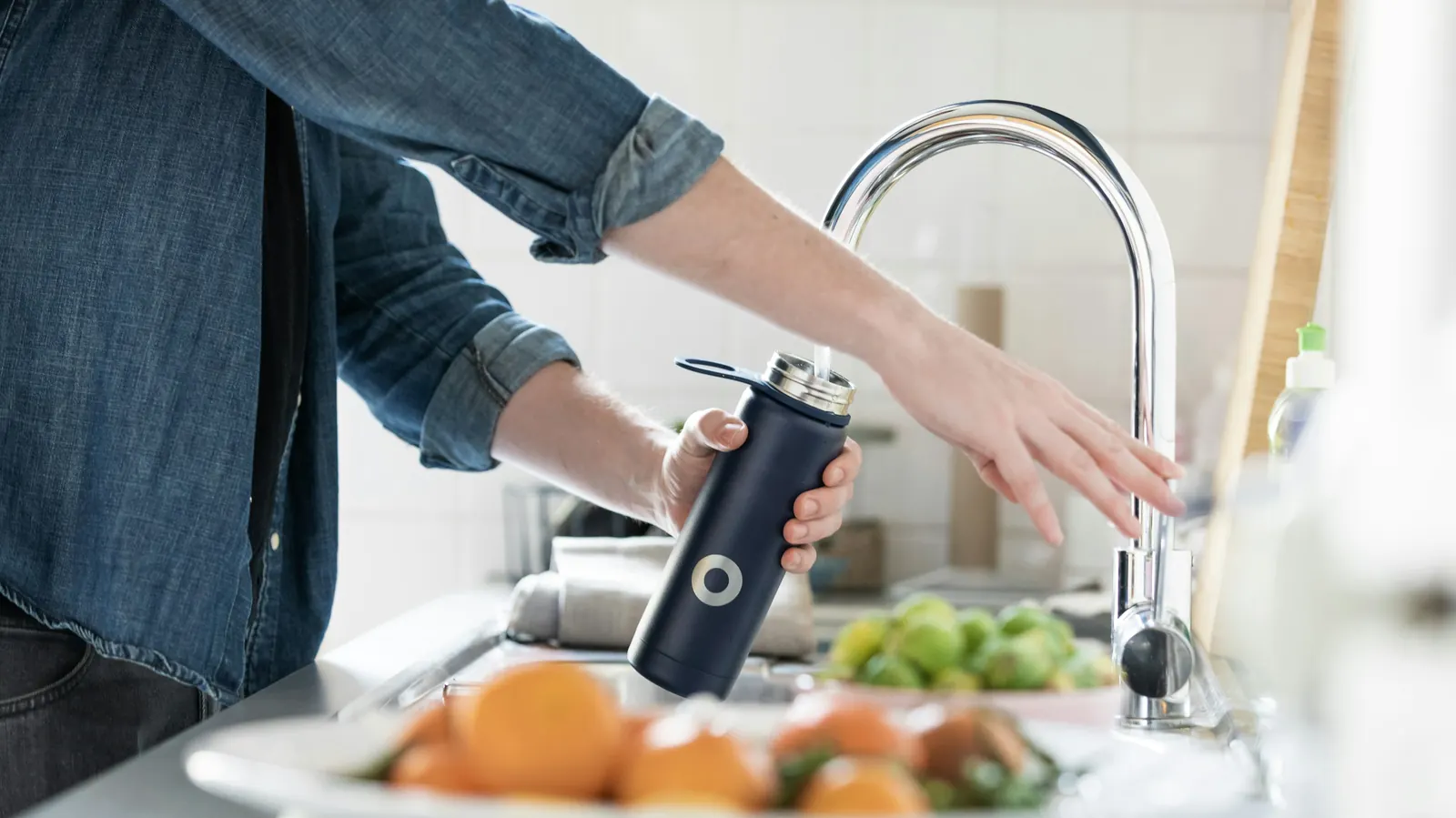
A filter pitcher in the fridge is the easy way to better-tasting water at home. A filter bottle does the same job wherever you are: you fill it from any tap, and the water passes through a filter in the lid or straw on its way to you. On a long shift, a day out or a road trip, that means you can refill from a sink or a fountain instead of buying bottled water, and lose the chlorine taste many tap waters have.
Not every filter bottle does the same thing, though. Some carry a small carbon filter certified only for chlorine taste and odor. Others add a membrane the maker says stops bacteria and parasites, or a dense filter block the maker says reduces lead, PFAS and fluoride. This guide compares nine bottles from Brita, Clearly Filtered, LifeStraw, LARQ, Epic, Philips, HydraPak and OKO, and reports each maker’s filter claims and certifications exactly as the maker states them.
Julia’s earns a commission on purchases made through links on this page, at no cost to you. Recommendations are based on what a restaurant kitchen looks for, product specifications and verified buyer reports.
Quick verdict: which filter bottle to buy
For most people refilling from city tap water, buy the Brita Premium Filtering Water Bottle, 26 oz: Brita says its filter is certified by the WQA to NSF/ANSI Standard 42 for chlorine taste and odor and particulates, it is top-rack dishwasher-safe, and filters are easy to find. If you want a filter with much broader contaminant claims, the Clearly Filtered Water Bottle, 32 oz says it is independently tested to NSF/ANSI 42, 53, 401 and 473. For travel and the outdoors, the LifeStraw Go Series Filter Bottle, 1 L adds a membrane LifeStraw says removes bacteria and parasites.
The table compares the five standouts. All nine bottles are reviewed in full after it, followed by how to read filter claims, how to choose and answers to common questions.
Five filter bottles compared
One pick for each kind of drinker, with the capacity and filter claims each maker states.
| Filter bottle | Best for | Capacity | Certification or testing (as stated) | Buy on Amazon |
|---|---|---|---|---|

Brita Premium Filtering Water Bottle, 26 ozBest overall
|
Everyday refills from city tap water | 26 oz | WQA certified, NSF/ANSI 42 | View on Amazon |

Clearly Filtered Water Bottle, 32 ozBroadest filter claims
|
Reducing more than chlorine taste | 32 oz | Independently tested to NSF/ANSI 42, 53, 401, 473 | View on Amazon |

LifeStraw Go Series Filter Bottle, 1 LBest for travel
|
Road trips, travel and day hikes | 1 L (33.8 oz) | Meets NSF 42 and EPA/NSF P231, says LifeStraw | View on Amazon |

LARQ PureVis 2 Bottle with Filter Straw, 34 ozBest self-cleaning
|
A bottle that stays fresh between washes | 34 oz (1 L) | Tested to NSF/ANSI 42 and 53 | View on Amazon |

Epic Nalgene OG Filter Bottle, 48 ozLargest capacity
|
Long days, tap and outdoor water | 48 oz | Tested to meet NSF/ANSI standards (not named) | View on Amazon |
Product images from Amazon. “Certified” means the maker says an outside body certified the product; “tested to” means the maker says it was tested against the standard, which is not the same as certification. All claims are as stated by each maker or listing.

Our picks for the best filter bottle water on the go
The nine bottles below fall into three groups: everyday bottles with a carbon filter for chlorine taste and odor (Brita, Philips), bottles with dense filters that claim to reduce a long list of contaminants (Clearly Filtered, LARQ, Epic), and travel and outdoor bottles with a membrane for bacteria and parasites (LifeStraw, HydraPak, OKO). Each review says who the bottle suits, what the maker states and one honest reason to skip it.
1. Brita Premium Filtering Water Bottle, 26 oz – Certified for Chlorine Taste
This is the filter bottle most people picture: a hard-sided, BPA-free plastic bottle with a carbon filter that sits under the lid and a straw you sip through. Brita says the activated carbon block filter reduces the taste and odor of chlorine and also reduces particulates, and it is clear that this is not a water purifier.
Brita’s user guide says the Premium Filtering Bottle, models BB10 to BB13, has been tested and certified by the WQA (Water Quality Association) against NSF/ANSI Standard 42 for the reduction of chlorine taste and odor and particulates (Class VI). This 26-ounce plastic bottle is model BB10. The guide also says the bottle is not intended to purify water and should not be used with water that is microbiologically unsafe or of unknown quality.
For daily use it is easy to live with. The lid opens with one push of a button, there is a carry loop, Brita describes the design as leakproof, and the bottle goes in the top rack of the dishwasher. Brita says to change the filter every 40 gallons, or about every two months, and replacement filters are sold widely.
Why we like it
- WQA certified to NSF/ANSI 42, per Brita
- Top-rack dishwasher-safe bottle
- One-handed push-button lid
- Filters easy to find
Key specifications
| Model | BB10 (filter BB06) |
|---|---|
| Capacity | 26 oz |
| Body | BPA-free hard plastic |
| Filter type | Activated carbon block |
| Filter life | 40 gallons, about 2 months |
| Reduces (as stated) | Chlorine taste and odor, particulates |
| Certification or testing | WQA certified to NSF/ANSI 42 |
| Dishwasher safe | Bottle, top rack |
Why we recommend it
It suits anyone on treated city water who mostly wants to lose the chlorine taste, with a certification to back that up.
Skip it if you want lead, PFAS or microbe reduction; Brita certifies this filter only for chlorine taste and odor and particulates.
Pros and cons
Pros
- Independent certification stated
- Easy to clean
- Widely sold filters
Cons
- Not a purifier, says Brita
- Not insulated
- Filter changes every two months
2. Clearly Filtered Water Bottle, 32 oz – A Long List of Tested Contaminants
Clearly Filtered is a water filter company that also makes pitchers and under-sink systems, and its bottle carries its most ambitious claims into something you can carry. The listing says its Affinity filtration targets and removes up to 99.99 percent of more than 220 contaminants, including fluoride, lead and chlorine, without targeting beneficial minerals.
How that is backed up matters. Clearly Filtered says the bottle was third-party independently tested to comply with NSF/ANSI standards 42, 53, 401 and 473, and that the full test data is on its website. That is a testing claim, not a certification, and we report it as the maker states it. The four standards cover, broadly, taste and odor (42), health-related contaminants such as lead (53), emerging contaminants (401) and PFOA/PFOS (473).
The bottle is double-wall insulated stainless steel and keeps water cold for up to 24 hours, says the maker, and it is built in the USA. One filter lasts 25 gallons, about two months at three or four refills a day. Clearly Filtered warns that the dense filter makes the straw feel like sipping a thick milkshake, and that some people notice a slight salty taste at first, which it says a rinse clears.
Why we like it
- Tested to four NSF/ANSI standards, per the maker
- Claims to reduce lead, fluoride and chlorine
- Insulated steel, cold for up to 24 hours
- Test data published by the maker
Key specifications
| Model | ISS-30 |
|---|---|
| Capacity | 32 oz |
| Body | Double-wall insulated stainless steel |
| Filter type | Affinity filtration block |
| Filter life | 25 gallons, about 2 months |
| Reduces (as stated) | 220+ contaminants incl. fluoride, lead, chlorine |
| Certification or testing | Independently tested to NSF/ANSI 42, 53, 401, 473 |
| Dishwasher safe | Not stated |
Why we recommend it
It suits someone who wants a bottle aimed at more than chlorine taste and is willing to work a little harder on the straw.
Skip it if you want an easy sip; the maker itself says the straw is slow.
Pros and cons
Pros
- Widest stated contaminant list here
- Insulated steel body
- Made in the USA
Cons
- Hard draw through the straw
- Tested, not certified, per the listing
- Shorter filter life than Brita
3. LifeStraw Go Series Filter Bottle, 1 L – Membrane Plus Carbon
LifeStraw built its name on emergency and outdoor filters, and the Go Series is its everyday bottle. It has two stages: a carbon filter that LifeStraw says reduces chlorine, odors and organic chemical matter, and a membrane microfilter that it says protects against 99.999999 percent of bacteria (including E. coli and salmonella), 99.999 percent of parasites (including giardia and cryptosporidium) and 99.999 percent of microplastics.
LifeStraw’s product pages say the Go Series meets NSF 42 for chlorine reduction and EPA and NSF P231 drinking water protocols for removing bacteria and parasites. The listing does not claim the bottle removes viruses, so for travel to places where water safety is uncertain, follow local health advice rather than relying on a filter alone.
The membrane lasts up to 1,000 gallons, about five years of daily use, says LifeStraw; the carbon filter lasts 26 gallons, about two months. The bottle is BPA-free plastic and holds a liter. LifeStraw also sells an insulated steel version if you want cold water all day.
Why we like it
- Membrane for bacteria and parasites, per LifeStraw
- Carbon stage for chlorine taste
- Membrane rated for 1,000 gallons
- Large 1-liter capacity
Key specifications
| Model | LGV41LCLWW (Clear) |
|---|---|
| Capacity | 1 L (33.8 oz) |
| Body | BPA-free plastic |
| Filter type | Membrane microfilter plus carbon |
| Filter life | Membrane 1,000 gal; carbon 26 gal |
| Reduces (as stated) | Bacteria, parasites, microplastics, chlorine, odors |
| Certification or testing | Meets NSF 42 and EPA/NSF P231 protocols, says LifeStraw |
| Dishwasher safe | Not stated |
Why we recommend it
It suits travelers and road-trippers who refill from unfamiliar taps and want more than a taste filter.
Skip it if you need virus protection; LifeStraw does not claim it for this bottle.
Pros and cons
Pros
- Two filter stages
- Long-lasting membrane
- Big capacity
Cons
- No virus claim
- Carbon stage needs changing every two months
- Not insulated
4. LARQ PureVis 2 Bottle with Filter Straw, 34 oz – UV-C Cap Keeps It Fresh
LARQ’s bottle does two separate jobs. A nano filter straw inside reduces chlorine, VOCs, PFAS (PFOA/PFOS) and pharmaceuticals, says LARQ, and the listing says it is tested to NSF/ANSI 42 and 53. In the cap, a UV-C LED switches on every two hours and, according to LARQ, eliminates 99 percent of bio-contaminants such as E. coli and mold from the water and the bottle, which keeps it from going musty.
The body is double-wall, vacuum-insulated 18/8 stainless steel that keeps water cold for up to 24 hours and is dishwasher-safe; LARQ says to hand-wash the cap, straw and filter pod. The cap tracks your sips through a free app if you want it to, and it charges by USB-C, with one charge lasting two to three weeks.
LARQ is honest about the trade-off: the dense filter means the straw takes a little more draw. One filter lasts 40 gallons, about two months. The bottle has a one-year warranty, and it is not for hot drinks.
Why we like it
- Filter tested to NSF/ANSI 42 and 53, per LARQ
- UV-C cap cleans water and bottle, says LARQ
- Insulated, dishwasher-safe steel body
- One-year warranty
Key specifications
| Model | BWOB100A |
|---|---|
| Capacity | 34 oz (1 L) |
| Body | Insulated 18/8 stainless steel |
| Filter type | Nano filter straw plus UV-C cap |
| Filter life | 40 gallons, about 2 months |
| Reduces (as stated) | Chlorine, VOCs, PFAS, pharmaceuticals |
| Certification or testing | Tested to NSF/ANSI 42 and 53 |
| Dishwasher safe | Body yes; cap, straw and filter by hand |
Why we recommend it
It suits someone who leaves water in a bottle all day and wants it to stay fresh, with a filter aimed beyond chlorine.
Skip it if you do not want to charge a water bottle; the UV cap needs USB-C power every few weeks.
Pros and cons
Pros
- Self-cleaning cap
- Insulated and dishwasher-safe body
- Broad stated filter claims
Cons
- Needs charging
- Stiffer sip through the filter
- Not for hot drinks
5. Epic Nalgene OG Filter Bottle, 48 oz – Two Filters, Tap or Stream
Epic Water Filters builds its filter into a classic wide-mouth Nalgene bottle made from Nalgene’s BPA/BPS-free Sustain material, and this version comes with two filters you swap depending on where the water comes from. The blue EveryTap filter is for tap water and, says Epic, reduces more than 70 common tap water contaminants, including chlorine, heavy metals and PFAS. The white Everywhere filter is for outdoor fresh water and, Epic says, reduces 99.99 percent of contaminants from outdoor sources.
Epic says its filters are designed and made in the USA and undergo testing to meet NSF/ANSI drinking water standards, but the listing does not name which standards or say they are certified, so treat that as a general claim. Each filter lasts up to 75 gallons, about three to four months, which is longer than most here.
At 48 ounces it is the largest bottle on this page, enough for a long shift or a hot afternoon outside. The bottle is dishwasher-safe without the filter.
Why we like it
- Two filters: tap and outdoor water
- 75-gallon filter life
- 48-ounce capacity
- Filters made in the USA, says Epic
Key specifications
| Model | EW-NAOG |
|---|---|
| Capacity | 48 oz |
| Body | Nalgene Sustain plastic, BPA/BPS-free |
| Filter type | EveryTap and Everywhere filters |
| Filter life | 75 gallons, 3 to 4 months |
| Reduces (as stated) | 70+ tap contaminants incl. chlorine, heavy metals, PFAS |
| Certification or testing | Tested to meet NSF/ANSI standards (not named) |
| Dishwasher safe | Bottle yes, filter no |
Why we recommend it
It suits people who drink a lot of water in one go and move between the city and the outdoors.
Skip it if you want a named certification; Epic’s listing does not say which standards its filters meet.
Pros and cons
Pros
- Biggest bottle here
- Long filter life
- Swap filters for the water source
Cons
- Standards not named
- Large to carry
- Not insulated
6. Brita Stainless Steel Filtering Water Bottle, 20 oz – Brita’s Filter, Kept Cold

This is the same Brita filter in a double-wall insulated stainless steel bottle that Brita says keeps water cold for a full 24 hours. It is model BB11, which Brita’s user guide lists among the Premium Filtering Bottles certified by the WQA against NSF/ANSI Standard 42 for chlorine taste and odor and particulates.
Everything else matches the plastic bottle: an activated carbon block filter that reduces chlorine taste and odor and particulates, a push-button lid, an easy-sip straw, a carry loop and a leakproof design, according to Brita. The filter lasts 40 gallons or about two months, and uses the same replacements.
It holds less, at 20 ounces, and the listing for this steel version does not say it is dishwasher-safe, unlike the plastic bottle. Brita, like the plastic version, says it is not a water purifier.
Why we like it
- Same certified Brita filter, per Brita
- Insulated, cold for 24 hours
- Shares replacement filters with the plastic bottle
Key specifications
| Model | BB11 (filter BB06) |
|---|---|
| Capacity | 20 oz |
| Body | Double-wall insulated stainless steel |
| Filter type | Activated carbon block |
| Filter life | 40 gallons, about 2 months |
| Reduces (as stated) | Chlorine taste and odor, particulates |
| Certification or testing | WQA certified to NSF/ANSI 42 |
| Dishwasher safe | Not stated |
Why we recommend it
It suits Brita fans who want cold water through a hot Houston afternoon.
Skip it if you drink a lot between refills; 20 ounces goes quickly.
Pros and cons
Pros
- Keeps water cold
- Certified taste filter
- Common replacement filters
Cons
- Small capacity
- Chlorine and particulates only
7. Philips GoZero Everyday Filtered Bottle, 32 oz – Insulated, Easy Sip

Philips’ GoZero Everyday bottle is a 32-ounce, double-wall insulated bottle of 18/8 food-grade stainless steel with an activated carbon fiber filter. Philips says the filter reduces chlorine and particulates to improve taste and odor, and it is upfront that activated carbon filters typically do not reduce minerals or TDS.
It is built for everyday carrying: a pop-up lid you open with one hand, a silicone mouthpiece, a carry loop, a size that fits a cup holder, and a leak-proof design, says the maker. The bottle is top-rack dishwasher-safe without the filter, and one filter lasts two months or 40 gallons.
The listing does not name a certification for the filter, so we cannot tell you it is certified to any standard. Philips gives a 30-day refund and a one-year warranty for a replacement, and notes that if sipping feels hard, the filter may be in upside down.
Why we like it
- 32 ounces, insulated steel
- Top-rack dishwasher-safe bottle
- One-year warranty
- Honest about what carbon does not remove
Key specifications
| Model | AWP2772NBO/37 |
|---|---|
| Capacity | 32 oz |
| Body | Double-wall insulated 18/8 stainless steel |
| Filter type | Activated carbon fiber |
| Filter life | 40 gallons, about 2 months |
| Reduces (as stated) | Chlorine, particulates, taste and odor |
| Certification or testing | Not stated |
| Dishwasher safe | Bottle, top rack; not the filter |
Why we recommend it
It suits anyone who wants a large, cold, everyday bottle that improves the taste of tap water.
Skip it if a named certification matters to you; the listing gives none.
Pros and cons
Pros
- Large and insulated
- Easy to clean
- Cup-holder friendly
Cons
- No certification stated
- Taste filter only
8. HydraPak Flux+ Filter Bottle, 1.5 L – Rolls Up When Empty

HydraPak makes soft bottles and reservoirs for runners and hikers, and the Flux+ is a collapsible 1.5-liter bottle with an integrated filter. HydraPak says the filter removes 99.99 percent of E. coli and parasitic cysts, filters about 1,500 liters of fresh water, and flows at more than a liter a minute.
The bottle is a dual-layer film laminate with abrasion-resistant TPU and welded seams, and HydraPak says it is 50 percent lighter than a hard bottle and compresses to pocket size when empty. A high-flow nozzle with a dust cover opens and closes with one hand.
This is an outdoor tool more than a desk bottle. The listing does not name a certification or say it reduces chlorine or other tap water contaminants, so it is the wrong pick if your goal is better-tasting city water. HydraPak lists a lifetime warranty.
Why we like it
- 1.5 liters, collapses when empty
- Removes E. coli and cysts, per HydraPak
- About 1,500-liter filter life
- Lifetime warranty listed
Key specifications
| Model | GF425F |
|---|---|
| Capacity | 1.5 L (50.7 oz) |
| Body | TPU film laminate, collapsible |
| Filter type | Integrated filter (type not stated) |
| Filter life | About 1,500 L |
| Reduces (as stated) | 99.99% of E. coli and parasitic cysts |
| Certification or testing | Not stated |
| Dishwasher safe | Not stated |
Why we recommend it
It suits hikers and campers who want a light bottle that filters stream water and packs away flat.
Skip it if you want better-tasting tap water; HydraPak makes no chlorine claim for it.
Pros and cons
Pros
- Very light and packable
- Fast stated flow
- Lifetime warranty
Cons
- No tap water taste claim
- Filter type not stated
9. OKO ÖKOH2O Filter Bottle, 22 oz – Squeeze Instead of Suck

OKO’s bottle works differently from the straw bottles above: you squeeze it, and the water is pushed through the filter, at up to 2 liters a minute according to the maker. That means no hard sipping through a dense filter.
OKO makes the broadest microbial claim on this page. Its listing says dual-stage electro-adsorptive and mechanical filtration removes 99.99 percent of viruses, 99.999 percent of bacteria, parasites, heavy metals, PFAS and microplastics as small as 1 micron. It also says the bottle is NSF certified, without naming a standard or the certifying scope, so we cannot say which of those claims the certification covers.
The 22-ounce bottle is BPA-free plastic with a retractable nozzle, a cap and a metal carabiner. Each filter cartridge lasts up to 100 gallons, says OKO. The listing does not say whether the bottle is dishwasher-safe or give a warranty.
Why we like it
- Squeeze-through flow, up to 2 L a minute
- Virus claim, unlike most bottles here
- 100-gallon filter life
Key specifications
| Model | OKO650ARCAZ |
|---|---|
| Capacity | 22 oz (650 ml) |
| Body | BPA-free plastic |
| Filter type | Electro-adsorptive and mechanical, two stage |
| Filter life | 100 gallons |
| Reduces (as stated) | Viruses, bacteria, parasites, heavy metals, PFAS, microplastics |
| Certification or testing | “NSF certified”; standard not named |
| Dishwasher safe | Not stated |
Why we recommend it
It suits travelers who want the widest stated protection and an easy squeeze instead of a stiff straw.
Skip it if you want to know exactly what is certified; the listing does not say.
Pros and cons
Pros
- Easy, fast flow
- Broad stated protection
- Long filter life
Cons
- Certification scope unclear
- Smaller capacity
- Care and warranty not stated
Certified, tested or just claimed: reading filter labels
Every filter bottle says it makes water better. What separates them is what the maker can point to. The standards come from NSF International and ANSI, and the main ones you will see on bottles are NSF/ANSI 42 (aesthetic effects such as chlorine taste and odor), NSF/ANSI 53 (health-related contaminants such as lead), NSF/ANSI 401 (emerging contaminants such as some pharmaceuticals) and NSF/ANSI 473 (PFOA and PFOS). NSF P231 is a protocol for microbiological water purifiers.
Read the verb. Certified means an outside body such as NSF, the WQA or IAPMO has certified the product to that standard; Brita says this about its bottle filter. Tested to or tested to comply with means the maker says the product was tested against the standard, which is useful information but not the same as certification; Clearly Filtered and LARQ use that wording. A bare meets standards or NSF certified with no standard named, as on the Epic and OKO listings, tells you less.
Read what is covered, too. A certification to NSF/ANSI 42 covers taste and odor, not lead or microbes. If a particular contaminant matters to you, look for that contaminant by name in the maker’s performance data, and you can check certifications in NSF’s own certified products listings.
How to choose the best filter bottle water for you
Know your water. On treated city water, most people mainly want to lose the chlorine taste, and a carbon filter certified to NSF/ANSI 42, like Brita’s, does that. If your water report shows lead or PFAS, look for NSF/ANSI 53 or 473 claims. If you fill from streams or travel where tap water is unsafe, you need a membrane or purifier, and you should still follow local health advice.
Sip or squeeze. Dense filters that claim to reduce more contaminants are harder to drink through; Clearly Filtered and LARQ both say so. Squeeze bottles like OKO push water through instead.
Filter life and cost of ownership. Filters here last from about 25 gallons (Clearly Filtered) to 75 gallons (Epic) before a change, with LifeStraw’s membrane rated much longer. Check that replacements are easy to buy before you choose.
Insulation. Steel bottles from Clearly Filtered, LARQ, Brita and Philips keep water cold for up to 24 hours, say their makers. In a Texas summer that makes a real difference.
Size. A 20-ounce bottle needs refilling often; a 1-liter or 48-ounce bottle carries a morning’s water. Check it fits your car’s cup holder if that matters.
Cleaning. Keep filters out of the dishwasher; Epic and Philips say so outright. Brita’s plastic bottle, LARQ’s body, Epic’s bottle and Philips’ bottle are dishwasher-safe without the filter, according to their makers.
How we chose these filter bottles
We looked for water bottles with a filter built into the lid, straw or body, sold on Amazon in the United States by identifiable makers, and checked each one’s stock with Amazon’s product data before writing. We left out pitchers, countertop and under-sink systems, and stand-alone straws and pump filters, which are covered in other guides. Capacities, filter types, filter life, contaminant claims and certifications come from each maker’s Amazon listing and, for Brita, the bottle user’s guide on Brita’s website; for LifeStraw’s standards claim, LifeStraw’s own product pages. We report every claim in the maker’s own terms and say “not stated” where a listing is silent. We did not use these bottles ourselves for this guide, and we did not rely on published reviews.
Filter bottle questions, answered
What is the best water filter bottle?
For everyday city tap water, the Brita Premium Filtering Bottle: Brita says its filter is certified by the WQA to NSF/ANSI 42 for chlorine taste and odor. For broader contaminant claims, the Clearly Filtered bottle; for travel, the LifeStraw Go Series.
Do filter bottles remove lead?
Some claim to. Clearly Filtered says its bottle was tested to NSF/ANSI 53, which covers lead, and LARQ says its filter was tested to 53 too. Brita’s bottle filter is certified only for chlorine taste and odor and particulates.
Can I drink from a stream with a filter bottle?
Only with a bottle made for it. LifeStraw, HydraPak, OKO and Epic’s Everywhere filter all make claims about bacteria and parasites in outdoor water; Brita and Philips do not, and Brita says its bottle is not a purifier.
How often should I change the filter?
Follow the maker: about every two months for Brita, Philips, LARQ and Clearly Filtered at typical use, three to four months for Epic. Change it sooner if the flow slows or the water tastes off.
Are filter bottles better than a filter pitcher?
They do a different job. A pitcher filters a large batch for the fridge, and its filter often lasts longer; a bottle filters as you drink, wherever you are. Many households use both.
Our final pick for filtered water on the go
Buy the Brita Premium Filtering Water Bottle if your aim is better-tasting tap water with a certification behind it. Choose the Clearly Filtered bottle for the broadest contaminant claims, the LifeStraw Go Series for travel, the LARQ PureVis 2 if you want a bottle that cleans itself, and the Epic Nalgene OG if you drink a lot and split time between the city and the outdoors.
Related guide: Best bottle brush.
For filtered water at home, see our guide to the best water filter pitcher, or go further with the best faucet water filter. If you are putting together a kit for when the taps stop, our emergency water filter guide covers pumps, straws and gravity systems. Filtered water also makes a better agua fresca; read what aguas frescas are, then see what Julia’s serves on the menu or call to order.