A fully automatic espresso machine, often called a super-automatic or bean-to-cup machine, does every step of a shot for you. You pour whole beans into the hopper and water into the tank, press a button, and the machine grinds, doses, tamps, brews and dumps the used puck into a drawer. Most of them also froth the milk. There is no portafilter to lock in and no separate grinder to dial in.
That convenience is the whole point, and it is why these machines cost more and take up more counter space than a pod brewer. This guide is the narrow version of our complete espresso machine guide: only machines with the grinder built in and a one-touch brew, compared on the parts that matter once the box is open, which are the grinder, the milk system, the tank sizes and how much cleaning each one asks of you.
Julia’s earns a commission on purchases made through links on this page, at no cost to you. Recommendations are based on what a restaurant kitchen looks for, product specifications and verified buyer reports.
Quick verdict: which bean-to-cup machine to buy
For most kitchens, the best fully automatic espresso machine with grinder is the De’Longhi Dinamica Plus: a 13-setting conical burr grinder, an automatic milk system, 24 one-touch drinks and four user profiles for a household that drinks different things. If easy milk cleanup matters most, choose the Philips 3300 LatteGo, whose milk system is three parts with no internal tubes. If you want a premium machine with automatic milk-line cleaning, look at the Jura E8.
Below, nine machines from eight makers, with one honest reason to skip each.
Five bean-to-cup machines side by side
Our five standout picks, one for each kind of household, with the specifications each maker or listing states. All nine machines are reviewed in full below.
| Machine | Best for | Grinder | Milk system | Buy on Amazon |
|---|---|---|---|---|

De’Longhi Dinamica PlusBest overall
|
Most households | Conical burr, 13 settings | Automatic, LatteCrema Hot | View on Amazon |

Philips 3300 LatteGoEasiest milk cleanup
|
Daily lattes, little cleaning | Ceramic, 12 settings | LatteGo, 3 parts, no tubes | View on Amazon |

Jura E8Best premium
|
Many drinks, low-effort milk | P.A.G.2, selector switch | One-touch, automatic cleaning | View on Amazon |

Bosch 800 Series VeroCafeBest for big households
|
Many drinkers, two cups at once | Ceramic, 6 settings | Integrated milk container | View on Amazon |

Philips 2200 with Classic Milk FrotherBudget pick
|
Espresso first, milk sometimes | Ceramic, 12 settings | Manual steam frother | View on Amazon |
Product images from Amazon. Specifications are as stated by each maker, listing or retailer spec sheet; check the listing before you buy.
Our picks for the best fully automatic espresso machine with grinder
Every machine here grinds whole beans on demand and brews at the press of a button. They differ in how they handle milk (automatic carafe, hose into your own container, or a manual steam wand), how big the tanks are and how much daily rinsing they expect. None of them repeats a pick from our beginner espresso guide or our coffee and espresso combo guide.
1. De’Longhi Dinamica Plus – Four Profiles, Hands-Free Milk
The Dinamica Plus is the machine that suits the widest range of households. The listing gives it 24 one-touch or customized drinks, from espresso and flat white to iced coffee and a regular cup of coffee, and a built-in conical burr grinder with 13 settings, so you can move finer for a dark espresso roast or coarser for a lighter bean.
Milk is handled by De’Longhi’s LatteCrema Hot system, which the listing describes as automatic and customizable for milk or milk alternatives. You choose the drink on a 3.5-inch color touch screen, and the machine’s Smart One-Touch feature moves the drinks you choose most often to the front of the menu. Up to four people can save their own profiles, which helps when one person drinks double espressos and another drinks oat-milk lattes.
Retailer spec sheets for this model (ECAM380.85.SB) list a 1.8-liter removable water tank and a 300-gram bean container, enough for a couple’s morning drinks for several days. The listing does not state a warranty, so check it at checkout.
Why we like it
- Conical burr grinder with 13 settings
- 24 one-touch or customized drinks, per the listing
- Up to four saved user profiles
- Automatic LatteCrema Hot milk system for dairy or alternatives
Key specifications
| Model | ECAM38085SB |
|---|---|
| Grinder | Conical burr |
| Grind settings | 13 |
| Milk system | LatteCrema Hot, automatic |
| Drink options | 24 one-touch or customized |
| Water tank | 1.8 L (retailer spec) |
| Bean hopper | 300 g (retailer spec) |
| Warranty | Not stated |
Why we recommend it
It suits a household where several people want different drinks every morning and nobody wants to steam milk by hand. The profiles and the drink list cover nearly everything a café menu does.
Skip it if you want the simplest milk cleanup; an automatic carafe system has more parts to rinse than the Philips LatteGo.
Pros and cons
Pros
- Wide drink menu, hot and iced
- Four user profiles
- 13 grind settings
Cons
- Warranty not stated in the listing
- Milk system needs regular rinsing
2. Philips 3300 LatteGo – Three-Part Milk System
Our parent guide recommends the Philips 3200; the 3300 is its newer sibling, with the same LatteGo idea and iced coffee added to the menu. The listing gives six presets: espresso, coffee, iced coffee, cappuccino, latte macchiato and hot water, each adjustable for strength, volume and milk level.
The reason to buy it is the milk system. Philips says LatteGo has three parts, no internal tubes and no hidden compartments, and that it is dishwasher safe or can be rinsed in about ten seconds. With most automatic milk systems, cleaning is the chore that decides whether you keep making lattes; this one keeps that chore short.
Retailer spec sheets list a ceramic grinder with 12 settings, a 1.8-liter water tank and a 275-gram bean hopper. The AquaClean filter, changed when the machine prompts, means you will not need to descale for up to 5,000 cups, according to Philips. The listing gives the size as about 9.7 by 17 by 14.6 inches.
Why we like it
- LatteGo: three parts, no internal tubes
- Milk parts are dishwasher safe, per Philips
- Iced coffee preset
- AquaClean filter, up to 5,000 cups without descaling
Key specifications
| Model | EP3341/50 |
|---|---|
| Grinder | Ceramic |
| Grind settings | 12 (retailer spec) |
| Milk system | LatteGo, automatic |
| Drink options | 6 presets including hot water |
| Water tank | 1.8 L (retailer spec) |
| Bean hopper | 275 g (retailer spec) |
| Warranty | Not stated |
Why we recommend it
It suits anyone who makes a milk drink every day and wants the cleanup to take seconds rather than minutes.
Skip it if you want a long menu of specialty drinks; six presets is a short list next to the De’Longhi or Bosch.
Pros and cons
Pros
- Fast, simple milk cleaning
- Iced coffee button
- Long gap between descaling with the filter
Cons
- Fewer drink presets
- Retailers disagree on tank size (1.7 or 1.8 L)
3. Jura E8 – Seventeen Drinks, Self-Cleaning Milk Line
The E8 belongs to Jura’s E line of automatic machines. The listing gives up to 17 coffee classics and specialties at one touch, each adjustable to your taste, chosen on a 3.5-inch color display with six buttons.
Jura’s P.A.G.2 grinder is adjusted with a selector switch, and the listing says it rests between preparations to extend its life. The eighth-generation brewing unit is Jura’s own. The milk system cleans itself at the touch of a button, which removes the part of milk drinks most people skip, and the drip tray is designed to come out with one hand without spilling.
Retailers list a 1.9-liter water tank and a 280-gram bean container. Jura does not publish a grind-setting count in the listing, and warranty terms vary by seller, so confirm both before you buy.
Why we like it
- Up to 17 one-touch specialties
- Milk system cleaning at the touch of a button
- Grinder rests between preparations
- One-hand removable drip tray
Key specifications
| Model | Jura E8 Piano Black 15648 |
|---|---|
| Grinder | P.A.G.2 |
| Grind settings | Not stated (selector switch) |
| Milk system | One-touch, automatic cleaning |
| Drink options | Up to 17 |
| Water tank | 1.9 L (retailer spec) |
| Bean hopper | 280 g (retailer spec) |
| Warranty | Not stated; varies by seller |
Why we recommend it
It suits a buyer who wants a long drink menu and the least milk maintenance, and is happy to pay for it.
Skip it if budget matters; it sits at the top of the price range on this page.
Pros and cons
Pros
- Large drink menu
- Push-button milk cleaning
- Larger water tank than most here
Cons
- Expensive
- Grind settings and warranty not stated in the listing
4. Bosch 800 Series VeroCafe – Thirty Profiles, Two Cups
The 800 Series is built for a busy house. The listing gives 36 drinks, including cold brew, two cups at once and up to 30 saved profiles, and Bosch’s Home Connect app lets you start a drink remotely. Strength, size, milk ratio and aroma are all adjustable on the touch screen.
Bosch’s US spec sheet lists a removable water container of about 81 ounces (2.4 liters) and a bean container of about 11.3 ounces, the largest tanks on this page, which means fewer refills when four people make coffee before work. Bosch’s UK listing for the same model describes a ceramic grinder with six settings. Milk comes from an integrated milk container included in the box.
Maintenance is simplified by a combined cleaning and descaling program called Calc’n Clean, with step-by-step guidance. Bosch’s US product page lists a two-year limited warranty covering parts and labor, or 7,000 cups, whichever comes first.
Why we like it
- About 81 oz water and 11.3 oz beans, per Bosch
- Two cups at once
- Up to 30 user profiles
- Two-year limited warranty, per Bosch
Key specifications
| Model | TQU60703 |
|---|---|
| Grinder | Ceramic |
| Grind settings | 6 (Bosch UK listing) |
| Milk system | Integrated milk container |
| Drink options | 36, including cold brew |
| Water tank | About 81 oz (2.4 L) |
| Bean hopper | About 11.3 oz |
| Warranty | 2-year limited or 7,000 cups |
Why we recommend it
It suits households of four or more, offices at home, and anyone who hosts weekend brunch and wants to make two cappuccinos at a time.
Skip it if counter space is tight or you only drink one espresso a day; this is a lot of machine.
Pros and cons
Pros
- Largest tanks on this page
- Many profiles and drinks
- Clear warranty terms
Cons
- Fewer grind settings than the Philips or De’Longhi
- App features need a home network
5. Philips 2200 with Classic Milk Frother – Bean to Cup for Less
The 2200 is the plainest way into bean-to-cup coffee from an established maker. The listing gives three presets, espresso, coffee and hot water, each adjustable for strength and volume. It still grinds, tamps and brews automatically; what it leaves to you is the milk.
Instead of an automatic carafe it has what Philips calls a classic milk frother, a steam wand you hold a pitcher under. That takes a little practice, but it is also the easiest milk part to clean: wipe it and purge it with a burst of steam. Philips’ spec sheet for this model lists a ceramic grinder with 12 settings and three aroma strengths.
Philips’ sheet for the same 2200 platform lists a 1.8-liter water tank and a 275-gram bean hopper. The AquaClean filter, changed on prompt, lets you skip descaling for up to 5,000 cups, according to Philips, and the listing gives a two-year warranty.
Why we like it
- Ceramic grinder with 12 settings
- Steam wand works with dairy or plant milk
- Two-year warranty, per the listing
- AquaClean filter cuts descaling
Key specifications
| Model | EP2220/14 |
|---|---|
| Grinder | Ceramic |
| Grind settings | 12 |
| Milk system | Classic frother (steam wand) |
| Drink options | 3 presets including hot water |
| Water tank | 1.8 L (Philips 2200 sheet) |
| Bean hopper | 275 g (Philips 2200 sheet) |
| Warranty | 2 years |
Why we recommend it
It suits espresso and Americano drinkers who make a milk drink now and then and want fresh-ground coffee without paying for an automatic milk system.
Skip it if everyone in the house drinks lattes; frothing each one by hand gets old on a busy morning.
Pros and cons
Pros
- Fewest parts to look after
- Simple, easy-to-clean steam wand
- Stated two-year warranty
Cons
- Only three presets
- Milk is not one-touch
6. Gaggia Brera – Compact, Front-Loading, Steam Wand
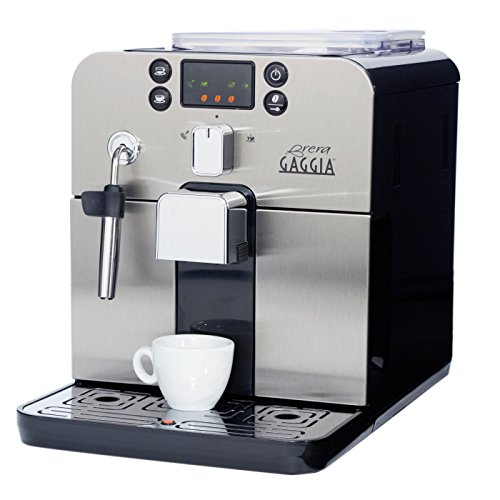
The Brera is the small machine in Gaggia’s super-automatic range. The listing calls it small, with a 40-ounce reservoir, and retailers note that the water tank and the used-puck drawer both load from the front, so it can sit under a low cabinet without being pulled out.
Retailers list a ceramic flat burr grinder with five settings and an airtight bean hopper of about 8.8 ounces. There is also a bypass for pre-ground coffee, useful for a late-evening decaf. Milk is handled with a Pannarello steam wand, a sleeve over the wand that pulls in air and makes frothing easier for beginners.
The listing gives a one-year limited warranty, and Gaggia asks you to read the user guide before first use. The drink menu is short: espresso and a longer coffee, adjusted for strength and volume.
Why we like it
- Small footprint, per the listing
- Front-access water tank and puck drawer
- Bypass for pre-ground coffee
- Pannarello wand eases frothing
Key specifications
| Model | Gaggia Brera 10003358 |
|---|---|
| Grinder | Ceramic flat burr (retailer) |
| Grind settings | 5 (retailer) |
| Milk system | Pannarello steam wand |
| Drink options | Espresso and coffee |
| Water tank | 40 oz |
| Bean hopper | About 8.8 oz (retailer) |
| Warranty | 1-year limited |
Why we recommend it
It suits small kitchens and apartments, and one or two people who mostly drink espresso.
Skip it if you want one-touch cappuccinos; you froth milk yourself, and the grinder has only five settings.
Pros and cons
Pros
- Compact and front-loading
- Takes pre-ground coffee too
- Long-running model with known parts
Cons
- Smallest tank here
- Short drink menu
- One-year warranty
7. Miele CM 5310 Silence – Quiet Grinder, Self-Rinsing Milk

Miele is known for dishwashers and ovens built to last, and the CM 5310 brings that approach to coffee. The listing describes a quiet grinder made of wear-resistant steel, part of what Miele calls its AromaticSystem, a dynamic brewing system. If your machine will run at 6 a.m. near sleeping children, the quiet grinder is the feature to notice.
The listing says it makes coffee, espresso, latte macchiato and hot milk, two of any drink at one touch, and up to eight cups into a coffee pot (sold separately). The milk pipework is cleaned automatically after every milk drink, and many parts, including the water tank and waste container, go in the dishwasher. There is also a drawer for ground coffee.
Miele’s US spec sheet lists a 44-ounce (1.3-liter) water tank, and retailers give a bean container of about 7 ounces, the smallest here. The box includes descaling and cleaning tablets. The listing does not state a warranty.
Why we like it
- Quiet steel grinder, per Miele
- Milk pipework rinsed after every milk drink
- Two drinks at one touch
- Dishwasher-safe tank and waste container
Key specifications
| Model | CM 5310 Silence (11648150) |
|---|---|
| Grinder | Wear-resistant steel |
| Grind settings | Not stated |
| Milk system | Automatic, self-rinsing pipework |
| Drink options | Coffee, espresso, latte macchiato, hot milk and more |
| Water tank | 44 oz (1.3 L) |
| Bean hopper | About 7 oz (retailer) |
| Warranty | Not stated |
Why we recommend it
It suits early risers in a quiet house and anyone who wants milk cleaning handled automatically.
Skip it if you drink a lot of coffee; the small bean container and tank mean frequent refills.
Pros and cons
Pros
- Quiet grinding
- Automatic milk-line rinse
- Ground-coffee drawer for decaf
Cons
- Small bean container
- Coffee pot sold separately
8. KitchenAid KF7 – Milk Hose into Any Container

The KF7 sits between the KF6 and KF8 in KitchenAid’s fully automatic range. The listing gives more than 20 recipe options and a metal-clad body, and its built-in grinder uses what KitchenAid calls smart dosing to set the amount and grind for each drink.
The milk idea is different from a carafe: you place the milk hose into any container you like, a carton or a jar from the fridge, and the machine froths and heats the amount each drink needs. That means no extra carafe to wash. Coffee and milk dispense together through what KitchenAid calls a dual drink system.
The bean hopper twists and lifts out, so you can empty it and swap to decaf or a different roast without vacuuming beans out by hand. Retailers list a 2.2-liter water tank (also in the listing title), a 270-gram hopper and seven grind settings. The listing does not state a warranty.
Why we like it
- Milk hose works with any container
- Removable twist-off bean hopper
- 2.2-liter water tank
- Metal-clad construction, per KitchenAid
Key specifications
| Model | KES8557SX |
|---|---|
| Grinder | Built-in, smart dosing |
| Grind settings | 7 (retailer) |
| Milk system | Automatic, hose into any container |
| Drink options | 20+ recipes |
| Water tank | 2.2 L |
| Bean hopper | 270 g, removable (retailer) |
| Warranty | Not stated |
Why we recommend it
It suits households that switch beans often or use several kinds of milk, since both the hopper and the milk source change in seconds.
Skip it if you want lots of grind adjustment; seven settings is fewer than the Philips or De’Longhi offer.
Pros and cons
Pros
- No carafe to wash
- Easy bean swaps
- Big water tank
Cons
- Fewer grind settings
- Warranty not stated in the listing
9. Terra Kaffe TK-02 – Espresso and True Drip Coffee

Most super-automatics make “coffee” by pulling a long espresso shot. The TK-02 is different: the listing says its hybrid brew unit makes authentic drip coffee as well as espresso, from whole beans or pre-ground coffee. If half the house drinks a regular mug and the other half drinks cappuccinos, that matters.
Terra Kaffe lists a metal conical burr grinder, and reviewers at Tom’s Guide and Coffeeness report five grind settings. The machine froths dairy and plant milk from a carafe. Its app saves every drink to your Terra Kaffe account, sets automatic wake and sleep times, and can scan QR codes on Terra Kaffe coffee to load roaster-recommended settings.
Terra Kaffe’s spec sheet lists a 75-ounce water tank, and its product materials describe a 16-ounce bean hopper, the largest here. New machines carry a two-year or 5,000-brew limited warranty, according to Terra Kaffe. It does not take coffee pods.
Why we like it
- Real drip coffee as well as espresso
- 16-ounce bean hopper, per Terra Kaffe
- App saves drinks and schedules wake-up
- Two-year or 5,000-brew limited warranty
Key specifications
| Model | TK-02 |
|---|---|
| Grinder | Metal conical burr |
| Grind settings | 5 (reviewer reports) |
| Milk system | Automatic carafe, dairy or plant milk |
| Drink options | Espresso drinks and drip coffee, customizable |
| Water tank | 75 oz |
| Bean hopper | 16 oz |
| Warranty | 2-year or 5,000-brew limited |
Why we recommend it
It suits a household split between drip coffee and espresso drinks that wants one machine on the counter instead of two.
Skip it if you don’t want an app in your morning routine; many of its conveniences live there.
Pros and cons
Pros
- Drip coffee and espresso in one
- Large bean hopper and tank
- Clear warranty terms
Cons
- Leans on the app
- Smaller maker with a shorter track record
How to choose a bean-to-cup espresso machine
The milk system decides the daily work
There are three kinds. An automatic carafe or milk container (De’Longhi, Philips LatteGo, Bosch, Terra Kaffe) makes one-touch lattes but has parts to rinse after use. A hose that draws from your own container (KitchenAid, and the milk line on the Jura and Miele) avoids a carafe, and the better ones rinse themselves. A manual steam wand (Philips 2200, Gaggia Brera) is the cheapest and simplest to clean but asks you to froth by hand. If you skip cleaning, milk systems clog and smell, so pick the one you will actually keep clean. If you already own a separate milk frother, a steam-wand machine may be all you need.
Grinder type and settings
All these machines use burr grinders, ceramic or steel. More settings let you fine-tune for different beans, but even five settings will cover a medium or dark espresso roast. What matters more is fresh beans; check your manual for any advice on very oily, dark roasts. If you want full control over grind, a separate grinder and a manual machine are the better route; see our coffee and espresso grinder guide.
Tank and hopper size
A small water tank means daily refills; a small bean hopper means beans run out mid-week. For one or two people, around 1.2 to 1.8 liters of water is fine. For four or more, look at the Bosch, KitchenAid or Terra Kaffe.
Descaling and filters
Hard water is the enemy of any espresso machine. Several makers here include a water filter (Philips AquaClean, a Mavea filter with the Bosch) that cuts how often you descale. Follow the machine’s prompts; ignoring them is the most common way these machines fail early.
Counter space
Measure under your cabinets before you buy. A front-loading machine like the Gaggia Brera does not need to be pulled out to refill, while top-filled bean hoppers need clearance above.
How we chose these nine machines
We started with fully automatic machines from established espresso and appliance makers sold on Amazon US, and kept only those listed in stock when we checked. We left out machines already recommended on our main espresso guide, beginner guide and combo guide, near-duplicates from the same maker, and anonymous brands that only exist on Amazon. Several well-known models, including Jura’s ENA 8 and E6, Philips’ 4400 and De’Longhi’s Eletta Explore, were left out because Amazon listed them only in limited stock.
Specifications come from the Amazon listings, the makers’ own spec sheets and, where the maker did not publish a figure, retailer spec sheets, which we label. Where no source states a figure, we write “Not stated”. We have not used these machines in our kitchen; this is a comparison of what the makers state and what reputable sources report. We also checked the U.S. Consumer Product Safety Commission’s recall database for each maker and found no recall for any machine on this page.
Bean-to-cup espresso questions, answered
What is the difference between fully automatic and semi-automatic?
A semi-automatic machine controls water and pressure, but you grind, dose, tamp and lock in the portafilter yourself. A fully automatic machine does all of those steps from whole beans at the press of a button. Our main espresso machine guide covers the semi-automatic side.
Does a fully automatic machine make espresso as good as a café?
It makes consistent espresso with no learning curve, which many people prefer to an inconsistent shot made by hand. A skilled barista with a commercial machine and a separate grinder has more control, but that takes practice most home cooks do not want to put in.
Can I use pre-ground coffee?
Some can. The Gaggia Brera has a bypass for pre-ground coffee, the Miele has a ground-coffee drawer, and the Terra Kaffe takes pre-ground coffee. Check the listing for the others.
How often do these machines need cleaning?
Empty the drip tray and puck drawer every day or two, rinse the milk system after use unless the machine does it for you, and descale when prompted. Many have removable brewing units that should be rinsed weekly; check the manual.
Can these machines make iced coffee?
The Philips 3300, De’Longhi Dinamica Plus and Bosch 800 list iced coffee or cold brew options. For the other machines, brew espresso over ice yourself.
Our pick for fresh-ground espresso at a touch
Buy the De’Longhi Dinamica Plus if you want one machine that suits most households, with fine grind control, automatic milk and profiles for everyone. Choose the Philips 3300 LatteGo if quick milk cleanup matters most, the Jura E8 for the most hands-off premium machine, the Bosch 800 for a big household, and the Philips 2200 if you want bean-to-cup coffee for less and are happy to steam milk yourself.
For portafilter machines and the full range of espresso options, go back to the complete espresso machine guide. And when you would rather someone else made dinner, see the menu or call to order.