
Set an ordinary microwave to half power and it does not really run at half power. It runs at full power, switches off, and switches on again, over and over. An inverter microwave, according to the makers who sell them, can run at a steady lower power instead. That matters most for the jobs microwaves are worst at: thawing a pound of ground beef without cooking the edges, or warming a dense pan of enchiladas through without drying out the corners.
This guide narrows our best countertop microwave oven roundup down to inverter models only. It compares eight countertop microwaves from Panasonic, Breville, Toshiba, Sharp and Frigidaire, from 1.0 to 2.2 cubic feet, using each maker’s specifications on its Amazon listing. None of them repeats a pick from that guide.
Julia’s earns a commission on purchases made through links on this page, at no cost to you. Recommendations are based on what a restaurant kitchen looks for, product specifications and verified buyer reports.
Quick verdict: which inverter microwave to buy
The best inverter microwave oven for most kitchens is the Panasonic 1.6 Cu Ft Cyclonic Inverter Microwave: 1,250 watts, inverter Turbo Defrost and sensor reheat, and 20 presets. For the quietest kitchen, the Breville Smooth Wave; for big casserole dishes, the Panasonic 2.2 Cu Ft Cyclonic Inverter; and for a flat, turntable-free floor, the Toshiba 1.3 Cu Ft Flatbed Inverter.
What an inverter microwave does differently
A microwave’s power comes from a part called the magnetron. In a standard microwave, lower power settings are made by cycling the magnetron: Panasonic describes conventional ovens as using the same maximum power all the time and repeatedly turning it on and off to create lower energy levels. Emerson’s listing puts it the same way: alternating between full power and no power.
An inverter supplies the magnetron with a steady stream of power at the level you set. Panasonic calls it a seamless stream of power that cooks evenly from edges to center; Toshiba describes smooth, continuous power rather than on and off pulses; Breville calls its version a power-smoothing inverter. What the makers claim follows from that: more even reheating, defrosting without cooked edges, and gentler low-power jobs such as softening butter or keeping a sauce warm.
Two things to keep in mind. The difference the makers describe is at lower power settings, since at full power both kinds run the magnetron flat out. And these are the makers’ descriptions. An inverter does not remove the need to stir, cover and check reheated food, which we cover below.
Five inverter microwaves at a glance
Our five standout picks, one for each kind of kitchen, with the capacity, power and interior each maker states. All eight are reviewed in full below.
| Microwave | Capacity | Power | Interior | Sensor | Buy on Amazon |
|---|---|---|---|---|---|

Panasonic 1.6 Cu Ft Cyclonic Inverter MicrowaveBest overall
|
1.6 cu ft | 1,250 W | Turntable (size not stated) | Genius Sensor | View on Amazon |
| 1.2 cu ft | 1,250 W | Turntable, can be turned off | Sensor iQ | View on Amazon | |

Toshiba 1.3 Cu Ft Flatbed Inverter MicrowaveBest flatbed
|
1.3 cu ft | 1,200 W | Flatbed, no turntable | Smart Sensor | View on Amazon |
| 2.2 cu ft | 1,250 W | 16.5 in turntable | Automatic sensor | View on Amazon | |
| 1.0 cu ft | 1,200 W | Flatbed, hidden turntable | Genius Sensor 2.0 | View on Amazon |

Our picks for the best inverter microwave oven
The first five cover most kitchens: a mid-size Panasonic, a quiet Breville, two flatbeds and a large family model. The last three add a large Toshiba, a mid-size Sharp flatbed and a simple Frigidaire. Our countertop guide already covers Panasonic’s 1.2 cu ft NN-SN67QS and Toshiba’s 1.6 cu ft inverter, so they are not repeated here. Each entry lists capacity, power, the maker’s name for its inverter, the interior, the sensor, size and warranty.
1. Panasonic 1.6 Cu Ft Cyclonic Inverter Microwave – Even Defrost and Reheat
The Panasonic NN-SN75LB is the inverter microwave we would point most households toward. It is the size up from the 1.2 cu ft Panasonic in our countertop guide: 1.6 cubic feet and 1,250 watts, which is room for a casserole dish of rice or a family-size tray of enchiladas.
Panasonic says its Turbo Defrost and Sensor Reheat use a microwave sequencing system built on the inverter’s continuous power to thaw and reheat quickly and evenly. That is the feature to buy it for if you often defrost meat for tacos or reheat dense leftovers. The Genius Sensor drives 20 preset smart cooking options, including fresh and frozen entrees and vegetables, rice, soup, potatoes, pasta and pizza.
There are dedicated buttons for Popcorn, Keep Warm and Quick 30, along with a child lock, a kitchen timer and three-stage cooking. Panasonic gives the outside size as 11 15/16 inches high, 21 7/8 wide and 19 7/16 deep. The listing does not state the turntable size. This is the black finish, with a one-year manufacturer’s warranty.
Why we like it
- Inverter Turbo Defrost and Sensor Reheat
- 1,250 W in a 1.6 cu ft cavity
- 20 sensor and auto cook presets
- Keep Warm button
Key specifications
| Model | Panasonic NN-SN75LB |
|---|---|
| Capacity | 1.6 cu ft |
| Power | 1,250 W |
| Inverter | Cyclonic Inverter |
| Turntable or interior | Turntable, size not stated |
| Sensor | Genius Sensor |
| Outside size | 21 7/8 W x 19 7/16 D x 11 15/16 H in |
| Warranty | 1 year |
Why we recommend it
Families who defrost and reheat most days and want a bigger cavity than a standard 1.2 cu ft model.
Skip it if your counter is shallow; at nearly 19.5 inches deep it needs room.
Pros and cons
Pros
- Inverter defrost and reheat
- High power for its size
- Three-stage cooking
Cons
- Turntable size not stated
- Deep footprint
- Black finish only on this listing
2. Breville Smooth Wave 1.2 Cu Ft Inverter Microwave – Quiet Door, Smooth Power

The Breville Smooth Wave BMO850 is the plain microwave version of Breville’s line, with no convection or air fry. Breville calls its inverter power smoothing: it adjusts power intensity and delivers smooth, even power, which the maker says lets you reheat pizza, soup and lasagna precisely and defrost meat without drying out the edges.
Its other selling point is noise. Breville says the soft-close door is 80 percent quieter and the oven is 50 percent quieter in operation, and there is a mute button and Breville’s adjustable sound settings. Sensor iQ reads the steam released during Smart Reheat and sets the time, and there are 15 smart presets across Smart Cook, Smart Defrost and Smart Reheat.
A shortcuts panel inside the door covers common jobs such as melting chocolate and softening butter, and an A Bit More button adds a little extra time without restarting. You can switch the turntable off for dishes that would catch on the walls. It is 1.2 cubic feet (34 liters) and 1,250 watts, with a one-year limited warranty.
Why we like it
- Power-smoothing inverter
- Soft-close door and quieter operation, per Breville
- Sensor iQ smart reheat
- Turntable-off option
Key specifications
| Model | Breville BMO850BSS |
|---|---|
| Capacity | 1.2 cu ft (34 L) |
| Power | 1,250 W |
| Inverter | Power smoothing inverter |
| Turntable or interior | Turntable, can be switched off |
| Sensor | Sensor iQ |
| Outside size | Not stated |
| Warranty | 1 year limited |
Why we recommend it
Open-plan kitchens and early risers who want an inverter microwave that does not slam or beep.
Skip it if you need more than 1.2 cu ft; the Panasonic picks are larger.
Pros and cons
Pros
- Quiet door and operation
- Thoughtful shortcuts and A Bit More button
- Mute and sound settings
Cons
- Outside dimensions not stated in the listing
- Turntable size not stated
- No convection; for that see Breville’s Combi Wave in our countertop guide
3. Toshiba 1.3 Cu Ft Flatbed Inverter Microwave – No Turntable to Clean
The Toshiba ML-EM13PAITF has no turntable. Its flat interior, Toshiba says, takes dishes of different sizes and shapes, or several plates at once, without turntable noise or the stuttering of a dish catching on the walls, and the smooth floor is easy to wipe. That suits a rectangular baking dish of enchiladas that will not turn on a round plate.
It pairs that with Toshiba’s Origin inverter, which the maker says gives even cooking, precise temperature control and quieter running. The Smart Sensor adjusts power by detecting the moisture coming off food and runs 11 pre-programmed sensor menus for foods such as pizza, pasta and vegetables. There are 11 power levels and a mute function.
The listing gives 1.3 cubic feet and 1,200 watts in the title, with a black stainless steel finish, but does not state outside dimensions or the usable floor size. It is a newer model, first listed in early 2026. Warranty is one year.
Why we like it
- Flatbed interior, no turntable
- Origin inverter
- 11 sensor auto menus, 11 power levels
- Mute function
Key specifications
| Model | Toshiba ML-EM13PAITF(BS) |
|---|---|
| Capacity | 1.3 cu ft |
| Power | 1,200 W |
| Inverter | Origin inverter |
| Turntable or interior | Flatbed, no turntable |
| Sensor | Smart Sensor (moisture) |
| Outside size | Not stated |
| Warranty | 1 year |
Why we recommend it
Anyone tired of cleaning around a turntable, or who reheats in square and rectangular dishes.
Skip it if you want a long track record; this model was first listed in 2026.
Pros and cons
Pros
- Easy-clean flat floor
- Fits rectangular dishes
- Sensor plus inverter
Cons
- Dimensions not stated
- Newer model with less buyer history
4. Panasonic 1.0 Cu Ft Flatbed Inverter Microwave with Genius Sensor 2.0 – Temperature-Reading Sensor

The Panasonic NN-SF57RM is a compact 1.0-cubic-foot, 1,200-watt microwave engineered in Japan, with a pull-down door and a flatbed look borrowed from built-in ovens. Its Genius Sensor 2.0 is the reason to pick it: Panasonic says this version uses thermo-sensing to monitor food temperature, then chooses the power level and cooking time for one-touch cooking and reheating.
The flat floor hides a turntable underneath, which Panasonic says puts power where it is needed for even defrosting and heating while keeping the cooking surface clear and easy to clean. Panasonic’s inverter, which the maker describes as delivering consistent microwave power, handles cooking, reheating and defrosting from edges to center. Auto defrost is included.
At 1.0 cu ft it is the smallest microwave on this page, so it suits a dinner plate or a bowl of pozole rather than a casserole. The listing does not give outside dimensions. Warranty is one year from the manufacturer.
Why we like it
- Genius Sensor 2.0 reads food temperature, per Panasonic
- Flat floor with a hidden turntable
- 1,200 W in a compact cavity
- Pull-down door
Key specifications
| Model | Panasonic NN-SF57RM |
|---|---|
| Capacity | 1.0 cu ft |
| Power | 1,200 W |
| Inverter | Panasonic Inverter |
| Turntable or interior | Flatbed with hidden turntable |
| Sensor | Genius Sensor 2.0 (thermo-sensing) |
| Outside size | Not stated |
| Warranty | 1 year |
Why we recommend it
One or two people who mostly reheat single plates and want a sensor that does the guessing.
Skip it if you reheat family-size dishes; 1.0 cu ft is small.
Pros and cons
Pros
- Temperature-based sensor
- Easy-clean flat floor
- Compact
Cons
- Smallest capacity here
- Dimensions not stated
- Usable floor size not stated
5. Panasonic 2.2 Cu Ft Cyclonic Inverter Microwave – Family-Size Turntable
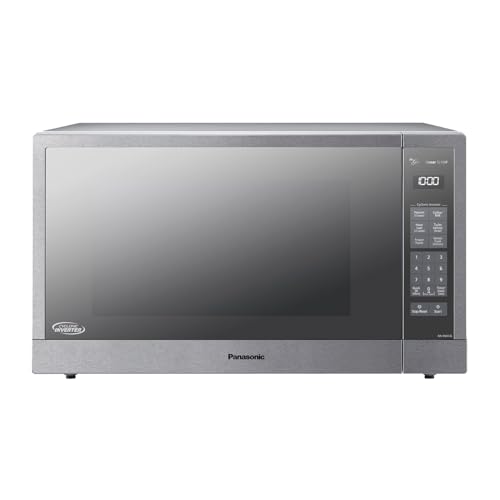
For a big household, the Panasonic NN-SN97JS is the large inverter pick: 2.2 cubic feet, 1,250 watts and a 16.5-inch turntable. Panasonic gives the inside dimensions as about 10 15/16 inches high, 18 7/16 wide and 18 1/2 deep, room for a large casserole dish or a big pot of beans.
Panasonic describes its Cyclonic Wave inverter as circulating heat for efficient cooking at all power levels and says the inverter generates a seamless stream of power for even results without overcooking. Inverter Turbo Defrost speeds up thawing. A built-in sensor adjusts power and time for different foods, with 20 preset menu items, a quick-minute timer, delay start and a keep-warm feature for soups and sauces.
It is sold as countertop or built-in. The child lock ships enabled, as on every countertop microwave sold in the U.S. Warranty is one year from the manufacturer. A dial-controlled sibling, the NN-SD975S, has the same capacity and power if you prefer a dial.
Why we like it
- 2.2 cu ft with a 16.5-inch turntable
- Inverter Turbo Defrost
- Keep-warm feature
- Delay start
Key specifications
| Model | Panasonic NN-SN97JS |
|---|---|
| Capacity | 2.2 cu ft |
| Power | 1,250 W |
| Inverter | Cyclonic Wave Inverter |
| Turntable or interior | 16.5 in turntable |
| Sensor | Automatic sensor |
| Outside size | Not stated (inside 18 7/16 W x 18 1/2 D x 10 15/16 H in) |
| Warranty | 1 year |
Why we recommend it
Large families and anyone who reheats full casserole dishes or big pots of soup.
Skip it if counter space is tight; a 2.2 cu ft box is bulky.
Pros and cons
Pros
- Biggest turntable class
- Inverter defrosting
- Countertop or built-in
Cons
- Large footprint
- Outside dimensions not stated in the listing

6. Toshiba 2.2 Cu Ft Inverter Countertop Microwave – Big Turntable, Clear Specs

The Toshiba ML4-EM22PAIT is the other 2.2-cubic-foot option, and its listing gives the full figures: 1,200 watts output, 1,350 watts input, 24.4 inches wide, 19.5 deep and 13.6 high outside, with a 16.5-inch glass turntable. Knowing the input draw helps if it will share a circuit with a coffee maker.
Toshiba says the inverter gives even cooking, reheating and defrosting with no cold spots, and a built-in humidity sensor adjusts power and time. That is the maker’s claim; stirring and checking still matter. There are six sensor cook and auto menus and 10 power levels.
The two-step child lock is mandatory, and Toshiba shows how to open the door in the listing’s diagram. Warranty is one year limited. Compared with the Panasonic 2.2, it has fewer presets and no keep-warm button, but you know exactly how much counter it needs.
Why we like it
- Full dimensions and input power stated
- 16.5-inch turntable
- Inverter plus humidity sensor
- 10 power levels
Key specifications
| Model | Toshiba ML4-EM22PAIT(SS) |
|---|---|
| Capacity | 2.2 cu ft |
| Power | 1,200 W output (1,350 W input) |
| Inverter | Toshiba inverter |
| Turntable or interior | 16.5 in turntable |
| Sensor | Humidity sensor |
| Outside size | 24.4 W x 19.5 D x 13.6 H in |
| Warranty | 1 year limited |
Why we recommend it
Large households that want a big inverter microwave and need exact measurements before buying.
Skip it if you want lots of presets; it has six.
Pros and cons
Pros
- Clear, complete specifications
- Large turntable
- Humidity sensor
Cons
- 24.4 inches wide
- Only six auto menus
- Two-step child lock takes getting used to
7. Sharp 1.1 Cu Ft Flatbed Inverter Microwave – Takes 13-Inch Dishes

Sharp’s SMC1174KS is a mid-size flatbed: 1.1 cubic feet and 1,100 watts with no turntable. Sharp says the flat floor takes plates and dishes up to 13.25 by 13 inches, so a large dinner plate or a square baking dish fits without turning.
Sharp describes its lightweight inverter as distributing cooking power evenly through the cavity for consistent, thorough results. Controls are kept simple: Express Cook for one-touch cooking up to six minutes, a +30 key, preset buttons for popular foods and drinks, and Auto Defrost for meat, poultry and fish.
Inside is a gray flatbed interior with LED lighting, and there is a child lock. The listing does not mention a sensor or give outside dimensions. Warranty is one year limited.
Why we like it
- Flat floor takes dishes up to 13.25 x 13 in
- Inverter at 1,100 W
- Express Cook and +30 key
- Auto Defrost
Key specifications
| Model | Sharp SMC1174KS (ZSMC1174KS) |
|---|---|
| Capacity | 1.1 cu ft |
| Power | 1,100 W |
| Inverter | Sharp inverter |
| Turntable or interior | Flatbed, up to 13.25 x 13 in dishes |
| Sensor | Not stated |
| Outside size | Not stated |
| Warranty | 1 year limited |
Why we recommend it
Couples and small families who want a flat floor and an inverter in a mid-size box with simple buttons.
Skip it if you want sensor reheating; the listing does not mention one.
Pros and cons
Pros
- Stated usable floor size
- No turntable to clean
- Simple controls
Cons
- No sensor listed
- Dimensions not stated
8. Frigidaire 1.1 Cu Ft Inverter Microwave – Simple and Mid-Size

The Frigidaire EMW122 is the most basic inverter microwave here: 1.1 cubic feet and 1,000 watts, with eight one-touch quick menus for popcorn, pizza, vegetables, beverages, meat and bread. Frigidaire says the inverter provides a steady stream of power for faster, more precise cooking and defrosting without hot spots or overcooked edges.
Frigidaire describes the interior as roomy enough for a wide range of dish sizes, and there is a built-in child safety lock. That is about all the listing says: it does not give the turntable size, outside dimensions or whether there is a sensor.
We include it because it is an inverter microwave from a large appliance maker for kitchens that want the steady-power benefit without many buttons. Warranty is one year.
Why we like it
- Inverter from a major appliance brand
- Eight one-touch menus
- 1,000 W, 1.1 cu ft
- Child safety lock
Key specifications
| Model | Frigidaire EMW122 |
|---|---|
| Capacity | 1.1 cu ft |
| Power | 1,000 W |
| Inverter | Frigidaire inverter |
| Turntable or interior | Not stated |
| Sensor | Not stated |
| Outside size | Not stated |
| Warranty | 1 year |
Why we recommend it
Anyone who wants inverter defrosting in a straightforward mid-size microwave.
Skip it if you want full specifications before buying; this listing is thin.
Pros and cons
Pros
- Simple one-touch menus
- Known appliance brand
- Inverter defrost
Cons
- Thin listing details
- Lowest power of the eight
- No sensor listed
How to choose an inverter microwave oven
1. Make sure the inverter is named
Look for the word inverter in the maker’s own description, not just in a seller’s title. Every pick here names it: Panasonic’s Cyclonic Inverter, Toshiba’s Origin inverter, Breville’s power-smoothing inverter, and Sharp’s and Frigidaire’s inverters. Phrases like “gentle reheat” or “low power defrost” on their own do not mean the oven has one.
2. Capacity and interior
Capacity tells you the box; the turntable or floor tells you what fits. A 1.0 to 1.2 cu ft model takes a dinner plate. A 1.6 cu ft model takes a casserole. A 2.2 cu ft model with a 16.5-inch turntable takes almost anything. Flatbeds (Toshiba, Sharp, Panasonic NN-SF57RM) fit square and rectangular dishes and are easier to wipe.
3. Power
Output on these picks runs from 1,000 to 1,250 watts. Package directions assume a stated wattage, so on a 1,000-watt model expect slightly longer times. If a listing gives input power too, that is the figure that matters for your circuit.
4. Sensor
The inverter controls how power is delivered; a sensor decides how long. Most picks have both. Panasonic’s Genius Sensor 2.0 reads food temperature, according to Panasonic, while the Toshiba and Breville sensors read steam or moisture.
5. Noise and controls
If the microwave runs late at night or in an open-plan room, look at the Breville’s soft-close door and quiet operation, or any model with a mute function. If you would rather not learn a menu, the Frigidaire and Sharp keep the buttons simple.

Defrosting and reheating Mexican food in an inverter microwave
An inverter earns its keep on the jobs a Mexican home kitchen does most: thawing ground beef or chicken for tacos, reheating a pan of enchiladas, softening frozen tamales, and warming a pot of frijoles without splattering. Steady low power heats more gently than full power switched on and off, according to the makers, so edges are less likely to overcook before the center warms.
It does not change the food-safety basics. Clemson Cooperative Extension’s Home & Garden Information Center notes that uneven microwave heating can leave cold spots where harmful bacteria may survive, and advises covering food to hold moisture and promote even heating, stirring or rotating it midway, allowing standing time so the heat evens out, and using a food thermometer. Leftovers and casseroles should reach 165°F. Our guide to reheating Mexican leftovers goes dish by dish, and our guide to what tamales are explains why they reheat best in their husks.
If you also want to crisp reheated taquitos or bake, an inverter microwave will not do it on its own. Pair it with something from our guides to the best toaster oven or the best small toaster oven.
How we picked these eight inverter microwaves
We did not test these microwaves. We kept only models whose makers name an inverter, then compared what each maker states on its Amazon listing: capacity, power, the inverter and sensor, turntable or flatbed interior, size and warranty, and we point out where a listing leaves something out. The explanation of how an inverter differs from on-off power comes from Panasonic’s and the other makers’ own descriptions. Every microwave was in stock on Amazon when we wrote this, and we searched the U.S. Consumer Product Safety Commission’s recall database for each brand and found no recall listed for these models.
We left out Panasonic’s 1.2 cu ft NN-SN67QS and Toshiba’s 1.6 cu ft inverter because our countertop guide already covers them, and Panasonic’s NN-SN65KB because it is close to the NN-SN67QS. We also left out the Breville Compact Wave, whose listing describes lower-power reheating but does not name an inverter, inverter combos with convection, a renewed Panasonic, and listings that were scarce.

Inverter microwave questions, answered
What is an inverter microwave?
One that can deliver a steady, lower level of microwave power instead of switching full power on and off to imitate a lower setting. Makers say this heats and defrosts more evenly.
Is an inverter microwave worth it?
If you defrost meat or reheat dense leftovers often, the makers’ case is strong. If you mostly heat drinks and popcorn at full power, you will notice little difference.
Does an inverter microwave cook faster?
At full power, not much. Some makers say inverter defrosting is quicker, such as Panasonic’s Turbo Defrost, but total speed depends mostly on wattage.
Do I still need to stir food in an inverter microwave?
Yes. Clemson Extension advises covering, stirring or rotating midway, letting food stand and checking leftovers reach 165°F with a thermometer, whatever the microwave.
What size inverter microwave should I buy?
About 1.0 to 1.2 cu ft for one or two people, 1.6 cu ft for a family, and 2.2 cu ft if you reheat full casserole dishes.
Our final pick for an inverter microwave
Buy the Panasonic 1.6 cu ft Cyclonic Inverter for most kitchens. Choose the Breville Smooth Wave for quiet, the Panasonic 2.2 cu ft for big dishes, and the Toshiba 1.3 cu ft flatbed if you are done cleaning around turntables. For sensor models without an inverter and for compacts, see our countertop microwave guide.
Related guide: Best over the range microwave.
Or let us do the cooking: see the menu and call to order.