
A restaurant kitchen runs on timers as much as on burners. Tamales sit in the steamer for an hour or more and have to be checked before the water runs low, a pot of frijoles needs a reminder to stir and top up, rice has to rest covered for exactly as long as it rests, and a tray of conchas or a pan of flan in the oven does not care that three other things are happening at once. When the clock on the stove is already counting something else, a separate timer you can see and hear across the room is what keeps a batch from scorching.
At home the stakes are smaller but the problem is the same. The phone is in another room, the oven timer only does one thing, and a beep you cannot hear over the extractor fan is no use. This guide compares eight kitchen timers, from single-dial wind-ups to keypad timers that run three or four countdowns, and explains which kind suits the way you cook.
Julia’s earns a commission on purchases made through links on this page, at no cost to you. Recommendations are based on what a restaurant kitchen looks for in a timer, the makers’ own specifications and the details on each Amazon listing.
Quick verdict: which kitchen timer to buy
For most home cooks, the best kitchen timer is the OXO Good Grips Digital Triple Kitchen Timer: three independent countdowns of up to 100 hours each, a full keypad for setting times directly, a large backlit screen and adjustable alarm volume, according to OXO’s listing. If your timer lives next to the sink or the steamer, the splash-resistant CDN Waterproof Kitchen Timer is built for wet stations. If you want no batteries and no buttons, the Taylor 60-Minute Mechanical Kitchen Timer is a twist-and-go dial.
The table below compares our five standout timers, one for each kind of cook. All eight are reviewed in full after it, followed by what to look for and answers to common questions.
Five kitchen timers side by side
One pick for each kind of kitchen, with the channels and maximum time each maker or listing states.
| Timer | Best for | Channels | Max time | Buy on Amazon |
|---|---|---|---|---|
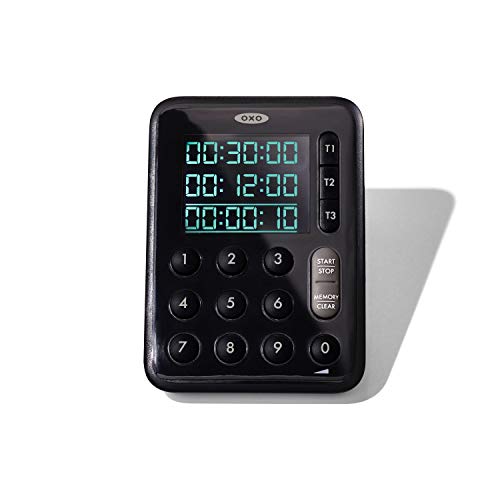
OXO Good Grips Digital Triple Kitchen TimerBest overall
|
Several dishes at once | 3 | 100 hours each | View on Amazon |

CDN Waterproof Kitchen TimerBest for wet stations
|
Near the sink, steamer or stockpot | 1 | 100 minutes | View on Amazon |

Taylor 60-Minute Mechanical Kitchen TimerBest mechanical
|
No batteries, no buttons | 1 | 60 minutes | View on Amazon |

Escali Multi-Task Four-Event TimerBest four-channel
|
Holiday meals and big cooks | 4 | 99 hours plus | View on Amazon |

Polder Twist Digital Kitchen TimerSimplest digital
|
One task, set with a twist | 1 | 100 minutes | View on Amazon |
Product images from Amazon. Channels and maximum times are as stated by each maker or listing; check the listing before you buy.
Our picks for the best kitchen timer
These eight timers cover the jobs a kitchen timer actually does: tracking several pots and pans at once, surviving splashes and steam, counting down one thing simply and loudly, and living on the fridge or range hood where you can see it. Each pick says who it suits, what the maker or listing states, and one honest reason to skip it.
1. OXO Good Grips Digital Triple Kitchen Timer – Three Countdowns, One Screen
OXO’s triple timer is built for the moment when the beans, the rice and the salsa roasting under the broiler all need watching at the same time. It runs three independent timers, each able to count down up to 100 hours, so it covers everything from a three-minute egg to a long braise or an overnight soak. The screen is large and uses an inverse backlight, which OXO says makes it easy to read at a glance.
The detail that sets it apart from most multi-timers is the full number keypad. Instead of holding a minute button while the digits creep upward, you type the time you want, which is quicker when your hands are busy. The body is angled upward on a sturdy base, so it can be pressed with one hand without sliding, and the listing also describes a magnetic back for the fridge or range hood.
The alarm volume is adjustable, there is a stopwatch function, and three AAA batteries come in the box. OXO’s listing does not give a decibel figure for the alarm, so if you cook in a loud room, set it to the top volume and check it before relying on it.
Why we like it
- Three independent timers, 100 hours each
- Full keypad for direct time entry
- Large screen with inverse backlight
- Adjustable alarm volume and a stopwatch
Key specifications
| Model | 11303700 |
|---|---|
| Type | Digital, keypad entry |
| Channels | 3, plus stopwatch |
| Max time | 100 hours per timer |
| Alarm (stated) | Adjustable volume; loudness not stated |
| Mount | Angled stand base; magnetic back |
| Power | 3 AAA batteries (included) |
Why we recommend it
It suits anyone who regularly has more than one thing going: a pot of beans, rice resting off the heat and something in the oven. The keypad makes it the fastest of these timers to set.
Skip it if you only ever time one thing; a single-channel timer is smaller and simpler.
Pros and cons
Pros
- Runs three events independently
- Type in times instead of scrolling
- Readable backlit display
Cons
- Alarm loudness not stated
- Larger than single timers
2. CDN Waterproof Kitchen Timer – Made for Wet, Steamy Stations
CDN makes timers for commercial kitchens, and the TMW1 is the one built for the wettest corner of the room. The listing calls it waterproof, steamproof and shatterproof, and says it keeps working accurately if it gets wet or is accidentally dropped in water; CDN’s own spec sheet, published by its distributors, rates it IPX4, which means protected against splashing from any direction. That makes it a sensible timer to stand beside a tamale steamer or a sink full of soaking dried chiles.
It counts up or down for up to 100 minutes in minutes and seconds, and keeps counting up after it reaches zero so you can see how long ago the alarm went off. CDN describes the alarm as the loudest it offers, and the listing says it sounds for 90 seconds with a flashing light, which helps in a noisy kitchen.
It stands on its own stand or sticks to a fridge or hood with its magnet, runs on AAA batteries (included), and carries a limited five-year warranty according to the listing. One timer per unit, so for several dishes you need more than one.
Why we like it
- Rated for splashes and steam
- Long alarm with a flashing light
- Counts up after zero
- Limited five-year warranty
Key specifications
| Model | TMW1 |
|---|---|
| Type | Digital, waterproof (IPX4 per CDN spec sheet) |
| Channels | 1 |
| Max time | 100 minutes (minutes and seconds) |
| Alarm (stated) | CDN’s loudest; 90 seconds with flashing light |
| Mount | Magnet or stand |
| Power | AAA batteries (included) |
Why we recommend it
It suits cooks who keep the timer where water, steam and wet hands are part of the job, and anyone who has lost a cheaper timer to a splash.
Skip it if you need to track several things at once; it is a single-channel timer capped at 100 minutes.
Pros and cons
Pros
- Splash- and steam-resistant body
- Audio and visual alert
- Magnet and stand included
Cons
- One countdown only
- 100-minute limit is short for long braises
3. Taylor 60-Minute Mechanical Kitchen Timer – Twist, Walk Away, No Batteries
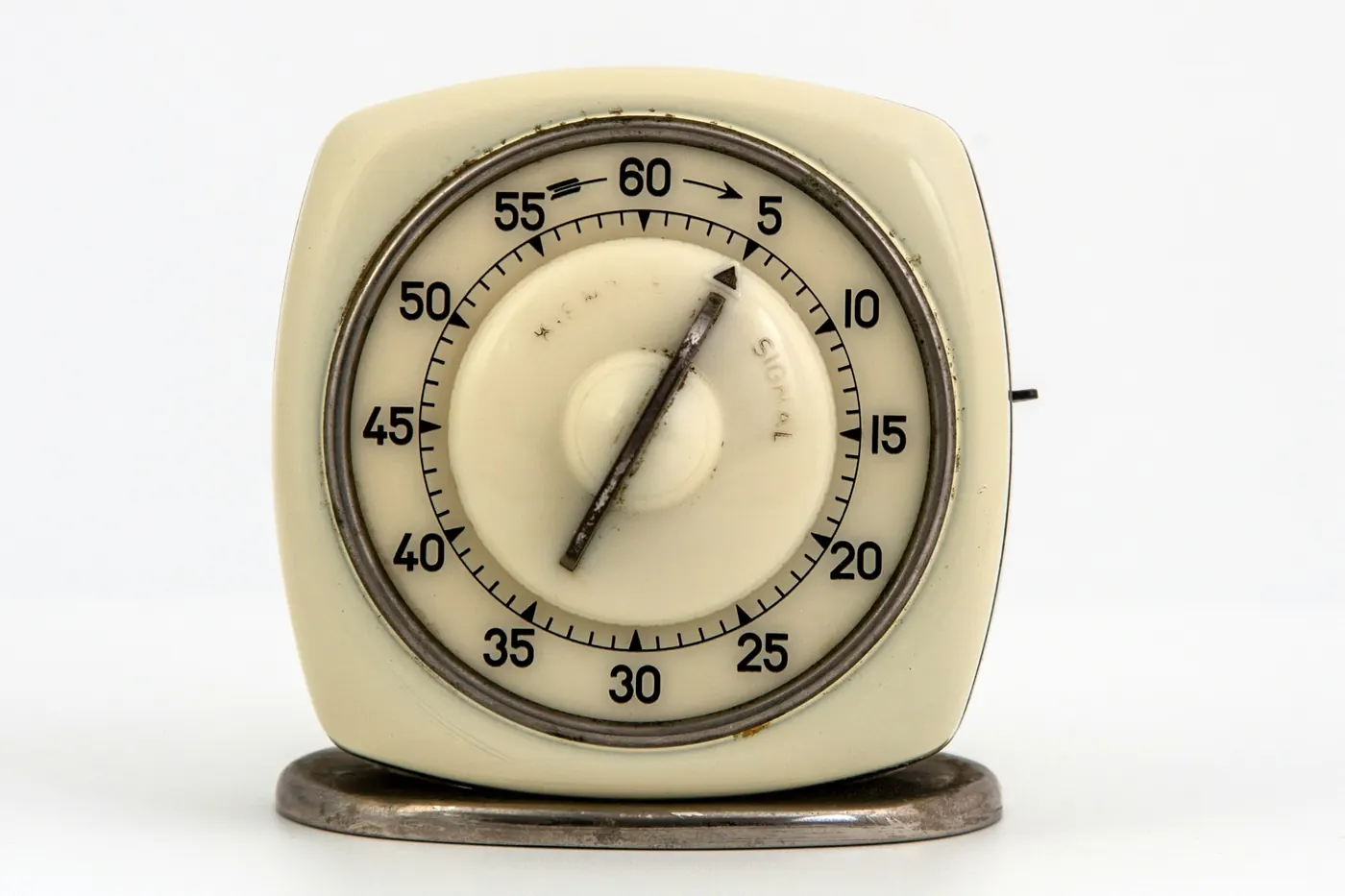
A wind-up dial timer is the oldest design on this list and still one of the most practical. Taylor’s version has a brushed stainless steel housing, a rubberized knob and a slip-proof base. You twist the dial to the time you want and, as the listing puts it, the alarm rings once it reaches zero. There is nothing to program, no battery to die halfway through a batch, and it can be set by feel with a floury hand.
The dial runs to 60 minutes with bold black graphics, which covers most stovetop jobs: rice, a quick salsa simmer, a batch of tortillas resting under a towel, or eggs. Taylor says the ring lasts nine seconds and is loud enough to hear around the home. That is short compared with digital timers that keep beeping for a minute or more, so it works best when you stay within earshot.
Taylor lists a one-year parts and labor warranty. As with any mechanical timer, it is accurate enough for cooking but not to the second.
Why we like it
- No batteries or buttons
- Stainless steel housing
- Slip-proof base and rubberized knob
- Large, bold dial face
Key specifications
| Model | 5830 |
|---|---|
| Type | Mechanical wind-up dial |
| Channels | 1 |
| Max time | 60 minutes |
| Alarm (stated) | Loud nine-second ring |
| Mount | Countertop, slip-proof base |
| Power | None (wind-up) |
Why we recommend it
It suits cooks who want a timer that works the same way every time, with nothing to set up, and who mostly time things under an hour.
Skip it if you often step out of the kitchen; a nine-second ring is easy to miss from another room.
Pros and cons
Pros
- Never needs a battery
- Sets in one twist
- Steel body with a non-slip base
Cons
- Short ring
- No magnet; countertop only
- Less precise than digital
4. Escali Multi-Task Four-Event Timer – Four Timers for Big Cooks
When a meal has four moving parts, Escali’s DR6 can track all of them. It runs four separate events at once and lists a timer range of 99 hours, 99 minutes and 59 seconds, which is far more than any home cook needs but means a long overnight job is not a problem. It also has a clock mode, so it can sit on the counter as a clock when no timer is running.
Two small features matter in a busy kitchen. The overtime counter keeps counting up after an alarm goes off until you press Start/Stop, so if you were busy plating you can see how far past the mark you are. And a recall button brings back the last setting, which helps when you cook in rounds, such as batch after batch of tortillas or several trays of cookies.
It measures 3.5 by 3.75 by 0.75 inches according to the listing, takes two AAA batteries (included), and can stick to the fridge by its magnetic back, stand on a built-in kickstand or hang from a retractable wall tab. Escali does not state the alarm volume.
Why we like it
- Four events at once
- Overtime counter after the alarm
- Recall for repeated batches
- Magnet, kickstand and wall tab
Key specifications
| Model | DR6 |
|---|---|
| Type | Digital, with clock mode |
| Channels | 4 |
| Max time | 99 hr 99 min 59 sec (as listed) |
| Alarm (stated) | Not stated; counts overtime after alarm |
| Mount | Magnet, kickstand or wall tab |
| Power | 2 AAA batteries (included) |
Why we recommend it
It suits anyone cooking holiday meals or batch-prepping several dishes, who wants one device to keep track of all of them.
Skip it if you prefer typing times in; it does not have the OXO’s full keypad.
Pros and cons
Pros
- Four channels in a compact body
- Shows how long since the alarm
- Clock mode when idle
Cons
- Alarm volume not stated
- Four channels can be fiddly to set
5. Polder Twist Digital Kitchen Timer – Dial Feel, Digital Display
Polder’s Twist sits between a wind-up and a button timer. You set it by turning a dial, as you would a mechanical timer, but the countdown shows on an extra-large digital display in minutes and seconds, so you know exactly how much time is left. It counts down from up to 100 minutes and can also count up.
The alert is the most flexible here for a single timer. The listing says you can choose a silent alert, a backlit visual alert or a loud alarm that sounds for 60 seconds, which is handy when you want to time something without waking the house. A memory function recalls the last setting, and rubberized magnets hold it to metal surfaces without scratching them.
Polder does not state the battery type on the listing, and it runs only one countdown at a time. For a single job, such as the rest time for a pot of rice or the steam time on a small batch of tamales, it is about as quick to set as a timer gets.
Why we like it
- Twist dial for quick setting
- Silent, backlit or loud 60-second alert
- Memory recall of the last time
- Rubberized, no-scratch magnets
Key specifications
| Model | TMR-900-90 |
|---|---|
| Type | Digital, twist-dial setting |
| Channels | 1 |
| Max time | 100 minutes; also counts up |
| Alarm (stated) | Silent, backlit or loud 60-second alarm |
| Mount | Rubberized magnets |
| Power | Not stated |
Why we recommend it
It suits cooks who like the speed of a dial but want a precise digital readout and a choice of quiet or loud alerts.
Skip it if you time several dishes at once; it has a single channel.
Pros and cons
Pros
- Fast to set by twisting
- Three alert modes
- Magnets will not scratch
Cons
- One timer only
- Battery type not stated on the listing
6. Taylor Four-Event Digital Timer with Whiteboard – Label Every Timer

The trouble with any multi-timer is remembering which beep belongs to which pot. Taylor’s four-event timer answers that two ways. Each of its four countdowns has its own distinct alarm tone, and the front has a built-in dry-erase whiteboard with a marker, so you can write “beans”, “rice” and “oven” next to the right timer, or jot down a temperature or step.
The LCD screen measures 2 by 1.75 inches, which Taylor says reads easily across the kitchen. A magnet holds it to the fridge or another metal surface, and a fold-out stand keeps it upright on the counter. Two AA batteries are included.
Taylor does not state a maximum countdown time on the listing, nor a decibel figure for the alarms. It is a good fit for home kitchens where several people cook together and need to see at a glance what each timer is for.
Why we like it
- Four timers with distinct tones
- Dry-erase board to label each one
- Magnet or fold-out stand
- Batteries included
Key specifications
| Model | 5849 |
|---|---|
| Type | Digital, with dry-erase board |
| Channels | 4 |
| Max time | Not stated |
| Alarm (stated) | Distinct tone for each timer |
| Mount | Magnet or fold-out stand |
| Power | 2 AA batteries (included) |
Why we recommend it
It suits shared kitchens and anyone who has stood in front of a beeping timer wondering which pot it meant.
Skip it if you need to know the maximum countdown before buying; the listing does not say.
Pros and cons
Pros
- Easy to tell timers apart
- Room for notes on the front
- Large LCD
Cons
- Max time not stated
- Dry-erase marker is one more thing to lose
7. Lavatools KT8 Dual Timer – Two Timers With a Mute Option

Lavatools’ KT8 is a compact two-timer for kitchens where two things at once is the usual load: beans and rice, or a sauce and a tray in the oven. Both timers run at the same time, quick-set minute and second buttons speed up entry, and it doubles as a stopwatch. The display is backlit for reading in a dim kitchen.
Lavatools describes the beeper as super loud, loud enough to hear in another room, and adds a mute function with a light indicator for times when noise is not welcome. That combination is unusual at this size. A built-in magnet and a lanyard hole, with a lanyard included, let you stick it to the fridge or carry it on you.
The listing does not state the maximum countdown or the battery type, so check those details before buying if they matter to you. Lavatools lists a three-year limited warranty.
Why we like it
- Two timers plus a stopwatch
- Loud alarm or silent light alert
- Backlit display
- Three-year limited warranty
Key specifications
| Model | KT8 |
|---|---|
| Type | Digital, backlit |
| Channels | 2, plus stopwatch |
| Max time | Not stated |
| Alarm (stated) | “Super loud” beeper; mute with light indicator |
| Mount | Magnet; lanyard hole |
| Power | Not stated |
Why we recommend it
It suits cooks who usually juggle two dishes and want the option to switch the beeper off without losing the alert.
Skip it if you want full specifications up front; the maximum time and battery are not on the listing.
Pros and cons
Pros
- Small but runs two timers
- Mute with visual alert
- Can be worn on a lanyard
Cons
- Max time not stated
- Battery type not stated
8. KitchenAid Digital Magnetic Timer – Strong Magnets, Backlit Screen
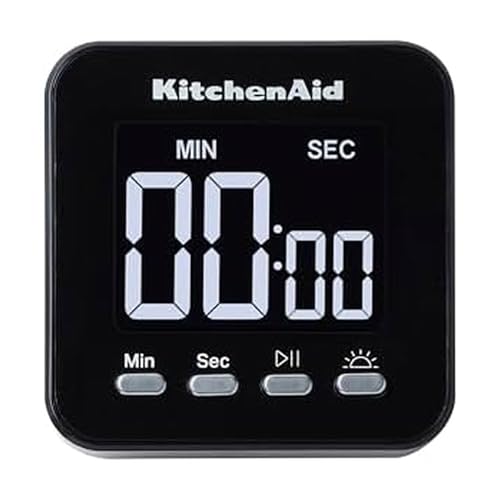
KitchenAid’s KQ912 is a plain single-event timer whose strongest feature is where it can live. KitchenAid describes extra-strong covered magnets that hold it to a cooktop panel, fridge or vent hood without scratching the surface, so it can sit at eye level right above the pot it is timing.
It counts down from up to 99 minutes and 59 seconds or counts up from zero, set with separate minute and second buttons. The display is large and backlit, with an extra button to switch the backlight on. Two AAA batteries are included.
KitchenAid is clear that it is not water-resistant: hand wash only, do not immerse it or put it in the dishwasher, and wipe it with a damp cloth. It does not state the alarm volume. Keep it away from the steamer and the sink, and it is a tidy, easy timer for one job at a time.
Why we like it
- Extra-strong covered magnets
- Large backlit display
- Counts down or up
- Batteries included
Key specifications
| Model | KQ912 |
|---|---|
| Type | Digital, backlit |
| Channels | 1 |
| Max time | 99 min 59 sec |
| Alarm (stated) | Not stated |
| Mount | Covered magnets |
| Power | 2 AAA batteries (included) |
Why we recommend it
It suits cooks who want a single timer stuck right on the hood or cooktop panel where they will see it.
Skip it if it will live near water; KitchenAid says not to immerse it.
Pros and cons
Pros
- Magnets designed not to scratch
- Backlight on demand
- Simple two-button setting
Cons
- Not water-resistant
- One timer only
- Alarm volume not stated
Mechanical, digital or multi-channel: which timer suits you
Mechanical dial timers wind up with a twist and need no batteries. They are quick, durable and easy to use with messy hands, but they top out at about an hour, ring briefly and are less precise than digital timers. Good for one cook timing one thing nearby.
Single digital timers show minutes and seconds, usually run up to 100 minutes, and often count up after the alarm. Most stick to a fridge or hood. Good for precise single jobs, like the rest time on rice or the steam on a small batch.
Multi-channel timers run two, three or four countdowns at once. They take a moment longer to set, but they are what a restaurant line relies on when several pots are going, and they suit holiday cooking at home.

How to choose a kitchen timer
Count your pots. If you regularly have two or more things on a clock at once, buy a multi-channel timer. One device with three labeled countdowns is easier to manage than three separate timers scattered around the counter.
Check the maximum time. Most single digital timers stop at 100 minutes and wind-ups at 60. That covers rice, eggs and most baking, but not a long pot of beans, a slow braise or a big batch of tamales, which can need well over an hour in the steamer. For those, a timer that runs for hours, such as the OXO or Escali, avoids resetting it halfway. Our guide to the best tamale steamer covers the pot side of that job.
Make sure you will hear it. Few makers publish decibel figures, so read the alarm description: how long it sounds, whether volume is adjustable, and whether there is a light or vibration alert. A long alarm with a visual signal matters more than a sharp beep that stops after a few seconds.
Decide where it lives. A magnet keeps it on the fridge or hood, a stand keeps it on the counter, and a clip or lanyard lets you carry it. Near the sink or the steamer, choose a water-resistant model.
Think about setting speed. Keypads are fastest for odd times, dials are fastest for round numbers, and memory recall saves time when you cook in repeated batches.
Pair it with the right tools. A timer tells you when to check, not whether it is done. For meat, check with a thermometer; see our guide to the best meat thermometer. For baking and masa, accurate weights matter as much as time; see the best kitchen scale.
How we chose these eight timers
We started from the timing jobs a working Mexican kitchen gives a timer: long steams for tamales, pots of beans that need checking, rice that has to rest, and several dishes finishing at once. We then looked for timers sold on Amazon in the United States from identifiable makers, across mechanical, single digital and multi-channel designs, and checked each one’s stock with Amazon’s product data before writing. Channels, maximum times, alarm descriptions, mounting and power come from each listing, and for the CDN waterproof timer also from CDN’s spec sheet as published by restaurant-supply retailers; where no source states a figure we say “not stated”, and we report alarm loudness only as the maker describes it. ThermoWorks’ Extra Big & Loud timer was not in stock on Amazon when we checked, so it is not included, and we avoided unbranded listings. We did not use these timers for this guide, and we have not cited published reviews from America’s Test Kitchen, Serious Eats, Wirecutter or Consumer Reports, because we did not read them for this page.
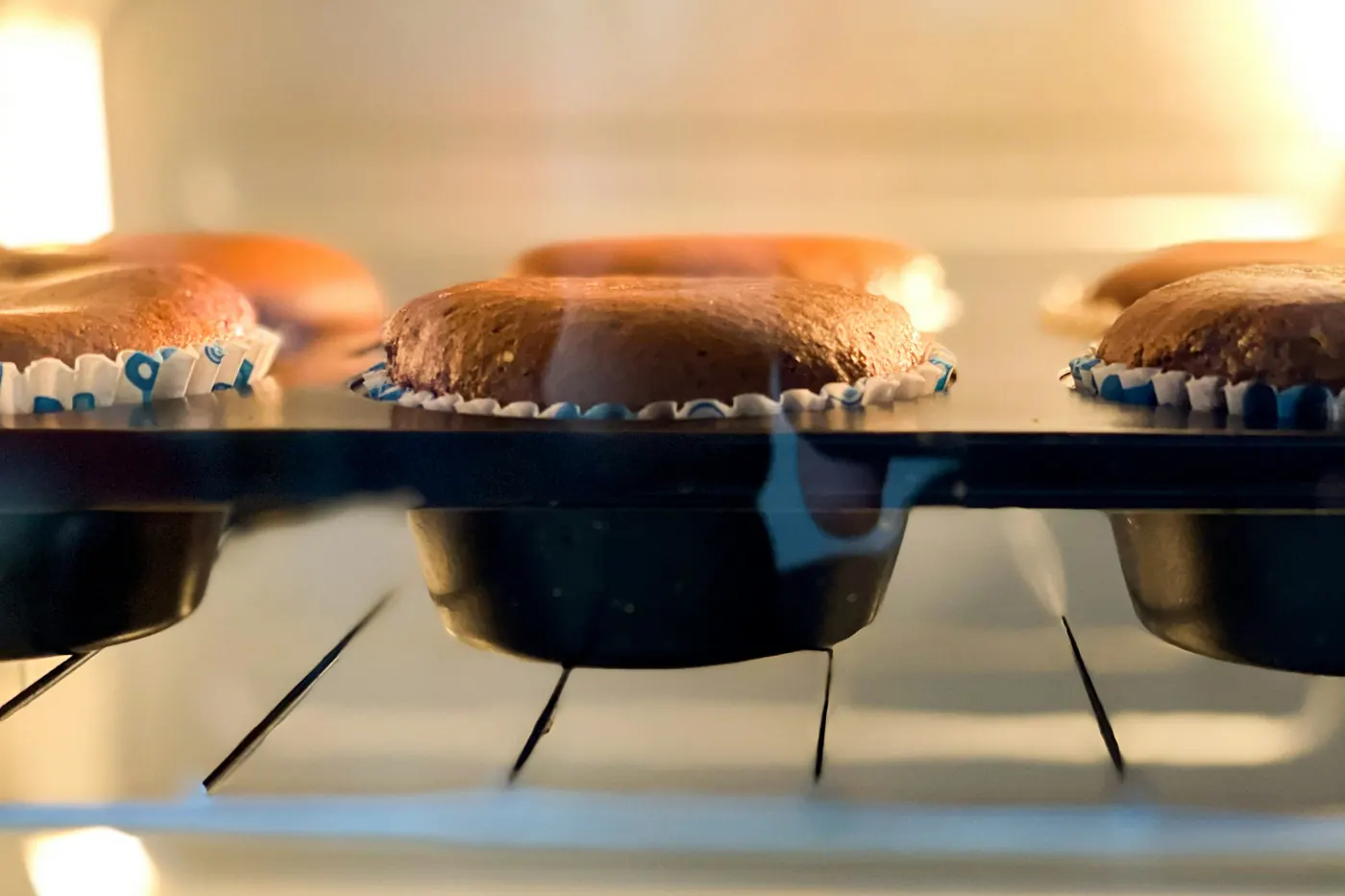
Kitchen timer questions, answered
What is the best basic kitchen timer?
For a no-fuss timer, a 60-minute mechanical dial such as Taylor’s, or a single digital timer such as the Polder Twist. Both set in seconds and do one job well.
Are mechanical or digital kitchen timers better?
Digital timers are more precise, run longer and often have louder, longer alarms. Mechanical timers never need batteries and are quicker to set by feel. Many kitchens keep one of each.
What makes a quality kitchen timer?
A display you can read from across the room, an alarm you will actually hear, a mount that keeps it where you look, and enough channels and maximum time for the way you cook. A maker’s warranty is a good sign too; CDN, Taylor and Lavatools all state one.
How many timers do I need?
Most home cooks manage with one multi-channel timer. If you often cook in two places, such as stovetop and grill, a second single timer you can carry helps.
Is a phone timer good enough?
It works, but phones get carried off, go silent and are awkward with wet hands. A dedicated timer on the fridge stays put and is always on.
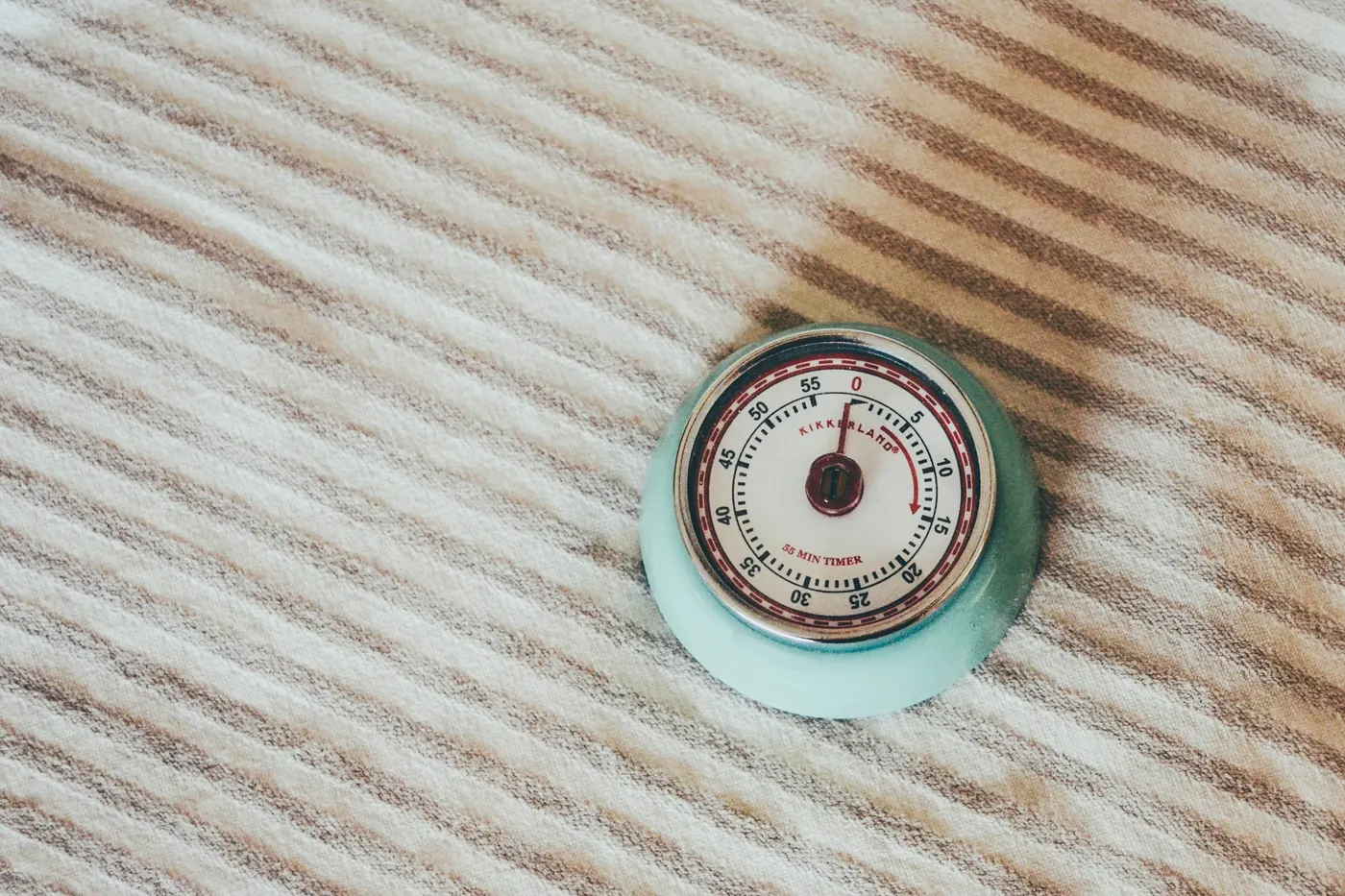
Our final pick for timing the stove and oven
Buy the OXO Good Grips Digital Triple Kitchen Timer if you want one timer that handles a full meal. Choose the CDN Waterproof timer for steamy, splashy stations, the Taylor mechanical dial if you want no batteries, the Escali four-event if you cook big holiday spreads, and the Polder Twist if you only ever time one thing.
A timer earns its place in a kitchen where long, slow jobs are common. Our guide to what tamales are explains why the steam takes so long, charro beans vs refried beans covers what happens to the pot of beans you are timing, and Mexican cooking tools shows the rest of the kit.
Related guide: Best tea timer.
And if you would rather someone else watched the clock tonight, see the menu or call to order.