A meat thermometer does not need to be expensive to do its one job: tell you the temperature in the middle of a chicken thigh before it comes off the grill. What changes as you spend less is how fast it reads, how thin the probe is, what powers it and how long the maker stands behind it. Those trade-offs matter more than the logo on the handle.
This page is for cooks who want a dependable thermometer without paying for a top-tier model. We compare the speed and accuracy each maker states, the build and the warranty, and we say plainly what each one gives up. The top-tier picks, including the ThermoWorks models, are on our main best meat thermometer guide, and we have kept them off this list.
Julia’s earns a commission on purchases made through links on this page, at no cost to you. Recommendations are based on what a restaurant kitchen looks for, product specifications and verified buyer reports.
Quick verdict: which low-cost thermometer to buy
For most kitchens, the ThermoMaven 0.5 Sec Professional Meat Thermometer is the one to buy: ThermoMaven states a 0.5-second read and NIST-certified accuracy of ±0.5°F, with an IP67 waterproof body and a screen that rotates for either hand. If you want a slim, commercial-style probe for thin cuts, choose the Taylor 9878E slim digital thermometer. If you never want to buy another battery, the Rubbermaid Commercial pocket dial thermometer runs on none at all.
Five budget thermometers compared
Our five standout picks, one for each kind of cook. All eight thermometers are reviewed in full below.
| Thermometer | Best for | Stated read time | Power | Buy on Amazon |
|---|---|---|---|---|

ThermoMaven 0.5 Sec Professional Meat ThermometerBest overall value
|
Fast reads at the grill | 0.5 seconds | Battery (type not stated) | View on Amazon |

Taylor 9878E Slim Digital Meat ThermometerBest thin probe
|
Chops, thin chicken, fish | Not stated | Battery (type not stated) | View on Amazon |

Escali DHP3 Waterproof Digital Meat ThermometerBest warranty
|
A thermometer to keep for years | 1 to 4 seconds | Battery (type not stated) | View on Amazon |

Inkbird 0.5 Second Rechargeable Instant Read ThermometerBest rechargeable
|
No coin cells to replace | 0.5 seconds | Built-in rechargeable | View on Amazon |

Rubbermaid Commercial Pocket Dial ThermometerBest without batteries
|
Thick roasts, a spare in a drawer | Not stated | None (mechanical dial) | View on Amazon |
Product images from Amazon. Read times, accuracy and ranges are as each maker or its listing states them.
Our picks for the best meat thermometer cheap enough for any kitchen
All eight are low-cost thermometers from identifiable makers. Six are digital instant-read models, one is a battery-free pocket dial, and one is a leave-in dial for oven roasts. Each review gives what the maker states, what it leaves out, and one honest reason to skip it.
1. ThermoMaven 0.5 Sec Professional Meat Thermometer – Fast, Waterproof, Easy to Read
The ThermoMaven HT04 is a folding instant-read thermometer that, on paper, matches the speed and accuracy of thermometers costing much more. ThermoMaven states a 0.5-second reading and NIST-certified accuracy of ±0.5°F, and says it upgraded the probe for faster heat transfer from first contact. Those are the maker’s figures; we found no independent review of this model.
The everyday details are what make it a good value. The display rotates automatically, so it reads the right way up in either hand, and the backlight helps at a dark grill. It wakes when you lift it and sleeps to save the battery. The body is rated IP67, so it can be rinsed under the tap, and it stores on a hook or with a magnet on the fridge door. There is even a bottle opener built in.
Use it the way you would any instant-read thermometer: open the probe, push it into the thickest part of a chicken thigh or a pork chop, and read. The listing does not give the temperature range, probe length, battery type or a warranty term, so those gaps are the price of the low cost.
Why we like it
- 0.5-second read, per ThermoMaven
- NIST-certified ±0.5°F accuracy, per the listing
- IP67 waterproof body
- Auto-rotating, backlit display
Key specifications
| Model | HT04 |
|---|---|
| Read time (stated) | 0.5 seconds |
| Accuracy (stated) | ±0.5°F, NIST certified |
| Range (stated) | Not stated on listing |
| Probe | Folding; length not stated |
| Water rating | IP67 |
| Power | Battery; type not stated on listing |
| Warranty | Not stated on listing |
Why we recommend it
It suits a cook who wants top-tier speed and stated accuracy for everyday grilling and roasting without paying top-tier money.
Skip it if you want a stated warranty and an independent accuracy check; the Escali has the first, and the ThermoPop 2 on our main guide has the second.
Pros and cons
Pros
- Fastest stated read on this page
- Rinse under the tap
- Readable for left and right hands
Cons
- No warranty term on the listing
- Range and probe length not given
- No independent review found
2. Taylor 9878E Slim Digital Meat Thermometer – A Thin Commercial Probe
Taylor’s 9878E is a pen-style thermometer built in the style of the ones line cooks keep in a sleeve pocket. Its selling point is the probe: a 4.5-inch stem that steps down to a 1.5 mm tip, the thinnest tip stated on this page. A thin tip leaves a smaller hole and reaches the center of a thin cut more easily, which matters for a butterflied chicken breast, a pork chop or a fillet of fish for tacos.
Taylor gives a range of −40 to 500°F, so it also covers frying oil and candy. The listing describes it as waterproof and NSF listed, with an amber backlit screen for a grill at dusk. A hold button freezes the reading after you pull the probe out, and there is a min/max memory and an auto-off you can disable. Taylor says it meets HACCP recalibration requirements, meaning you can recalibrate it, and it comes with a case and sleeve.
What the listing does not state is the read time, an accuracy figure or a battery type, and the warranty field just says to contact the seller. Because it does not fold, the stem is always out, so keep it in its sleeve.
Why we like it
- 1.5 mm step-down tip, per Taylor
- −40 to 500°F range
- Hold, min/max and recalibration
- Backlit screen, waterproof body
Key specifications
| Model | 9878E |
|---|---|
| Read time (stated) | Not stated on listing |
| Accuracy (stated) | Not stated on listing |
| Range (stated) | −40 to 500°F |
| Probe | 4.5-inch stem, 1.5 mm step-down tip |
| Water rating | Waterproof (no IP rating given) |
| Power | Battery; type not stated on listing |
| Warranty | Not stated; listing says contact seller |
Why we recommend it
It suits cooks who check a lot of thin cuts and want a slim, recalibratable probe that stays in a sleeve.
Skip it if you want a stated read time or a folding probe; the ThermoMaven gives both a speed figure and a fold-away design.
Pros and cons
Pros
- Thinnest stated tip here
- Widest stated range here
- Hold button for awkward angles
Cons
- No read time or accuracy figure
- Does not fold
- Warranty unclear on the listing
3. Escali DHP3 Waterproof Digital Meat Thermometer – Lifetime Limited Warranty
The Escali DHP3 is a pen-style thermometer with a large grip, a backlit display and two buttons with a firm click. What sets it apart at this level is the warranty: the listing states a limited lifetime warranty, which is rare among low-cost thermometers and the longest on this page.
Escali gives a 1.8 mm step-down stainless steel tip, an IPX7 waterproof rating, NSF certification and a range of −58 to 572°F, wide enough for frying oil and candy as well as meat. The listing is not consistent about speed: the title says one to three seconds, while the bullet points say about four. Either is quick enough for a steak or a pork tenderloin, but it is slower than the 0.5-second claims from ThermoMaven and Inkbird.
The listing does not give an accuracy figure, the probe length or the battery type. Because it is a straight pen with no folding probe, keep the cap on between uses.
Why we like it
- Limited lifetime warranty, per the listing
- IPX7 waterproof
- −58 to 572°F range
- NSF certified
Key specifications
| Model | DHP3 |
|---|---|
| Read time (stated) | 1 to 3 seconds (title); about 4 seconds (bullets) |
| Accuracy (stated) | Not stated on listing |
| Range (stated) | −58 to 572°F |
| Probe | 1.8 mm step-down tip; length not stated |
| Water rating | IPX7 |
| Power | Battery; type not stated on listing |
| Warranty | Limited lifetime |
Why we recommend it
It suits a cook who wants one simple thermometer and the reassurance of a long warranty more than the fastest possible read.
Skip it if speed matters most; the ThermoMaven and Inkbird state much faster reads.
Pros and cons
Pros
- Longest warranty here
- Fully waterproof
- Large, simple controls
Cons
- Listing gives two different read times
- No accuracy figure
- Does not fold
4. Inkbird 0.5 Second Rechargeable Instant Read Thermometer – Charge It, Skip the Coin Cells
Most low-cost thermometers run on small coin or button cells, which go flat at the wrong moment and have to be stored away from children. This Inkbird runs on a built-in 500 mAh rechargeable lithium battery instead, and Inkbird says a full charge lasts 11 hours with the backlight on. That is many weeks of quick checks for most home cooks.
The rest of the specification is strong for the money. Inkbird states a K-type thermocouple sensor reading in 0.5 seconds, accuracy of ±0.5°F, a range of −58 to 572°F and a user calibration of up to 5°F either way. The 1.42-inch VA LCD screen is large and backlit, and two magnets hold it to the side of a grill or the fridge. The probe folds away for storage.
The water rating is the trade-off: IP65, which Inkbird describes as safe to wash under running water, but a step below the IP67 and IPX7 bodies elsewhere on this list, so do not leave it in the sink. The listing does not give the probe length or a warranty term. It is a different model from the Inkbird IHT-1P on our instant-read guide.
Why we like it
- Rechargeable, 11 hours with backlight
- 0.5-second thermocouple read, per Inkbird
- Stated ±0.5°F accuracy
- User calibration up to ±5°F
Key specifications
| Model | Listing part number 021 |
|---|---|
| Read time (stated) | 0.5 seconds |
| Accuracy (stated) | ±0.5°F |
| Range (stated) | −58 to 572°F |
| Probe | Folding; length not stated |
| Water rating | IP65 |
| Power | Built-in 500 mAh rechargeable |
| Warranty | Not stated on listing |
Why we recommend it
It suits a cook who is tired of hunting for coin cells and wants a fast, large-screen thermometer that charges like a phone.
Skip it if you wash tools by soaking them; its IP65 rating is lower than the others here.
Pros and cons
Pros
- No disposable batteries
- Large backlit screen
- Calibration built in
Cons
- Lower water rating
- Has to be charged
- Warranty not stated
5. Rubbermaid Commercial Pocket Dial Thermometer – No Batteries, Ever
This is the simplest thermometer on the page: a stainless steel stem with a dial on top, made for commercial kitchens. It is mechanical, so there is no battery to fail, and Rubbermaid says it is dishwasher safe at commercial temperatures, NSF certified and fitted with a shatterproof lens. A protective sheath with a pocket clip comes with it.
The dial reads 0 to 200°F. That covers every safe minimum temperature for meat, poultry and fish in the USDA chart further down, but it will not reach frying oil or candy. Rubbermaid notes it is meant to test food outside the oven or grill, not to stay in the meat while it cooks.
The trade-off is speed and depth. The USDA’s Food Safety and Inspection Service says an instant-read dial thermometer takes about 15 to 20 seconds to register and needs its stem about 2 to 2½ inches into the food. That is fine for a pork shoulder or a whole chicken, and awkward for a thin steak, where you have to go in from the side. Rubbermaid does not state an accuracy figure or warranty, and the listing does not say whether the dial can be recalibrated.
Why we like it
- Battery free
- Dishwasher safe, per Rubbermaid
- Shatterproof lens, stainless steel
- Sheath with pocket clip
Key specifications
| Model | FGTHP220DS |
|---|---|
| Read time (stated) | “Instant”; no figure given |
| Accuracy (stated) | Not stated on listing |
| Range (stated) | 0 to 200°F |
| Probe | Stainless stem; 5 × 1.4 × 1.25 in overall |
| Water rating | Dishwasher safe |
| Power | None (mechanical) |
| Warranty | Not stated on listing |
Why we recommend it
It suits a cook who checks big roasts and whole birds, or anyone who wants a spare that always works when the digital one is flat.
Skip it if you mostly cook thin cuts; a slow dial with a deep sensing area is the wrong tool for them.
Pros and cons
Pros
- Nothing to charge or replace
- Goes in the dishwasher
- Built for commercial kitchens
Cons
- Slow, per USDA guidance on dial thermometers
- Tops out at 200°F
- Hard to use in thin cuts
6. CDN ProAccurate DT450X Pocket Thermometer – Small, Slim and Simple
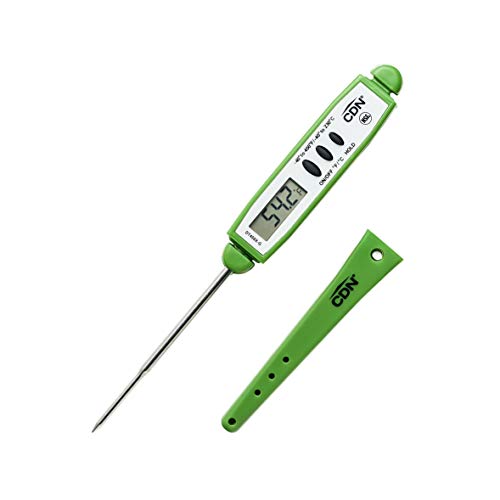
CDN makes thermometers for professional kitchens, and the DT450X is the plain pocket version of its ProAccurate line. It has a 2.75-inch stainless steel stem with a 2.5 mm reduced tip, a range of −40 to 450°F and NSF certification. It is a different model from the long-stem CDN on our main guide.
Be clear about the speed: CDN states a six-to-eight-second response, the slowest digital read on this page. In practice that means holding the probe still in the meat while you count, which is fine at a counter and less pleasant over a hot charcoal fire. The short stem has a second cost: America’s Test Kitchen, in its review of instant-read thermometers, advises a probe of at least four inches and avoiding probes of three inches or shorter. A short stem puts your hand closer to the heat and has less reach into a big roast.
What you get in return is a small, light thermometer that fits a shirt pocket or an apron, from a maker that sells mainly to food service. The listing does not state accuracy, water resistance, battery type or warranty.
Why we like it
- 2.5 mm reduced tip
- −40 to 450°F range
- NSF certified
- True pocket size
Key specifications
| Model | DT450X-G |
|---|---|
| Read time (stated) | 6 to 8 seconds |
| Accuracy (stated) | Not stated on listing |
| Range (stated) | −40 to 450°F |
| Probe | 2.75-inch stem, 2.5 mm reduced tip |
| Water rating | Not stated on listing |
| Power | Battery; type not stated on listing |
| Warranty | Not stated on listing |
Why we recommend it
It suits a cook who wants a small, no-frills digital thermometer for the stovetop and the oven and does not mind waiting a few seconds.
Skip it if you grill over high heat; the short stem and slow read keep your hand over the fire longer.
Pros and cons
Pros
- Small and light
- Food-service maker
- Wide range for candy and oil
Cons
- Slowest digital read here
- Short stem
- No water rating stated
7. OXO Good Grips Chef’s Precision Digital Instant Read Thermometer – A Head That Pivots

OXO’s Chef’s Precision digital thermometer solves one specific annoyance: the head pivots 90 degrees, so you can read the screen without bending over a hot pan or twisting your wrist into the steam. The numbers are large and the display is backlit, according to the listing, and it switches between Fahrenheit and Celsius.
OXO describes an ultra-thin tip for quick readings, and the probe cover has a printed chart of chef-recommended and USDA-recommended temperatures, which is handy if you do not cook meat often enough to remember them. A CR2032 coin battery is included. Keep spare coin cells out of children’s reach.
The listing is short on hard numbers. It does not state a read time, an accuracy figure, a temperature range, a water rating or a warranty. This is not the OXO thermocouple model that America’s Test Kitchen recommended in its instant-read review, so that result does not carry over to it.
Why we like it
- Head pivots 90 degrees
- Temperature chart on the cover
- Large, backlit numbers
- Battery included
Key specifications
| Model | Chef’s Precision Digital (part 11168300V1) |
|---|---|
| Read time (stated) | “Quick”; no figure given |
| Accuracy (stated) | Not stated on listing |
| Range (stated) | Not stated on listing |
| Probe | Ultra-thin tip, with cover |
| Water rating | Not stated on listing |
| Power | CR2032 coin cell, included |
| Warranty | Not stated on listing |
Why we recommend it
It suits a cook who checks food in deep pots and pans and wants to read the number without contorting.
Skip it if you want stated speed and accuracy figures; the ThermoMaven and Inkbird give both.
Pros and cons
Pros
- Pivoting head
- Built-in temperature reminder
- Known maker
Cons
- Few stated specifications
- No water rating given
- Coin-cell battery
8. OXO Good Grips Chef’s Precision Analog Leave-In Thermometer – Stays in the Roast

Every other thermometer on this page is for spot checks. This one stays in the meat. It is a dial thermometer with a bimetallic coil that OXO sells for monitoring roasts in the oven, so you can watch a pork loin or a turkey climb without opening the door and stabbing it repeatedly.
A shaded section on the probe shows how deep to insert it, which takes the guesswork out of placement, and the probe cover lists both chef-recommended and USDA-recommended temperatures. The dial shows Fahrenheit and Celsius, and with no electronics there is nothing to charge.
The listing does not give the dial’s range, its accuracy, the maximum oven temperature or a warranty, so read the instructions in the box before using it under a broiler or on a grill. A leave-in dial is also slower to settle than a digital probe; when the roast looks close, confirm with an instant-read thermometer in a second spot.
Why we like it
- Made to stay in the roast
- Shaded insertion-depth guide
- Temperature chart on the cover
- No battery
Key specifications
| Model | 11133400 |
|---|---|
| Read time (stated) | “Rapid-responding”; no figure given |
| Accuracy (stated) | Not stated on listing |
| Range (stated) | Not stated on listing |
| Probe | Stainless probe with shaded depth guide |
| Water rating | Not stated on listing |
| Power | None (bimetallic dial) |
| Warranty | Not stated on listing |
Why we recommend it
It suits a cook who roasts in the oven a few times a year and wants a low-cost way to watch the temperature without a wireless probe.
Skip it if you want an alarm when the meat is done; a digital leave-in probe on our main guide does that.
Pros and cons
Pros
- Leave it in, no door-opening
- Clear depth guide
- Nothing to charge
Cons
- No stated range or heat limit
- No alarm
- Slower than a digital probe
What you give up when a thermometer costs less
The gap between a budget thermometer and a premium one is narrower than it used to be, at least on paper. Two picks here state a 0.5-second read and ±0.5°F accuracy, figures that match or beat what premium thermometers advertise. What usually separates them is everything around the sensor.
Independent checks. The premium names are the ones America’s Test Kitchen and other reviewers have measured. Most budget models have not been independently tested, so their speed and accuracy figures are the maker’s word. If that matters to you, the ThermoPop 2, which America’s Test Kitchen calls its best inexpensive pick, is reviewed on our main guide.
Warranty and support. Only one pick here, the Escali, states a long warranty on its listing. Several say nothing at all.
Missing details. Low-cost listings often leave out the probe length, the battery type or the range. We wrote “not stated” in each spec table rather than guess.
Speed on the cheapest designs. The CDN states six to eight seconds, and a dial like the Rubbermaid takes far longer. A few seconds are no problem in the kitchen and a real cost over a hot grill.
How to choose a low-cost meat thermometer
1. Speed
A faster read means less time with your hand over the heat. The USDA’s Food Safety and Inspection Service lists thermocouples as the fastest type of food thermometer; instant-read dials take about 15 to 20 seconds. For grilling, look for a stated read of a few seconds or less.
2. A stated accuracy figure
A maker that puts a number on accuracy, such as ±0.5°F, gives you something to check against. If no figure is given, test it in ice water when it arrives (see below).
3. Probe thickness and length
A thin tip leaves a smaller hole and finds the center of a thin cut more easily. A longer stem keeps your hand away from the fire and reaches the middle of a big roast. The Taylor has the thinnest stated tip here; the CDN has the shortest stem.
4. Power
Coin cells are cheap but run out without warning. A rechargeable model like the Inkbird avoids them, and a dial needs no power at all.
5. Water resistance and cleaning
FSIS advises washing a food thermometer in hot, soapy water before and after each use. An IP67 or IPX7 body handles a rinse under the tap; check the rating before you put any digital thermometer near the sink.
6. Calibration
Some thermometers can be recalibrated and some cannot. The Inkbird and Taylor state a calibration feature; the listings for the others do not say.
Where to put the probe, and the USDA temperatures to aim for
The USDA’s Food Safety and Inspection Service guidance on food thermometers says to place the probe in the thickest part of the food, away from bone, fat and gristle, and to check in more than one spot. For thin foods such as burger patties and chicken breasts, insert the probe from the side so the sensing area sits in the center. FSIS gives these depths: about ¼ inch for a thermocouple, at least ½ inch for a thermistor, and about 2 to 2½ inches for an instant-read dial.
These are the safe minimum internal temperatures from the FSIS Safe Minimum Internal Temperature Chart:
| Food | Safe minimum internal temperature (USDA FSIS) |
|---|---|
| Beef, pork, veal and lamb steaks, chops and roasts | 145°F, then rest at least 3 minutes |
| Ground beef, pork, veal and lamb | 160°F |
| All poultry, including ground poultry | 165°F |
| Fish and shellfish | 145°F |
These are safety floors, not doneness targets. Pork shoulder for carnitas or beef for barbacoa is cooked well beyond 145°F so it pulls apart; a thermometer simply tells you when you have passed the safe line.
Check it in ice water. FSIS describes a simple test: fill a glass with crushed ice, top it with water, put the stem in at least 2 inches without touching the glass, wait 30 seconds and look for 32°F. If a thermometer can be calibrated and reads off, adjust it per the maker’s instructions; if it cannot, keep the difference in mind or replace it.
How we chose these eight budget thermometers
We started from low-cost instant-read and dial thermometers from identifiable makers on Amazon, including ThermoMaven, Taylor, Escali, Inkbird, Rubbermaid Commercial, CDN, OXO, KitchenAid, TempPro and several unbranded sellers. We kept only models showing as in stock when we checked, skipped unbranded listings, and preferred listings that state their speed, accuracy and range. Specifications come from the Amazon listings.
We left out the thermometers already reviewed on our main meat thermometer guide and on our instant-read, wireless, grill and oven thermometer guides, including the ThermoPop 2, Alpha Grillers, Taylor’s folding model and the TempPro TempSwift models, so this page adds new options instead of repeating them. We checked the U.S. Consumer Product Safety Commission’s recall listings for these brands’ food thermometers and found none. For guidance on use and temperatures we relied on the USDA’s Food Safety and Inspection Service, and for probe length on America’s Test Kitchen’s instant-read review. We have not used these thermometers for this guide.
Budget meat thermometer questions, answered
What is the best meat thermometer on a budget?
On stated specifications, the ThermoMaven HT04: a 0.5-second read, ±0.5°F accuracy and an IP67 body. If you would rather have an independently reviewed budget model, America’s Test Kitchen’s best inexpensive pick is the ThermoPop 2, which we cover on our main guide.
Is a cheap meat thermometer accurate enough?
It can be. Several picks here state ±0.5°F, but those are maker figures. Check any new thermometer in ice water, as FSIS describes, and confirm doneness in a second spot.
What is the best value meat thermometer for grilling?
A fast read keeps your hand out of the heat, so look at the ThermoMaven or the Inkbird, both stated at 0.5 seconds. Avoid short stems and slow dials over a hot fire.
Do I need a digital thermometer, or is a dial fine?
A dial works and never needs a battery, but FSIS notes that instant-read dials take 15 to 20 seconds and need 2 to 2½ inches of depth, which makes thin cuts hard. Digital models read faster and work in thinner foods.
Can I leave an instant-read thermometer in the oven?
No. Instant-read thermometers are for checks outside the heat; leave-in models such as the OXO analog dial are built to stay in the roast.
The budget thermometer we would start with
Start with the ThermoMaven if you want speed and stated accuracy for very little, the Taylor 9878E if you cook a lot of thin cuts, and the Escali if a long warranty matters more than the fastest read.
For premium instant-read and leave-in models, see our main guide to the best meat thermometer, and for more fast-read choices our best meat thermometer instant read guide. If you want a probe that stays in the meat and reports to your phone, see the best meat thermometer wireless guide, and to check the oven itself, the best oven thermometer. Mexican cooking methods explained covers how barbacoa and carnitas are cooked. Or let someone else watch the temperature: see the menu and call to order.