
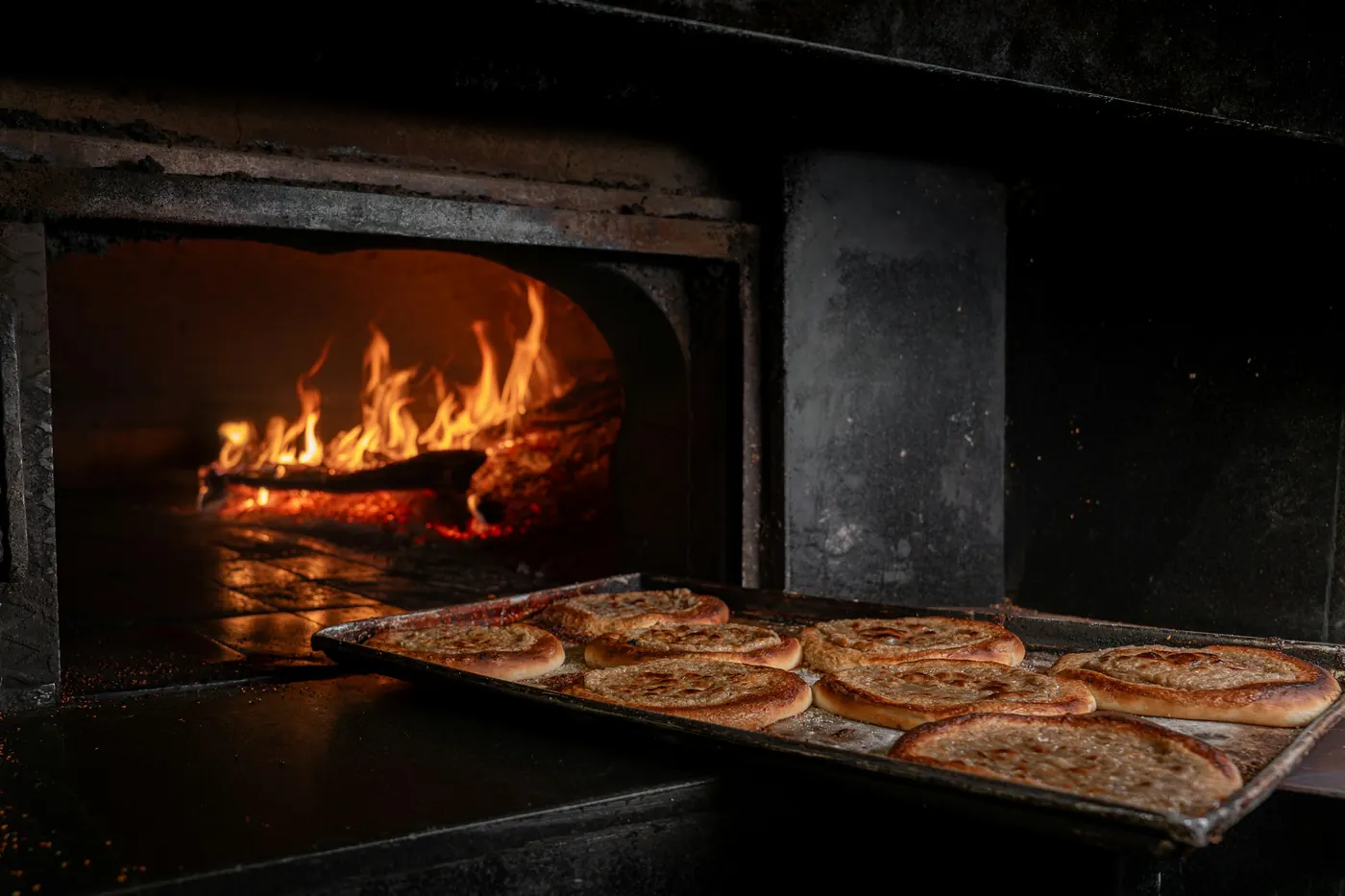
An oven dial is a suggestion, not a measurement. The thermostat reads one spot inside the oven, it ages, and door seals leak, so the number you set and the heat your conchas actually get can drift apart. CDN puts it plainly in its own listing: it is common to find an oven’s temperature off by more than 50°F. That is the difference between a pale bolillo and a well-browned one, or between tomatoes that blister under the broiler and tomatoes that just go soft.
An oven thermometer is the fix, and it is one of the cheapest tools in a kitchen. This guide covers dial thermometers that hang or stand on the rack, and digital models with an air probe that read the oven from outside the door. For each, it gives the range, how it mounts, whether the maker states NSF certification, and how easy it is to read through the glass.
Julia’s earns a commission on purchases made through links on this page, at no cost to you. Recommendations are based on what a restaurant kitchen looks for, product specifications and verified buyer reports.
Quick verdict: which oven thermometer to buy
For most kitchens, the best oven thermometer is the CDN ProAccurate Oven Thermometer (DOT2): America’s Test Kitchen named it its best analog model because every copy it checked was accurate, it stands or hangs, it is NSF certified per CDN, and it needs no batteries. If you want a digital reading outside the oven, with alarms, choose the ThermoWorks Signals, which comes with an air probe. For the biggest, easiest dial, the Taylor 3-Inch Analog Oven Thermometer.
Below, five standouts side by side, then all nine thermometers reviewed in full.
Five oven thermometers compared
One pick for each kind of cook, with the range and mounting each maker or listing states. All nine are reviewed below.
| Thermometer | Best for | Range (per listing) | Type and mount | Buy on Amazon |
|---|---|---|---|---|

CDN ProAccurate Oven ThermometerBest overall
|
Checking any home oven | 150–550°F | Dial; stands or hangs | View on Amazon |

ThermoWorks Signals 4-Channel Alarm ThermometerBest digital
|
Oven air plus the food, with alarms | Not stated; ±1.8°F accuracy | Digital, air probe; magnets outside | View on Amazon |

Taylor 3-Inch Analog Oven ThermometerEasiest to read
|
Reading through the oven window | 100–600°F | 3-in dial; hangs or stands | View on Amazon |
CDN ProAccurate High Heat Oven ThermometerBest for high heat
|
Broiling, pizza stones, very hot ovens | Up to 750°F | Dial; wide base and hook | View on Amazon |
TempPro TempTrack CORE TP-16 Probe ThermometerBudget digital
|
A simple digital readout outside the oven | 32–572°F | Digital, one probe; magnet or stand | View on Amazon |
Product images from Amazon. Ranges and certifications are as each maker or listing states them; check the listing before you buy.
Our picks for the best oven thermometer
The nine below cover the two real choices. Dial thermometers live in the oven, cost little and need no batteries, but you have to open the door or peer through the glass to read them. Digital models put a probe in the oven and the display outside, with alarms, and they double as meat thermometers. Each section gives the range, mounting and readability the maker states, and one honest reason to skip it.
1. CDN ProAccurate Oven Thermometer – Accurate, Simple, No Batteries
CDN’s DOT2 is the plain stainless dial you see in professional kitchens, and it is part of CDN’s ProAccurate line of NSF-certified products. It reads from 150 to 550°F (70 to 280°C) in 25-degree marks, with zones printed from WARM to BROIL, and it either stands on the rack or hangs from it.
It also has the strongest outside endorsement here. America’s Test Kitchen named it its best analog oven thermometer and wrote that “all copies of this model aced our accuracy tests.” The one complaint ATK raised is cosmetic but real: the silver face is more prone to glare than a white one, so you may need to angle it toward the door.
CDN’s own tip is worth following with any dial model: put the thermometer in the oven during the preheat, so the coil expands with the heat and settles before you read it. The housing is stainless steel with a glass lens that CDN says resists cracking, it wipes clean, and the listing gives a five-year warranty.
Why we like it
- America’s Test Kitchen’s best analog oven thermometer
- NSF certified, per CDN’s ProAccurate line
- 150–550°F with WARM-to-BROIL zones
- Stands or hangs; no batteries
- Five-year warranty
Key specifications
| Thermometer | CDN DOT2 ProAccurate |
|---|---|
| Type | Analog dial |
| Range | 150–550°F (70–280°C), 25-degree marks |
| Mount (hang/stand) | Stands or hangs |
| NSF listed (as stated) | Yes, NSF certified (CDN) |
| Readability | 2-in dial; silver face can glare (ATK) |
| Care | Wipe clean |
| Warranty | 5 years |
Why we recommend it
It suits anyone who wants to know, once and for all, whether the oven runs hot or cold. Leave it on the middle rack, check it when you bake, and adjust the knob to match.
Skip it if you broil or bake on a stone above 550°F, which is off its scale, or if small numbers are hard for you to read through the door; the Taylor’s 3-inch dial is larger.
Pros and cons
Pros
- Accurate in ATK’s review
- NSF certified
- No batteries, stands or hangs
Cons
- Small 2-inch dial
- Silver face can glare
- Tops out at 550°F
2. ThermoWorks Signals 4-Channel Alarm Thermometer – Oven Air and Food at Once
America’s Test Kitchen prefers digital oven thermometers overall, calling them more precise and durable than dials, and its favorite digital model, the ThermoWorks Square DOT, is valued for having two probes, one for the oven air and one for the food. We could not find the Square DOT or the ChefAlarm sold on Amazon when we checked, so our digital pick is ThermoWorks’ Signals, which the listing says includes Pro-Series high-temperature cooking probes and an air probe.
Signals tracks up to four channels on one backlit display, with ±1.8°F accuracy and separate high and low alarms for each probe, according to the listing. In a home oven, that means one probe clipped in the air to watch the real oven temperature and another in a pork shoulder for carnitas or a turkey, with an alarm if the oven drifts. Wi-Fi and Bluetooth send the readings to the ThermoWorks app, but it also works as a standalone unit.
The housing is IP66 splash-resistant, magnets hold it to the side of the range, and the built-in battery runs up to 16 hours wireless, with an adapter for continuous power. The listing does not give the probes’ temperature range, and it is built and marketed for outdoor smokers first, so it is more thermometer than many home bakers need.
Why we like it
- Includes an air probe for the true oven temperature
- Four channels with separate high and low alarms
- ±1.8°F accuracy, per the listing
- Wi-Fi and Bluetooth, or standalone use
- Magnetic, IP66 splash-resistant housing
Key specifications
| Thermometer | ThermoWorks Signals (AZ-1505-CY) |
|---|---|
| Type | Digital, 4 channels; cooking probes plus air probe |
| Range | Not stated in the listing; ±1.8°F accuracy |
| Mount (hang/stand) | Probe in the oven; base outside on magnets or a stand |
| NSF listed (as stated) | Not stated |
| Readability | Large backlit display; app graphs and alerts |
| Care | IP66 splash-resistant housing |
| Warranty | Not stated in the listing |
Why we recommend it
Choose it if you roast and smoke as well as bake, and want one tool that watches the oven air and the meat at the same time without opening the door. It replaces both an oven thermometer and a leave-in probe.
Skip it if you only want to check your oven now and then. It is a multi-probe smoker controller at heart, and a simple dial does that one job without batteries or an app.
Pros and cons
Pros
- Air probe included
- Alarms if the oven drifts
- Reads without opening the door
Cons
- Probe range not stated in listing
- Far more than a basic oven check needs
- Probe cables run through the oven door
3. Taylor 3-Inch Analog Oven Thermometer – Big Dial, Clear Zones
Taylor’s model 5932 has a 3-inch, color-coded dial designed, Taylor says, for visibility through the oven window. That matters more than it sounds: every time you open the door to read a small dial, the oven loses heat, and the reading you get is no longer the one your bread is baking at.
It reads 100 to 600°F (50 to 300°C), so it covers everything from slow-roasting a pork shoulder to a hot oven for roasting chiles. The body is stainless steel, it hangs from a rack or stands on it, and Taylor states that it is NSF listed. The listing says not to put it in the dishwasher.
America’s Test Kitchen recommended a Taylor dial oven thermometer in its review, noting that every copy “relayed accurate average temperatures when properly preheated”, though its face discolored to beige after extended use. ATK does not give a model number, so we cannot confirm it was this exact 3-inch version.
Why we like it
- Large 3-inch, color-zoned dial
- 100–600°F (50–300°C)
- Hangs or stands
- NSF listed, per Taylor
Key specifications
| Thermometer | Taylor 5932 |
|---|---|
| Type | Analog dial |
| Range | 100–600°F (50–300°C) |
| Mount (hang/stand) | Hangs or stands |
| NSF listed (as stated) | Yes, NSF listed (Taylor) |
| Readability | 3-in color-coded dial |
| Care | Not dishwasher safe |
| Warranty | Not stated |
Why we recommend it
Choose it if you want to read the oven through the glass without opening the door, or if small numbers are hard on your eyes. It is the most legible dial here.
Skip it if a white face that may yellow with use would bother you, or if you need readings above 600°F.
Pros and cons
Pros
- Biggest, clearest dial
- Wide range
- NSF listed
Cons
- Face may discolor (ATK)
- No warranty stated
- Dial resolution is coarse
4. CDN ProAccurate High Heat Oven Thermometer – Reads Up to 750°F
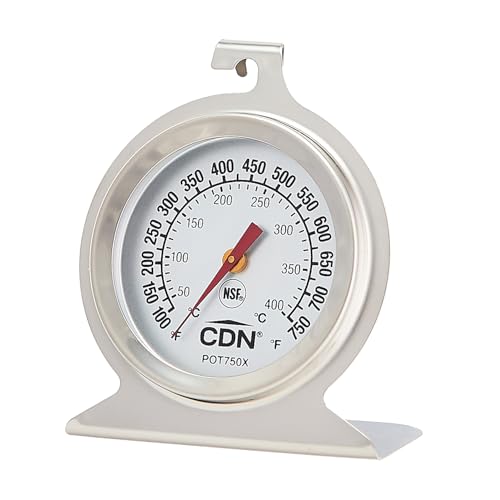
Most dial thermometers stop at 550 or 600°F, which is fine for baking but not for a pizza stone preheated as hot as the oven goes, or for the broiler where you char tomatoes, onions and jalapeños for salsa. CDN’s POT750X is built for that end of the dial: CDN’s description gives a range of 100 to 750°F (50 to 400°C), and one bullet gives 150 to 750°F.
The 2.25-inch dial has a red needle and printed cooking zones, and a wide base plus an integrated hook let it stand or hang anywhere in the oven. CDN describes the body as commercial-grade stainless steel with a glass lens that resists cracking, and states that this model is NSF certified. The listing says not to soak it, and gives a limited five-year warranty.
Like the DOT2, it is a simple bimetal dial with no batteries. The trade-off for the wide range is resolution: the more degrees a small dial has to show, the farther apart the marks, so fine readings around 350°F are harder to make out.
Why we like it
- Reads up to 750°F for broiling and stones
- NSF certified, per CDN
- Wide base and hook
- Limited five-year warranty
Key specifications
| Thermometer | CDN POT750X ProAccurate High Heat |
|---|---|
| Type | Analog dial |
| Range | Up to 750°F (low end 100 or 150°F, per listing) |
| Mount (hang/stand) | Wide base or integrated hook |
| NSF listed (as stated) | Yes, NSF certified (CDN) |
| Readability | 2.25-in dial, red needle, cooking zones |
| Care | Do not soak |
| Warranty | Limited 5 years |
Why we recommend it
Choose it if you bake on a stone or steel, broil often, or have an oven that runs very hot. It is the only dial here that stays on scale at the top of a home oven.
Skip it if you mostly bake cakes and pan dulce at moderate heat; a dial with a narrower range, like the DOT2, is easier to read precisely there.
Pros and cons
Pros
- Highest range here
- NSF certified
- Stands or hangs
Cons
- Coarser marks at baking temperatures
- Listing gives two different low ends
5. TempPro TempTrack CORE TP-16 Probe Thermometer – Digital Reading on a Budget
America’s Test Kitchen’s Best Buy among oven thermometers is the ThermoPro TP16, which it calls “impressively accurate” despite “a few operational quirks.” On Amazon, the TP-16 is now sold under the TempPro name as the TempTrack CORE TP-16, with the same model number.
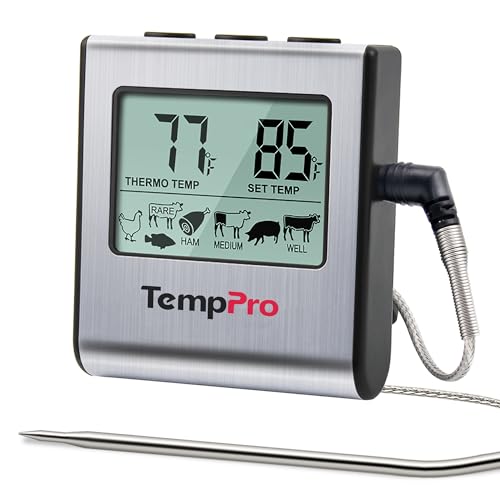
It is a single-probe digital thermometer: a 6.5-inch stainless probe on a 40-inch stainless mesh cable, with the display outside the oven. The listing gives a range of 32 to 572°F with ±1.8°F accuracy, and says the probe and wire can withstand up to 716°F. It has USDA preset temperatures, a timer up to 99 hours 59 minutes, a magnetic back, a hanging hole and a tabletop stand, and runs on one AAA battery, included. NSF appears in the listing’s specification field.
To use it as an oven thermometer, the probe has to sit in the air, not touching the rack or the food. ATK’s method is to put the probe in a rack clip in the middle of the center rack; the listing does not mention a clip, so plan to secure the probe yourself, or move it into a roast when you want a meat reading instead.
Why we like it
- Same TP-16 model ATK named its Best Buy
- Reads outside the oven, 32–572°F
- ±1.8°F accuracy, per the listing
- Timer, presets, magnet and stand
Key specifications
| Thermometer | TempPro TempTrack CORE TP-16 |
|---|---|
| Type | Digital, one wired probe |
| Range | 32–572°F; probe and wire to 716°F |
| Mount (hang/stand) | Probe in oven; base on magnet, hook or stand |
| NSF listed (as stated) | NSF in listing’s specification field |
| Readability | Large LCD outside the oven |
| Care | Wipe clean |
| Warranty | Not stated in the listing |
Why we recommend it
Choose it if you want the convenience of a digital readout without paying for a multi-probe system, and if a meat thermometer is on your list too.
Skip it if you want oven and food readings at the same time. With one probe you choose one or the other, and there is no grate clip in the box per the listing.
Pros and cons
Pros
- ATK’s Best Buy model
- Reads without opening the door
- Doubles as a meat thermometer
Cons
- One probe only
- No air clip listed
- Operational quirks noted by ATK
6. CDN Multi-Mount Oven Thermometer – Sticks to the Oven Wall

The MOT1’s party trick is its magnet. CDN says you can mount it on the side wall of the oven, out of the way of the racks and of large items like a turkey or a big roasting pan of birria, or hang it from a rack by its hook, or set it on a rack with its tilt-down stand.
It reads 100 to 600°F (50 to 300°C) on a dial with a glass lens and stainless steel housing, and the listing gives a limited five-year warranty. CDN also suggests moving it around to sample different parts of the oven and find hot and cool spots, which is worth doing once in any oven you bake in often.
One instruction matters: CDN says to remove it from self-cleaning ovens during the cleaning cycle. That applies to every dial on this list, but CDN is the one that says it.
Why we like it
- Magnet, hook or stand mounting
- 100–600°F (50–300°C)
- Stays clear of racks and big pans
- Limited five-year warranty
Key specifications
| Thermometer | CDN MOT1 Multi-Mount |
|---|---|
| Type | Analog dial |
| Range | 100–600°F (50–300°C) |
| Mount (hang/stand) | Magnet, hook or stand |
| NSF listed (as stated) | Not stated in the listing |
| Readability | Small dial; place where you can see it |
| Care | Wipe clean; remove during self-clean |
| Warranty | Limited 5 years |
Why we recommend it
Choose it if your racks are always full, or if a standing thermometer keeps getting knocked over when you slide pans in and out.
Skip it if your oven walls are not magnetic or you want the NSF mark; CDN’s listing for this model does not state NSF certification.
Pros and cons
Pros
- Three ways to mount
- Out of the way of pans
- Five-year warranty
Cons
- NSF not stated
- Wall readings run differently from the center
7. OXO Good Grips Oven Thermometer – A Hook That Stays Put

OXO designed its Chef’s Precision oven thermometer around one complaint, that oven thermometers do not stay put. The integrated clip has an inverted V shape that grips thin or thick rack wires when hanging, and a wide, angled base keeps it steady when standing. OXO says it checked the fit in over 50 different oven models.
The listing gives a range of 100 to 600°F with large numbers in both Fahrenheit and Celsius and 5-degree resolution. OXO recommends placing it near where your food will cook, since temperatures can differ around the oven. The body is stainless steel, and the care instruction is hand wash only.
Note that the OXO model America’s Test Kitchen highly recommended in its oven thermometer review is OXO’s leave-in probe thermometer, not this dial.
Why we like it
- Two-point hook for thin or thick rack wires
- Wide, angled base when standing
- Large F and C numbers
- 100–600°F
Key specifications
| Thermometer | OXO Good Grips Chef’s Precision Oven, 11133600 |
|---|---|
| Type | Analog dial |
| Range | 100–600°F; 5-degree resolution |
| Mount (hang/stand) | Two-point hook or angled stand |
| NSF listed (as stated) | Not stated |
| Readability | Large F and C numbers |
| Care | Hand wash only |
| Warranty | Not stated |
Why we recommend it
Choose it if your current thermometer keeps falling through the rack or tipping over when you pull out a sheet of galletas.
Skip it if you want third-party accuracy results for this exact dial; none of the reviews we read covered it.
Pros and cons
Pros
- Secure hook and base
- Easy-to-read numbers
- Wide range
Cons
- NSF not stated
- No independent accuracy result found
8. Rubbermaid Commercial Oven Monitoring Thermometer – Shatter-Resistant Lens
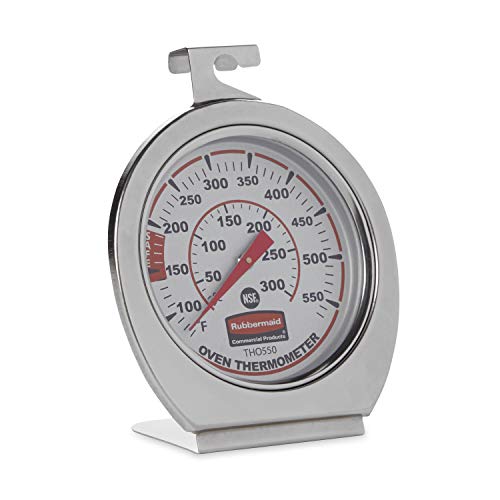
Rubbermaid’s commercial dial is designed for professional kitchens and reads 60 to 580°F (20 to 300°C). Its selling point is durability: a stainless steel body and what the listing calls a shatterproof lens, which matters in a kitchen where things get knocked around. It is NSF certified, needs no battery, and can hang or stand.
America’s Test Kitchen gave it a mixed verdict, “recommended with reservations”: it “faithfully reported accurate average oven temperatures,” but its relatively small base often fell through the slats of the oven racks. The fix is to hang it rather than stand it.
Rubbermaid also lists it for toaster ovens, grills and smokers. The care field says oven safe, wipe clean.
Why we like it
- Accurate average readings, per ATK
- Shatterproof lens and stainless body
- NSF certified
- Hangs or stands; no battery
Key specifications
| Thermometer | Rubbermaid Commercial FGTHO550 |
|---|---|
| Type | Analog dial |
| Range | 60–580°F (20–300°C) |
| Mount (hang/stand) | Hangs or stands (small base, per ATK) |
| NSF listed (as stated) | Yes, NSF certified (listing) |
| Readability | F and C scales |
| Care | Oven safe, wipe clean |
| Warranty | Not stated |
Why we recommend it
Choose it for a tough, NSF-certified dial that will survive a busy kitchen, and hang it from a rack.
Skip it if you want a thermometer that stands securely on wide-spaced racks; ATK found its base slipped through.
Pros and cons
Pros
- Durable, shatterproof lens
- NSF certified
- Accurate averages (ATK)
Cons
- Small base falls through racks
- Recommended only with reservations
9. KitchenAid 3-Inch Dial Oven Thermometer – Rotating Clip for Any Angle

KitchenAid’s thermometer pairs a large, colorful 3-inch dial with a rotating clip on the back that doubles as a stand. KitchenAid says the clip adjusts to fit most oven racks and turns for the best reading angle, so you can face the dial toward the door wherever you put it.
It reads 100 to 600°F (40 to 320°C, per the listing), with a red pointer behind a shatter-resistant tempered glass lens and a stainless steel body. KitchenAid’s description says it is NSF listed. Care is hand wash only: do not immerse it or put it in the dishwasher, and wipe it with a damp cloth.
It is a practical alternative to the Taylor if you want the same dial size with a clip that swivels.
Why we like it
- Large 3-inch dial
- Rotating clip and stand for the best angle
- NSF listed, per KitchenAid
- 100–600°F
Key specifications
| Thermometer | KitchenAid KQ903 |
|---|---|
| Type | Analog dial |
| Range | 100–600°F |
| Mount (hang/stand) | Rotating clip that also stands |
| NSF listed (as stated) | Yes, NSF listed (KitchenAid) |
| Readability | 3-in color dial, red pointer |
| Care | Hand wash only; do not immerse |
| Warranty | Not stated |
Why we recommend it
Choose it if you want a big dial and tend to move the thermometer around the oven, since the swivel clip keeps it facing you.
Skip it if you want outside accuracy results; no review we read covered it.
Pros and cons
Pros
- Big dial
- Adjustable clip
- NSF listed
Cons
- No independent review found
- Hand wash only
How to choose an oven thermometer
Five things matter. The brand name matters least.
1. Dial or digital
Dial thermometers are cheap, need no batteries and live in the oven. America’s Test Kitchen notes that they are relatively fragile and can lose calibration over time, and they are slower to respond. Digital thermometers with an air probe read faster, show the number outside the oven, can sound an alarm, and also check meat, oil or candy, which is why ATK prefers them overall. If you already own a probe thermometer, see our guide to the best meat thermometer before buying a second device.
2. Range
Most dials cover about 100 to 600°F. That handles baking conchas, roasting a chicken and slow-cooking barbacoa. If you broil often or preheat a stone as hot as the oven goes, pick a dial that reads higher, such as the CDN POT750X. Our guide to the best pizza stone explains why those temperatures matter.
3. Mounting
A thermometer you cannot keep in place is one you stop using. Hang it from a rack if the base is small, stand it if it has a wide foot, or use a magnet on the oven wall. ATK places analog models in the middle of the center rack, or hanging slightly above center, and clips a digital air probe to the middle of the center rack.
4. Readability
Choose a dial you can read through the oven window, so you do not lose heat every time you check. A 3-inch dial (Taylor, KitchenAid) is easier than a 2-inch one; white faces glare less than silver. Digital displays solve the problem entirely.
5. Certification
Taylor describes NSF certification on its thermometers as meeting standards for quality, durability and cleanability. It is not an accuracy rating, so it matters most in a commercial kitchen that gets inspected; at home, accuracy and readability matter more. We list NSF only where the maker or listing states it.
How we chose these nine oven thermometers
We started from what a kitchen needs to know: the true temperature where the food sits, read quickly and reliably. We looked at dial and digital models sold on Amazon in the United States and in stock when we checked, from identifiable makers, and took every range, mount, certification and care instruction from the maker’s listing. Where a figure is missing, we say “not stated.” For accuracy and design, we relied on America’s Test Kitchen’s review of oven thermometers, and we say which picks it covered and which it did not. We have not used these thermometers ourselves. ATK’s top digital pick, the ThermoWorks Square DOT, and its long-time favorite ChefAlarm did not turn up on Amazon when we searched, so we chose the in-stock ThermoWorks model that includes an air probe. We left out a dial sold as “KT Thermo” whose listing named a different brand, and unbranded two-packs.
Oven thermometer questions, answered
Do I really need an oven thermometer?
If you bake, yes. Oven thermostats drift, and CDN says it is common to find an oven off by more than 50°F. A thermometer tells you how far, so you can set the dial to match.
Are digital oven thermometers better than dial ones?
America’s Test Kitchen prefers digital models, calling them more precise and durable and faster to read. Dial thermometers still work well, need no batteries and cost less; its best analog pick, the CDN DOT2, was accurate in every copy it checked.
Where should an oven thermometer go?
Near where the food cooks, usually the middle of the center rack. OXO recommends placing it near the food because temperatures differ across the oven, and CDN suggests moving it around once to find hot and cool spots.
Can I use an oven thermometer in a toaster oven or on the grill?
Many dials are made for it: Rubbermaid lists toaster ovens, grills and smokers. Check the range and the space; small ovens run hot near the elements. See the best toaster oven and the best grill thermometer for those jobs.
How do I check an oven thermometer is accurate?
Preheat with the thermometer inside, as CDN advises, and wait until the oven has cycled a few times before reading. ATK’s results are averages over several cycles, because ovens swing above and below the set point.
The thermometer we would leave on the rack
More appliance and fixture guides: countertop ice makers, nugget ice makers, induction cooktops, kitchen faucets, water filter pitchers, oven mitts, electric hot plates.
Related guide: Best fridge thermometer.
Buy the CDN ProAccurate DOT2 if you want one accurate, battery-free dial to leave in the oven. Choose the ThermoWorks Signals if you also roast and smoke and want alarms for the oven air and the meat, or the TempPro TP-16 for a digital readout on a smaller budget. For a dial you can read from across the kitchen, the Taylor 3-inch. Then bake one batch of bolillos at the temperature the thermometer shows, not the one the knob says, and you will see the difference. And if you would rather leave the baking to someone else tonight, see the menu or call to order.