Most pitcher filters are bought for taste. They take the chlorine edge off tap water, and that is enough for a pitcher of agua de jamaica or the water in the coffee pot. Lead is a different question. You cannot taste it, it usually comes from the pipes and fixtures between the street and your faucet, and a pitcher only helps if its filter has been certified to reduce it.
This guide is for that narrower job. Every pitcher and dispenser below uses a filter whose lead claim is certified to NSF/ANSI Standard 53 by an accredited body, and we say which body and which document. Where a maker only says its filter was “tested to” a standard, we say that too, and leave it off the list.
Julia’s earns a commission on purchases made through links on this page, at no cost to you. Recommendations are based on what a restaurant kitchen looks for, product specifications and verified buyer reports.
Quick verdict: the pitcher to buy for lead
The best pitcher water filter for lead removal for most homes is the Culligan ZeroWater 10-Cup Pitcher: IAPMO R&T’s certificate of listing names this exact model (ZEROP10) as certified to NSF/ANSI 53 for lead, along with fluoride, mercury and total PFAS, though each filter is rated for only 20 gallons. If you would rather change filters twice a year, the Brita Small 6-Cup Metro with an Elite filter carries a certified lead claim on a 120-gallon filter.
Below, five standouts side by side, then all seven reviewed in full, and then what the lead certification actually means.
Five lead-certified pitchers compared
One pick for each kind of household. The certifier and the filter life are as each maker’s data sheet or certificate lists them.
| Pitcher | Best for | Lead certified by | Filter life (as stated) | Buy on Amazon |
|---|---|---|---|---|

Culligan ZeroWater 10-Cup PitcherBest overall
|
Widest certified list, named model | IAPMO R&T, NSF/ANSI 53 | 20 gal | View on Amazon |
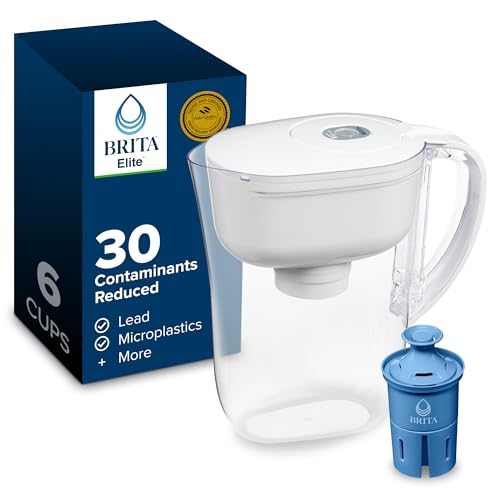
Brita Small 6-Cup Metro Pitcher, Elite FilterLongest filter life
|
Few filter changes, small fridges | NSF International (lead row); WQA for the filter | 120 gal, about 6 months | View on Amazon |

PUR 11-Cup Pitcher with PUR Plus FiltersBest for pouring while it filters
|
Busy kitchens, dishwasher cleaning | WQA, NSF/ANSI 53 (PUR Plus filter) | 40 gal, about 2 months | View on Amazon |

Culligan ZeroWater 22-Cup DispenserBest dispenser
|
Families, a fridge shelf | IAPMO R&T, NSF/ANSI 53 | 20 gal | View on Amazon |

Brita UltraMax 27-Cup Elite DispenserBest long-life dispenser
|
Big households, few filter changes | NSF International (lead row); WQA for the filter | 120 gal, about 6 months | View on Amazon |
Product images from Amazon. Certifications are as listed on each maker’s performance data sheet or the certifier’s certificate, and apply to the pitcher and filter models named there.
Our picks for the best pitcher water filter for lead removal
Seven pitchers and dispensers from three filter families: Culligan’s new ZeroWater filter, the older ZeroWater filter, Brita’s Elite filter and PUR’s PLUS filter. Those are the pitcher filters we could confirm carry a certified lead claim under NSF/ANSI 53 and are in stock on Amazon. Most are deliberately different from the picks in our best water filter pitcher guide; one, the Brita UltraMax, appears in both, and its section says why.
1. Culligan ZeroWater 10-Cup Pitcher – Lead Certified by Model Number
This is the 2025 version of the ZeroWater pitcher, sold under the Culligan name with a new five-stage filter. It holds 10 cups, has a built-in TDS meter that reads the dissolved solids in the filtered water, and uses the new Culligan ZeroWater filters only; the listing says the older ZeroWater filters will not fit.
What puts it first is how clean the paperwork is. IAPMO R&T’s certificate of listing (file W-17155, revised June 2026) certifies the pitcher model ZEROP10 to NSF/ANSI 53-2024 and lists its reduction claims: lead, cadmium, copper, fluoride, mercury, total PFAS, hexavalent chromium and nitrate/nitrite. Culligan’s performance data sheet gives the lead numbers: a challenge of 0.15 mg/L (150 parts per billion) reduced by 98.9% at pH 6.5 and 98.8% at pH 8.5, against a maximum allowed of 0.005 mg/L in the filtered water. It is the only pitcher here with a certified fluoride claim, which matters if you want fluoride out as well, and is a drawback if you want it kept.
The trade-off is filter life. Culligan rates each filter at 20 gallons, with a service flow of 2 gallons a day, at 40 to 90°F. Ion-exchange filters like this one wear out faster in water with a lot of dissolved minerals, and the TDS meter is how you tell when it is spent.
Why we like it
- IAPMO R&T certificate names this model for lead under NSF/ANSI 53
- Also certified for total PFAS, fluoride and mercury
- Built-in TDS meter shows when the filter is spent
- Fits small fridges, per the listing
Key specifications
| Model | ZEROP10, filter ZEROFXX |
|---|---|
| Capacity | 10 cups |
| Filter type | Five-stage, ion exchange |
| Lead claim | 98.9% (pH 6.5), 98.8% (pH 8.5) |
| Lead certified by | IAPMO R&T, NSF/ANSI 53-2024 |
| Other certified claims | Fluoride, total PFAS, mercury, cadmium, copper, hexavalent chromium, nitrate/nitrite |
| Filter life (as stated) | 20 gallons |
| Change reminder | Built-in TDS meter |
Why we recommend it
It suits anyone who wants the lead claim confirmed on the certifier’s own document, by model number, and who also wants PFAS and fluoride reduced.
Skip it if you drink a lot of water or have very hard water: a 20-gallon filter can mean a new one every few weeks.
Pros and cons
Pros
- Certificate lists the exact model
- Broadest certified list here
- Meter takes the guesswork out of changes
Cons
- Short 20-gallon filter
- Removes fluoride, wanted or not
- Older ZeroWater filters do not fit
2. Brita Small 6-Cup Metro Pitcher, Elite Filter – Six Months Per Filter
Brita’s Metro is the small one: 6 cups, slim enough that the listing says it fits most mini-fridge doors, with an easy-fill lid and an electronic SmartLight reminder. This listing ships it (model OB11) with the Elite filter (OB06), which is the Brita filter with a lead claim. The Standard Brita filter does not have one, so check which filter a Brita pitcher comes with before buying it for lead.
Brita’s performance data sheet for the Elite filter lists the Metro (OB11) among its systems and states that the filter is certified by WQA against NSF/ANSI 42, 53 and 401 for the claims on that sheet. The lead rows are marked “Certified by NSF International”: a 150 ppb challenge reduced by 99.5% at pH 6.5 and 99.6% at pH 8.5, to the 5 ppb limit. The same sheet adds a note that the Pacifica pitcher with the Elite filter was tested and certified by NSF for lead; the Metro is one of the models that also gets the sheet’s model-specific claims, including PFOA/PFOS (certified by IAPMO R&T) and cadmium.
Each Elite filter is rated for 120 gallons, about six months. Brita’s limits are 2 gallons a day and cold water, 32 to 85°F.
Why we like it
- Lead row certified, 99.5% and 99.6% reduction on Brita’s data sheet
- 120-gallon filter, about six months
- PFOA/PFOS claim applies to the Metro model
- Fits most mini-fridge doors, per the listing
Key specifications
| Model | OB11 pitcher, OB06 Elite filter |
|---|---|
| Capacity | 6 cups |
| Filter type | Activated carbon (Brita Elite) |
| Lead claim | 99.5% (pH 6.5), 99.6% (pH 8.5) |
| Lead certified by | NSF International (lead row); filter certified by WQA to 42, 53, 401 |
| Other certified claims | Chlorine, mercury, cadmium, asbestos, PFOA/PFOS (IAPMO R&T), microplastics and others |
| Filter life (as stated) | 120 gallons, about 6 months |
| Change reminder | Electronic SmartLight |
Why we recommend it
It suits one or two people, a dorm or an office, and anyone who wants lead reduction with the fewest filter changes.
Skip it if you fill several bottles a day; 6 cups runs out quickly, and the UltraMax below uses the same filter.
Pros and cons
Pros
- Longest filter life among the lead picks
- Small and slim
- Electronic reminder
Cons
- Only 6 cups
- Cold water only, 2 gallons a day
- Same pitcher is sold with the non-lead Standard filter
3. PUR 11-Cup Pitcher with PUR Plus Filters – Pour While It Filters
This is a bundle: PUR’s 11-cup pitcher with one regular PUR filter, plus a three-pack of PUR Plus filters. The difference matters. PUR’s performance data sheet covers both filters in this pitcher (model CR1100), but only the PUR Plus filter (PPF951K) has the lead claim; for the basic filter (PPF900Z) the lead rows read “Not Certified”. For lead, put a PUR Plus filter in from the start and keep the basic one for later, or skip it.
With the PUR Plus filter, the sheet lists lead under NSF/ANSI 53, marked as certified by WQA: 99.7% reduction at pH 6.5 and 99.4% at pH 8.5. The sheet’s footer states the system is tested and certified by NSF International and by WQA against NSF/ANSI 42, 53 and 401. The PUR Plus claims also include mercury, cadmium, copper, benzene and Class I particulates, plus a set of 401 compounds such as bisphenol A and ibuprofen.
The pitcher has a stay-tight lid that lets you pour while water is still filtering, a change light, and dishwasher-safe parts. Each filter is rated for 40 gallons, about two months, at up to 82°F.
Why we like it
- PUR Plus filter’s lead claim certified by WQA under NSF/ANSI 53
- Three lead-certified filters in the box, about six months’ supply
- Pour while it filters, per PUR
- Dishwasher-safe parts
Key specifications
| Model | CR1100 pitcher, PPF951K PUR Plus filters (3) plus 1 basic filter |
|---|---|
| Capacity | 11 cups |
| Filter type | Activated carbon and ion exchange |
| Lead claim | 99.7% (pH 6.5), 99.4% (pH 8.5), PUR Plus filter only |
| Lead certified by | WQA, NSF/ANSI 53 |
| Other certified claims | Chlorine, mercury, cadmium, copper, benzene, particulates, 401 compounds |
| Filter life (as stated) | 40 gallons, about 2 months |
| Change reminder | Change light |
Why we recommend it
It suits a family kitchen that wants a mid-size pitcher, dishwasher cleaning and a supply of lead-certified filters from day one.
Skip it if you want long filter life; at 40 gallons, a PUR Plus filter lasts a third as long as Brita’s Elite.
Pros and cons
Pros
- Three PUR Plus filters included
- Pours while filtering
- Dishwasher safe
Cons
- The filter fitted in the pitcher has no lead claim
- 40-gallon filter life
- No PFAS claim on the data sheet we read
4. Culligan ZeroWater 22-Cup Dispenser – Certified Filter, Bigger Tank
The same new Culligan ZeroWater filter as pick 1, in a 22-cup dispenser for a fridge shelf or a counter. IAPMO R&T’s certificate of listing (W-17155) names this model, ZEROD22, with the same certified claims: lead, cadmium, copper, fluoride, mercury, total PFAS, hexavalent chromium and nitrate/nitrite under NSF/ANSI 53-2024.
A dispenser makes sense for lead in one specific way: the CDC and EPA both advise using cold water for drinking and cooking, and a large tank of filtered cold water in the fridge means nobody is tempted to fill the pot from the hot tap. The listing describes a drop-in filter, an easy-slide lid and a built-in TDS meter.
The filter life is the same 20 gallons, so a 22-cup tank (about 1.4 gallons) goes through a filter in roughly 14 fills. It takes only the new Culligan ZeroWater filters.
Why we like it
- Model named on IAPMO R&T’s lead certificate
- 22-cup tank for cold filtered water
- Built-in TDS meter
Key specifications
| Model | ZEROD22, filter ZEROFXX |
|---|---|
| Capacity | 22 cups |
| Filter type | Five-stage, ion exchange |
| Lead claim | 98.9% (pH 6.5), 98.8% (pH 8.5) |
| Lead certified by | IAPMO R&T, NSF/ANSI 53-2024 |
| Other certified claims | Fluoride, total PFAS, mercury, cadmium, copper, hexavalent chromium, nitrate/nitrite |
| Filter life (as stated) | 20 gallons |
| Change reminder | Built-in TDS meter |
Why we recommend it
It suits households that want the broadest certified list in a size that covers a day’s drinking and cooking water.
Skip it if filter cost per gallon matters most; the Brita UltraMax below holds more on a 120-gallon filter.
Pros and cons
Pros
- Certificate names this model
- Certified for PFAS and fluoride too
- Large tank
Cons
- 20-gallon filter in a large tank
- Older ZeroWater filters do not fit
- Dimensions not stated in the listing
5. Brita UltraMax 27-Cup Elite Dispenser – A Big Tank on a Six-Month Filter
This dispenser is also in our main pitcher guide, and we repeat it on purpose: it is the only large dispenser we found in stock that ships with Brita’s 120-gallon Elite filter. Brita’s 10-cup “dispenser” listing turned out to be the same Everyday pitcher (OB46) as the main guide’s top pick, so for a big tank on a long-life lead filter, this is the one.
The UltraMax (OB24) holds 27 cups, has a spigot, and works on a counter or a fridge shelf. Brita’s Elite data sheet lists it among its systems; the lead rows (99.5% at pH 6.5, 99.6% at pH 8.5) are marked “Certified by NSF International”, and the filter is certified by WQA against NSF/ANSI 42, 53 and 401. The UltraMax is one of the models that also gets the model-specific claims, including PFOA/PFOS (certified by IAPMO R&T) and cadmium.
Each Elite filter is rated for 120 gallons, about six months, with the same 2-gallons-a-day and 85°F limits as the Metro.
Why we like it
- Lead row certified on Brita’s Elite data sheet
- 120-gallon filter in a 27-cup tank
- Spigot for filling glasses and pots
- PFOA/PFOS claim applies to this model
Key specifications
| Model | OB24 dispenser, OB06 Elite filter |
|---|---|
| Capacity | 27 cups |
| Filter type | Activated carbon (Brita Elite) |
| Lead claim | 99.5% (pH 6.5), 99.6% (pH 8.5) |
| Lead certified by | NSF International (lead row); filter certified by WQA to 42, 53, 401 |
| Other certified claims | Chlorine, mercury, cadmium, asbestos, PFOA/PFOS (IAPMO R&T), microplastics and others |
| Filter life (as stated) | 120 gallons, about 6 months |
| Change reminder | Electronic indicator |
Why we recommend it
It suits big households and anyone filling pots and coffee makers from a tank, who wants filter changes twice a year.
Skip it if you need fluoride or total PFAS reduced; those claims are on the Culligan ZeroWater filter, not Brita’s.
Pros and cons
Pros
- Long filter life in a big tank
- Spigot
- Counter or fridge
Cons
- Takes a deep fridge shelf
- Same product as in our main pitcher guide
- Cold water only
6. ZeroWater 12-Cup Ready-Read Pitcher – For the Original ZeroWater Filter

Before Culligan’s version, there was this one, and it is still sold. The 12-cup Ready-Read pitcher (ZD-012RP) uses the original ZeroWater five-stage filter, which is not interchangeable with the new Culligan filter. If you already have a stack of the original filters, this is the pitcher to buy.
ZeroWater’s performance data sheet lists this model and states the system is certified by IAPMO R&T against NSF/ANSI 53 or 42 for the substances in its table: lead (98.9% at pH 6.5, 98.8% at pH 8.5), mercury, hexavalent chromium and PFOA/PFOS (99.8%) under Standard 53, and chlorine under Standard 42. That is a shorter certified list than the new filter’s: no fluoride, no total PFAS beyond PFOA/PFOS.
The rated filter life is 15 gallons, with a service flow of 4 gallons a day at 40 to 90°F. The listing says the pitcher has a TDS meter to check the water before you pour.
Why we like it
- Lead certified by IAPMO R&T under NSF/ANSI 53
- Uses the widely sold original ZeroWater filter
- 12-cup capacity with a TDS meter
Key specifications
| Model | ZD-012RP, filter ZR-001/ZF-201 |
|---|---|
| Capacity | 12 cups |
| Filter type | Five-stage, ion exchange |
| Lead claim | 98.9% (pH 6.5), 98.8% (pH 8.5) |
| Lead certified by | IAPMO R&T, NSF/ANSI 53 |
| Other certified claims | Mercury, hexavalent chromium, PFOA/PFOS, chlorine |
| Filter life (as stated) | 15 gallons |
| Change reminder | TDS meter |
Why we recommend it
It suits ZeroWater owners replacing a pitcher, and anyone who wants certified lead reduction while keeping fluoride in the water.
Skip it if you are starting fresh; the Culligan version has a longer filter and a broader certified list.
Pros and cons
Pros
- Certified lead and PFOA/PFOS claims
- Original filters are easy to find
- Larger than the 10-cup
Cons
- Shortest filter life here, 15 gallons
- New Culligan filters do not fit
7. ZeroWater 23-Cup Dispenser – Original Filter, Larger Tank

The dispenser counterpart to pick 6: 23 cups, the original ZeroWater five-stage filter, and a TDS meter, per the listing. The model, ZD-018, is the first one named on ZeroWater’s performance data sheet, so it carries the same IAPMO R&T certification under NSF/ANSI 53 for lead, mercury, hexavalent chromium and PFOA/PFOS, and under 42 for chlorine.
The listing is explicit that it takes only the original ZeroWater filters, not the new Culligan ones. With a 15-gallon filter and a tank of nearly 1.5 gallons, expect a new filter after about ten fills.
It belongs here for the same reason as pick 6: if you already own original ZeroWater filters, you can use them in a bigger tank without switching systems.
Why we like it
- Model named on ZeroWater’s IAPMO-certified data sheet
- 23-cup tank
- TDS meter included
Key specifications
| Model | ZD-018, filter ZR-001/ZF-201 |
|---|---|
| Capacity | 23 cups |
| Filter type | Five-stage, ion exchange |
| Lead claim | 98.9% (pH 6.5), 98.8% (pH 8.5) |
| Lead certified by | IAPMO R&T, NSF/ANSI 53 |
| Other certified claims | Mercury, hexavalent chromium, PFOA/PFOS, chlorine |
| Filter life (as stated) | 15 gallons |
| Change reminder | TDS meter |
Why we recommend it
It suits households already on original ZeroWater filters that want more water on hand.
Skip it if you are not tied to the original filter; the Culligan 22-cup has the broader certificate.
Pros and cons
Pros
- Certified lead claim
- Large tank
- Uses common original filters
Cons
- 15-gallon filter in a big tank
- No fluoride or total PFAS claim
What NSF/ANSI 53 lead certification means
NSF/ANSI 53 is the American standard for drinking water filters that make health-effects claims, and lead is one of them. To earn a lead claim, the filter is challenged with test water spiked to 150 parts per billion of lead at two pH levels, 6.5 and 8.5. The filtered water has to stay at or under 5 ppb throughout. That is why every data sheet above shows two lead rows and a percentage around 99%.
The certification part matters as much as the test. The EPA’s consumer guide to lead filters says to look for a filter evaluated by an ANSI-accredited third-party certification body, names NSF, IAPMO R&T, WQA, UL Solutions and CSA, and says the packaging should carry the body’s mark with a statement of testing against NSF/ANSI 53 and a lead reduction claim. It also recommends looking for NSF/ANSI 42 Class I particulate reduction. You can check any claim in the certifiers’ own online listings.
“Tested to NSF/ANSI 53” is not the same thing. It means the maker had the test run, but no certification body is checking the product, the factory or later production. Several popular pitchers advertise lead reduction on that basis. Epic’s Pure XP and Nano XP filters, for example, are certified to NSF/ANSI 42 and 372 and only “independently tested” to 53, according to their Amazon listings, so they are not on this list.
Why bother at all? The EPA sets the health goal for lead in drinking water at zero, and says EPA and the CDC agree there is no known safe level of lead in a child’s blood. Both agencies say the most common sources are lead pipes, faucets and fixtures, and the CDC adds that solder and fittings from before 1986 may contain lead. See the EPA’s basic information on lead in drinking water and the CDC’s page on lead in drinking water.
How to choose a pitcher for lead
Start by testing. The CDC suggests asking your water system to test your water, and many will do it on request. A result tells you whether lead is the problem to solve or whether taste is.
- The certification document, not the box front. Look for NSF/ANSI 53 with lead named, and the certifier. Then check that your pitcher model is on the data sheet or certificate. Brita and PUR both sell the same pitcher with filters that do and do not have a lead claim.
- Filter life, honestly counted. A lead claim only holds up to the rated capacity. Brita’s Elite is rated for 120 gallons, PUR Plus for 40, the Culligan ZeroWater filter for 20 and the original ZeroWater for 15. Ion-exchange filters run out sooner in mineral-heavy water.
- What else you want out, or left in. Only the Culligan ZeroWater filter here has a certified fluoride claim; if you want fluoride kept, choose Brita, PUR or the original ZeroWater.
- Size against your day. Count drinking water, coffee and the water you cook with. If a pitcher runs dry by lunch, people go back to the tap. A dispenser on a fridge shelf keeps a day’s worth cold.
- Cold water only. The EPA says not to run hot water through a filter, and both the EPA and CDC say to use cold water for drinking and cooking, because hot tap water can carry more lead. Boiling does not remove lead.
If a pitcher will not keep up, a filter on the tap may suit you better; our guides to faucet water filters and under-sink water filters cover those, and countertop water filters cover the larger units in between.
How we picked these seven lead filters
We started from every pitcher and dispenser with a lead claim we could find in stock on Amazon, then kept only those whose lead claim we could trace to a certification document: Culligan’s performance data sheet and IAPMO R&T’s certificate of listing W-17155; ZeroWater’s performance data sheet, which states IAPMO R&T certification; Brita’s Elite performance data sheet; and PUR’s pitcher filter data sheet. Model numbers were matched against the Amazon listing details. We did not test any of these pitchers ourselves, and we do not quote lead claims from listings that say only “tested”. We left out LARQ, Aquagear and Epic for that reason. Waterdrop’s pitcher filters list NSF/ANSI 53 for mercury, not lead, and Brita’s Standard filter has no lead claim. Clearly Filtered’s 10-cup pitcher is already in our main guide, and the certification statements we found for it conflict, so we did not repeat it here. We found no recall for these brands’ pitchers on cpsc.gov.
Lead filter pitcher questions, answered
What is the best water filter pitcher for lead removal?
Any pitcher whose filter is certified to NSF/ANSI 53 for lead has met the same 5 ppb limit under that standard. Among those, we pick the Culligan ZeroWater 10-Cup for the clearest certificate and the broadest list, and the Brita Metro with an Elite filter for the longest filter life.
Do Brita filters remove lead?
The Brita Elite filter has a certified lead claim; Brita’s Standard filter does not. Check the filter in the box: Brita sells the same pitchers with either.
Does boiling water remove lead?
No. The EPA and CDC both say boiling does not remove lead. Use cold water and a certified filter, or another source, if your water has lead.
Can I filter hot water for cooking?
No. Every data sheet here sets a maximum temperature, between 82 and 90°F, and the EPA says not to run hot water through a filter. Filter cold water, then heat it.
How do I check a filter’s certification myself?
Find the model number on the box or listing, then search the certifier’s online directory, which the EPA lists: NSF, IAPMO R&T, WQA, UL Solutions or CSA. The lead claim should be named under NSF/ANSI 53.
Our final pick for lead in tap water
Buy the Culligan ZeroWater 10-Cup if you want lead, PFAS and fluoride all certified on one document that names the pitcher, and you do not mind a new filter every 20 gallons. Choose the Brita Metro with an Elite filter for the fewest filter changes, the PUR 11-Cup bundle for pouring while it filters, and a dispenser if you drink and cook from it all day. For taste-first pitchers, see our main water filter pitcher guide. And when you would rather someone else made the agua fresca, see the menu or call to order.