An under sink reverse osmosis system pushes tap water through a membrane so fine that it takes out dissolved solids a carbon filter leaves behind. It lowers TDS, which carbon does not, and it sends a share of your water down the drain to do it. Those two facts should decide which system you buy.
This guide covers eight under sink RO systems, two tankless and six with a tank, with the drain ratio and the certification spelled out for each. It is the RO companion to our wider guide to the best under sink water filter, which also covers carbon systems.
Julia’s earns a commission on purchases made through links on this page, at no cost to you. Recommendations are based on what a restaurant kitchen looks for, product specifications and verified buyer reports.
Quick verdict: which under sink RO system to buy
The Waterdrop G3P800 is our pick for most kitchens: it is tankless and fast, and Water Filter Guru measured less drain water than its 3:1 claim. If you have no outlet, the Home Master TMAFC-ERP has the best stated waste figure among the tank systems. For a certification you can look up, the EcoPure ECOP30 is on NSF’s list.

Five RO systems at a glance
| Product | Best for | Design | Pure-to-drain ratio | Buy on Amazon |
|---|---|---|---|---|
Waterdrop G3P800 Tankless Reverse Osmosis SystemBest overall
|
Most kitchens with an outlet | Tankless, 800 GPD | 3:1 claimed | View on Amazon |

AquaTru Under Sink Reverse Osmosis SystemBest for certified claims
|
Buyers who read data sheets | Tank, 1.7 gallons | Not stated | View on Amazon |

EcoPure ECOP30 Reverse Osmosis SystemBest NSF-listed tank
|
Checking the listing yourself | Tank | Not stated | View on Amazon |
APEC ROES-50 Reverse Osmosis SystemBest simple tank
|
No outlet, no electronics | Tank, 4 gallons | Not stated | View on Amazon |

Home Master TMAFC-ERP Reverse Osmosis SystemBest low-waste tank
|
Less waste with a tank | Tank with permeate pump | 1:1 | View on Amazon |
Our picks for the best reverse osmosis system under sink
1. Waterdrop G3P800 Tankless Reverse Osmosis System – Fast Flow, Little Drain Water
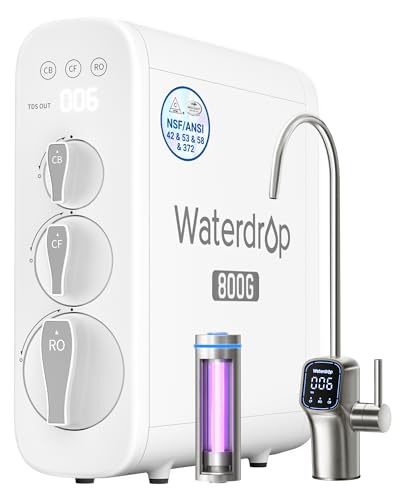
This is the under sink RO system with the most outside evidence behind it, which is why it leads. Water Filter Guru names the G3P800 its best tankless RO and reports that it beat its own waste claim, draining about 0.45 ounces for each ounce of purified water against a stated 3:1. Bob Vila’s reviewer installed one under a home kitchen sink in under an hour and reported no leaks.
There is no tank, so water comes straight off the membrane at a rated 800 gallons a day, and the unit leaves more of the cabinet free. Waterdrop puts a TDS and water quality readout in the faucet. Three cartridges load from the front, and Bob Vila’s reviewer changed them with a quarter-turn and no tools.
It has two real costs. It needs power under the sink: that same reviewer had to add a GFCI outlet. It also strips minerals. Water Filter Guru measured a pH of 6.3 and about 87% less calcium and magnesium without Waterdrop’s separate remineralizing add-on, and it recorded 43 to 46 decibels while running.
Waterdrop says IAPMO R&T certifies this system to NSF/ANSI 58, 42 and 53, and to 372 for materials. That is the maker’s claim, and Waterdrop says its wider contaminant results come from SGS testing, which is a different thing from certification.
Why we like it
- Water Filter Guru’s best tankless RO
- Measured drain water came in better than the 3:1 claim
- Tankless design frees cabinet space
- TDS and water quality readout in the faucet
Key specifications
| Model | WD-G3P800-W |
|---|---|
| Storage | Tankless |
| Rated output | 800 GPD |
| Pure-to-drain ratio | 3:1 (maker) |
| Certification | IAPMO R&T to NSF/ANSI 42, 53, 58, 372 (maker’s claim) |
| Power | Needs an outlet under the sink |
| Filter life | 6, 12 and 24 months by cartridge (replacement listings) |
| Warranty | 1 year (listing field) |
Why we recommend it
Buy it if you fill pots and pitchers often, have or can add an outlet, and want the least drain water here for each glass.
Skip it if you have no outlet under the sink; a tank system can run without one.
Pros and cons
Pros
- Quick, steady flow
- Low drain water in Water Filter Guru’s measurements
- Tool-free front cartridge changes
Cons
- Needs under-sink power
- Remineralizing stage is sold separately
- Audible while running
2. AquaTru Under Sink Reverse Osmosis System – Every Claim Certified
Pick the AquaTru if the paperwork matters most. AquaTru says IAPMO certifies it to NSF/ANSI standards for 84 contaminants. Water Filter Guru, which reviewed the Gen 2 under sink system with the same 84-contaminant figure, gave it the top certification score, calls it its best tank-based system for certifications and lists NSF/ANSI 42, 53, 58 and 401.
The system stores up to 1.7 gallons in a small tank and feeds a dedicated faucet. A leak detector sounds an alert and shuts off the cold line to the unit, and a control panel shows filter alerts, battery status and leak status.
It is slow and thirsty, and Water Filter Guru has the numbers. It measured about 32.65 gallons a day, among the slowest under sink systems it looked at, and collected 41 ounces of drain water while making 12 ounces of purified water. The pH dropped to 6.7 and calcium fell about 99.8%, since there is no mineral stage. AquaTru gives no drain ratio on this listing, so that measurement is the best figure we have.
Why we like it
- Listed certification covers all 84 claimed contaminants
- Leak detector with automatic shutoff
- Small 1.7-gallon tank
- Includes a sanitizer for the RO system
Key specifications
| Model | 90AT02US01-S |
|---|---|
| Storage | Tank, up to 1.7 gallons |
| Rated output | Not stated |
| Pure-to-drain ratio | Not stated by maker; about 1 part pure to 3.4 drain measured by Water Filter Guru |
| Certification | IAPMO to NSF/ANSI standards (maker’s claim) |
| Power | Not stated; control panel shows battery status |
| Filter life | Pre/carbon 6 months, VOC 1 year, RO 2 years |
| Warranty | 1 year |
Why we recommend it
Choose it for a home where the goal is a specific contaminant on a certified list, and where a glass or two at a time is the usual draw.
Skip it if you pay close attention to your water bill or fill big stockpots; both the drain water and the slow flow work against you.
Pros and cons
Pros
- Strongest certification record here
- Automatic leak shutoff
- Clear filter lives
Cons
- Slow measured flow
- High measured drain water
- No remineralization
3. EcoPure ECOP30 Reverse Osmosis System – Confirmed on NSF’s List
This is the pick you can verify yourself. NSF’s own directory lists the ECOP30 under NSF/ANSI 58 and 42, plus CSA B483.1, with Water Channel Partners of Eagan, Minnesota, as the company. The NSF 58 entry covers TDS, lead, fluoride, nitrate/nitrite, cyst, barium, cadmium, copper, selenium, radium, turbidity, two forms of chromium, and pentavalent arsenic at or below 300 ppb.
That entry also gives a useful reality check on output: a daily production rate of 14.76 gallons. It is a modest figure, and a reminder that the storage tank is doing the work when you open the faucet.
EcoPure builds this one as three stages in encapsulated cartridges, so you twist the old one out without touching the filter or shutting off the water. The box includes a storage tank, a dedicated faucet, color-coded tubing and push-in connectors. NSF rates the post filter at 3,850 gallons. EcoPure gives a one-year warranty, which it extends with registration and regular filter changes, so read those terms before counting on them.
The listing gives no drain ratio or tank size, and this pick rests on the listing and NSF’s entry.
Why we like it
- System appears in NSF’s directory under NSF/ANSI 58
- Broad list of certified reductions
- Encapsulated, tool-free cartridges
- Warranty can be extended with registration
Key specifications
| Model | ECOP30 |
|---|---|
| Storage | Tank, size not stated |
| Rated output | 14.76 GPD (NSF daily production rate) |
| Pure-to-drain ratio | Not stated |
| Certification | NSF/ANSI 42, 58 and CSA B483.1 (confirmed on NSF’s list) |
| Power | Not stated |
| Filter life | Post filter 3,850 gallons (NSF) |
| Warranty | 1 year; extendable with registration |
Why we recommend it
Buy it if you want an NSF entry you can read for yourself, and your household drinks water at a normal pace rather than filling big pots.
Skip it if you need quick flow for pitchers; a tankless system suits that better.
Pros and cons
Pros
- Certification confirmed at the source
- Simple twist-out cartridges
- Tank, faucet and tubing are in the box
Cons
- Low daily production rate
- Drain ratio is not stated
- Tank size is not stated
4. APEC ROES-50 Reverse Osmosis System – Plain Five-Stage Tank Design
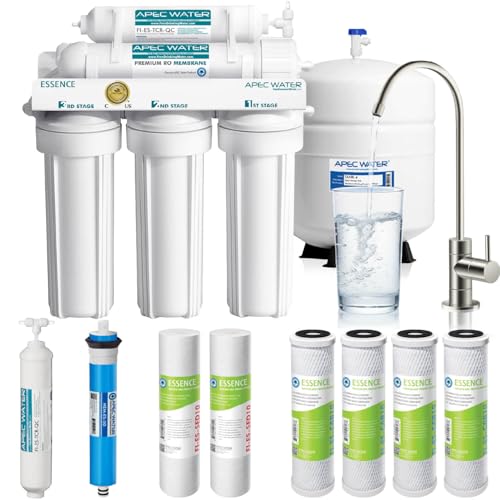
The ROES-50 is the plain version of this category: five stages, a tank, a faucet and quick-connect fittings, with no screen or pump. This listing is the ROES-50X bundle, which APEC describes as the ROES-50 with an extra high-capacity set of stage 1 to 3 pre-filters. APEC’s page calls it WQA Gold Seal certified and says it was tested for TDS reduction, while the listing title says NSF/ANSI 372 and 58. We are passing those on as APEC’s claims. We did not read a WQA entry, and it did not appear in NSF’s directory, which would fit a WQA certification.
APEC rates it at 50 gallons a day at 60 psi but only 30 gallons at 50 psi, and gives a 40 to 85 psi feed range. That is good to know before you buy, because a lower-pressure home should expect the smaller number. The 4-gallon pressurized tank measures 11 by 11 by 15 inches, so measure your cabinet with the pipes and disposal in mind.
APEC lists no drain ratio on the pages we read. This pick rests on the listing and maker details. Water Filter Guru measured APEC’s alkaline ROES-PH75, a related system, at 5.1 to 10.6 ounces of drain water per ounce of purified water, depending on the draw. Take that as a caution about tank systems with no pump, not a figure for this model.
Why we like it
- Five stages with large-capacity filters
- Colored tubing and quick-connect fittings
- 4-gallon tank and brushed nickel faucet
- No screen or electronics to maintain
Key specifications
| Model | ROES-50X (ROES-50 with an extra high-capacity pre-filter set) |
|---|---|
| Storage | Tank, 4 gallons |
| Rated output | 50 GPD at 60 psi; 30 GPD at 50 psi |
| Pure-to-drain ratio | Not stated |
| Certification | WQA Gold Seal; NSF/ANSI 372 and 58 in the title (maker’s claim) |
| Power | None stated |
| Filter life | 6 to 24 months, by water quality |
| Warranty | Not stated; lifetime support offered |
Why we recommend it
Choose it for a straightforward install with no outlet, and for a home with solid water pressure.
Skip it if your water pressure is under 40 psi; that is below APEC’s stated range.
Pros and cons
Pros
- Simple system with few parts
- Filter set, faucet, tank and install kit included
- Pressure figures are published
Cons
- Output drops with pressure
- Large tank takes cabinet space
- Drain ratio is not stated
5. Home Master TMAFC-ERP Reverse Osmosis System – Pump Cuts the Drain Water
Home Master tackles the waste problem on a tank system without needing an outlet. A non-electric permeate pump is built in, and Home Master says it reduces water waste by up to 80% and boosts production by up to 50%. The title gives a 1:1 waste ratio, the best stated figure among the tank systems on this page.
It also goes after the two common RO complaints. Home Master says it adds calcium and magnesium back twice during filtering, and its Fast Flo kit uses larger fittings and tubing for a stated 4.5-second fill of an 8-ounce glass. Filters change once a year or every 2,000 gallons, with no wrenches, and a dedicated 5-micron sediment filter sits ahead of a catalytic carbon stage, which Home Master says handles chloramines as well as chlorine.
Read the certification line closely. The listing says components “meet or exceed NSF standards,” which is a claim about parts, not a certified system, and we did not find the brand in NSF’s directory. This pick rests on the listing and maker details. If a certified system is your goal, take the AquaTru or EcoPure above.
Why we like it
- Non-electric permeate pump
- Stated 1:1 waste ratio
- Minerals added back twice during filtering
- Yearly filter changes without wrenches
Key specifications
| Model | TMAFC-ERP |
|---|---|
| Storage | Tank, size not stated |
| Rated output | Not stated |
| Pure-to-drain ratio | 1:1 (maker) |
| Certification | Components meet NSF standards (maker’s claim); no system certification stated |
| Power | None for the pump |
| Filter life | 1 year or 2,000 gallons |
| Warranty | 5-year limited, parts |
Why we recommend it
Buy it if you want a tank system with better waste and flow numbers, plus minerals in the water, and can accept a parts-level claim instead of a certified system.
Skip it if system-level certification is your reason for buying RO.
Pros and cons
Pros
- Pump needs no power
- Five-year limited parts warranty
- Long filter interval
Cons
- No system certification stated
- Rated output is not stated
- Tank size is not stated
6. Brondell Capella RC250 Reverse Osmosis System – Compact Tank, LED Faucet

Brondell’s Capella is the tidy tank option. The listing gives a size of 14 by 13.75 by 3.5 inches, with a 3.2-gallon tank, and its filters twist in and seal with a quarter turn. An LED on the designer faucet reminds you when a change is due.
Brondell says the Water Quality Association tested and certified it for 86 contaminants, and lists NSF/ANSI 42, 53, 58, 372 and 401 plus CSA B483.1. That is a strong list, but it is Brondell’s claim. We did not read a WQA entry, and it did not appear in NSF’s directory, which would fit a WQA certification.
On waste, Brondell says an Eco-Efficient membrane makes it “up to 20x more efficient than traditional RO systems.” It gives no ratio, so treat that as marketing until you have seen a number. Rated output and filter life are missing from the listing too, so check Brondell’s manual before you buy. This pick rests on the listing and maker details.
Why we like it
- Slim stated dimensions for a tank system
- Twist-and-seal filters
- LED filter reminder on the faucet
- Quick-connect supply fittings
Key specifications
| Model | RC250 |
|---|---|
| Storage | Tank, 3.2 gallons |
| Rated output | Not stated |
| Pure-to-drain ratio | Not stated |
| Certification | WQA Gold Seal; NSF/ANSI 42, 53, 58, 372, 401, CSA B483.1 (maker’s claim) |
| Power | Not stated |
| Filter life | Not stated |
| Warranty | 1-year limited |
Why we recommend it
Choose it for a shallow cabinet or a kitchen where the look of the faucet matters as much as the system below it.
Skip it if you want a published drain ratio before buying.
Pros and cons
Pros
- Long list of claimed certifications
- Simple filter changes
- US-based customer support, per Brondell
Cons
- No stated drain ratio
- Filter life is not on the listing
- Output is not on the listing
7. Aquasana AQ-HSRO800 Tankless Reverse Osmosis System – Leak Shutoff Built In

Water and a kitchen cabinet are a bad mix, and Aquasana builds around that worry. The unit monitors for water inside itself and, if it finds any, shuts down key components and sounds an alarm with flashing lights. An automatic membrane flush is there to reduce the TDS creep you get after a system sits unused.
Aquasana rates it at 800 gallons a day and gives a slim 5.13-inch width. It combines Claryum filtration with an RO membrane, and Aquasana says IAPMO certifies it to NSF/ANSI 42, 53, 58, 372 and 401, for up to 99.99% reduction of 85 contaminants. That is the maker’s claim, and it did not appear in NSF’s directory, which would fit an IAPMO certification. Water Filter Guru measured heavy TDS creep on some rival systems, so the flush is a practical feature.
This pick rests on the listing and maker details; we did not read a review of this model. The drain ratio, filter lives and power needs are not on the listing, so check them before you buy, and assume a tankless system with these features wants an outlet until the manual says otherwise. Its 2-year limited warranty beats the one-year terms on most picks here.
Why we like it
- Leak detection inside the unit
- Automatic membrane flush
- Slim 5.13-inch width
- 2-year limited warranty
Key specifications
| Model | AQ-HSRO800-BN |
|---|---|
| Storage | Tankless |
| Rated output | 800 GPD |
| Pure-to-drain ratio | Not stated |
| Certification | IAPMO to NSF/ANSI 42, 53, 58, 372, 401 (maker’s claim) |
| Power | Not stated |
| Filter life | Not stated |
| Warranty | 2-year limited |
Why we recommend it
Buy it for a finished cabinet you do not want to risk, or a home where nobody looks under the sink for months at a time.
Skip it if you want a published drain ratio or outside measurements first; the Waterdrop has both.
Pros and cons
Pros
- Stated leak response
- Slim tankless shape
- Longer warranty than most here
Cons
- Drain ratio is not stated
- Filter life is not on the listing
- Power needs are not on the listing
8. Pentair FreshPoint GRO-575M Reverse Osmosis System – TDS Monitor and Air-Gap Faucet

The FreshPoint is the pick for someone who wants to see the membrane doing its job. A built-in digital monitor shows TDS in real time, which tells you more than a calendar reminder. The box includes all cartridges, a 75 GPD membrane, a storage tank, a dedicated air-gap faucet and an installation kit.
Certification needs a careful read. The Amazon listing says NSF/ANSI 42, 53, 58 and CSA B483.1, and IAPMO R&T certification for total PFAS. NSF’s directory lists a sibling, the GRO-575B, under 42, 53, 58, 401 and CSA B483.1, but we did not find this monitor version there, and the NSF entries show no PFOA or PFOS claim. So take the system and PFAS claims for the 575M as Pentair’s own.
The GRO-575B’s NSF entry also shows a daily production rate of 21.08 gallons, well under the 75 GPD on the membrane. Expect something closer to that from this design and let the tank cover the gap. Filters are click-in and color coded: pre and post every 12 months, the RO membrane every 18, with a stated 675-gallon capacity. The unit measures 17.82 by 5.46 by 12.54 inches and weighs 10.7 pounds, per the listing.
Why we like it
- Digital TDS monitor
- Air-gap faucet included
- Click-in, color-coded cartridges
- Clear replacement schedule
Key specifications
| Model | GRO-575M |
|---|---|
| Storage | Tank, size not stated |
| Rated output | 75 GPD membrane; sibling GRO-575B listed at 21.08 GPD by NSF |
| Pure-to-drain ratio | Not stated |
| Certification | NSF/ANSI 42, 53, 58, CSA B483.1; IAPMO R&T for PFAS (maker’s claim) |
| Power | Not stated |
| Filter life | Pre/post 12 months, RO 18 months, 675 gallons |
| Warranty | Not stated |
Why we recommend it
Choose it if you like a live number to check, and if an air-gap faucet suits your plumbing.
Skip it if your household goes through a lot of water; 675 gallons is the lowest stated filter capacity here.
Pros and cons
Pros
- Real-time TDS reading
- Tool-free filter changes
- Sibling model is on NSF’s list
Cons
- This exact version not found on NSF’s list
- Drain ratio is not stated
- Warranty is not on the listing
Tank or tankless: the choice that shapes everything else
A tank system makes water slowly and stores it, so a pressurized tank does the pouring. It takes up cabinet space and the flow fades as the tank empties, but many designs need no power. NSF’s production figures show how slow the membrane itself can be: 14.76 gallons a day for the ECOP30 and 21.08 for Pentair’s GRO-575B.
A tankless system makes water as you draw it. That gives a steady stream and a smaller footprint, but plan for an outlet under the sink, as Bob Vila’s reviewer had to. Water Filter Guru recorded 43 to 48 decibels on two tankless systems, against about 24 on an APEC tank system. If you have no outlet nearby, price in an electrician before you choose one.
How to choose an under sink RO system
1. Read the drain ratio, and ask whose number it is
A pure-to-drain ratio of 3:1 means three parts drinking water for each part sent down the drain. Makers quote their own figures, and real results move. Water Filter Guru measured the Waterdrop G3P800 better than claimed, but it collected 128 ounces of drain water for 12 ounces of purified water on APEC’s ROES-PH75, against a stated 1:3. A measured figure is worth more than a printed one. Where a maker gives no ratio, we say so.
2. Check who certified what
NSF/ANSI 58 is the RO standard, 42 covers taste and chlorine, 53 covers health-related contaminants, 401 covers emerging contaminants, and 372 covers lead content in the materials. A system can hold 372 and nothing else, so 372 tells you about the parts, not what comes out of the faucet. Water Filter Guru flagged misleading certification wording on one budget RO listing, and we left that system out.
NSF, WQA and IAPMO each keep their own lists, so a system certified by IAPMO will not appear in NSF’s directory. We mark a certification as confirmed only where we read the entry on NSF’s list, and label everything else as the maker’s claim. Look up the exact model number before you rely on one.

3. Check your water pressure
RO needs pressure to work. APEC’s own figures show the output of the ROES-50 falling from 50 to 30 gallons a day when pressure drops from 60 to 50 psi, and it lists 40 psi as the bottom of its range. If your pressure is low, look at a system with a pump, such as the non-electric one in the Home Master.
4. Measure the cabinet
Measure around the drain, the disposal and the shutoff valves, not just the floor of the cabinet. A tank needs its own space: APEC’s is 11 by 11 by 15 inches. These systems also use a dedicated faucet, so plan for a hole in the sink or countertop. Waterdrop and Philips both warn on their listings that drilling may be needed.
5. Add up the filters
Filters are the running cost, and the schedules here vary from every 6 months to every 2 years by stage. Before you buy, look up the replacement set on Amazon and check that it is in stock. Set a calendar reminder too, unless the system has its own alert.
6. Decide about minerals
RO takes out calcium and magnesium along with everything else, and Water Filter Guru measured both falling sharply on systems with no mineral stage, with pH dropping too. Taste is the main reason to care. Home Master adds minerals back as standard, and Waterdrop sells an add-on stage.
Where RO water earns its place in a kitchen
Water is the main ingredient in plenty of what comes out of a Mexican kitchen. An agua fresca is mostly water, so a strong chlorine note in the tap carries straight through. If you already like your tap water, a water filter pitcher may be all you need. RO makes sense when you have high-TDS water, or a water report showing something a simple carbon filter does not handle.
Coffee is the other daily use, and our guide to the best coffee maker covers the brewing side. A new kitchen faucet is worth planning at the same time if you will be working under the sink anyway.

How we picked these eight under sink RO systems
We started with the makers known for under sink RO, then kept only systems that install under the sink and were in stock on Amazon when we wrote this. We left out countertop units, which are a different product, and the three RO systems already on our under sink guide: the Waterdrop X16, the iSpring RCC7 and the Delta Clarifi.
We read Water Filter Guru’s reverse osmosis guide, which sends water samples out for analysis, and Bob Vila’s review of the G3P800. Those two cover only the Waterdrop and the AquaTru on this page, plus a related APEC model. The other picks rest on the listing and maker details, as their sections say. We looked up each brand in NSF’s directory for certifications. We have not used any of these systems ourselves. We also queried the CPSC recall database by brand and saw no recall of these systems, which is a result of that query and not a guarantee.
Under sink RO water filter questions, answered
What is the best reverse osmosis system under sink for most homes?
The Waterdrop G3P800 suits the most kitchens if you have an outlet under the sink. It has fast flow, a tankless design and measured drain water better than its claim. Without an outlet, look at the Home Master TMAFC-ERP or the APEC ROES-50.
How much water does an under sink RO filter waste?
It depends heavily on the system. Water Filter Guru measured about 0.45 ounces of drain water per ounce on the Waterdrop G3P800, and 41 ounces of drain water for 12 ounces of purified water on the AquaTru. Home Master states 1:1 for its pump-assisted tank system.
Do I need electricity for a reverse osmosis system?
The Waterdrop G3P800 does. Home Master says its permeate pump runs without electricity, and APEC lists no power need for the ROES-50. Check the listing for the exact model, because displays and leak detectors can need batteries or power.
Does an under sink RO system remove minerals?
Yes. Water Filter Guru measured large drops in calcium and magnesium on systems without a mineral stage. The Home Master adds minerals back, and Waterdrop offers it as an add-on.
Can an under sink RO filter supply my refrigerator?
Often, with a connection kit. Waterdrop and Philips both point buyers of their tankless RO systems to kits for an ice maker or fridge. If you only want filtered ice and fridge water, the cartridge in the door may be enough: see our guide to the best refrigerator water filter.
Our final word on RO under the sink
Related guide: Under sink vs reverse osmosis filter.
Choose the design first, then the certification, then the drain ratio. For most kitchens with an outlet, that leads to the Waterdrop G3P800. For a tank and a certification you can read for yourself, it leads to the EcoPure ECOP30. If you decide RO is more than you need, our guide to the best under sink water filter covers simpler carbon systems. And if you would rather let someone else handle the aguas frescas, see the Julia’s menu or call to order at (346) 546-8283.