Every kitchen leans on its saucepan more than it notices. It is the pan that toasts the rice before the tomato broth goes in, warms yesterday’s beans, simmers a red chile sauce down for enchiladas and boils the eggs. A good one heats evenly up the sides, holds a lid tight enough to steam rice properly, and pours without dribbling down the outside. A poor one scorches the bottom while the top of the pot is still cold.
This guide looks at the saucepan from a working kitchen’s point of view: which construction heats evenly, what size covers most cooking, when a nonstick or enameled pan makes sense, and where copper fits. It names nine saucepans worth buying across those materials, with every specification taken from the maker or the Amazon listing.
Julia’s earns a commission on purchases made through links on this page, at no cost to you. Recommendations are based on what a restaurant kitchen looks for, product specifications and verified buyer reports.
Quick verdict: which saucepan to buy
For most kitchens, the best saucepan is the All-Clad D3 3-quart saucepan with lid: fully bonded tri-ply from base to rim, induction ready and oven safe to 600°F, from the line America’s Test Kitchen names as its saucepan winner. The Tramontina Signature tri-ply 3-quart gives you the same kind of clad build for less and goes in the dishwasher. Cook rice and beans for a family? Step up to the Made In 5-ply 4-quart. If you want a coated pan for oatmeal, milk and reheating, the KitchenAid Hard Anodized Induction 3-quart nonstick works on induction too.
The table below lines up the five picks most cooks should look at first. All nine saucepans are reviewed in full after it.
Five saucepans side by side
One pick for each kind of cook, with the construction and oven limit each maker or listing states.
| Saucepan | Best for | Construction | Oven limit (per maker) | Buy on Amazon |
|---|---|---|---|---|

All-Clad D3 3-quart Stainless Saucepan with LidBest overall
|
Rice, sauces, everyday simmering | Fully bonded tri-ply | 600°F, broiler safe | View on Amazon |

Tramontina Signature Tri-Ply 3-quart SaucepanBest value clad
|
Clad build, dishwasher care | Tri-ply clad, aluminum core | 500°F | View on Amazon |

Made In 4-quart Stainless Clad SaucepanBest for big batches
|
Family-size rice and beans | 5-ply stainless clad | 800°F | View on Amazon |
| Oatmeal, milk, reheating | Hard-anodized aluminum, PTFE nonstick (per retailers) | 500°F, glass lid 350°F (per retailers) | View on Amazon | |
| A first stainless saucepan | Aluminum encapsulated base (disc) | Not stated | View on Amazon |
Product images from Amazon. Construction, oven limits and care are as stated by each maker or its Amazon listing; check the listing before you buy.
What a saucepan actually does in a busy kitchen
A skillet browns and a stockpot boils, but the saucepan does the in-between work that fills most of a cooking day. In a Mexican kitchen that means rice first of all: the dry grains are toasted in a little oil until they smell nutty, then tomato broth goes in, the lid goes on and the heat goes down to the barest simmer. That last stretch is where a saucepan shows its quality. If the base has a hot spot, the rice catches in a ring before the top grains are tender. If the lid sits loosely, steam escapes and the rice cooks unevenly. Our guide to Mexican rice vs Spanish rice explains why that toasting step matters.
The same pan reheats refried beans, which are thick and stick the moment they are left alone; it reduces a chile sauce for enchiladas, which spits and scorches if the heat is uneven; and it warms a cup of milk for hot chocolate or atole. Each of those jobs asks for steady heat across the base and up the walls, a handle you can hold while you stir, and a rim that pours cleanly. If you want to know what goes into those sauces, see our guide to enchilada sauces.
Clad, disc bottom, nonstick, enamel or copper?
Stainless steel is tough and does not react with tomatoes or lime, but on its own it spreads heat poorly. Every good stainless saucepan pairs it with aluminum or copper, and how it does that matters more than the brand name.
- Fully clad (tri-ply, 5-ply). Layers of stainless steel and aluminum run through the whole pan, base and walls. America’s Test Kitchen lists fully clad construction first among the things to look for in a saucepan, and its current saucepan review names the All-Clad D3 as the winner in both its large and small sizes.
- Disc bottom (encapsulated base). A thick aluminum disc is fixed under a single layer of stainless. These cost less. America’s Test Kitchen says they heat slowly at first, then run hot, making them sluggish to respond to changes in the heat setting, and in its saucepan review it marked down a pan clad only at the base because the edges overcooked food.
- Nonstick. A coated aluminum pan, either PTFE (the coating sold as Teflon and under other names) or a ceramic coating. Release is easy and cleanup is quick, but America’s Test Kitchen prefers a light, uncoated interior for a saucepan because it lets you see food browning.
- Enameled cast iron. Heavy, slow to heat and slow to cool, with a glassy enamel interior. Good for long simmering and for holding a sauce warm; less good when you need to drop the heat quickly.
- Copper. Lined copper heats fast and evenly and responds quickly when you turn the burner down. It costs far more than clad steel, needs polishing to stay bright, and does not work on induction without an adapter.
For most cooks, a fully clad stainless saucepan is the one to buy first. Add a nonstick saucepan later if you make a lot of oatmeal, custards or sticky reheats.
Our picks for the best saucepan
These nine saucepans cover tri-ply and 5-ply stainless, a disc-bottom budget pan, PTFE and ceramic nonstick, enameled cast iron and lined copper, from 1.9 to 4 quarts. Each lists the same eight specifications from the maker or the Amazon listing; “Not stated” means neither said.
1. All-Clad D3 3-quart Stainless Saucepan with Lid – Even Heat Up the Walls
All-Clad’s D3 is the original fully bonded tri-ply: an aluminum core between layers of stainless steel, running from the base up to the rim. According to the listing it is made in the company’s Pennsylvania factory with global components. In America’s Test Kitchen’s saucepan review, the D3 is the winner at both 4 quarts and 2 quarts, praised for even heating, good visibility into the pan and a handle that stays cool; ATK also notes it survived its abuse tests with only minor dents.
This 3-quart sits between those two sizes, and it is the one we would point most households toward. It holds a batch of rice for four, a pint of salsa roja or chile sauce reducing on the back burner, or enough beans to reheat for dinner. All-Clad’s listing describes it for “soups, pasta, sauces, rice, and more” and gives it a flared rim for drip-free pouring.
It works on every stovetop including induction and is oven and broiler safe to 600°F. One quirk: the Amazon title mentions the dishwasher, but All-Clad’s own care line on the same listing says hand wash only, and that is what we would follow. It carries a limited lifetime warranty.
Why we like it
- Fully bonded tri-ply, base and walls
- D3 is ATK’s saucepan winner in large and small sizes
- Induction ready; oven and broiler to 600°F
- Flared rim pours without drips
Key specifications
| Model | 4203 |
|---|---|
| Capacity | 3 quarts |
| Material/construction | Tri-ply: stainless steel, aluminum core |
| Coating | None (stainless interior) |
| Lid | Included |
| Oven-safe to | 600°F, including broiler |
| Induction | Yes |
| Dishwasher safe | Hand wash only, per All-Clad’s care line |
Why we recommend it
It suits a cook who wants one saucepan for rice, sauces and reheating that will last for decades and respond quickly when the heat comes down.
Skip it if you want to put your saucepan in the dishwasher without a second thought; All-Clad says hand wash.
Pros and cons
Pros
- Even heating, per ATK’s review of the D3 line
- Works on gas, electric and induction
- Made in the USA with global components
- Limited lifetime warranty
Cons
- Hand wash only
- Costs more than the Tramontina
- Lid material not stated on the listing
2. Tramontina Signature Tri-Ply 3-quart Saucepan – Clad Build, Easy Care
Tramontina’s Signature line gives you the same idea as the All-Clad at a lower cost: tri-ply clad construction with an aluminum core, a stainless lid that the listing says seals in moisture, and riveted stainless handles. It is made in Brazil and NSF certified, a standard used for commercial kitchen equipment.
The 3-quart size handles everyday soups, rice and sauces. Tramontina rates it for every cooktop including induction, oven safe to 500°F, and dishwasher safe, which makes it the easier pan to live with if you cook every night and load the dishwasher after. It carries a lifetime warranty.
America’s Test Kitchen’s best buy among saucepans is a Tramontina tri-ply clad pan from the brand’s Gourmet range, which ATK says performs almost as well as the All-Clad but runs a little hot and has a handle that warms up. The Signature is a related clad line rather than that exact pan, so treat ATK’s verdict as a guide to the brand’s clad construction, not a review of this model.
Why we like it
- Tri-ply clad with an aluminum core
- Dishwasher safe, per Tramontina
- Stainless lid seals in moisture
- NSF certified, lifetime warranty
Key specifications
| Model | 80116/023DS |
|---|---|
| Capacity | 3 quarts |
| Material/construction | Tri-ply clad stainless steel, aluminum core |
| Coating | None (stainless interior) |
| Lid | Stainless steel |
| Oven-safe to | 500°F |
| Induction | Yes |
| Dishwasher safe | Yes |
Why we recommend it
It suits a cook who wants fully clad stainless and a pan that goes in the dishwasher, without paying for the All-Clad name.
Skip it if you plan to finish dishes under a very hot broiler; Tramontina rates it to 500°F, lower than the All-Clad or Made In.
Pros and cons
Pros
- Clad construction for less
- Dishwasher and induction ready
- Stainless lid, not glass
Cons
- Lower oven limit than the premium pans
- Weight not stated
3. Made In 4-quart Stainless Clad Saucepan – Room for Family Batches
Four quarts is the size America’s Test Kitchen calls the workhorse of the kitchen, and the Made In is a heavy, five-layer version of it. The listing gives an 8.5-inch total diameter with a 7.5-inch cooking surface and a 5-inch depth, which leaves room for rice for six or a pot of beans without boiling over. Made In’s own product page puts it at 3.1 pounds and rates it heat safe to 800°F.
Five layers of metal make the walls thick, so the pan holds heat well once it is hot. The top layer is 430 stainless steel, which the listing says makes it work on induction. The handle is fixed with stainless rivets and designed to stay cool. In its saucepan review, America’s Test Kitchen rates Made In’s Stainless Clad Saucepan as recommended: it made good custard and rice, heated fairly quickly and felt well balanced, though ATK noted a slight dent and a lid trough that is hard to clean.
Made In says hand washing is preferred. One detail to know: the Amazon listing says this pan is crafted in Italy, while Made In’s own page describes a U.S.-made version, so check the listing if origin matters to you.
Why we like it
- 4-quart capacity with a 7.5-inch cooking surface
- 5-ply clad construction
- Heat safe to 800°F, per Made In
- Recommended in ATK’s saucepan review
Key specifications
| Model | COOK-4L-SCE-ISS |
|---|---|
| Capacity | 4 quarts |
| Material/construction | 5-ply stainless clad |
| Coating | None (stainless interior) |
| Lid | Included |
| Oven-safe to | 800°F |
| Induction | Yes |
| Dishwasher safe | Hand wash preferred, per Made In |
Why we recommend it
It suits a household that cooks rice, beans or soup for four to six and wants one large saucepan that will take anything.
Skip it if you mostly cook for one or two; a 2- or 3-quart pan heats faster and is easier to lift.
Pros and cons
Pros
- Large, deep pan for family batches
- Very high oven limit
- Induction compatible
Cons
- ATK found the lid trough hard to clean
- Hand washing preferred
- Country of manufacture differs between listing and maker page
4. Misen 5-Ply 2-quart Stainless Saucier with Lid – Rounded Sides for Stirring
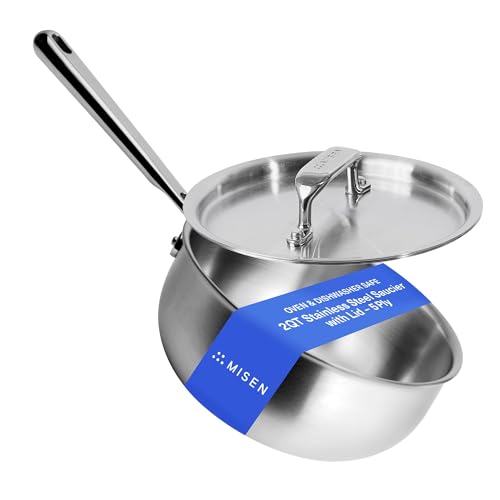
A saucier is a saucepan with rounded, sloping walls instead of a sharp corner where the side meets the base. Misen’s listing says those curved walls and wider mouth make stirring and whisking easier and leave “no corners for food to stick and burn”. That is exactly what you want for anything you stir constantly: a roux, a cheese sauce, cajeta, or a thick atole that catches in the corners of an ordinary saucepan.
This 2-quart version is 5-ply, 3.0mm thick, built from layers of stainless steel and aluminum, and comes with a lid. Misen rates it for gas, electric and induction cooktops and oven safe to 800°F, and the handle is designed to stay cool on the stovetop. Misen also makes 1.5-quart and larger sizes.
Two quarts is a small-batch size: sauces, a pot of rice for two, warm milk or reheated beans. The listing does not say whether it is dishwasher safe, so hand washing is the safe default.
Why we like it
- Rounded walls, no corners to scorch
- 5-ply, 3.0mm construction
- Lid included; oven safe to 800°F
- Induction compatible
Key specifications
| Model | MK-2021 |
|---|---|
| Capacity | 2 quarts |
| Material/construction | 5-ply stainless steel and aluminum, 3.0mm |
| Coating | None (stainless interior) |
| Lid | Included |
| Oven-safe to | 800°F |
| Induction | Yes |
| Dishwasher safe | Not stated |
Why we recommend it
It suits a cook who makes stirred sauces, custards or sweets and is tired of scraping burnt bits out of the corners.
Skip it if you need to cook rice or beans for a crowd; at 2 quarts it is a small pan.
Pros and cons
Pros
- Easy to whisk and stir clean
- Thick 5-ply walls
- Works on induction
Cons
- Small capacity
- Dishwasher guidance not stated
- Sloped sides mean less volume for the diameter
5. Cuisinart Chef’s Classic 3-quart Stainless Saucepan – Low-Cost Stainless Start

Cuisinart’s Chef’s Classic has been on the market for a long time and is a sensible first stainless saucepan. It uses a stainless body with an aluminum encapsulated base, which the listing says heats quickly and spreads heat evenly across the bottom. The interior has measurement markings, the rim is shaped for drip-free pouring, and the listing describes a “flavor lock” lid.
Know what you are buying: this is a disc-bottom pan, not fully clad. The base heats well, but the walls are a single layer of steel. America’s Test Kitchen says disc-bottom pans tend to heat slowly and then run hot, so turn the heat down a little earlier than you would with a clad pan, and stir thick sauces and beans more often.
The stainless interior will not react with tomato or lime, and Cuisinart says the pan is dishwasher safe and backs it with a limited lifetime warranty. The listing we read does not state an oven limit or induction compatibility, so check the box before using it in the oven or on an induction hob.
Why we like it
- Aluminum encapsulated base for the bottom
- Measurement markings inside
- Dishwasher safe
- Limited lifetime warranty
Key specifications
| Model | 7193-20 |
|---|---|
| Capacity | 3 quarts |
| Material/construction | Stainless steel, aluminum encapsulated base |
| Coating | None (stainless interior) |
| Lid | Included |
| Oven-safe to | Not stated |
| Induction | Not stated on the listing |
| Dishwasher safe | Yes |
Why we recommend it
It suits a first kitchen or a second saucepan for boiling eggs, pasta for two or vegetables, where even heat up the walls matters less.
Skip it if you cook thick sauces and refried beans often; a clad pan scorches less at the edges.
Pros and cons
Pros
- Low cost for stainless
- Measurement markings
- Goes in the dishwasher
Cons
- Disc base, single-layer walls
- Oven limit and induction not stated on the listing
6. KitchenAid Hard Anodized Induction 3-quart Nonstick Saucepan – Easy Release on Induction

Some saucepan jobs go better with a coating: oatmeal, rice pudding, milk for hot chocolate, cheese sauces and anything sugary. KitchenAid’s Hard Anodized Induction saucepan is a hard-anodized aluminum pan with what the listing calls a triple-layer nonstick finish and a thick, forged base that it says heats evenly on any stovetop, including induction.
The 3-quart size handles a pot of oatmeal or a batch of queso as easily as reheated beans. One detail we like: the listing says the handle rivets inside the pan are also finished with nonstick, so food does not catch around them. It comes with a glass lid, and the listing says both pan and lid are dishwasher safe. Retailer listings for this model rate it oven safe to 500°F, or 350°F with the lid on; the Amazon listing does not give an oven limit.
The listing does not name the coating, but retailers’ California cookware disclosures for this model list PTFE. On that: the U.S. Food and Drug Administration lists nonstick cookware coatings among its authorized food-contact uses of PFAS, the family PTFE belongs to, and says studies show negligible amounts migrate to food. As with any nonstick pan, follow the maker’s heat and utensil guidance.
Why we like it
- Forged base works on induction
- Nonstick finish covers the rivets too
- Pan and glass lid are dishwasher safe
- 3-quart size covers most daily jobs
Key specifications
| Model | 80206 |
|---|---|
| Capacity | 3 quarts |
| Material/construction | Hard-anodized aluminum, forged base |
| Coating | Triple-layer nonstick (PTFE per retailer disclosures) |
| Lid | Glass (oven safe to 350°F per retailers) |
| Oven-safe to | 500°F per retailers; not stated on the Amazon listing |
| Induction | Yes |
| Dishwasher safe | Yes, pan and lid |
Why we recommend it
It suits a cook who wants a second saucepan for sticky, milky or sugary jobs, including on an induction cooktop.
Skip it if this will be your only saucepan; a coating will not last as long as bare stainless, and it is harder to see browning.
Pros and cons
Pros
- Easy release and cleanup
- Induction compatible, unlike many nonstick pans
- Glass lid lets you watch a simmer
Cons
- Coating type not named on the Amazon listing
- Glass lid limited to 350°F in the oven
- Dark interior hides browning
7. Caraway 3-quart Ceramic Nonstick Saucepan in Sage – Ceramic Coating, Many Colors

If you came here looking for a green or pink saucepan, this is most likely the kind of pan you have in mind. Caraway sells its 3-quart ceramic nonstick saucepan in several colors on Amazon, including the sage green shown here, cream, navy, gray and black. “Green” in cookware is also used loosely for ceramic-coated pans in general, and one large maker, GreenPan, carries it in its name; the color and the coating are separate things.
Caraway describes the interior as a proprietary ceramic nonstick coating and says it is made without PTFE, PFOA, PFAS, lead and cadmium. The pan works on gas, electric and induction cooktops and, according to Caraway, is oven safe to 550°F. Caraway’s product page lists it at 4 pounds. The listing advises low to medium heat with a little oil or butter, which is the usual care rule for ceramic coatings.
Three quarts covers rice, soups and sauces for a family. Caraway does not state on the listing whether the pan is dishwasher safe, so hand washing is the safer default for the coating.
Why we like it
- Ceramic nonstick, made without PTFE per Caraway
- Induction compatible
- Oven safe to 550°F
- Sold in several colors
Key specifications
| Model | Sage (color) |
|---|---|
| Capacity | 3 quarts |
| Material/construction | Not stated beyond ceramic-coated body |
| Coating | Ceramic nonstick |
| Lid | Included |
| Oven-safe to | 550°F |
| Induction | Yes |
| Dishwasher safe | Not stated |
Why we recommend it
It suits a cook who wants a coated saucepan without PTFE and a color that matches the kitchen.
Skip it if you cook over high heat; Caraway recommends low to medium heat for its coating.
Pros and cons
Pros
- Easy release at moderate heat
- Works on induction
- Choice of colors, including green
Cons
- Low to medium heat only, per Caraway
- Body construction and dishwasher guidance not stated
8. Tramontina Bestow Enameled Cast Iron 2.5-quart Saucepan – Slow, Steady Simmering

An enameled cast iron saucepan is the opposite of a quick-response clad pan: it heats slowly and then holds that heat, which is what you want for a sauce that should barely tremble for an hour or beans kept warm on the back of the stove. Tramontina’s Bestow is cast from what the listing calls HT150 iron, with a porcelain-enamel exterior and an off-white enamel interior that makes it easy to see what is happening in the pan.
The cast iron lid has self-basting condensation ridges underneath, which the listing says collect steam and drip it back onto the food. It works on gas, electric, ceramic glass and induction, and Tramontina rates it oven safe to 450°F. The handles are cast into the body, and the lid knob is stainless steel.
At 2.5 quarts it is a modest size, and cast iron makes it heavy for its capacity. The listing does not state whether it is dishwasher safe; enameled cast iron is usually washed by hand.
Why we like it
- Holds heat for slow simmering
- Light enamel interior shows browning
- Self-basting cast iron lid
- Induction ready; oven safe to 450°F
Key specifications
| Model | 80131/396DS |
|---|---|
| Capacity | 2.5 quarts |
| Material/construction | Enameled cast iron (HT150) |
| Coating | Porcelain enamel, inside and out |
| Lid | Cast iron, self-basting ridges |
| Oven-safe to | 450°F |
| Induction | Yes |
| Dishwasher safe | Not stated |
Why we recommend it
It suits a cook who simmers sauces and beans low and slow and likes a pan that can go to the table.
Skip it if you need to cut the heat fast or want a light pan; cast iron is slow to cool and heavy to lift.
Pros and cons
Pros
- Steady, even simmer
- Enamel needs no seasoning
- Works on every cooktop including induction
Cons
- Heavy for its size
- Slow to respond when the heat drops
- Dishwasher guidance not stated
9. Mauviel M’Heritage 1.9-quart Copper Saucepan with Lid – Fast, Responsive Heat

Copper is the honest luxury in this list. Mauviel has made cookware in France since 1830, according to the listing, and its M’Heritage 150 B saucepan is 1.5mm thick: 90 percent copper on the outside, lined with 10 percent 18/10 stainless steel on the inside, so food only touches steel. Mauviel says the copper heats evenly and much faster than other metals, which is the reason cooks pay for it.
That responsiveness comes with conditions. Mauviel says copper conducts so well that you should run your burner at about 60 percent of its maximum, not to leave the empty pan on a hot burner, and not to use bleach, steel wool or abrasive cleaners. It works on gas, electric and halogen stovetops and in the oven, but on induction only with Mauviel’s separate interface disc. The exterior will darken unless you polish it, and the brass handles are traditional rather than stay-cool.
At 1.9 quarts it is a small saucepan, best for sauces, caramel or cajeta, and warming milk. It is the right pan for a cook who already owns clad steel and wants the finest control for delicate work, not a first saucepan.
Why we like it
- 1.5mm copper with a stainless lining
- Responds quickly to heat changes, per Mauviel
- Pouring rim and lid included
- Made in France
Key specifications
| Model | 6720.17 |
|---|---|
| Capacity | 1.9 quarts |
| Material/construction | 1.5mm copper (90%), 18/10 stainless lining (10%) |
| Coating | None (stainless lining) |
| Lid | Included |
| Oven-safe to | Oven safe; temperature not stated |
| Induction | Only with Mauviel interface disc (sold separately) |
| Dishwasher safe | Not stated; no bleach or abrasives |
Why we recommend it
It suits an experienced cook who makes delicate sauces and sweets and will polish a pan that lasts a lifetime.
Skip it if you cook on induction or want a low-maintenance pan; this one needs an adapter and regular care.
Pros and cons
Pros
- Very fast, even heating
- Stainless lining will not react with food
- Traditional French build
Cons
- Small capacity for the cost
- Induction only with an adapter disc
- Needs polishing to stay bright
How to choose a saucepan for your kitchen
1. Size: 2, 3 or 4 quarts
A 2-quart pan suits one or two people: sauces, a little rice, warm milk. A 3-quart pan is the middle ground most households reach for daily. A 4-quart pan holds rice or beans for six and gives a sauce room to bubble without spitting over the rim; America’s Test Kitchen calls it the unsung workhorse of the kitchen. If you can own only one, a 3- or 4-quart pan covers more jobs than a 2-quart. If you want two sizes at once, our guide to the best saucepan set compares sets of two to three saucepans with lids.
2. Fully clad or disc bottom
Fully clad pans (All-Clad, Tramontina Signature, Made In, Misen) heat the walls as well as the base, so thick sauces scorch less at the edges. Disc-bottom pans (Cuisinart Chef’s Classic) cost less and boil water perfectly well, but ATK finds them slower to respond.
3. The lid
For rice, the lid matters as much as the pan. America’s Test Kitchen favors tightly fitting stainless-steel lids with large, looped handles and suggests avoiding glass lids because they fog up. Glass lids do let you watch a simmer, and they often carry a lower oven limit than the pan: 350°F on the KitchenAid Hard Anodized, per retailers.
4. Handles and weight
You hold a saucepan by one handle while you stir with the other hand, sometimes while it is full of boiling liquid. Look for a long handle that stays cool and is not too thin or round to grip securely, and a helper handle on 4-quart pans. ATK suggests a sturdy pan that is still not too heavy to handle when filled.
5. Your cooktop
On induction, check the listing: every pan here works on induction except the copper Mauviel (which needs an interface disc) and the Cuisinart, whose listing does not say. Many nonstick saucepans with plain aluminum bodies do not work on induction at all.
6. Coating or no coating
Uncoated stainless lasts the longest, takes metal spoons and high heat, and shows browning clearly. A nonstick saucepan is easier for oatmeal, milk and sticky reheats but needs gentler heat and utensils; our guide to the best nonstick pans covers coated skillets and how to care for them. Many kitchens own one of each. If cost is the deciding factor, see our guide to the best value saucepan for low-cost options, or the best skillet electric guide if you need extra cooking space without another burner.
How we chose these nine saucepans
We started from what a working kitchen asks of a saucepan: even heat across the base and up the walls, a lid that seals for rice, a cool and secure handle, and a body that survives years of daily scrubbing. We searched for saucepans sold on Amazon in the United States, checked each listing’s stock with Amazon’s product data, and kept only in-stock pans from identifiable makers, covering fully clad and disc-bottom stainless, PTFE and ceramic nonstick, enameled cast iron and copper, in sizes from 1.9 to 4 quarts. Specifications come from the makers’ websites or their Amazon listings, and we wrote “Not stated” where neither gave a figure. We read America’s Test Kitchen’s current review of saucepans and its articles on choosing a saucepan and on the 4-quart saucepan. Coating facts come from the makers and from the U.S. Food and Drug Administration. We have not cooked with these pans for this guide.
What cooks ask about saucepans
What is the best saucepan type for everyday cooking?
A fully clad stainless steel saucepan of 3 to 4 quarts with a tight stainless lid. It heats evenly, works on most cooktops, takes metal utensils and high oven heat, and has no coating to wear out. Add a small nonstick pan for oatmeal and milk if you like.
Which saucepan does America’s Test Kitchen recommend?
In its current saucepan review, America’s Test Kitchen names the All-Clad D3 stainless saucepan as the winner at both 4 quarts and 2 quarts, and a Tramontina tri-ply clad saucepan as the best buy. It also rates Made In’s Stainless Clad Saucepan as recommended.
What are the best saucepan brands?
For clad stainless, All-Clad, Made In, Tramontina and Misen all make fully clad saucepans in the sizes most cooks need. Cuisinart offers lower-cost disc-bottom pans; All-Clad, Caraway and GreenPan make nonstick saucepans; Le Creuset and Tramontina make enameled cast iron; and Mauviel makes lined copper.
Are green saucepans better?
“Green” can mean a color or a ceramic coating. Many ceramic-coated saucepans come in green, and GreenPan uses the word in its brand name. GreenPan says its Thermolon coating is made from sand-derived silicon dioxide and is PFAS-free. A ceramic coating releases food easily at low to medium heat, but the color itself changes nothing about how a pan cooks.
Is there a good pink saucepan?
Yes. Several ceramic nonstick saucepans are sold in pink, including models from GreenLife and Sensarte, and Caraway offers its saucepan in several colors. Choose on construction, size and induction compatibility first, then pick the color.
What size saucepan should I buy first?
A 3-quart pan covers the widest range of jobs for most households. If you cook rice or beans for four or more, go to 4 quarts.
Our final word on saucepans
Buy the All-Clad D3 3-quart if you want one saucepan that does everything and lasts, the Tramontina Signature for clad performance with dishwasher care, or the Made In 4-quart if you feed a family. Add the KitchenAid Hard Anodized or the Caraway for sticky, milky jobs. Toast your rice, put the lid on, turn the heat down, and a good saucepan does the rest.
Cooking a lot of rice? See the best saucepans for rice. Not sure which shape you need? See saucepan vs pan.
Cooking soup, pozole or stock for a crowd? See our guide to the best stockpots and soup pots.
Related guide: Best double boiler.
Related guide: Best saucier pan.
Related guide: Best butter warmer.
Want two or three sizes at once? Compare our picks for the best saucepan set, or find lower-cost single pans in our best value saucepan guide. For what to cook in it, read charro beans vs refried beans. Or let someone else cook: see the menu or call to order.