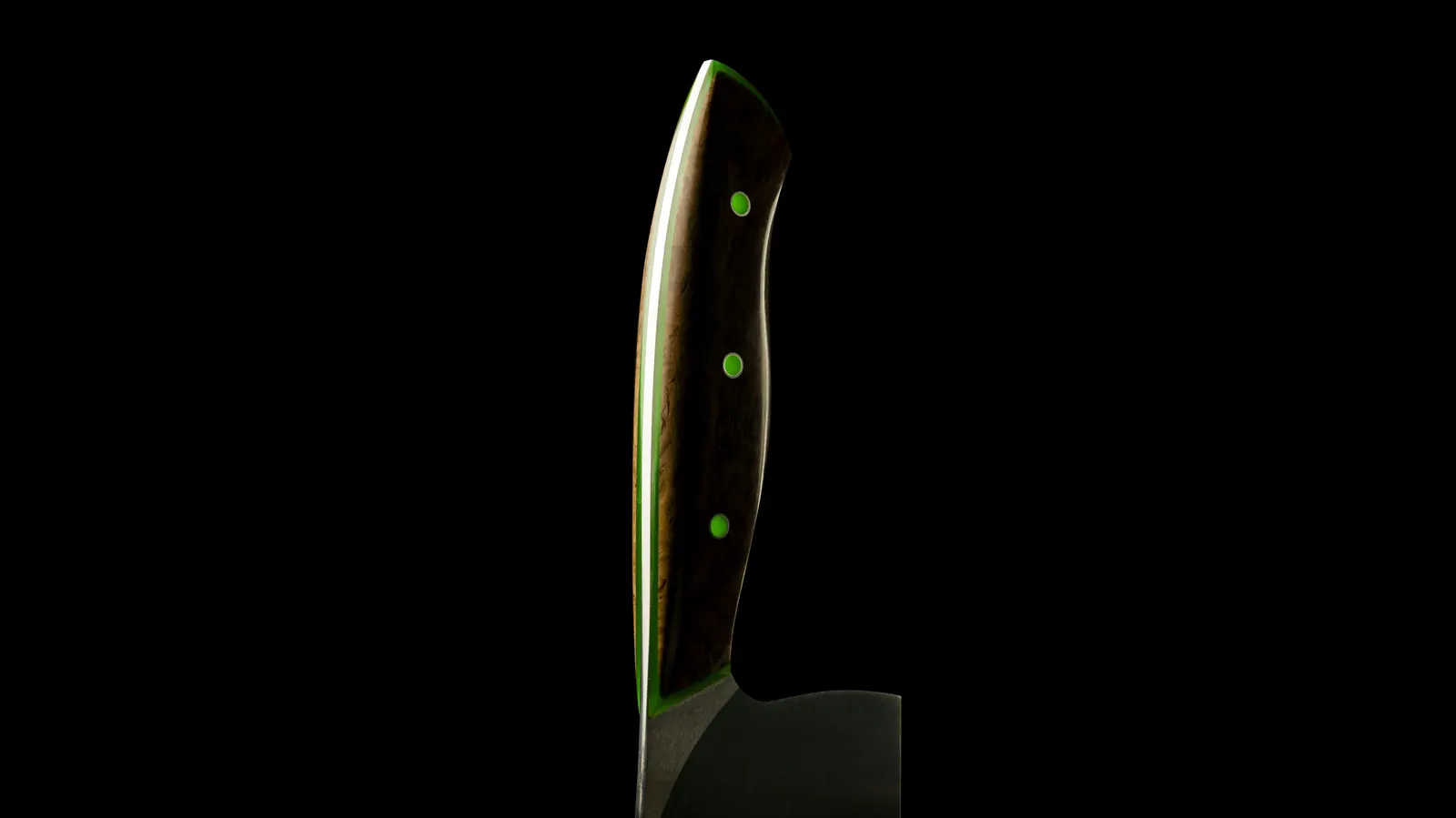
Wüsthof makes several lines of knives, and the Classic and Gourmet names cause most of the confusion. One is forged and the other is laser cut, and they feel quite different in the hand. If you have chosen the brand, this page helps you pick the line and the knife.
We compare lines and knife types, not colors. We also pass on what testers said about the Classic’s weight, and say where a German knife may not be the right choice.
Julia’s earns a commission on purchases made through links on this page, at no cost to you. Recommendations are based on what a restaurant kitchen looks for, product specifications, makers’ statements and the independent sources we name. We have not used these products ourselves.
Quick verdict: which Wüsthof knife to buy
Buy the Classic 8-inch chef’s knife if you want one forged knife with heft. America’s Test Kitchen lists it as Recommended and found the blade quite sharp, though a little less nimble. Choose the Gourmet 8-inch if you want a lighter, lower-cost knife with no bolster. Smaller hands should look at the Classic 6-inch.
Five Wüsthof knives at a glance
| Wüsthof knife | Construction | Blade | Best for | Buy on Amazon |
|---|---|---|---|---|

Wüsthof Classic Chef’s Knife, 8-inchBest overall
|
Forged | 8 in. | One serious chef’s knife | View on Amazon |
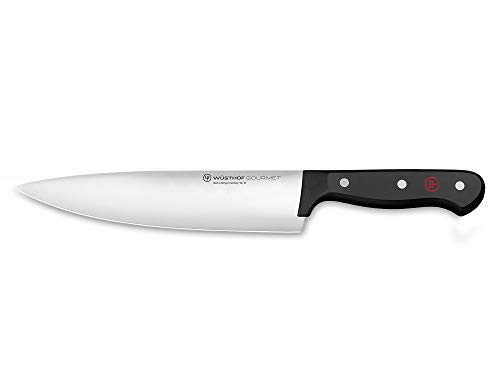
Wüsthof Gourmet Chef’s Knife, 8-inchBest lighter chef’s knife
|
Laser-cut | 8 in. | Lighter, lower-cost choice | View on Amazon |
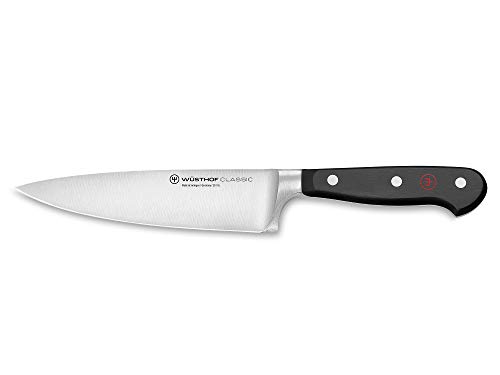
Wüsthof Classic Chef’s Knife, 6-inchBest for smaller hands
|
Forged | 6 in. | Smaller hands | View on Amazon |

Wüsthof Classic Ikon Hollow Edge Santoku, 7-inchBest santoku
|
Forged | 7 in. | Straight-down chopping | View on Amazon |

Wüsthof Classic Bread Knife, 8-inchBest bread knife
|
Forged | 8 in. | Regular bread slicing | View on Amazon |
Our picks for the best Wusthof knives
1. Wüsthof Classic Chef’s Knife, 8-inch – The Forged Workhorse
This is the knife that most buyers come to Wüsthof for. It is forged from one piece of high-carbon stainless steel, with a full tang, a full bolster and three rivets. This listing has a Wild Blueberry colored handle; the blade and shape match the black Classic, and the black version appears on our other knife pages.
America’s Test Kitchen places the Classic 8-inch in its Recommended tier, one step under its top group. Testers found the blade quite sharp and approved of the handle, but said the weight “sometimes felt a little less nimble.” Prudent Reviews gives 9.1 ounces, 58 on the Rockwell scale and a 14-degree edge per side. If you like a heavier knife, that is the appeal.
Why we like it
- Forged with a full bolster and tang, per the listing
- America’s Test Kitchen lists it as Recommended
- Made in Solingen, Germany, per the listing
Key specifications
| Model | 1061700620 |
|---|---|
| Line | Classic |
| Knife type | Chef’s |
| Blade length | 8 in. |
| Construction | Forged |
| Stated hardness | 58 HRC, per Prudent Reviews |
| Handle | Synthetic with brass rivets, Wild Blueberry |
| Sold by | Amazon.com |
Why we recommend it
A home cook who wants one heavy, durable knife for vegetables, meat and everything in between.
Skip it if you prefer a light, nimble blade. Testers noted the weight, and a Japanese-style knife will feel very different.
Pros and cons
Pros
- Independent test exists for this model
- Full bolster protects the hand
- Hand-wash care is simple
Cons
- Heavier than many chef’s knives
- Colored handle on this listing
2. Wüsthof Gourmet Chef’s Knife, 8-inch – Lighter and Stamped
Gourmet is the other half of the question most people have. The blade is laser cut rather than forged, the handle is synthetic polypropylene and there is no bolster. Prudent Reviews gives 56 on the Rockwell scale and an 18-degree edge per side, with a weight of 6.4 ounces in its text and 8 ounces in its chart, so treat the exact figure with care.
The author there prefers a heavier knife and warns that without a bolster your hand can slip toward the blade, so you must be careful. Some cooks prefer a lighter knife, though. Prudent Reviews suggests buying Classic for the knives you use most and Gourmet for those you use less.
Why we like it
- Lighter than the Classic, per Prudent Reviews
- Laser-cut blade, per the listing
- Made in Germany with a limited lifetime warranty, per the listing
Key specifications
| Model | 1025044820 |
|---|---|
| Line | Gourmet |
| Knife type | Chef’s |
| Blade length | 8 in. |
| Construction | Laser-cut (stamped) |
| Stated hardness | 56 HRC, per Prudent Reviews |
| Handle | Polypropylene |
| Sold by | Amazon.com |
Why we recommend it
Someone who wants a German knife at a lower cost, or who finds forged knives too heavy.
Skip it if you want a bolster to guard your fingers. This line has none.
Pros and cons
Pros
- Lighter in the hand
- Costs less than Classic, per Prudent Reviews
- Sold by Amazon
Cons
- Softer steel on paper
- No bolster
- Prudent Reviews gives two weights
3. Wüsthof Classic Chef’s Knife, 6-inch – Same Knife, Shorter Blade
A 6-inch blade is easier to control if you have smaller hands or a small cutting board. It is the same forged Classic design, with a full tang and full bolster, and the listing states a 58 HRC temper. The maker claims the Precision Edge Technology edge is 20 percent sharper and stays sharp twice as long as earlier versions, which is its own comparison and not an outside measurement.
The tradeoff is reach. A 6-inch knife will struggle across a large cabbage or a whole brisket, and it can feel short for big piles of vegetables. It weighs less than the 8-inch, so it is the piece to choose for nimble work.
Why we like it
- Shorter reach gives more control
- Same forged build as the 8-inch
- 58 HRC, per the listing
Key specifications
| Model | 1040100116 |
|---|---|
| Line | Classic |
| Knife type | Chef’s |
| Blade length | 6 in. |
| Construction | Forged |
| Stated hardness | 58 HRC |
| Handle | Synthetic, three rivets |
| Sold by | Amazon.com |
Why we recommend it
A cook with smaller hands, or a tiny kitchen where a long blade feels awkward.
Skip it if you often cut large squash, cabbage or roasts. Buy the 8-inch.
Pros and cons
Pros
- Easier to control
- Full bolster
- Sold by Amazon
Cons
- Short for large produce
- Edge claims are the maker’s own
4. Wüsthof Classic Ikon Hollow Edge Santoku, 7-inch – Double Bolster, Thinner Edge
Classic Ikon is a step up in design from Classic: a sleek black handle and a double bolster for balance, by the maker’s description. This santoku has a thinner blade with a 10-degree edge, and hollow scallops along the sides. It is the one knife here shaped for chopping straight down, with a straighter edge and little rocking curve.
If you already know you chop more than you rock, this is a sensible first Wüsthof. We did not read an independent test of this exact knife, so its case rests on the listing. Our Japanese santoku guide is the place to compare it with thinner, harder blades from Japan.
Why we like it
- Double bolster, per the maker
- Thin 10-degree edge, per the listing
- Hollow scallops along the blade
Key specifications
| Model | 1040331317 |
|---|---|
| Line | Classic Ikon |
| Knife type | Santoku |
| Blade length | 7 in. |
| Construction | Forged |
| Stated hardness | 58 HRC |
| Handle | Synthetic, black |
| Sold by | Amazon.com |
Why we recommend it
A cook who chops vegetables with an up-and-down motion and likes a German handle.
Skip it if you rock your knife through herbs. A chef’s knife suits that better.
Pros and cons
Pros
- Thinner edge for clean slices
- Good balance, per the maker
- Sold by Amazon
Cons
- No independent test read
- Less rocking curve
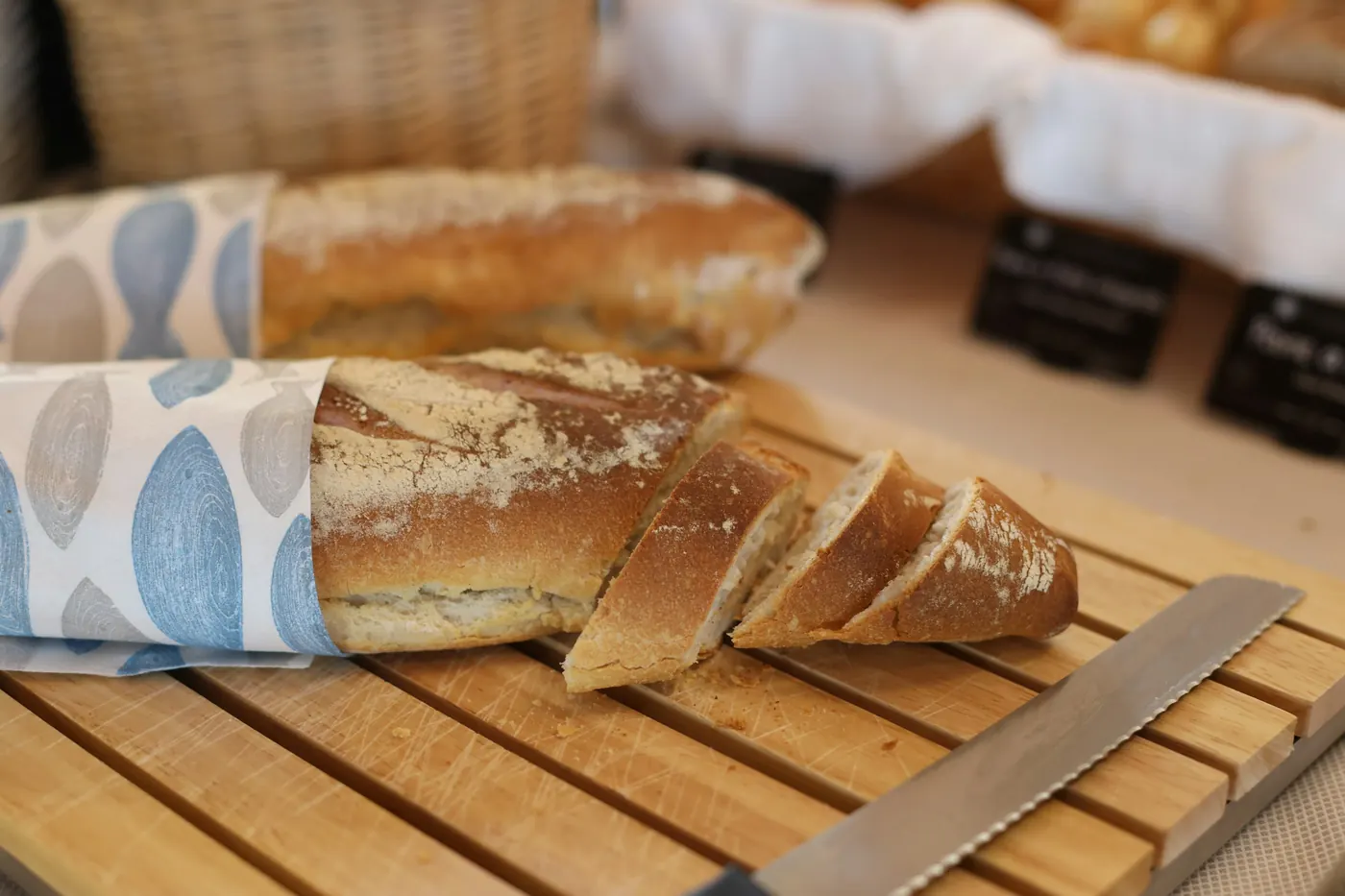
5. Wüsthof Classic Bread Knife, 8-inch – A Forged Serrated Blade
A bread knife is a separate purchase worth making because a chef’s knife crushes soft crumb. The listing says the serrations guide the blade through tough crust without compressing the inside, and the same forged steel and 58 HRC temper apply. The listing also says to clean it by hand with a damp cloth and to avoid hard surfaces.
Prudent Reviews argues that lower-use knives such as bread knives are where Gourmet is the sensible saving. That is worth considering: you may reach for this only a few times a week. Buy Classic here if you want a matched block or you slice a lot of crusty loaves. Our bread knife guide compares other makers.
Why we like it
- Serrated edge suited to crust and soft crumb
- Same forged steel as the Classic line
- Clear hand-wash care, per the listing
Key specifications
| Model | 1040101020 |
|---|---|
| Line | Classic |
| Knife type | Bread |
| Blade length | 8 in. |
| Construction | Forged |
| Stated hardness | 58 HRC |
| Handle | Synthetic, three rivets |
| Sold by | Amazon.com |
Why we recommend it
A regular home baker who wants a knife that matches a Classic block.
Skip it if you only slice sandwich loaves now and then. A cheaper line will do.
Pros and cons
Pros
- Forged build
- Works well on crust, per the listing
- Sold by Amazon
Cons
- Serrated blades are harder to sharpen
- Modest length for very large loaves
6. Wüsthof Classic Asian Utility Knife, 4.5-inch – A Small Do-Most Knife

This small knife sits between a paring knife and a chef’s knife. The maker describes a curved straight-edge blade that can act as a mini cook’s knife or as a paring knife, and it suggests it for small and medium fruits and vegetables. It weighs about 0.16 pounds by the listing, the lightest pick in the Classic group here.
It suits small jobs when you do not want to take out the big knife: an avocado, a few limes or a couple of tomatoes for salsa. It will not replace a chef’s knife for onions by the pound. It is a fine second knife, and it has the same triple-rivet Classic handle.
Why we like it
- Useful between paring and chef’s knives
- Same Classic handle style
- Limited lifetime warranty, per the listing
Key specifications
| Model | 1040136812 |
|---|---|
| Line | Classic |
| Knife type | Asian utility |
| Blade length | 4.5 in. |
| Construction | Not stated on this listing |
| Stated hardness | Not stated on this listing |
| Handle | Synthetic, three rivets |
| Sold by | Amazon.com |
Why we recommend it
Someone who does most small prep with one short knife.
Skip it if you already have a good paring knife and chef’s knife. It overlaps with both.
Pros and cons
Pros
- Handy size
- Very light
- Sold by Amazon
Cons
- Overlaps with other knives
- Too small for large prep
7. Wüsthof Crafter Utility Knife, 6-inch – Forged With Smoked Oak

Crafter is the line to look at if you want wood rather than synthetic. The listing describes a blade forged from a single piece of stainless steel, smoked oak handles, traditional brass rivets and the trident branding, and it pitches this 6-inch for fruit, vegetables, meats and carving roasts.
Wood needs more care than synthetic: dry it soon after washing and keep it out of the dishwasher, as you should with any good knife. The listing gives very little else, including no hardness figure, and the seller is Everything Kitchens rather than Amazon. It is a looks-led choice, so buy it if you like the handle enough to care for it.
Why we like it
- Smoked oak handle, per the listing
- Forged from one piece of stainless, per the listing
- Brass rivets
Key specifications
| Model | 1010800716 |
|---|---|
| Line | Crafter |
| Knife type | Utility |
| Blade length | 6 in. |
| Construction | Forged |
| Stated hardness | Not stated |
| Handle | Smoked oak |
| Sold by | Everything Kitchens |
Why we recommend it
Someone who wants a good-looking wood-handled knife for a small display or a gift.
Skip it if you want an easy-care handle, or you want more detail on the listing.
Pros and cons
Pros
- Distinctive wood handle
- Forged
- Useful mid-size blade
Cons
- Thin listing detail
- Third-party seller
- Wood needs more care
8. Wüsthof Gourmet Paring Knife, 3-inch – A Small, Cheap Way In

A paring knife is a job where forging matters less, because nobody bears down on it the way they do with a chef’s knife. This 3-inch clip-point blade is laser cut, with a polypropylene handle. The listing says it is made in Germany, hand wash only and carries a limited lifetime warranty.
One detail differs between sources: this listing says triple riveted, while Prudent Reviews says Gourmet knives under 4.5 inches have a half tang with two rivets. Check the knife when it arrives if that matters to you. For peeling, trimming and coring, either build will do the work, and it is the cheapest way to see whether you like Wüsthof.
Why we like it
- Small clip-point blade
- Made in Germany, per the listing
- Hand wash care stated
Key specifications
| Model | 1025048208 |
|---|---|
| Line | Gourmet |
| Knife type | Paring |
| Blade length | 3 in. |
| Construction | Laser-cut (stamped) |
| Stated hardness | 56 HRC, per Prudent Reviews |
| Handle | Polypropylene |
| Sold by | Amazon.com |
Why we recommend it
Someone who wants a good paring knife or a low-cost first Wüsthof.
Skip it if you want a forged, full-tang small knife. Look at the Classic line.
Pros and cons
Pros
- Low-cost way to try the brand
- Easy to control
- Sold by Amazon
Cons
- Sources conflict on rivets and tang
- Stamped blade
Wüsthof Classic vs Gourmet in plain terms
The core difference is how the blade is made. Classic is forged, with a thick bolster and an exposed full tang, and Prudent Reviews lists it at 58 on the Rockwell scale. Gourmet is laser cut from sheet steel, with no bolster, and it lists Gourmet at 56. Classic is heavier and sturdier. Gourmet is lighter and costs less.
Prudent Reviews gives a sensible rule: buy Classic for the chef’s and santoku knives you use most, and Gourmet for ones you use less. We agree with that as a way of spending money, though a lighter knife can also simply feel better to some cooks.
Which Wüsthof suits which cook
Buy the Classic 8-inch if you want one main knife with some heft. Buy the Gourmet 8-inch if you want a lighter or lower-cost one. Smaller hands point to the Classic 6-inch. Up-and-down choppers should look at the Classic Ikon santoku. Regular bakers need the bread knife. The Asian utility and paring knife fill in the small jobs, and Crafter is for those who want wood.

Where Wüsthof falls short
German knives are thicker and softer than many Japanese ones. If you want a thin, very sharp blade, Prudent Reviews puts Shun’s steel at 60 to 61 on the Rockwell scale against 57 to 58 for German makers, though harder edges chip more easily. America’s Test Kitchen also noted the Classic can feel less nimble. For a lighter alternative, look at the MAC MTH-80 in our Japanese knife guide; America’s Test Kitchen lists it as Highly Recommended among gyuto knives.
Wüsthof’s edge claims, such as “20 percent sharper,” compare its own knives to its own earlier ones. They are not an independent score, so we would not choose on them.
Caring for a German knife
The listings ask for hand washing and warn against cutting on glass, ceramic or metal. Dry the blade straight away. Hone before use, and sharpen when honing stops helping. Our chef’s knife guide covers how to compare knives with other makers.
How we picked these eight knives
We pulled the range from Amazon’s listing data and kept different lines and knife types, not colors, in stock with a new lead offer. Exact listings on our other pages were left out, and two models appear as a different listing with the reason noted in our records. We read America’s Test Kitchen’s chef’s knife review for the Classic 8-inch and Prudent Reviews’ Classic vs Gourmet comparison. Other knives here rest on the listings. Our search for side-by-side tests of Classic and Gourmet found mostly retailers and blogs we did not rely on. We searched the US Consumer Product Safety Commission recall database by brand and got no Wüsthof entries. We have not used these knives ourselves.
Wüsthof questions, answered
What is the difference between Wusthof Classic and Gourmet?
Classic is forged with a bolster and heavier. Gourmet is laser cut, lighter and lower in cost. Prudent Reviews lists 58 against 56 on the Rockwell scale.
Which Wüsthof knife should I buy first?
The Classic 8-inch chef’s knife, unless you prefer a lighter knife. In that case, start with the Gourmet 8-inch.
Are Wüsthof knives dishwasher safe?
The listings here ask for hand washing. Treat them as hand-wash knives.
Where are Wüsthof knives made?
The listings say Solingen, Germany.
Is Classic Ikon worth it over Classic?
Ikon adds a double bolster and a sleeker handle, by the maker’s description. We did not read a test comparing them, so choose by how the handle feels.
Our final pick for one good knife
Related guide: Wusthof vs zwilling.
Buy the Classic 8-inch if you want one main knife with heft, and the Gourmet 8-inch if you want something lighter for less. For other makers, see our best chef knife guide and the Zwilling chef knife guide. When the board stays clean tonight, see Julia’s menu and call to order.