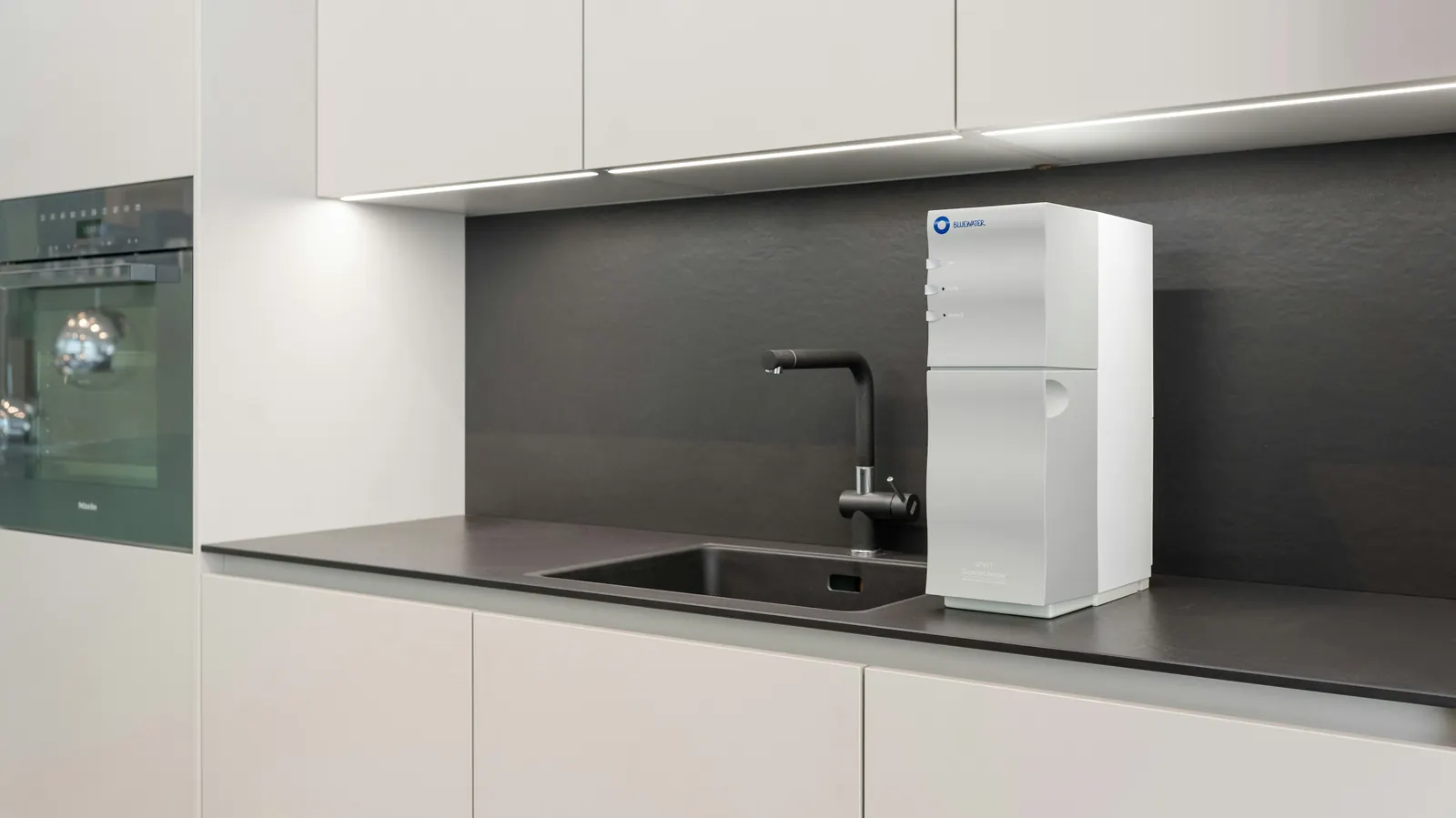
A countertop filter and an under-sink filter can put the same carbon block between your tap and your glass. What separates them is where they live and how they get water. An under-sink system taps the cold line inside the cabinet and sends filtered water to a faucet whenever you open it. A countertop unit sits in plain view and either hooks onto the faucet you already have or holds water you pour in yourself. Those two facts decide nearly everything else: installation, counter space, flow, how much water is ready at once and whether a renter can use it.
In a restaurant kitchen, filtered water goes into the coffee, the ice and the big jars of agua fresca, so we care most about volume and convenience. This guide compares the two types on installation, renting, space, flow, capacity, filter life and certification, then names two picks for each side.
Julia’s earns a commission on purchases made through links on this page, at no cost to you. Recommendations are based on what a restaurant kitchen looks for, product specifications and verified buyer reports.
Quick verdict: countertop or under the sink?
If you own your home and have room in the sink cabinet, buy an under-sink filter. It keeps the counter clear, gives filtered water on demand without refilling anything, and the best ones carry third-party certification for a long list of contaminants. Buy a countertop filter if you rent, can’t or won’t work on the plumbing, have a crowded cabinet, or want something you can take with you when you move. The EPA’s WaterSense guide notes that under-sink systems can treat larger quantities of water, and that is the main reason they win for most households.
The table sums up the differences; the sections after it explain each one.
Countertop vs under sink water filter, side by side
| Countertop filter | Under-sink filter | |
|---|---|---|
| Where it sits | On the counter, next to the sink or anywhere | In the cabinet below the sink |
| Water source | A hose from the faucet, or water you pour in | The cold supply line |
| Installation | No plumbing; swap the aerator for an adapter, or just fill it | A tee on the cold line; often a separate faucet |
| Renters | Easy to remove and take along | Possible, but it is plumbing work; ask first |
| Counter space | Takes some | None, apart from a small faucet |
| Water ready at once | Unlimited if faucet-connected; a tank’s worth if you fill it | On demand |
| Cost class | Usually lower to buy (Aquasana) | Usually higher to buy (Aquasana) |
| What to check | Faucet thread or outlet; certification | Cabinet space; certification |
Installation: the difference that decides most cases
An under-sink system needs to reach water before the faucet does. Aquasana’s 2-stage system connects with an included tee to the 3/8-inch cold supply line and feeds a second faucet that comes in the box. Aquasana says most of its under-sink systems need that dedicated faucet, which means a spare hole in the sink deck or countertop. If your sink has an unused sprayer or soap-dispenser hole, that is usually where it goes; if not, a hole has to be made.
There is a middle route. Direct-connect systems, such as A. O. Smith’s Advanced Direct Connect, sit under the sink but connect to the cold line feeding your existing faucet, so no second faucet and no new hole. A. O. Smith says installation takes a few minutes and needs no plumber.
Countertop filters skip all of that. A faucet-connected one, like the Frizzlife SS99, screws onto the faucet once the aerator is off; its hose runs to the filter, and a diverter switches between tap and filtered water. A self-contained unit, like the Ninja HydraSense, needs no connection at all: you fill the reservoir and plug it in. Aquasana, which sells both kinds, says countertop installation is “much simpler.”

Renting? Read this first
For renters, the countertop is the safe choice. Nothing is cut, drilled or left behind, and the unit goes with you when you move. A faucet-connected unit needs only the aerator, which you keep in a drawer and screw back on before you leave.
An under-sink system can still work in a rental, and Aquasana markets its under-sink line to “homeowners and renters alike.” But it means working on the water supply, and a dedicated faucet may mean a new hole in someone else’s countertop. That is general kitchen sense rather than a rule from any maker: ask the landlord before you touch the plumbing, and if you go ahead, choose a direct-connect system that uses the existing faucet and can be removed cleanly.
Space: counter or cabinet
Counter space is the countertop filter’s real cost. A faucet-connected unit is fairly compact, but it lives beside the sink with a hose running to the tap. A dispenser like the Ninja takes more room, because it holds water and needs an outlet nearby.
The under-sink filter costs cabinet space instead. Aquasana says its 2-stage system needs 12 inches of space under the sink plus clearance, and A. O. Smith asks for a 4 by 4 by 20-inch space for its direct-connect unit. Measure around the garbage disposal, drain trap and cleaning supplies before you order. If the cabinet is already full, that pushes you toward the countertop.
Flow and how much water is ready
Under-sink filters run straight off line pressure. Aquasana rates its 2-stage system at 0.5 gallons per minute, and A. O. Smith rates its direct-connect at 1.5 gallons per minute. Neither has a tank to empty, so filling a stockpot for pozole or a big jar of horchata is a matter of waiting at the tap, not refilling.
A faucet-connected countertop filter is the same in principle: it draws from the tap, so water keeps coming. Frizzlife lists its SS99 at up to 2 gallons per minute at 60 psi. A self-contained unit is different. Ninja’s HydraSense has a 96-ounce reservoir, according to the listing, and once that runs low you refill it. Aquasana makes the same point about any countertop unit you fill by hand: you can only filter as much water as it holds at a time.
Filter life and upkeep
Every filter has to be changed on schedule. Nebraska Extension calls regular cartridge replacement critical to keeping a filter effective and to limiting bacterial growth in it, and the EPA warns that an unmaintained system may make water quality worse.
Filter life depends on the model, not the type. The Aquasana under-sink filters last up to 6 months or 500 gallons; the A. O. Smith direct-connect lasts 784 gallons or 6 months. On the counter, Frizzlife rates the SS99 cartridge at up to 12 months or 8,000 gallons, and the Ninja at about 120 gallons, which the maker puts at two replacements a year. Under the sink, a change means kneeling into the cabinet; on the counter, it is in front of you, which helps you remember it.
Certification: check the claim, not the type
Neither type is better at filtering by nature; the cartridge inside decides that. Check what each model is certified to do. The EPA’s WaterSense guide lists the standards that apply to filters: NSF/ANSI 42 for taste and odor such as chlorine, NSF/ANSI 53 for health-related contaminants, and NSF/ANSI 401 for emerging compounds. It names the third-party certifiers, including IAPMO R&T, NSF, UL and the Water Quality Association, and advises reading a system’s performance data sheet or looking it up on a certifier’s site.
Here is how our four picks state it. Aquasana’s performance data sheet says WQA tested and certified the 2-stage system to NSF/ANSI 42, 53 and 401. A. O. Smith’s listing says IAPMO certified its direct-connect to the same three standards. Ninja’s listing says IAPMO R&T certified the HydraSense to 42, 53 and 401. Frizzlife’s listing says the SS99 is certified to NSF 42 and 372 but doesn’t name the certifier, and 372 covers lead content in the materials, not what the filter removes. We take each claim as the maker states it and don’t add to it.
One more limit from the EPA’s guide: carbon filtration doesn’t remove nitrates, bacteria or dissolved minerals. If you need those removed, you are looking at reverse osmosis, which also comes in both countertop and under-sink forms. Our best reverse osmosis system guide covers it.
Cost class without the price tags
Aquasana, which sells both, says under-sink filters typically cost more than countertop filters. The EPA’s guide adds that basic pitchers and tap filters need no installation, and that upkeep for every type comes down to filter changes. So compare the cost of a year of cartridges, not just the box price. An under-sink system that you install yourself costs little more over time; one that needs a plumber or a new faucet hole costs more.
Choose a countertop filter if… / Choose an under-sink filter if…
Choose a countertop filter if…
- You rent, or you’d rather not touch the plumbing.
- The sink cabinet is full or awkward.
- You want to take the filter with you when you move.
- Your faucet takes a standard aerator thread, or you’re happy to fill a reservoir.
Choose an under-sink filter if…
- You own the home and want a clear counter.
- You use a lot of filtered water for cooking, coffee, ice and drinks.
- You want filtered water at line pressure with nothing to refill.
- You have about a foot of free cabinet space, or a spare hole for a faucet.
Our picks on each side of the countertop vs under sink water filter question
Two picks per side, each certification as its maker states it. All four were in stock when we checked, and none appears as an exact listing on our other pages. The Aquasana is the current AQ-6200 version of the AQ-5200 system in our best under sink water filter guide; we include it because it is the clearest example of a certified under-sink system with a dedicated faucet, and its updated data sheet is public.
1. Aquasana Claryum 2-Stage Under Sink Filter – Certified, With Its Own Faucet

This is the standard under-sink setup: two filter housings in the cabinet, a tee on the cold line and a brushed-nickel faucet of its own. Aquasana’s performance data sheet for the AQ-6200 says WQA tested and certified the system to NSF/ANSI 42, 53 and 401. The sheet lists chlorine and chloramine under 42; lead, mercury, asbestos, cysts, PFOA and PFOS and a set of VOCs under 53; and a list of trace compounds plus microplastics under 401.
The data sheet rates it at 500 gallons and 0.5 gallons per minute, for water pressure of 20 to 80 psi and cold water only. The listing says filters last up to 6 months, twist off for replacement, and that the system does not reduce TDS, so minerals stay in. It needs 12 inches of space under the sink plus clearance, and the box includes the faucet, the first filters and the installation parts.
Plan for the faucet. It needs a spare hole in the sink or countertop, so check before you buy.
Why we like it
- WQA certification to NSF/ANSI 42, 53 and 401 (data sheet)
- Full contaminant list published
- Keeps minerals; no wastewater
- Faucet and installation parts included
Key specifications
| Model | AQ-6200-BN |
|---|---|
| Type | Under-sink, 2-stage, dedicated faucet |
| Installation | Tee on 3/8-inch cold line; 12 inches of cabinet space |
| Flow rate | 0.5 gpm |
| Filter life | 500 gallons or up to 6 months |
| Certification (as stated) | WQA, NSF/ANSI 42, 53, 401 |
| Power | None |
| Warranty | 1-year limited |
Why we recommend it
It suits a homeowner with a spare faucet hole who wants a certified system out of sight, with a published list of what it reduces.
Skip it if your sink has no spare hole and you don’t want to make one; the A. O. Smith below uses your existing faucet.
Pros and cons
Pros
- Third-party certification on the data sheet
- Counter stays clear
- Simple twist-off filter changes
Cons
- Needs a faucet hole
- 0.5 gpm is slower than the others here
- Filters every 6 months
2. A. O. Smith Advanced Direct Connect Under Sink Filter – Uses Your Existing Faucet

This is the under-sink option for people who don’t want a second faucet. A single Claryum filter sits in the cabinet and connects to the cold line that already feeds your kitchen faucet, so every cold tap you pour is filtered. A. O. Smith says installation takes a few minutes, needs no plumber, and that all the parts are in the box.
The listing says IAPMO certified it to NSF/ANSI 42, 53 and 401, naming lead, PFAS, chlorine, chloramine, microplastics, mercury, asbestos, pesticides and pharmaceuticals among its reduction claims. It is rated at 1.5 gallons per minute and 784 gallons or 6 months per filter. Like the Aquasana, it doesn’t reduce TDS, so it leaves minerals in and wastes no water.
Measure first: the maker asks for a space of 4 by 4 by 20 inches under the sink. Because it filters all your cold tap water, the filter will see dishwashing and rinsing water too, so it may reach its gallon rating sooner than a filter with its own faucet would.
Why we like it
- No second faucet or new hole
- IAPMO certification to 42, 53 and 401 (listing)
- Rated at 1.5 gpm
- Slim 4 x 4 x 20-inch space
Key specifications
| Model | AO-MF-ADV |
|---|---|
| Type | Under-sink, direct connect |
| Installation | Cold line to existing faucet; 4 x 4 x 20-inch space |
| Flow rate | 1.5 gpm |
| Filter life | 784 gallons or 6 months |
| Certification (as stated) | IAPMO, NSF/ANSI 42, 53, 401 |
| Power | None |
| Warranty | 1-year limited |
Why we recommend it
It suits someone who wants under-sink filtering without a new faucet, including a renter whose landlord agrees to a simple, removable hookup.
Skip it if you want filtered water kept separate from dishwashing water; a system with its own faucet makes each filter last longer.
Pros and cons
Pros
- Keeps the faucet you have
- Faster flow than a dedicated-faucet system
- Certification named in the listing
Cons
- Filters washing-up water too
- Filters every 6 months
- Certification read on the listing, not a data sheet
3. Frizzlife SS99 Countertop Filter – Hooks to the Faucet, No Drilling

This is the classic countertop filter: a stainless steel housing next to the sink, connected by a hose to the faucet. You remove the aerator, attach the adapter, and switch between tap and filtered water with the diverter. Frizzlife says it needs no drilling, no electricity and produces no wastewater, and it lists the SS99 for rentals, RVs and offices.
The housing is 304 stainless steel, and the single DSF02 cartridge combines a PP membrane, a carbon block and a lead-reduction medium at 0.5 micron, according to the listing. Frizzlife rates the cartridge at up to 12 months or 8,000 gallons and the flow at up to 2 gallons per minute at 60 psi. Only the inner cartridge is replaced, not the housing.
The listing says the SS99 is certified to NSF 42 and 372 but does not name the certifier, and 372 is a materials standard. Its other reduction claims are not tied to a named certification, so we don’t repeat them. Adapters for six thread sizes are included. Check your faucet’s thread first; Frizzlife asks buyers to contact it if none fit.
Why we like it
- No plumbing, no drilling, no power
- Up to 12 months or 8,000 gallons per cartridge
- Up to 2 gpm at 60 psi (listing)
- Stainless steel housing
Key specifications
| Model | SS99 (listing model TCB10F); cartridge DSF02 |
|---|---|
| Type | Countertop, faucet-connected |
| Installation | Replace aerator with adapter; 6 thread sizes |
| Flow rate | Up to 2 gpm at 60 psi |
| Filter life | Up to 12 months or 8,000 gallons |
| Certification (as stated) | NSF 42 and 372; certifier not named |
| Power | None |
| Warranty | Not stated |
Why we recommend it
It suits a renter or anyone who wants filtered water at tap speed without touching the plumbing, and who has a standard aerator thread.
Skip it if you need a certified health-related claim such as lead reduction; for that, the Ninja below or either under-sink pick names its certifier.
Pros and cons
Pros
- Easy to fit and remove
- Long cartridge life
- Fast flow from the tap
Cons
- Certifier not named; no NSF/ANSI 53 claim
- Takes counter space
- Won’t fit every faucet
4. Ninja HydraSense Countertop Water Filtration System – No Hookup at All

This is a countertop filter that never touches the faucet. You fill a 96-ounce reservoir, plug the unit in, and dispense filtered water at a touch. SharkNinja launched it in August 2026 and says it needs no plumbing and no installation. Its press release says the system is certified to NSF 42, 53 and 401, and the Amazon listing names IAPMO R&T as the certifier.
The maker rates the filter at 120 gallons, about two replacements a year, and says the system dispenses water up to six times faster than the leading pitcher. A touchscreen tracks how much you use and when the filter is due, and you can set a volume for one-touch filling. For cold water, the listing says to add ice to the reservoir and run a recirculate cycle, or keep water in the fridge.
The trade-off is the one Aquasana describes for any fill-it-yourself unit: you get only what the reservoir holds before you top it up. It also needs an outlet on the counter. It is new, so it has a short track record.
Why we like it
- No plumbing or faucet adapter
- IAPMO R&T, NSF/ANSI 42, 53 and 401 (listing)
- Filter-life tracking on the display
- Can sit anywhere near an outlet
Key specifications
| Model | WF1001WH1 |
|---|---|
| Type | Countertop, self-contained, 96-ounce reservoir |
| Installation | None; fill and plug in |
| Flow rate | Not stated in gpm |
| Filter life | About 120 gallons, about 6 months |
| Certification (as stated) | IAPMO R&T, NSF/ANSI 42, 53, 401 |
| Power | Plug-in |
| Warranty | 1 year |
Why we recommend it
It suits a renter, or anyone whose faucet won’t take an adapter, who wants a certified filter that leaves the plumbing alone.
Skip it if you fill big pots or jars often; refilling a 96-ounce reservoir will slow you down, and a plumbed filter won’t.
Pros and cons
Pros
- Works with any faucet or none
- Named certifier and three standards
- Usage and filter tracking
Cons
- Limited to what the reservoir holds
- Needs an outlet
- New model with little track record
Countertop and under-sink filter questions, answered
Is an under-sink filter better than a countertop filter?
For most homeowners, yes, because it keeps the counter clear and supplies filtered water on demand. But filtering quality depends on the cartridge and its certification, not the location. A certified countertop unit can outperform an uncertified under-sink one.
Can renters install an under-sink water filter?
Often, with permission. A direct-connect system that uses the existing faucet is the easiest to remove later. A system with its own faucet may need a new hole in the sink or counter, which is a bigger ask. If in doubt, a countertop filter needs no permission at all.
Do countertop filters work with pull-down or sprayer faucets?
Faucet-connected models need a standard aerator thread, so many pull-down and sprayer faucets won’t take one. Check the thread sizes the maker lists. If none match, a self-contained countertop unit that you fill by hand avoids the question.
Which lasts longer between filter changes?
It depends on the model. Among our picks, the Frizzlife countertop cartridge has the longest stated life, up to 12 months or 8,000 gallons; the Aquasana and A. O. Smith under-sink filters are rated for 6 months. Follow each maker’s schedule.
What does NSF/ANSI certification on a filter mean?
That a third party has checked the filter against a standard. The EPA lists 42 for taste and odor, 53 for health-related contaminants and 401 for emerging compounds. Check which standard and which contaminants are covered, and look for the certifier’s name.
Where to put your filter
If you own your home and have the cabinet space, go under the sink: it is tidier, faster and needs no refilling. If you rent, have no room below or would rather not touch the plumbing, a countertop filter does the same basic job and comes with you when you move. Either way, buy on certification and change the filter on time. Our best under sink water filter guide has eight more systems, our best countertop water filter guide covers reverse osmosis and gravity units, and the best faucet water filter guide covers the smallest option of all.
Filtered water makes the best aguas frescas at home. And when you’d rather someone else made them, see the menu or call to order.