
Most people looking for a dehydrator alternative want to dry a little food without buying, storing and finding counter space for one more machine. Maybe it’s a bag of apples from the market, a handful of fresh oregano from the garden, or a first batch of jerky to see if the hobby sticks. A full dehydrator makes sense for someone who dries every week. For everyone else, the oven and the air fryer already in the kitchen can do much of the job.
Drying food is simple in principle: gentle heat, dry air and air moving across the food. The catch is the “gentle” part. The National Center for Home Food Preservation (NCHFP) says dehydrators are designed to dry food fast at 140°F, and many home ovens and appliances can’t hold that low. This guide covers seven tools that let you dry without a dehydrator, says honestly how well each one works, and sets out the food safety steps that apply whatever you use.
Julia’s earns a commission on purchases made through links on this page, at no cost to you. Recommendations are based on what a restaurant kitchen looks for, product specifications and verified buyer reports.
Quick verdict: the best dehydrator alternative for most kitchens
For most people, the best dehydrator alternative is the oven you already own, with a wire rack set in a sheet pan, such as the Nordic Ware Naturals Half Sheet with Multi-Purpose Oven and Cooling Rack, plus an oven thermometer to check it holds 140°F to 145°F. That’s the method university extension services describe for fruit and for jerky. If your oven won’t go that low, an air fryer with a dehydrate setting and a low floor, like the Cosori TurboBlaze (from 90°F), is the next best choice for small batches. For herbs, a hanging mesh dryer works with no heat at all. If you dry large batches often, though, a real dehydrator is still the better buy.
Why people skip the dehydrator, and what they give up
The reasons are practical. A dehydrator takes up space, it runs for hours, and many people dry food only a few times a year. The NCHFP is frank that “the major disadvantage of a dehydrator is its limited capacity.” An oven, by contrast, has room for two or three full sheet pans.
What you give up is control. A dehydrator has an enclosed element, a fan, vents and a thermostat built for low temperatures. A home oven is designed to cook, not dry. North Dakota State University Extension’s guide to drying fruits (FN1587, by Julie Garden-Robinson) says to set the oven to its lowest setting and put an oven-safe thermometer on the rack where the food will sit. The oven should hold 140°F to 145°F. If it runs hotter, the food can “case harden”: a crust forms on the outside and stops the inside from drying.
Airflow is the other gap. NDSU advises leaving the oven door open 2 to 6 inches and placing a fan near the open door to move the air. It also warns that oven drying is not a safe procedure if young children or pets are around, since the door stays open on a hot oven for hours. Colorado State University Extension’s “Drying Fruits” adds that food generally dries more quickly in convection ovens or electric dehydrators than in conventional ovens, so a convection setting helps if you have one.
Seven ways to dry food without a dehydrator, side by side
Our five standout alternatives, from oven racks to low-temperature air fryers and a hanging herb dryer, and how close each gets to a dehydrator. All seven picks are reviewed in full below.
| Alternative | Type | How close to a dehydrator | Best for | Buy on Amazon |
|---|---|---|---|---|
| Sheet pan with rack, for oven drying | Close if your oven holds 140°F; slower | Fruit, chiles and jerky in the oven | View on Amazon | |
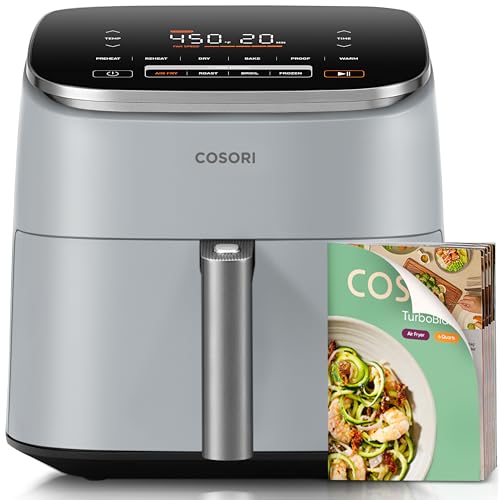
Cosori TurboBlaze 6 Qt Air FryerBest air fryer for drying
|
Basket air fryer with dehydrate | Close on temperature; small basket | Small batches, low settings from 90°F | View on Amazon |

Instant Vortex Plus Mini 4 Qt Air FryerBest for small kitchens
|
Compact air fryer with dehydrate | Fair: low floor, very small batch | Singles, herbs and chile flakes | View on Amazon |

USA Pan Half Sheet Nonstick Cooling Rack, Set of 2Best for the pans you own
|
Two oven-safe racks | Close in a low oven; two shelves at once | Doubling an oven batch | View on Amazon |

Desy & Feeci 8-Layer Hanging Herb Drying RackBest for herbs
|
Hanging mesh air dryer | Herbs only; no heat, so slow | Oregano, epazote and other leafy herbs | View on Amazon |
The other two picks, a stackable three-tier rack for more oven capacity and a dual-zone Instant air fryer for bigger air-fryer batches, are reviewed below.
Our picks for a dehydrator alternative
1. Nordic Ware Naturals Half Sheet with Oven and Cooling Rack – Oven Drying Done Right

The NCHFP’s jerky directions describe the oven method in one line: arrange strips on “cake racks placed on baking sheets for oven drying.” This Nordic Ware set is exactly that, a half sheet pan with a rack that sits in it. The listing says the rack’s grid has diagonal stiffening ribs, holds small and delicate foods so they don’t fall through, and leaves room for air to circulate. That matters for drying, because thin apple rings and chile pieces shrink as they dry and would slip through a wide wire grid.
How well does it work? As well as your oven allows. With a thermometer showing 140°F to 145°F, the door propped open and air moving, it does the same job as a dehydrator tray, only slower and with more attention. Colorado State University Extension notes that oven trays should be about 1½ inches smaller in length and width than the oven so air can move around them; a half sheet fits most full-size ovens with room to spare.
The sheet and rack are uncoated aluminum, oven-safe to 500°F and safe under the broiler, according to the listing, so the set is not wasted the rest of the year: it roasts vegetables and holds carnitas while they crisp. Nordic Ware says it is made in America of domestic and imported materials.
Why we like it
- Rack and pan are sold as a matched set
- Fine grid holds small, shrinking pieces (listing)
- Oven-safe to 500°F, so it’s useful for roasting too
- Made in America of domestic and imported materials
Key specifications
| Model | 43330AMZM |
|---|---|
| Type | Half sheet pan with oven and cooling rack |
| Low-heat setting | Uses your oven; check it holds 140°F to 145°F |
| Capacity | One half sheet |
| Material | Uncoated aluminum |
| Heat limit or power | Oven-safe to 500°F |
| Cleaning | Not stated |
| Made in | USA (domestic and imported materials) |
Why we recommend it
It suits anyone with a full-size oven that holds a low temperature who wants to dry fruit, chiles or jerky a few times a year without buying a machine.
Skip it if your oven’s lowest setting runs well above 145°F on a thermometer; an air fryer with a low dehydrate setting is the better route.
Pros and cons
Pros
- The setup extension guides describe
- Grid suits small pieces
- Useful year-round
Cons
- Only as good as your oven’s low setting
- One tray; most ovens fit two or more
- Oven door stays open for hours
2. Cosori TurboBlaze 6 Qt Air Fryer – Low Settings From 90°F
An air fryer is a small box with a heating element and a strong fan, which is most of what a dehydrator is. The question is whether it can run cool enough. This Cosori lists a temperature range of 90°F to 450°F, five fan speeds and a dedicated dehydrate function among its nine modes, according to the listing. A 90°F floor reaches below the 95°F to 115°F range the NCHFP gives for drying herbs in a dehydrator, and well below the 140°F used for fruit and jerky.
How close does it get? On temperature, close. On capacity, not very. The basket is 6 quarts, so think a sliced apple or two, a tray of chile strips or a few jerky strips at a time, in a single layer. A lighter fan speed is worth trying for leaves and thin slices so they don’t blow around (general kitchen sense, not a maker instruction). The listing says the nonstick basket and crisper plate are dishwasher-safe, and the unit is rated at 1725 watts.
This is the same TurboBlaze model (CAF-DC601) that appears on our air fryer vs toaster oven page, in a different color listing. We use it again here because its 90°F floor is the lowest stated on any air fryer we could include, which is the feature that matters for drying.
Why we like it
- Stated range starts at 90°F
- Dedicated dehydrate mode
- Five fan speeds
- Dishwasher-safe basket and crisper plate
Key specifications
| Model | CAF-DC601-AUS |
|---|---|
| Type | Basket air fryer, 9 functions |
| Low-heat setting | 90°F to 450°F; dehydrate mode |
| Capacity | 6 quarts |
| Material | Nonstick ceramic-coated basket |
| Heat limit or power | 1725 watts |
| Cleaning | Dishwasher-safe basket and crisper plate |
| Made in | Not stated |
Why we recommend it
It suits someone whose oven runs too hot to dry and who would use an air fryer for everyday cooking as well, drying small batches of fruit, chiles or herbs now and then.
Skip it if you want to dry several pounds at once; one basket is a small fraction of a dehydrator’s tray space.
Pros and cons
Pros
- Reaches true drying temperatures
- Adjustable fan
- Earns its space as a daily air fryer
Cons
- One small basket
- Single layer only
- Warranty not stated on this listing
3. Instant Vortex Plus Mini 4 Qt Air Fryer – Small Batches, Small Counter
Instant’s smallest Vortex Plus lists six functions, dehydrate among them, and a temperature dial that runs from 95°F to 400°F, according to the listing. That 95°F floor sits at the bottom of the NCHFP’s herb range and comfortably below 140°F, so it can dry at the temperatures the guides call for.
The limit is size. Instant describes the 4-quart basket as right for up to four servings, aimed at students, singles and small families. For drying, that means a cup or two of sliced fruit, a handful of chiles de árbol or a bunch of herbs at a time. It suits someone who wants to make chile flakes from a few fresh peppers, or dry a small harvest of oregano, rather than put up a season’s worth of mango.
The basket is nonstick, and the listing names overheat protection and auto-shutoff. Power and warranty are not stated on this listing.
Why we like it
- Stated range starts at 95°F
- Dehydrate is one of six functions
- Small footprint for a crowded counter
- Overheat protection and auto-shutoff (listing)
Key specifications
| Model | Vortex Plus 4 (140-3079-01) |
|---|---|
| Type | Compact basket air fryer, 6 functions |
| Low-heat setting | 95°F to 400°F; dehydrate function |
| Capacity | 4 quarts |
| Material | Nonstick basket; stainless exterior |
| Heat limit or power | Not stated |
| Cleaning | Nonstick basket |
| Made in | Not stated |
Why we recommend it
It suits a one- or two-person household that dries small amounts of herbs, chiles or fruit and has little counter space.
Skip it if you cook for a family; the basket is small even for everyday air frying.
Pros and cons
Pros
- Low temperature floor
- Compact
- Simple dial and touchscreen
Cons
- Very small drying area
- Wattage and warranty not stated
4. USA Pan Half Sheet Nonstick Cooling Rack, Set of 2 – Two Oven Shelves at Once
If you already have half sheet pans, you only need the racks. This USA Pan set includes two half sheet racks with a tight crosswire design and six raised feet, oven-safe up to 450°F, according to the listing. USA Pan says they nest into its own half sheet pans, and they’ll sit in most standard half sheets.
Two racks matter for oven drying, because the oven is the one alternative with real capacity. With one rack on each oven shelf you can dry two trays of fruit or jerky in the same hours. NDSU recommends leaving about 2 inches between racks and at least 3 inches of clearance at the top and bottom of the oven, so check your shelf spacing first. Swapping the trays between shelves partway through helps them dry evenly (general kitchen sense).
The racks have a silicone-based nonstick coating that USA Pan says is made without “forever chemicals.” Sticky fruit like mango and pineapple releases more easily from a coated rack, though the coating needs gentler cleaning than bare steel.
Why we like it
- Two racks for two oven shelves
- Tight crosswire grid and six raised feet
- Oven-safe to 450°F
- Nonstick coating helps sticky fruit release
Key specifications
| Model | 1602CR-ST-2 |
|---|---|
| Type | Half sheet cooling and roasting racks, set of 2 |
| Low-heat setting | Uses your oven; check it holds 140°F to 145°F |
| Capacity | Two half sheet racks |
| Material | Aluminized steel, silicone nonstick coating |
| Heat limit or power | Oven-safe to 450°F |
| Cleaning | Not stated |
| Made in | Not stated |
Why we recommend it
It suits a cook who already owns sheet pans and wants to double an oven batch of dried fruit or jerky.
Skip it if you have no half sheet pans; the Nordic Ware set includes one.
Pros and cons
Pros
- Doubles oven capacity
- Stable raised feet
- Easy release
Cons
- Pans not included
- Coated racks need gentle cleaning
- Country of manufacture not stated
5. Desy & Feeci 8-Layer Hanging Herb Drying Rack – Herbs With No Heat
Herbs are the one food the NCHFP says you can dry without any appliance. Its herb directions suggest tying small bundles to hang, or hanging tender-leaf herbs inside paper bags, and leaving them in a well-ventilated area until the moisture evaporates. It also notes that drying indoors usually keeps color and flavor better than drying outdoors.
A hanging mesh dryer does the same job with more room. This one has eight collapsible mesh layers on steel wire rings, about 24 inches across and 61 inches tall when open, with a stated load of 2.2 pounds per layer, according to the listing. Leaves are spread flat on each layer instead of tied in bunches, and the whole thing hangs from an S-hook and folds flat when you’re done.
How well does it work? For Mexican oregano, epazote, bay leaves and other herbs, well, if the room is dry and the air moves. Be realistic about humidity: the NCHFP says that in humid areas even a dehydrator may need up to 125°F for herbs, so a muggy kitchen will be slow. It is not a substitute for heat with fruit, chiles or meat. The NCHFP says vegetables and meats are best dried indoors under the controlled conditions of an oven or food dehydrator.
Why we like it
- No power needed
- Eight layers in a small footprint
- Collapses flat for storage
- Matches the NCHFP’s air-drying method for herbs
Key specifications
| Model | Not stated (8-layer, 60 cm) |
|---|---|
| Type | Hanging mesh air dryer |
| Low-heat setting | None; room-air drying |
| Capacity | 8 layers, 2.2 lb per layer |
| Material | Polyester mesh, steel wire rings |
| Heat limit or power | No power |
| Cleaning | Not stated |
| Made in | Not stated |
Why we recommend it
It suits a gardener with a steady supply of herbs and a dry, airy spot to hang a 5-foot net.
Skip it if you want to dry fruit, chiles or jerky; those need controlled heat.
Pros and cons
Pros
- No energy use
- Lots of flat space for leaves
- Stores flat
Cons
- Herbs only
- Slow in humid weather
- Amazon-first brand, sold by a third-party seller when we checked
6. Ultra Cuisine 3-Tier Stackable Cooling Rack – More Trays on One Shelf

A stacking rack turns one oven shelf into three drying levels. This Ultra Cuisine set has three 16-by-10-inch racks of 304 stainless steel, each standing 2.7 inches tall, that stack or work separately, according to the listing. Ultra Cuisine lists it as oven-safe to 575°F and names drying among its uses, and the set folds flat to store.
The 2.7-inch height leaves a little more than the 2 inches between racks that NDSU recommends. Stacked three high on a sheet pan, it gives jerky strips or apple rings three levels in the space one tray would use. The trade-off is airflow: the middle and top levels get less air than an open shelf, so rotate the tiers and check pieces on each level (general kitchen sense). Measure first, too, since three tiers on a pan need about 9 inches of headroom plus clearance below the top of the oven.
The stainless steel is dishwasher-safe, which helps after sticky marinades.
Why we like it
- Three levels from one oven shelf
- 304 stainless steel, no coating
- Dishwasher-safe
- Folds flat
Key specifications
| Model | UC-CR3T1016SV |
|---|---|
| Type | Stackable 3-tier rack |
| Low-heat setting | Uses your oven; check it holds 140°F to 145°F |
| Capacity | Three 16 x 10 in racks, 2.7 in tall each |
| Material | 304 (18/8) stainless steel |
| Heat limit or power | Oven-safe to 575°F |
| Cleaning | Dishwasher-safe |
| Made in | Not stated |
Why we recommend it
It suits someone drying a big batch of jerky or fruit in an oven with limited shelf positions.
Skip it if your oven is small or you dry only a tray at a time; the flat racks above are simpler.
Pros and cons
Pros
- Triples space per shelf
- Uncoated stainless
- Easy cleanup
Cons
- Less airflow on the stacked levels
- Needs tall oven clearance
- Amazon-first brand
7. Instant VersaZone 9 Qt Air Fryer – Two Drying Zones

The usual problem with drying in an air fryer is a single small basket. Instant’s VersaZone works as one 9-quart space or two 4.5-quart zones with separate controls, according to the listing, and dehydrate is one of its functions. Two zones let you dry chile strips in one and apple slices in the other, or simply run a larger single batch.
How close does it get? Closer on capacity than the other air fryers here, though still far from a stacked dehydrator. One honest gap: this listing does not state the dehydrate temperature range, so check the manual before buying if you plan to dry herbs, which need lower heat than fruit. It’s rated at 1700 watts and ETL certified, the listing says, with overheat protection and auto-off.
The nonstick basket, cooking tray and divider are dishwasher-safe.
Why we like it
- Two zones or one large 9-quart space
- Dehydrate function
- ETL certified (listing)
- Dishwasher-safe basket, tray and divider
Key specifications
| Model | 140-3092-01 |
|---|---|
| Type | Dual-zone air fryer, 8 functions |
| Low-heat setting | Dehydrate function; range not stated |
| Capacity | 9 quarts, or two 4.5-quart zones |
| Material | Nonstick basket |
| Heat limit or power | 1700 watts |
| Cleaning | Dishwasher-safe basket, tray and divider |
| Made in | Not stated |
Why we recommend it
It suits a family that wants a large air fryer for dinner and will dry fruit or jerky in it occasionally.
Skip it if you mainly want to dry herbs; the Cosori and Instant Mini state lower temperature floors.
Pros and cons
Pros
- Most capacity among the air fryers here
- Independent zones
- Stated safety certification
Cons
- Dehydrate temperature range not stated
- Wide footprint
How to dry food in an oven, step by step
These steps come from NDSU Extension’s drying guide and Colorado State University Extension, with the jerky steps from the NCHFP.
- Test the oven first. Set it to its lowest setting with an oven-safe thermometer on the rack. It should hold 140°F to 145°F. If it won’t, use an air fryer with a low dehydrate setting instead. Our best oven thermometer guide covers the tool.
- Get air under and around the food. Use racks set in sheet pans, leaving about 2 inches between racks and 3 inches of clearance top and bottom. Colorado State notes that cheesecloth or netting stretched over racks also works for small pieces.
- Prop the door and move the air. NDSU advises leaving the door open 2 to 6 inches with a fan near the opening. Keep children and pets away.
- Slice evenly and don’t overlap. The NCHFP’s jerky directions say to place pieces close together but not touching.
- Expect it to take a while. Colorado State gives about 6 hours for thin apple slices up to 36 hours for peach halves at 140°F, and NDSU says the time varies with the equipment, the food’s moisture and the humidity.

Food safety when you dry without a dehydrator
Fruit is the most forgiving food to dry. The NCHFP says the high sugar and acid in fruit make it safe to dry outdoors when conditions are right: at least 85°F, ideally with humidity below 60 percent. On a muggy Gulf Coast day, that’s often out of reach, so indoor drying is the practical choice (general kitchen sense). Vegetables, except vine-dried beans, and meats are not recommended for outdoor drying, the NCHFP says. Dry them indoors in an oven or dehydrator.
Jerky and carne seca
Meat needs an extra heating step, whatever you dry it in. The NCHFP’s jerky directions say to dry the strips in a dehydrator or oven preheated to 140°F, and to heat the meat to 160°F in one of two ways. Either bring the strips and marinade to a boil and boil for 5 minutes before draining and drying, or heat the finished jerky for 10 minutes in an oven preheated to 275°F for strips ¼ inch thick or less. The jerky is done when a test piece cracks but doesn’t break when bent; unheated strips take 10 to 24 hours. Our jerky dehydrator guide covers the same rules in more detail.
Herbs
The NCHFP suggests drying herbs in a “very cool oven,” noting that the oven light of an electric range or the pilot light of a gas range gives enough heat for overnight drying. In a dehydrator it suggests 95°F to 115°F, or up to 125°F in humid areas. For small amounts, it says a microwave is a fast option if you follow your microwave’s directions. If you’d rather buy it dried, our best Mexican oregano guide covers what to look for.
When a real dehydrator is the better buy
The alternatives make sense when you dry occasionally. If you dry weekly, or want to put up whole flats of mango or pounds of jerky, a dehydrator is worth the space. The NCHFP recommends looking for a thermostat from 85°F to 160°F, four to 10 mesh trays, enclosed heating elements, a UL seal and a timer. Those are features no oven rack can give you. A dehydrator also runs with its door shut and doesn’t tie up the oven for a day. Our best food dehydrator guide covers the machines, and if you’d rather have one appliance that bakes, air fries and dries, see our best air fryer dehydrator toaster oven guide.
Drying without a dehydrator: your questions
What can I use instead of a dehydrator?
A low oven with racks set in sheet pans is the most common substitute, provided it holds about 140°F. An air fryer with a dehydrate setting works for small batches, and herbs can be air-dried by hanging them in a well-ventilated room.
Can I dehydrate food in my oven?
Yes, if it can hold 140°F to 145°F. Check with an oven thermometer, prop the door open 2 to 6 inches and keep air moving, as NDSU Extension advises. If the lowest setting runs hotter, food can harden on the outside before the inside dries.
Is an air fryer a good dehydrator alternative?
For small batches, yes, if it has a dehydrate setting and a low temperature range. The Cosori TurboBlaze lists 90°F and the Instant Vortex Plus Mini 95°F as their lowest settings. Capacity is the limit.
Can I make jerky without a dehydrator?
Yes. The NCHFP’s jerky directions include oven drying at 140°F on cake racks over baking sheets, plus a step to heat the meat to 160°F, either by boiling the strips in their marinade first or by heating the dried jerky at 275°F for 10 minutes.
Can I dry chiles by hanging them?
Ristras are a long tradition, but the NCHFP’s guidance is to dry vegetables, which include chiles, indoors in an oven or dehydrator rather than outdoors. If you just want dried chiles for cooking, our guide to the best place to buy dried chiles online is the shortcut.
Our final word on drying without a dehydrator
You don’t need a dehydrator to dry food now and then. Start with what you own: test your oven with a thermometer, set a rack in a sheet pan like the Nordic Ware Naturals set, prop the door and keep the air moving. If your oven runs too hot, a low-temperature air fryer such as the Cosori TurboBlaze handles small batches, and a hanging mesh dryer takes care of herbs with no power at all. Follow the NCHFP’s heating step for any meat. If drying becomes a weekly habit, that’s the time to buy the dehydrator. And when you’d rather let someone else cook, see the menu or call to order.