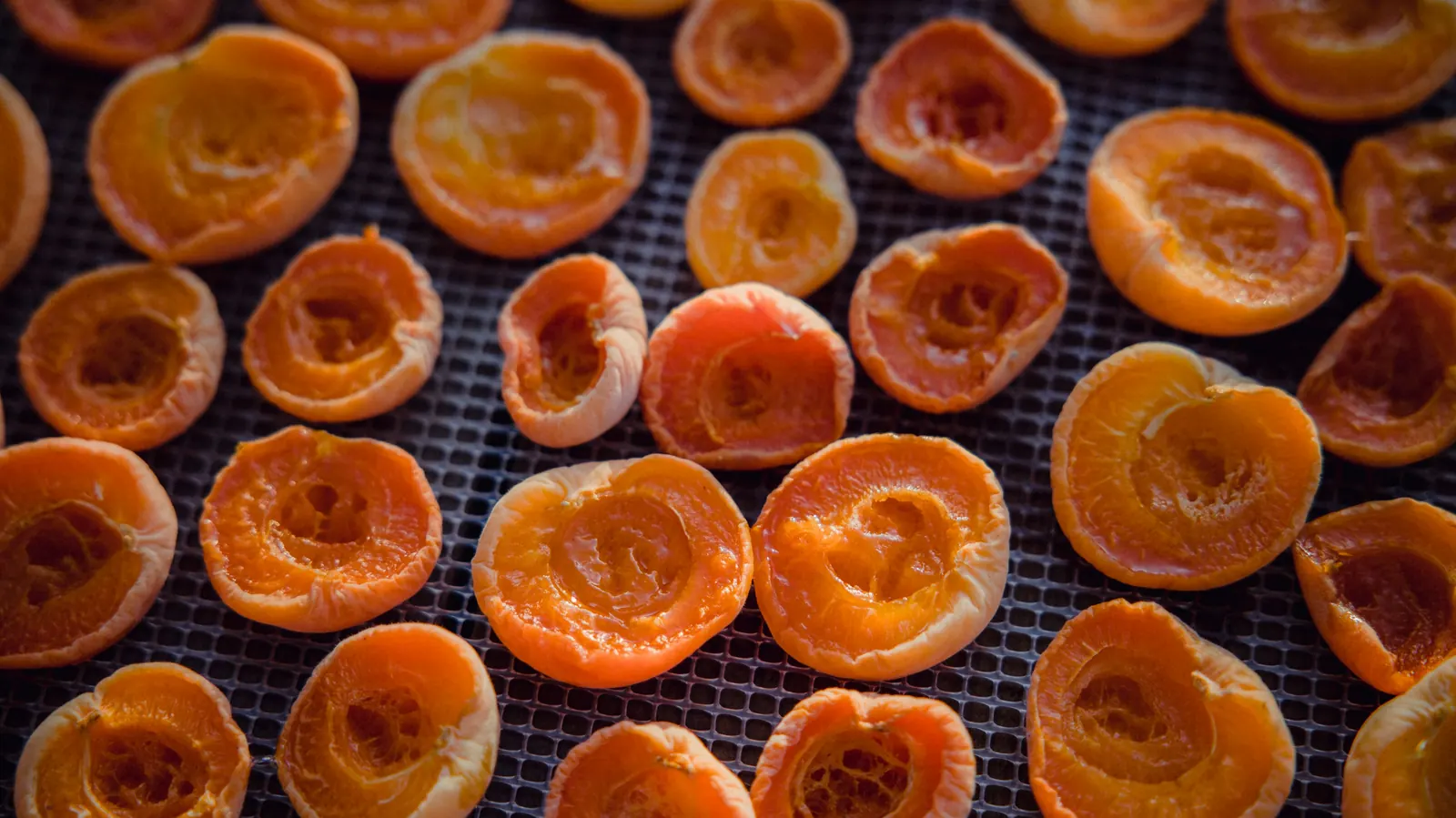
A food dehydrator is a slow, quiet machine: a heater, a fan and a stack of trays that pull the water out of food over many hours. In a Mexican kitchen that covers more than you might think. Fresh red jalapeños, serranos or chiles de árbol from the garden become dried chiles for salsas. Thin slices of ripe mango turn into chewy strips for mango con chile. Lean beef, marinated and dried, is the start of carne seca and the shredded machaca of northern Mexico.
The machines vary more than they look. Some blow air sideways across square shelves, others push it up or down through a stack of round trays, and their temperature ranges, timers and tray materials all differ. This guide covers eight dehydrators, using what each maker and Amazon listing states and America’s Test Kitchen’s review of food dehydrators, plus the food safety steps that matter for meat.
Julia’s earns a commission on purchases made through links on this page, at no cost to you. Recommendations are based on what a restaurant kitchen looks for, product specifications and verified buyer reports.
Quick verdict: which food dehydrator to buy
The best food dehydrator for most kitchens that dry in quantity is the Excalibur Performance 10-Tray: square stainless steel trays, rear-fan horizontal airflow, a range of 85°F to 165°F and a timer of up to 80 hours. Excalibur’s older 9-tray model was America’s Test Kitchen’s winner. For a smaller, lower-cost horizontal machine, the Cosori 6-Tray Stainless Steel is the pick. On a tight budget, the Presto Dehydro comes from the line that made ATK’s Best Buy.
Whatever you dry, start with good raw material. Our guide to Mexican chiles explains which fresh chiles become which dried ones.
Five food dehydrators at a glance
Our five standout picks, one for each kind of cook, with the trays, airflow and temperature range each maker or listing states. All eight dehydrators are reviewed in full below.
| Dehydrator | Best for | Trays and airflow | Temperature and timer | Buy on Amazon |
|---|---|---|---|---|

Excalibur Performance 10-Tray DehydratorBest overall
|
Big batches of chiles, fruit and jerky | 10 stainless trays, horizontal | 85–165°F; up to 80 hours | View on Amazon |

Cosori 6-Tray Stainless Steel DehydratorBest value
|
Horizontal drying for less | 6 stainless trays, horizontal | 95–165°F; up to 48 hours | View on Amazon |

Nesco Snackmaster Pro Digital DehydratorBest stackable
|
Growing from 4 to 12 trays | 4 round trays (up to 12), top fan | 90–160°F; up to 24 hours | View on Amazon |

Magic Mill Pro 7-Tray DehydratorBest all-stainless
|
No plastic near the food | 7 stainless trays, rear fan | 95–176°F; up to 48 hours | View on Amazon |

Presto Dehydro 4-Tray DehydratorBudget pick
|
Trying dehydrating for the first time | 4 round trays, top fan | Preset heat, no dial or timer | View on Amazon |
Product images from Amazon. Trays, ranges and timers are as stated by each maker or listing; check the listing before you buy.
Our picks for the best food dehydrator
The eight machines below split into two designs. Shelf-style boxes, like the Excalibur, Cosori and Magic Mill, have a fan at the back that blows air across every tray at once. Stacking units, like the Nesco, Presto and Hamilton Beach, move air through a tower of round or square trays from the top or the base. Each pick lists the trays, airflow, temperature range and timer its maker states, with one honest reason to skip it.
1. Excalibur Performance 10-Tray Dehydrator – Room for a Whole Harvest
Excalibur is the name most associated with shelf-style dehydrators, and its older 9-tray model, the 3926T, was the winner of America’s Test Kitchen’s food dehydrator review. ATK liked its spacious square trays and the timer that allowed hands-off drying, and noted that long strips of beef fit its trays well. Its drawbacks were bulk and price. That 9-tray model is not the one sold here; this is Excalibur’s current Performance Series, which ATK has not reviewed.
According to the listing, the Performance 10-Tray has ten stainless steel trays with 16 square feet of drying space, a rear fan with what Excalibur calls Horizontal Parallex Air Flow, and a range of 85°F to 165°F with a timer that runs for up to 80 hours. A glass door with a view window lets you check on a batch without opening it, and an LED progress bar shows how far along the cycle is.
For a kitchen that dries in quantity, this is the size that makes sense: a full run of sliced mango, a few pounds of beef for carne seca, or the end-of-season chiles from a backyard plant, all at once and without rotating trays. The low end of the range suits herbs such as Mexican oregano and epazote, and the top end covers the drying stage for meat that has already been heated to a safe temperature (see the food safety section below).
Why we like it
- Ten stainless steel trays, 16 square feet of space
- Rear fan with horizontal airflow, no tray rotation
- 85°F to 165°F range with a timer up to 80 hours
- Glass door with a view window
- 3-year limited warranty, per the listing
Key specifications
| Dehydrator | Excalibur Performance Series, DH10SSSS13 |
|---|---|
| Trays & material | 10, stainless steel |
| Drying space | 16 sq ft |
| Airflow | Horizontal, rear fan |
| Temp range | 85–165°F |
| Timer/auto-off | Up to 80 hours |
| Expandable | No; fixed 10 shelves |
| Warranty | 3-year limited |
Why we recommend it
Choose it if you dry in big batches and want square stainless trays that take long strips of meat and whole slices of fruit without puzzle-fitting.
Skip it if counter space is tight; a ten-shelf box is large, and ATK’s main complaint about the Excalibur it tested was its bulk.
Pros and cons
Pros
- Largest drying area here
- Stainless trays
- Long timer and wide range
Cons
- Bulky
- This series not reviewed by ATK
- Top temperature stops at 165°F
2. Cosori 6-Tray Stainless Steel Dehydrator – Horizontal Airflow for Less
The Cosori gives you the same basic design as the Excalibur, a box with shelves and a rear fan, in a smaller and less costly package. The listing gives six stainless steel trays with 6.5 square feet of drying space, a 600-watt rear-mounted fan and a digital panel that sets the temperature from 95°F to 165°F one degree at a time and the timer for up to 48 hours.
Cosori lists a brushless motor running below 48 decibels, which matters if the machine runs overnight in an open kitchen. The trays are dishwasher safe, and the box includes a mesh screen for small pieces such as chopped chiles or herbs, a fruit roll sheet and a recipe book. The listing for the same model in black adds automatic shutoff and overheat protection and says it is ETL listed.
Six shelves cover a typical home batch of sliced mango, chiles or thin-cut beef. If you find yourself running it every weekend, that is the point to look at a bigger machine.
Why we like it
- Stainless steel, dishwasher-safe trays
- Rear fan with horizontal airflow
- One-degree temperature steps from 95°F to 165°F
- Quiet brushless motor, under 48 dB per Cosori
- 2-year warranty
Key specifications
| Dehydrator | Cosori CP267-FD |
|---|---|
| Trays & material | 6, stainless steel |
| Drying space | 6.5 sq ft |
| Airflow | Horizontal, rear fan |
| Temp range | 95–165°F |
| Timer/auto-off | Up to 48 hours; automatic shutoff |
| Expandable | Not stated |
| Warranty | 2 years |
Why we recommend it
Choose it if you want shelf-style, even drying and stainless trays without paying for a ten-tray machine.
Skip it if you plan to dry large harvests regularly; six trays fill quickly, and the listing does not offer extra shelves.
Pros and cons
Pros
- Even horizontal airflow
- Precise digital controls
- Quiet for overnight runs
Cons
- Mid-size capacity
- Not in the reviews we read
- Tops out at 165°F
3. Nesco Snackmaster Pro Digital Dehydrator – Add Trays as You Go
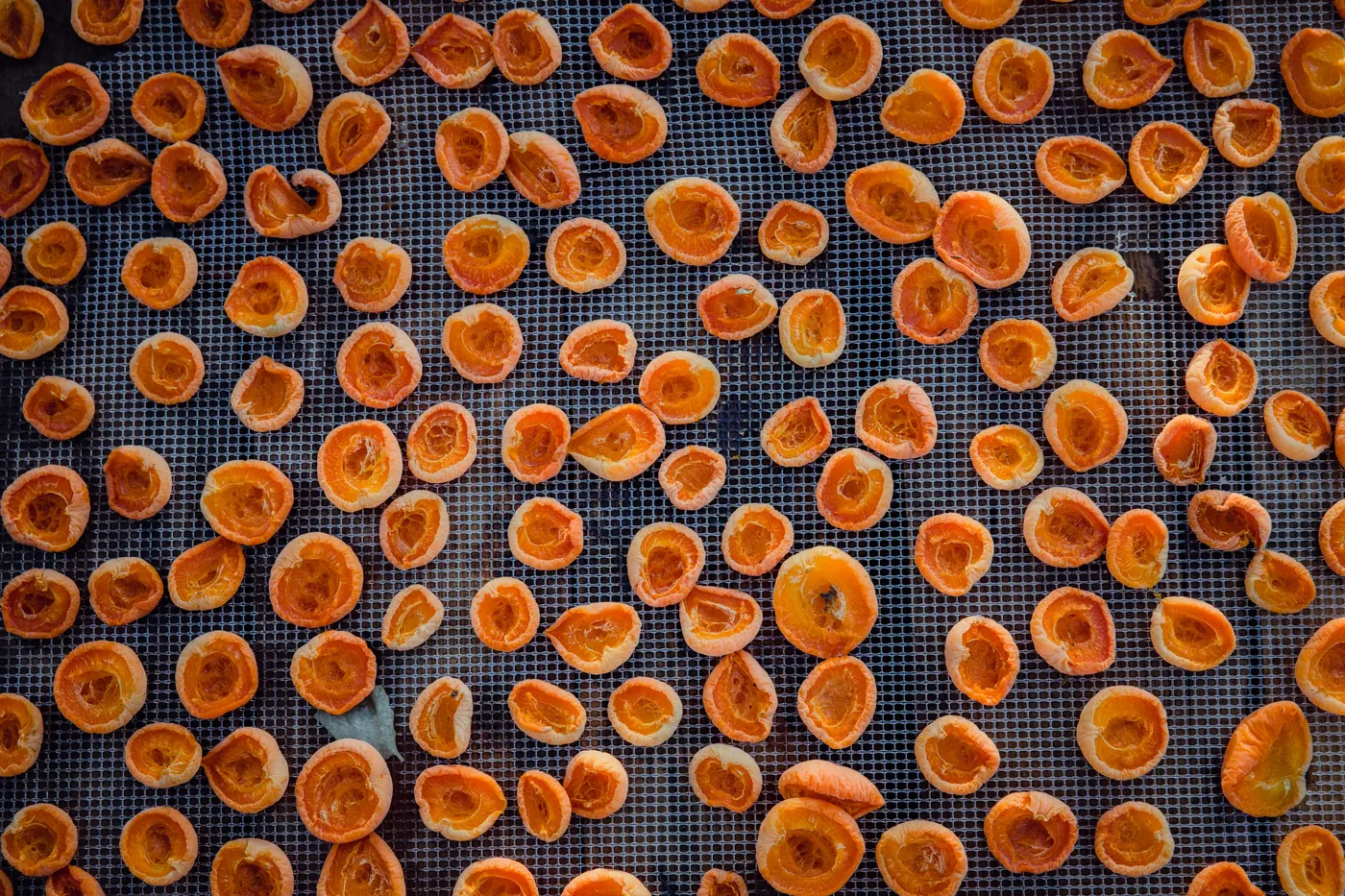
Nesco’s round, stacking dehydrators have been around for decades, and the FD-79 is the digital version of its Snackmaster. It comes with four 13½-inch trays and expands to 12 with Add-A-Trays sold separately, so you can run four trays for a small batch of chiles and stack on more when the mangoes are cheap.
The fan sits on top, which Nesco says keeps juices from dripping into the heater. According to Nesco, the fan pushes heated air down the outside of the chamber and then across each tray, converging in the center, so there is no need to rotate trays. The digital controls set 90°F to 160°F, and Nesco says the timer runs for up to 24 hours and switches off automatically. It is rated at 600 watts.
The box includes two fruit roll sheets, two fine-mesh screens and a sample of jerky seasoning and cure. Nesco says it is made in the USA of global and domestic components, with the powerhead imported. America’s Test Kitchen tested an earlier Snackmaster Pro, the FD-75, and rated it Recommended, noting that the lid-mounted fan made it hard to check food and that it had no timer; the FD-79 adds a timer. ATK also found that round trays with a center hole made arranging long strips of jerky harder.
Why we like it
- Expands from 4 to 12 trays
- Top-mounted fan away from drips
- Digital 90°F to 160°F with a 24-hour auto-off timer
- Screens and fruit roll sheets included
Key specifications
| Dehydrator | Nesco FD-79 |
|---|---|
| Trays & material | 4 round 13½-inch BPA-free trays |
| Drying space | 0.8 sq ft per tray (3.2 sq ft with 4) |
| Airflow | Top fan; air down the sides and across each tray |
| Temp range | 90–160°F |
| Timer/auto-off | Up to 24 hours; auto-off |
| Expandable | Yes, to 12 trays |
| Warranty | 1 year |
Why we recommend it
Choose it if you want to start small and add capacity later, or you need a machine that stores in a cabinet.
Skip it if you mostly make jerky or carne seca; round trays with a center hole are awkward for long strips, as ATK found.
Pros and cons
Pros
- Grows with your batches
- Compact to store
- Auto-off timer
Cons
- Round trays waste space
- Must lift the lid to check food
- Trays are not stainless
4. Magic Mill Pro 7-Tray Dehydrator – Stainless Inside and Out
Magic Mill’s Pro is for the cook who does not want plastic anywhere near the food. The listing describes a stainless steel exterior, a stainless interior and seven full-size stainless steel trays, with a 600-watt rear fan and rear heater blowing across every shelf.
It has the widest range of the shelf-style machines here, 95°F to 176°F in one-degree steps, and a 48-hour timer in 30-minute steps with automatic shutoff. When a cycle ends, a keep-warm mode holds 95°F for up to 24 hours. The box includes two mesh screens for small pieces and a fruit roll sheet that doubles as a drip tray, which is useful under marinated beef. The listing also states overheat protection and an ETL listing.
A higher ceiling does not replace the food safety steps for meat. University of Kentucky Extension, citing the USDA, says to heat meat to 160°F before drying and then keep the dehydrator between 130°F and 140°F. The extra range is still handy for drying thick pieces quickly.
Why we like it
- Stainless trays, interior and exterior
- Rear fan with horizontal airflow
- 95°F to 176°F in one-degree steps
- 48-hour timer with auto shutoff and keep-warm
Key specifications
| Dehydrator | Magic Mill Pro MFD-7700 |
|---|---|
| Trays & material | 7, stainless steel |
| Drying space | Not stated |
| Airflow | Horizontal, rear fan |
| Temp range | 95–176°F |
| Timer/auto-off | Up to 48 hours; auto shutoff; keep-warm |
| Expandable | Not stated |
| Warranty | Not stated |
Why we recommend it
Choose it if you want an all-stainless box with a wide temperature range and a keep-warm mode for runs that finish while you sleep.
Skip it if you want an independent review behind your pick; we found none for this model, and the listing does not state a warranty.
Pros and cons
Pros
- No plastic trays or walls
- Widest range of the box models
- Drip tray included
Cons
- Warranty not stated
- Not independently reviewed
- Drying area not stated
5. Presto Dehydro 4-Tray Dehydrator – A Simple, Low-Cost Start
The Presto Dehydro is the plainest machine here, and that is its appeal. America’s Test Kitchen’s Best Buy was the digital Dehydro, model 06301, which ATK said produced “very good dehydrated food” and was often the second machine to finish. That digital model was out of stock when we checked, so this is its simpler sibling, the 06300, which ATK did not test.
According to Presto, the 06300 has a 600-watt top-mounted fan and heating element, four drying trays and room to expand to eight with extra trays sold separately. The trays nest when not in use to save storage space, and the cord wraps around the cover. There is no temperature dial and no timer: you switch it on, check the food, and switch it off.
That makes it best for fruit, vegetables and chiles, where a few hours either way matters less. For meat, heat the strips to 160°F first, as the extension guidance below explains, and keep a close eye on them. If you later want more control, Presto’s add-on trays, mesh screens and fruit roll sheets all fit.
Why we like it
- From the line that made ATK’s Best Buy
- Expands from 4 to 8 trays
- Trays nest for compact storage
- Top-mounted fan, no tray rotation per Presto
Key specifications
| Dehydrator | Presto Dehydro 06300 |
|---|---|
| Trays & material | 4 round trays; material not stated |
| Drying space | Not stated |
| Airflow | Top-mounted fan and heater |
| Temp range | Preset; no dial (figure not stated by Presto) |
| Timer/auto-off | None |
| Expandable | Yes, to 8 trays |
| Warranty | 1-year limited |
Why we recommend it
Choose it if you want to find out whether you will actually dry chiles and fruit before buying a bigger machine.
Skip it if you want to set a temperature for herbs or meat; this model has no dial and no timer.
Pros and cons
Pros
- Very simple
- Expandable
- Stores small
Cons
- No temperature control
- No timer
- Not the model ATK tested
6. Cosori 5-Tray Compact Stainless Dehydrator – Small Footprint, High Ceiling
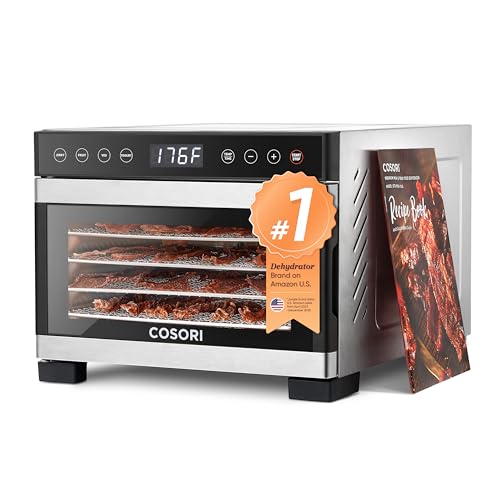
If the six-tray Cosori is still too big for your counter, this smaller model keeps the same idea, a rear fan blowing across stainless shelves, in a box the listing gives as 13.9 by 11.3 by 8.9 inches. It has five stainless steel trays with 3.1 square feet of drying space, and Cosori says no plastic touches the food.
The range runs from 95°F to 176°F in one-degree steps, with a 48-hour timer and four presets for jerky, fruit, vegetables and yogurt that you can adjust. The box includes a mesh screen, a fruit roll sheet and a recipe book. The listing makes a claim about the USDA and jerky temperatures that does not match the extension guidance we read, so follow the food safety steps below instead.
Three square feet is a modest amount of space: a couple of mangoes, a tray or two of sliced chiles, or a small batch of carne seca. For a household of two, that may be all you need.
Why we like it
- Compact footprint, per the listing
- Stainless trays; no plastic contact with food
- 95°F to 176°F with a 48-hour timer
- Adjustable presets
Key specifications
| Dehydrator | Cosori P501 |
|---|---|
| Trays & material | 5, stainless steel |
| Drying space | 3.1 sq ft |
| Airflow | Horizontal, rear fan |
| Temp range | 95–176°F |
| Timer/auto-off | Up to 48 hours |
| Expandable | Not stated |
| Warranty | 2 years |
Why we recommend it
Choose it if you want horizontal airflow and stainless trays in the smallest box here.
Skip it if you dry for a family; at 3.1 square feet it holds about half of what the six-tray Cosori does.
Pros and cons
Pros
- Fits small counters
- High top temperature
- Presets you can adjust
Cons
- Small capacity
- Listing’s jerky claim is off
- Not in the reviews we read
7. Excalibur Select 8-Tray Dehydrator – Glass French Doors

The Select Series is Excalibur’s mid-size option. It shares the Performance model’s horizontal airflow, 85°F to 165°F range and 80-hour timer, but has eight chrome trays instead of ten stainless ones, and Excalibur describes it as a compact design with a smaller footprint. Clear glass French doors open from the middle, so you can reach any shelf without moving the others.
Chrome-plated trays are the main difference to weigh. The listing does not say how the chrome trays should be cleaned, so check the manual before soaking them or running them through the dishwasher. The warranty is also shorter, one year against the Performance model’s three.
For a family that dries chiles, fruit and the occasional batch of beef, eight shelves are a comfortable middle ground between the Cosori’s six and the Performance’s ten.
Why we like it
- Eight trays with horizontal airflow
- Glass French doors
- 85°F to 165°F with up to 80 hours
- Smaller footprint than the 10-tray, per Excalibur
Key specifications
| Dehydrator | Excalibur Select Series, DH08SCSS13 |
|---|---|
| Trays & material | 8, chrome |
| Drying space | Not stated |
| Airflow | Horizontal, rear fan |
| Temp range | 85–165°F |
| Timer/auto-off | Up to 80 hours |
| Expandable | No; fixed 8 shelves |
| Warranty | 1-year limited |
Why we recommend it
Choose it if you want Excalibur’s design and controls in a slightly smaller box with doors that open wide.
Skip it if you want stainless trays and a longer warranty; the Performance 10-Tray has both.
Pros and cons
Pros
- Easy access through French doors
- Long timer
- Good mid-size capacity
Cons
- Chrome, not stainless, trays
- 1-year warranty
- Not reviewed by ATK
8. Hamilton Beach 5-Tray Digital Dehydrator – Dishwasher-Safe Trays

Hamilton Beach’s digital dehydrator is a stacking design with five trays and 4.2 square feet of drying space, according to the listing. A 500-watt heater and fan sit in the base and push air up through the stack, and Hamilton Beach says the trays do not need rotating.
The digital controls set 100°F to 160°F and count down from 1 to 48 hours, then switch the machine off. The lid is clear and vented, so you can watch a batch without lifting it. The trays and lid go in the dishwasher (Hamilton Beach says not to use heated drying or sanitize cycles), and the box includes a mesh screen for herbs and a solid sheet for fruit leather.
With the heater below, juices from marinated beef or very ripe mango can drip toward it, so use the solid sheet on the bottom tray for wet foods. The 100°F floor is also a little high for delicate herbs.
Why we like it
- Five trays, 4.2 square feet
- 48-hour timer with auto shutoff
- Clear vented lid
- Dishwasher-safe trays and lid
Key specifications
| Dehydrator | Hamilton Beach 32100A |
|---|---|
| Trays & material | 5, BPA-free plastic |
| Drying space | 4.2 sq ft |
| Airflow | Vertical, base heater and fan |
| Temp range | 100–160°F |
| Timer/auto-off | 1–48 hours; auto shutoff |
| Expandable | Not stated |
| Warranty | 1 year |
Why we recommend it
Choose it if easy cleanup and a set-and-forget timer matter more to you than tray material.
Skip it if you dry a lot of herbs or marinated meat; the 100°F minimum and base-mounted heater suit fruit and chiles better.
Pros and cons
Pros
- Dishwasher-safe parts
- Auto-off timer
- See-through lid
Cons
- Heater below the food
- Plastic trays
- 100°F minimum
How to choose a food dehydrator for chiles, fruit and beef
Start with what you will dry most often, then match the machine to it.
1. Airflow: across the shelves or through the stack
America’s Test Kitchen explains the two designs simply: sliding-shelf models have a fan in the back, and stacking models have one at the top or bottom; both blow heated air across the food to carry moisture away. Rear-fan boxes such as the Excalibur, Cosori and Magic Mill treat every shelf about the same and keep drips away from the heater. Stacking units are cheaper and more compact, and models like the Nesco and Presto can grow with extra trays.
2. Tray shape and material
ATK found that large square or rectangular trays hold more and are easier to load, while round trays with a center hole made arranging food “like a jigsaw puzzle.” That matters most for long strips of beef. Stainless steel trays, which the Cosori and Magic Mill listings describe as dishwasher safe or food-grade, avoid plastic contact with food; plastic trays are lighter and cheaper. A fine mesh screen is worth having for chopped chiles, seeds and herbs that would fall through.

3. Temperature range and timer
ATK suggests about 90°F to 100°F for herbs and 135°F to 140°F for most fruit and vegetables, so a dial that reaches down low is useful for Mexican oregano and epazote (our guide to Mexican herbs covers both). A timer with automatic shutoff lets a batch finish overnight. The Presto 06300 has neither a dial nor a timer, which is the trade-off for its simplicity.
4. Food safety for jerky, carne seca and machaca
Drying alone is not a cooking step. University of Kentucky Extension, citing the USDA, says to heat meat to 160°F, or poultry to 165°F, before the dehydrating process begins, then keep the dehydrator between 130°F and 140°F during drying, and to check the meat with a thermometer. The National Center for Home Food Preservation gives two methods: heat the strips in their marinade before drying, or heat the dried strips in a 275°F oven for 10 minutes for strips ¼ inch or thinner. It also says raw poultry is generally not recommended for jerky. A good meat thermometer makes the pre-heating step easy.
5. Capacity and counter space
Buy for your usual batch, not your biggest dream harvest. A household that dries a few mangoes and a bag of chiles each month is well served by five or six trays. Ten trays make sense if you dry meat in quantity or put up a garden’s worth of peppers each fall.
6. What about an air fryer with a dehydrate setting?
Many air fryers now include a dehydrate mode. Ninja’s AF101, for example, lists dehydrate among its four functions and a range starting at 105°F, in a 4-quart basket. That is fine for a handful of chile slices or a few strips of fruit, but a 4-quart basket holds far less than even the smallest dehydrator here. If you already own one, try it before buying a second machine; our best air fryer guide covers the models.
How we picked these eight dehydrators
We started with America’s Test Kitchen’s food dehydrator review, which named the Excalibur 3926T its winner, the digital Presto Dehydro 06301 its Best Buy, and the Nesco Snackmaster Pro FD-75 Recommended. That review is several years old, and the exact Excalibur and Nesco models it tested are no longer the ones on sale, so we chose each maker’s current in-stock models and say in each pick what ATK did and did not test. We added shelf-style and stacking machines from established makers to cover different sizes, tray materials and temperature ranges, taking every specification from the maker’s page or the Amazon listing and writing “Not stated” where they are silent.
We checked every pick against the CPSC recall database. Recalls we found involve different models: Excalibur EZ DRY dehydrators (models TTEVM50W, EVM50W and EPD60W, recalled by Greenfield World Trade over fire hazards), the Nesco American Harvest Gardenmaster FD-1020 with certain date codes, three older American Harvest Snackmaster models (FD-30, FD-50 and FD-50T), and Brod & Taylor’s Sahara folding dehydrator (DR710, within a recalled serial range). None of those is recommended here, and the Sahara was not available in stock on Amazon when we checked. We have not used these machines ourselves, and we were unable to read Serious Eats’ or Wirecutter’s dehydrator reviews for this guide, so we do not quote them.
Food dehydrator questions, answered
What is the best food dehydrator brand?
Excalibur made America’s Test Kitchen’s winning dehydrator and is the standard for shelf-style machines. Presto made ATK’s Best Buy, and Nesco is the long-running name in stacking dehydrators. Cosori and Magic Mill make shelf-style models with stainless trays.
Which food dehydrator does America’s Test Kitchen recommend?
ATK’s winner was the Excalibur Food Dehydrator, model 3926T, and its Best Buy was the Presto Dehydro Digital, model 06301. The Aroma Professional 6 Tray and the Nesco Snackmaster Pro FD-75 were Recommended. Neither the winner nor the Best Buy was in stock in that exact form when we checked, so this guide lists current alternatives.
What is the best food dehydrator for home use?
For most homes, a five- to six-tray shelf-style machine such as the Cosori 6-Tray, with a timer and a range down to 95°F. If you are not sure you will use it, the Presto Dehydro is an inexpensive way to find out.
Can I dry chiles in a food dehydrator?
Yes. Slice thicker chiles, or split them, so they dry evenly, and use a mesh screen for small pieces. If you would rather buy them already dried, see where to buy dried chiles online.
How do I store dried mango, chiles and carne seca?
Let everything cool completely, then pack it airtight. A vacuum sealer helps dried chiles and beef keep longer, and a sprinkle of chile-lime seasoning turns dried mango into a snack; our chamoy vs. Tajín guide explains the two classic toppings.
Our final pick for drying at home
Buy the Excalibur Performance 10-Tray if you dry in quantity, or the Cosori 6-Tray for the same horizontal design at a smaller size. Choose the Nesco Snackmaster Pro if you want to start small and add trays, the Magic Mill Pro for an all-stainless machine, and the Presto Dehydro for the simplest, least costly way to begin.

More small-appliance guides: food processors, personal blenders, hand mixers, vegetable choppers, spice grinders, meat grinders, yogurt makers, pasta makers, bread machines.
Making jerky? See our guide to the best food dehydrators for jerky.
On a budget? See our guide to the best value food dehydrators.
Related guide: Dehydrator alternative.
Dried chiles are only as good as the spices you cook them with, so see our guide to the best Mexican spices. And when you would rather someone else did the cooking, see our menu or call to order.