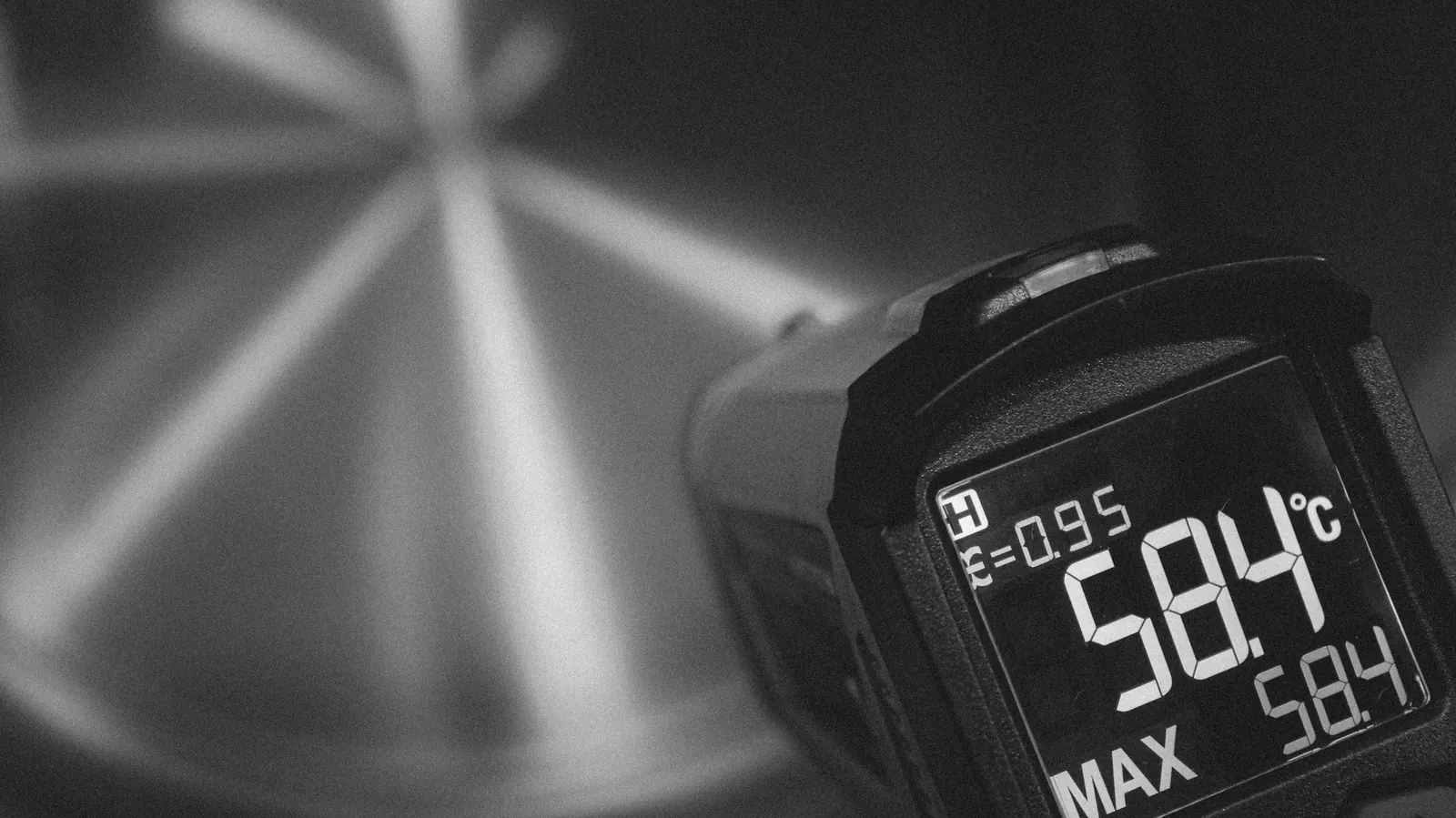
An infrared thermometer and a probe thermometer both put a number on heat, but they answer different questions. The infrared gun tells you how hot a surface is, from a distance, in a fraction of a second: the comal, the cast iron, the pizza stone. The probe tells you how hot the inside of the food is, which is the number that decides whether chicken is safe to eat. Buying the wrong one for the job gives you a confident reading of the wrong thing.
This guide compares the two on what each measures, doneness and food safety, cookware, frying oil, accuracy and ease of use, then names one pick for each side. Safe temperatures come from Penn State Extension, which follows FoodSafety.gov, and the performance points come from America’s Test Kitchen’s reviews of both kinds of thermometer.
Julia’s earns a commission on purchases made through links on this page, at no cost to you. Recommendations are based on what a restaurant kitchen looks for, product specifications and verified buyer reports.
Quick verdict: infrared or probe?
If you buy only one, buy a probe thermometer. It is the one that tells you when meat, poultry and casseroles reach a safe internal temperature, and America’s Test Kitchen says plainly that an infrared thermometer cannot tell you whether meat is done. Add an infrared thermometer if you cook on surfaces where heat matters: a comal for tortillas, a griddle, a skillet for searing or a pizza stone. The two do not compete; they cover different halves of the job.
The table sums up the differences. The sections after it explain each one.
Infrared vs probe thermometer, side by side
| Infrared | Probe | |
|---|---|---|
| What it reads | Surface temperature, without contact (ATK) | Internal temperature of food, oil or syrup |
| Meat doneness and safety | No (ATK) | Yes; insert into the thickest part (Penn State) |
| Comal, griddle, skillet, pizza stone | Yes (ATK) | Not designed for it |
| Oven air | No (ATK) | Some leave-in models can check it (ATK) |
| Frying oil | Not recommended by ATK | Yes; clip-on or leave-in probe (ATK) |
| Shiny cookware | Needs adjustable emissivity (ATK) | Not affected |
| Contact with food | None | Inserted; clean between uses |
| Best for | Preheating surfaces evenly | Knowing when food is cooked and safe |
What each one actually measures
An infrared thermometer reads the heat radiating from whatever it is pointed at. America’s Test Kitchen’s 2025 review of infrared thermometers, by Miye Bromberg, puts the limit clearly: because infrared thermometers measure surface temperature, not internal or air temperature, they cannot tell you whether meat is done or whether an oven has preheated. Point one at a steak and you learn how hot the crust is, not the center.
A probe thermometer works the other way. Its metal stem goes into the food, so it reads the temperature where the sensor sits. Penn State Extension says to insert a thermometer into the thickest part of the food, in two different places, and to push a digital stem ¼ to ½ inch or deeper into the food. A leave-in probe stays there for the whole cook; America’s Test Kitchen’s leave-in review says these let you monitor a roast or brisket without ever opening the oven or grill.
Doneness and safe temperatures: only a probe can tell
Food safety rests on internal temperature, so this is the decisive difference. Penn State Extension, citing FoodSafety.gov, lists these safe minimum cooking temperatures:
- All poultry, including ground poultry: 165°F.
- Ground meat and meat mixtures: 160°F.
- Fresh beef, veal, lamb and pork steaks, roasts and chops: 145°F, with a 3-minute rest.
- Leftovers and casseroles: 165°F.
- Egg dishes such as quiches and frittatas: 160°F.
An infrared reading cannot confirm any of these, because the surface of a chicken thigh can be far hotter than the meat next to the bone. That is why the answer for anyone who cooks meat is a probe first. Use it for carnitas, a pork shoulder for cochinita, chicken for tinga, a tray of enchiladas reheated the next day, or a pan of tamales being warmed through. For the difference between a quick instant-read probe and a leave-in probe, see our instant-read vs probe thermometer guide.
Surfaces: where infrared is the right tool
On a hot surface, a probe is the wrong tool and infrared is the right one. ATK calls infrared thermometers useful for learning the surface temperature of anything you cook or bake on, such as the heat at which a skillet sears steak best, for checking whether a griddle has preheated evenly, and for a baking stone. A single trigger pull tells you whether the comal is ready for tortillas, or whether one side of a plancha is cooler than the other.
That is the case for a pizza oven too. Our best infrared thermometer for pizza oven guide covers range and spot size for the hottest stones. As general kitchen sense, not a maker rule: aim at the cooking surface itself, not at a flame, smoke or steam, which can throw the number off.
Shiny pans and emissivity
Infrared readings depend on the surface. ATK explains that readings are affected by how shiny the object is: thermometers with fixed emissivity assume every object has an emissivity of 0.95, which makes them much less accurate on shiny cookware. In ATK’s tests, one fixed-emissivity model was off by as much as 175 degrees on shinier cookware. That makes adjustable emissivity a key feature.
A seasoned comal or black cast iron is easy for an infrared gun. Polished stainless steel and bright aluminum are not. ATK’s tip for a shiny pan is to add a thin layer of oil and measure that, with emissivity set to 0.95. A probe has none of this trouble, because it reads by contact.
Frying oil and sugar: the probe wins
For frying churros, chiles rellenos or flautas, the oil temperature is what matters. ATK’s infrared review does not recommend an infrared thermometer for frying oil, and suggests a clip-on probe for tracking food or oil temperature over time. Its leave-in review says these probes can sit in food, oil or syrup and give a constant readout, with a high alarm when oil or sugar reaches the target.
As general kitchen sense: an infrared gun only sees the top of the oil, which can differ from the oil deeper in the pot. A probe in the oil gives the number you actually fry at. For candy and cajeta, our candy thermometer guide covers probes made for sugar.
Speed, distance and ease of use
Infrared is faster to take and touches nothing. Etekcity says its Lasergrip 1260 shows a reading in under half a second after the trigger is pulled. ATK notes that a larger distance-to-spot ratio lets you pinpoint smaller areas from farther away, and its reviewer preferred 12:1 among the models tested.
A probe is slower to read but keeps reading. A leave-in model sits in the roast with its cord running out of the oven, so you watch the number climb on the display and get an alarm at your target. The trade-off is cleaning: the probe touches raw food, so wash it between uses. Penn State Extension describes the ice-water check for accuracy: a digital thermometer that does not read 32°F in ice water should be replaced.
Choose infrared if… / Choose a probe if…
Choose infrared if…
- You want to know when the comal, griddle or skillet is ready.
- You bake on a pizza stone or in a pizza oven.
- You want to check that a surface heats evenly.
- You already own a probe for meat.
Choose a probe if…
- You cook meat, poultry or casseroles and need a safe internal temperature.
- You fry, and want the oil temperature over time.
- You roast or smoke for hours and want an alarm.
- You only want one thermometer.
Our pick on each side of the infrared vs probe thermometer question
One pick per side. Both were in stock when we checked, and neither exact listing appears on our other pages.
1. Etekcity Lasergrip 1260 Infrared Thermometer – Color Display and Adjustable Emissivity

An infrared temperature gun with a color LCD and large digits. Etekcity says it measures from -58°F to 1130°F with an accuracy of ±2%, which covers a comal, a griddle and a pizza stone. The reading appears in under half a second after the trigger is pulled and locks when you let go, and the display also shows the maximum temperature.
Emissivity adjusts from 0.1 to 1.0 by holding the up and down buttons, with 0.95 recommended for normal household use. That is the feature ATK calls key for shiny cookware. The listing does not state a distance-to-spot ratio. Etekcity offers a 2-year warranty. ATK named a different Etekcity model, the Lasergrip 1022, its Best Buy, calling it a solid option for useful, reliable ballpark temperatures; this 1260 was not part of that review.
Why we like it
- Adjustable emissivity, 0.1 to 1.0 (listing)
- Range to 1130°F (listing)
- Color display with max reading
- 2-year warranty (Etekcity)
Key specifications
| Model | Lasergrip 1260 |
|---|---|
| Range | -58°F to 1130°F |
| Stated accuracy | ±2% |
| Emissivity | Adjustable, 0.1–1.0 |
| Reads | Surfaces only, no contact |
| Warranty | 2 years |
Why we recommend it
It suits a cook who wants to know when a comal, griddle, skillet or pizza stone is at the right heat.
Skip it as your only thermometer if you cook meat; it cannot read the inside of food.
Pros and cons
Pros
- Fast, no-contact readings
- Adjustable emissivity for shiny pans
- Easy-to-read color screen
Cons
- No internal or oven-air readings
- Distance-to-spot ratio not stated
- Not tested by ATK
2. OXO Good Grips Chef’s Precision Digital Leave-In Thermometer – USDA Presets and Early Alarm

A leave-in probe thermometer with a stainless steel probe and cord and a base with a large LCD. The listing says the cord withstands temperatures up to 700°F, so it can go in an oven, under a broiler or on a grill, and the probe continuously monitors internal temperature. You set a target, or choose from preset USDA and chef-recommended temperatures for nine types of meat, poultry and fish, and there is a 24-hour timer.
America’s Test Kitchen rated this OXO leave-in probe (model 11231300) Recommended in its 2025 leave-in review, calling it very accurate and praising the early warning alarm that sounds when food is within 10 degrees of its target. ATK’s complaints: the console is large, there is no low alarm, it reads more slowly than the top models, and changing the alarm temperature takes longer. The cord and probe nest inside the base for storage.
Why we like it
- Very accurate in ATK’s leave-in review
- Early alarm 10 degrees before target (ATK)
- Preset USDA temperatures (listing)
- Cord rated to 700°F (listing)
Key specifications
| Model | 11231300 |
|---|---|
| Type | Leave-in probe with base display |
| Probe and cord | Stainless steel; cord to 700°F |
| Presets | Nine meats, poultry and fish |
| Timer | 24 hours |
| Reads | Internal temperature |
Why we recommend it
It suits a cook who roasts, smokes or braises and wants to know the inside temperature without opening the oven.
Skip it if you want a quick spot check in seconds; an instant-read is faster for that.
Pros and cons
Pros
- Accurate internal readings
- Alarm before and at target
- Stays in for long cooks
Cons
- Large console (ATK)
- No low alarm (ATK)
- Slow to change alarm settings (ATK)
Infrared and probe thermometer questions, answered
Can an infrared thermometer check if meat is done?
No. ATK says infrared thermometers measure surface temperature and cannot tell you whether meat is done. Use a probe in the thickest part of the meat.
Can a probe thermometer read a pan or comal?
It is not designed to. A probe reads what it is inserted into; for a cooking surface, an infrared thermometer is the right tool.
Which is better for frying oil?
A probe. ATK does not recommend an infrared thermometer for frying oil and suggests a clip-on or leave-in probe that tracks oil temperature over time.
Why does my infrared thermometer read low on a stainless pan?
Shiny surfaces throw off infrared readings. ATK found a fixed-emissivity model off by as much as 175 degrees on shiny cookware. Adjust emissivity, or measure a thin layer of oil in the pan.
What temperature should chicken reach?
165°F for all poultry, according to Penn State Extension, which follows FoodSafety.gov. Measure it with a probe.
Which thermometer to buy first
Buy a probe first, because safe cooking depends on internal temperature. Add an infrared thermometer when you start cooking on a comal, griddle or pizza stone and want to know the surface heat. For more probes, see our best meat thermometer and instant-read meat thermometer guides; for the oven itself, our oven thermometer guide. And when you would rather someone else did the cooking, see the menu or call to order.