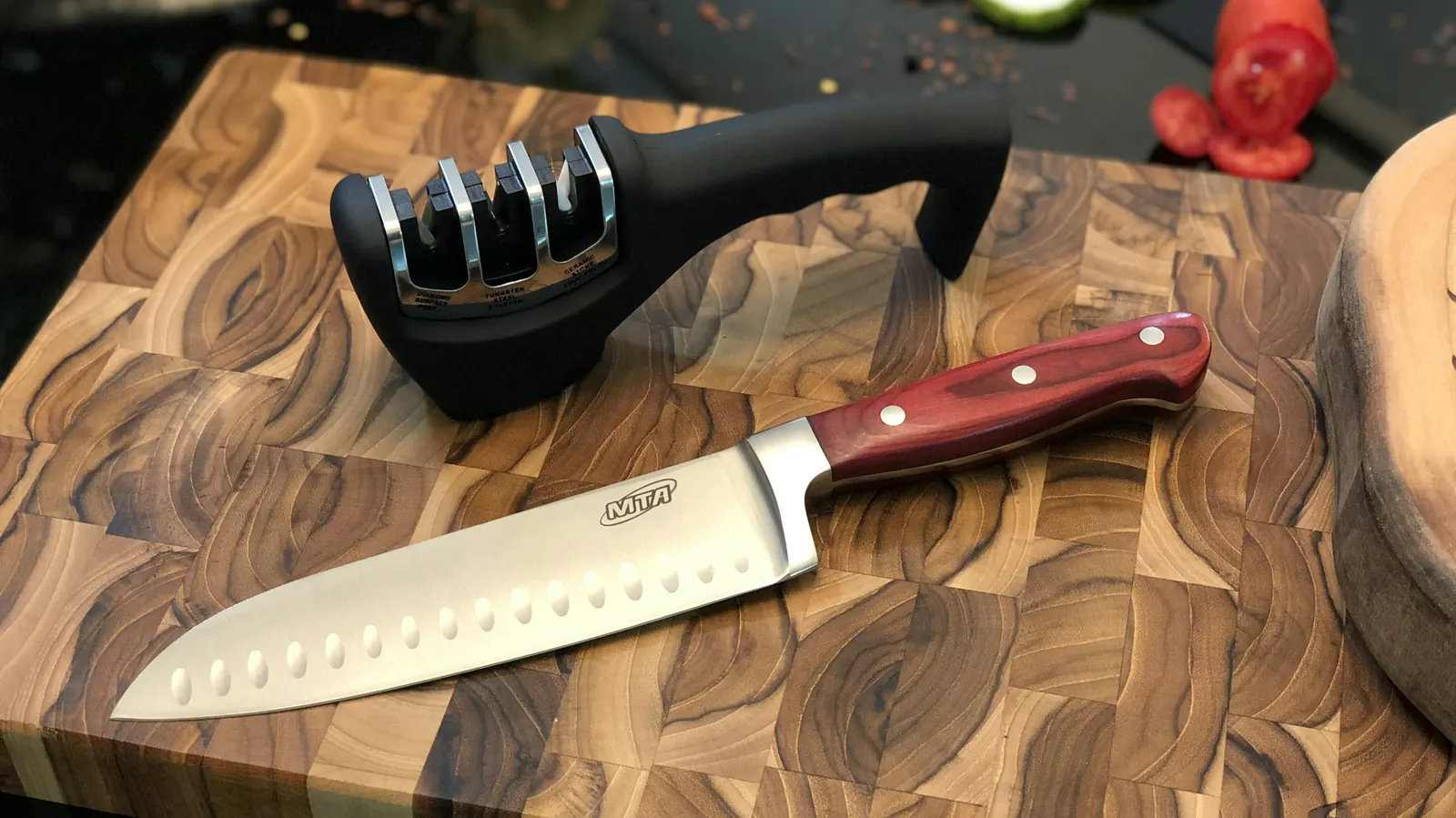
A dull knife is slow and slips, and every kitchen eventually has to decide how to bring the edge back. The two common answers sit at opposite ends. A knife sharpener, electric or pull-through, holds the blade at a set angle and does most of the work for you in a minute or two. A whetstone is a flat block of abrasive that you soak or wet, and you move the knife across it by hand, holding the angle yourself.
Cooks argue about this a lot, and both sides have a point. This guide sets out the differences that actually matter for a home cook: how much steel each removes, who controls the angle, how long each takes to learn, and what changes when the knife is Japanese. Then it names one example of each, both of which also appear in our full sharpener roundup.
Julia’s earns a commission on purchases made through links on this page, at no cost to you. Recommendations are based on what a restaurant kitchen looks for, product specifications and verified buyer reports.
Quick verdict: sharpener or whetstone?
Choose an electric or pull-through sharpener if you want sharp Western knives with no practice, in a minute or two, and you are happy with the angle the machine sets. Choose a whetstone if you own Japanese or other thin, hard knives, want to set the angle yourself, and are willing to practice. Many kitchens end up with both: a sharpener for everyday knives and a stone for the good ones.
The table sums up the knife sharpener vs whetstone differences; the sections after it explain each one.
Knife sharpener vs whetstone, side by side
| Electric or pull-through sharpener | Whetstone | |
|---|---|---|
| Angle | Fixed by the slots or guides | Held by your hand (guides sold separately) |
| Speed | About a minute; seconds to touch up (per Chef’sChoice for its 15XV) | Slower; time to soak and work each side |
| Steel removed | Quick with coarse stages; easy to overdo | As much or as little as you choose |
| Learning curve | Very little | Real practice needed |
| Japanese knives | Only if the maker’s angle matches | The traditional method |
| Power and space | Electric needs an outlet and counter room | No power; small and portable |
| Serrated knives | Some models handle them | Not practical on a flat stone |
Honing first: the step that isn’t sharpening
Before choosing a sharpener, it helps to separate two jobs. Shun’s care guide explains that with normal use a knife’s edge “can shift slightly out of alignment even if it is not truly dull,” and honing realigns it. Honing “does not remove steel.” Sharpening is different: it “removes a small amount of steel to create a fresh edge.” Shun adds that for most home cooks, sharpening once or twice a year is enough.
That matters for this comparison. If you hone regularly on a steel or ceramic rod, you sharpen rarely, and the speed of an electric machine matters less. If you never hone, you will be sharpening often, and a quick machine becomes more attractive.
How much steel each removes
Every sharpener removes steel; that is how it makes a new edge. The difference is speed and control. An electric sharpener with a coarse diamond stage removes metal quickly. America’s Test Kitchen, in its guide to choosing a sharpening method, describes its favorite electric model, the Chef’sChoice Trizor XV, as “super effective on everything from a quick touch-up to repairing severely damaged and chipped blades.” Repairing a chip means grinding away steel until the chip is gone, which a powered diamond wheel does fast.
That speed cuts both ways. Running a knife through the coarse stage every time it feels a little dull takes off more steel than it needs, and over the years the blade gets narrower. With an electric model, use the fine stages for touch-ups and save the coarse one for a truly dull or damaged edge. Chef’sChoice itself says the first sharpening on its 15XV takes about a minute and resharpening about ten seconds, which tells you the first pass is doing much more work.
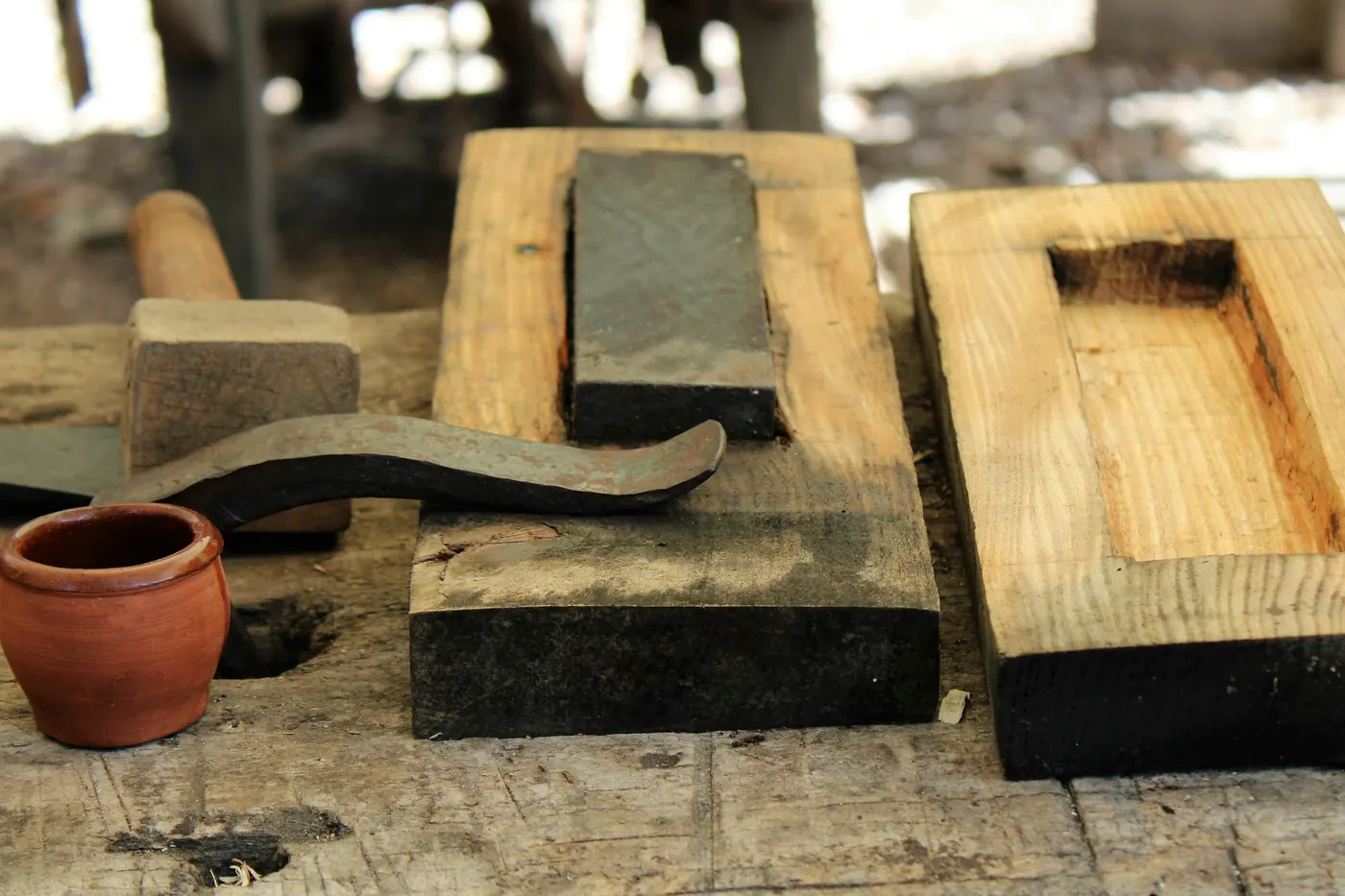
A manual pull-through sharpener with carbide or ceramic slots is gentler and slower. ATK notes its favorite manual model is slower than an electric one and “can’t repair severely damaged knives.” On a whetstone, you decide everything: a coarse stone for repair, a medium stone for regular sharpening, a fine stone to polish. You remove as little steel as the edge needs, and you can see what you are doing.
Who holds the angle
The angle is the single biggest factor in how a knife cuts and how long the edge lasts, and here the two approaches differ completely.
A sharpener sets the angle for you. ATK says the spring-loaded slots of its favorite electric model guide the blade “at a precise angle.” Chef’sChoice says its 15XV converts traditional 20-degree factory edges into 15-degree edges. That is useful when your knives suit 15 degrees and a limitation when they don’t, because a fixed-angle machine will grind every knife to its own angle. Some electric machines, like the Work Sharp Ken Onion model in our best knife sharpener guide, let you set the angle across a range, which adds flexibility at the cost of more decisions.
On a whetstone, you hold the angle by hand. Global’s knife care page tells owners to hold the blade against the stone at 10 to 15 degrees and says “the key to maintaining the same angle is hearing the same sound with each back-and-forth stroke.” Global also notes that guide rails help you achieve the correct angle when using a whetstone, which is a good way to start. The reward is control: you can match each knife’s original angle instead of forcing every knife to one.
The learning curve
An electric or pull-through sharpener asks almost nothing of you: switch it on, draw the knife through each slot the number of times the instructions say, and you are done. That is its whole appeal, and for many busy cooks it is the right answer.
A whetstone asks for practice. ATK puts it plainly: “There’s a learning curve and it can be tricky to get right,” and it suggests practicing on a cheap knife you don’t care about before working on a good one. The same guide lists the upside: a lifelong skill, very little storage space and a tool you can take anywhere. Stones also need care of their own. Shun’s 1000/6000 stone is soaked in water before use, and Global says its waterstones need about 10 to 15 minutes of soaking.
The honest middle ground: if you have never sharpened anything, start with one inexpensive Western knife on a combination stone, and keep using your sharpener on the rest until you trust your hands.
What changes with Japanese knives
Japanese knives are often thinner and harder than German ones, with a narrower edge angle, and that is where the choice matters most. Shun says its blades are sharpened to a 16-degree angle per side and that Japanese knives “are traditionally sharpened on stones, which allow for precise control.” Global says its knives are factory sharpened at 10 to 15 degrees and recommends a waterstone or ceramic stone. Neither maker’s care page mentions electric or pull-through sharpeners at all.
A 15-degree electric sharpener sits near Shun’s 16 degrees, but near is not the same. If you run a Japanese knife through a fixed-angle machine, you are changing its edge to the machine’s angle. Check the knife maker’s instructions first. Shun also offers free sharpening for its knives, which is worth using if you are nervous. Single-bevel knives such as the yanagiba and deba are generally sharpened by hand on stones; follow the maker’s instructions for those. Our best Japanese knife guide sticks to double-bevel knives for that reason.
Serrated knives, space and power
A few practical points round out the choice. Serrated bread and steak knives cannot be sharpened on a flat stone in any useful way, while some machines handle them; Chef’sChoice says its 15XV sharpens straight-edge and serrated blades. An electric sharpener needs an outlet and takes up room; ATK compares its favorite to the size of a loaf pan. A whetstone needs no power and stores in a drawer, but it needs a damp towel or a holder to keep it steady, and a place to dry after use.
Choose a sharpener if… / Choose a whetstone if…
Choose an electric or pull-through sharpener if…
- Your knives are mostly Western, double-bevel and stainless.
- You want a sharp edge quickly, with no practice.
- You have serrated knives to keep up too.
- You are happy with the angle the machine sets.
Choose a whetstone if…
- You own Japanese or other thin, hard knives.
- You want to keep each knife’s own angle and remove as little steel as possible.
- You are willing to practice, ideally on a cheap knife first.
- You want a tool that needs no power and fits in a drawer.
Our pick on each side of the knife sharpener vs whetstone question
Both picks also appear in our best knife sharpener roundup, where the Chef’sChoice is the top pick and the Shun kit is the whetstone pick. We repeat them here on purpose: if you have read the roundup, these are the same two products, chosen as the clearest example of each approach. Both were in stock on Amazon when we checked.
1. Chef’sChoice Trizor XV 15XV Electric Sharpener – Fast 15-Degree Edges

The 15XV is a three-stage electric sharpener. According to the listing, stages 1 and 2 use 100 percent diamond abrasives to sharpen and hone, and stage 3 is a patented flexible stropping stage that polishes the edge and also handles serrated knives. Spring guides set and control the angle automatically, and the machine converts traditional 20-degree factory edges into 15-degree edges.
Chef’sChoice says a first sharpening takes about a minute and resharpening about ten seconds. America’s Test Kitchen names the Trizor XV its favorite electric sharpener in its guide to sharpening methods, calling it fast and “super effective” from a quick touch-up to repairing chipped blades, with the downsides that it needs electricity and is larger than a manual sharpener.
The fixed 15-degree angle is its strength and its limit. It suits Western knives you are happy to move to 15 degrees; for Japanese knives, check the knife maker’s instructions first.
Why we like it
- Diamond abrasives in stages 1 and 2
- Spring guides set the angle for you
- Handles straight and serrated edges
- ATK’s favorite electric model
Key specifications
| Model | 15XV (0101500) |
|---|---|
| Type | Electric, 3-stage |
| Abrasive | 100% diamond (stages 1–2); flexible strop (stage 3) |
| Angle | 15 degrees, fixed by guides |
| Grits or stages | 3 stages |
| Power | Electric; wattage not stated |
| Size | About 10 x 4.25 x 4.25 in |
| Warranty | 3-year limited |
Why we recommend it
It suits a cook with a block of Western knives who wants them sharp in minutes, without learning a skill.
Skip it if most of your knives are Japanese and you want to keep their original angles; a stone does that.
Pros and cons
Pros
- Fast, per maker and ATK
- No technique needed
- Repairs chipped edges
Cons
- One fixed angle
- Needs an outlet and counter room
- Coarse stage is easy to overuse
2. Shun 3-Piece Whetstone Sharpening System – Stone, Steel and Stand

Shun’s kit puts a whetstone, a honing steel and a stand in one box, which makes it a sensible way into stone sharpening. The listing describes a 1000/6000-grit combination whetstone, fine on one side and extra-fine on the other, to be soaked in water before use. The 9-inch stainless honing steel has a smooth side for weekly honing and a micro-ribbed side for monthly honing, so you sharpen less often.
The angled bamboo stand is meant to help with the angle; Shun’s listing says it ensures the correct sharpening angle and keeps the tools organized, though it does not give a figure in degrees. Shun sharpens its own knives to 16 degrees per side, which is the angle to aim for on Shun knives.
A 1000 side is a medium stone for regular sharpening, not a coarse stone for repairing chips, so badly damaged knives need a coarser stone or a professional. Shun backs the kit with a limited lifetime warranty, and its knives come with free sharpening.
Why we like it
- 1000/6000 combination stone
- Honing steel included for upkeep
- Angled stand to help hold the angle
- Limited lifetime warranty
Key specifications
| Model | DM0610 |
|---|---|
| Type | Whetstone kit with honing steel and stand |
| Abrasive | Combination whetstone; stainless honing steel |
| Angle | Set by hand; stand angle not stated |
| Grits or stages | 1000 and 6000 |
| Power | None; soak stone before use |
| Size | 9 in honing steel; stone size not stated |
| Warranty | Limited lifetime |
Why we recommend it
It suits a cook with Japanese or other good knives who wants to learn stone sharpening with everything needed in one kit.
Skip it if you want sharp knives today with no practice, or need to repair chips; the electric sharpener is faster.
Pros and cons
Pros
- Full control of the angle
- Removes only the steel you choose
- No power needed
Cons
- Takes practice
- No coarse grit for chips
- Stand angle not stated
Whetstone vs knife sharpener questions, answered
Is a whetstone better than a knife sharpener?
Not for everyone. A whetstone gives more control over the angle and how much steel comes off, which matters most for Japanese knives. An electric sharpener is faster and needs no skill. For a set of Western knives and a busy cook, the machine is often the better tool.
Do electric sharpeners ruin knives?
They don’t ruin knives when used as the maker instructs, but they remove steel quickly. Use the fine stages for touch-ups, save the coarse stage for dull or damaged edges, and check that the machine’s angle suits your knife.
Can I use a pull-through or electric sharpener on Japanese knives?
Check the knife maker’s instructions first. Shun sharpens its knives to 16 degrees per side and says Japanese knives are traditionally sharpened on stones; Global recommends waterstones or ceramic stones. A fixed-angle machine will change the edge to its own angle.
What grit whetstone should a beginner start with?
A combination stone with a medium side around 1000 for sharpening and a finer side for polishing is the usual starting point, like Shun’s 1000/6000 stone. Practice on an inexpensive knife first, as America’s Test Kitchen suggests.
How often should I sharpen my knives?
Less often than you might think if you hone. Shun says once or twice a year is enough for most home cooks, with regular honing in between to keep the edge aligned.
Which way to sharpen in your kitchen
For a home kitchen with Western knives and little time, an electric sharpener such as the Chef’sChoice Trizor XV does the job quickly and well. For Japanese knives, or for anyone who wants control and doesn’t mind practicing, a whetstone is the better long-term tool. Many cooks end up with both. Our best knife sharpener guide compares nine options, from pull-through sharpeners to guided systems, and the best chef knife guide covers the knife you will sharpen most.
Sharp knives make quick work of onions, chiles and cilantro; see our list of Mexican cooking tools for the rest of the kit. Or leave the chopping to us: see the menu or call to order.