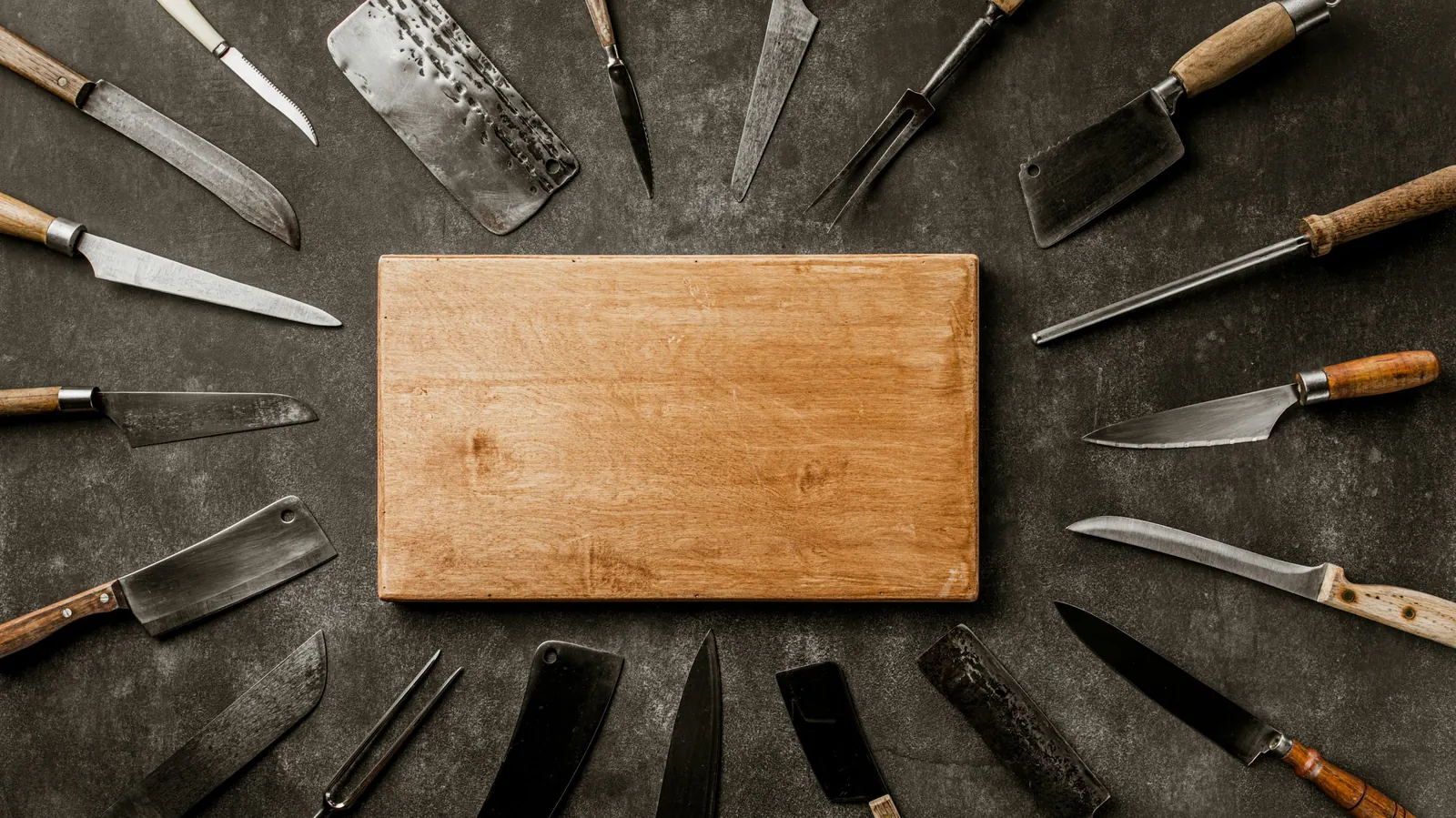
A dull knife is the most common problem in a home kitchen, and the easiest to fix. It crushes tomatoes for pico de gallo instead of slicing them, bruises cilantro, slips on onion skin and tears a grilled flank steak instead of cutting it into clean strips for tacos. A sharp edge is safer too, because a knife that bites where you put it is less likely to skid toward your fingers.
The question is which kind of sharpener suits you. There are electric machines that do the work in a minute, small pull-through sharpeners that live in a drawer, Japanese-style whetstones that reward practice, guided systems that hold the angle for you, and honing rods that keep an edge straight between sharpenings. This guide explains what each one does, names the sharpeners worth buying in every category, and says plainly where a maker does not publish a figure.
Julia’s earns a commission on purchases made through links on this page, at no cost to you. Recommendations are based on what a restaurant kitchen looks for in a knife sharpener, the makers’ own specifications and the details on each Amazon listing.
Quick verdict: which knife sharpener to buy
For most home cooks, the best knife sharpener is the Chef’sChoice Trizor XV 15XV electric sharpener: three stages with diamond abrasives, spring guides that hold the angle for you, a 15-degree edge, serrated-knife support and a stated three-year limited warranty. If you want to set your own angle and sharpen scissors and outdoor blades too, choose the Work Sharp Ken Onion Mk2. If you prefer to learn the craft, the Shun 3-piece whetstone system gives you a 1000/6000 stone, a honing steel and an angled stand in one box.
The rest of this page explains how these sharpeners differ, which edge angle your knives need, and how often to sharpen and hone.
Five knife sharpeners side by side
Our five standout sharpeners, one for each kind of cook, with the angle and abrasives each maker or listing states. All nine sharpeners are reviewed in full below.
| Sharpener | Best for | Type | Angle (stated) | Buy on Amazon |
|---|---|---|---|---|

Chef’sChoice Trizor XV 15XV Electric SharpenerBest overall
|
Fast, foolproof edges at home | Electric, 3 stages, diamond | 15 degrees | View on Amazon |

Work Sharp Ken Onion Mk2 Electric SharpenerBest adjustable electric
|
Kitchen, pocket and outdoor blades | Electric belt, variable speed | 15 to 30 degrees, adjustable | View on Amazon |

Zwilling 4-Stage Pull-Through SharpenerBest pull-through
|
Quick touch-ups, small drawers | Manual, coarse and fine ceramic | Western and Asian settings | View on Amazon |

Shun 3-Piece Whetstone Sharpening SystemBest whetstone kit
|
Learning to sharpen by hand | 1000/6000 whetstone, steel, stand | Set by angled stand (degrees not stated) | View on Amazon |
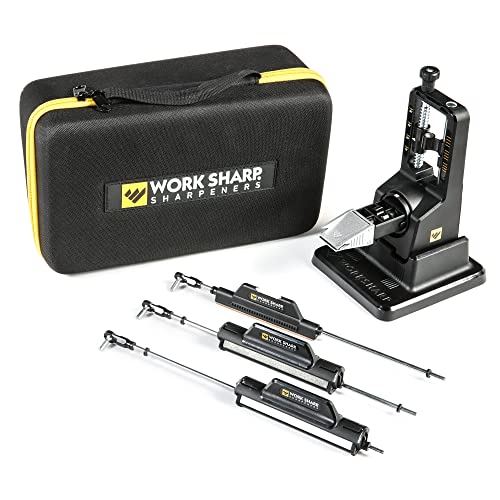
Work Sharp Precision Adjust EliteBest guided system
|
Exact angles without power | Guided manual, diamond and ceramic | 15 to 30 degrees, adjustable | View on Amazon |
Product images from Amazon. Angles, abrasives and warranties are as stated by each maker or Amazon listing; check the listing before you buy.
Our picks for the best knife sharpener
These nine sharpeners cover every way to put an edge back on a kitchen knife: two belt-driven and one diamond-wheel electric machine, two manual pull-through sharpeners, two whetstone options, a guided angle system and a honing steel. Each review gives the type, the angle the maker states, the abrasives, whether it handles serrated blades and the warranty, and says “not stated” where nothing is published.
1. Chef’sChoice Trizor XV 15XV Electric Sharpener – Diamond Stages and a Fixed 15-Degree Edge
The Trizor XV is the sharpener to buy if you want sharp knives without learning a skill. It is a countertop electric machine with three slots. According to Chef’sChoice, stages 1 and 2 are plated with 100 percent diamond abrasives to sharpen and hone the edge, and stage 3 uses a flexible stropping system to polish it. Spring-loaded guides press the blade against the abrasive at the right angle, so all you do is draw the knife through slowly, alternating sides.
The machine puts a 15-degree edge on each side. Chef’sChoice says it is designed to convert the traditional 20-degree factory edge of household knives into its thinner “XV” edge, and that the first sharpening takes about a minute, with later resharpening taking around ten seconds. A thinner edge cuts with less effort, which you notice on a pile of white onions or when you slice a rested arrachera across the grain.
The listing says it handles both straight-edge and serrated knives, with serrated blades going through the polishing stage only. It measures about 10 by 4.25 by 4.25 inches, so it needs a spot on the counter or a deep cabinet. Chef’sChoice gives it a three-year limited warranty.
The trade-off with any powered diamond sharpener is that it removes metal quickly. Use the first stage only when a knife is truly dull, and use the polishing stage alone for routine touch-ups.
Why we like it
- Spring guides set the angle automatically
- Diamond abrasives in stages 1 and 2, per the maker
- Converts 20-degree factory edges to 15 degrees
- Handles serrated knives in the polishing stage
- Three-year limited warranty
Key specifications
| Model | 15XV (item 0101500) |
|---|---|
| Type | Electric, diamond wheels |
| Angle(s) (stated) | 15 degrees per side |
| Grits/stages | 3 stages: diamond sharpen, diamond hone, flexible strop/polish |
| Power | Corded electric (wattage not stated) |
| Serrated capable | Yes |
| Size | About 10 x 4.25 x 4.25 in |
| Warranty | 3-year limited |
Why we recommend it
It suits the cook who wants every knife in the block sharp in a couple of minutes, with no angle to judge and no stones to soak. The fixed guides make the result repeatable from the first use.
Skip it if you own single-bevel Japanese knives or want a 20-degree edge on heavy German knives; the angle is fixed at 15 degrees.
Pros and cons
Pros
- No skill or angle to hold
- Fast resharpening, per the maker
- Works on serrated blades
Cons
- One fixed angle only
- Bulky on the counter
- Coarse stage removes metal fast
2. Work Sharp Ken Onion Mk2 Electric Sharpener – Any Angle From 15 to 30 Degrees
Where the Chef’sChoice holds one angle, the Ken Onion Mk2 lets you choose. It is a powered belt sharpener: a narrow, flexible abrasive belt runs around a small frame, and an adjustable guide holds the blade against it. Work Sharp says the guide sets any angle from 15 to 30 degrees, so you can keep a thin edge on a santoku and a sturdier one on a cleaver or a heavy chef’s knife used to split chicken.
Work Sharp lists five belts in the box, from P120 extra coarse through X65, X22 and X4 to a 6000 extra-fine belt, and a seven-setting variable-speed motor. A slow speed with a fine belt polishes; a fast speed with a coarse belt reshapes a chipped or rolled edge. Because the belt flexes, it tends to leave a slightly rounded, convex edge rather than a flat bevel.
The maker says it sharpens kitchen knives, pocket knives, serrated blades, scissors and garden tools, which makes it a good buy for a household where the same person keeps the paring knife, the hunting knife and the hedge shears sharp. It weighs 3.3 pounds, per Work Sharp, and carries a three-year warranty.
It asks a little more of you than a slot sharpener: you choose the belt, the speed and the angle, and you have to keep the blade moving so the belt does not dwell in one spot.
Why we like it
- Adjustable angle from 15 to 30 degrees
- Five belts from extra coarse to extra fine
- Seven-speed motor control
- Sharpens serrated blades and scissors
- Three-year warranty
Key specifications
| Model | WSKTS-KO2-ATL |
|---|---|
| Type | Electric belt sharpener |
| Angle(s) (stated) | 15 to 30 degrees, adjustable |
| Grits/stages | Belts P120, X65, X22, X4, 6000 |
| Power | Corded electric, 7 speeds |
| Serrated capable | Yes |
| Size | Dimensions not stated; 3.3 lb |
| Warranty | 3 years |
Why we recommend it
It suits the cook with a mixed collection, Western and Japanese knives, outdoor blades and scissors, who wants one powered tool that adapts to each. It is also the pick here for repairing a badly damaged edge.
Skip it if you only want to sharpen a few kitchen knives quickly; the choices of belt, speed and angle are more than most kitchens need.
Pros and cons
Pros
- Widest angle range of the electrics here
- Handles knives, scissors and tools
- Coarse belt can repair chips
Cons
- Small learning curve
- Belts wear and need replacing
- Dimensions not published
3. Wüsthof Easy Edge Electric Sharpener – One-Touch Programs and Dust Suction
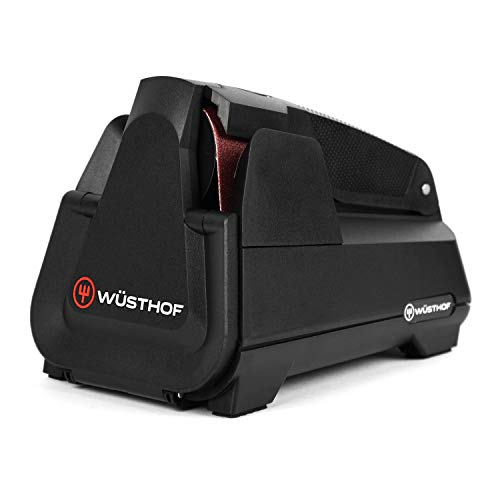
The Easy Edge is Wüsthof’s belt-driven sharpener, and its selling point is that you do not have to choose settings. The listing describes three pre-programmed buttons: Shape for a very dull or damaged knife, Sharpen to expose a fresh edge about once a month, and Refine to maintain the edge weekly. Press the button that matches the knife and the machine runs the right belt and speed.
Wüsthof’s own product page adds that it has an interchangeable angle guide, a replaceable blade guide, an anti-slip rubber base and integrated dust suction to catch the metal grit sharpening produces. That matters on a kitchen counter where the next job might be chopping cilantro. The page does not state the angle the machine produces, so we list it as not stated.
The listing gives its size as 7 by 4.5 by 5 inches tall, says it is made in the USA and gives a three-year warranty. Wüsthof does not say on either page whether it sharpens serrated blades, so if you need that, the Chef’sChoice or Work Sharp is the safer choice.
Why we like it
- Three one-touch programs: Shape, Sharpen, Refine
- Built-in dust suction, per Wüsthof
- Compact: 7 x 4.5 x 5 in
- Made in the USA, three-year warranty
Key specifications
| Model | Easy Edge (model number not stated on listing) |
|---|---|
| Type | Electric belt sharpener |
| Angle(s) (stated) | Not stated; interchangeable angle guide |
| Grits/stages | 3 programs; coarse to ultra-fine belts |
| Power | Corded electric |
| Serrated capable | Not stated |
| Size | 7 x 4.5 x 5 in |
| Warranty | 3 years |
Why we recommend it
It suits the cook who wants a belt sharpener’s clean edge with the simplicity of pressing one button, and who cares about keeping metal dust off the counter.
Skip it if you need a published angle to match your knives or want to sharpen serrated blades; Wüsthof does not state either.
Pros and cons
Pros
- Simple program buttons
- Collects metal dust
- Small footprint
Cons
- Angle not published
- Serrated use not stated
4. Zwilling 4-Stage Pull-Through Sharpener – Western and Asian Settings in One
A manual pull-through sharpener is the simplest tool on this list: you set it on the counter, hold the handle and draw the knife through a slot a few times. Zwilling’s version has four slots, a coarse and a fine stage for Western knives and a coarse and a fine stage for Asian-style knives, using ceramic sharpening rods. That covers the two edge styles most home cooks own, a German chef’s knife and a Japanese santoku, in one small tool.
The handle doubles as a finger guard and the base is non-slip, according to Zwilling. The listing does not give the exact angles of the two settings, its dimensions or a warranty, and it says the sharpener should be wiped clean with a damp cloth and is not dishwasher safe.
Pull-through sharpeners are quick, but they are less precise than a stone or a guided system, and the coarse slots remove metal. Use the fine slot for regular touch-ups and save the coarse slot for knives that no longer bite.
Why we like it
- Separate stages for Western and Asian blades
- Coarse and fine ceramic rods
- Protective handle and non-slip base
- No power, fits in a drawer
Key specifications
| Model | 32602-001 |
|---|---|
| Type | Manual pull-through |
| Angle(s) (stated) | Western and Asian settings (degrees not stated) |
| Grits/stages | 4 stages: coarse and fine ceramic, two edge styles |
| Power | None (manual) |
| Serrated capable | Not stated |
| Size | Not stated |
| Warranty | Not stated |
Why we recommend it
It suits a kitchen with both German and Japanese knives that wants a fast, cheap, drawer-sized way to bring them back between proper sharpenings.
Skip it if you want precise angles or a warranty in writing; neither is published on the listing.
Pros and cons
Pros
- Two edge styles in one tool
- Small and simple
- Guarded handle
Cons
- Angles not published
- Not dishwasher safe
- Less precise than stones
5. Wüsthof 2-Stage Hand-Held Sharpener – Carbide and Ceramic in a Small Tool

This is the smallest and simplest sharpener here, and the cheapest way to own something from a major knife maker. It has two slots. Wüsthof says stage 1 uses carbide abrasive wheels to sharpen a blunt knife, and stage 2 uses ceramic slats for fine sharpening. You set the edge with the carbide side, then finish it on the ceramic side.
The listing’s instructions are clear: place the sharpener on a flat surface, hold the grip in one hand and the knife in the other, insert the blade fully at a right angle to the sharpener and pull back a few times. It gives a pre-set angle of 34 degrees for the carbide and ceramic slats; Wüsthof does not say whether that is per side or the total of both sides, so treat it as a guide for Wüsthof-style Western knives rather than thin Japanese blades.
Carbide sharpeners work by scraping, and they take off metal quickly, so use the carbide slot sparingly and lean on the ceramic slot for routine upkeep. Wüsthof states a lifetime warranty against manufacturer’s defects on its products.
Why we like it
- Carbide stage for dull knives, ceramic stage to finish
- Non-slip base and ergonomic handle
- Clear step-by-step instructions from Wüsthof
- Lifetime warranty against defects
Key specifications
| Model | 3059730101 |
|---|---|
| Type | Manual pull-through |
| Angle(s) (stated) | 34 degrees, pre-set |
| Grits/stages | 2 stages: carbide, ceramic |
| Power | None (manual) |
| Serrated capable | Not stated |
| Size | Not stated |
| Warranty | Lifetime, manufacturer defects |
Why we recommend it
It suits a cook with a couple of Western knives who wants a cheap, drawer-sized sharpener from a knife maker that stands behind it.
Skip it if your knives are thin Japanese blades; the stated angle is meant for sturdier Western edges.
Pros and cons
Pros
- Small and simple
- Lifetime warranty
- Two-step sharpen and finish
Cons
- Carbide removes metal quickly
- One fixed angle
6. Shun 3-Piece Whetstone Sharpening System – Stone, Steel and Angled Stand
A whetstone is how knives were sharpened long before electric machines, and it is still how many professional cooks do it. You soak the stone, set it on a stable base, and draw the blade across it at a steady angle, first on a coarser side to raise a fresh edge, then on a finer side to polish it. It takes practice, but it removes only as much metal as you choose and works on any straight-edged knife, including single-bevel Japanese blades.
Shun’s kit puts the pieces you need in one box. The listing describes a 1000/6000-grit combination whetstone for fine and extra-fine sharpening, a 9-inch stainless honing steel with a smooth side for weekly honing and a micro-ribbed side for monthly honing, and an angled bamboo stand that holds the stone and helps you find the right angle. Shun says to soak the stone in water before use.
A 1000 grit is a medium stone for regular sharpening; 6000 is a finishing grit. Neither is coarse, so a badly chipped knife will need a coarser stone first. Shun gives a limited lifetime warranty on its products and offers free sharpening for Shun knives.
Why we like it
- 1000/6000 combination stone
- Includes a two-sided 9-inch honing steel
- Angled bamboo stand helps hold the angle
- Limited lifetime warranty
Key specifications
| Model | DM0610 |
|---|---|
| Type | Whetstone kit with honing steel |
| Angle(s) (stated) | Set by angled stand (degrees not stated) |
| Grits/stages | 1000 and 6000 grit; smooth and micro-ribbed steel |
| Power | None (manual) |
| Serrated capable | Not stated |
| Size | 9-inch steel; stone size not stated |
| Warranty | Limited lifetime |
Why we recommend it
It suits the cook who wants to learn to sharpen properly and would rather buy a matched kit than piece one together, especially if the knife block holds Japanese knives.
Skip it if you want sharp knives in two minutes without practice; a whetstone rewards patience, and the finest grit here will not fix chips.
Pros and cons
Pros
- Stone, steel and stand in one box
- Gentle on the blade
- Works on single-bevel knives
Cons
- Takes practice
- No coarse grit for repairs
- Stone size not listed
7. Kai #1000 Commercial Medium Whetstone – A Japanese Stone for Everyday Sharpening

If you already have a honing rod and only need a stone, Kai’s commercial medium whetstone is a sensible choice. Kai is the Japanese company behind Shun, and the listing says this stone is made in Japan. It is a single #1000 stone of white aluminum abrasive, the medium grit that does most everyday sharpening.
A #1000 stone is the practical first stone for home cooks: it brings a dull knife back to a working edge for slicing tomatoes or cutting raw steak into thin strips for fajitas, and the honing rod you already own keeps that edge straight between sessions. Kai sells a matching #3000 finishing stone in the same commercial line if you later want a finer polish. The listing gives the size as about 8.3 by 2.6 by 1.3 inches, a common bench-stone size with room for a chef’s knife.
The listing does not mention a base, an angle guide, soaking instructions or a warranty, so plan to set the stone on a damp towel or a separate holder and to learn the angle by eye, or pair it with an inexpensive angle guide.
Why we like it
- #1000 medium grit for everyday sharpening
- Made in Japan, per the listing
- Bench-stone size: about 8.3 x 2.6 x 1.3 in
- Works on any straight-edged kitchen knife
Key specifications
| Model | AP0324 |
|---|---|
| Type | Single-grit whetstone |
| Angle(s) (stated) | Freehand (no guide) |
| Grits/stages | #1000 |
| Power | None (manual) |
| Serrated capable | Not stated |
| Size | About 8.3 x 2.6 x 1.3 in |
| Warranty | Not stated |
Why we recommend it
It suits the cook who wants a single, well-made medium stone and is happy to supply their own base and practice the angle.
Skip it if you want a kit with a stand and guide; the Shun system or the Work Sharp guided sharpener does more of the work for you.
Pros and cons
Pros
- Practical everyday grit
- Made in Japan
- Full bench-stone size
Cons
- No base or guide listed
- One grit only; no finishing side
8. Work Sharp Precision Adjust Elite – Clamp, Set the Angle and Sharpen
A guided system sits between a whetstone and a machine. The knife is clamped in place, the angle is set on a dial, and you sweep an abrasive across the edge on an arm that pivots at that exact angle. You get the control and low metal removal of hand sharpening with the consistency of a fixed guide, and no power is needed.
Work Sharp says the Precision Adjust Elite sets angles from 15 to 30 degrees, and its listing even suggests a starting point: 15 degrees for Japanese-style knives, 20 for Western kitchen knives, 25 for hunting blades and 30 for cleavers. The Elite kit includes a 320-grit coarse diamond plate, a 600-grit fine diamond plate, a ceramic finishing rod, a conical ceramic rod for serrated blades, a tri-brasive attachment for curved blades and a leather strop.
That serrated rod is worth noting in a kitchen with steak knives and a bread knife for bolillos, because most pull-through and whetstone options cannot sharpen scallops. The Elite listing does not state a warranty or dimensions; Work Sharp’s listing for the standard Precision Adjust kit gives three years.
Why we like it
- Angle set on a dial from 15 to 30 degrees
- Diamond 320 and 600 plates plus ceramic finishing
- Dedicated rod for serrated blades
- No power or water needed
Key specifications
| Model | WSBCHPAJ-ELT-ATL |
|---|---|
| Type | Guided manual system |
| Angle(s) (stated) | 15 to 30 degrees, adjustable |
| Grits/stages | 320 and 600 diamond, ceramic rod, leather strop |
| Power | None (manual) |
| Serrated capable | Yes, with included rod |
| Size | Not stated |
| Warranty | Not stated on this listing |
Why we recommend it
It suits the careful cook who wants exact, repeatable angles on every kind of knife, including serrated ones, without a motor or the practice a whetstone takes.
Skip it if you want speed; clamping and setting each knife takes longer than a pull-through or an electric machine.
Pros and cons
Pros
- Precise, repeatable angle
- Handles serrated and curved blades
- Low metal removal
Cons
- Slower per knife
- Warranty not on this listing
9. Wüsthof 10-Inch Honing Steel – Keeps the Edge Straight Between Sharpenings

A honing steel does not grind a new edge. It pushes the thin, slightly bent edge of a knife back into line, which is what makes a knife feel dull long before the metal is worn. A few light strokes before you start cutting keep a knife working for weeks between sharpenings, and that is why a steel so often sits within reach of a busy cutting board.
Wüsthof’s 10-inch steel is long enough for a standard chef’s knife. The listing says it is forged from a single block of high-carbon stainless steel and tempered to 58 HRC, a hardness rating, and calls it German made with a limited lifetime warranty. The listing title calls it a sharpening steel while the bullets call it a honing rod; what it does is hone.
Hold the steel upright with its tip on a towel, set the heel of the knife against it at roughly the angle of the edge, and draw the blade down and across so the whole edge touches the rod, alternating sides. Gentle, even strokes matter more than speed. Wüsthof does not publish a recommended angle on the listing, so match the angle your knife was sharpened at.
Why we like it
- 10-inch length suits chef’s knives
- High-carbon stainless, tempered to 58 HRC
- German made, per the listing
- Limited lifetime warranty
Key specifications
| Model | 3039700526 |
|---|---|
| Type | Honing steel |
| Angle(s) (stated) | Not stated (freehand) |
| Grits/stages | Steel rod, 58 HRC |
| Power | None (manual) |
| Serrated capable | Not stated |
| Size | 10 in |
| Warranty | Limited lifetime |
Why we recommend it
It suits anyone who already owns a sharpener, or has knives sharpened professionally, and wants to keep them cutting cleanly between sessions. It is the cheapest way to make every other sharpener on this page last longer.
Skip it if your knife is truly dull; honing straightens an edge but cannot rebuild one.
Pros and cons
Pros
- Fast daily upkeep
- Removes almost no metal
- Lifetime warranty
Cons
- Does not sharpen a dull edge
- Technique takes a little practice
Honing and sharpening are different jobs
Most confusion about knife sharpeners comes from mixing up two jobs. Sharpening grinds metal away to form a new edge. Every electric machine, pull-through, whetstone and guided system on this page does that. Honing straightens an edge that has rolled or bent to one side from use, without removing much metal. A steel or ceramic rod does that.
In a busy kitchen a knife edge gets knocked out of line every service: by the board, by bone, by the crust on a grilled steak. Honing puts it back. Sharpening is only needed when honing no longer brings the bite back. The makers on this list say the same thing in their own words: Wüsthof’s Easy Edge listing suggests a full sharpen about once a month and a light refine weekly, and Shun describes its steel’s smooth side for weekly honing and its ribbed side for monthly use. How often you need each depends on how much you cut, but most home cooks should hone often and sharpen rarely.
How to choose a knife sharpener
Start with how much effort you want to put in, then match the sharpener to your knives.
Type. Electric machines are fastest and need no skill; they suit a cook who wants to sharpen the whole block in one go. Pull-through sharpeners are small and cheap but less precise. Whetstones give the best control and the gentlest treatment of the blade, but take practice. Guided systems hold the angle for you without power. A honing rod is a companion to any of them, not a replacement.
Angle. Thinner edges cut more easily; thicker ones last longer. Chef’sChoice describes the traditional factory edge of household knives as 20 degrees and builds the Trizor XV to convert it to 15, and Work Sharp’s guided-system listing suggests 15 degrees for Japanese-style knives and 20 for Western kitchen knives. Check your knife maker’s recommendation, and choose a fixed-angle sharpener only if it matches.
Abrasive and grit. Diamond and carbide cut quickly; ceramic and fine whetstones polish. Coarse grits repair chips and very dull edges; fine grits refine. A sharpener with both, or a stone with two sides, covers routine upkeep and the occasional repair.
Serrated knives. Steak knives and bread knives have scallops that flat stones cannot reach. The Chef’sChoice, the Ken Onion Mk2 and the Precision Adjust Elite all state that they handle serrated blades; most others do not say. Our guide to grill tools covers the rest of what you need at the grill.
Space and cleanup. Electrics need counter or cabinet room and produce metal dust; Wüsthof’s Easy Edge collects it. Whetstones need soaking and a towel. Pull-throughs and rods fit in a drawer.
Single-bevel knives. Traditional Japanese knives sharpened on one side only, such as a yanagiba, are generally sharpened by hand on stones. If you own one, check its maker’s instructions before putting it through any slot sharpener.
How we chose these nine sharpeners
We started from what a kitchen that cuts onions, chiles, tomatoes, citrus and grilled beef every day needs from a sharpener: a dependable edge, a sensible angle for the knives most people own, reasonable metal removal and easy upkeep. We then looked for sharpeners sold on Amazon in the United States from identifiable makers, across every main type, and checked each one’s stock with Amazon’s product data before writing. Angles, abrasives, sizes and warranties come from the maker’s own pages where we could reach them and otherwise from the brand’s Amazon listing; where neither states a figure, we say “not stated”. We left out sharpeners that were down to their last few units when we checked, including Spyderco’s Tri-Angle Sharpmaker and several King and Shapton stones, and unbranded look-alike kits. We did not sharpen knives with these products for this guide, and we have not cited published equipment reviews, because we did not read them for this page.
Knife sharpener questions, answered
What is the best knife sharpener for home use?
For most home kitchens, an electric sharpener with fixed angle guides, such as the Chef’sChoice Trizor XV, gives the most consistent result for the least effort. If you prefer a quiet, low-cost option, a two-sided whetstone or a guided manual system like the Work Sharp Precision Adjust gives more control, and a honing rod keeps any edge going longer.
Are electric knife sharpeners bad for knives?
Not if you use them as the maker intends. Electric sharpeners remove metal faster than stones, so the coarse stage should be saved for genuinely dull knives and the fine or polishing stage used for routine touch-ups. Used every week on the coarsest setting, any sharpener will wear a knife down sooner.
Which knife sharpener brands are worth trusting?
Chef’sChoice, Work Sharp, Wüsthof, Zwilling, Shun and Kai all publish clear specifications and stand behind their sharpeners with stated warranties or long track records in knife making. Be cautious with unbranded kits that promise everything and publish little.
Can I sharpen serrated steak knives?
Yes, with the right tool. Flat stones and most pull-through slots cannot reach into the scallops. The Chef’sChoice Trizor XV, the Work Sharp Ken Onion Mk2 and the Work Sharp Precision Adjust Elite all state that they sharpen serrated blades. Serrated knives also stay usable much longer between sharpenings than straight edges.
How often should I sharpen my kitchen knives?
Hone often, sharpen when honing no longer helps. For a home cook that is often every few months; for someone cutting every day, more often. If a knife slides off a tomato skin or crushes it instead of slicing, it is time.
Do I need a honing rod if I have a sharpener?
It helps. A few strokes on a rod before you cook keep the edge aligned, so you reach for the sharpener less often and remove less metal over the life of the knife.
Our final pick for sharp kitchen knives
Buy the Chef’sChoice Trizor XV if you want the whole knife block sharp in minutes with nothing to judge. Choose the Work Sharp Ken Onion Mk2 if you sharpen many kinds of blades, the Shun whetstone kit if you want to learn the traditional way, and the Precision Adjust Elite if you want exact angles without power. Whatever you choose, keep a honing steel next to the cutting board and use it before you cook.
A sharp knife earns its keep at the grill and at the table. See our pick of the best cast iron skillet for steak, the best meat claws for shredding, and our guide to how to eat fajitas, which starts with steak sliced thin across the grain. For the rest of the kit, see Mexican cooking tools.
Never sharpened a knife before? See our guide to the best knife sharpeners for beginners.
Own Japanese knives? See our guide to the best sharpeners for Japanese knives.
On a budget? See our guide to the best cheap knife sharpeners.
More specific guides: the best electric knife sharpeners, and if you are weighing a stone, knife sharpener vs whetstone.
Related guide: Pull through vs electric knife sharpener.
Related guide: Knife sharpener alternative.
And if you would rather someone else did the slicing tonight, see the menu or call to order.