
Every margarita starts with limes, and every home bar eventually hits the same question: keep squeezing by hand, or buy a machine? A hand press costs little, lives in a drawer and is ready in a second. An electric juicer spins the fruit for you, which matters a great deal when the recipe calls for a cup of juice rather than a tablespoon.
This comparison of manual vs electric citrus juicer types looks at what actually differs: how much juice each gets out, how much work it asks of your hands, how fast it is, and what it costs you in counter space and washing up. We lean on two America’s Test Kitchen reviews by Valerie Sizhe Li, one of manual juicers and one of electric models, and on the makers’ own specifications, and we pick two juicers for each side.
Julia’s earns a commission on purchases made through links on this page, at no cost to you. Recommendations are based on what a restaurant kitchen looks for, product specifications and verified buyer reports.
Quick verdict: manual or electric juicer?
For most home kitchens, a good manual press is the right first juicer: it is quick for a few limes, needs no outlet and goes in the drawer. Buy an electric reamer if you regularly juice more than a handful of fruit at a time, such as a pitcher of margaritas, weekend orange juice or batches of lemonade, or if hand strength is a problem. America’s Test Kitchen found its top electric models pulled noticeably more juice from lemons than its favorite manual model, but the best electric was only slightly faster than the best manual one.
Manual vs electric citrus juicer at a glance
| Factor | Manual (hand press or lever press) | Electric (reamer) |
|---|---|---|
| Juice yield (ATK lemon tests) | Winning manual: about 23% of fruit weight | Top electrics: about 36% to 38% |
| Speed | Fastest press: 10 lemons in under 3 minutes | Only slightly faster than the best manual |
| Effort | Your grip or arm; longer handles help | Motor turns the fruit; you press down |
| Space | Drawer (hand press) or counter (lever press) | Counter or cupboard, plus a cord |
| Power | None | Needs an outlet |
| Cleanup | One or two parts | Several parts, most dishwasher safe |
| Best for | A few limes, cocktails by the glass | Pitchers, orange juice, big batches |
Yield and speed figures are from America’s Test Kitchen’s electric juicer review (February 2026) and manual juicer review (August 2025). Lemons, ATK notes, are typically 40 to 45 percent juice by weight, which is the ceiling every juicer is working toward.
Juice yield: where electric pulls ahead
This is the clearest difference in the reviews. In ATK’s electric juicer review, the top machines extracted about 36 to 38 percent of a lemon’s weight as juice, against about 23 percent for the winning manual model. With lemons at 40 to 45 percent juice, the best electrics got most of what was there. A reamer that keeps spinning while you press simply reaches more of the fruit than one squeeze of a hand press.
That said, manual juicers vary a great deal. ATK’s manual review found that, as a category, presses got more juice than reamers, and that longer-handled models yielded more and were easier to use because of the extra leverage. The worst manual tool it tested, a short-armed squeezer, averaged under 13 percent. So a well-designed press closes part of the gap, and a poor one widens it.
For a home bar, the difference adds up at volume. If you make one drink, a few drops do not matter. If you juice two dozen limes for a party pitcher, a machine that gets substantially more from each fruit means fewer limes to buy and cut.
Effort and hands
Electric juicers take over most of the work: the motor turns the cone and you only press the fruit down. ATK notes that machines avoid the hand strain a manual squeezer can cause. That is the main reason to go electric if you have weak or sore hands, and we cover that in more depth in our guide to the best citrus juicer for arthritic hands.
Manual juicers differ here too. Handheld presses rely on your grip, so leverage matters: ATK found longer handles and gear mechanisms made squeezing easier. Countertop lever presses move the work from your fingers to your arm and body weight, which is why bars use them for volume without a plug.
One shared caution: push too hard and both types taste worse. ATK warns that excess pressure can make the reamer scrape the pith, and that bitter peel and pith in the juice are a real fault. Gentle, steady pressure gets more clean juice than force.
Speed, space and cleanup
Speed is closer than most people expect. ATK’s fastest manual press juiced 10 lemons in under three minutes, and in its electric review the top electric model was only slightly faster than the favorite manual one. Where electrics win is stamina: the tenth lime is as easy as the first.
Space is where manual wins. ATK points out that manual models generally need less space and don’t need to be plugged in, while electrics are bulkier and have more parts. Among electrics, lever-style machines were the tallest and hardest to store, and ATK found them less tidy and harder to judge when the juice was fully out. That is one reason both electric picks below are compact press-down reamers.
For cleanup, a hand press is one piece that rinses in seconds. An electric reamer has a cone, strainer and pitcher or jug to wash, though makers usually make those parts dishwasher safe. ATK advises washing parts right after use, before pulp dries on, and found that models with lots of small nooks were harder to clean. Its review also found that auto-reversing rotation, which many machines advertise, made no real difference.
Which juicer for a margarita bar?
Think in batches. For cocktails made one or two at a time, a hand press is the bartender’s tool: squeeze half a lime straight over the shaker and you are done. For a pitcher, a party or a week of lime juice for salsas and marinades, an electric reamer with a jug lets you juice into one container and measure as you go.
There is a third route, and it is a good one for serious home bars: a cast iron lever press. It needs no outlet, handles limes through grapefruit, and puts your body weight behind each pull. It takes counter space, but it is the manual option that comes closest to an electric for volume. Whichever you choose, our guide to home margarita bar accessories covers the rest of the kit.
Choose manual if… / Choose electric if…
Choose a manual juicer if
- You juice a few limes or lemons at a time, mostly for drinks and cooking.
- Drawer space is all you have, or you want a juicer that travels.
- You want almost nothing to wash.
- You want volume without a plug, in which case choose a lever press.
Choose an electric juicer if
- You regularly juice a pitcher’s worth, such as orange juice or batched margaritas.
- Getting the most juice from each fruit matters to you.
- Your hands tire or ache with a squeezer.
- You have a cupboard or counter spot for one more appliance.
Our picks: two manual, two electric
We chose from makers with published specifications and avoided any juicer already featured on our other citrus guides. All four were in stock on Amazon US, sold new, when we checked. Specifications come from the listings; we have not used these juicers ourselves, and where we describe performance we name whose findings they are.
1. Chef’n Max Yield Lemon Squeezer – Dual Gears for an Easier Squeeze
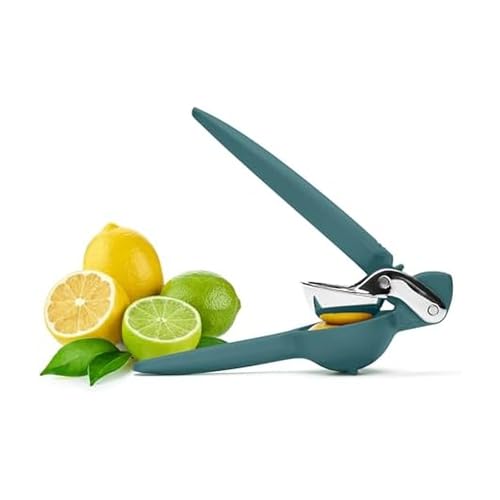
This handheld press is the drawer juicer for most kitchens. Chef’n says its patented dual-gear mechanism gives more juice than standard squeezers with less hand strain; the listing claims up to 20 percent more. The handles are long, about 10.25 inches overall, and ATK’s manual review found that long handles and leverage were what separated the easy squeezers from the hard ones.
It is built from nylon and stainless steel, with non-slip handles, and the listing says it is designed for lemons, key limes and similar fruit, which makes it the right size for margarita limes. It is top-rack dishwasher safe and compact enough for a drawer.
Chef’n’s FreshForce, which ATK named its overall manual winner, uses a dual-gear design too. This listing does not use the FreshForce name, so we do not assume ATK’s verdict carries over; it is the same maker and, per the listing, the same gear principle. We chose it because the FreshForce listings already appear on our other citrus pages.
Why we like it
- Dual-gear leverage, per Chef’n
- Sized for lemons and limes
- Top-rack dishwasher safe
- Fits a drawer
Key specifications
| Model | 5312711 |
|---|---|
| Type | Handheld press |
| Power | None (manual) |
| Capacity | One fruit at a time |
| Fruit sizes | Lemons, key limes, similar |
| Cleaning | Top-rack dishwasher safe |
| Size | 10.25 in |
| Warranty | Not stated |
Why we recommend it
For drinks by the glass and everyday cooking, a geared hand press gives you most of what a machine does for a fraction of the space.
Skip it if you want orange juice or big batches; it is sized for lemons and limes.
Pros and cons
Pros
- Easy squeeze for a hand press
- Drawer size
- Dishwasher safe
Cons
- Too small for oranges
- Yield claim is the maker’s own
2. Focus Foodservice Jupiter Large Commercial Juice Press – Bar Volume Without a Plug

The Jupiter press is the countertop answer for people who want volume but not a motor. Focus Foodservice describes it as a commercial-grade press for oranges, grapefruit, limes and lemons, built from cast iron with an 18-8 stainless steel perforated strainer, and designed for maximum pressure with minimal effort.
A lever press puts your arm and body weight behind each pull, so it spares the fingers a hand squeezer works hardest. The listing says the handles are sure-grip rubber and that the handle stop is rubberized, so it closes quietly. Focus Foodservice backs it with a seven-year warranty, per the listing.
The trade-offs are size and weight: this is a counter appliance, not a drawer tool. The listing does not state its dimensions or weight or say whether parts are dishwasher safe, so we would rinse the strainer and cone by hand right after use, as ATK advises for all juicers.
Why we like it
- Handles limes through grapefruit, per the listing
- Cast iron body, stainless strainer
- Seven-year warranty
- No outlet needed
Key specifications
| Model | 97336 |
|---|---|
| Type | Countertop lever press |
| Power | None (manual) |
| Capacity | One fruit at a time; juices into your own container |
| Fruit sizes | Limes, lemons, oranges, grapefruit |
| Cleaning | Not stated; rinse by hand |
| Size | Not stated |
| Warranty | 7 years |
Why we recommend it
It suits busy home bars and anyone who juices a lot but would rather not run a motor or find another outlet.
Skip it if counter space is tight; it is a heavy countertop tool, and in ATK’s manual review one countertop press was singled out as heavy to move at cleanup time.
Pros and cons
Pros
- Leverage instead of grip
- All citrus sizes
- Long warranty
Cons
- Takes counter space
- Size, weight and dishwasher use not stated

3. Proctor Silex 34 oz Electric Citrus Juicer – Two Cones and a Pitcher

This is a press-down electric reamer: set a halved fruit on the cone, press, and the motor turns it. Proctor Silex includes two nesting reamers, one for small fruit and one for large, and says it handles everything from tiny key limes to large grapefruit. The juice runs into a detachable 34-ounce pitcher with a pour spout and measurement markings, which is what makes it useful for batching a pitcher of margaritas or measuring lime juice for a recipe.
A pulp control dial lets you choose how much pulp passes into the juice, and the strainer catches the rest. The pitcher, reamers, lid and pulp strainer are dishwasher safe, per the listing, and there is a cord wrap with nested storage, so it packs into one cupboard spot. The listing says it automatically reverses direction; ATK found reverse rotation made no meaningful difference, so we would not choose it for that.
The wide reamer matters more. ATK found wide reamers worked better than narrow ones on fruit of all sizes. Proctor Silex does not state the motor’s wattage on this listing.
Why we like it
- Two reamers for key limes to grapefruit
- 34 oz pitcher with markings
- Dishwasher-safe parts
- Pulp control and cord storage
Key specifications
| Model | 66340 |
|---|---|
| Type | Press-down electric reamer |
| Power | Not stated |
| Capacity | 34 oz pitcher |
| Fruit sizes | Key limes to grapefruit (2 reamers) |
| Cleaning | Pitcher, reamers, lid, strainer dishwasher safe |
| Size | Not stated |
| Warranty | Not stated |
Why we recommend it
It is the simplest way to juice a big batch into one measured container, and it stores neatly when the party is over.
Skip it if you only ever juice a lime or two; a hand press is faster to grab and wash.
Pros and cons
Pros
- Large measured pitcher
- Handles every citrus size
- Easy dishwasher cleanup
Cons
- Wattage not stated
- More parts to wash than a press
4. Elite Gourmet 1.2L Electric Citrus Juicer – Slim Jug for Small Kitchens

Elite Gourmet’s ETS740 is a slim press-down juicer for kitchens where cupboard space is short. The listing gives a 40-watt motor with an auto-reversing reamer: push down to juice, release to stop. It comes with two cones, and the juice collects in a 1.2-liter (5-cup) container with a built-in handle, pour spout and a pulp and seed strainer.
All detachable parts are dishwasher safe, per the listing, and the maker describes the shape as slim and suited to small kitchens, dorms and campers. The listing states the juicer complies with ETL and FDA requirements and is made without BPA plastic.
A 40-watt motor is modest, so expect to take your time on large grapefruit; for limes and lemons it is plenty. As with any reamer, ATK’s advice applies: press gently, because pressing hard pushes the cone into the pith and makes the juice bitter.
Why we like it
- Slim footprint, per the maker
- 1.2 L jug with spout and handle
- Two cones; dishwasher-safe parts
- ETL listed, per the listing
Key specifications
| Model | ETS740 |
|---|---|
| Type | Press-down electric reamer |
| Power | 40 W |
| Capacity | 1.2 L (5 cups) |
| Fruit sizes | Two cones, small and large fruit |
| Cleaning | Detachable parts dishwasher safe |
| Size | Slim; dimensions not stated |
| Warranty | Not stated |
Why we recommend it
It suits apartment kitchens and anyone who wants an electric juicer that takes little room and still holds a pitcher’s worth.
Skip it if you juice lots of large oranges and grapefruit; a more powerful machine will be quicker.
Pros and cons
Pros
- Small footprint
- Generous jug
- Stated ETL listing
Cons
- Modest 40 W motor
- Warranty not stated
Citrus juicer questions, answered
Do electric juicers get more juice than manual ones?
Generally, yes. In ATK’s lemon tests, the top electric models extracted about 36 to 38 percent of the fruit’s weight as juice, against about 23 percent for the winning manual model. A long-handled manual press narrows the gap; a short squeezer widens it.
Is an electric juicer faster?
Only a little. ATK found its top electric only slightly faster than its favorite manual model, and its fastest manual press did 10 lemons in under three minutes. The electric’s advantage is that it does not tire your hands.
Which is better for limes?
For a few limes, a hand press sized for limes and lemons. For a batch, an electric reamer with a small cone, or a lever press. Our lime squeezer vs lemon squeezer guide covers hand press sizes.
Is auto-reverse worth paying for?
Not on ATK’s evidence: its electric juicer review found reverse rotation made no real difference. A wide, sharp reamer mattered more.
Why does my juice taste bitter?
Usually because the juicer pressed into the pith or shaved peel into the juice. ATK traces bitterness to excess pressure, so press gently with either type.
Our last word on hand vs machine juicing
Start with a good hand press; most kitchens never need more. Add an electric reamer once you find yourself juicing pitchers rather than glasses, or choose a lever press if you want that volume without a plug. For every juicer type side by side, see our full guide to the best citrus juicer, and for motorized options only, the best citrus juicer machine.
And if you would rather someone else squeezed the limes tonight, see our drinks or call to order.