Plenty of Mexican menus list the same dish twice, at two sizes: lunch and dinner. It looks like a pricing trick, and it is not.
It is a leftover from how meals are actually structured in Mexico, where the middle of the day carries the weight that dinner carries in the United States.
The short answer
In Mexico the main meal is la comida, eaten in the mid-afternoon, and the evening meal is small. Mexican restaurants in the US inherited that logic as lunch and dinner portions of the same dish. The lunch size is a complete meal with the same sides, just less protein — not a half portion. Order it if you are eating alone, ordering a starter, or want to leave without a box.
How meals are structured in Mexico
Three eating occasions, arranged differently from the American day.
Desayuno is breakfast, often substantial — eggs, chilaquiles, beans. La comida lands somewhere between two and four in the afternoon and is the main meal. La cena, in the evening, is deliberately light: tamales and atole, sweet bread and coffee, a couple of tacos.
That inverts the American pattern, where dinner is the event. It also explains why Mexican restaurants can offer a serious midday plate without it feeling like an oversized lunch.
The comida corrida
The formalized version of the midday meal, and the direct ancestor of the lunch portion.
The Larousse gastronomic dictionary entry for comida corrida describes it as a set multi-course midday meal offered at a fixed price — typically a soup, a rice or pasta course, a main dish with garnish, and often a simple dessert and a drink.
The structure is the interesting part. The rice course is a course, not a side: the sopa seca or “dry soup” that our rice guide covers. It arrives between the soup and the main, in its own dish.
Fondas — small family-run places — still run on this model in Mexico. It is fast, cheap, complete, and finished within an hour.
The evening meal, and why it is small
The half of this that Americans find strangest is the cena.
If the main meal happened at three in the afternoon, the evening does not need another one. So la cena is deliberately slight and often sweet: tamales with atole, pan dulce with coffee, a couple of tacos from a stand, or leftovers from the comida.
It is also late — eight or nine, sometimes later — and it is not a sit-down production. Nobody sets a table for it.
That is the piece that does not survive the move north. American dining puts the big meal in the evening, so a US Mexican restaurant does most of its business at exactly the hour when a Mexican household would be eating sweet bread.
What actually differs between the two sizes
Less than people assume, and not in the direction they assume.
| Lunch portion | Dinner portion | |
|---|---|---|
| Protein | Reduced | Full |
| Rice and beans | Usually the same | The same |
| Tortillas | The same | The same |
| Plate | Often the same plate | The same plate |
| Leftovers | Rarely | Frequently |
| Availability | Usually until mid-afternoon | All day in many kitchens |
The sides are the key row. Because the rice, beans and tortillas usually stay the same, a lunch portion is a complete plate rather than a scaled-down one. What comes off is meat.
That is also why the lunch version often reads as better value if you are not especially hungry: you are paying less for the part you were going to take home anyway.
Why the plates are large regardless
Even the lunch portion at a Mexican restaurant tends to be substantial, and there is a reason beyond generosity.
The volume comes from ingredients that are cheap and filling — rice, beans, tortillas and chips. A kitchen can be liberal with those in a way it cannot be with brisket or shrimp. The plate looks abundant because the inexpensive components are doing most of the covering.
That is not a criticism. Beans and rice are not filler in Mexican cooking; they are the base of the cuisine, and they are seasoned to be eaten rather than pushed aside. But it does explain why the plate can be enormous and the meat portion moderate at the same time.
Which one to order
Order the lunch portion if you are eating alone, if you have already ordered chips and guacamole, if you want to finish what you ordered, or if it is genuinely lunchtime and you have an afternoon to get through.
Order the dinner portion if you are sharing, if you skipped the starter, if you actively want leftovers, or if the dish is one that reheats well.
That last point matters more than it sounds. A dinner portion of something braised is effectively two meals, because the second one is genuinely good — our reheating guide covers which dishes come back best and which do not.
Conversely, a dinner portion of something fried is one meal plus a disappointment tomorrow.
How Julia’s menu handles it
Julia’s uses lunch and dinner sizing across a large part of the menu rather than on a handful of dishes.
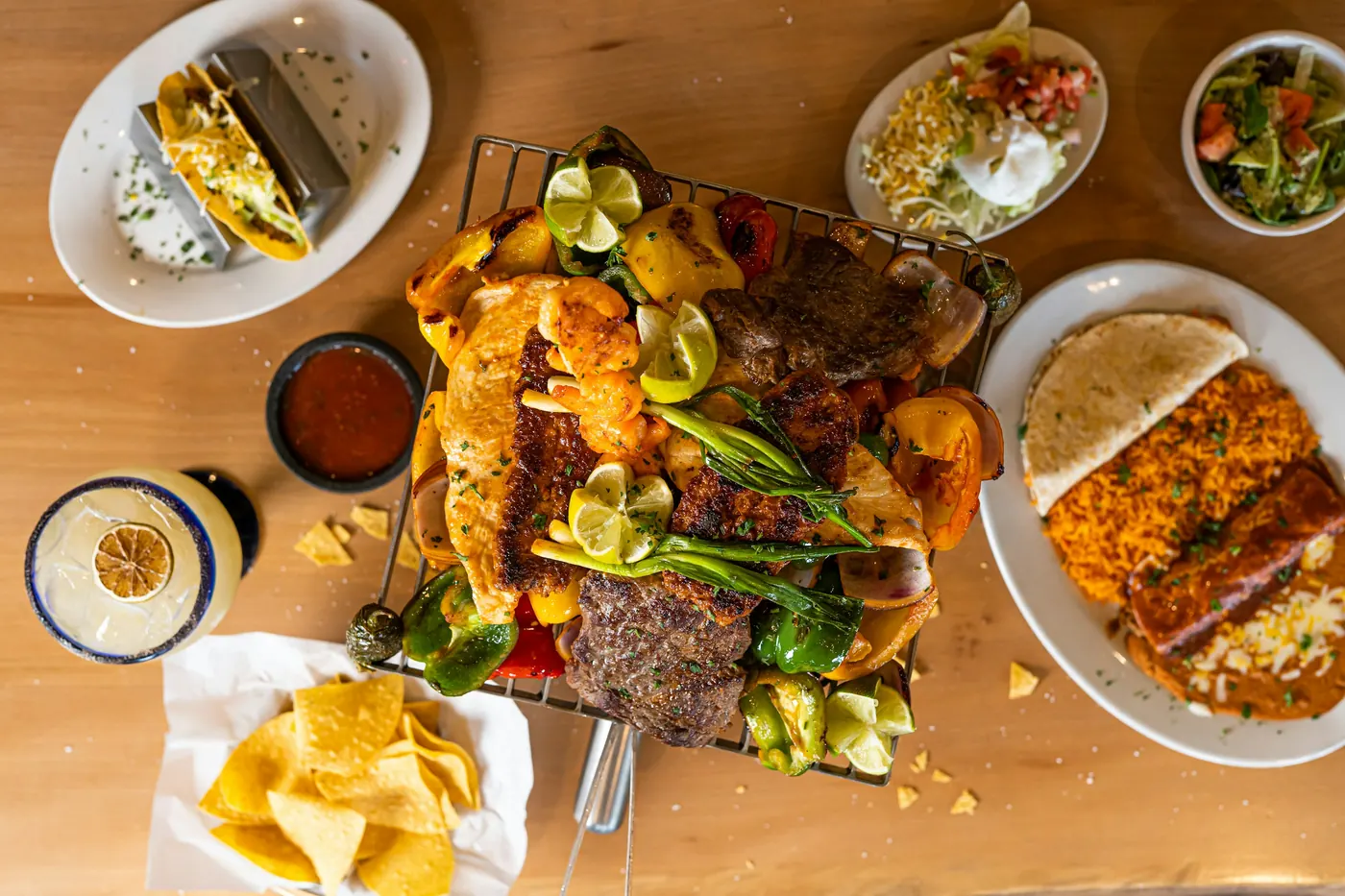
The fajitas are sized both ways, across chicken, beef, shrimp, combo and mixed. So are the pollo en mole, the tamales, the chile relleno, the veggie enchiladas, the camarones chipotle and the fiesta plate. The house specialties carry a note that lunch and dinner portion sizes differ, which is the menu saying it plainly.
The soups work the same way with small and large, which is a separate decision: a small pozole is a starter and a large one is a meal, as our soup guide notes.
Between those two systems, most of the menu can be ordered at the scale you actually want, which is unusual and worth using rather than defaulting to the larger number.
Frequently asked questions
Is a lunch portion just half a dinner portion?
No. The sides — rice, beans, tortillas — are usually identical. What is reduced is the protein, which makes the lunch plate a complete meal rather than a smaller one.
Why is the main meal in Mexico eaten in the afternoon?
La comida traditionally falls between two and four, with a light evening cena afterwards. The working day was historically built around it.
What is a comida corrida?
A set midday meal at a fixed price: soup, a rice course, a main with garnish, and often dessert and a drink. Common in fondas across Mexico.
Why are Mexican restaurant portions so large?
Because the bulk of the plate is rice, beans and tortillas, which are inexpensive and filling. The protein portion is usually more moderate than the plate size suggests.
Can I order a lunch portion at dinner?
Sometimes. Many kitchens restrict lunch sizing to lunch hours, but it is worth asking rather than assuming.
The short version
The two sizes exist because the Mexican main meal is at midday, not in the evening. The lunch plate keeps the sides and trims the protein, which makes it the honest choice if you are eating alone.
Julia’s sizes most of the menu both ways, and the soups small or large on top of that.