Bamboo boards and hardwood boards sit side by side on the same shelf, look alike and are often both sold as “wood.” They are not the same material. Bamboo is a fast-growing grass, cut into strips and glued into a slab. A hardwood board is cut from a tree such as maple, walnut or teak, and many are glued from strips too. That difference in what the surface is made of decides how each board treats your knives, how it handles water and how long it lasts.
Cutting boards take a beating in any restaurant, and the lesson there is simple: the board is part of the knife’s life. This guide compares bamboo and hardwood on hardness and knife wear, moisture and cracking, glue, weight and care, using extension-service guidance and what the makers say, then names two boards on each side.
Julia’s earns a commission on purchases made through links on this page, at no cost to you. Recommendations are based on what a restaurant kitchen looks for, product specifications and verified buyer reports.
Quick verdict: bamboo or hardwood?
For an everyday prep board, choose hardwood, such as maple or teak. It is gentler on knife edges, and the University of Maine Cooperative Extension describes wood as gentle on knives and highly durable. Choose bamboo if you want a lighter, lower-cost board for fruit, bread, serving or a second station, and you accept that the University of Maine says it can dull knives over time and crack if it is not looked after. If you own good knives, the hardwood board is the better first buy.
The table sums up the differences; the sections after it explain each one.
Bamboo vs wood cutting board, side by side
| Bamboo | Hardwood (maple, walnut, teak) | |
|---|---|---|
| What it is | A grass, cut into strips and glued into a board | Tree wood, as strips glued edge to edge, end-grain blocks or a single slab |
| Hardness | Harder than most wood (University of Maine) | Softer surface that gives slightly under the edge |
| Knife wear | Can dull knives over time (University of Maine) | Gentle on knives (University of Maine; John Boos) |
| Moisture | Less porous than most wood | Absorbs moisture if not maintained |
| Main risk | Cracking if not cared for; warping in a dishwasher | Warping or cracking if soaked; seams splitting |
| Weight | Light: 3.5 lb for an 18 x 12.5-inch, 0.6-inch board (Greener Chef) | Heavier when thick: 12 lb for a 20 x 15 x 1.5-inch teak board (Teakhaus) |
| Care | Hand wash, no soaking, no dishwasher, oil occasionally | Hand wash, no soaking, no dishwasher, oil about once a month |
| Glue | Always laminated; neither bamboo listing here names its adhesive | Most boards are glued strips; adhesive rarely named either |
Hardness and knife wear: the deciding difference
A cutting board should be a little softer than your knife’s edge so the edge sinks in slightly instead of slamming against something hard. The University of Maine Cooperative Extension’s bulletin on safe cutting boards puts bamboo on the harder side: harder than most wood and less porous, but able to dull knives over time. It describes wood as gentle on knives and highly durable, and warns that the hardest surfaces, glass, marble and stone, dull knives quickly. John Boos, which makes maple boards, says wood boards are known to be easier on knife blades, and that on end-grain boards the fibers absorb the impact of the blade.
The bamboo makers see it differently. Totally Bamboo’s listing calls bamboo gentle on knives, and that is true compared with glass or stone. But between bamboo and a good hardwood, the extension guidance points the other way, and it is the more neutral source. In practice, that means a sharp knife used daily on bamboo will want honing a little more often than the same knife on maple.
If you use a softer carbon-steel or thin Japanese blade, this matters more. If your knives are inexpensive stamped steel that you hone often anyway, the gap is small enough that weight and cost may decide it for you.
Moisture, cracking and warping
Both materials fail the same way: too much water. The University of Maine says to avoid soaking wooden boards, because excess moisture can warp or crack them over time, and it warns that bamboo boards may warp or be damaged in a dishwasher. It also says bamboo is more prone to cracking if it is not properly cared for. John Boos is blunter about wood: its boards are not dishwasher safe, and soaking or submerging one disturbs the moisture content and can split the rails.
Bamboo’s lower porosity is a small plus: the University of Maine says it resists moisture buildup better than wood when cleaned properly. But both need the same habits. Wash with warm water and dish soap, dry upright and keep them out of the dishwasher. The University of Maine also lists undiluted white vinegar, apple cider vinegar or 3 percent hydrogen peroxide as food-safe sanitizers for wood, and says any bleach soak should last no more than two minutes.
Glue and construction: what holds the board together
Bamboo stalks are hollow, so a bamboo board is always strips or fibers glued into a slab. That is not unique to bamboo: most hardwood boards are also strips glued edge to edge, and end-grain boards are blocks glued together. The University of Maine notes that boards with inlays or glued-together pieces are prone to cracking or separating in a dishwasher, which applies to both.
The fair complaint about bamboo is that you rarely know what the glue is. Neither bamboo listing on this page names its adhesive. Greener Chef says its board has no plastics, toxins or BPA, which is a broad marketing claim, not a named adhesive or a test result. The two hardwood listings here don’t name a glue either. If the adhesive matters to you, ask the maker before you buy, or choose a single-slab wood board, which has no glue lines at all.
Weight, size and handling
Bamboo is the lighter board at a given size, mostly because bamboo boards tend to be thin. Greener Chef lists its 18 by 12.5-inch board at 0.6 inch thick and 3.5 pounds. A thick hardwood board of a similar footprint is a different object: Teakhaus lists its 20 by 15 by 1.5-inch teak carving board at 12 pounds. That weight keeps a hardwood board still while you chop, which is safer, but it also makes it harder to lift to the sink.
For a small kitchen or a cook who moves the board between the counter and the table, a light bamboo board is easier to live with. For a board that stays put and takes heavy chopping, the heavier hardwood earns its weight. Put a damp towel under either one to stop it from sliding.
Care and oiling
The routine is almost identical. The University of Maine recommends food-safe mineral oil or beeswax about once a month, and says to avoid olive or vegetable oil because they can turn sticky and rancid. John Boos also says at least once a month, depending on use. Greener Chef asks you to wash with soap, rinse and let it air dry, never submerge it or put it in the dishwasher, and oil it occasionally. Teakhaus says hand wash only with ordinary dish soap and an occasional oiling. J.K. Adams finishes its Farmhouse maple board in mineral oil and beeswax and asks you to wipe it clean and re-oil it from time to time. Our best cutting board oil guide covers what to buy.
Both materials also need replacing at some point. The University of Maine says boards with deep grooves, cracks or heavy wear should be replaced once they can no longer be cleaned effectively.
Choose bamboo if… / Choose hardwood if…
Choose a bamboo board if…
- You want a light board you can lift to the sink or carry to the table easily.
- It is a second board, for fruit, bread, cheese or serving.
- You want a lower-cost start and are happy to hone your knife a little more often.
- You will hand wash it and keep it out of the dishwasher.
Choose a hardwood board if…
- It is your main prep board and you care about keeping knife edges sharp.
- You want a heavy board that stays put for chopping onions, chiles and herbs.
- You use softer or thinner Japanese blades.
- You are happy to oil it about once a month.
Our picks for the bamboo vs wood cutting board choice
Two boards on each side, in two sizes, all in stock when we checked. The two bamboo boards are not on our other pages. Both hardwood boards are different versions of lines we cover elsewhere, and we say why: the J.K. Adams is a smaller size of the Farmhouse maple board in our best turkey carving board guide, chosen because 17 by 11 inches is an everyday size to set against the Totally Bamboo, and the Teakhaus is the juice-groove carving version of the large Teakhaus board in our best cutting board wood guide, chosen to match the large Greener Chef.
1. Totally Bamboo Martinique 15 x 11-inch Bamboo Board – Everyday Size From a Bamboo Specialist

Totally Bamboo is a bamboo specialist, and its listing describes the Caribbean Collection, which includes this board, as one of the first bamboo cutting board lines. The Martinique is a 15 by 11-inch utility board with a strip of end-grain bamboo set between plain bamboo strips, which gives it a three-tone look. The listing says it is made from organically grown Moso bamboo and calls bamboo a renewable resource that grows back quickly.
At 15 by 11 inches it is big enough for a few onions or a pile of limes, and small enough to wash in a sink. The inlay is worth knowing about: the University of Maine notes that boards with inlays or glued pieces are prone to cracking or separating in a dishwasher, so wash it by hand and dry it standing up. The listing doesn’t give a thickness, weight or care instructions, so follow the general bamboo routine above.
Why we like it
- From a long-running bamboo specialist
- Practical 15 x 11-inch size
- Moso bamboo, per the listing
- 5-year warranty against defects (listing)
Key specifications
| Model | 20-1830 |
|---|---|
| Material | Moso bamboo with end-grain bamboo inlay |
| Size | 15 x 11 inches |
| Thickness | Not stated |
| Weight | Not stated |
| Juice groove | Not stated |
| Care | Not stated on listing; hand wash, no dishwasher |
| Warranty (stated) | 5 years against defects |
Why we recommend it
It suits a cook who wants a light, everyday bamboo board for fruit, vegetables and serving from a maker that specializes in bamboo.
Skip it if it would be your only board for heavy daily chopping with good knives; a hardwood board is kinder to the edge.
Pros and cons
Pros
- Specialist maker
- Easy size to handle and wash
- Stated defect warranty
Cons
- Thickness, weight and care not stated
- Inlay adds glue lines
- Bamboo is harder on knives than hardwood
2. Greener Chef 18 x 12.5-inch Bamboo Board – Large but Light
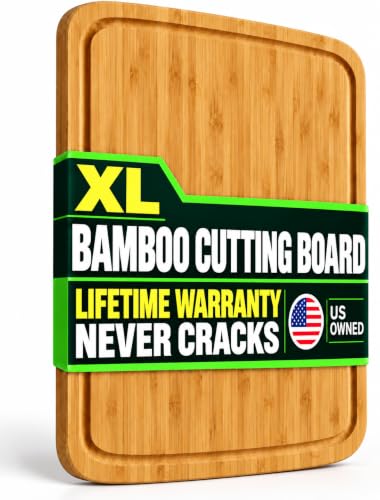
This is the bamboo board for anyone who wants a big surface without a heavy block. The listing gives 18 by 12.5 inches, 0.6 inch thick and 3.5 pounds, with a juice groove on one side and a flat face on the other. Greener Chef says it uses FSC-certified Moso bamboo in what it calls vertical-grain construction, and backs the board with a lifetime replacement guarantee.
The care instructions are clear: wash with dish soap, rinse and let it air dry, never submerge it or put it in the dishwasher, and oil it occasionally. That matches the University of Maine’s guidance. The size makes it handy for a whole chicken or a stack of tortillas and fillings, and the light weight means it’s easy to clean.
Greener Chef is a brand that sells mainly online, and the strength claims on the listing are its own. The board’s thinness is the trade-off: it will feel lighter and less planted than a 1.5-inch hardwood board.
Why we like it
- Weight stated: 3.5 lb at 18 x 12.5 inches
- Reversible, with a groove on one side
- Clear care instructions from the maker
- Lifetime replacement guarantee (listing)
Key specifications
| Model | 1250-ST (single-tone) |
|---|---|
| Material | FSC-certified Moso bamboo |
| Size | 18 x 12.5 inches |
| Thickness | 0.6 inch |
| Weight | 3.5 lb |
| Juice groove | One side |
| Care | Soap, rinse, air dry; no soaking or dishwasher; oil occasionally |
| Warranty (stated) | Lifetime replacement guarantee |
Why we recommend it
It suits a cook who wants a large board that is still easy to lift and wash.
Skip it if you want a heavy board that won’t move under hard chopping; the Teakhaus below is two and a half times as thick.
Pros and cons
Pros
- Large and light
- Reversible
- Strong stated guarantee
Cons
- Thin, so it can slide without a mat
- Adhesive not named
- Online-first brand; claims are its own
3. J.K. Adams Farmhouse 17 x 11-inch Maple Board – Knife-Friendly Everyday Hardwood

Maple is the classic cutting-board wood, and J.K. Adams is a long-established maker of it. This Farmhouse board is 17 by 11 inches and 0.75 inch thick, made from sustainably harvested North American maple according to the listing, with a deep juice groove and rounded corners. It arrives finished in mineral oil and beeswax.
It is the hardwood counterpart to the Totally Bamboo: a similar everyday size, but with the softer maple surface the University of Maine and John Boos both describe as kinder to knives. The groove makes it useful for carving a roast chicken or slicing tomatoes for salsa. Care is the usual wood routine: wipe it clean, keep it out of the dishwasher and re-oil it now and then.
This listing is sold by a third-party retailer rather than J.K. Adams, and it does not state a weight, a warranty or where the board is made.
Why we like it
- Maple from an established board maker
- Deep juice groove
- Finished in mineral oil and beeswax (listing)
- Everyday 17 x 11-inch size
Key specifications
| Model | FARM-1711-M |
|---|---|
| Material | North American maple |
| Size | 17 x 11 inches |
| Thickness | 0.75 inch |
| Weight | Not stated |
| Juice groove | Yes, deep |
| Care | Wipe clean, re-oil occasionally |
| Warranty (stated) | Not stated |
Why we recommend it
It suits a cook who wants an everyday maple board that is kind to good knives without being heavy to move.
Skip it if you need a big surface for large roasts; the Teakhaus is larger.
Pros and cons
Pros
- Maple is gentle on edges
- Useful groove for juicy foods
- Arrives oiled
Cons
- Weight and warranty not stated
- Sold by a third party on this listing
- Needs regular oiling
4. Teakhaus 20 x 15-inch Edge-Grain Teak Carving Board – Heavy and Stays Put

Teak is a dense, oily hardwood, and Teakhaus describes it as moisture resistant and kind to knives because of its natural oils. This is its large edge-grain carving board: 20 by 15 inches, 1.5 inches thick and 12 pounds according to the listing, made from FSC-certified teak, reversible, with a deep juice well on one side and grip handles.
Next to the Greener Chef, it shows the hardwood trade-off clearly. It weighs more than three times as much, which makes it a board that stays on the counter, but that weight keeps it planted for carving brisket or chopping a big batch of pico de gallo. It arrives pre-oiled. Teakhaus says to hand wash it with dish soap, keep it out of the dishwasher and oil it now and then.
Why we like it
- FSC-certified teak (listing)
- 1.5 inches thick, 12 lb: stays put
- Reversible with grip handles
- Deep juice well for carving
Key specifications
| Model | 109 |
|---|---|
| Material | FSC-certified teak, edge grain |
| Size | 20 x 15 inches |
| Thickness | 1.5 inches |
| Weight | 12 lb |
| Juice groove | Yes, one side |
| Care | Hand wash with dish soap; no dishwasher; oil occasionally |
| Warranty (stated) | Not stated |
Why we recommend it
It suits a cook with counter space who wants one large, heavy hardwood board for carving and big prep jobs.
Skip it if you need to lift your board often; at 12 pounds it is heavy to carry to the sink.
Pros and cons
Pros
- Heavy and stable
- Large carving surface
- Arrives pre-oiled
Cons
- Heavy to move
- Sold by a third-party retailer on this listing
- Warranty not stated
Bamboo and wood board questions, answered
Is bamboo better than wood for a cutting board?
Not for knives. The University of Maine says bamboo is harder than most wood and can dull knives over time, while wood is gentle on knives. Bamboo is lighter and less porous, which makes it a good second board.
Do bamboo cutting boards dull knives?
More than hardwood does, according to the University of Maine, though far less than glass, marble or stone. Regular honing with a honing steel keeps the edge working either way.
Can bamboo or wood boards go in the dishwasher?
No. The University of Maine says bamboo may warp or be damaged, John Boos says wood boards are not dishwasher safe, and Greener Chef and Teakhaus both say hand wash only.
How often should I oil a bamboo or wood board?
About once a month with food-safe mineral oil or beeswax, according to the University of Maine and John Boos, and more often if the board looks dry. Avoid olive and vegetable oil, which can go rancid.
Is the glue in bamboo boards safe?
Neither bamboo listing here names its adhesive, and most hardwood listings don’t either. If it matters to you, ask the maker which adhesive it uses, or choose a single-slab wood board with no glue lines.
Our take: hardwood for prep, bamboo as the extra
If you buy one board, make it hardwood. Maple or teak looks after your knives and lasts with a little oil, and our best cutting board wood guide compares the best of them. A bamboo board is a sensible, lighter second board for fruit, bread and serving. If you are still deciding between materials, our best cutting board guide covers plastic and composite too. And when you would rather someone else did the chopping, see the menu or call to order.