A Japanese knife does not have to be an expensive one. Every well-known Japanese maker sells an entry tier: plain stainless blades instead of layered Damascus, resin or simple wood handles instead of figured burl, and a factory edge instead of hours of hand finishing. Those knives are still thin, light and sharp in the way that makes Japanese cutlery worth wanting, and for a home cook they do almost everything the costlier lines do.
This guide covers only that entry tier. Our main guide to the best Japanese knife covers the step-up knives from Mac, Misono’s UX10 line, Shun and Miyabi, and our Japanese gyuto guide covers longer chef’s knives in harder steels. None of the seven knives below appear on either page, or on our set, santoku, nakiri, paring or bread knife pages. Prices change too often to quote, so instead we explain what the cheaper construction gives up and what it does not.
Julia’s earns a commission on purchases made through links on this page, at no cost to you. Recommendations are based on what a restaurant kitchen looks for in a chef’s knife, the makers’ own specifications, the details on each Amazon listing and published retailer and maker information, which we cite.
Quick verdict: which budget Japanese knife to buy
For most home cooks, the best Japanese knife cheap enough to buy without a second thought is the Kai Seki Magoroku Akane 7.1-inch Gyuto: made in Japan by one of Seki’s biggest makers, a three-layer stainless blade, and a resin handle that Kai’s listing says is dishwasher safe. If you want a classic gyuto from a traditional knife-making town, the Sakai Takayuki Inox 18 cm Gyuto is the entry point to a Sakai maker’s range. If you want a full 8-inch blade that stays light, the Masahiro MV 210 mm Gyuto weighs 150 grams, according to the listing.
Below are the five standouts side by side, all seven knives in detail, and a plain guide to telling a good-value Japanese knife from one that only borrows the look.
Five budget Japanese knives at a glance
Our five standout knives, one for each kind of cook, with the blade, steel and care each maker or listing states. All seven are reviewed in full below.
| Knife | Best for | Blade & steel | Care (per maker) | Buy on Amazon |
|---|---|---|---|---|

Kai Seki Magoroku Akane 7.1-inch GyutoBest overall
|
Busy kitchens, easy care | 180 mm, three-layer stainless | Dishwasher safe; dry promptly | View on Amazon |

Sakai Takayuki Inox 18 cm GyutoBest traditional maker
|
A plain, light Sakai gyuto | 180 mm, molybdenum steel | Not stated; hand wash advised | View on Amazon |

Masahiro MV 210 mm GyutoBest light 8-inch gyuto
|
A full-size gyuto that stays light | 210 mm, 150 g, made in Seki | Not stated; hand wash advised | View on Amazon |
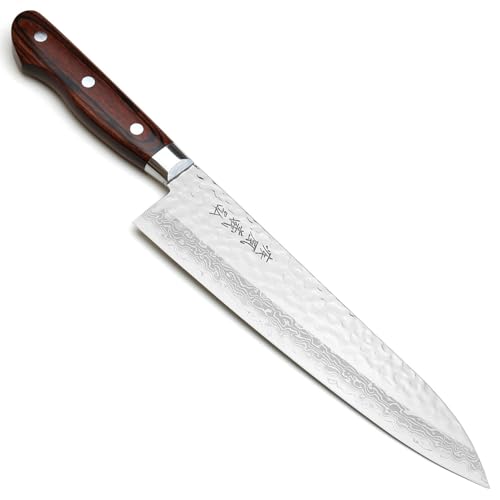
Yoshihiro VG10 16-Layer Hammered Damascus 8.25-inch GyutoBest Damascus for less
|
A harder steel and a hammered finish | 210 mm, VG10 core, HRC 60 | Hand wash and dry only | View on Amazon |

Shimomura Verdun Fine 160 mm SantokuBest all-steel santoku
|
Chopping vegetables, easy wiping | 160 mm, molybdenum vanadium stainless | Dishwasher safe | View on Amazon |
Product images from Amazon. Blade length, steel and care instructions are as stated by each maker or listing; check the listing before you buy.
Our picks for the best Japanese knife cheap enough for every day
These seven knives are all made in Japan, according to their listings, five of them by established Japanese cutlers, and each is the entry point of its maker’s range rather than a discounted premium knife. Between them they cover the choices that matter at this level: Western or Japanese-style handle, plain stainless or layered steel, a gyuto or a santoku, and dishwasher or hand wash. Each pick explains who it suits, the specifications that matter and one honest reason to skip it.
1. Kai Seki Magoroku Akane 7.1-inch Gyuto – Made in Japan, Dishwasher Safe
Seki Magoroku is Kai’s long-running Japanese-market brand, and Akane is one of its everyday lines. This 180 mm gyuto is a compact chef’s knife, a size many Japanese home cooks use as their main knife. According to the listing, the blade is three-layer steel: a molybdenum vanadium stainless core sandwiched between softer stainless layers that are easier to sharpen, with a three-step grind along the edge to reduce drag through food.
The detail that sets it apart is care. Kai’s listing says the heat-resistant resin handle is dishwasher safe, and it gives a heat limit for the handle of 284°F. Very few Japanese knives are sold that way. Kai still asks you to remove moisture and dirt promptly and dry the knife after use, because leaving it wet causes rust and discoloration.
The listing calls it a right-handed knife that left-handed cooks can also use. At 180 mm it is shorter than the usual American 8-inch chef’s knife, which makes it nimble on a small board but a little short for a big cabbage or watermelon.
Why we like it
- Made in Japan, per the listing.
- Three-layer stainless blade with a molybdenum vanadium core.
- Dishwasher-safe resin handle, according to Kai.
- Seamless stainless bolster.
Key specifications
| Model | AE-2907 |
|---|---|
| Blade length | 7.1 in (180 mm) |
| Steel | Three-layer: molybdenum vanadium stainless core, stainless cladding |
| Hardness | Not stated |
| Construction | Three-layer blade, stainless bolster |
| Handle | Polyacetal resin (heat resistant to 284°F) |
| Care | Dishwasher safe; dry promptly |
| Made in | Japan |
Why we recommend it
It suits a household where knives end up in the dishwasher whatever the label says, and a cook who wants a genuine made-in-Japan knife from one of Seki’s biggest makers.
Skip it if you want an 8-inch or longer blade; this one is 180 mm, and the listing does not give a hardness figure.
Pros and cons
Pros
- Dishwasher safe per the maker
- Made in Japan
- Laminated blade is easy to sharpen
Cons
- Shorter than a standard chef’s knife
- Listing is a translation and thin on detail
2. Sakai Takayuki Inox 18 cm Gyuto – A Sakai Maker’s Entry Knife
Sakai, near Osaka, is one of Japan’s oldest knife-making towns, and Sakai Takayuki is one of its best-known brands. Inox is the brand’s stainless everyday line, and this 18 cm gyuto is its smallest chef’s knife. The listing is brief but specific: a molybdenum steel blade, a POM resin handle, a total length of 305 mm, a 2 mm thick blade and a weight of 160 grams, made in Japan.
That 160 grams is the point. A Japanese gyuto at this level is lighter and thinner behind the edge than most Western chef’s knives, so it glides through onions and tomatoes rather than wedging them apart. Japanese knife retailers describe the Inox line as a stainless, stain-resistant steel on a Western handle, and they all advise hand washing and keeping it away from bones and frozen food.
The listing does not state care instructions, hardness or the exact grade of steel, and retailers disagree on that last point. What you can count on is a plain, honest knife from a maker whose higher lines are used in professional Japanese kitchens.
Why we like it
- Made in Japan by a Sakai brand.
- Light at 160 grams, per the listing.
- Thin 2 mm blade.
- Moisture-proof POM resin handle.
Key specifications
| Model | 11011 |
|---|---|
| Blade length | 7.1 in (18 cm) |
| Steel | Molybdenum stainless steel |
| Hardness | Not stated |
| Construction | 2 mm blade, 160 g |
| Handle | POM resin |
| Care | Not stated (retailers advise hand wash) |
| Made in | Japan |
Why we recommend it
It suits a cook who wants the light, thin feel of a real Japanese gyuto from a traditional knife town, and who is happy to hand wash and dry it.
Skip it if you want full specifications before you buy; the listing gives size and weight but not hardness or care.
Pros and cons
Pros
- Made in Japan
- Light and thin
- Resin handle tolerates water
Cons
- Very short listing
- 180 mm is small for big produce
3. Yoshihiro VG10 16-Layer Hammered Damascus 8.25-inch Gyuto – Harder Steel, Western Handle
Yoshihiro sells knives made by Japanese workshops, and its VG10 Hammered Damascus series is the maker’s own description of “extraordinary value” in its range. This 210 mm gyuto has a VG10 stainless core wrapped in 16 layers of steel, with a hammered texture that Yoshihiro says reduces friction and helps food come off the blade. The listing gives a hardness of HRC 60, which is harder than every other knife on this page that states a figure, and the main reason to choose it: a harder edge stays sharp longer.
The handle is a Western-style mahogany handle that runs the full tang of the knife, so it will feel familiar to anyone used to an American or German chef’s knife. At 210 mm the blade is a true 8-inch chef’s knife, long enough for a whole brisket point or a head of cabbage.
Harder steel asks more of you. Yoshihiro says to sharpen and hone only on water whetstones, hand wash and dry immediately, especially after acidic food like lime or tomato, and never use it on bones, nutshells or frozen food. If that sounds like too much care, the Kai Akane or Sakai Takayuki above are easier knives.
Why we like it
- VG10 core at HRC 60, per the listing.
- Hammered finish to reduce sticking.
- Full-tang Western handle.
- Made in Japan.
Key specifications
| Model | HDGY21 |
|---|---|
| Blade length | 8.25 in (210 mm) |
| Steel | VG10 core, 16-layer Damascus |
| Hardness | HRC 60 |
| Construction | Forged, hammered, full tang |
| Handle | Mahogany, Western style |
| Care | Hand wash and dry only; whetstones only |
| Made in | Japan |
Why we recommend it
It suits a cook who wants a harder, longer-lasting edge and a Damascus look, and who already owns or will learn to use a whetstone.
Skip it if you sharpen with a pull-through sharpener or wash knives in the dishwasher; Yoshihiro rules out both.
Pros and cons
Pros
- Hardest stated steel on this page
- Full-size 210 mm blade
- Made in Japan
Cons
- Strict care: whetstones and hand wash only
- Wood handle needs drying
4. Shimomura Verdun Fine 160 mm Santoku – Stainless Blade and Handle, Easy to Clean
Shimomura Kogyo is a cutlery maker in Tsubame-Sanjo, Niigata, a metalworking region known across Japan, and Verdun is its everyday knife line. This 160 mm Verdun Fine santoku has the short, tall blade and flat edge that make chopping straight down easy: onions, peppers, cilantro and cabbage for salsa are what a santoku does best.
According to the listing, the blade is molybdenum vanadium stainless steel and the handle is 18-8 stainless steel. It gives a thickness of 2.4 mm without saying which part that measures, and it gives no weight. A steel handle has no wood to soak up water, and the listing title calls the knife dishwasher safe.
The trade-off is grip. A smooth steel handle is easy to wipe but can feel slippery with wet or oily hands, which is why rubbery handles are the norm in restaurant kitchens. If you can, hold one before you buy, and keep your hands dry when you use it.
Why we like it
- Made in Tsubame-Sanjo, Japan, per the listing.
- Molybdenum vanadium stainless blade.
- 18-8 stainless steel handle.
- Dishwasher safe, per the listing title.
Key specifications
| Model | OVF-101 |
|---|---|
| Blade length | 6.3 in (160 mm) |
| Steel | Molybdenum vanadium stainless steel |
| Hardness | Not stated |
| Construction | Stainless blade and handle; 2.4 mm thickness as listed; weight not stated |
| Handle | 18-8 stainless steel |
| Care | Dishwasher safe, per the listing title |
| Made in | Japan |
Why we recommend it
It suits a cook who mostly chops vegetables and herbs and wants a made-in-Japan santoku with a steel handle that is simple to clean.
Skip it if you often cook with wet or greasy hands; a smooth steel handle is less secure than resin or wood.
Pros and cons
Pros
- Made in Japan
- Steel handle wipes clean
- Compact 160 mm blade
Cons
- Steel handle can feel slippery
- Hardness, weight and warranty not stated
5. Masahiro MV 210 mm Gyuto – Full Size, Only 150 Grams
Masahiro is a long-established cutler in Seki, Gifu Prefecture, and MV is its stainless range for everyday kitchen work. This is the 210 mm gyuto, the Japanese equivalent of an 8-inch chef’s knife, and the Amazon listing gives three facts: a 210 mm blade, a weight of 150 grams, and made in Seki.
That weight is the reason to look at it. At 150 grams it is barely heavier than the 180 mm Sakai Takayuki above, yet it has the reach of a full 8-inch chef’s knife for halving cabbages or slicing a tray of fajita steak. A light, long blade lets you work through a sack of onions without your wrist tiring.
The listing does not name the steel, the handle or care instructions. Japanese knife retailers list Masahiro’s model 14811 as a 210 mm gyuto in MBS-26 stainless steel with a synthetic handle, at roughly HRC 58 to 60, and one describes the edge as asymmetric, favoring right-handed cooks. We could not confirm that against Masahiro’s own catalog, so check the photos and ask the seller if steel or handedness matters to you. Treat it as hand wash only.
Why we like it
- Made in Seki, Japan, per the listing.
- Full 210 mm blade at 150 grams.
- From an established Seki cutler.
Key specifications
| Model | 14811 |
|---|---|
| Blade length | 8.25 in (210 mm) |
| Steel | Not stated (retailers list MBS-26 stainless) |
| Hardness | Not stated (retailers list about HRC 58–60) |
| Construction | 150 g |
| Handle | Not stated (retailers list synthetic) |
| Care | Not stated |
| Made in | Japan (Seki) |
Why we recommend it
It suits a cook who wants a full-length gyuto that stays light in the hand, from a traditional Seki maker.
Skip it if you want full specifications on the listing itself; this one gives only length, weight and origin.
Pros and cons
Pros
- Made in Japan
- Very light for its length
- Full 8-inch class blade
Cons
- Very thin listing
- Edge may favor right-handed cooks, per a retailer
6. TONMA 8.2-inch Chef Knife – Seki-Made AUS-8 With Lifetime Warranty

TONMA is a brand that sells mainly on Amazon, but unlike most such brands it says exactly where and how its knives are made. According to the listing, this 8.2-inch gyuto is made by craftsmen in Seki, Gifu Prefecture, from AUS-8 stainless steel hardened to HRC 59, plus or minus one, with a one-piece forged blade and a full-tang black pakkawood handle. The edge is ground in a convex “hamaguri” (clamshell) profile, which the listing says makes it durable.
AUS-8 is a common, well-regarded Japanese stainless steel: harder than the Kimura’s HRC 57 steel below, softer than the Yoshihiro’s VG10, rust resistant and easy to resharpen. Pakkawood is a resin-impregnated wood laminate that looks like wood but stands up to water better.
TONMA lists a lifetime warranty, which is unusual for a knife at this level. The listing does not give care instructions, so treat it as hand wash only.
Why we like it
- Made in Seki, Japan, per the listing.
- AUS-8 steel at HRC 59 ±1.
- Full-tang pakkawood handle.
- Lifetime warranty.
Key specifications
| Model | TCK-1 |
|---|---|
| Blade length | 8.2 in |
| Steel | AUS-8 stainless, hamaguri edge |
| Hardness | HRC 59 ±1 |
| Construction | One-piece forged, full tang |
| Handle | Black pakkawood |
| Care | Not stated |
| Made in | Japan |
Why we recommend it
It suits a cook who wants a full-size, made-in-Japan gyuto with a wood-look handle and a long warranty, and who is comfortable buying from a newer brand.
Skip it if you prefer a maker with a long public history; TONMA is a young, Amazon-first brand.
Pros and cons
Pros
- Stated steel, hardness and origin
- Lifetime warranty
- Full-size 8.2-inch blade
Cons
- Newer brand with a short track record
- Care instructions not stated
7. Kimura 8-inch Chef Knife – Bolstered, Riveted and Made in Seki

Kimura is another brand that sells mainly on Amazon, and like TONMA it says where its knives are made: according to the listing, this 8-inch gyuto is manufactured in Seki, Japan. The blade is high-carbon chrome molybdenum stainless steel heat treated to HRC 57 and hand sharpened to a 15-degree angle, a softer, forgiving class of steel like the molybdenum stainless in Sakai Takayuki’s and Shimomura’s entry knives.
What sets it apart is the build. The listing describes a single piece of steel with a full tang, triple-riveted to a non-slip POM resin handle, with a full bolster. That makes it the most German-feeling knife on this page: heavier at the heel, steady on hard squash, and comfortable in a pinch grip. A full bolster does make the heel of the edge harder to sharpen all the way down, a small trade-off for the extra heft.
Kimura lists a lifetime warranty and says the knife comes in a gift box. The listing gives no care instructions, so treat it as hand wash only.
Why we like it
- Made in Seki, Japan, per the listing.
- Stated HRC 57 and 15-degree edge.
- Full tang, triple rivets and full bolster.
- Lifetime warranty.
Key specifications
| Model | Kimura 8-inch chef knife |
|---|---|
| Blade length | 8 in (listed as 8.3 in) |
| Steel | High-carbon chrome molybdenum stainless, 15° edge |
| Hardness | HRC 57 |
| Construction | One piece, full tang, full bolster, triple riveted |
| Handle | POM resin, non-slip |
| Care | Not stated |
| Made in | Japan (Seki) |
Why we recommend it
It suits a cook moving from a German chef’s knife who wants a made-in-Japan blade without giving up a bolster and a familiar riveted handle.
Skip it if you want the lightest possible knife; the bolster and full tang make this heavier than the gyutos above.
Pros and cons
Pros
- Clear steel, hardness and edge figures
- Familiar riveted Western handle
- Lifetime warranty
Cons
- Full bolster complicates sharpening the heel
- Newer, Amazon-first brand
What you give up with a budget Japanese knife
We do not print prices because they change week to week. A better question is what the extra money buys further up a Japanese maker’s range, and whether you will miss it. Most of the difference comes from four places.
The steel. Entry knives use AUS-8 or molybdenum stainless steels around HRC 57 to 59. These are softer than the VG10 or SG2 in costlier lines, so they lose their edge sooner. They are also tougher, less likely to chip and easier to sharpen at home. For a cook who hones every few uses, that is a fair trade.
The cladding. Layered Damascus and hammered finishes look beautiful and can help food release, but a plain stainless blade cuts just as well. The Yoshihiro is the one knife here where you pay a little for looks.
The handle. Resin, POM and stainless handles cost less than burl wood or horn and tolerate water better. Commercial kitchens prefer them for that reason.
The finishing. Expensive Japanese knives are often thinner behind the edge and more carefully polished. Entry knives are still thinner than most Western chef’s knives, which is what most people mean when they say a Japanese knife feels sharper.
Where a budget Japanese knife should not cut corners: it should come from a maker you can identify, say what steel it uses, and ideally say where it is made and how to care for it. All seven knives here are made in Japan according to their listings, and six of the seven listings name the steel.
How to choose a Japanese knife on a budget
1. Gyuto or santoku
A gyuto is the Japanese chef’s knife: a pointed tip and a curved edge that rocks as well as chops. A santoku is shorter and taller, with a flatter edge for chopping straight down. If you cook meat as often as vegetables, buy a gyuto; if you mostly chop vegetables, herbs and aromatics, a santoku is easier. Our cheap santoku knife guide covers more santokus at this level.
2. Blade length
For a first knife, 180 to 210 mm (7 to 8.25 inches) suits almost every kitchen. Longer blades of 240 mm and up need a big board and practice.
3. Steel and hardness
Harder steel (HRC 60 and up) holds an edge longer but can chip and needs a whetstone. Softer steels around HRC 56 to 59 are more forgiving. Match the steel to how you sharpen: pull-through sharpener users should stay with the softer knives.
4. Handle style and care
Western handles with rivets feel familiar; Japanese-style and stainless handles are lighter. Only the Kai Akane and the Shimomura are sold as dishwasher-friendly here. Hand washing and drying is still kinder to every knife.
5. Warranty and sharpening support
TONMA and Kimura both list a lifetime warranty. Support like that is worth more than a fancier steel. If you want to sharpen at home, our Japanese knife sharpener guide covers the tools.
How we chose these seven entry-level knives
We started with what a chef’s knife has to do in a working kitchen: slice and chop quickly, feel secure in a wet hand and be easy to keep sharp. We then looked only at knives in stock on Amazon in the United States, from identifiable makers, and only at the entry tier of each maker’s range. For each knife we read the Amazon listing for the steel, hardness, construction, handle, care and origin, and used published information from Japanese knife retailers where a listing was thin, as with the Masahiro and Sakai Takayuki. We left out every knife already recommended on our best Japanese knife, gyuto, Japanese knife set, santoku, nakiri, paring and bread knife pages, or on our other chef’s knife guides. Tojiro’s DP gyuto, the most often recommended budget Japanese knife, was not in stock when we checked, and the Kai Wasabi chef’s and Mac Original chef’s knives were listed as scarce. We left out Global, Shun and Mac’s Professional knives because they are not entry-level, Victorinox and Mercer because they are not Japanese, and sellers with no identifiable maker; TONMA and Kimura are the two Amazon-first brands here, both of which state that their knives are made in Seki. We checked the U.S. Consumer Product Safety Commission’s recall database for each brand on this page and found no kitchen knife recalls. We have not used these knives ourselves; where we describe how a knife performs, we say whose description it is.
Affordable Japanese knife questions, answered
What is the best value Japanese knife?
For most cooks, the Kai Seki Magoroku Akane gyuto: made in Japan, a three-layer stainless blade and, according to Kai, a dishwasher-safe handle. If you want a full 8-inch blade, the Masahiro MV 210 mm or the Kimura 8-inch are the better value.
Which Japanese knife brands are affordable?
Kai (including its Seki Magoroku lines), Tojiro, Masahiro, Misono’s Molybdenum line, Sakai Takayuki’s Inox line and Shimomura all make entry-level knives. Shun, Miyabi and Misono’s UX10 sit higher up; our main Japanese knife guide covers those.
Are cheap Japanese knives worth buying?
Yes, if they come from an identifiable maker and you keep them sharp. They give up some edge retention and finish, not the thin blade that makes Japanese knives pleasant to use. Pair one with a honing steel or a whetstone.
Can a budget Japanese knife go in the dishwasher?
Most makers say no. The Kai Seki Magoroku Akane is listed as dishwasher safe and the Shimomura Verdun Fine as dishwasher safe; Yoshihiro says hand wash only. Dry any knife straight away to prevent rust spots.
Should my first Japanese knife be a gyuto or a santoku?
A 180 to 210 mm gyuto is the most versatile first knife. Choose a santoku if you mostly chop vegetables and prefer a shorter blade.
Our final pick for a first Japanese knife
Buy the Kai Seki Magoroku Akane gyuto if you want one dependable, made-in-Japan knife that tolerates the dishwasher. Choose the Sakai Takayuki Inox for a light, traditional gyuto from a Sakai maker, or the Masahiro MV for a full 210 mm blade that still weighs only 150 grams.
If you are ready to spend more, our main guide to the best Japanese knife covers the step-up knives, and the Japanese knife set guide covers buying several at once.
And if you would rather someone else did the chopping tonight, see the menu or call to order.