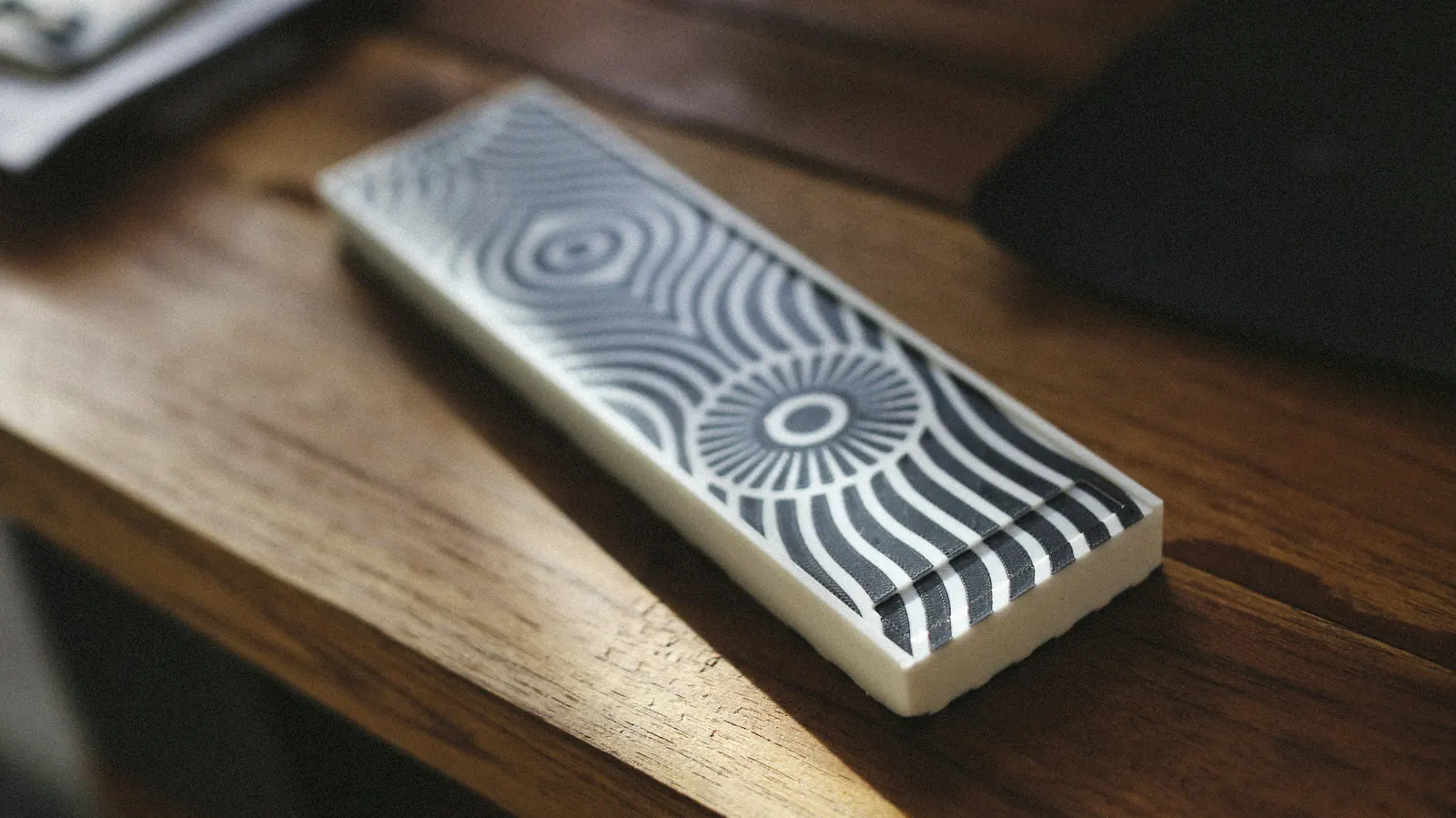
A sharp knife is the cheapest upgrade in any kitchen. In a Mexican kitchen it shows quickly: a dull blade crushes tomatoes for pico de gallo instead of cutting them, tears cilantro into a bruised mess and skids off the waxy skin of a jalapeño. A sharpening stone fixes all of that, and an entry-level stone from a real maker does the job without the cost of a specialist set.
This guide is for cooks who want a first stone, a spare stone or a second grit without paying for a premium line. We do not quote prices, because they change daily. Instead, this page explains how to judge value in a cheap whetstone, then reviews seven entry-level stones from makers that state what they sell: Kai, Norton, DMT, King, Suehiro, Shan Zu and Update International.
Julia’s earns a commission on purchases made through links on this page, at no cost to you. Recommendations are based on what a restaurant kitchen looks for, product specifications and verified buyer reports.
Quick verdict: which cheap whetstone to buy
For most home cooks, the best cheap whetstone is the Kai Combination Whetstone #400/#1000: a coarse side for neglected edges, a #1000 side for routine sharpening, and a holder with a water channel and rubber feet, all from a Japanese knife maker. If you prefer oil and a stone that lasts for decades, the small Norton Crystolon combination stone is the classic entry point. If you never want to flatten a stone, the DMT DiaFold fine/coarse diamond sharpener works dry and is made in the USA.
Below you will find a short comparison table, the seven stones in full, and a section on how to tell a good budget stone from a false economy.
Five budget whetstones side by side
Our five standout entry-level stones, one for each kind of cook, with the abrasive and grit each maker or listing states. All seven are reviewed in full below.
| Whetstone | Best for | Abrasive | Grit | Buy on Amazon |
|---|---|---|---|---|

Kai Combination Whetstone #400/#1000Best overall
|
A first stone for kitchen knives | Green silicon carbide | #400 / #1000 | View on Amazon |

Norton Crystolon Combination Bench StoneBest oil stone
|
Oil sharpening, small blades | Silicon carbide | Coarse / fine | View on Amazon |

DMT DiaFold Fine/Coarse Diamond SharpenerBest diamond
|
No soaking, no flattening | Monocrystalline diamond | 325 / 600 mesh | View on Amazon |

Shan Zu 1000 and 5000 Two-Stone SetBest boxed set
|
Sharpen and polish from one box | White corundum | #1000 and #5000 | View on Amazon |

King Deluxe #8000 Finishing StoneBest polishing stone
|
A fine edge after a #1000 stone | Not stated (“special abrasive”) | #8000 | View on Amazon |
Product images from Amazon. Abrasives and grits are as stated by each maker or listing; check the listing before you buy.
Our picks for the best cheap whetstone
These seven stones are the entry tier of each maker’s range: a Japanese water stone with its own holder, an American oil stone, a folding diamond plate, two Japanese finishing stones, a two-stone set and a foodservice bench stone. Each pick says who it suits, what the maker or listing states, and one honest reason to skip it.
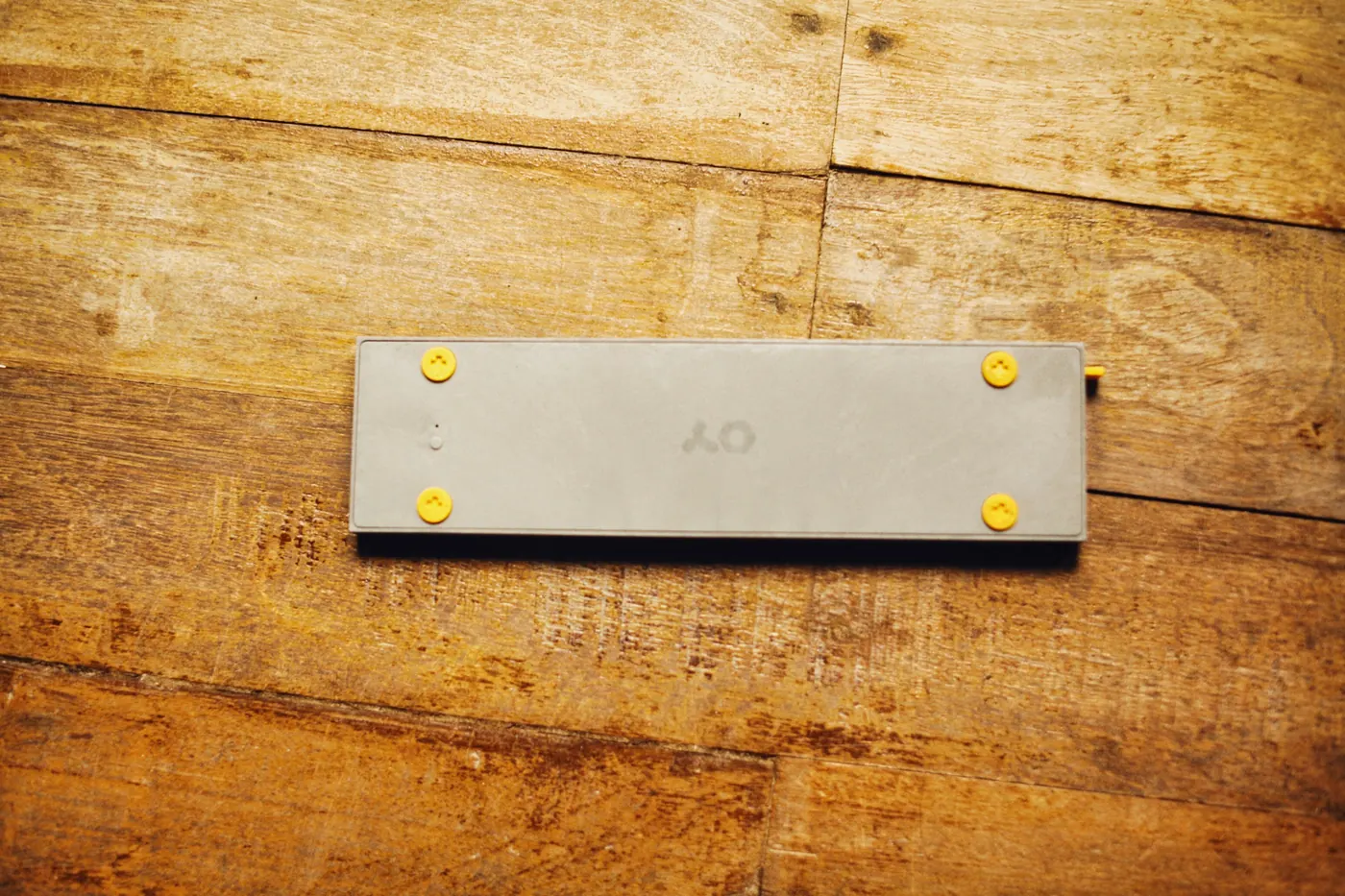
1. Kai Combination Whetstone #400/#1000 – Two Grits in Their Own Holder
Kai is the Japanese company behind Shun knives, and this AP-0305 combination stone is one of the plainest items in its sharpening range. The listing describes it as green carbide, which is green silicon carbide, rated as equivalent to #400 on the coarse side and #1000 on the medium side. That pairing is the most useful one for a first stone: #400 restores an edge that has gone properly dull or has a small nick, and #1000 does the routine sharpening a kitchen knife needs every month or two.
The holder is what makes it good value. According to the listing, the base has synthetic rubber ribs to stop it sliding, a groove that catches the water running off the stone so the counter stays cleaner, and it doubles as a drying rack after use. Many cheap stones ship with a thin rubber pad and nothing else, so a stand that does three jobs is worth having.
The listing gives the size, holder included, as 10.0 by 3.7 by 2.2 inches and the weight as 26.9 ounces, and states the country of origin as China. Treat it as a soaking stone: a Japanese retailer that sells it advises soaking before use, keeping the surface wet while you sharpen and flattening it when it becomes uneven.
Why we like it
- Coarse and medium grits on one stone
- Holder with non-slip ribs and a water channel
- From a Japanese knife maker
- Holder doubles as a drying stand
Key specifications
| Model | AP-0305 |
|---|---|
| Abrasive | Green silicon carbide |
| Grit | #400 / #1000 equivalent |
| Size | 10.0 x 3.7 x 2.2 in with holder |
| Lubricant | Water (soak before use) |
| Base | Holder with rubber ribs and water groove |
| Made in | China |
Why we recommend it
It suits a home cook sharpening a block of German or Japanese kitchen knives for the first time who wants one purchase that covers repair and routine sharpening.
Skip it if you want a polished, very fine edge; #1000 leaves a working edge, and you would add a finishing stone later.
Pros and cons
Pros
- The two grits a beginner needs most
- Stable holder included
- Keeps water off the counter
Cons
- No finishing grit
- Needs soaking and flattening
- Made in China, not Japan
2. Norton Crystolon Combination Bench Stone – A Small Oil Stone That Lasts
Norton, the abrasives maker now part of Saint-Gobain, has sold Crystolon stones for a long time; Crystolon is its silicon carbide line: hard, fast-cutting and used with oil rather than water. The 85440 is the smallest combination bench stone in the range, with a coarse face and a fine face. The listing gives its size as 4 inches long, 1-3/4 inches wide and 5/8 inch thick.
That size is the main thing to understand before you buy. Four inches is short for an 8-inch chef’s knife; you sharpen the blade in sections rather than in one long stroke, which takes a little practice. It is well suited to paring knives, small utility knives and the pocket knife many cooks carry. Industrial distributors that sell the same stone describe it as a coarse/fine combination stone that needs oil to keep its pores open, and list it for chisels and plane blades as well as knives.
Oil stones generally wear more slowly than soft water stones and need flattening less often, which is a real saving over years. Use a light honing oil or mineral oil, wipe the stone after each session, and store it in a box or bag so it does not pick up grit from the drawer.
Why we like it
- Coarse and fine faces on one stone
- Silicon carbide cuts quickly
- Oil stones wear slowly
- From a long-established abrasives maker
Key specifications
| Model | 85440 |
|---|---|
| Abrasive | Silicon carbide (Crystolon) |
| Grit | Coarse / fine combination |
| Size | 4 x 1-3/4 x 5/8 in |
| Lubricant | Oil |
| Base | Not stated |
| Made in | Not stated |
Why we recommend it
It suits a cook who wants a durable, low-maintenance stone for paring and utility knives, or a small stone to keep in a kitchen drawer or a camping box.
Skip it if your main knife is a long chef’s knife and you want full-length strokes; a longer stone is easier to learn on.
Pros and cons
Pros
- Fast-cutting silicon carbide
- Needs flattening less often than water stones
- Compact enough for a drawer
Cons
- Short for chef’s knives
- Oil is messier than water
- No base included
3. DMT DiaFold Fine/Coarse Diamond Sharpener – Works Dry, Stays Flat
DMT’s bench plates are well known and well made, but the DiaFold is the cheapest way into the company’s diamond range. It is a double-sided diamond plate whose plastic handles fold over to protect it. The listing gives a coarse side of 45 micron (325 mesh) for restoring neglected edges and a fine side of 25 micron (600 mesh) for sharpening, with the tool measuring 9.5 inches open and 5 inches closed.
Diamond has two advantages for a budget buyer. It does not need soaking, because DMT says it can be used dry or with water and needs no oil, and the plate stays flat, so you never buy a flattening stone. It also cuts hard steels that wear down a cheap water stone. DMT states that its sharpeners are made in the USA using monocrystalline diamond.
The trade-off is surface area. The diamond plate is narrow and only part of the open length, so a chef’s knife is sharpened in sections, in the same way as on a small oil stone. Note that the Amazon title calls it a DuoSharp; the listing’s description, model FWFC and fold-and-go handles all point to the DiaFold.
Why we like it
- Use dry or with water, no oil
- Diamond plate does not dish
- Coarse and fine grits stated in microns
- Made in the USA, according to DMT
Key specifications
| Model | FWFC |
|---|---|
| Abrasive | Monocrystalline diamond |
| Grit | Coarse 45 micron (325 mesh) / fine 25 micron (600 mesh) |
| Size | 9.5 in open, 5 in closed |
| Lubricant | Dry or water |
| Base | Folding handles (no bench base) |
| Made in | USA |
Why we recommend it
It suits cooks who want to sharpen without soaking, flattening or oil, and who also like a sharpener small enough for a picnic basket or a tackle box.
Skip it if you want a large bench surface for long, even strokes; DMT’s bench stones cost more for that reason.
Pros and cons
Pros
- No soaking or flattening
- Handles protect the plate
- Cuts hard steels
Cons
- Narrow plate for long knives
- Fine side is not a polishing grit
- Amazon title names it a DuoSharp
4. Shan Zu 1000 and 5000 Two-Stone Set – Sharpen and Polish From One Box
Shan Zu is a knife brand sold mainly on Amazon, and this set takes a different approach from the usual double-sided budget stone. Instead of one stone with two faces, it supplies two separate stones, #1000 and #5000, made of white corundum according to the listing. The listing argues that individual stones last longer than a combination stone; that is plausible, because each stone is a full thickness of one grit, but it is the seller’s claim.
The box is part of the appeal. The listing describes an acacia wood case that holds the stones, a silicone holder that grips them in the base while you work, and an angle guide that clips to the spine of the blade. For a beginner, the angle guide removes the hardest part of freehand sharpening, at least for the first few sessions.
These are soaking stones. The listing says to soak them in tap water for about 10 minutes before use, and its note mentions soaking a flattening stone with them; check the listing’s photos to see exactly what comes in the box. Grit numbers on budget stones are not standardized between makers, so expect the #5000 to give a refined edge rather than a mirror.
Why we like it
- Two separate full-thickness stones
- Sharpening and polishing grits
- Angle guide included
- Wood storage case doubles as a base
Key specifications
| Model | Not stated |
|---|---|
| Abrasive | White corundum |
| Grit | #1000 and #5000 (separate stones) |
| Size | Not stated |
| Lubricant | Water (soak about 10 minutes) |
| Base | Acacia wood case with silicone holder |
| Made in | Not stated |
Why we recommend it
It suits a beginner who wants a sharpening grit, a finishing grit and an angle guide in one tidy box, and who likes the idea of separate stones.
Skip it if you need to repair chips or a very dull edge; there is no coarse stone in the set.
Pros and cons
Pros
- Two grits as separate stones
- Angle guide for beginners
- Storage case included
Cons
- Stone size not stated
- No coarse grit
- Amazon-first brand with little maker information
5. King Deluxe #8000 Finishing Stone – A Fine Edge From a Japanese Maker
King is one of the best-known names in Japanese water stones, and its Deluxe line is the maker’s everyday range. This is the #8000 finishing stone: it is not for sharpening a dull knife, but for refining an edge you have already sharpened on a #1000 stone. The result is a smoother, keener edge that glides through tomato skin and slices raw onion cleanly.
The listing gives the size as about 8.2 by 2.6 by 0.8 inches and the weight as about 22 ounces, describes the material only as a special abrasive, and states that it is made in Japan and comes with a simple whetstone base. That is a full-size bench stone, long enough for a chef’s knife in one stroke.
Soaking advice for King’s finishing stones varies between sellers, and the listing does not say. The safe approach is to wet the surface and keep it wet as you work. Rinse the stone after use and let it dry in the shade, as King’s product description, quoted by a retailer, advises. Add this stone to a coarse and medium stone; on its own it cannot bring back a dull edge.
Why we like it
- Very fine #8000 grit
- Full-size stone for long knives
- Made in Japan
- Base included
Key specifications
| Model | No.8000 |
|---|---|
| Abrasive | Not stated (“special abrasive”) |
| Grit | #8000 |
| Size | About 8.2 x 2.6 x 0.8 in |
| Lubricant | Water |
| Base | Simple whetstone base |
| Made in | Japan |
Why we recommend it
It suits a cook who already owns a #1000 stone and wants an inexpensive way to take the edge further, especially for slicing and fine knife work.
Skip it if this would be your only stone; a finishing grit cannot sharpen a dull blade.
Pros and cons
Pros
- Refines an edge after #1000
- Japanese-made King stone
- Long enough for a chef’s knife
Cons
- Not a sharpening grit
- Abrasive not stated
- Soaking advice unclear
6. Suehiro Rika #5000 Finishing Stone – Comes With Its Own Nagura
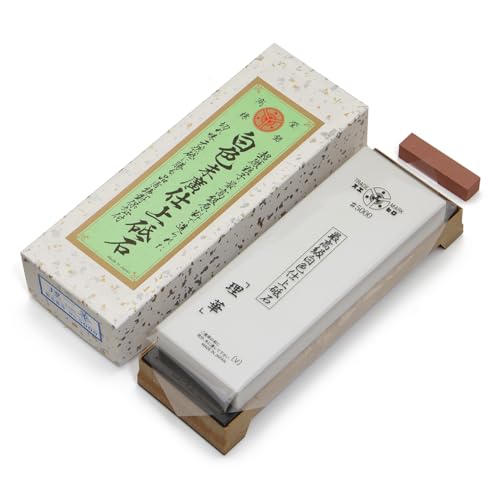
Suehiro is a Japanese whetstone maker, and the Rika is the long-running finishing stone in its range. The listing describes the white #5000 as a size 1 finishing stone with smooth sharpening properties that has been popular for many years, made in Japan and designed for professionals but suitable for home cooks.
It ships with a nagura, a small, harder stone that you rub on the surface to clean it and raise a little slurry. Retailers that sell the Rika recommend a short soak of about 5 to 10 minutes before use, and one specialist seller notes that the stone wears faster than some alternatives, so it needs regular flattening. Another describes its cutting speed as similar to many #2000 to #3000 stones, which makes it a forgiving step after a #1000 stone.
Choose between this and the King #8000 by what you want from the edge. #5000 is a little coarser and leaves slightly more bite on the edge; #8000 goes finer. Neither replaces a medium stone, and the listing does not give dimensions.
Why we like it
- Nagura included for cleaning the surface
- Made in Japan
- A gentle step after #1000
- Long-running Suehiro design
Key specifications
| Model | Rika 5000 |
|---|---|
| Abrasive | Not stated |
| Grit | #5000 |
| Size | Not stated |
| Lubricant | Water (short soak) |
| Base | Base and nagura included |
| Made in | Japan |
Why we recommend it
It suits a cook adding a first finishing stone who wants an edge that is refined but still grips the skin of a tomato or a jalapeño.
Skip it if you dislike flattening stones; this one wears faster than harder finishers, according to a specialist seller.
Pros and cons
Pros
- Nagura in the box
- Japanese-made finisher
- Edge keeps some bite
Cons
- Wears and needs flattening
- Dimensions not on the listing
7. Update International 8 x 2 Inch Combination Stone – A Plain Foodservice Bench Stone

Update International supplies restaurant kitchens, and this G-0208 is the kind of plain combination stone found in a lot of commercial prep areas. The listing gives the size as 8 inches long, 2 inches wide and 1 inch thick, with a coarse and a fine grit for general sharpening of hand tools and cutlery. Eight inches by two is a comfortable bench size: long enough for a chef’s knife, wide enough to hold a steady angle.
There is one inconsistency to know about. The Amazon title calls it an aluminum oxide stone, while the listing’s bullet points describe it as silicon carbide. Both are common abrasives for combination stones, and the stone works the same way either way, but we cannot tell you which it is. The listing also does not say whether to use it with oil or water. Stones like this are often used with oil; whichever you choose, stick with it, because a stone that has been oiled will not work properly with water.
It has no base, so set it on a damp towel or a rubber mat to stop it sliding.
Why we like it
- Full 8 x 2 inch bench size
- Coarse and fine grits on one stone
- From a foodservice supplier
- Thick 1-inch stone
Key specifications
| Model | G-0208 |
|---|---|
| Abrasive | Listing states both aluminum oxide and silicon carbide |
| Grit | Coarse / fine combination |
| Size | 8 x 2 x 1 in |
| Lubricant | Not stated |
| Base | None |
| Made in | Not stated |
Why we recommend it
It suits a cook who wants a large, no-frills stone for restoring work knives and does not need fine grits or accessories.
Skip it if you want a clear answer on the abrasive and lubricant before you buy; the listing does not give one.
Pros and cons
Pros
- Large bench surface
- Two grits
- Restaurant-supply maker
Cons
- Contradictory abrasive description
- No base or lubricant guidance
- Grits not given as numbers
How to judge value in a cheap whetstone
A cheap stone is only good value if it sharpens your knives, stays usable and comes from a maker who tells you what it is. These are the points we weigh, from a kitchen’s point of view.
The grit you actually need. For most kitchen knives, a #1000 stone does the regular work. Add a coarse grit (around #400) if your knives are badly dull or chipped, and a finishing grit (#3000 to #8000) only once you are comfortable on the medium stone. A combination stone that gives you #400 and #1000 is usually better value than a kit with four grits you will not use.
Size and thickness. A stone around 8 inches long and 2.5 inches wide lets you sharpen a chef’s knife in one stroke. Smaller stones are cheaper but slower to use on long blades. Thickness is lifespan: a thick water stone lasts years longer than a thin one.
Water, oil or diamond. Water stones cut quickly and are the norm for Japanese knives, but they wear and need flattening. Oil stones wear slowly and suit tougher, softer steels. Diamond plates stay flat and cut anything, at the cost of a slightly coarser finish at the same price point.
What is in the box. A holder or non-slip base matters more than a leather strop or a flattening stone of unknown quality. Count only what you will use.
A named maker and stated specifications. Value disappears if the grit numbers are guesswork. Prefer makers that state grit, abrasive, size and country of manufacture; where a listing contradicts itself, as one of our picks does, we say so.
How we chose these seven budget stones
We started from what a kitchen that cuts onions, chiles, tomatoes, citrus and grilled meat every day needs from a stone: the right grits, a size that suits kitchen knives, a stable base and a maker that states what it sells. We then looked at the entry level of each maker’s range on Amazon in the United States and checked every stone’s stock with Amazon’s product data before writing. Several well-known budget stones were down to their last few units or unavailable when we checked, including several King water stones, most Naniwa and Shapton stones, Norton’s India stones and Smith’s Arkansas stones, so we left them out rather than send you to a listing that may not ship. We also left out stones already recommended in our other sharpening guides, so this page adds new options.
Specifications come from the makers and the Amazon listings; where neither states a figure, we write “not stated”. We searched the U.S. Consumer Product Safety Commission’s recall database for every brand on this page and found no recalls of their sharpening stones. We did not sharpen knives on these stones for this guide, and we do not quote prices, which change too often to be useful.
Budget whetstone questions, answered
What is the best affordable whetstone for a beginner?
A combination stone with a coarse and a medium side, on a stable holder, such as the Kai #400/#1000. It covers repair and routine sharpening, and the holder makes the first sessions safer.
Is an inexpensive whetstone good enough for Japanese knives?
Yes, if the grit is right and the stone is flat. Use a #1000 water stone for sharpening and keep a light touch; a finishing stone such as the King #8000 or Suehiro #5000 refines the edge further.
What makes a whetstone good value rather than just cheap?
Stated grit and abrasive, a size that suits your knives, enough thickness to last, and a base that stops it moving. A big kit with unlabeled grits is rarely better value than one good stone.
Do cheap whetstones wear out faster?
Softer water stones wear faster, whatever their cost, and thin stones run out sooner. Oil stones and diamond plates wear far more slowly, which is why they can be the better buy if you sharpen often.
Should I buy a whetstone on a budget or a pull-through sharpener?
A pull-through sharpener is quicker to learn. A stone gives more control and a better edge, and lasts longer, but takes practice. Our guide for beginners compares both approaches.
Our final word on budget sharpening stones
Buy the Kai #400/#1000 if you want one stone that handles most kitchen sharpening. Choose the Norton Crystolon for a durable oil stone for small knives, the DMT DiaFold if you never want to soak or flatten, the Shan Zu set for two grits and an angle guide in one box, and the King #8000 or Suehiro #5000 when you are ready to refine the edge.
For the full range, including premium stones, see the best whetstone, or the best whetstone kit if you would rather buy everything at once. New to sharpening? Start with the best knife sharpener for beginners, and for hard Japanese blades see the best Japanese knife sharpener.
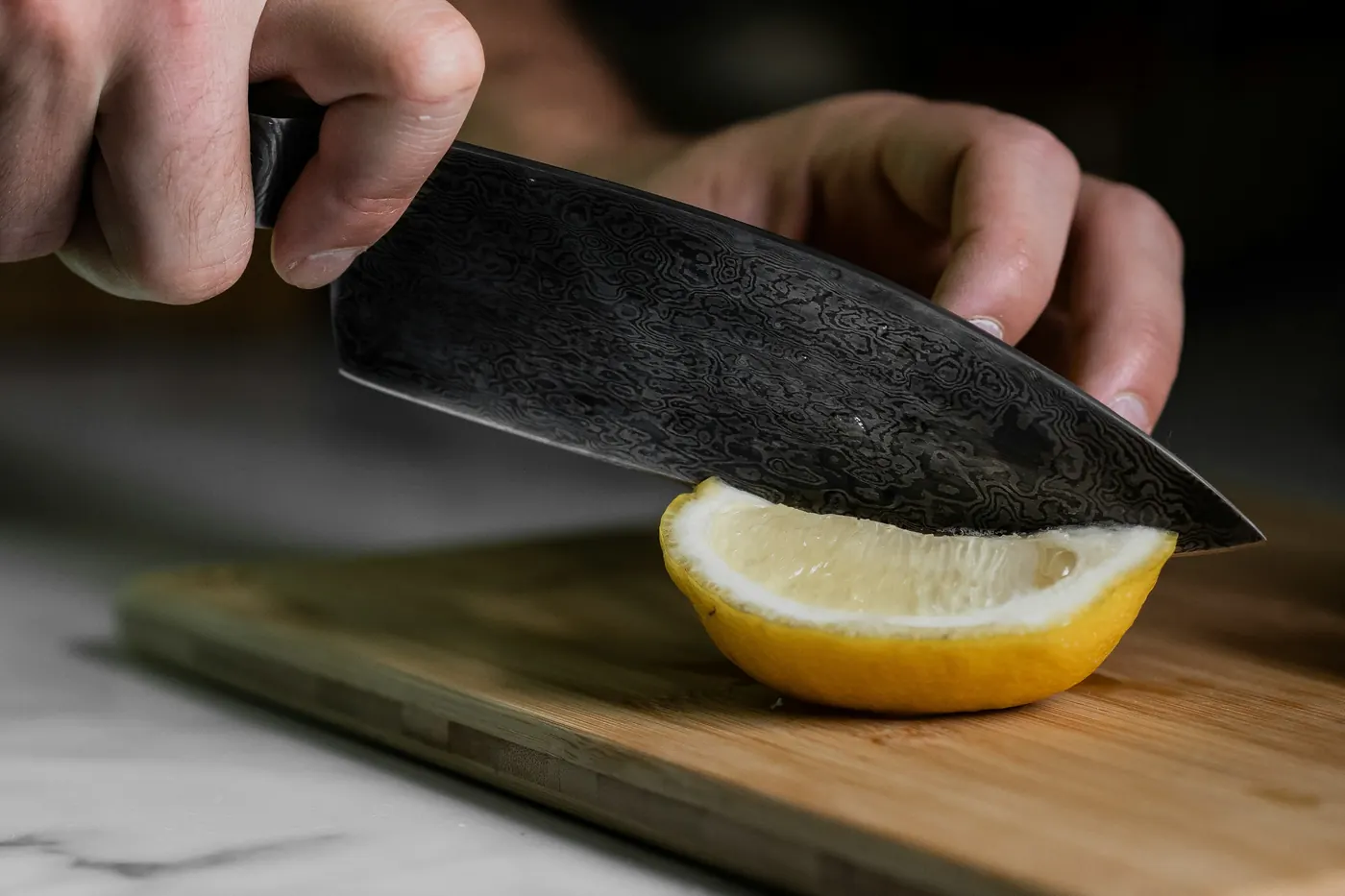
A sharp knife makes short work of a salsa; if you would rather someone else did the chopping tonight, see the menu or call to order.