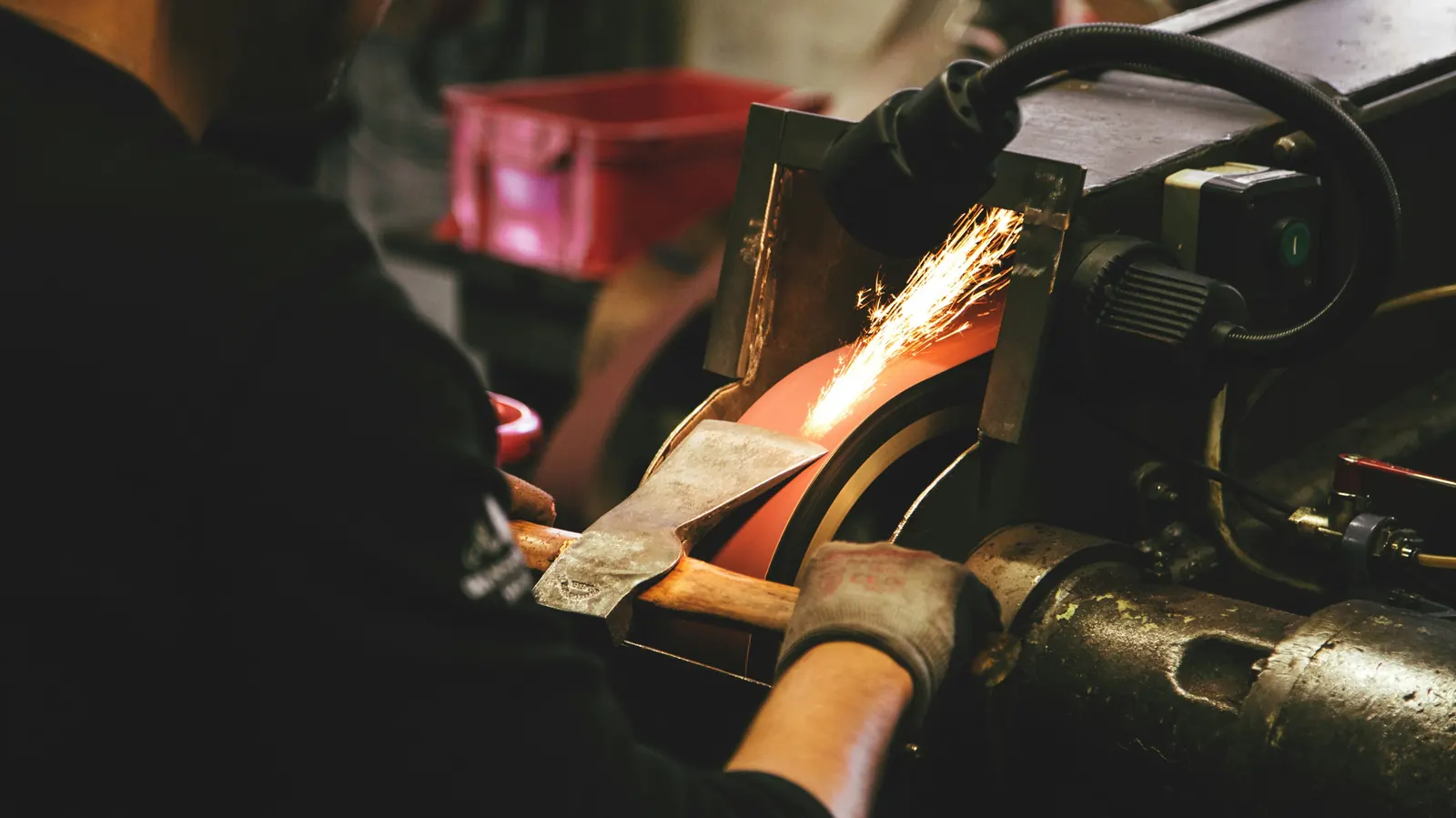
Every prep shift in a Mexican kitchen starts with the same pile: white onions for pico de gallo and the flat-top, bunches of cilantro, jalapeños and serranos, tomatoes, limes, and a few pounds of skirt steak for carne asada. A knife that was sharp on Monday is skating off tomato skins by Thursday. An electric sharpener is the quickest way to put the bite back without learning to use a stone, and it is why so many home cooks ask which machine to buy.
This page is narrower than our main knife sharpener guide, which covers every type from pull-throughs to whetstones. Here we look only at plug-in machines: which angle each one sets, how many stages it has, whether it handles serrated blades, and what the maker says about warranty. Where a maker or listing does not publish a figure, we say so.
Julia’s earns a commission on purchases made through links on this page, at no cost to you. Recommendations are based on what a restaurant kitchen looks for in an electric knife sharpener, the makers’ own specifications and the details on each Amazon listing.
Quick verdict: which electric sharpener to buy
For most home kitchens, the best knife sharpener electric option is the Chef’sChoice 1520 AngleSelect: three stages, diamond abrasives, and separate guides for 15-degree Asian-style and 20-degree European and American knives, so one machine handles a mixed knife block, serrated blades included. If you want to set your own angle and sharpen scissors and outdoor blades as well, choose the Work Sharp Ken Onion Mk2. On a tight budget, the Presto EverSharp 08800 is a simple two-stage machine for plain-edge knives.
Below, the five standouts side by side, then all nine machines in full, and the points that decide which one suits your knives.
Five electric sharpeners side by side
Our five standout electric sharpeners, one for each kind of cook, with the angle and stages each maker or listing states. All nine are reviewed in full below.
| Sharpener | Best for | Stages and abrasive | Angle (stated) | Buy on Amazon |
|---|---|---|---|---|

Chef’sChoice 1520 AngleSelect Electric SharpenerBest overall
|
Mixed knife blocks | 3 stages, diamond plus stropping | 15 or 20 degrees | View on Amazon |

Work Sharp Ken Onion Mk2 Electric SharpenerBest adjustable
|
Knives, scissors and tools | Flexible belts, five grits | 15 to 30 degrees | View on Amazon |

Chef’sChoice 315XV Diamond Hone Electric SharpenerBest for Japanese knives
|
Santoku, gyuto, nakiri | 2 stages, diamond plus stropping | 15 degrees | View on Amazon |
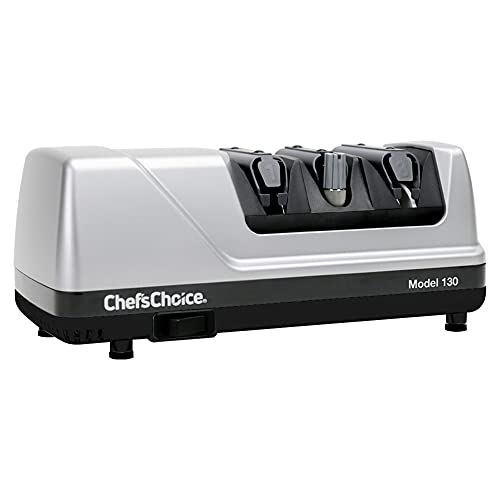
Chef’sChoice 130 Sharpening StationBest for German-style knives
|
20-degree Western knives | 3 stages, diamond first stage | 20-degree class | View on Amazon |
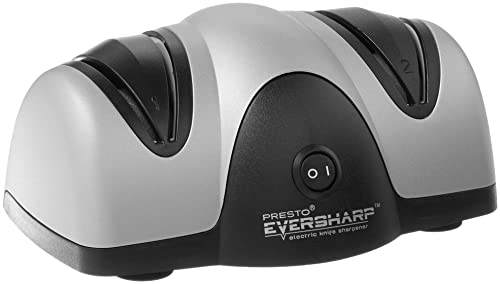
Presto EverSharp 08800 Electric SharpenerBudget pick
|
Plain-edge knives, small budget | 2 stages, Sapphirite wheels | Set by guides (degrees not stated) | View on Amazon |
Product images from Amazon. Angles, stages, abrasives and warranties are as stated by each maker or Amazon listing; check the listing before you buy.
Our picks for the best knife sharpener electric models
Nine plug-in sharpeners, from diamond-disk machines with fixed angle guides to belt sharpeners where you choose the angle. Two of them, the Chef’sChoice Trizor XV and the Work Sharp Ken Onion Mk2, also appear in our all-types sharpener guide; here they are compared only against other electric machines, which changes where each one fits. Every review gives the stated angle, the stages, the abrasive, serrated-knife support and the warranty, and says “not stated” where nothing is published.
1. Chef’sChoice 1520 AngleSelect Electric Sharpener – Two Angles in One Machine
Most home knife blocks are mixed: a German chef’s knife from a wedding gift, a Japanese santoku bought later, a paring knife from the grocery store. The 1520 is built for that. Chef’sChoice says it applies either a traditional 20-degree edge or a finer 15-degree edge, so you pick the slot that matches each knife rather than converting everything to one angle.
It is a three-stage machine. According to Chef’sChoice, the sharpening stages use 100 percent diamond abrasives, and patented stropping disks polish the edge in the final stage. The maker describes the result as a double-bevel edge with two facets set at different angles, which it calls an arch-shaped edge and says lasts longer. Precision angle guides hold the blade from bolster to tip, so there is no angle for you to judge.
For a kitchen that slices tomatoes, limes and grilled steak every day, the serrated support matters too: Chef’sChoice states that the 1520 sharpens most straight-edge and serrated knives, so the bread knife and steak knives can go through the same machine. The Amazon listing for this white model does not give dimensions or the warranty term, so check the box or Chef’sChoice before you buy if those matter to you.
Why we like it
- Separate 15-degree and 20-degree settings for a mixed knife block
- Diamond abrasives for sharpening, stropping disks to polish
- Angle guides that run from bolster to tip
- Maker says it sharpens straight-edge and serrated knives
Key specifications
| Model | 1520 (listing model 0115200) |
|---|---|
| Type | Electric, fixed angle guides |
| Stages | 3 |
| Angle | 15 or 20 degrees |
| Abrasive | 100% diamond; stropping disks in final stage |
| Serrated blades | Yes, per maker |
| Size | Not stated on this listing |
| Warranty | Manufacturer warranty (term not stated on this listing) |
Why we recommend it
It suits anyone whose knives come from more than one tradition. Instead of thinning a sturdy German blade to 15 degrees or leaving a Japanese knife at a thicker angle than its maker intended, you sharpen each at the angle it was made for, in a minute or two, with nothing to learn.
Skip it if every knife you own is Japanese or every one is German; a single-angle machine such as the 315XV or the 130 does that job with fewer slots to choose from.
Pros and cons
Pros
- Handles both common kitchen-knife angles
- Diamond abrasives and a polishing stage
- Works on serrated knives
Cons
- You need to know which angle each knife has
- Size and warranty term not on this listing
- More slots to choose between than a single-angle machine
2. Chef’sChoice Trizor XV 15XV Electric Sharpener – Converts Knives to 15 Degrees

The Trizor XV is the top pick in our all-types sharpener guide, and among electric machines it earns a narrower role: the sharpener for a cook who wants every knife at a fine 15-degree edge. Chef’sChoice says it is designed to convert the traditional 20-degree factory edges of household knives into 15-degree Trizor XV edges.
Stages 1 and 2 are plated with 100 percent diamond abrasives to sharpen and hone, according to the listing, and stage 3 uses a patented flexible abrasive system to polish the edge and help serrated knives last. Spring guides adjust automatically to hold the angle. Chef’sChoice puts the first sharpening at about a minute and later resharpening at about ten seconds.
A thinner edge cuts more easily through onion layers and ripe tomatoes, but it also has less metal behind it, so it can roll sooner on a hard board or against bone. If you mostly slice vegetables and boneless meat, that is a fair trade. The listing gives a three-year limited warranty and a footprint of about 10 by 4.25 by 4.25 inches.
Why we like it
- Converts 20-degree factory edges to 15 degrees
- Diamond stages 1 and 2, flexible polishing stage 3
- Spring guides hold the angle for you
- Three-year limited warranty
Key specifications
| Model | 15XV (listing model 0101500) |
|---|---|
| Type | Electric, spring angle guides |
| Stages | 3 |
| Angle | 15 degrees |
| Abrasive | 100% diamond; flexible polishing stage |
| Serrated blades | Yes |
| Size | About 10 x 4.25 x 4.25 in |
| Warranty | 3-year limited |
Why we recommend it
It suits a cook who wants the sharpest practical edge on everything in the block and is happy for a German chef’s knife to end up thinner than it left the factory. The routine is simple, and the touch-up time is short enough to do before every big prep day.
Skip it if you want to keep some knives at 20 degrees; the 1520 above gives you both.
Pros and cons
Pros
- Fine 15-degree edge on every knife
- Quick resharpening, per maker
- Handles serrated blades
Cons
- One angle only
- A thinner edge needs more frequent touch-ups
3. Work Sharp Ken Onion Mk2 Electric Sharpener – Pick Any Angle From 15 to 30
The Ken Onion Mk2 works differently from the disk machines on this list. It runs a flexible abrasive belt over a guide, and you set the guide anywhere from 15 to 30 degrees. Work Sharp says the belt sharpens and hones in a guided pass, and the variable speed lets you run it slowly for finishing and faster to reshape a damaged edge.
Work Sharp lists five belts for it: P120, X65 (P220), X22 (1000), X4 (3000) and a 6000 grit, so you can go from repairing a chipped edge to a fine polish on one machine. The listing names kitchen knives, pocket knives, serrated blades, scissors and garden tools, which makes it the one sharpener here that can also handle the pruning shears and the camp knife. Work Sharp gives the weight as 3.3 pounds and a three-year warranty.
That flexibility asks a little more of you. Unlike a slot machine, you choose the angle and the belt, and a belt removes metal quickly, so a light hand and a slow speed are the safer start on a thin kitchen blade.
Why we like it
- Adjustable angle from 15 to 30 degrees
- Five belt grits from P120 to 6000, per Work Sharp
- Variable speed control
- Sharpens knives, serrated blades, scissors and tools
- Three-year warranty
Key specifications
| Model | WSKTS-KO2-ATL |
|---|---|
| Type | Electric belt, adjustable guide |
| Stages | Belt changes (5 grits) |
| Angle | 15 to 30 degrees, adjustable |
| Abrasive | Flexible belts, P120 to 6000 |
| Serrated blades | Yes |
| Size | Not stated; weight 3.3 lb (Work Sharp) |
| Warranty | 3 years |
Why we recommend it
It suits the household with more than kitchen knives to keep sharp, or the cook who wants to set an exact angle for each blade. One machine replaces a drawer of single-purpose sharpeners.
Skip it if you want to push a button and walk away; the belt and angle choices take some learning, and a fixed-slot Chef’sChoice is simpler.
Pros and cons
Pros
- Any angle from 15 to 30 degrees
- Coarse repair to fine polish
- Handles tools and scissors too
Cons
- More to learn than a slot sharpener
- Belts remove metal quickly
- Belts need replacing over time
4. Chef’sChoice 315XV Diamond Hone Electric Sharpener – Made for Asian-Style Blades
If your block is a santoku, a gyuto and a nakiri, you do not need a 20-degree slot at all. The 315XV is a two-stage machine set at 15 degrees, and Chef’sChoice describes it as ideal for contemporary double-bevel and traditional single-bevel Asian-style knives, which is unusual for a slot sharpener.
The listing says it pairs 100 percent diamond abrasives with flexible stropping and polishing disks, and uses spring guides to control the angle. Chef’sChoice calls it a budget-friendly two-stage edition of its three-stage 15XV. It also handles straight and serrated blades, and the maker states it is designed, engineered and assembled in the USA, with a two-year limited warranty.
For the vegetable side of Mexican prep, a fine edge on a nakiri or santoku is what lets you slice a white onion thin for a taco garnish without crushing it. If you are still choosing those knives, our Japanese knife guide covers the shapes.
Why we like it
- 15-degree edge to match Japanese-style knives
- Maker names both double-bevel and single-bevel Asian-style knives
- Diamond abrasives plus flexible stropping disks
- Designed, engineered and assembled in the USA
Key specifications
| Model | 315XV (listing model 0315101) |
|---|---|
| Type | Electric, spring angle guides |
| Stages | 2 |
| Angle | 15 degrees |
| Abrasive | 100% diamond; flexible stropping disks |
| Serrated blades | Yes |
| Size | Not stated |
| Warranty | 2-year limited |
Why we recommend it
It suits a cook whose knives are mostly Japanese and who wants a smaller, simpler machine than the three-stage 15XV. Two slots, one angle, nothing to choose.
Skip it if you own German knives you want to keep at 20 degrees, or if you own an expensive single-bevel knife and would rather follow its maker’s advice to sharpen on stones.
Pros and cons
Pros
- Angle matches most Japanese knives
- Simple two-stage routine
- Assembled in the USA
Cons
- One fewer stage than the 15XV
- Shorter warranty than the three-stage models
- Size not stated
5. Chef’sChoice 130 Sharpening Station – A Choice of Finish for 20-Degree Knives
The 130 is for the opposite kitchen: a block of German or American knives that left the factory at about 20 degrees and should stay there. Chef’sChoice says it sharpens straight-edge and serrated 20-degree class knives, and its three stages give you a choice of edge rather than three steps you always run in order.
According to the listing, stage 1 uses 100 percent diamond abrasives to sharpen and hone, and stages 2 and 3 create either a micro-serrated or a polished finish depending on the cutting task. That matters in a Mexican kitchen. A slightly toothy edge bites into tomato skins and the crust on a grilled steak; a polished edge glides through cilantro and onion. The maker describes the edge as Trizor engineered, with two facets at different angles forming an arch-shaped edge.
The listing gives a three-year limited warranty. It does not give dimensions or wattage.
Why we like it
- Keeps Western knives at their 20-degree class angle
- Diamond first stage
- Choice of micro-serrated or polished finish
- Three-year limited warranty
Key specifications
| Model | 130 (listing model 0130506) |
|---|---|
| Type | Electric, precision angle guides |
| Stages | 3 |
| Angle | 20-degree class |
| Abrasive | 100% diamond in stage 1; finishing stages 2 and 3 |
| Serrated blades | Yes |
| Size | Not stated |
| Warranty | 3-year limited |
Why we recommend it
It suits a cook with a full set of German-style knives who wants to keep their factory angle and choose the finish for the job: toothy for tomatoes and steak, polished for herbs.
Skip it if you own Japanese knives; they would come out thicker than their makers intended.
Pros and cons
Pros
- Matches the angle of most Western knives
- Two finishes for different foods
- Handles serrated blades
Cons
- 20-degree only
- Size and power not stated
6. Work Sharp E2 Electric Kitchen Sharpener – Small Enough for a Drawer

Not every kitchen has counter space for a sharpener the size of a toaster. The E2 is Work Sharp’s compact electric model, and the listing says its small footprint tucks into a kitchen drawer or cabinet between uses.
Work Sharp’s own specification page lists a 20-degree edge angle, with angle guides that hold that angle while you sharpen and hone. The abrasives are a 120-grit flexible sharpening disc and a fine ceramic honing wheel, which Work Sharp says keeps knives sharp between sharpenings and refreshes serrated blades. The maker gives the weight as 1.2 pounds and a three-year warranty, and the Amazon listing names chef, santoku, paring, utility and serrated kitchen knives.
The fixed 20-degree angle is the trade-off. It suits Western knives well; a Japanese knife sharpened in it will end up with a thicker edge than it came with.
Why we like it
- Compact enough to store in a drawer
- Angle guides hold a 20-degree edge
- 120-grit disc plus ceramic honing wheel
- Three-year warranty, per Work Sharp
Key specifications
| Model | CPE2 |
|---|---|
| Type | Electric, guided slots |
| Stages | 2 (sharpen and hone) |
| Angle | 20 degrees |
| Abrasive | 120-grit flexible disc; fine ceramic wheel |
| Serrated blades | Yes (hones serrations) |
| Size | Not stated; weight 1.2 lb (Work Sharp) |
| Warranty | 3 years |
Why we recommend it
It suits a small kitchen or a cook who sharpens once a month and wants the machine out of sight the rest of the time.
Skip it if your knives are Japanese, or if you want a coarse stage for repairing chips; the single 120-grit disc is the only sharpening abrasive.
Pros and cons
Pros
- Light and compact
- Simple two-step routine
- Three-year warranty
Cons
- 20-degree only
- Fewer grits than larger machines
7. Presto EverSharp 08800 Electric Sharpener – Simple Two-Stage Sharpening
Presto’s EverSharp is the plainest machine here, and for many households that is enough. It has two slots: the first grinds a precisely angled edge and the second hones and polishes it, according to the listing. Both use Sapphirite wheels, which Presto says are made of the same hard material used in professional sharpening shops.
Precision blade guides position the knife, so you simply draw it through each slot a few times. Presto says it sharpens kitchen and sport knives and “most any non-serrated blade”. That last phrase is the important limit: the bread knife and the serrated steak knives stay out of this one. The listing gives a length of 8.18 inches, a 120-volt rating and a one-year limited warranty. It does not state the angle in degrees.
Why we like it
- Two stages: grind, then hone and polish
- Sapphirite wheels, per Presto
- Blade guides set the angle for you
- One-year limited warranty
Key specifications
| Model | 08800 |
|---|---|
| Type | Electric, blade guides |
| Stages | 2 |
| Angle | Not stated |
| Abrasive | Sapphirite wheels |
| Serrated blades | No (non-serrated blades only) |
| Size | 8.18 in long |
| Warranty | 1-year limited |
Why we recommend it
It suits a cook who wants dull plain-edge knives working again without spending much, and who will keep using the factory edge on serrated knives.
Skip it if you want to sharpen serrated blades or choose your angle; Presto does neither on this model.
Pros and cons
Pros
- Very simple to use
- Compact two-slot design
- Guides do the angle work
Cons
- No serrated knives
- Angle not published
- Shorter warranty than most here
8. Presto Professional EverSharp 08810 – Guides That Adjust to Blade Thickness

The Professional EverSharp adds two things to the basic Presto: a third stage and a blade-thickness selector. Presto says you set the selector to thick for hunting knives, medium for chef’s knives and standard kitchen knives, and thin for light blades such as fillet and paring knives, and the guides adjust to the best sharpening angle for each.
The three-stage system finishes on an extra-fine-grit ceramic wheel that fine-hones the edge, according to the listing, and Presto names santoku knives among the blades it handles. For a kitchen that runs from a thin boning knife for trimming pork shoulder to a heavy chef’s knife for breaking down chiles and squash, the selector is the reason to choose this one over the 08800. The listing gives a one-year limited warranty. It does not state the angles in degrees or whether serrated blades are supported, so treat it as a plain-edge sharpener unless Presto tells you otherwise.
Why we like it
- Thickness selector: thick, medium and thin settings
- Three-stage system
- Extra-fine ceramic wheel for the final hone
- Presto names santoku knives as suitable
Key specifications
| Model | 08810 |
|---|---|
| Type | Electric, adjustable blade guides |
| Stages | 3 |
| Angle | Set by thickness selector (degrees not stated) |
| Abrasive | Extra-fine ceramic in final stage; others not stated |
| Serrated blades | Not stated |
| Size | Not stated |
| Warranty | 1-year limited |
Why we recommend it
It suits a household with knives of very different thicknesses, from fillet and paring knives to hunting blades, that wants one inexpensive machine to handle them all.
Skip it if you want published angles or serrated support; the Chef’sChoice machines state both.
Pros and cons
Pros
- Adjusts to blade thickness
- Ceramic final hone
- Three stages
Cons
- Angles not published
- Serrated support not stated
- One-year warranty
9. Smith’s Edge Pro Compact Electric Sharpener – Powered Wheels Plus a Ceramic Slot

Smith’s is better known for outdoor sharpeners, and the Edge Pro Compact shows it: the listing names kitchen, pocket and fillet knives. It combines an electric stage with a manual one. The electric wheels are a bonded synthetic abrasive that sharpens one side of the blade at a time, with blade guides holding the angle, and the manual slot uses crossed ceramic rods.
Smith’s recommends the ceramic slot for final edge honing, and it is also handy for quick touch-ups without switching the machine on. The maker says the wheel material keeps heat build-up low so it will not damage or de-temper the blade. The 120-volt unit has a soft-grip rubber handle and non-slip rubber feet. It is a straight-edge sharpener; the listing does not mention serrated knives, and it gives no warranty term.
Why we like it
- Electric sharpening plus a manual ceramic honing slot
- Sharpens one side of the blade at a time
- Maker says the wheels keep heat build-up low
- Rubber handle and non-slip feet
Key specifications
| Model | 50005 |
|---|---|
| Type | Electric and manual hybrid |
| Stages | 2 (electric, ceramic) |
| Angle | Preset (degrees not stated) |
| Abrasive | Bonded synthetic wheels; crossed ceramic rods |
| Serrated blades | Not stated (straight-edge) |
| Size | Not stated |
| Warranty | Not stated |
Why we recommend it
It suits a cook who also sharpens fishing and pocket knives and wants a ceramic slot for quick hones between full sharpenings.
Skip it if you want published angles and a stated warranty; the kitchen-focused Chef’sChoice and Work Sharp models give both.
Pros and cons
Pros
- Electric and manual in one unit
- Ceramic slot for touch-ups
- Stable rubber feet
Cons
- Angle and warranty not stated
- Straight-edge blades only, per listing
Diamond disks or belts: two ways a machine sharpens
Electric sharpeners fall into two families, and the difference explains most of what you will notice in use.
Disk and wheel machines (Chef’sChoice, Presto, Smith’s, the Work Sharp E2) have fixed slots with guides. You draw the knife through and the guide sets the angle. They are the easiest to use and the hardest to get wrong, but you are limited to the angles built into the slots. Chef’sChoice uses diamond-coated disks; Presto uses Sapphirite wheels; Smith’s uses a bonded synthetic wheel.
Belt machines (the Work Sharp Ken Onion Mk2) run a flexible abrasive belt that conforms to the blade. You choose the angle and the grit, so one machine covers a paring knife, a cleaver and a pair of shears. The cost is a little technique and the need to replace belts.
How to choose an electric knife sharpener
Match the angle to your knives. This is the decision that matters most. Chef’sChoice describes 20 degrees as the traditional factory edge for household knives, and its 15-degree machines are built for Asian-style blades. If your knives are all one style, buy a single-angle machine for that style. If they are mixed, buy one with both angles, such as the 1520, or an adjustable belt machine. Check your knife maker’s recommendation before you start.
Count the stages you will use. A coarse stage repairs a dull or chipped edge; a fine or polishing stage refines it. For routine upkeep you will mostly use the finest stage. Save the coarse slot for knives that no longer respond to honing, because every pass removes metal.
Check serrated support. If you want to sharpen a bread knife or steak knives, choose a machine whose maker says it handles serrated blades. Presto’s 08800 says plainly that it does not. Our steak knife guide covers which serrated knives are worth keeping sharp.
Think about single-bevel knives. Traditional Japanese knives sharpened on one side only are usually sharpened by hand. Of the machines here, only the Chef’sChoice 315XV names single-bevel Asian-style knives. For anything valuable, follow the knife maker’s instructions or use a stone; our whetstone guide covers the options.
Size, storage and warranty. The E2 fits a drawer; the Chef’sChoice machines sit better on a shelf. Warranties on this list run from one year (Presto) to three years (Chef’sChoice three-stage models and Work Sharp), and Smith’s does not state one on the listing.
Keep a honing rod anyway. A few strokes on a honing steel before each prep session straightens the edge so you reach for the sharpener, and remove metal, less often.
Safety and recall check
Before writing this page we searched the U.S. Consumer Product Safety Commission’s public recall database for knife sharpeners and for each brand here. We found no recalls of electric knife sharpeners. The only sharpener recalls the search returned were for pencil sharpeners. A recall can be announced at any time, so check cpsc.gov/Recalls before you buy, and read the maker’s instructions: keep fingers clear of the slots, unplug before cleaning, and empty metal filings as the manual directs.
How we chose these nine electric sharpeners
We started from what a kitchen that cuts onions, chiles, tomatoes, limes and grilled beef every day needs from a sharpener: a dependable edge at the right angle for the knives most people own, sensible metal removal and easy upkeep. We then looked for plug-in sharpeners sold on Amazon in the United States from identifiable makers, and checked each one’s stock with Amazon’s product data before writing. Angles, abrasives, weights and warranties come from Chef’sChoice and Work Sharp’s own product pages where we could read them, and otherwise from the brand’s Amazon listing; where neither states a figure, we say “not stated”. We left out machines that were down to their last few units, a Work Sharp model whose listing conflicted with the maker’s own description, and unbranded sharpeners with little published information. We did not sharpen knives with these machines for this guide, and we have not cited published equipment reviews, because we did not read them for this page. For the case for and against power, see knife sharpener vs whetstone.
Electric sharpener questions, answered
What is the best electric knife sharpener for home use?
For a mixed set of knives, the Chef’sChoice 1520 AngleSelect, because it sharpens at both 15 and 20 degrees and handles serrated blades. If all your knives are Japanese, the 315XV; if all are German-style, the Chef’sChoice 130.
Which brand of electric knife sharpener is best?
Chef’sChoice makes the widest range of fixed-angle machines and publishes the angle for each. Work Sharp makes belt machines with adjustable angles and states a three-year warranty on all its sharpeners. Presto and Smith’s make simpler, lower-cost machines but publish less detail.
Are electric knife sharpeners bad for knives?
Not when used as the maker intends. They remove metal faster than a stone, so use the coarse stage only on genuinely dull knives and the fine stage for routine touch-ups. A machine set at the wrong angle for a knife will change its edge, which is why matching the angle matters.
Can an electric sharpener handle Japanese knives?
Double-bevel Japanese knives, yes, on a 15-degree machine such as the 1520, the 15XV or the 315XV, or on the Ken Onion Mk2 set to 15 degrees. Single-bevel knives are usually sharpened by hand; check your knife maker’s advice.
How often should I use an electric sharpener?
Hone often, sharpen when honing stops working. For a home cook that is often every few months. If a knife slides off a tomato skin instead of cutting it, it is time.
Do electric sharpeners work on serrated knives?
Some do. The Chef’sChoice 1520, 15XV, 315XV and 130, and the Work Sharp Ken Onion Mk2 and E2, all state serrated support. The Presto 08800 does not.
Our electric sharpener for a mixed knife block
Buy the Chef’sChoice 1520 AngleSelect if your knives come from more than one tradition and you want each sharpened at its own angle. Choose the Work Sharp Ken Onion Mk2 if you sharpen tools and scissors too, the 315XV for an all-Japanese block, the 130 for German knives, and the Presto 08800 if the budget is tight and your knives have plain edges. Whatever you buy, hone before you cook.
For the knives themselves, see our guide to the best chef’s knife, and for what a sharp blade is for, our guide to how to eat fajitas starts with steak sliced thin across the grain. And if you would rather someone else did the chopping tonight, see the menu or call to order.