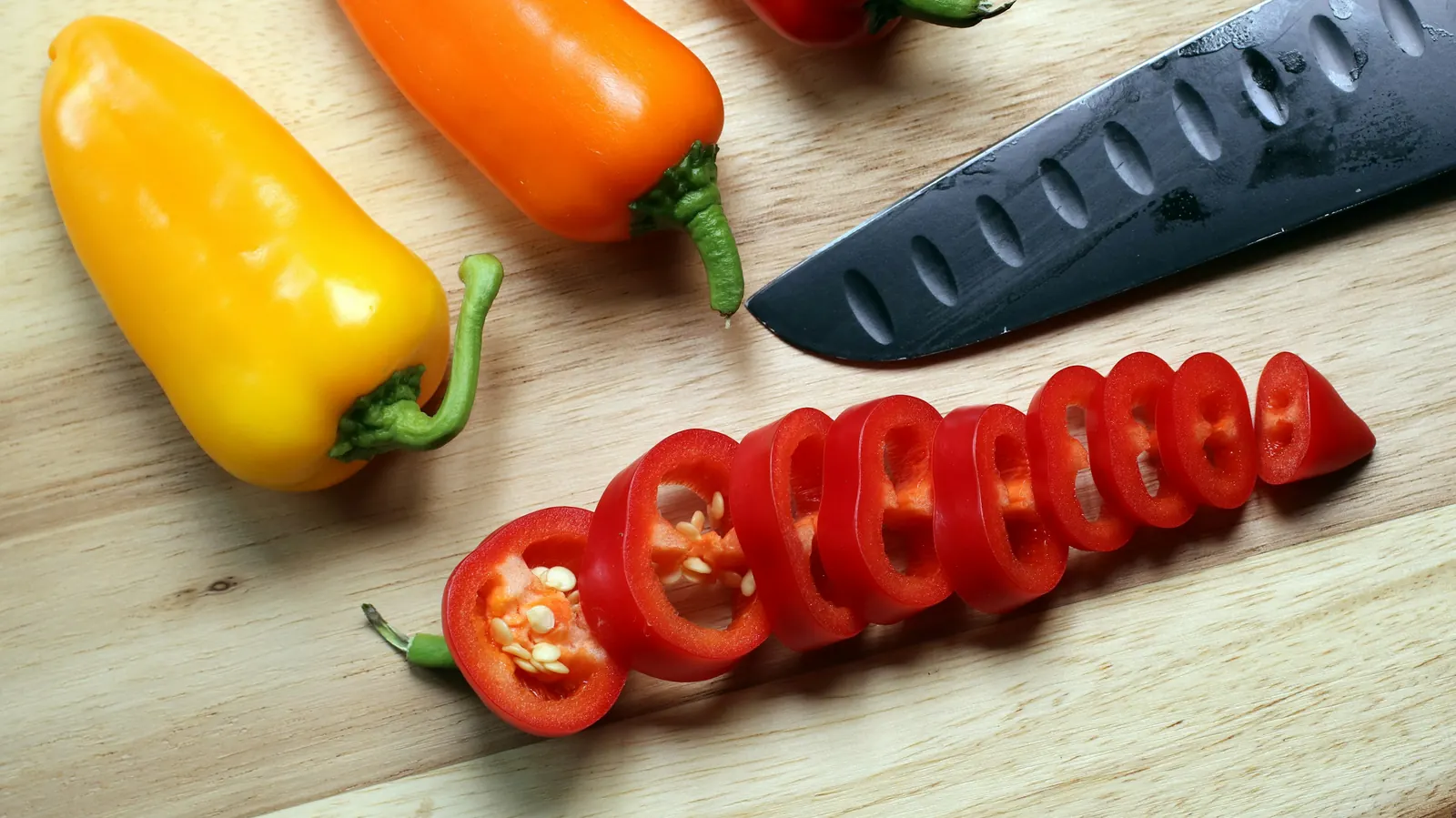
Most home cooks who ask us about sharpening are not after a perfect edge. They want the chef’s knife to bite into a tomato again, to slice an onion for pico de gallo without crushing it, and to get through a bunch of cilantro without bruising the leaves. They also do not want to spend a weekend learning to hold a blade at 15 degrees on a wet stone.
This guide is for that cook. It sits under our main knife sharpener guide, which compares every type, and it covers only sharpeners that hold the angle for you: pull-through slots, rolling sharpeners with magnetic angle blocks, a clamp-and-rod system, and a simple electric machine. None of the products here appear on our other sharpener pages; for whetstones and powered machines with more settings, those pages go deeper.
Julia’s earns a commission on purchases made through links on this page, at no cost to you. Recommendations are based on what a restaurant kitchen looks for in a beginner’s knife sharpener, product specifications and verified buyer reports.
Quick verdict: which beginner sharpener to buy
For most beginners, the Chef’sChoice ProntoPro 4643 is the easiest place to start: a manual pull-through with diamond abrasives, separate slots for 15-degree and 20-degree knives, and a polishing stage that the maker says also handles serrated blades. If you would rather sharpen slowly and see what you are doing, the Work Sharp Rolling Knife Sharpener gives you four preset angles on a magnetic block. On a small budget, the AccuSharp handheld sharpener is a carbide tool that the maker backs with a limited lifetime warranty.
Below, the five standouts side by side, then all eight sharpeners in full, and what to look for if this is your first one.
Five beginner sharpeners side by side
Five beginner-friendly sharpeners, one for each kind of first-time sharpener, with the angle and abrasive each maker or listing states. All eight are reviewed in full below.
| Sharpener | Best for | How it guides you | Angle (stated) | Buy on Amazon |
|---|---|---|---|---|
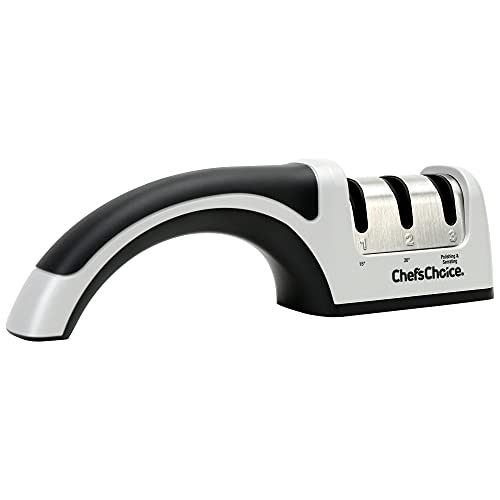
Chef’sChoice ProntoPro 4643 Manual SharpenerBest overall
|
A mixed knife block | Pull-through slots, diamond | 15 or 20 degrees | View on Amazon |

Work Sharp Rolling Knife SharpenerBest rolling sharpener
|
Learning at your own pace | Magnetic block, diamond discs | 15, 17, 20 or 25 degrees | View on Amazon |

Lansky Standard 3-Stone Sharpening SystemBest guided rod system
|
Cooks who want to learn stones | Clamp and guide rods, 3 hones | 17, 20, 25 or 30 degrees | View on Amazon |

Chef’sChoice 120 Electric SharpenerBest beginner electric
|
German-style knives, no effort | Powered slots, 3 stages | 20-degree class | View on Amazon |

AccuSharp Handheld Knife SharpenerBudget pick
|
Quick touch-ups, small budget | Fixed carbide V, finger guard | Not stated | View on Amazon |
Product images from Amazon. Angles, abrasives and warranties are as stated by each maker, retailer or Amazon listing; check the listing before you buy.
Our picks for the best knife sharpener beginner cooks can use
Eight sharpeners, each chosen because the tool, not your hand, sets the angle. They run from a carbide pull-through that fits in a drawer to a clamp system that teaches you how stones work. Every review gives the stated angle, the abrasive, serrated-knife support and the warranty, and says “not stated” where the maker and listing are silent.
1. Chef’sChoice ProntoPro 4643 Manual Sharpener – Two Angles, No Plug
A pull-through sharpener is the simplest kind there is: you draw the blade through a slot a few times and the slot sets the angle. The ProntoPro is a more careful version of that idea. The Amazon listing says it uses 100 percent diamond abrasives in all three stages, with the first stages sharpening and honing and the third polishing the edge with micron-sized diamonds. Chef’sChoice calls its approach CrissCross sharpening, with diamond abrasive wheels working on the edge at the same time.
What makes it a good first sharpener is the choice of angles. Retailer descriptions of the 4643 explain that one stage sets a 15-degree edge for Asian-style and many newer Western knives, another sets the traditional 20-degree edge for European and American knives, and the shared final stage polishes both. The listing says it sharpens straight-edge and serrated knives as well as sports and pocket knives, so the bread knife can go through the polishing slot too.
It is a manual tool, so there is no motor to remove metal faster than you intend, and it has a soft-touch handle to hold it steady on the counter. One caution: this Amazon listing’s title calls it “2-Stage” while its feature list describes three stages, and retailers describe three. We have gone with the three-stage description and the maker’s model number, 4643.
Why we like it
- Separate settings for 15-degree and 20-degree knives
- Diamond abrasives in every stage, per the listing
- Listing says it handles straight-edge and serrated knives
- No power cord; it stores in a drawer
Key specifications
| Model | 4643 (part 4643009) |
|---|---|
| Type | Manual pull-through |
| Angle | 15 or 20 degrees |
| Abrasive | 100% diamond; micron diamond in final stage |
| Stages | 3 (listing title says 2; see review) |
| Serrated blades | Yes, per listing |
| Size | Not stated |
| Warranty | 10-year, per listing |
Why we recommend it
It suits a cook with a mixed block, perhaps a German chef’s knife and a Japanese-style santoku, who wants each sharpened at a sensible angle without learning any technique. A few pulls through the right slot before a prep session is all it asks.
Skip it if you want to see and control the edge as you work; a rolling sharpener or the Lansky system teaches you more about what sharpening does.
Pros and cons
Pros
- Two common kitchen angles in one tool
- Diamond abrasives throughout
- Works on serrated knives, per listing
Cons
- Listing title and features disagree on stage count
- You need to know which angle each knife has
- Size not stated on the listing
2. Work Sharp Rolling Knife Sharpener – Four Angles on a Magnetic Block
Rolling sharpeners split the job in two. A magnetic block holds the knife at a fixed angle, and you roll a cylinder with an abrasive disc on its end along the edge. Because the angle is fixed by the block, the beginner’s usual mistake, letting the angle wander, is taken out of the process, while you still see and feel the edge being worked.
Work Sharp’s version has more angles than most. The maker lists four settings on the block, 15, 17, 20 and 25 degrees, plus a riser for folding knives. It comes with three abrasives: a 320-grit diamond disc, a 600-grit diamond disc and a fine ceramic hone, which swap on and off, and Work Sharp sells each as a replacement. That matters, because a rolling sharpener with fixed discs is finished when the abrasive wears out.
The listing gives a size of 3.75 by 2.6 by 2.6 inches, so it fits in a drawer. Work Sharp states a three-year warranty on the product page. One buyer review on the maker’s page notes that long knives can flex away from the block and that new users may need a few sessions to get the angles right; take that as a sign that this tool is slower than a pull-through, not harder.
Why we like it
- Four preset angles: 15, 17, 20 and 25 degrees
- 320 and 600-grit diamond discs plus a ceramic hone
- Replacement abrasives sold by the maker
- Three-year warranty, per Work Sharp
Key specifications
| Model | WSKTNRKS |
|---|---|
| Type | Rolling, magnetic angle block |
| Angle | 15, 17, 20 or 25 degrees |
| Abrasive | 320 and 600-grit diamond, fine ceramic |
| Stages | 3 interchangeable discs |
| Serrated blades | Not stated |
| Size | 3.75 x 2.6 x 2.6 in |
| Warranty | 3 years, per maker |
Why we recommend it
It suits a beginner who wants to understand sharpening, not just get it done. You pick the angle, start on the coarser disc, move to the finer one and finish with the ceramic, which is the same progression a whetstone uses, without having to hold the angle yourself.
Skip it if you sharpen a bread knife or steak knives often; Work Sharp does not list serrated blades for this tool.
Pros and cons
Pros
- Widest angle choice of the rolling sharpeners here
- Three abrasives included, all replaceable
- Compact enough for a drawer
Cons
- Slower than a pull-through
- Serrated knives not listed
- A buyer reports long blades can flex off the block
3. Tumbler Rolling Knife Sharpener – Two Angles and Nothing to Swap

Tumbler’s original model keeps the idea as simple as it gets. Tumbler says you attach the knife to the magnetic holder, choose the 15-degree or 20-degree side and roll. One end of the roller carries a diamond disc that sharpens; the other carries a stainless steel helix disc that, according to the listing, hones and refines the edge afterward.
Tumbler’s own guidance is plain: the 20-degree angle is for everyday stainless kitchen knives and gives a sturdier edge, and the 15-degree angle is for finer knives such as high-quality carbon steel and Damascus blades. It also says to check the knife maker’s recommendation where you can. Its product page states that the sharpener is not suitable for serrated knives or scissors, which is a useful, honest limit.
Because both discs are fixed to the roller, there are no parts to lose and nothing to change mid-job. GearJunkie’s review notes the same thing and adds that two angles is a limited choice. Tumbler’s site advertises a lifetime warranty against manufacturing defects.
Why we like it
- Fixed 15 and 20-degree settings on a magnetic holder
- Diamond disc to sharpen, steel helix disc to hone
- No discs to change or lose
- Lifetime warranty against defects, per Tumbler
Key specifications
| Model | TU1D35S |
|---|---|
| Type | Rolling, magnetic angle holder |
| Angle | 15 or 20 degrees |
| Abrasive | Diamond disc; stainless steel helix hone |
| Stages | 2 (sharpen, hone) |
| Serrated blades | No, per maker |
| Size | Not stated |
| Warranty | Lifetime against defects, per maker |
Why we recommend it
It suits a cook who wants the control of a rolling sharpener with the fewest decisions: one of two angles, sharpen, flip, hone. It is the rolling sharpener to give someone who has never sharpened a knife.
Skip it if you want more than two angles or a fine ceramic finish; the Work Sharp roller offers both.
Pros and cons
Pros
- Very few steps to learn
- Both discs built in
- Clear maker guidance on which angle to use
Cons
- Not for serrated knives or scissors
- Only two angles
- Size not stated on the listing
4. HORL 3 Cruise Rolling Sharpener – A German-Made Roller With More Grip

HORL is a German maker of rolling sharpeners, and the HORL 3 Cruise is the version its Amazon listing describes as beginner-friendly. It pairs a permanently fixed diamond disc with a stainless steel honing disc, and the magnetic angle support offers 15 degrees for fine Japanese, carbon and Damascus blades and 20 degrees for European chef’s knives and outdoor knives.
Two changes from the earlier HORL 2 are aimed at people new to sharpening. HORL says the grip pad on the angle support gives up to 70 percent more grip than the HORL 2, so even small paring knives stay put, and that the diamonds in the HORL 3 remove up to 80 percent more steel than the HORL 2 version. The honing disc then removes the burr, the thin curl of metal that sharpening leaves behind. It works dry, with no water or oil.
The Cruise body is made from recycled ocean-bound plastic, according to HORL, and the listing says the sharpener is made in Germany. One caution from a HORL retailer, Borough Kitchen: it does not recommend the steel honing disc for premium Japanese knives harder than 60 on the Rockwell scale. If you own a very hard Japanese knife, check that before you buy.
Why we like it
- 15 and 20-degree settings on one magnetic support
- Grip pad holds small knives, per HORL
- Diamond disc to sharpen, steel disc to remove the burr
- Made in Germany, per the listing
Key specifications
| Model | HO3C |
|---|---|
| Type | Rolling, magnetic angle support |
| Angle | 15 or 20 degrees |
| Abrasive | Fixed diamond disc; stainless steel honing disc |
| Stages | 2 (sharpen, hone) |
| Serrated blades | No; listing covers smooth blades |
| Size | Not stated |
| Warranty | Not stated on listing |
Why we recommend it
It suits a cook who has decided on a rolling sharpener and wants a German-made one with a firmer hold for small knives. It is also the most gift-like tool on this page.
Skip it if your best knife is a very hard Japanese blade; follow the retailer’s caution or use a whetstone for that knife.
Pros and cons
Pros
- Firm grip on small blades
- Faster diamond than the HORL 2, per HORL
- Works dry
Cons
- Discs are fixed and cannot be swapped
- Retailer cautions on very hard Japanese steel
- Warranty term not stated on the listing
5. Lansky Standard 3-Stone Sharpening System – Learn Stones With a Guide
The Lansky system is the bridge between a gadget and a whetstone. You clamp the knife in a metal holder, then push a small hone across the edge. Each hone is mounted on a guide rod that passes through a hole in the clamp, so the angle stays the same on every stroke. It is the same motion as freehand sharpening, with the hardest part done for you.
The listing names three hones: a coarse red hone of 120 grit for reconditioning a damaged edge, a medium green hone of 280 grit for sharpening, and a fine blue hone of 600 grit for frequent touch-ups, with a guide rod for each. Retailers including Sharpening Supplies describe the clamp’s angle settings as 17, 20, 25 and 30 degrees, and say the kit includes honing oil and a storage case. For kitchen knives, the 17 and 20-degree holes are the ones you will use.
The trade-off is set-up. Clamping a long chef’s knife takes care, and you may need to reposition it partway to cover the whole edge. That is slower than any other tool here, but it is also the one that teaches you most about how an edge is formed. The listing states a one-year warranty.
Why we like it
- Guide rods keep the angle fixed on every stroke
- Three hones from 120 to 600 grit
- Clamp settings of 17, 20, 25 and 30 degrees, per retailers
- Teaches the stone technique in a controlled way
Key specifications
| Model | LKC03 |
|---|---|
| Type | Clamp and guide-rod system |
| Angle | 17, 20, 25 or 30 degrees |
| Abrasive | 3 hones: 120, 280 and 600 grit |
| Stages | 3 hones |
| Serrated blades | Not stated |
| Size | Not stated |
| Warranty | 1 year, per listing |
Why we recommend it
It suits a beginner who suspects they will want a whetstone one day and would like to learn how grit progression and a steady angle work first. It also suits pocket and outdoor knives, which the clamp handles well.
Skip it if you want a two-minute job before dinner; set-up alone takes longer than a whole session on a pull-through.
Pros and cons
Pros
- Most control of any guided tool here
- Three grits for repair, sharpening and touch-ups
- Good preparation for freehand stones
Cons
- Slow to set up
- Long knives may need re-clamping
- Angle settings come from retailers, not the listing
6. Chef’sChoice 120 Electric Sharpener – Three Stages With Guides Doing the Work
For some beginners the right answer is a machine. The Chef’sChoice 120 is a three-stage electric sharpener for 20-degree class knives, which covers most German-style and American kitchen knives. According to Chef’sChoice, the first stage uses coarse diamond abrasives to form a new edge, the second uses medium diamond abrasives to sharpen it, and the third uses patented stropping disks to polish both straight-edge and serrated knives.
Precision angle guides hold the blade, so the only skill involved is pulling the knife through at a steady pace. Chef’sChoice describes the result as three facets at different angles that form an arch-shaped edge, which it says lasts longer. The listing adds resilient feet that hold the unit to the counter and a three-year household warranty.
Our electric knife sharpener guide covers machines with more angles; the 120 is here because it is a single-angle machine with nothing to choose, which is what many beginners want. The flip side is that a motor removes metal faster than a hand tool, so use the coarse first stage only when a knife is truly dull.
Why we like it
- Angle guides do all the positioning
- Diamond abrasives in stages 1 and 2
- Maker says it handles straight-edge and serrated knives
- Three-year household warranty, per listing
Key specifications
| Model | 120 (0120000) |
|---|---|
| Type | Electric, fixed angle guides |
| Angle | 20-degree class |
| Abrasive | Diamond (stages 1–2); stropping disks (stage 3) |
| Stages | 3 |
| Serrated blades | Yes, per maker |
| Size | Not stated on this listing |
| Warranty | 3-year household, per listing |
Why we recommend it
It suits a cook with a block of German-style knives who wants sharp edges with no learning at all. Plug it in, pull each knife through the stages and you are done.
Skip it if your knives are mostly Japanese with 15-degree edges; the 120 is built for 20-degree knives, and the ProntoPro handles both angles without power.
Pros and cons
Pros
- The least technique of any tool here
- Polishing stage for serrated knives
- Three-year warranty
Cons
- One angle only
- Removes metal faster than hand tools
- Needs counter space and an outlet
7. AccuSharp Handheld Knife Sharpener – Carbide Blades That Reverse
The AccuSharp is the opposite of a pull-through: the knife stays still on the edge of a table or board, and you draw the small tool along the blade. A V of diamond-honed tungsten carbide does the sharpening, and a full-length guard covers your fingers the whole time. AccuSharp says most blades are sharpened in around ten seconds.
It handles a wide range of kitchen knives, according to the listing: chef’s knives, paring knives, serrated knives, fillet knives and cleavers. The carbide blades can be reversed to double their life, and the listing says the tool can be washed with soap and water or in the dishwasher. The handle is shaped for either hand.
Carbide sharpeners work by scraping a fresh edge, which is fast but less refined than diamond or ceramic, and AccuSharp does not state an angle. For a beginner whose knives are dull and inexpensive, that is a fair trade. AccuSharp’s own site says its sharpeners carry a limited lifetime warranty.
Why we like it
- Full-length finger guard
- Reversible carbide blades
- Dishwasher-safe, per the listing
- Limited lifetime warranty, per AccuSharp
Key specifications
| Model | ACCU-001C |
|---|---|
| Type | Handheld, fixed V |
| Angle | Not stated |
| Abrasive | Diamond-honed tungsten carbide |
| Stages | 1 |
| Serrated blades | Yes, per listing |
| Size | 9 x 4 x 1 in, per listing |
| Warranty | Limited lifetime, per maker |
Why we recommend it
It suits a cook who wants a sharper knife today for very little money, or a second sharpener for a camp box or a grill kit. It is also the easiest tool here to keep clean.
Skip it if you own good Japanese knives; a scraping carbide edge is not what their makers have in mind, and the angle is not stated.
Pros and cons
Pros
- Fast and very simple
- Finger guard runs the full length
- Goes in the dishwasher
Cons
- Angle not stated
- Coarser edge than diamond or ceramic tools
- Not suited to fine Japanese blades
8. Victorinox Ceramic Knife Sharpener – Two Ceramic Stages for Straight Edges

Victorinox, the Swiss knife maker, sells a small pull-through with ceramic discs instead of carbide. According to Victorinox, it has two stages: “pre-grinding”, which prepares the blade, and “precision-grinding”, which hones it. Ceramic is a gentler abrasive than carbide, so this is a sharpener for keeping a reasonably sharp knife sharp, rather than reviving a badly damaged one.
Victorinox lists it at 6.4 ounces, and the listing gives a size of 8.1 by 2.6 by 2.2 inches. It is designed for left-handed and right-handed use. The maker is clear that it is for straight-edged knives, so leave the bread knife out.
Victorinox’s product page says it is covered by the Victorinox lifetime warranty. The maker does not state an angle, which is common for pull-throughs of this kind.
Why we like it
- Ceramic discs in two stages
- Light at 6.4 ounces, per Victorinox
- Works left or right-handed
- Lifetime warranty, per Victorinox
Key specifications
| Model | 7.8721 |
|---|---|
| Type | Manual pull-through |
| Angle | Not stated |
| Abrasive | Ceramic discs |
| Stages | 2 (pre-grinding, precision-grinding) |
| Serrated blades | No; straight edges only |
| Size | 8.1 x 2.6 x 2.2 in |
| Warranty | Lifetime, per maker |
Why we recommend it
It suits a cook who owns a Victorinox or similar Western knife and wants a gentle, regular touch-up between bigger sharpenings. It is small enough to keep beside the knife block.
Skip it if your knives are already very dull; a ceramic pull-through works slowly on a damaged edge, and a diamond tool such as the ProntoPro will get there sooner.
Pros and cons
Pros
- Gentle ceramic abrasive
- Small and light
- Lifetime warranty
Cons
- Straight-edged knives only
- Angle not stated
- Slow on a very dull knife
Pull-through, rolling or rod: three ways a tool holds the angle
The single hardest thing about sharpening is holding the same angle on every stroke. Every tool on this page solves that for you, in one of three ways.
Pull-through slots, such as the ProntoPro, the Victorinox and the AccuSharp, fix the angle inside the tool. They are the fastest to use and need no practice. The trade-off is that you cannot see the edge being formed, and coarse slots can remove more metal than a careful hand would.
Rolling sharpeners, such as the Work Sharp, Tumbler and HORL, fix the angle with a magnetic block and let you move the abrasive. They are slower, but you watch the edge improve, and they treat a good knife more gently than a coarse pull-through.
Clamp-and-rod systems, such as the Lansky, fix the angle with a guide rod. They take the most set-up and teach the most, because they work the way a whetstone does.
How to choose a knife sharpener as a beginner
Start with your knives’ angle. Western kitchen knives are traditionally sharpened at about 20 degrees per side, and many Japanese-style knives at about 15. Chef’sChoice and Tumbler both describe their settings this way. If your block is mixed, choose a tool with both angles: the ProntoPro, the Work Sharp roller, the Tumbler or the HORL. Check your knife maker’s recommendation if you are unsure.
Decide how much you want to learn. A pull-through or the Chef’sChoice 120 asks nothing of you. A rolling sharpener asks for a few minutes of attention. The Lansky asks for patience, and rewards it. None of these is wrong; pick the one you will actually use.
Check serrated support. If you want to sharpen a bread knife or serrated steak knives, choose a tool whose maker says it handles them: the ProntoPro, the Chef’sChoice 120 and the AccuSharp do. Tumbler and Victorinox say theirs do not.
Look at the abrasive. Diamond cuts quickly and lasts; ceramic is gentler and better for regular upkeep; carbide scrapes a fast, coarser edge. Coarse grits repair damage, fine grits refine. Use the coarse stage only when a knife no longer responds to the fine one.
Keep a honing rod as well. A few strokes on a honing steel before each prep session straightens the edge so you sharpen, and remove metal, less often.
Safety and recall check
Before writing this page we searched the U.S. Consumer Product Safety Commission’s recall database for knife sharpeners and for each brand here: Chef’sChoice and its maker EdgeCraft, Work Sharp, Tumbler, HORL, Lansky, AccuSharp and Victorinox. We found no recalls of knife sharpeners from any of them; the only sharpener recalls the database returned were for pencil sharpeners. A recall can be announced at any time, so check cpsc.gov/Recalls before you buy, and follow each maker’s instructions: keep fingers behind the guard, work slowly, and wipe away metal filings after use.
How we chose these eight beginner sharpeners
We started from what a kitchen that cuts onions, chiles, tomatoes, limes and grilled beef every day needs from a knife: a dependable edge at the right angle, without fuss. For this page we looked only at sharpeners that set the angle for you, sold on Amazon in the United States by identifiable makers, and checked each one’s stock with Amazon’s product data before writing. Angles, abrasives and warranties come from the makers’ own pages where we could read them (Chef’sChoice, Work Sharp, Tumbler, Victorinox and AccuSharp), from the Amazon listings, and, for the Lansky angles and HORL hardness caution, from named retailers. We left out the products already reviewed on our other sharpener pages, unbranded rolling sharpeners with little published information, and listings down to their last few units. We did not sharpen knives with these tools for this guide. For the bigger picture on hand tools versus power, see knife sharpener vs whetstone.

Beginner sharpener questions, answered
What is the best knife sharpener for beginners?
For most people, the Chef’sChoice ProntoPro 4643: no power, no technique, slots for both 15 and 20-degree knives, and serrated support according to its listing. If you want to watch the edge form, choose the Work Sharp Rolling Knife Sharpener.
Are rolling knife sharpeners good for beginners?
Yes, because the magnetic block holds the angle and you only move the roller. They are slower than pull-throughs and most do not handle serrated knives, but they give you more control.
Do pull-through sharpeners ruin knives?
Not when used as the maker intends. Coarse slots remove metal quickly, so save them for dull knives and use the fine or polishing stage for routine touch-ups. A slot set at the wrong angle for a knife will change its edge, which is why matching the angle matters.
Should a beginner start with a whetstone?
You can, but it takes practice to hold the angle freehand. A guided tool gets your knives sharp now, and a clamp system like the Lansky teaches the same motion. Our whetstone guide covers the stones when you are ready.
How often should I sharpen my kitchen knives?
Hone often and sharpen when honing stops helping. For many home cooks that is every few months. When a knife slides off a tomato skin instead of cutting it, it is time.
Our first sharpener for a home kitchen
Buy the Chef’sChoice ProntoPro 4643 if you want sharp knives with the least effort and a choice of two angles. Choose the Work Sharp roller if you would like to learn as you go, the Tumbler or HORL if you want a rolling sharpener with fewer decisions, the Lansky if a whetstone is your long-term goal, the Chef’sChoice 120 if you want a machine to do it all, and the AccuSharp if the budget is tight. For more options at every level, go back to our knife sharpener guide.
Once your knives are sharp, put them to work: our guide to how to eat fajitas starts with steak sliced thin across the grain. And if you would rather someone else did the chopping tonight, see the menu or call to order.