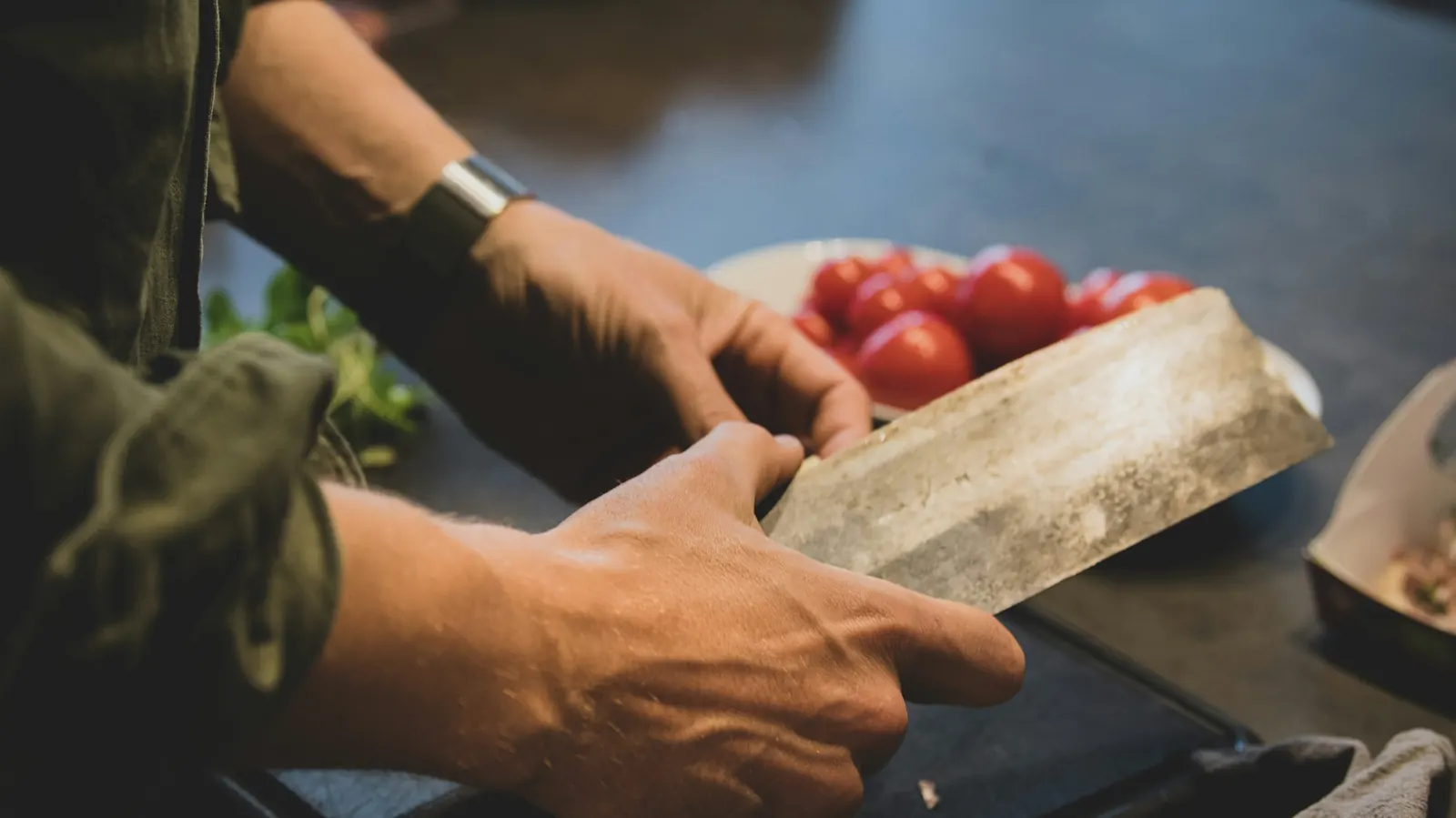
A single whetstone sharpens a knife. A whetstone kit is what makes it practical to keep doing it. The stone needs something to hold it still on a wet counter, a second grit to finish the edge the first one raised, a way to keep it flat as it wears, and, for most of us, something to help hold the blade at the same angle stroke after stroke. Buy those pieces one at a time and you end up with a drawer of mismatched parts; buy them as a kit and they arrive sized to work together.
This guide is for the cook who wants the whole setup in one box. If you already know which stone you want, our main guide to the best whetstone compares individual stones, and none of its picks are repeated here. Below are seven kits that bundle multiple grits with a base or holder, and in most cases an angle guide, a flattening stone or a honing steel, with what each maker says is in the box.
Julia’s earns a commission on purchases made through links on this page, at no cost to you. Recommendations are based on what a restaurant kitchen looks for in a sharpening setup, the makers’ own specifications and the details on each Amazon listing.
Quick verdict: which whetstone kit to buy
For most home kitchens, the Shun 3-Piece Whetstone Sharpening System is the kit to buy: a 1000/6000 combination water stone on a bamboo stand that Shun’s U.S. distributor says is angled at 16 degrees, plus a 9-inch honing steel to keep the edge between sharpenings. If you want a flattening stone and a clip-on angle guide in the box, the Seido 1000/6000 Whetstone Sharpening Kit has both. If you would rather not soak or flatten anything, the DMT 10-inch DuoSharp with Universal Base is a two-grit diamond plate that works dry or with water.
Further down: five standout kits side by side, all seven in detail, and what to check before you buy.
Five whetstone kits side by side
Our five standout kits, one for each kind of sharpener, with the grits and accessories each maker or listing states. All seven are reviewed in full below.
| Kit | Best for | Grits | In the box | Buy on Amazon |
|---|---|---|---|---|

Shun 3-Piece Whetstone Sharpening SystemBest overall
|
Japanese and thin-edged knives | 1000 / 6000 | Angled bamboo stand, honing steel | View on Amazon |
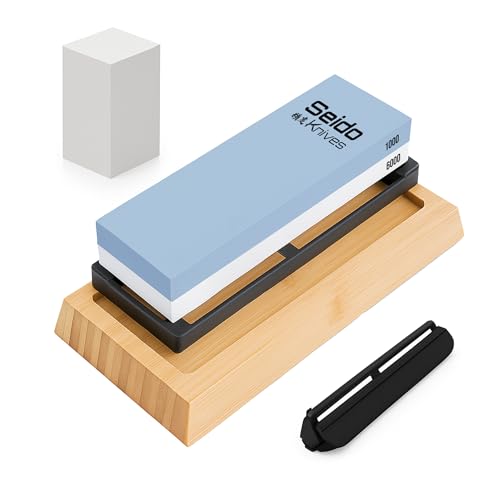
Seido 1000/6000 Whetstone Sharpening KitBest classic starter kit
|
A first full water-stone setup | 1000 / 6000 | Bamboo base, flattening stone, angle guide | View on Amazon |

Wüsthof Tri-Stone SharpenerBest three-grit water stone
|
Repairing as well as refining | 240 / 1000 / 3000 | Wood base, water bottle | View on Amazon |

DMT 10-inch DuoSharp with Universal BaseBest diamond
|
No soaking, no flattening | Coarse / fine diamond | Adjustable base | View on Amazon |

Spyderco Tri-Angle SharpmakerEasiest for beginners
|
Fixed angles, no freehand skill | Medium / fine ceramic | Angled base, safety rods, lid | View on Amazon |
Product images from Amazon. Grits and contents are as stated by each maker or listing; check the listing before you buy.
Our picks for the best whetstone kit
The seven kits cover the abrasives that matter in a kitchen: water stones, which cut fast and leave a fine edge but need soaking or splashing and occasional flattening; diamond plates, which stay flat and work dry; and ceramic stones, which suit cooks who want a fixed system. If you want oil stones, see the parent guide’s oil-stone pick, the Norton tri-stone, which is not repeated here.
1. Shun 3-Piece Whetstone Sharpening System – Stone, Stand and Steel
Shun’s kit is built around the knives it makes, and it solves the hardest part of freehand sharpening: the angle. Kai USA, Shun’s U.S. distributor, says the bamboo stand has a built-in 16-degree slope to match the 16-degree edge on Shun knives. Cutlery and More, a retailer that sells the kit, explains the effect: because the stone sits at that slant, you only need to keep the blade flat and parallel to the counter as you draw it across.
The stone is a 1000/6000 combination. The listing says the 1000 side restores a sharp edge and the 6000 side gives a fine finish, and that the stone should be soaked in water before use; Cutlery and More gives 10 to 20 minutes. A rubber base holds the stone in the stand. The third piece is a 9-inch combination honing steel with a smooth side, which Shun suggests for weekly honing, and a micro-ribbed side for monthly honing.
Shun states a limited lifetime warranty. The kit also appears in our best knife sharpener guide; we include it here because, for a kitchen of mostly Japanese or thin-edged knives, it is the most complete whetstone kit from a major knife maker. There is no flattening stone, so plan to buy one once the 1000 side starts to dish.
Why we like it
- Stand angled at 16 degrees, per Kai USA
- 1000 and 6000 grits on one stone
- 9-inch combination honing steel included
- Limited lifetime warranty
Key specifications
| Model | DM0610 |
|---|---|
| Abrasive | Combination water stone |
| Grits | 1000 / 6000 |
| Base or holder | Angled bamboo stand with rubber base |
| Angle guide | Built into stand, 16 degrees |
| Flattening stone | Not included |
| Lubricant | Water, soak before use |
| Warranty | Limited lifetime |
Why we recommend it
It suits owners of Shun and other 16-degree Japanese knives who want the angle set for them and a steel for upkeep between sessions.
Skip it if your knives are German with a wider edge angle; the fixed 16-degree stand is designed around Shun’s edge.
Pros and cons
Pros
- Angle set by the stand
- Sharpening and honing in one kit
- Major knife maker’s warranty
Cons
- Stone needs soaking
- No flattening stone
- No coarse grit for chips
2. Seido 1000/6000 Whetstone Sharpening Kit – Every Accessory in One Box
This is the classic whetstone kit layout, from Seido Knives, a kitchen knife brand that sells under its own name. The listing gives a double-sided 1000/6000 grit stone, a non-slip rubber holder, a bamboo base, a flattening stone and an angle guide. That is every piece a beginner needs to sharpen on a water stone and keep the stone in shape.
Seido says the 1000 side is for bringing back dull knives and the 6000 side is for a polished edge. The rubber holder sits in the bamboo base to keep the stone from sliding, and the clip-on angle guide gives you a consistent starting angle while you learn. The flattening stone is the piece many single-stone buyers skip and later regret: rub it across the face of the water stone every few sessions and the stone stays flat, so the edge stays straight.
A Seido listing on a deals site describes the stone as a water stone that should not be oiled. The Amazon listing does not give the stone’s dimensions, abrasive material or a warranty.
Why we like it
- Flattening stone included
- Clip-on angle guide
- Rubber holder plus bamboo base
- 1000 and 6000 grits
Key specifications
| Model | SK-1k6k |
|---|---|
| Abrasive | Not stated (water stone) |
| Grits | 1000 / 6000 |
| Base or holder | Bamboo base, rubber holder |
| Angle guide | Included |
| Flattening stone | Included |
| Lubricant | Water |
| Warranty | Not stated |
Why we recommend it
It suits a cook learning to sharpen on water stones who wants the stone, the holder, the guide and the flattener at once.
Skip it if you want a stated warranty or a well-known stone maker behind the abrasive.
Pros and cons
Pros
- Most complete water-stone kit here
- Keeps the stone flat
- Guide helps beginners
Cons
- Abrasive and size not stated
- No warranty stated
3. Wüsthof Tri-Stone Sharpener – Coarse, Medium and Fine on One Base
Most kits stop at two grits. Wüsthof’s Tri-Stone gives you three: coarse J240, medium J1000 and fine J3000, according to the listing. That coarse stone is the difference. It is the grit for a chipped tip or an edge that has been neglected for a year, the jobs a 1000 stone does slowly.
Abt, an appliance retailer that sells it, describes a wood base for a stable surface and a water bottle for re-wetting the stones while you work, and gives the package at about 10 inches long and 3 pounds. Wüsthof’s listing describes the stones as firm but porous, releasing small particles as you sharpen, which together with water is what cuts the new edge.
Wüsthof is a seventh-generation family company in Solingen, Germany, its listing says, and Abt lists a limited lifetime warranty. There is no angle guide or flattening stone in the box; Wüsthof sells an angle guide separately.
Why we like it
- Three grits, 240 to 3000
- Coarse stone repairs damaged edges
- Wood base and water bottle included
- Limited lifetime warranty, per Abt
Key specifications
| Model | 3069720201 |
|---|---|
| Abrasive | Water stones |
| Grits | 240 / 1000 / 3000 |
| Base or holder | Wood base |
| Angle guide | Not included |
| Flattening stone | Not included |
| Lubricant | Water (bottle included) |
| Warranty | Limited lifetime |
Why we recommend it
It suits a kitchen with knives in mixed condition, where some need repair and others only need refreshing.
Skip it if you want a mirror finish; 3000 is the finest grit here, well short of the 6000 on the Shun and Seido stones.
Pros and cons
Pros
- Coarse grit for repairs
- Three steps on one base
- German maker’s warranty
Cons
- No angle guide
- No flattening stone
4. DMT 10-inch DuoSharp with Universal Base – Two Diamond Grits That Stay Flat
Diamond plates answer the two chores water stones bring: soaking and flattening. DMT’s listing says the monocrystalline diamond surface sharpens faster than conventional stones without messy oils and can be used dry or with water. A diamond plate does not dish the way a water stone does, so there is nothing to flatten.
This 10-inch DuoSharp is double-sided, color-coded coarse (blue) to bring a dull edge back to cutting condition and fine (red) to put a good edge on slightly dull knives. Retail listings for the 10-inch fine and coarse DuoSharp give the grits as 45 micron (325 mesh) and 25 micron (600 mesh). DMT says the recessed polka-dot surface captures swarf, the metal and abrasive dust, so it stays clean, and the kit includes a lightweight adjustable base for better ergonomics. Retail listings say the plate is made in the USA.
The trade-off is the finish. Fine diamond at 600 mesh leaves a toothy, working edge rather than a polished one; add a fine ceramic or 6000 water stone if you want more. There is no angle guide.
Why we like it
- Works dry or with water
- Stays flat, no flattening stone needed
- Coarse and fine sides on a 10-inch plate
- Adjustable base included
Key specifications
| Model | W250FC-WB-2 |
|---|---|
| Abrasive | Monocrystalline diamond |
| Grits | Coarse 325 mesh / fine 600 mesh (per retailers) |
| Base or holder | Lightweight adjustable base |
| Angle guide | Not included |
| Flattening stone | Not needed |
| Lubricant | Dry or water |
| Warranty | Not stated |
Why we recommend it
It suits a cook who wants to sharpen on a whim without soaking a stone first, and anyone with hard-working German knives.
Skip it if you want a polished, refined edge from one kit; the finest side is 600 mesh.
Pros and cons
Pros
- No soaking or flattening
- Fast cutting
- Large 10-inch surface
Cons
- Coarser finish than water stones
- No angle guide
5. Spyderco Tri-Angle Sharpmaker – Fixed Angles for Anyone
The Sharpmaker takes the angle out of your hands entirely. Instead of laying the knife on a flat stone, you set two triangular ceramic stones upright in an ABS base and draw the knife straight down. Spyderco’s listing says keyed holes in the base set the stones at 30 or 40 degrees; retailer descriptions of the kit, such as Fisheries Supply’s, explain those as 15 or 20 degrees per side.
The kit includes two pairs of high-alumina ceramic stones, medium (brown) for aggressive sharpening and fine (white) for finishing, plus aluminum safety rods that guard your hand. Spyderco says the rounded edges of the stones sharpen serrated blades, which none of the flat-stone kits here can do well, and that everything snaps into the base and lid for storage.
Retailer descriptions of the kit say to use the stones dry, with no oil, water or lubricant, and warn that the ceramic will break if dropped. The listing gives a two-year manufacturer warranty.
Why we like it
- Fixed 15- or 20-degree angles per side
- Medium and fine ceramic stones
- Sharpens serrated edges
- Stores in its own base and lid
Key specifications
| Model | 204MF |
|---|---|
| Abrasive | High-alumina ceramic |
| Grits | Medium / fine |
| Base or holder | ABS base with keyed holes and lid |
| Angle guide | Built in, 30 or 40 degrees inclusive |
| Flattening stone | Not needed |
| Lubricant | None, used dry |
| Warranty | 2 years |
Why we recommend it
It suits a cook who has tried freehand sharpening and could not hold an angle, and anyone who wants to sharpen serrated steak knives too.
Skip it if your knives are badly dull or chipped; the medium stones are slow at removing much metal.
Pros and cons
Pros
- No angle to hold
- No water, no mess
- Handles serrations
Cons
- Ceramic breaks if dropped
- Slow on very dull edges
6. Cangshan 7-Piece Knife Care and Sharpening Kit – Stone, Strop and Polish

Cangshan’s kit goes past sharpening into the whole of knife care. The listing gives a double-sided whetstone on an acacia wood base, a 16-degree sharpening guide, a double-sided genuine leather strop, 6 ounces of fine polishing compound, 6 ounces of knife blade oil, a microfiber cloth, a pair of cut-resistant gloves and a hard-shell storage bag that holds it all.
The strop and compound are the reason to choose it. After the stone, a few passes on a leather strop loaded with compound remove the last fine burr and polish the edge. The blade oil protects carbon-steel knives from rust between uses. Cangshan says the oil, compound and gloves are made in the USA, and that the gloves comply with FDA regulations for food contact.
The Amazon listing does not give the whetstone’s grits. A shopping guide lists the kit’s stone as 1000/6000, but Cangshan’s listing does not confirm it, so check the product photos. There is no flattening stone, and the listing does not state a warranty.
Why we like it
- Leather strop and polishing compound
- 16-degree sharpening guide
- Acacia base and hard-shell storage bag
- Cut-resistant gloves included
Key specifications
| Model | 1026757 |
|---|---|
| Abrasive | Double-sided whetstone |
| Grits | Not stated on listing |
| Base or holder | Acacia wood base |
| Angle guide | 16-degree guide |
| Flattening stone | Not included |
| Lubricant | Not stated |
| Warranty | Not stated |
Why we recommend it
It suits a cook who wants a finished, polished edge and a single bag that holds every tool for looking after knives, including carbon steel.
Skip it if you need to know the grits before you buy; the listing does not state them.
Pros and cons
Pros
- Strop for a polished edge
- Gloves and storage bag
- Angle guide included
Cons
- Grits not stated
- No flattening stone
7. DMT Tristone Rotator – Three Diamond Grits and Three Angle Guides

DMT’s Tristone Rotator puts three diamond stones and three angle guides on one rotating handle. The listing gives coarse (325), fine (600) and extra-fine (1200) stones, color-coded blue, red and green, which DMT says are made in the USA. You pick a stone, rotate to the 15-, 20- or 22-degree angle guide, and sharpen.
Choose the angle closest to what your knife’s maker states; Zwilling and Victorinox, for example, give 15 degrees per side for some of their kitchen knives, and many cooks sharpen sturdier knives nearer 20. The stones are removable for cleaning or replacement, and the non-slip handle lets you use it on the counter or in the hand. The listing gives it at 8.75 inches long, 1.75 inches wide and 1.5 inches high.
That small size is the limit. A short stone means more strokes and more repositioning on an 8- or 10-inch chef’s knife than a full bench stone. It is a better fit for paring and utility knives, or as a compact second kit.
Why we like it
- Three diamond grits, 325 to 1200
- 15, 20 and 22 degree guides
- USA-made stones, per DMT
- Removable, replaceable stones
Key specifications
| Model | 20176 |
|---|---|
| Abrasive | Diamond |
| Grits | 325 / 600 / 1200 |
| Base or holder | Rotating non-slip handle, 8.75 in |
| Angle guide | 15, 20 and 22 degrees |
| Flattening stone | Not needed |
| Lubricant | Not stated |
| Warranty | Not stated |
Why we recommend it
It suits a cook who wants guided angles and diamond speed in something that fits in a drawer.
Skip it if you mainly sharpen long chef’s knives; a full-size bench stone is easier.
Pros and cons
Pros
- Three grits, three angles
- Compact
- No soaking
Cons
- Short stones for long knives
- Warranty not stated
What a complete whetstone kit should include
At least two grits. A medium stone, around 1000, does the sharpening; a finer stone, 3000 to 6000, refines the edge. A coarse stone around 240 to 400 is worth having if your knives get chipped or neglected. Three-stone kits like the Wüsthof cover all three steps.
A base or holder. A stone that slides on a wet counter is dangerous and gives an uneven edge. Look for a rubber holder, a wooden or bamboo base, or a sink bridge.
An angle guide. Holding a steady angle is the hardest skill in sharpening. A clip-on guide, an angled stand like Shun’s or a fixed system like the Sharpmaker gets you consistent results sooner.
A way to keep the stone flat. Water stones wear into a shallow dish with use, and a dished stone puts a curve in your edge. A flattening stone fixes that; diamond and ceramic stones barely wear, so they rarely need one.
How to choose a whetstone kit
Your knives. Thin Japanese knives with 15- to 16-degree edges suit fine water stones and kits like Shun’s. Knives with wider edges are well served by diamond or the Sharpmaker’s 20-degree setting. Check your knife maker’s stated angle before you choose a fixed guide.
Water, oil or dry. Water stones cut fast and finish fine but need soaking or splashing and flattening. Oil stones are slower and messier but durable. Diamond and ceramic work dry or with a little water and stay flat.
Freehand or guided. If you want to learn the craft, choose a kit with a clip-on guide and graduate to freehand. If you just want sharp knives, a fixed-angle system is faster to master.
Stone length. Bench stones of 7 to 11.5 inches suit chef’s knives. Short stones and handheld rotators suit small knives and tight storage.
What else is in the box. A honing steel, strop or flattening stone adds value only if you will use it. Count what you would otherwise buy separately.
Not sure you need a whetstone at all? Our knife sharpener vs whetstone comparison explains when a pull-through or electric sharpener is the better choice.
How we chose these seven sharpening kits
We started from what a kitchen that cuts onions, tomatoes, chiles and grilled meat every day needs from a sharpening setup: more than one grit, a stable base, and a way to hold a consistent angle or keep the stone flat. We looked for kits sold on Amazon in the United States from identifiable knife and sharpening makers, across water, diamond, ceramic and oil stones, and checked every listing’s stock with Amazon’s product data before writing. We left out kits that were down to their last few units or unavailable, including Norton and Smith’s starter kits and most Naniwa sets with bases. We left out Lansky’s clamp systems, which hold the blade in a clamp that is awkward on a long chef’s knife, and we did not use the many unbranded kits that sell the same stone, base and guide under different names. We did not repeat any stone from our best whetstone guide. Specifications come from the makers’ listings and pages and, where noted, from retailers; where none states a figure, we say “not stated”. We checked the U.S. Consumer Product Safety Commission recall database for each brand and found no sharpener or whetstone recalls listed. We did not sharpen knives with these kits for this guide.
Whetstone kit questions, answered
What grits should a whetstone kit have?
At minimum a medium grit around 1000 for sharpening and a fine grit of 3000 to 6000 for finishing. Add a coarse grit around 240 to 400 if you need to repair chips. The Wüsthof Tri-Stone has 240, 1000 and 3000; the Shun and Seido kits have 1000 and 6000.
Do I need a flattening stone?
For water stones, yes, eventually. They wear unevenly with use, and a dished stone sharpens a curved edge. The Seido kit includes one. Diamond plates, like the DMT DuoSharp, stay flat and do not need one.
Is an angle guide worth it?
For beginners, yes. It teaches the feel of a consistent angle. The Shun stand, the Seido and Cangshan guides and the fixed Sharpmaker and DMT Rotator systems all help.
Should I soak my whetstone?
Follow the maker. Shun says to soak its stone before use, and Cutlery and More gives 10 to 20 minutes. Diamond and ceramic stones do not need soaking; the Sharpmaker’s stones are used dry.
How often should I sharpen with a whetstone?
When honing no longer brings the edge back. With regular honing, a home kitchen may only need the stones every few months. Our guide to the best honing steel covers the upkeep in between.
Our final pick for a complete sharpening setup
Buy the Shun 3-piece system if you own thin Japanese knives and want the angle set for you. Choose the Seido kit for every water-stone accessory in one box, the Wüsthof Tri-Stone for three grits including a coarse one, the DMT DuoSharp to skip soaking and flattening, and the Spyderco Sharpmaker if you never want to think about the angle again.
For individual stones, see the best whetstone, and for faster options, the best knife sharpener. A sharp knife makes every job in Mexican cooking tools easier.
And if you would rather someone else did the chopping tonight, see the menu or call to order.