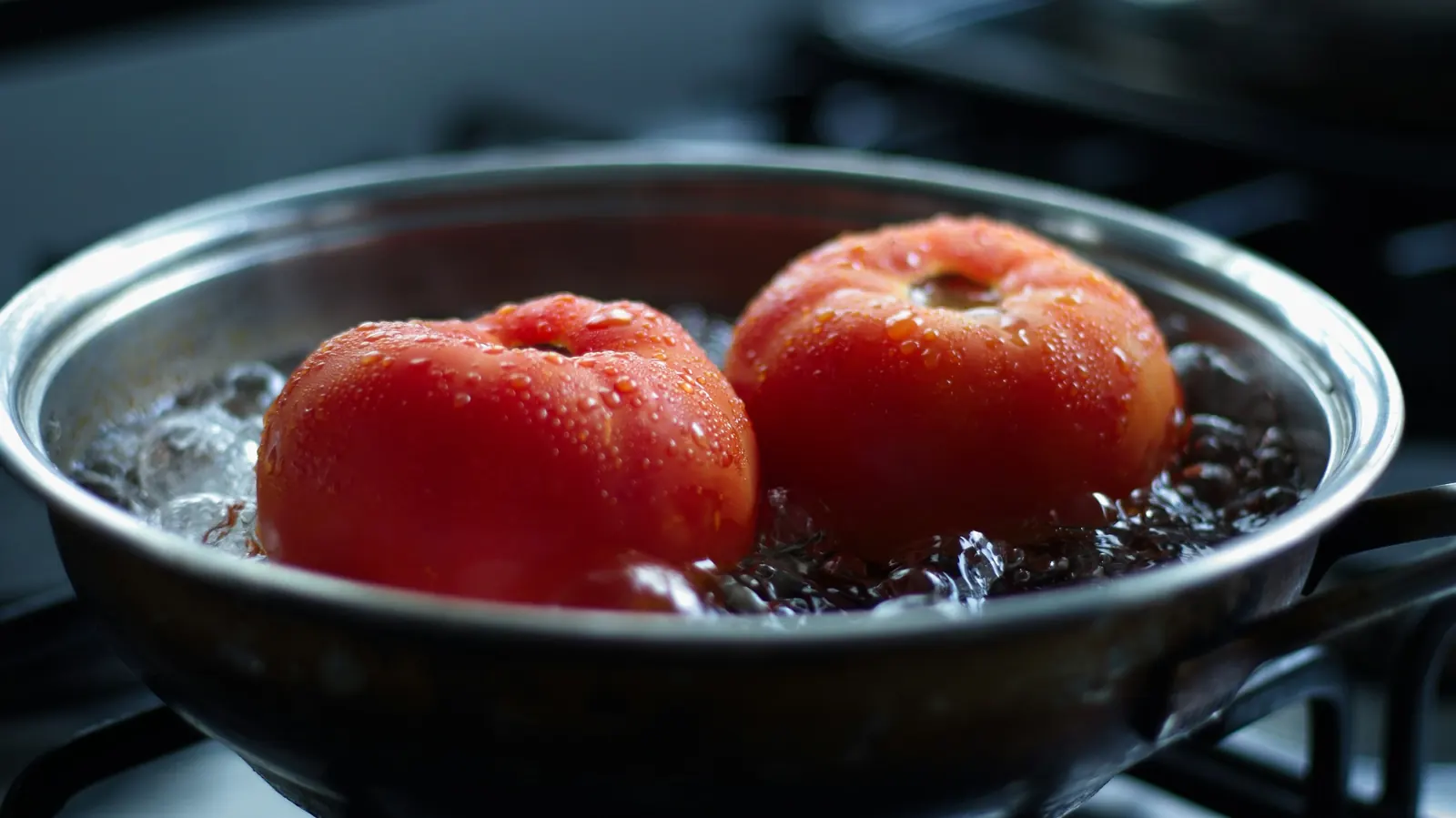
A food mill is a hand-cranked sieve. You fill it with cooked tomatoes, apples or potatoes and turn the handle, and a blade pushes the soft flesh through a perforated disc while skins and seeds stay behind. A blender cannot do that part, because it grinds everything together. That is why a mill still earns a place for sauce, applesauce and smooth purees.
The trouble is that two of the best-known mills, the Cuisipro Deluxe and the OXO Good Grips, were not in stock on Amazon when we checked. So this guide covers what you could actually buy, explains where a clamp-on tomato strainer makes more sense, and says plainly where the evidence on a pick is thin.
Julia’s earns a commission on purchases made through links on this page, at no cost to you. Recommendations are based on what a restaurant kitchen looks for, product specifications, verified buyer reports and the independent equipment reviews we name.
Quick verdict: which food mill to buy
For most cooks who make sauce often, the best pick in stock is the Küchenprofi 4-Disc Stainless Steel Food Mill: America’s Test Kitchen found it the best at removing seeds, with reservations about its handle and stability. For a small household, choose the GEFU Flotte Lotte, which has a built-in scraper. For a big tomato harvest, the Weston 1-Gallon Metal Tomato Strainer clamps on and has room for a long session.
Below, you will find the five standouts side by side, then all seven reviewed in full.
Five food mills side by side
Five picks for five kinds of kitchen, with each maker’s or listing’s own details. All seven are reviewed in full below.
| Food mill | Best for | Capacity | Discs or screens | Buy on Amazon |
|---|---|---|---|---|
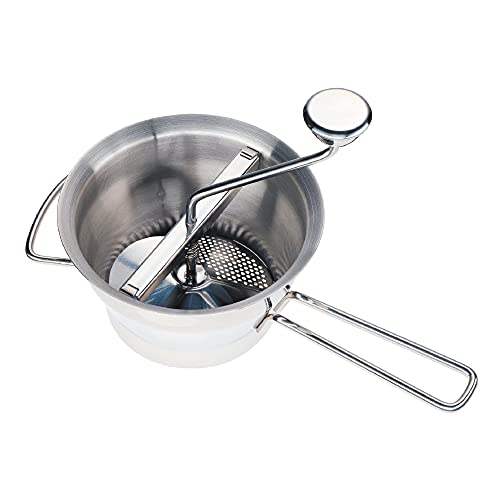
Küchenprofi 4-Disc Stainless Steel Food MillBest overall
|
Smooth sauce, few seeds | Not stated | 4 discs, 1.3 to 5 mm | View on Amazon |

Mirro Foley 3.5-Quart Stainless Steel Food MillBest classic mill
|
Simple big batches | 3.5 quarts | Not stated | View on Amazon |

GEFU Flotte Lotte 3-Disc Stainless Steel Food MillBest for easy cleanup
|
Small households | 2 liters | 3 discs, 1 to 8 mm | View on Amazon |

Louis Tellier N.5 Stainless Steel Food MillBest for very large batches
|
Catering, full stockpots | 8 quarts | 1 disc, more sold separately | View on Amazon |
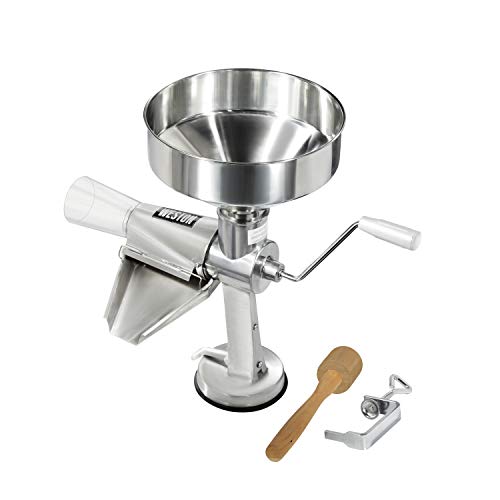
Weston 1-Gallon Metal Tomato StrainerBest for tomato harvests
|
Garden tomato harvests | 1-gallon hopper | 1 screen, kit sold separately | View on Amazon |
Product images from Amazon. Capacity and disc details are as each maker or listing states them; check the listing before you buy.
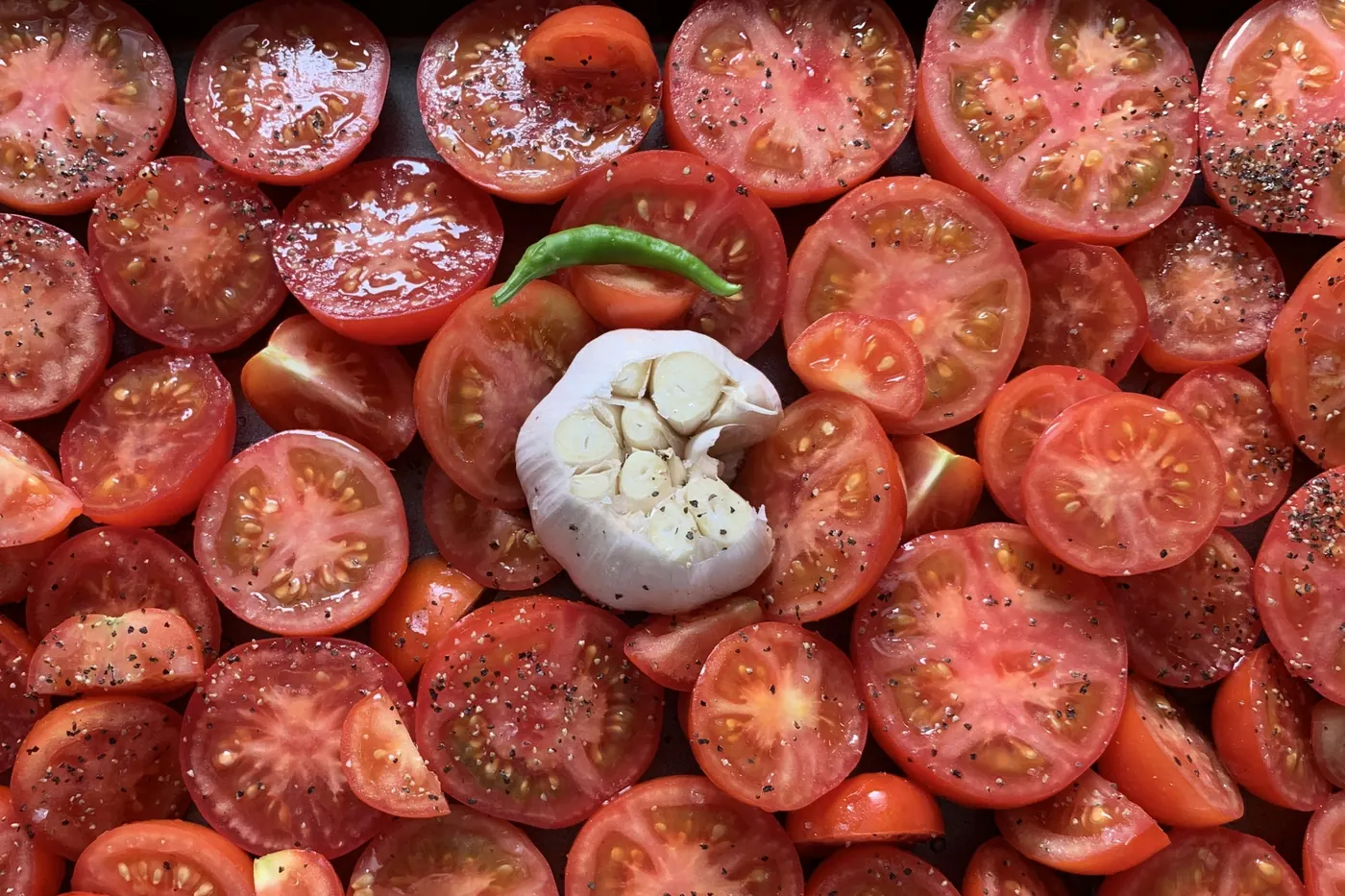
Our picks for the best food mill
Five of these seven are rotary mills that sit over a pot or bowl, and two are crank strainers that mount to a surface. We have not used these products ourselves; the notes come from the makers, the listings and the reviews we name. Only one pick here, the Küchenprofi, has a positive independent review we could confirm, and the write-ups say so.
1. Küchenprofi 4-Disc Stainless Steel Food Mill – Strong on Seed Removal
This is the one mill in stock that America’s Test Kitchen rates as Recommended with Reservations, and in that review it did the best job of keeping seeds out of raspberry coulis and tomato sauce. The review describes a four-disc Küchenprofi, which matches this listing, although ATK does not print an item number.
The four discs measure 1.3, 2.5, 3 and 5 mm, so the same mill can make a fine coulis, a smooth tomato sauce or a coarser vegetable puree. The maker’s listing gives an 8.75-inch diameter and 18/10 stainless steel, and it says the mill is dishwasher safe.
You set it on a pot or bowl and hold it by the long side handle while you turn the crank. That single handle is also the weak point. ATK found the wide wire handle uncomfortable and said the hook did not always latch, so the mill rocked during use. Keep one hand on the handle and use a pot it sits on squarely.
Why we like it
- ATK found it the best mill at removing seeds from coulis and tomato sauce
- Four discs from 1.3 to 5 mm
- 18/10 stainless steel, listed as dishwasher safe
- Five-year warranty against manufacturing defects, per the listing
Key specifications
| Model | K0966002820 |
|---|---|
| Type | Rotary hand-crank mill |
| Capacity | Not stated (8.75-inch diameter) |
| Discs or screens | 4 discs: 1.3, 2.5, 3 and 5 mm |
| Food-contact material | 18/10 stainless steel |
| Rests or mounts | Sits on a pot or bowl; long handle and hook |
| Cleaning | Dishwasher safe |
| Warranty | 5 years against manufacturing defects |
Why we recommend it
This suits a cook who makes sauce often and cares most about what ends up in it. If smooth tomato sauce with no stray seeds is the goal, this is the best-documented option you can buy today, with a disc for each job.
Skip it if you want a mill that stays put on its own. ATK saw it rock and called it somewhat heavy, so a mill with legs may feel steadier.
Pros and cons
Pros
- Best seed removal in ATK’s review
- Four disc sizes included
- Dishwasher safe
- Five-year warranty on the listing
Cons
- ATK found the wire handle uncomfortable
- Hook did not always latch in ATK’s review
- Capacity is not stated
2. Mirro Foley 3.5-Quart Stainless Steel Food Mill – A Simple Big-Batch Classic
The Foley is the familiar old-style food mill, sold now under the Mirro name. This is the larger of the two sizes, at 3.5 quarts, and the listing names tomatoes, apples and potatoes as the foods it is meant for.
Information on this one is thin, so we will say exactly what is known. The Mirro listing confirms the capacity and the stainless steel construction. All American Canner, an independent canning retailer that sells it, says the mill separates skins, seeds and fibers as you crank, and suggests the 3.5-quart size for heavy harvests or larger recipes and the 2-quart size for everyday batches.
The listing does not say how many discs come with it or how it should be washed, so check the product photos and the questions on Amazon if a choice of textures matters to you. We found no recent independent test of this model, so treat this as a pick for capacity and simplicity, not for proven results.
Why we like it
- 3.5-quart capacity for bigger batches
- Stainless steel construction
- The maker names tomatoes, apples and potatoes as its main uses
- A canning retailer points to this size for heavy harvests
Key specifications
| Model | 50025 (part number 2100043387) |
|---|---|
| Type | Rotary hand-crank mill |
| Capacity | 3.5 quarts |
| Discs or screens | Not stated |
| Food-contact material | Stainless steel |
| Rests or mounts | Not stated |
| Cleaning | Not stated |
| Warranty | Not stated |
Why we recommend it
This is for the cook who wants a plain, roomy mill for a weekend of tomatoes or applesauce and has no need for a set of disc sizes. Of the rotary mills here with a stated capacity, it holds more than the GEFU and far less than the commercial Louis Tellier.
Skip it if you want to choose between textures. The listing names no disc sizes, and the Küchenprofi and GEFU both spell theirs out.
Pros and cons
Pros
- Large home capacity
- Stainless steel
- Suited to tomatoes, apples and potatoes
Cons
- Listing gives no disc information
- Cleaning and warranty are not stated clearly
- No recent independent test found
3. GEFU Flotte Lotte 3-Disc Stainless Steel Food Mill – Built-In Scraper, Dishwasher Safe
The Flotte Lotte is GEFU’s long-running food mill. This version holds 2 liters, a little over 2 quarts, and comes with three stainless steel discs with 1, 3 and 8 mm holes. That is a wide spread, from fine sauces to chunky vegetable mash.
The feature that sets it apart is the integrated scraper, which the listing says keeps puree from going to waste. That matters when you are working through a pot of cooked tomatoes. The mill is purely manual and is listed as dishwasher safe.
GEFU’s own product page for a closely related Flotte Lotte says that model comes apart for cleaning, has spare parts available and carries a five-year guarantee. That page covers item 24100, not this three-disc set, so confirm those terms before relying on them. The US listing text reads like a rough translation, which is a nuisance but not a flaw in the mill itself.
Why we like it
- Integrated scraper, per the listing
- Three discs: 1, 3 and 8 mm
- Listed as dishwasher safe
- 2-liter capacity
Key specifications
| Model | 90011 |
|---|---|
| Type | Rotary hand-crank mill |
| Capacity | 2 liters (about 2.1 quarts) |
| Discs or screens | 3 discs: 1, 3 and 8 mm |
| Food-contact material | Stainless steel |
| Rests or mounts | Sits on a pot or bowl; ergonomic handles |
| Cleaning | Dishwasher safe |
| Warranty | Not stated on this listing |
Why we recommend it
This fits a small household that mills regularly and wants less scraping and less washing by hand. Baby food, jam and applesauce are all named on the listing, and the 1 mm disc is the finest here.
Skip it if you process big harvests. At 2 liters you will refill it more often than the Foley, and a clamp-on strainer suits a bushel better.
Pros and cons
Pros
- Scraper reduces waste
- Finest disc in this group
- Dishwasher safe
- Three disc sizes
Cons
- Smaller capacity
- Awkwardly translated listing
- No independent test found
4. Leifheit 3-Insert Stainless Steel Food Mill – Fits Pots Up to 11 Inches

Leifheit gives two numbers that many food mill listings leave out: a 20 cm body, close to 8 inches, and a fit on pots up to 28 cm, about 11 inches across. If you plan to mill straight into a saucepan or a mid-size pot, this tells you what to expect.
It comes with three stainless steel inserts of 2, 3 and 8 mm, labeled fine, medium and coarse. The listing names fruit, vegetables, soups, sauces and baby food as the uses, and says the mill goes in the dishwasher.
Fit is worth taking seriously. ATK found that stability decided which mills were pleasant to use, and that mills with supports reaching the sides of a pot sat more securely than others. Leifheit does not give a capacity, so judge the batch size from the 20 cm body. We found no independent test of this model.
Why we like it
- Stated fit on pots up to 28 cm (about 11 inches)
- Inserts of 2, 3 and 8 mm
- Rust-proof stainless steel, per the listing
- Listed as dishwasher safe
Key specifications
| Model | 23080 |
|---|---|
| Type | Rotary hand-crank mill |
| Capacity | Not stated (20 cm diameter) |
| Discs or screens | 3 inserts: 2, 3 and 8 mm |
| Food-contact material | Stainless steel |
| Rests or mounts | Sits on pots up to 28 cm |
| Cleaning | Dishwasher safe |
| Warranty | Not stated |
Why we recommend it
Buy this for everyday soups, sauces and baby food in the pots you already own. It suits a cook who wants plain specifications and straightforward cleanup more than a famous name.
Skip it if you need to cover a wide Dutch oven or stockpot. Anything over 28 cm is beyond the stated fit, so measure the rim first.
Pros and cons
Pros
- Clear pot-fit information
- Three insert sizes
- Dishwasher safe
Cons
- Capacity is not stated
- Too small for wide pots
- No independent test found
5. Louis Tellier N.5 Stainless Steel Food Mill – Restaurant-Size Batches
This is the restaurant-size mill here. Louis Tellier has made kitchen tools in France since 1947, according to the listing, and the N.5 holds 8 quarts. It rests on pots and bowls from 10-1/4 to 24 inches across, so it suits a stockpot and even a very wide kettle.
The listing describes a double milling action, with the blade pressing food against both the bottom and the sides of a basket-shaped disc, and it claims up to 11 pounds a minute. That is the maker’s figure, not an independent measurement. A 3 mm disc is included for purees, soups and compotes, and four more are sold separately.
There is one honest caution. America’s Test Kitchen did not recommend a smaller 9-1/2-inch Tellier stainless mill, saying it felt unstable, its legs would not span a Dutch oven and the crank often had to be reversed to clear the disk. The N.5 is a different, larger design with a much wider stated pot range, but ATK did not review it, so its verdict neither clears nor condemns this model.
Why we like it
- 8-quart capacity
- Rests on pots and bowls from 10-1/4 to 24 inches
- Made in France, per the listing
- Double milling action described by the maker
Key specifications
| Model | X530 |
|---|---|
| Type | Rotary hand-crank mill, commercial size |
| Capacity | 8 quarts |
| Discs or screens | 1 disc: 3 mm; 4 more sold separately |
| Food-contact material | Stainless steel |
| Rests or mounts | Rests on pots and bowls 10-1/4 to 24 inches |
| Cleaning | Hand wash recommended |
| Warranty | Not stated |
Why we recommend it
This is for caterers, big family cooks and anyone milling full stockpots of tomatoes or apples. Most home cooks will not need this much mill, but no other rotary design on this page comes close to its size.
Skip it if you cook for four. It is large to handle and store, and you get only one disc unless you buy more.
Pros and cons
Pros
- Largest rotary mill here
- Very wide pot fit
- Extra discs are available
Cons
- Only one disc included
- Hand wash recommended
- ATK did not recommend a smaller Tellier mill
6. Weston 1-Gallon Metal Tomato Strainer – Clamps On for Harvest Days
Strictly speaking this is a crank strainer, not a classic rotary mill. Instead of pressing food through a disc over a pot, you feed it into a hopper, and the machine removes skins and separates seeds as you turn the handle. For someone working through a garden’s worth of tomatoes, it does the job a food mill is usually bought for.
The hopper is stainless steel and holds 1 gallon. A dual mount offers both a suction-cup base and a C-clamp, so you can fix it to a counter or a table. There is a stainless splash guard, a chute that aims puree into a container, and a stomper for pressing food down.
Weston says there is no need to peel or core tomatoes first. The included 1.5 mm screen covers tomatoes and apples, and an accessory kit, sold separately as 07-0858, adds further screens. If you want a coarser texture as well as a smooth sauce, plan on that kit.
Why we like it
- 1-gallon stainless steel hopper
- Suction-cup base and C-clamp
- Splash guard and chute keep the work tidy
- Weston says no peeling or coring is needed
Key specifications
| Model | 07-1201-W |
|---|---|
| Type | Hand-crank strainer |
| Capacity | 1-gallon hopper |
| Discs or screens | 1 screen: 1.5 mm; more in kit 07-0858 |
| Food-contact material | Stainless steel hopper, splash guard and chute |
| Rests or mounts | Suction-cup base or C-clamp |
| Cleaning | Not stated |
| Warranty | Not stated |
Why we recommend it
Choose this if your food mill would mostly be a tomato machine. It suits gardeners and canners, because the hopper is large and the puree runs straight down the chute into your container.
Skip it if you only make a small pot of sauce now and then. It needs a clear edge or flat surface to mount on, and it is more to set up than a mill that rests on a pot.
Pros and cons
Pros
- Big hopper for long sessions
- Two ways to mount it
- Removes skins and seeds as it runs
Cons
- Only one screen included
- Takes more setup and space
- Cleaning is not described on the listing
7. Norpro Sauce Master 3-Quart Strainer – Add Screens for Salsa or Berries
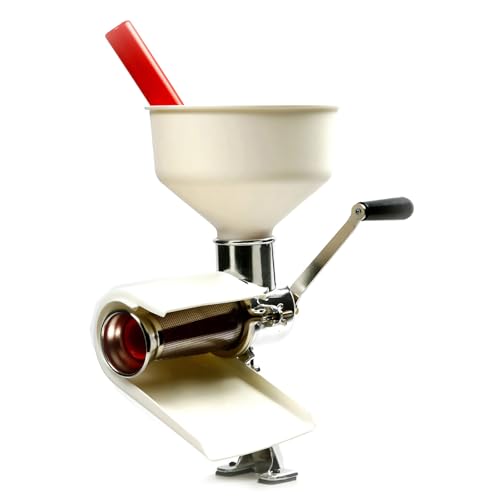
The Norpro Sauce Master is the other crank strainer on this page, and its listing files it under food mills as well as sauce makers. Food goes through a chrome-plated steel screen, and the machine separates juice and pulp in one pass.
The capacity is 3 quarts, and the box includes a standard fine mesh screen, a standard spiral and a recipe and instruction booklet. What makes it worth a look is the range of extras. Norpro sells a berry screen, a pumpkin screen and a salsa screen separately, so the same machine can move from smooth sauce to a coarser texture.
Note the materials. The screen is chrome-plated steel, unlike the stainless parts on the Weston, and the listing does not say what the body is made of. It is also hand wash only, so plan to dry the parts straight away.
Why we like it
- Separates juice and pulp in one operation
- Optional berry, pumpkin and salsa screens
- 3-quart capacity
- Recipe and instruction booklet included
Key specifications
| Model | 1951 |
|---|---|
| Type | Hand-crank strainer |
| Capacity | 3 quarts |
| Discs or screens | 1 fine mesh screen; berry, pumpkin and salsa screens sold separately |
| Food-contact material | Chrome-plated steel screen; body not stated |
| Rests or mounts | Not stated |
| Cleaning | Hand wash only |
| Warranty | Not stated |
Why we recommend it
This fits a home canner who wants a strainer but also makes berry jam or a coarser salsa-style sauce, because the optional screens are named and easy to identify. It holds less than the Weston, which suits a smaller harvest.
Skip it if you want everything stainless and dishwasher safe. The GEFU or Leifheit will suit you better.
Pros and cons
Pros
- Range of optional screens
- Separates pulp and juice automatically
- Comes with recipes
Cons
- Hand wash only
- Screen is chrome-plated, not stainless
- Mounting and body material not stated
How to choose a food mill for your kitchen
Rotary mill or crank strainer. A rotary mill sits over a pot, stores in a cupboard and handles potatoes, soups and small batches as well as tomatoes. A crank strainer such as the Weston or Norpro needs a counter edge or a flat surface and more setup, and it pays off when you have a full day of tomatoes or apples to get through.
Stability. America’s Test Kitchen treated stability as a deciding factor. In its review, mills with legs that reached the sides of a wide vessel sat more securely, while hooked models tended to wobble or rock. Measure the pot you plan to use before you order.
Discs. More discs mean more control. ATK’s review notes that the spring tension matters as well as the holes: slack springs slow the work, and overly tight ones force seeds through. Fine discs suit seedy berries and baby food, while coarser ones suit mashed vegetables.
Capacity. Larger mills take more produce per load, but ATK found they could be heavier and sit deeper in the puree. Two to three quarts suits regular sauce making. Eight quarts belongs in a catering kitchen.
Cleaning and materials. Stainless steel is the common choice here, and the Louis Tellier listing notes that it resists food acids. Check each listing for dishwasher use, because the Norpro is hand wash only and the Louis Tellier N.5 is listed as hand wash recommended. Food sets hard in small holes, so rinse the disc as soon as you finish.
Where a food mill helps in a Mexican kitchen
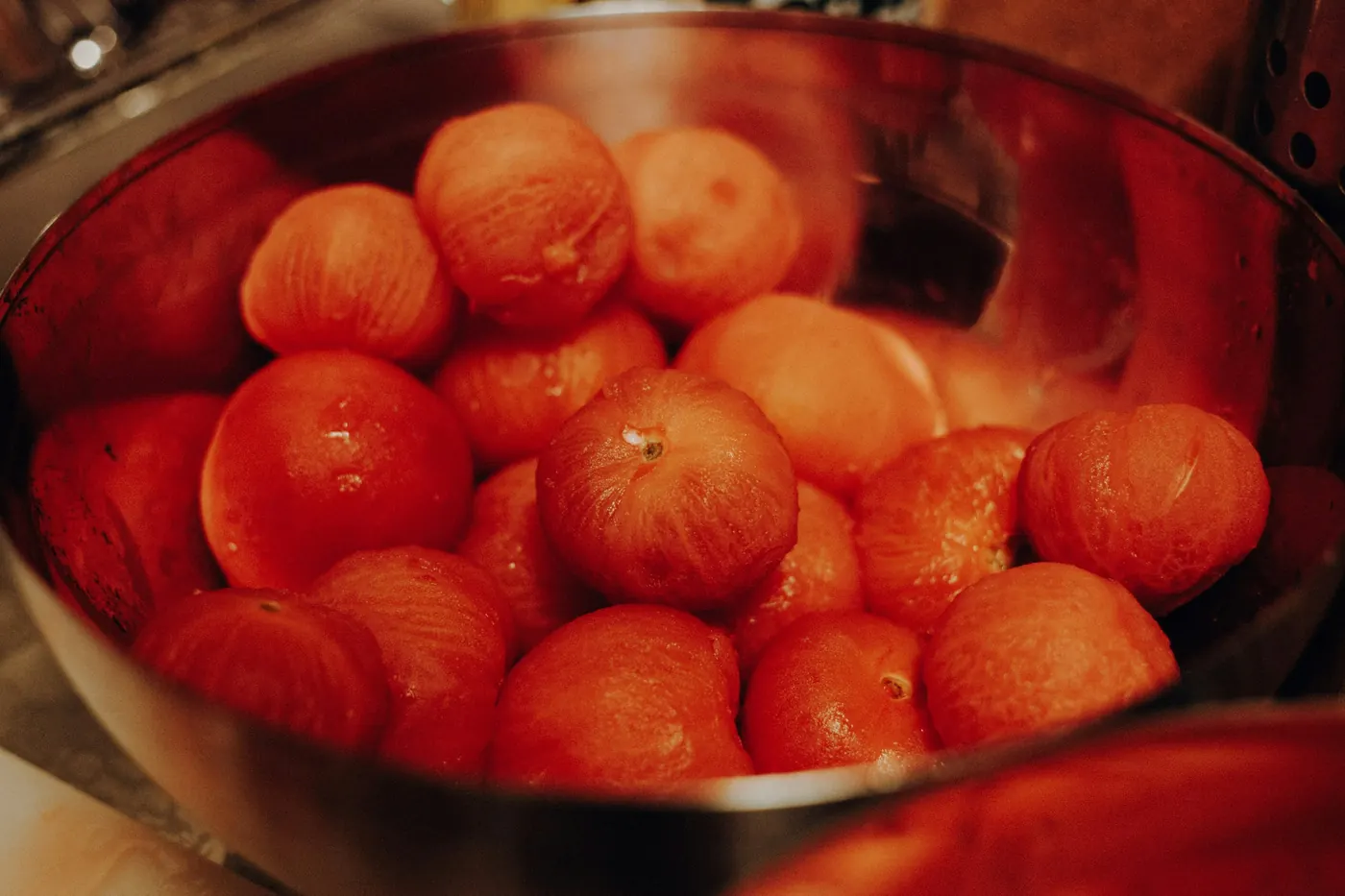
A red chile sauce or a smooth tomato salsa depends on texture, and bits of skin can spoil it. Passing the sauce through a mill catches skins and seeds without the extra work of pushing it through a strainer by hand. Our guide to enchilada sauces explains the sauces themselves, and salsa roja vs salsa verde covers the two classic salsas.
If you only need to smooth out a sauce and do not mind the seeds and skins staying in, an immersion blender is the simpler tool. For very small amounts, a fine-mesh strainer and a spoon will do it. And for potatoes alone, a potato ricer is smaller and easier to store.
Canning sauce from your mill
A mill changes the texture of tomatoes, so it does nothing for their acidity, and canning rules still apply. The National Center for Home Food Preservation says to add bottled lemon juice or citric acid to canned tomato products and not to leave the acid out. Its table gives 1 tablespoon of bottled lemon or lime juice per pint and 2 tablespoons per quart, or a quarter teaspoon of citric acid per pint and a half teaspoon per quart. Follow a tested recipe for the rest. If you are also buying equipment for low-acid foods, start with our canning pressure cooker guide.
How we picked these seven mills
We started with what a kitchen needs from a mill: seed and skin removal, a stable seat on a pot, sensible disc choices and cleanup that will not put you off using it. We then read the America’s Test Kitchen food mill review, the full Amazon listings and the maker pages we could reach, and we kept only products in stock on Amazon in the United States when we checked.
The Cuisipro Deluxe, ATK’s winner, was not in stock when we checked. Neither was the OXO Good Grips, which ATK did not recommend because of its slack blade tension. We left out the Louis Tellier N.3 because it looks like the model ATK found unstable, the Westmark 9-inch mill because its listing gave no material, and several newer stainless mills sold mainly on Amazon because we could not find an independent review of them, which matters for something that touches food. We did not run our own trials.
Food mill questions, answered
What is the best food mill for tomatoes?
For a pot of sauce, the Küchenprofi, because of its seed removal in ATK’s review. For bushels of tomatoes, the Weston strainer, because of its 1-gallon hopper and clamp mount.
Do you need to peel tomatoes before using a food mill?
Usually not. A mill’s job is to hold back skins and seeds, and Weston says its strainer needs no peeling or coring. Cook the tomatoes until soft first if you are using a rotary mill; the Louis Tellier listing specifically names cooked tomatoes.
What is the difference between a food mill and a blender?
A blender chops everything together, skins and seeds included. A food mill pushes the soft parts through a disc and leaves the skins and seeds behind, so you get a smoother result without a second straining step.
Can you make mashed potatoes in a food mill?
Yes. The Küchenprofi, Mirro and Louis Tellier listings all mention potatoes. A ricer is easier to store, while a mill gives you more uses.
What size disc is best for sauce?
The Louis Tellier listings say 1.5 mm suits fine coulis and baby food, and 4 mm suits thicker purees and rustic soups. For an everyday tomato sauce, a disc between those, around 2.5 to 3 mm, is a sensible start.
Our pick for smooth sauce at home
Buy the Küchenprofi if seed-free sauce matters most and you can live with its handle. Choose the GEFU for small batches and easy cleanup, the Foley for plain bigger batches, the Leifheit if you want clear pot-fit numbers, the Weston or Norpro for harvest days, and the Louis Tellier N.5 only if you really do cook for a crowd.
Related guide: Food mill alternative.
For the mash side of the job, see our potato ricer reviews, and for the sauces themselves read about enchilada sauces. And on a night when you would rather not cook, see Julia’s menu and call to order.