A food mill does two jobs at once. It purees cooked tomatoes, apples or potatoes, and it holds back the skins and seeds while it does it. Most kitchens can copy the first job with tools they already own. The second job, the separating, is where the substitutes differ, and it decides which one suits your recipe.
This guide covers what to use instead of a food mill: a potato ricer, a fine strainer or drum sieve worked with a spatula, a blender followed by a strainer, and a stand-mixer strainer attachment. For each one we say how close it gets to a mill, what it costs you in time and effort, and when it is the wrong tool.
Julia’s earns a commission on purchases made through links on this page, at no cost to you. Recommendations are based on what a restaurant kitchen looks for, product specifications and verified buyer reports.
Why cooks look for a food mill alternative
- You need sauce tonight. The tomatoes are already soft in the pot and there is no mill in the drawer.
- Storage. A mill is a wide bowl, a crank and a set of discs. Many cooks use one a few times a year and would rather not give it a shelf.
- Small batches. For a cup of puree or one bowl of mashed potatoes, a full-size mill means more to wash than the job is worth.
- You already own a blender or a stand mixer. Both can do part of a mill’s work, if you know what they miss.
Quick verdict: the best food mill alternative
For tomato sauce, salsa bases and applesauce, the best food mill alternative is a fine-mesh conical strainer such as the New Star Foodservice 10-inch China Cap, worked with a ladle or spatula: it holds back skins and seeds the way a mill does, just more slowly. For mashed potatoes, use a potato ricer such as the Rösle; America’s Test Kitchen calls the ricer the gentlest tool for the fluffiest mash. A stick blender plus a strainer is the fastest route for big pots, and if you own a KitchenAid stand mixer with its food grinder, the KitchenAid strainer attachment comes closest to a real mill. Do not use a blender alone if you want a seedless sauce.
Five food mill stand-ins side by side
Our five standout picks, one for each kind of cook, with what each maker or listing states. All six products are reviewed in full below.
| Alternative | Best for | Removes skins and seeds? | Effort | Buy on Amazon |
|---|---|---|---|---|

New Star Foodservice 10-inch China Cap StrainerBest overall alternative
|
Tomato sauce, purees, applesauce | Yes, with a ladle or spatula | Moderate, slower than a mill | View on Amazon |

Rösle Stainless Steel Potato RicerBest for mashed potatoes
|
Fluffy mash, small batches | Holds back potato skin; small seeds pass | Low, one load at a time | View on Amazon |

Vitamix 5-Speed Immersion BlenderFastest for big pots
|
Blending in the pot, then straining | No; pair it with a strainer | Low to blend, moderate to strain | View on Amazon |

KitchenAid Fruit and Vegetable Strainer AttachmentClosest to a real mill
|
Stand-mixer owners, canning batches | Yes, removes seeds per KitchenAid | Low; needs the KSMFGA grinder | View on Amazon |
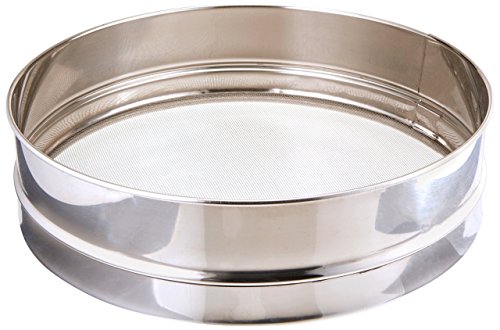
Winco 10-inch Stainless Steel Drum SieveBest flat sieve
|
Pressing purees with a scraper | Yes; mesh size not stated | Moderate, two hands | View on Amazon |
Product images from Amazon. Sizes and materials are as stated by each maker or listing; check the listing before you buy.
What a food mill does that other tools have to copy
America’s Test Kitchen’s food mill review puts the case for a mill plainly. Mills leave most skins and seeds behind in the hopper, so you often do not need to peel or seed the produce first, and even the slowest models it reviewed were faster than the peelers, ricers, wooden spoons, blenders and strainers cooks otherwise use. In its tomato comparison, peeling by hand and blending took 11 minutes, against 2 to 4 minutes in a mill, and the blender made a seedy, aerated sauce.
So every alternative gives something up, and it helps to know what. A strainer or sieve copies the separating but asks for more time and elbow. A blender copies the pureeing but not the separating, so it needs a strainer after it. A ricer separates potato skin well and makes excellent mash, but it holds only a small load. The KitchenAid strainer copies both jobs, at the cost of owning the mixer and grinder it fits.
For canning, the U.S. guidance leaves room for a substitute. The National Center for Home Food Preservation’s tomato juice directions say to press the heated juice “through a sieve or food mill to remove skins and seeds,” and its applesauce directions say to press through a sieve or food mill, or skip pressing for a chunky sauce. If you are canning, follow the tested recipe itself for acid, headspace and processing time; the tool you press with does not change those steps.

Six tools that can stand in for a food mill
All six are from identifiable makers and were in stock on Amazon, sold new, on the day of writing. Buy only what you are missing: most kitchens already own a strainer or a blender.
1. New Star Foodservice 10-inch China Cap Strainer – Holds Back Skins and Seeds
A conical strainer is the closest hand tool to a food mill, because it does the part a blender cannot: it keeps skins and seeds out of the sauce. The cone shape matters. Everything slides to the point, so a ladle or a stiff spatula pressed into the bottom pushes the soft flesh through a small area of mesh while the debris collects above it. A wide, flat strainer spreads the same work across more mesh and is slower to scrape clean.
New Star’s China cap is a 10-inch, fine-mesh cone in 18/8 stainless steel, with a reinforced build that the listing describes for sauces, soups, broths, stocks and purees. Ten inches is large enough to hold a good share of a pot of cooked tomatoes at once and still sit across a medium saucepan or bowl.
Expect it to be slower than a mill. Cook the produce until it is very soft, work in batches, and press and swirl rather than stab. For a salsa base or enchilada sauce built from rehydrated chiles, blend first and then strain through the cone, which catches chile skins and seeds that a blender breaks up but does not remove.
Why we like it
- NCHFP’s canning directions name a sieve as an option for removing tomato skins and seeds
- Fine 18/8 stainless steel mesh, per the listing
- 10-inch cone holds a large batch
- Reinforced build made for foodservice use
Key specifications
| Model | 34127 |
|---|---|
| Type | Conical strainer (China cap) |
| Material | 18/8 stainless steel |
| Size | 10-inch diameter |
| Separates skins and seeds | Yes, fine mesh |
| Power | Manual |
| Cleaning | Not stated; rinse the mesh right after use |
| Warranty | Not stated |
Why we recommend it
Choose it if you make tomato sauce, chile sauces or applesauce a few times a year and want a seedless result without giving a mill its own shelf.
Skip it if you put up bushels of tomatoes each summer; a mill or the KitchenAid strainer will save real time.
Pros and cons
Pros
- Removes skins and seeds
- Strains stocks and sauces too
- All stainless steel
Cons
- Slower than a mill
- No stand or pestle included
- Fine mesh takes care to clean
2. Rösle Stainless Steel Potato Ricer – The Fluffiest Mash
If mashed potatoes are why you wanted a food mill, a ricer is the better buy. America’s Test Kitchen’s comparison of mashing methods found that a ricer gives the gentlest touch and the fluffiest mash, while a food mill comes a close second with a smoother texture. It warns against the food processor and electric mixer, which make potatoes gluey.
Rösle’s ricer is stainless steel, with a basket 9.5 centimeters across and an overall size of 34 by 11.5 by 9.5 centimeters, per the listing. Rösle backs it with a 10-year warranty and recommends hand washing. You can rice boiled potatoes with the skin on: the skin stays in the basket, and you lift it out between loads.
It also works for small amounts of soft cooked vegetables or fruit, but keep expectations modest. The holes are sized for potato, so small seeds such as tomato seeds can pass through, and the basket holds only one or two potatoes at a time. The listing’s seller is Amazon’s German store, so allow extra time for it to arrive.
Why we like it
- America’s Test Kitchen rates a ricer best for fluffy mash
- Stainless steel throughout, per the listing
- 10-year Rösle warranty
- Small enough for a drawer
Key specifications
| Model | 16285 |
|---|---|
| Type | Potato ricer |
| Material | Stainless steel |
| Size | 34 x 11.5 x 9.5 cm; 9.5 cm basket |
| Separates skins and seeds | Potato skin stays behind; small seeds can pass |
| Power | Manual |
| Cleaning | Hand washing recommended |
| Warranty | 10 years |
Why we recommend it
Choose it if mashed potatoes, gnocchi dough or a small batch of soft vegetables is the main job you had in mind for a mill.
Skip it if you want seedless tomato sauce; a fine strainer does that job better.
Pros and cons
Pros
- Fluffy mash
- Long warranty
- Compact
Cons
- Small load per press
- Lets small seeds through
- Hand wash only, per Rösle
3. Vitamix 5-Speed Immersion Blender – Purees Right in the Pot
A blender is the alternative most people reach for, and it is only half of one. It purees quickly, but it grinds skins and seeds into the sauce rather than removing them; America’s Test Kitchen’s blender sauce came out seedy and aerated. The fix is a two-step method: blend, then press the puree through a fine strainer such as pick 1. That is our own kitchen reasoning, not a published test, but it follows directly from what each tool does.
A stick blender suits this method better than a countertop jar, because you blend hot food in the pot it cooked in and pour straight into the strainer. Vitamix’s model has a 625-watt motor, five speeds on the handle, four-pronged stainless steel blades and a bell guard that Vitamix says protects your pots. It works in containers with an opening of 3 inches or wider, has a 5-foot cord and carries a 3-year limited warranty, per the listing.
Blending first also makes the straining faster, because a smooth puree runs through the mesh more readily than chunks do. For mashed potatoes, though, leave it in the drawer: a blender’s speed overworks potato starch, just as America’s Test Kitchen found with the food processor.
Why we like it
- Blends hot food in the cooking pot, per Vitamix
- 625-watt motor and five speeds
- Bell guard protects cookware
- 3-year limited warranty
Key specifications
| Model | 067991 |
|---|---|
| Type | Corded immersion blender |
| Material | Stainless steel blades and shaft |
| Size | Fits containers with openings of 3 inches or more |
| Separates skins and seeds | No; strain afterward |
| Power | 625 watts, 5 speeds |
| Cleaning | Not stated |
| Warranty | 3-year limited |
Why we recommend it
Choose it if you cook big pots of sauce or soup and already own a strainer; together they are the quickest substitute.
Skip it if you were going to use it alone for a seedless sauce; it cannot remove seeds.
Pros and cons
Pros
- Fast purees in the pot
- Useful far beyond sauce
- Strong warranty
Cons
- Leaves skins and seeds in
- Needs a strainer step
- Wrong for mashed potatoes
4. KitchenAid Fruit and Vegetable Strainer Attachment – A Mill for Your Mixer
If a KitchenAid stand mixer already sits on your counter, this is the alternative that behaves most like a mill. KitchenAid says the strainer purees and strains fruits and vegetables for jams, sauces and baby food, and removes seeds as it goes, so it does both of a mill’s jobs with the mixer doing the turning.
There is a catch: it is not a stand-alone attachment. KitchenAid says it requires the KSMFGA food grinder, sold separately, and is not compatible with the discontinued FGA grinder. In the box are a strainer cone, a strainer shield, a splash lid, a food pusher and a removable tray, and the parts are dishwasher safe, per the listing, which gives a 1-year warranty.
The same strainer appears on our stand mixer meat grinder guide inside a grinder bundle. We list it here on its own, as a different listing of the same model, because cooks who already own the KSMFGA grinder need only the strainer, and for them it is the simplest way to turn a mixer into a mill.
Why we like it
- Purees and removes seeds, per KitchenAid
- The mixer does the cranking
- Dishwasher-safe parts
- Splash lid and pusher included
Key specifications
| Model | KSMFVSP |
|---|---|
| Type | Stand-mixer strainer attachment |
| Material | Not stated |
| Size | Not stated |
| Separates skins and seeds | Yes, removes seeds per KitchenAid |
| Power | KitchenAid stand mixer; needs KSMFGA grinder |
| Cleaning | Dishwasher-safe parts |
| Warranty | 1 year |
Why we recommend it
Choose it if you own a KitchenAid mixer and the KSMFGA grinder and process big batches of tomatoes or apples.
Skip it if you do not already have the grinder; buying both just to strain sauce is a bigger outlay than a hand mill.
Pros and cons
Pros
- Does both mill jobs
- Hands-free turning
- Dishwasher-safe parts
Cons
- Needs the KSMFGA grinder
- Only fits KitchenAid mixers
- Material not stated

5. Winco 10-inch Stainless Steel Drum Sieve – Flat Mesh for Pressing
A drum sieve, also called a tamis, is a flat screen stretched across a shallow round frame. Set it over a wide bowl, spoon on cooked fruit or vegetables and drag a stiff spatula or scraper across the mesh: the puree goes through, the skins and seeds stay on top. Because the screen is flat, you can press with long strokes and a lot of force, which suits thick purees better than a cone does.
Winco’s sieve is 10 inches across, in stainless steel, sold for foodservice and listed for sifting flour and dry ingredients. The listing does not give the mesh count or the frame depth, so treat it as a general-purpose screen; very fine seeds may pass. It also earns its space as a flour sifter, as our flour sifter guide explains for bakers.
The drawback is that it needs two hands and a bowl wide enough to hold the frame steady. It is slower than a mill and messier than a cone, but it costs little cupboard space if you bake as well.
Why we like it
- Flat screen takes firm scraper strokes
- Stainless steel, 10 inches across
- Doubles as a flour sifter
- Foodservice maker
Key specifications
| Model | SIV-10 |
|---|---|
| Type | Drum sieve (tamis) |
| Material | Stainless steel |
| Size | 10-inch diameter; depth not stated |
| Separates skins and seeds | Yes; mesh count not stated |
| Power | Manual |
| Cleaning | Not stated |
| Warranty | Not stated |
Why we recommend it
Choose it if you make thick purees, such as bean or squash, and want a tool that also sifts flour.
Skip it if you want one-handed straining over a pot; the cone in pick 1 is easier.
Pros and cons
Pros
- Firm pressing surface
- Two uses
- Stores flat
Cons
- Mesh size not stated
- Needs a wide bowl
- Slow for large batches
6. GIR Ultimate 11-inch Silicone Spatula – The Pusher for Any Sieve

Every strainer method depends on what you push with. A wooden spoon works, but its round bowl touches the mesh at one point. A flat, firm spatula presses across a wider strip and scrapes the puree off the underside of the mesh as well, which is where much of it clings.
GIR’s Ultimate spatula has a flexible silicone blade around a fiberglass core, measures 11 by 1.9 inches and is heat resistant to 425°F, per GIR. It is one seamless piece with no joint to trap food, it goes in the dishwasher, and GIR guarantees it for life against manufacturing defects. The heat rating matters here, because you will often be pushing hot sauce.
The same spatula appears in white on our silicone spatula guide. We list the black version here, a different listing of the same model, because no other spatula we found combined a firm core, a seamless head and a stated heat rating as clearly.
Why we like it
- Firm fiberglass core for pressing
- Heat resistant to 425°F, per GIR
- Seamless head, dishwasher safe
- Lifetime guarantee against defects
Key specifications
| Model | GIRSPU311BLK |
|---|---|
| Type | Silicone spatula |
| Material | Silicone over a fiberglass core |
| Size | 11 x 1.9 inches |
| Separates skins and seeds | No; used with a sieve |
| Power | Manual |
| Cleaning | Dishwasher safe |
| Warranty | Lifetime, manufacturing defects |
Why we recommend it
Choose it if you are straining by hand with a cone or drum sieve and your wooden spoon is slow going.
Skip it if you already own a firm silicone spatula; any stiff, heat-safe one does this job.
Pros and cons
Pros
- Presses and scrapes the mesh
- Safe with hot sauce
- Easy to clean
Cons
- Not a strainer on its own
- Same model as our spatula guide’s pick
How to strain sauce without a food mill
This is the method that matches a mill most closely with ordinary tools. It is our kitchen’s practice rather than a published test, built on the NCHFP and America’s Test Kitchen points above.
- Cook until very soft. Tomatoes should collapse and apples should fall apart; firm pieces jam the mesh.
- Blend if the batch is large. A short pulse with a stick blender breaks up the flesh so it passes faster. Skip this for applesauce you want chunky.
- Set the strainer over a bowl. Rest a cone across a pot, or a drum sieve across a wide bowl, and ladle in a few cups at a time.
- Press and scrape. Push with a ladle or firm spatula, then scrape the underside of the mesh into the bowl.
- Discard and repeat. Tip out the skins and seeds after each load so the mesh stays open.
For chile sauces, the same steps work with rehydrated dried chiles: blend them with their liquid, then strain. Our guide to enchilada sauces explains where a smooth, strained sauce matters.
What we left out, and why
A countertop blender works for the blend-then-strain method, but it means pouring hot food into a jar and back out again, so we chose a stick blender. A food processor purees but does not separate, and America’s Test Kitchen found it makes mashed potatoes gluey. A hand masher leaves lumps in potatoes and does nothing for seeds. And a colander’s holes are too large to stop tomato seeds; it is for draining, not straining.
When a real food mill makes more sense
If you can tomatoes or applesauce in quantity, the time difference America’s Test Kitchen measured, minutes per batch rather than a quarter hour, adds up fast. A mill also gives you discs for different textures. America’s Test Kitchen’s mashing comparison explains why a ricer or mill beats a food processor for potatoes. Our guide to the best food mill compares stainless hand mills and clamp-on tomato strainers. If the job is mash, see our potato ricer reviews, and for more strainer choices, our guides to the best chinois and fine-mesh strainers.

Food mill alternative questions, answered
What can I use instead of a food mill for tomato sauce?
A fine-mesh strainer or chinois, worked with a ladle or spatula. NCHFP’s canning directions say to press tomato juice through a sieve or food mill to remove skins and seeds, so a sieve is an accepted route.
Can I use a blender instead of a food mill?
Only with a strainer after it. America’s Test Kitchen found a blender made a seedy, aerated tomato sauce, because it grinds skins and seeds in rather than holding them back.
Is a potato ricer the same as a food mill?
No. A ricer presses one small load through a fixed set of holes and is best for potatoes. A mill turns continuously and has interchangeable discs. America’s Test Kitchen rates the ricer best for fluffy mash and the mill a close second, with a smoother result.
How do I make applesauce without a food mill?
Cook the apples until soft and press them through a sieve, or skip pressing for chunky sauce, as NCHFP’s applesauce directions allow. Coring first leaves less for the sieve to hold back.
Does a stand mixer replace a food mill?
A KitchenAid mixer does, with the KSMFVSP strainer attachment and the KSMFGA food grinder it requires. KitchenAid says the strainer purees and removes seeds.
Our final word on milling without a mill
For seedless sauce, use a fine conical strainer and a firm spatula; it is slower than a mill but does the same separating. For mash, buy a ricer. For big pots, blend in the pot and then strain. If you already own a KitchenAid with the food grinder, the strainer attachment is the nearest thing to a mill. And if you would rather someone else made the sauce tonight, see Julia’s menu or call to order.