Most home refrigerators have a dial or a screen, and most of us trust it without a second thought. The trouble is that a setting on the control panel tells you what you asked for, not what the air around your food is doing. A separate thermometer costs little, and it shows you what your food is sitting in.
It matters more in a kitchen that cooks in batches. A big pot of beans, a tray of tamales or a quart of salsa verde all go into the same fridge as the milk. Below we cover dials, tubes, digital models and one wireless set, and we explain what the FDA asks you to aim for.
Julia’s earns a commission on purchases made through links on this page, at no cost to you. Recommendations are based on what a restaurant kitchen looks for, product specifications and what each maker states.
Quick verdict: which fridge thermometer to buy
For most kitchens, the Taylor 3-Inch Dial Thermometer is the one to buy: a large, battery-free dial with printed zones that stands or hangs and is NSF certified. If you want a record of warm spells, get the Taylor Digital Min/Max Thermometer. To read the fridge and the freezer without opening a door, choose the AcuRite 00515M Wireless Thermometer.
Whichever you pick, the target stays the same. The FDA says to keep the refrigerator at 40°F or below and the freezer at 0°F, and to buy one appliance thermometer for each.
Five fridge thermometers at a glance
Our five standout picks side by side, one for each kind of fridge. All seven thermometers are reviewed in full below.
| Thermometer | Best for | Type | Range | Buy on Amazon |
|---|---|---|---|---|

Taylor 3-Inch Dial ThermometerBest overall
|
Most kitchens | 3-inch dial | -20°F to 80°F | View on Amazon |
Taylor Digital Min/Max ThermometerBest digital
|
Tracking warm spells | Min/max LCD | -4°F to 140°F | View on Amazon |

CDN FG80 Glass Column ThermometerBest warranty
|
Wire shelves | Glass column | -40°F to 80°F | View on Amazon |

Escali AHF2 Tube ThermometerBest suction mount
|
Solid glass shelves | Suction tube | -40°F to 80°F | View on Amazon |

AcuRite 00515M Wireless ThermometerBest wireless
|
Fridge and freezer together | Wireless with alarm | -40°F to 99°F | View on Amazon |
Product images from Amazon. Ranges are as stated by each maker or listing.
Our picks for the best fridge thermometer
We start with the simple dial that suits most homes, then move through memory, toughness and mounting before ending on a wireless set. Each section covers what it reads, how it mounts and when to pass on it.
1. Taylor 3-Inch Dial Thermometer – Big Dial, No Batteries
This is the plain answer for most home kitchens. It is a stainless steel dial, 3 inches across, that reads from -20°F to 80°F. Taylor prints FREEZER, REF and DANGER zones on the face, so anyone in the house can open the door and see where the fridge stands without learning anything first.
The dial can hang from a wire rack or stand on a shelf on its own, which matters more than it sounds. You want it in the middle of the fridge, and a stand-or-hang design lets you move it when the shelves fill up after a big shop. It runs without batteries, so there is nothing to replace and no screen to fade in the cold.
Taylor gives it a one-year warranty and says it is NSF certified. Hand wash it and keep it out of the dishwasher. Taylor does not state an accuracy figure on this listing, so compare it with a thermometer you trust when it arrives, as we describe further down. If you run a second freezer in the garage, Taylor also sells a two-pack of this dial.
Why we like it
- 3-inch dial is the largest stated size on this page
- Hangs from a rack or stands on a shelf
- Freezer, fridge and danger zones are printed on the face
- NSF certified, according to Taylor
- No batteries to change
Key specifications
| Model | 5924 |
|---|---|
| Type | Analog dial, 3 in |
| Range | -20°F to 80°F |
| Mounting | Hangs or stands |
| Power | None needed |
| NSF listed | Yes |
| Warranty | 1 year |
Why we recommend it
Buy this if you want one simple thermometer you can read at a glance for years. It suits a family fridge, where several people need to read it without any setup.
Skip it if you want to know what happened overnight. A dial only shows the temperature right now, with no memory of a warm spell.
Pros and cons
Pros
- Easy to read from a step back
- No batteries
- Stands or hangs
- NSF certified
Cons
- No min/max memory
- Accuracy figure not stated
- Takes up more shelf space than a tube
- Hand wash only
2. Taylor Digital Min/Max Thermometer – Remembers the Warm Spells
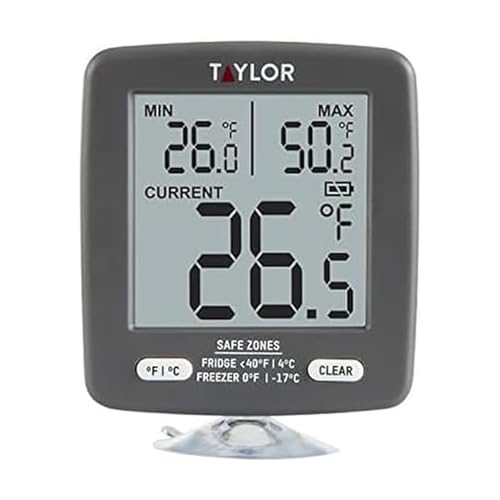
A dial tells you about this moment. This digital Taylor also shows the highest and lowest temperatures it has logged, on a 2-inch LCD with the current reading and the battery level. That memory is the reason to choose it. If the power flickered while you were at work, or someone left the door ajar, the max reading gives you a clue that a dial cannot.
It reads from -4°F to 140°F, which covers a fridge and a home freezer. It mounts with a removable suction cup or a clip, so it can sit on the wall of the fridge or hang off a wire shelf. Safe zones are printed on the body for quick reference.
It runs on one CR2032 coin battery, which is included. The cleaning note is short: hand wash only, and never immerse it in water or put it in the dishwasher. Taylor does not state an accuracy figure, a warranty or NSF status on this listing, so we mark those as not stated. Keep a spare coin cell in a drawer so a dead battery does not leave you guessing.
Why we like it
- Shows current, minimum and maximum temperatures
- 2-inch LCD also shows battery level
- Suction cup or clip mounting
- CR2032 battery included
- Safe zones printed on the body
Key specifications
| Model | 5262798 |
|---|---|
| Type | Digital LCD, 2 in |
| Range | -4°F to 140°F |
| Mounting | Suction cup or clip |
| Power | 1 CR2032, included |
| NSF listed | Not stated |
| Warranty | Not stated |
Why we recommend it
This suits anyone who wants a record, not only a reading. It is the one to pick if your power goes out now and then, or if you keep an older fridge you do not fully trust.
Skip it if you would rather have nothing to maintain. A coin battery will need changing, and a dial never will.
Pros and cons
Pros
- Min/max memory
- Current reading plus history on one screen
- Two mounting options
- Battery included
Cons
- Needs a battery
- Accuracy figure not stated
- NSF status not stated
- Must not be immersed
3. Rubbermaid Commercial Dial Thermometer – Built for Busy Kitchens

Rubbermaid Commercial sells to professional kitchens, and this dial reads that way: stainless steel body, shatterproof lens, no battery. The listing says it was designed for professional kitchens and works for fridges, mini fridges, freezers and coolers. It measures 3.75 by 2.5 by 1.5 inches.
One thing to know about the listing. It prints the range as 20 to 80°F and 30 to 30°C, which is clearly missing its minus signs. Food service retailers list the same model, FGR80DC, at -20°F to 80°F (-30°C to 30°C), and that is the range we show. Without the minus sign it would not read a freezer at all, so do not let the listing confuse you.
The listing says it is NSF certified. It does not state an accuracy figure or a warranty, so we leave those as not stated. It is a good choice for a drinks fridge, a garage fridge or a cooler for a big party, where something may get knocked around.
Why we like it
- Stainless steel body with shatterproof lens
- Sold for professional kitchens
- Works in fridges, freezers and coolers
- NSF certified, according to the listing
- No batteries
Key specifications
| Model | FGR80DC |
|---|---|
| Type | Analog dial |
| Range | -20°F to 80°F (see note above) |
| Mounting | Not stated in the listing |
| Power | None needed |
| NSF listed | Yes |
| Warranty | Not stated |
Why we recommend it
Choose this if the thermometer will live a hard life, such as in a garage fridge, a cooler or a kitchen with a lot of hands in it.
Skip it if you want the largest stated dial. The Taylor is 3 inches across and easy to read from a distance.
Pros and cons
Pros
- Tough construction
- Shatterproof lens
- No batteries
- Compact body
Cons
- Amazon listing misprints the range
- Mounting not stated in the listing
- No min/max memory
- Warranty not stated
4. CDN FG80 Glass Column Thermometer – Wide Range, Long Warranty
CDN sells a broad line of kitchen thermometers, and this is a different format from the dials above: a non-mercuric glass column that reads horizontally, held in place with stainless steel clips. Because it lies along a shelf edge, it can stay out of the way and leave room for pots and containers.
Its range runs from -40°F to 80°F, the lowest reach among the simple thermometers here, shared with the Escali tube. It is NSF certified, according to the listing, and has a five-year warranty, the longest on this page.
There are limits. Clips need a shelf edge or wire to grip, so check your fridge before you buy. A slim column also takes a closer look than a bold dial. There is no accuracy figure on the listing. If your fridge has wire racks and you want something you can fit and forget, it is a neat solution.
Why we like it
- Reads down to -40°F
- Five-year warranty
- Non-mercuric glass column
- Stainless steel clips hold it in place
- NSF certified, according to the listing
Key specifications
| Model | FG80 |
|---|---|
| Type | Glass column, horizontal |
| Range | -40°F to 80°F |
| Mounting | Stainless steel clips |
| Power | None needed |
| NSF listed | Yes |
| Warranty | 5 years |
Why we recommend it
This suits a fridge or freezer with wire shelves, and a cook who would like a thermometer that takes up little space and comes with a long warranty.
Skip it if your shelves leave the clips nothing to grip, or you need to read the temperature quickly from a step back.
Pros and cons
Pros
- Longest warranty here
- Very low range
- Takes little shelf room
- No batteries
Cons
- Clips need something to grip
- Slim column is harder to read
- Accuracy figure not stated

5. Escali AHF2 Tube Thermometer – Sticks to the Fridge Wall
Solid glass shelves leave a clip little to hold. This Escali tube solves that with suction cups, which fix it to an interior wall of the fridge or freezer, or you can hang it on a rack. At 1.25 by 4.75 by 0.75 inches, it suits a crowded fridge.
The range is -40°F to 80°F, and it shows both Fahrenheit and Celsius. Escali marks the ideal fridge and freezer zones and the freezing point, and the display is magnified and shatterproof. That last point counts in a place where you reach past glass jars with cold, wet hands.
Escali says it is NSF certified and gives it a two-year warranty on the product and parts. There is no accuracy figure on the listing, and no memory. Suction cups hold best on a clean, dry wall, so wipe the wall first, and take a look now and then to see that it has stayed in place.
Why we like it
- Suction cups suit fridges with solid shelves
- Magnified, shatterproof display
- Fridge, freezer and freezing-point marks
- Two-year warranty on product and parts
- NSF certified, according to Escali
Key specifications
| Model | AHF2 |
|---|---|
| Type | Tube, magnified |
| Range | -40°F to 80°F |
| Mounting | Suction cups or hanging |
| Power | None needed |
| NSF listed | Yes |
| Warranty | 2 years |
Why we recommend it
This is the pick for a full fridge with glass shelves, where a dial would be hidden behind the milk and a clip would have nothing to grab.
Skip it if you would like a large readout. A tube this slim takes a closer look than a 3-inch dial.
Pros and cons
Pros
- Very slim
- Two mounting options
- Shatterproof display
- No batteries
Cons
- Small readout
- No min/max memory
- Accuracy figure not stated
6. Comark RFT2AK Dial Thermometer – States Its Accuracy

Comark sells commercial-grade thermometers, and this listing does something most others here do not: it gives an accuracy figure, 2°F. That is why it earns a place next to the Taylor and Rubbermaid dials. On a job where the line between fine and too warm is only a few degrees, it helps to know what the listing will commit to.
It has a stainless steel body and bold numbers, with blue, green and red zones. The range is -20°F to 80°F, which covers the 40°F fridge target and the 0°F freezer target with room on either side. The listing marks it as NSF, and the warranty is one year.
The listing is short. It does not say how the thermometer mounts or give a dial size, so check the photos before you buy if you have a specific spot in mind. Keep that 2°F in view, too. If the needle sits at 39°F, your fridge could be at the limit, so we would set it a little colder rather than aim for the line.
Why we like it
- Lists a 2°F accuracy figure
- Bold numbers with blue, green and red zones
- Stainless steel construction
- NSF, according to the listing
- No batteries
Key specifications
| Model | RFT2AK |
|---|---|
| Type | Analog dial |
| Range | -20°F to 80°F |
| Mounting | Not stated |
| Power | None needed |
| NSF listed | Yes |
| Warranty | 1 year |
Why we recommend it
Pick this if you like to see a stated accuracy before you buy, and you want a simple dial from a company that sells commercial thermometers.
Skip it if you need to know the mounting before you order. The listing does not state it, and the dial size is missing too.
Pros and cons
Pros
- Accuracy is stated
- Clear color zones
- No batteries
- NSF
Cons
- Thin listing details
- Mounting not stated
- No min/max memory

7. AcuRite 00515M Wireless Thermometer – Reads Both Without Opening
Every time you open the door to check a thermometer, you let the cold out. This AcuRite set puts one sensor in the fridge and one in the freezer, and both report to a single LCD display outside. It comes with a magnetic back, a keyhole and a foldout stand, so the display can sit on the fridge door, a wall or the counter.
You can set high and low alarms, which helps you catch a door left open or a failing appliance. AcuRite’s support pages give the sensors a range of -40°F to 99°F at ±2°F, with a wireless reach of 75 feet and updates every 60 seconds. They also say the alarm sounds only after the reading has been out of range for more than five minutes, so a quick look for the salsa should not set it off.
You will need batteries: three AA for the display and four AA across the two sensors, and AcuRite advises lithium below -4°F. The listing gives it a one-year warranty. It has no phone alerts, so the alarm only helps if someone is home to hear it. We list the white version of this set, the 00523M, on our best freezer alarm page; this is the stainless listing, for buyers who want the display to sit well beside a steel fridge.
Why we like it
- Reads fridge and freezer on one display
- Adjustable high and low alarms
- Alarm waits five minutes, says AcuRite
- ±2°F accuracy, according to AcuRite
- Magnet, keyhole or foldout stand for the display
Key specifications
| Model | 00515M |
|---|---|
| Type | Wireless LCD, 2 sensors |
| Range | -40°F to 99°F |
| Mounting | Straps with suction cups; display magnet, keyhole or stand |
| Power | 7 AA total (display 3, sensors 4) |
| NSF listed | Not stated |
| Warranty | 1 year |
Why we recommend it
This is for the home with a full freezer to protect, or for anyone who wants to read both temperatures at a glance without opening a door.
Skip it if you are away a lot. A sound on a counter will not reach you, so you need an alarm that works through an app.
Pros and cons
Pros
- No need to open the door
- Covers fridge and freezer
- Adjustable alarms
- Display mounts three ways
Cons
- Seven batteries to look after
- Lithium advised for very cold freezers
- No phone alerts
- Owner reports on the brand are mixed
How to choose a fridge thermometer for your kitchen
This is a simple tool, so only a few things decide whether you will actually use it. These are the ones that count.
Dial, tube or digital
A dial is easy to read and needs no battery. A tube or column takes up less room. A digital model adds a memory of the highest and lowest temperatures, which a dial cannot do, but it needs batteries. For a family fridge, a dial is often enough. For a freezer holding a lot of food, memory is worth having.
Your shelves decide the mounting
Look inside your fridge before you order. Wire racks take clips and hooks. Solid glass shelves call for a thermometer that stands or sticks on with a suction cup. Put it where you can see it without moving half the shelf, or you will stop looking.
Range and the numbers that count
A fridge alone needs little range, but a freezer thermometer has to read below 0°F. All seven here do. Look for clear marks around 40°F and 0°F. Printed zones vary by maker, so read the number and not only the color.

Compare it with one you trust
Most listings here do not state an accuracy figure, so a home check is useful. Read the instructions first, because some models, including the digital Taylor, must not go in water. If yours can, ice water should read close to 32°F. If it cannot, set it next to a thermometer you trust on the same shelf and compare the two after a few hours. If it is well off, use the warranty.
Where to put it and how often to look
We would skip the door, which swings into room air every time it opens. USDA’s appliance thermometer guidance describes a check in the middle of the fridge: leave the thermometer in a glass of water for 5 to 8 hours, and adjust the control if it does not read 38 to 40°F. Then follow the FDA’s advice to check at least once a week.
How we picked these fridge thermometers
We read the Amazon listing for each thermometer and confirmed it was in stock when we wrote this. We kept to established thermometer and food service brands. We passed on low-cost multi-packs from sellers we could not identify, because you are relying on this tool to tell you whether food is safe. We also left out Wi-Fi models, because our freezer alarm guide covers them and we found no independent review of the ones we looked at. We looked for NSF status, a stated range and a stated warranty.
We searched for independent reviews and found few we could read in full. America’s Test Kitchen has a review of fridge and freezer thermometers, but we could not read its results. ThermoWorks says its RT8100 is a winner there, and we did not find that model on Amazon. Consumer Reports’ results were also closed to us. The roundups we could read did not explain their methods well enough for us to rely on them, so these picks rest mainly on maker and listing details. We have not put these thermometers through any trials ourselves.
Fridge thermometer questions, answered
What temperature should a fridge be?
The FDA says 40°F or below, and 0°F for the freezer. We aim a little under 40°F, so a thermometer’s margin of error does not carry the fridge over the line.
Where is the best place for a thermometer in the fridge?
Put it in the middle of a shelf, away from the door. USDA’s check also uses the middle of the fridge.
Can a freezer thermometer work in the fridge?
Yes, if its range covers both. All seven on this page read above 40°F and below 0°F, so each can do either job. The FDA does suggest one for each.
Is a digital thermometer better than a dial?
It is not automatically more accurate. Its advantage is memory, which shows you the highest temperature while you were away. A dial’s advantage is that it needs no battery.
What should I do after a power outage?
Keep the doors closed as much as you can, and check the thermometer before you eat anything. The FDA says frozen food that still has ice crystals can be refrozen or cooked. If you are not sure how long food has been warm, throw it out.
Do I need one if my fridge has a digital display?
We would still add one. The FDA calls appliance thermometers the best way of knowing these temperatures, and a separate one gives you a reading to set against the built-in display.
Our final word on a colder fridge
Buy the simple dial unless you have a reason not to, put it in the middle of a shelf, and look at it once a week. If you want an alert on your phone, read our best freezer alarm guide. To check heat as well as cold, see our best oven thermometer and best meat thermometer guides. For tidier shelves, our fridge organizers page can help, and our guide on how to reheat Mexican leftovers covers what comes back out. If you would rather leave the cooking to us, call Julia’s to order at (346) 546-8283.