
A gravity water filter is two tanks and a few filter elements: you pour tap water into the top, it drips through, and filtered water collects in the bottom chamber behind a spigot. No plumbing, no outlet, no water pressure. That makes it a good fit for renters, for a kitchen that wants a few gallons of filtered water ready for coffee and aguas frescas, and for anyone who wants filtered water during a power cut.
It is also the corner of the water-filter market where marketing runs furthest ahead of certification. This guide compares seven gravity systems and, for each, says plainly whether the filter is certified to an NSF/ANSI standard by a named certifier, or only “tested” by a laboratory the maker hired.
Julia’s earns a commission on purchases made through links on this page, at no cost to you. Recommendations are based on what a restaurant kitchen looks for, product specifications and verified buyer reports.
Quick verdict: which gravity filter to buy
The best gravity water filter for most kitchens is the Culligan MaxClear Scout, 2.25 Gallon: a stainless two-tank system whose filter Culligan says is certified by IAPMO R&T to NSF/ANSI 42, 53 and 401, including lead and total PFAS. If long filter ratings matter more, the Waterdrop King Tank TK-FS holds the same 2.25 gallons with carbon filters rated to 6,000 gallons a pair, but its stated certifications cover chlorine, taste and odor and the lead content of its own materials, not lead in your water.
Five gravity filters at a glance
Our five standout picks, one for each kind of kitchen, with the capacity, certification status and filter material each maker or listing states. All seven are reviewed in full below.
| Gravity filter | Capacity | Certification | Filter type | Buy on Amazon |
|---|---|---|---|---|
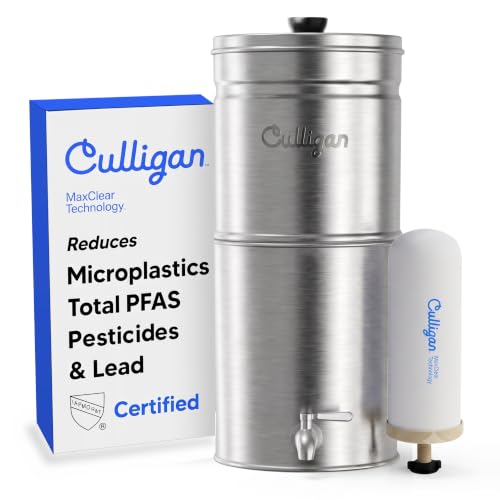
Culligan MaxClear Scout, 2.25 GallonBest overall
|
2.25 gal | IAPMO: NSF/ANSI 42, 53, 401 | Ceramic + carbon | View on Amazon |

Waterdrop King Tank TK-FS, 2.25 GallonLongest filter life
|
2.25 gal | NSF/ANSI 42 and 372 per listing | Carbon + fluoride | View on Amazon |
| 2.25 gal | NSF: 42, 53, 401 (per Doulton) | Ceramic candles | View on Amazon | |

LifeStraw Home 35-Cup DispenserBest plastic dispenser
|
35 cups | Tested to NSF standards | Membrane + carbon | View on Amazon |

Santevia Gravity Water SystemBest for added minerals
|
10 L (2.6 gal) | None stated for system | Ceramic + mineral stages | View on Amazon |
Product images from Amazon. Capacities and certifications are as stated by each maker or listing; check the maker’s performance data sheet before you buy.
Our picks for the best gravity water filter
Our countertop water filter guide already covers one gravity system, the Waterdrop King Tank, alongside plug-in RO units and dispensers. This page goes deeper on gravity alone and does not repeat that pick or the dispensers on our pitcher pages. Where a filter is only “tested” rather than certified, we say so in the text and in the specifications.
1. Culligan MaxClear Scout, 2.25 Gallon – Certified Lead and PFAS Reduction
The MaxClear Scout (MCS701B) is the classic two-chamber stainless design, a 2.25-gallon upper tank nesting inside a lower one, with a spigot and a stand. What sets it apart is the paperwork. Culligan’s performance data sheet says IAPMO R&T certifies the MaxClear systems to NSF/ANSI 42, 53 and 401, and to NSF/ANSI 372 for low-lead materials.
The claims under those standards, per Culligan’s Scout page, include chlorine and chloramine (42), lead and total PFAS (53), and microplastics plus several pharmaceuticals and pesticides (401). That is a broader certified list than most gravity filters carry. One caution from the same page: a comparison table there uses data for Boroux and Berkey filters, so read Culligan’s own “certified to reduce” table, not the comparison.
The Scout ships with one ceramic-and-carbon MaxClear filter and takes two; a second filter speeds up the drip. Culligan rates each filter for up to six months. The tanks nest to under 12 inches for storage, according to the listing, which makes the Scout easy to put away between hurricane seasons.
Why we like it
- Certifier named: IAPMO R&T (Culligan data sheet)
- Certified for lead and total PFAS under NSF/ANSI 53
- Microplastics claim certified under NSF/ANSI 401
- Nests under 12 inches for storage (listing)
Key specifications
| Model | Culligan MaxClear Scout MCS701B |
|---|---|
| Capacity | 2.25 gallons |
| Filters included | 1 MaxClear ceramic + carbon (holds 2) |
| Certifications | NSF/ANSI 42, 53, 401, 372 by IAPMO R&T (Culligan) |
| Rated filter life | Up to 6 months per filter |
| Material | Brushed stainless steel |
| Size | Nests under 12 in; 3.95 lb (Culligan) |
| Warranty | Not stated |
Why we recommend it
It suits a household that wants a gravity filter with a named certifier and a lead and PFAS claim it can check.
Skip it if you want the fastest drip from day one; it ships with one filter and needs a second for full speed.
Pros and cons
Pros
- Broad certified claim list
- Stainless tanks and spigot stand
- Fits Berkey-style elements, per the listing
Cons
- Only one filter in the box
- Warranty terms not stated on the pages we read
- Six-month filter life is shorter than Berkey’s rating
2. Waterdrop King Tank TK-FS, 2.25 Gallon – Thousands of Gallons per Pair
Waterdrop’s King Tank is a 304 stainless two-chamber tower holding 2.25 gallons, sold with a stand and a metal sight-glass spigot that shows the water level. Waterdrop sizes it for a family of four. The listing title says eight filters, while its text describes two carbon filters and two fluoride filters as the working set, so count what arrives.
Waterdrop rates the two carbon filters at up to 6,000 gallons and the two fluoride filters at up to 1,000 gallons. Those are as long as any rating on this page, and they are the main reason to pick it. The listing says the system does not lower TDS.
Be clear about the certification, though. The listing says the system is certified to NSF/ANSI 372 and the black carbon filter to NSF/ANSI 42 for chlorine, taste and odor, and it names no certifier. NSF/ANSI 372 covers the lead content of the product’s own materials, not lead in your water. The title also says it reduces lead, but the certified claims above do not cover that, and the heavy-metal wording rests on a third-party laboratory test. If certified lead or PFAS reduction is your reason for buying, the Culligan or Doulton picks fit better.
Why we like it
- 6,000-gallon rating for the two carbon filters (listing)
- 304 stainless steel housing
- Stand and sight-glass spigot included
- Two fluoride filters as well
Key specifications
| Model | Waterdrop TK-FS |
|---|---|
| Capacity | 2.25 gallons |
| Filters included | Carbon and fluoride; see listing for count |
| Certifications | NSF/ANSI 42 (carbon) and 372 per listing; certifier not named |
| Rated filter life | 6,000 gal carbon pair; 1,000 gal fluoride pair |
| Material | 304 stainless steel |
| Size | Not stated |
| Warranty | Not stated in listing |
Why we recommend it
It suits a family that wants a big batch of filtered water and long filter ratings, and accepts that the certified claims stop at chlorine, taste and odor.
Skip it if you need certification to NSF/ANSI 53 for lead or PFAS.
Pros and cons
Pros
- Very long rated filter life
- Fluoride filters included
- Sight-glass spigot and stand
Cons
- No NSF/ANSI 53 certification named
- Certifier not named
- Filter count unclear on the listing
3. British Berkefeld Doulton Stainless Gravity System – Ceramic Candles, Certified by NSF

Doulton has made ceramic water filters in Britain for a very long time, and this stainless countertop system (W9361139) is its gravity unit under the British Berkefeld name. The listing says it holds 2.25 gallons, comes with four Ultra Sterasyl ceramic candles and is made in the UK.
On certification, Doulton states that the Ultra Sterasyl candle is tested and certified by NSF International to NSF/ANSI 42, 53 and 401. Its published test data covers lead, cysts and microplastics. NSF is the certifier here, by Doulton’s account, which puts this filter in a different class from “laboratory tested” claims. Check the exact certified reductions on the NSF listing for the candle before you rely on a particular one.
Ceramic candles can be scrubbed to restore flow, and Doulton advises replacing the Ultra Sterasyl about every six months. This listing is the four-candle version, so budget for four replacements at a time.
Why we like it
- Certifier named: NSF International (Doulton)
- Ceramic candles with published test data
- Stainless steel, made in Britain (listing)
- 2.25 gallons and four candles, per the listing
Key specifications
| Model | British Berkefeld Doulton W9361139 |
|---|---|
| Capacity | 2.25 gallons, 8.5 L (listing) |
| Filters included | 4 Ultra Sterasyl ceramic candles |
| Certifications | NSF/ANSI 42, 53, 401 by NSF (Doulton, for the candle) |
| Rated filter life | Replace about every 6 months (Doulton) |
| Material | Stainless steel |
| Size | Not stated |
| Warranty | Not stated |
Why we recommend it
It suits a household that wants ceramic candles with an NSF certification behind them.
Skip it if you want dimensions confirmed on the listing itself; it gives none.
Pros and cons
Pros
- NSF certification stated by the maker
- Cleanable ceramic candles
- Long-established maker
Cons
- Sold by a third-party seller, Lehman’s
- Listing gives no dimensions
- Six-month replacement for four candles

4. LifeStraw Home 35-Cup Dispenser – A Membrane That Stops Bacteria
Not every gravity filter needs a steel tower. The LifeStraw Home 35-cup dispenser is a BPA-free plastic tank with a spigot that sits on the counter or in a fridge, and it filters by gravity in two stages: a membrane microfilter and an activated carbon plus ion exchange filter.
The membrane is the difference. LifeStraw says it removes bacteria, parasites and microplastics, which carbon-only gravity filters do not claim. The carbon stage targets lead, mercury, PFAS, chlorine and other chemicals. LifeStraw says the system was independently tested by outside laboratories to meet NSF 42, 53, 401 and P473 and the EPA and NSF P231 protocols for bacteria and parasites. That is tested-to, not a certification listing: we did not find a certifier named for this dispenser.
The membrane lasts 264 gallons or about a year, and the carbon filter 40 gallons or about two months, per the listing. Budget for the carbon filter; at 40 gallons it is the part you will buy most.
Why we like it
- Membrane stage for bacteria and parasites (LifeStraw)
- Carbon and ion exchange for lead and PFAS claims
- Large 35-cup tank
- Lighter and smaller than steel towers
Key specifications
| Model | LifeStraw Home LSHXLDWH41 |
|---|---|
| Capacity | 35 cups |
| Filters included | Membrane microfilter + carbon/ion exchange |
| Certifications | Tested to NSF 42, 53, 401, P473, P231 (LifeStraw); certifier not named |
| Rated filter life | Membrane 264 gal; carbon 40 gal |
| Material | BPA-free plastic |
| Size | Not stated |
| Warranty | Not stated |
Why we recommend it
It suits a kitchen that wants a membrane stage against bacteria without a tall steel system.
Skip it if you want a certification listing rather than test claims.
Pros and cons
Pros
- Two-stage filtration with a membrane
- Keeps minerals like magnesium, per LifeStraw
- Fits a fridge shelf more easily than steel
Cons
- Carbon filter lasts only 40 gallons
- Tested, not certified, by its own description
- Plastic, not steel
5. Santevia Gravity Water System – Ceramic Prefilter, Minerals Added
Santevia’s countertop model (9GS-101) is a stacked plastic gravity system holding 10 liters, about 2.6 gallons. Water passes a ceramic prefilter, then a filter that Santevia says reduces chlorine, fluoride and lead, then mineral stones that add calcium, magnesium and potassium and raise the pH.
That last step is the reason to buy it: people who find filtered water flat sometimes prefer the taste of water with minerals back in. The listing makes health claims for alkaline water; we do not repeat them, because no authority we cite backs them.
The listing names no NSF/ANSI certification for the system, and we did not find one. Treat the lead and fluoride claims as Santevia’s own. The listing’s warranty field gives a 30-day money-back guarantee. Santevia sells the prefilter, filter and mineral stones separately, so the system can be kept running part by part.
Why we like it
- Large 10-liter capacity
- Adds minerals back after filtering (Santevia)
- Replacement parts sold separately
- No power or plumbing
Key specifications
| Model | Santevia 9GS-101 |
|---|---|
| Capacity | 10 L (2.6 gal) |
| Filters included | Ceramic prefilter, chlorine/fluoride filter, mineral stones |
| Certifications | None stated for the system |
| Rated filter life | Not stated in listing |
| Material | BPA-free plastic |
| Size | Not stated |
| Warranty | 30-day money-back guarantee (listing) |
Why we recommend it
It suits someone who wants filtered water with minerals added back for taste.
Skip it if certification matters to you; none is stated for this system.
Pros and cons
Pros
- Big tank
- Mineral stage for taste
- Parts sold individually
Cons
- No system certification stated
- Filter life not stated in the listing
- Health claims in the listing go beyond the evidence
6. Purewell 6-Stage Gravity System, 2.25 Gallon – Water-Level Window

Purewell’s SF-2.25G is a stainless two-tank system with one practical extra: a clear window in the lower chamber so you can see how much filtered water is left without lifting the top tank. Its six-stage filter combines a mesh prefilter, PP cotton, activated carbon, KDF and silver ions, per the listing.
On certification the listing makes two claims. It says the system is IAPMO certified to reduce total PFAS, lead, chlorine and mercury, and that the filter is NSF/ANSI 42 certified, without naming who certified it. We could not find an IAPMO listing tied to this exact model, so treat both as the listing’s statements and ask Purewell for the certificate if they decide your purchase.
Purewell rates the filter at 3,000 gallons and recommends replacing it every six months. The listing says it does not lower TDS, and that its filter also fits ZeroWater pitchers and dispensers. It also warns not to add water to the top tank when the bottom one is full, or it can overflow.
Why we like it
- Window shows the filtered water level
- 3,000-gallon filter rating (listing)
- Stainless steel tanks
- Lead and PFAS claims stated in the listing
Key specifications
| Model | Purewell SF-2.25G |
|---|---|
| Capacity | 2.25 gallons |
| Filters included | 6-stage filter (count not stated) |
| Certifications | IAPMO (system) and NSF/ANSI 42 (filter) per listing; not verified |
| Rated filter life | 3,000 gal or 6 months |
| Material | Stainless steel, PC window |
| Size | Not stated |
| Warranty | Not stated |
Why we recommend it
It suits someone who wants a steel gravity system and likes seeing the water level at a glance.
Skip it if you want a certification you can look up by model number.
Pros and cons
Pros
- Level window
- Long filter rating
- Uses ZeroWater filters too, per the listing
Cons
- Certifier for the filter not named
- Can overflow if the top is refilled too soon
- Does not lower TDS
7. Travel Berkey, 1.5 Gallon – Small Enough for One or Two

The Travel Berkey (BT2X2-BB) is the smallest system in the Berkey line: a stainless two-chamber filter holding 5.6 liters, about 1.5 gallons, with two Black Berkey elements. It suits a one- or two-person household, a small apartment counter, or an RV.
One thing to know: since December 2022 the EPA has issued stop-sale orders against Berkey filter sellers, on the view that the silver in Black Berkey elements makes them pesticide devices that need registration. Berkey disputes this and has challenged the orders in court (per Berkey’s own support site). The orders concern registration, not a finding that the filters are unsafe, but they have made supply patchy; buy from the listing linked here or Berkey directly rather than an unknown reseller.
Be clear about the certification too. Berkey describes the elements as validated by more than 200 tests in the United States, but names no NSF/ANSI certification for the element. Berkey rates a pair of Black Berkey elements at up to 6,000 gallons on its Big Berkey listing; this listing does not repeat that figure.
We include a Berkey because it is the design many people picture when they hear “gravity filter,” and because the larger Big Berkey was not available when we last checked. The Travel Berkey listing gives no dimensions, so measure against the maker’s figures before you buy.
Why we like it
- Small 5.6-liter stainless system
- Same Black Berkey elements as the bigger models
- No power or plumbing
- Portable for RV and travel use, per Berkey
Key specifications
| Model | Travel Berkey BT2X2-BB |
|---|---|
| Capacity | 5.6 L (about 1.5 gal) |
| Filters included | 2 Black Berkey elements |
| Certifications | None named; laboratory tests only |
| Rated filter life | Not stated in this listing |
| Material | Stainless steel |
| Size | Not stated |
| Warranty | Not stated |
Why we recommend it
It suits one or two people who want the Berkey design in a small tower.
Skip it if you need certified reductions or more than a gallon and a half at a time.
Pros and cons
Pros
- Compact steel system
- Long-life elements
- Easy to move
Cons
- No certification named
- Small batch
- Sparse listing details
Certified, tested or neither: reading a gravity filter’s claims
Gravity filters are sold with long lists of contaminants, and the words around those lists matter more than the lists themselves. “Certified to NSF/ANSI 53 by IAPMO R&T” or “by NSF” means an accredited certifier checked the product against the standard and keeps checking it. “Tested to NSF standards” or “tested by an independent laboratory” means the maker paid for a test; the results may be good, but no certifier stands behind the claim.
The standards cover different things. NSF/ANSI 42 is for chlorine, taste and odor. NSF/ANSI 53 covers health-related contaminants such as lead and, in newer versions, PFAS. NSF/ANSI 401 covers trace compounds such as some pharmaceuticals and microplastics. NSF P473 was a protocol for PFOA and PFOS. NSF/ANSI 372 covers only the lead content of the product’s own materials, not what the filter removes. Of the seven systems here, only the Culligan and Doulton picks name an outside certifier for reductions.

How to choose a gravity water filter
1. The certifier, not the contaminant count
Look for the standard number and the certifier’s name together, then check the certifier’s own listing. A list of 200 contaminants “tested” is not the same as one certified lead claim.
2. Capacity against your household
A 2.25-gallon tank covers a family’s drinking and cooking water for a day; 1.5 gallons suits one or two people. A gravity filter drips slowly, so a bigger top tank saves refills more than it saves time.
3. Height and counter space
Steel towers are tall, and not every listing gives a height; a big two-chamber tower may not fit under wall cabinets. Measure before you buy.
4. Filter cost over a year
Element ratings run from 40 gallons (LifeStraw’s carbon filter) to 6,000 gallons per pair (Waterdrop’s carbon filters and Black Berkey). A short-lived filter is not a bad filter, but count on buying it often.
5. What you want left in the water
Carbon and ceramic filters leave minerals in; ion exchange takes many out. Santevia adds minerals back on purpose. Pick the taste you prefer for drinking water and coffee.
How we picked these seven gravity filters
We did not test these filters. We read each Amazon listing through Amazon’s product data, the makers’ pages and data sheets from Culligan, Doulton and LifeStraw, and reported each certification only as those documents state it, with the certifier when one is named. We checked that every pick was in stock on Amazon when we wrote this. We searched the Consumer Product Safety Commission’s site for recalls of these brands’ gravity filters and found none. We left out the Waterdrop King Tank (already on our countertop page), Alexapure and ProOne (only replacement elements came up on Amazon), and anonymous Amazon-only brands. We make no health claims: what a filter reduces is what its certification covers.
For the Berkey stop-sale background we relied on Berkey’s own January 2024 update on its dispute with the EPA; we found no later ruling, so check the current status before you buy.
Gravity filter questions, answered
What is the best gravity water filter?
For certified reductions with a named certifier, the Culligan MaxClear Scout. For long filter life, the Waterdrop King Tank TK-FS, with the caveat that its stated certifications do not cover lead or PFAS reduction.
Are Berkey filters NSF certified?
The Black Berkey elements in the Travel Berkey are sold with third-party laboratory test results, and the listing names no NSF/ANSI certification. Check the certifier’s database for any element you buy.
Do gravity filters remove bacteria?
Only some claim to. The LifeStraw Home’s membrane stage is designed for bacteria and parasites, and Doulton publishes cyst and bacteria test data for its ceramic. Carbon-only filters generally make no bacteria claim. For water that may be unsafe after a storm, follow your local boil-water notice.
How long does a gravity filter take to fill?
It depends on the number of elements and your water. Adding a second element, where the system takes one, speeds the drip, per Culligan and Berkey.
Do gravity filters need electricity?
No. Gravity does the work, which is why many people keep one for power cuts.
Our gravity pick for a home kitchen
Buy the Culligan MaxClear Scout if you want a gravity filter whose claims you can check against a certifier. Choose the Waterdrop King Tank for long filter life, the Doulton for NSF-certified ceramic, and the LifeStraw Home if you want a membrane stage in a plastic dispenser. For other ways to filter at home, see our countertop water filter picks, our water filter pitcher guide and our under-sink water filter picks.
Filtered water goes into almost every agua fresca. For ours, see our menu, or call to order.