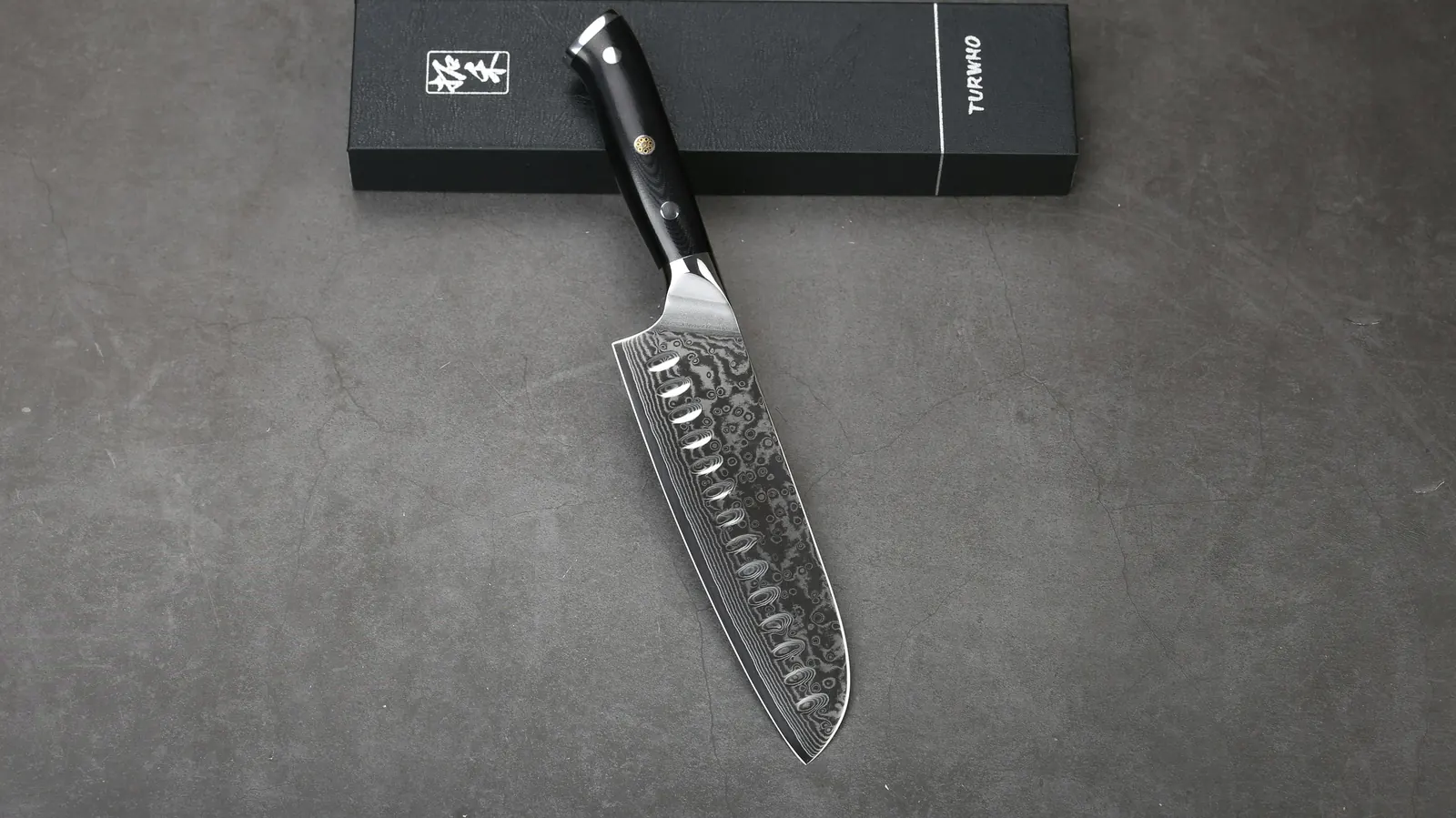
Stand at any prep station and you will see two knife shapes doing most of the work: the long, curved Western chef’s knife and the shorter, flatter Japanese santoku. Both dice onions for salsa, mince cilantro and garlic, slice chiles and trim chicken. The difference is in how they move, how much blade you get, and how they feel in the hand.
This guide compares the two on blade shape, cutting motion, length, height, tip, weight and the hollow-edge question, then names two picks on each side: one German and one Japanese santoku, and one German and one Japanese chef’s knife. Each difference is sourced to a knife maker or a named review.
Julia’s earns a commission on purchases made through links on this page, at no cost to you. Recommendations are based on what a restaurant kitchen looks for, product specifications and verified buyer reports.
Quick verdict: santoku or chef’s knife?
If you are buying one knife for everything, most home cooks are better served by an 8-inch chef’s knife: the longer, curved blade rocks through herbs, gives more leverage on squash and roasts, and its pointed tip handles fine work. Choose a santoku if you prefer a straight up-and-down chop, cook mostly vegetables, work on a small board or want a shorter, lighter knife that feels more controlled. America’s Test Kitchen calls the choice personal and suggests adding a santoku to a chef’s knife rather than replacing it.
The table sums up the differences. The sections after it explain each one and say where it comes from.
Santoku vs chef knife, side by side
| Santoku | Chef’s knife | |
|---|---|---|
| Blade length | Usually 5 to 7 inches (ATK); 14 to 18 cm (Zwilling) | Usually 8 to 10 inches (ATK); 16 to 26 cm (Zwilling) |
| Edge profile | Flatter, straighter edge | Curved belly, tapered toward the tip |
| Cutting motion | Straight up-and-down chop or push cut | Rocking motion; also chops and slices |
| Tip | Shorter, rounded tip | More pointed, tapered tip |
| Blade height | Tall, like a small cleaver | Tall at the heel, narrowing to the point |
| Weight | Typically a bit lighter (ATK) | Typically a bit heavier |
| Hollow edge | Available on many (Victorinox) | Available on some |
| Best at | Vegetables, fish, boneless meat, everyday prep | All-round prep, herbs, large produce, roasts |
Blade shape and cutting motion
This is the difference that matters most. Victorinox, which makes both, puts it simply: a santoku has a flatter cutting edge suited to straight chopping, while a chef’s knife has a curved blade designed for a rocking motion. America’s Test Kitchen describes the same thing in its comparison of the two, noting that santokus typically have a straighter bottom edge than the curved blade of a chef’s knife.
In practice, the curve lets a chef’s knife pivot on its belly while you keep the tip on the board and pump the handle up and down, which is the fast way to mince a big pile of cilantro or parsley. A santoku’s flat edge meets the board along its whole length at once, so it suits a straight down-and-forward push, the motion many cooks use to slice a cucumber or dice an onion into even pieces. General kitchen sense: neither motion is wrong, and good cooks use both, but the knife shape makes one of them easier.
The line is blurring. ATK notes that some newer santokus have more rounded bottom edges that allow a full rocking motion, and Zwilling describes a rocking santoku with a slightly upturned cutting edge. If you like the santoku’s size but rock-chop out of habit, look for one of those.
Length and leverage
ATK gives the usual ranges as 8 to 10 inches for a chef’s knife and 5 to 7 inches for a santoku. Zwilling’s knife guide gives 16 to 26 centimeters for a chef’s knife and 14 to 18 centimeters for a santoku, and calls the santoku quite compact. Victorinox says most santokus have a blade of around 17 centimeters, about 6¾ inches.
Length decides what the knife can cut in one stroke. Victorinox notes that for larger items, such as pumpkins or roast meat, a chef’s knife with a longer blade may offer more leverage. That covers a whole butternut squash, a cabbage for curtido, a watermelon or slicing a pork shoulder after it has come out of the oven. In the other direction, ATK writes that the shorter blade of a santoku can make users feel more in control, and the shorter knife fits a small cutting board or a crowded counter better.
Height, tip and weight
A santoku is a tall knife for its length. Zwilling describes a particularly high blade with the back flattening toward the tip, and ATK’s santoku review traces the shape to the vegetable cleaver, keeping its height and straight edge. That height gives your knuckles room above the board and makes the flat of the blade handy for scooping chopped onions into a pan. General kitchen sense: a tall blade also guides the knife straight down, which helps beginners cut even slices.
The tip is the santoku’s weak spot. ATK notes that a chef’s knife usually has a more pointed, tapered tip, while a santoku has a shorter, more rounded one. In its santoku review, ATK’s testers found that the turned-down tip puts more metal behind the point, and preferred santokus whose tips worked more like a chef’s knife. For scoring, trimming silver skin or seeding a jalapeño with the point, a chef’s knife is easier.
On weight, ATK’s comparison says a santoku is typically, but not always, a bit lighter than a chef’s knife, and that the lighter weight can make it feel more agile. General kitchen sense: construction matters as much as shape, and a thick forged German knife of either type will usually feel heavier than a thin Japanese one.
Hollow edges: do the dimples help?
Many santokus, including both picked below, have a row of scallops ground into the side of the blade, called a hollow or granton edge. Victorinox says the small indentations create air pockets that can help reduce sticking, and Zwilling says they help food slip off the blade. ATK’s santoku review is less convinced: it noticed no less sticking with the seven granton-edge blades in its lineup, and two of its top three performers lacked the feature. Treat the dimples as a small bonus, not a reason to choose one knife over another.
Which tasks suit which knife
The honest answer is that both do almost everything. ATK’s comparison says the two knives tackle almost all of the same tasks, from slicing piles of onions to mincing garlic, and its santoku review calls the choice really a personal one. Victorinox lists slicing, dicing and chopping, fish, boneless meat and everyday prep for the santoku, whose name it translates as three virtues, and describes the santoku as well suited to less experienced cooks.
In a Mexican home kitchen, a santoku is pleasant for the daily round of onions, tomatoes, chiles and avocado for pico de gallo and guacamole. A chef’s knife earns its place when the job is bigger: a pile of cilantro, a whole squash, a brisket or a pork shoulder for carnitas. If you already own a chef’s knife, ATK’s advice is to add a santoku as a second knife rather than replace the first.
Choose a santoku if… / Choose a chef’s knife if…
Choose a santoku if…
- You chop with a straight up-and-down or push motion.
- You cook mostly vegetables, fish and boneless meat.
- You want a shorter, lighter knife that feels easy to control.
- You work on a small board or have smaller hands.
Choose a chef’s knife if…
- You want one knife for everything, large jobs included.
- You rock-chop herbs and garlic.
- You need a pointed tip for detail work.
- You cut squash, cabbages or roasts and want the extra length.
Our picks on each side of the santoku vs chef knife question
Each side has a German knife, sturdy and easy to hone, and a Japanese knife, harder and thinner at the edge. All four were in stock as new when we checked. None of these four models appears on our other knife pages, though our best santoku knife and best chef knife guides cover other knives from the same makers.
1. ZWILLING Twin Signature 7-Inch Santoku – German Steel, Japanese Shape

Zwilling’s Twin Signature santoku brings German steel to the Japanese shape. The listing says it is made in a company-owned factory in Solingen, Germany, from Zwilling’s specially formulated German stainless steel, ice-hardened by the maker’s FRIODUR process to 57 Rockwell. This 7-inch santoku has a hollow edge.
The listing gives the edge angle as 15 degrees per side, the same as the Four Star chef’s knife below, so this pair differs in shape rather than in steel or sharpening. That makes it a good choice if you want to try a santoku alongside a German chef’s knife: the steel behaves the same way on a honing rod, and only the profile changes. The listing describes the knife as ergonomically shaped for comfort but does not say how the blade is made or what it weighs.
The listing title calls it dishwasher safe. General kitchen sense says to hand wash and dry any good knife, which protects the edge and handle. The listing gives a lifetime warranty against manufacturer’s defects.
Why we like it
- Hollow edge on a 7-inch santoku blade (listing)
- 15-degree edge per side, ice-hardened steel (listing)
- Made in Solingen, Germany (listing)
- Lifetime warranty against defects (listing)
Key specifications
| Model | 30749-183 |
|---|---|
| Blade length | 7 inches |
| Edge style | Hollow edge |
| Steel | German stainless steel, FRIODUR |
| Hardness | 57 Rockwell |
| Edge angle | 15 degrees per side |
| Handle | Not stated |
| Made in | Solingen, Germany |
Why we recommend it
It suits a cook who wants a santoku with tough, easy-to-hone German steel, from a maker with a long track record, as a first santoku or a partner to a chef’s knife.
Skip it if you want a thinner, harder Japanese edge; the Shun below is that option.
Pros and cons
Pros
- Forgiving German steel
- Sold by Amazon when we checked
- Lifetime warranty
Cons
- Handle material and weight not in the listing
- Softer steel needs regular honing
- Rounded tip, like most santokus
2. Shun Kanso 7-Inch Santoku – Simple Japanese Workhorse

Shun names its Kanso line after a design principle meaning simplicity, and it shows: a plain working blade and a wooden handle. The listing describes this 7-inch santoku as made from AUS10A high-carbon stainless steel refined with vanadium, sharpened to a 16-degree edge, with hollow-ground indentations for food release.
The handle is contoured tagayasan, a dense wood the listing calls iron sword wood, with a full tang and a shape it says suits both left- and right-handed cooks. The butt of the handle doubles as a bottle opener and hanging hook. Shun says each knife is handcrafted in Japan and comes with free sharpening and honing.
The listing pitches it for slicing vegetables, proteins and fruit, which is exactly the santoku’s job. It does not state weight, hardness or a warranty term, so we have marked those as not stated.
Why we like it
- AUS10A steel with a 16-degree edge (listing)
- Full-tang tagayasan wood handle (listing)
- Handcrafted in Japan (listing)
- Free sharpening and honing from Shun (listing)
Key specifications
| Model | SWT0718 |
|---|---|
| Blade length | 7 inches |
| Edge style | Hollow ground |
| Steel | AUS10A high-carbon stainless |
| Hardness | Not stated |
| Edge angle | 16 degrees |
| Handle | Tagayasan wood, full tang |
| Made in | Japan |
Why we recommend it
It suits a cook who wants a Japanese santoku for daily vegetable prep from an established maker, without paying for decorative steel.
Skip it if you want a dishwasher-tolerant, low-care knife; Japanese steel and a wood handle need hand washing and drying.
Pros and cons
Pros
- Plain, practical design
- Free sharpening service
- Sold by Amazon when we checked
Cons
- Hand wash only
- Hardness and weight not in the listing
- Rounded tip, like most santokus
3. ZWILLING Four Star 8-Inch Chef’s Knife – German All-Rounder

The Four Star 8-inch is a forged Zwilling chef’s knife with a polymer handle. The listing says it is made in Germany from the maker’s high-carbon NO STAIN steel, precision-forged from a single piece of solid steel and ice-hardened by the FRIODUR process, with a hardness of 57 Rockwell.
Zwilling gives the edge angle as 15 degrees per side, a sturdy edge that suits the jobs a chef’s knife gets that a santoku doesn’t: splitting a butternut squash, cutting through a cabbage, slicing a roast. At 8 inches it sits at the short end of ATK’s 8-to-10-inch range, long enough for leverage but still easy to control. The polymer handle is bonded to the full tang.
The listing gives a lifetime warranty. As with the santoku above, the title calls it dishwasher safe, but hand washing is kinder to any good knife.
Why we like it
- Forged from one piece of steel (listing)
- Sturdy 15-degree edge per side (listing)
- Made in Germany (listing)
- Lifetime warranty (listing)
Key specifications
| Model | 31071-203 |
|---|---|
| Blade length | 8 inches |
| Edge style | Plain edge |
| Steel | High-carbon NO STAIN steel, FRIODUR |
| Hardness | 57 Rockwell |
| Edge angle | 15 degrees per side |
| Handle | Polymer, full tang |
| Made in | Germany |
Why we recommend it
It suits a cook who wants one durable chef’s knife for everything from herbs to roasts, from a long-established maker.
Skip it if you want a thin, very hard Japanese edge; the MIYABI below is that knife.
Pros and cons
Pros
- Tough edge for heavy jobs
- Easy to hone and sharpen
- Lifetime warranty
Cons
- Lead offer from a third-party seller
- Weight not stated in the listing
- Needs more frequent honing than hard Japanese steel
4. MIYABI Mizu SG2 8-Inch Chef’s Knife – Hard Powder-Steel Edge

The Mizu is MIYABI’s SG2 powder-steel series with a hammered finish. The listing describes SG2 micro-carbide powder stainless steel with a hammered, or tsuchime, Damascus finish, ice-hardened by the Cryodur process to 63 Rockwell, much harder than either German pick.
The listing says the edge is finished by the traditional three-step Honbazuke method to a 12-degree double bevel. That thin, hard edge is the Japanese answer to the chef’s knife: it keeps the long, curved Western profile but cuts with a keener, longer-lasting edge. The handle is Micarta, D-shaped, with a bolster and metal end cap. The listing says it is made in Seki, Japan.
Harder steel holds an edge longer but is less forgiving. General kitchen sense: avoid twisting it through bone or frozen food, hand wash it, and use a whetstone rather than a pull-through sharpener.
Why we like it
- SG2 powder steel at 63 Rockwell (listing)
- 12-degree Honbazuke edge (listing)
- Micarta handle with bolster (listing)
- Made in Seki, Japan (listing)
Key specifications
| Model | 1012468 |
|---|---|
| Blade length | 8 inches |
| Edge style | Plain edge, hammered finish |
| Steel | SG2 powder stainless, Cryodur |
| Hardness | 63 Rockwell |
| Edge angle | 12 degrees, double bevel |
| Handle | Micarta, D-shaped, bolster |
| Made in | Seki, Japan |
Why we recommend it
It suits a confident cook who wants a chef’s knife with a very sharp, long-lasting edge and will look after it.
Skip it if you want a knife you can treat roughly; the Zwilling Four Star above is far more forgiving.
Pros and cons
Pros
- Very hard, keen edge
- Western chef’s knife profile
- Established Japanese maker
Cons
- High cost class
- Hard steel can chip if misused
- Warranty not stated in the listing
Santoku and chef’s knife questions, answered
Is a santoku better than a chef’s knife?
Not better, different. ATK calls the choice personal. A santoku is shorter, flatter and usually lighter; a chef’s knife is longer, curved and more versatile for large jobs and rock-chopping.
Can you rock a santoku?
Not easily with a classic flat santoku, which suits straight chopping. Some newer santokus have a curved edge for rocking; Zwilling sells one it calls a rocking santoku.
What size chef’s knife should I buy?
Eight inches is the usual starting point and sits at the short end of ATK’s 8-to-10-inch range. Go longer only if you regularly cut large produce or roasts and have a big board.
Is a santoku good for beginners?
Victorinox describes it as well suited to less experienced cooks, and ATK notes that the shorter blade can feel more controlled. A tall, flat blade also helps guide straight cuts.
Do I need both?
No, but many cooks end up with both. ATK suggests adding a santoku to a chef’s knife rather than replacing it.
Which knife to reach for first
If you’re buying your first good knife, start with an 8-inch chef’s knife: it does the widest range of jobs, from mincing cilantro to slicing carnitas. Buy a santoku if you prefer a straight chop, cook mostly vegetables, or want a shorter knife that feels nimble; as a second knife, it earns its keep every day. Whichever you choose, keep it sharp, since a dull knife of either shape is harder to control than a sharp one.
For more choices, see our best santoku knife and best chef knife guides, our best Japanese gyuto guide, and our best knife sharpener to keep either edge in shape. When you’d rather someone else did the chopping, see the menu or call to order.