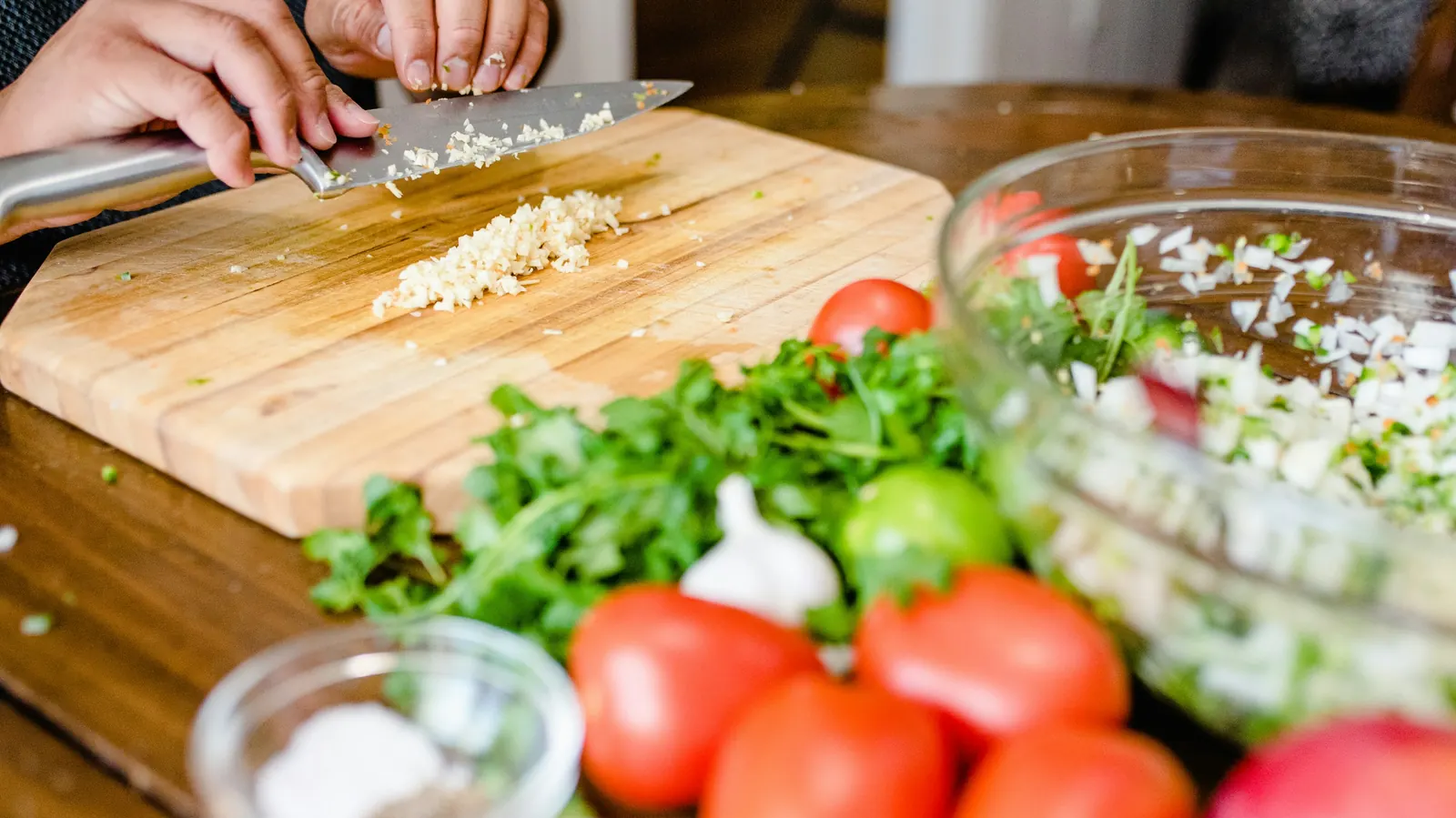
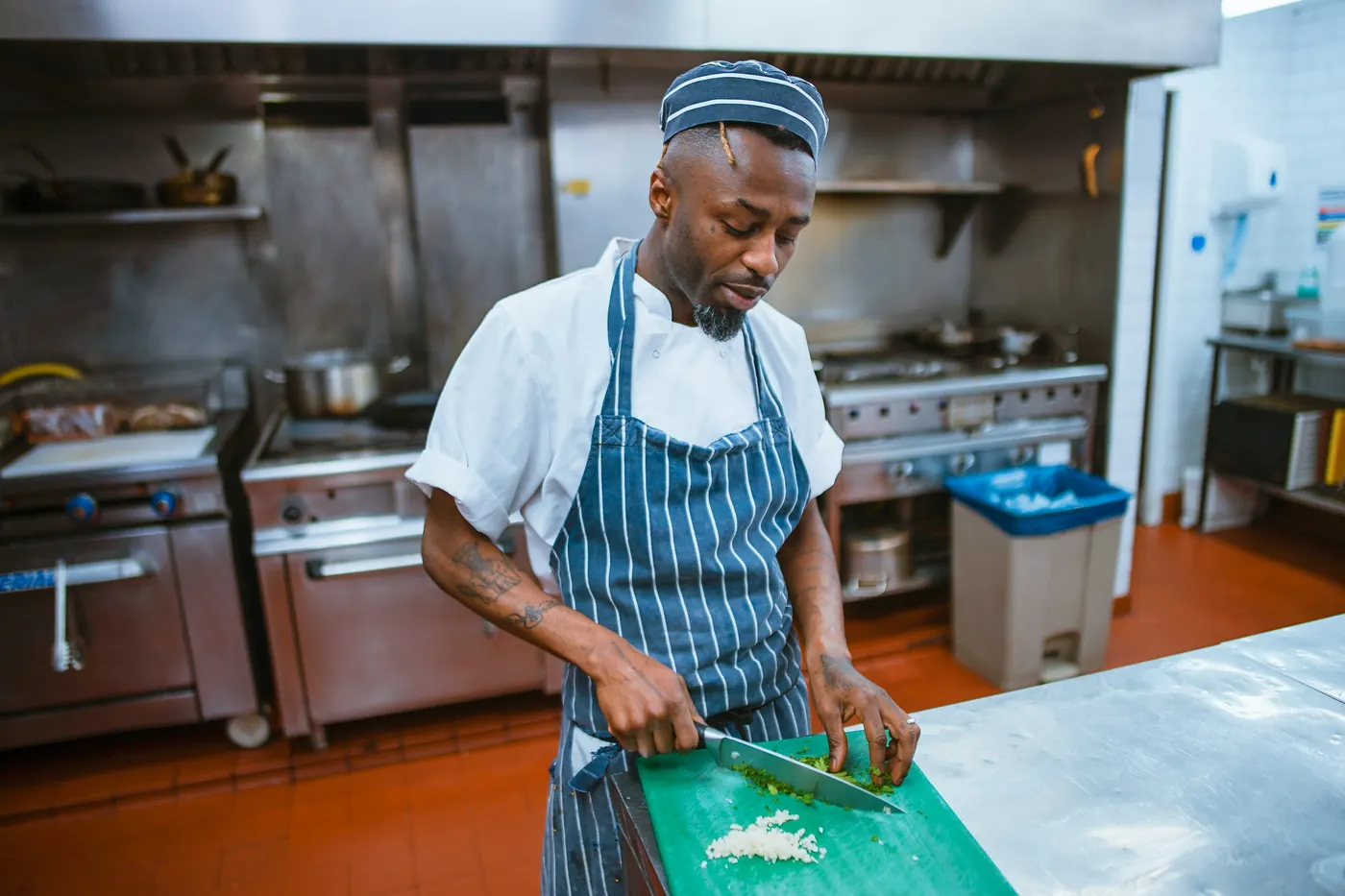
In a restaurant kitchen most of the knife work is vegetables: white onion for salsa and tacos, tomato and serrano for pico de gallo, cilantro, cabbage for tostadas, and jalapeños by the pound. A santoku is built for exactly that work. Its blade is shorter and taller than a chef’s knife, with a flatter edge and a tip that curves down to meet it, so it chops straight down and slices cleanly without much rocking.
Santokus come from German, Swiss, Japanese and American makers, with plain edges or a row of scallops along the side called a granton or hollow edge. This guide explains which features matter, names eight santokus worth buying from makers who publish their specifications, and gives a straight answer on whether the granton edge is worth paying for.
Julia’s earns a commission on purchases made through links on this page, at no cost to you. Recommendations are based on what a restaurant kitchen looks for, product specifications and verified buyer reports.
Quick verdict: which santoku to buy
For most home cooks, the best santoku knife is the Mac Professional 6.5-inch santoku with dimples (MSK-65): Mac lists a thin 2.0 mm blade and a weight of 6 ounces, which makes it quick and easy to control on a pile of onions. If you want a tough, dishwasher-safe knife for very little money, choose the Victorinox Fibrox 7-inch granton santoku, which America’s Test Kitchen recommends. For a plain-edged Japanese blade with a free sharpening service, the Shun Classic 7-inch santoku is the upgrade.
Five santoku knives side by side
Our five standout picks, one for each kind of cook, with the specifications each maker or its listing states. All eight santokus are reviewed in full below.
| Santoku | Best for | Blade & edge | Hardness (stated) | Buy on Amazon |
|---|---|---|---|---|
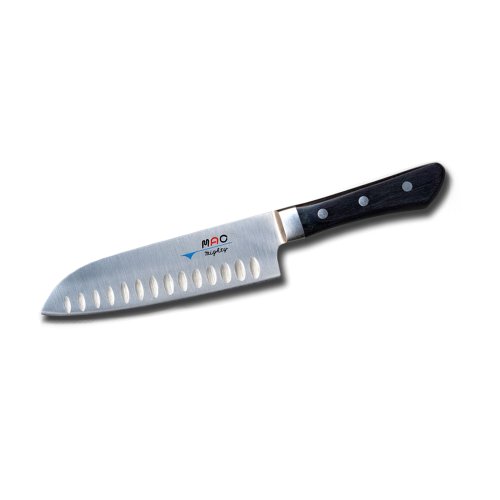
Mac Professional 6.5-inch Santoku with DimplesBest overall
|
Most cooks, daily vegetable prep | 6.69-inch, dimpled | Not stated by Mac | View on Amazon |

Victorinox Fibrox 7-inch Granton SantokuBest value
|
Tight budgets, busy kitchens | 6.7-inch, granton (fluted) | Not stated | View on Amazon |

Shun Classic 7-inch SantokuBest plain edge
|
A plain-edged Japanese upgrade | 7-inch, plain | Not stated on listing | View on Amazon |

Wüsthof Classic 7-inch Hollow Edge SantokuBest German forged
|
Cooks who like a heavier, forged knife | 7-inch, hollow edge | 58 HRC (Wüsthof) | View on Amazon |

Zwilling Pro 5.5-inch SantokuBest compact
|
Small hands, small boards | 5.5-inch, hollow edge | 55–58 HRC (Zwilling) | View on Amazon |
Product images from Amazon. Hardness is listed only where the maker or its listing states it; check the listing before you buy.
Our picks for the best santoku knife
These eight knives cover the santokus most home cooks will consider: Japanese blades from Mac, Shun and Tojiro, forged German knives from Wüsthof and Zwilling, stamped workhorses from Victorinox and Mercer, and a small OXO santoku with a sheath. We have kept away from the three santokus already reviewed on our best Japanese knife page (the Misono UX10, the Global G-80 and the Kai Seki Magoroku), so the two guides give you more choice rather than the same list twice; the reasons are explained further down. Each review covers who the knife suits, the specifications its maker states, and one honest reason to skip it.
1. Mac Professional 6.5-inch Santoku with Dimples – Thin, Light and Quick
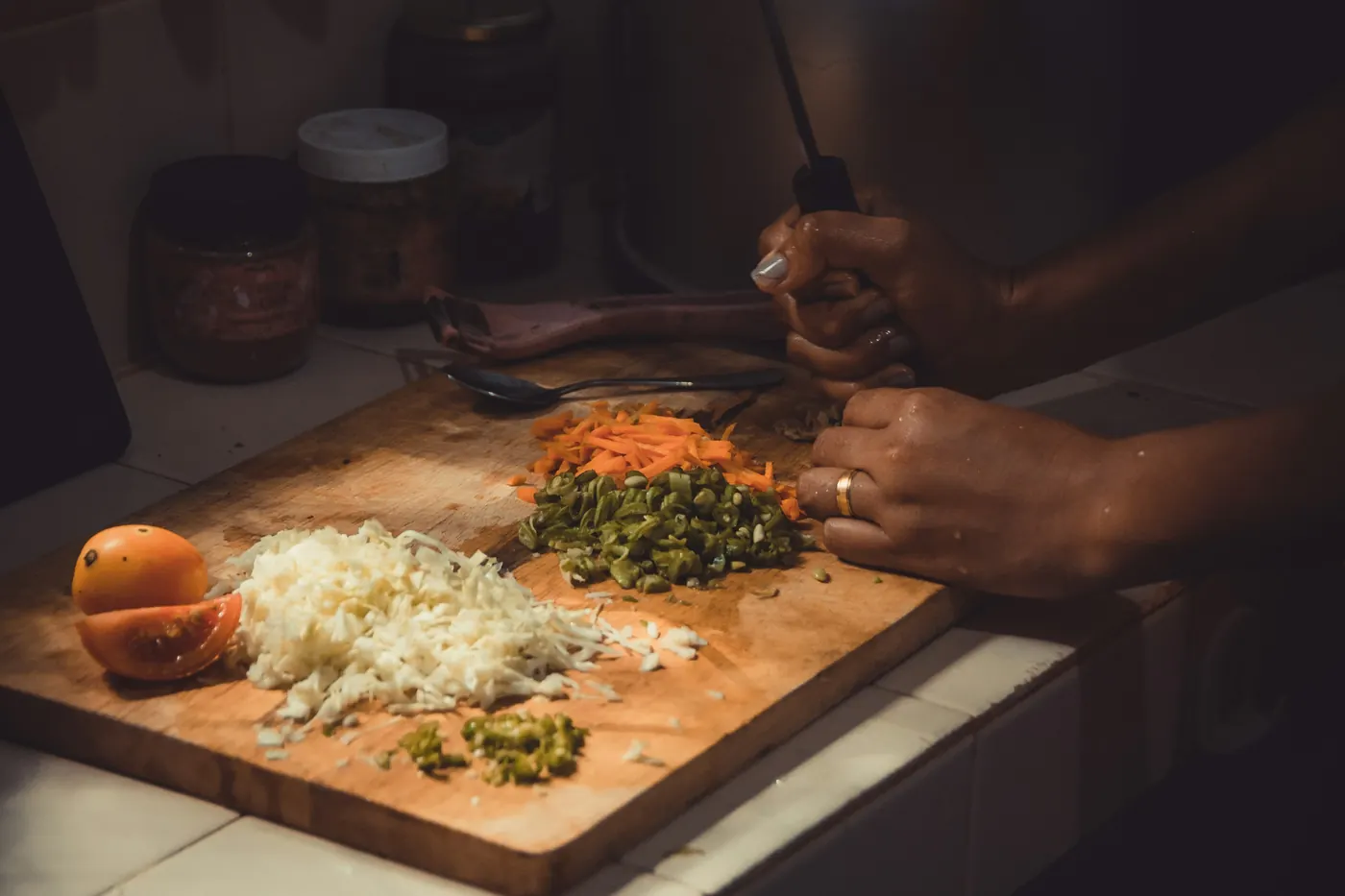
Mac’s Professional series is the line many cooks graduate to after a stamped knife, and the MSK-65 is its santoku. Mac’s product page lists a 6.69-inch blade, a blade thickness of 2.0 mm and a weight of 6.0 ounces (the Amazon listing gives 2.5 mm, so the two sources differ). Either figure puts it on the thin side for a santoku, which is what lets a blade pass through a firm white onion or a tomato without wedging and splitting it.
The dimples along the side are Mac’s version of a hollow edge: like a granton edge, they are meant to help slices fall away from the blade. Mac describes the steel only as sub-zero tempered steel that “retains its edge better than our original steel”; it does not publish a grade or hardness on that page. The listing says the knife is made in Japan, recommends hand washing, and says it is not dishwasher safe.
America’s Test Kitchen did not review this exact model in its santoku review, but it named the Mac Superior santoku, a cheaper Mac, its Best Buy, and its top-ranked knives all had spines of 2 mm or less, which is where Mac puts the MSK-65.
Why we like it
- Thin blade: 2.0 mm on Mac’s spec sheet
- Light at 6.0 ounces, per Mac
- Dimples to help slices fall away
- Made in Japan, per the listing
Key specifications
| Model | MSK-65 |
|---|---|
| Blade length | 6.69 inches (Mac) |
| Steel | Sub-zero tempered steel (Mac; grade not stated) |
| Hardness (stated) | Not stated by Mac |
| Edge (granton/plain) | Dimpled (hollow) edge |
| Handle | Black Pakka wood (listing) |
| Weight | 6.0 oz (Mac) |
| Warranty | Not stated on the listing |
Why we recommend it
It suits a cook who preps a lot of vegetables and wants one quick, light knife for onions, chiles, tomatoes and herbs, with a Western-style handle that feels familiar.
Skip it if you want to put your knives in the dishwasher: the listing says this one is hand wash only.
Pros and cons
Pros
- Thin, nimble blade
- Light in the hand
- Dimples help release slices
Cons
- Hand wash only
- Mac does not publish a hardness figure
- Blade thickness differs between Mac and the listing
2. Victorinox Fibrox 7-inch Granton Santoku – Tough, Light, Dishwasher Safe
Victorinox’s Fibrox range is its grippy, no-frills professional line, and this santoku puts that handle on a 6.7-inch fluted blade. Victorinox’s own product page lists a weight of 4.2 ounces, a thermoplastic elastomer (TPE) handle, Switzerland as the country of origin, dishwasher-safe construction and a lifetime warranty. Neither Victorinox nor the listing gives a steel grade or hardness; the listing calls it Swiss stainless steel.
America’s Test Kitchen recommends the Fibrox Pro 7-inch granton santoku in its santoku review: testers wrote that “mincing parsley was a pleasure”, but also that the edge “felt a bit dull from the beginning”. That matches what you would expect from an inexpensive stamped blade, and it is the reason to own a honing rod or a sharpener with it.
For a kitchen that goes through cilantro, onions and limes every day, the appeal is simple. The handle grips when wet, the knife is light enough to use for an hour, and you will not worry about it.
Why we like it
- Recommended by America’s Test Kitchen
- Very light at 4.2 ounces, per Victorinox
- Dishwasher safe, per Victorinox
- Lifetime warranty against defects
Key specifications
| Model | 5.2523.17BK (listing) |
|---|---|
| Blade length | 6.7 inches (Victorinox) |
| Steel | Swiss stainless steel (listing; grade not stated) |
| Hardness (stated) | Not stated |
| Edge (granton/plain) | Granton (fluted) |
| Handle | TPE, non-slip (Victorinox) |
| Weight | 4.2 oz (Victorinox) |
| Warranty | Lifetime, against defects in material and workmanship |
Why we recommend it
It suits a first santoku, a second knife for a busy kitchen, or anyone who wants something they can hand to a guest helping with the salsa without a second thought.
Skip it if you want a knife that arrives very sharp: America’s Test Kitchen found the edge a little dull from the start.
Pros and cons
Pros
- Hard to beat for the money
- Grippy handle, even with wet hands
- Dishwasher safe
Cons
- Edge less keen out of the box, per ATK
- No published steel grade or hardness
- Plain plastic look
3. Shun Classic 7-inch Santoku – Keen Edge, Free Sharpening
This is the plain-edged version of Shun’s Classic santoku (model DM0702). According to the listing it has a VG-MAX steel core clad in 68 layers of Damascus-patterned stainless steel, a 16-degree edge, and a D-shaped Pakkawood handle meant for both left- and right-handed cooks. It is handcrafted in Japan, carries a lifetime warranty and comes with Shun’s free sharpening and honing service.
America’s Test Kitchen reviewed the hollow-ground version of this knife and recommended it with reservations: it “felt handle-heavy” and seemed “obviously oriented for right-handed cooks”. The handle is the same on this plain-edged model, so if you are left-handed, hold one before you buy if you can.
We picked the plain edge on purpose. America’s Test Kitchen found no difference in sticking with granton edges, and a plain blade is simpler to clean and to sharpen. Like any hard, thin Japanese blade, keep it away from bones, frozen food and glass or stone boards.
Why we like it
- 16-degree edge, per the listing
- VG-MAX core steel, per Shun’s listing
- Free sharpening and honing service
- Lifetime warranty
Key specifications
| Model | DM0702 |
|---|---|
| Blade length | 7 inches |
| Steel | VG-MAX core, 68-layer Damascus cladding (listing) |
| Hardness (stated) | Not stated on listing |
| Edge (granton/plain) | Plain |
| Handle | D-shaped Pakkawood |
| Weight | Not stated on listing |
| Warranty | Lifetime (listing); free sharpening |
Why we recommend it
It suits a cook who wants a sharp, good-looking Japanese santoku and will hand wash it and use the free sharpening service to keep the edge at its best.
Skip it if you are left-handed and sensitive to handle shape: America’s Test Kitchen found the Shun Classic handle favors right-handed cooks.
Pros and cons
Pros
- Fine 16-degree edge
- Free sharpening service
- Plain edge is easy to clean
Cons
- Handle can feel heavy, per ATK
- No hardness or weight on the listing
- Hand care needed
4. Wüsthof Classic 7-inch Hollow Edge Santoku – Sturdy Forged Blade
Wüsthof’s Classic santoku is a German knife in a Japanese shape. According to the listing, the blade, bolster and tang are forged from a single piece of high-carbon stainless steel and fitted with a polypropylene handle held by three rivets; it is made in Germany. Wüsthof’s own page lists a 7.0-inch blade, a hardness of 58 HRC, oval hollows “for reduced sticking”, a sharpening angle of 10 degrees per side for its Asian-style blades, and a limited lifetime warranty.
That build gives a knife with more weight and a full bolster, which some cooks like for cutting through squash or a stack of tortillas. America’s Test Kitchen was less keen: it recommended the knife with reservations because it took “some force” to dice onion despite its narrow edge angle.
Wüsthof’s care advice is to wash it by hand, towel-dry it at once, avoid soaking it, and avoid cutting on hard surfaces such as metal, glass or bamboo.
Why we like it
- Forged from one piece of steel, per the listing
- Hardness of 58 HRC, per Wüsthof
- Full bolster and triple-riveted handle
- Made in Germany
Key specifications
| Model | 4183 (listing); 1040131317 (Wüsthof) |
|---|---|
| Blade length | 7.0 inches (Wüsthof) |
| Steel | Forged high-carbon stainless (listing) |
| Hardness (stated) | 58 HRC (Wüsthof) |
| Edge (granton/plain) | Hollow edge |
| Handle | Polypropylene, triple-riveted (listing) |
| Weight | Not stated by Wüsthof |
| Warranty | Limited lifetime (Wüsthof) |
Why we recommend it
It suits a cook who already likes German knives and wants a santoku with the same heft and bolster, especially for denser vegetables.
Skip it if you want the lightest, most nimble santoku: America’s Test Kitchen found it needed some force on onions.
Pros and cons
Pros
- Solid forged construction
- Hardness stated by the maker
- Familiar German handle
Cons
- Heavier style than Japanese santokus
- ATK found it less effortless on onion
- Hand wash only
5. Zwilling Pro 5.5-inch Santoku – Small, Forged and Steady
America’s Test Kitchen’s runner-up santoku was the Zwilling Pro 7-inch rocking santoku, but it was down to its last few units on Amazon when we checked, so we picked its smaller sibling from the same Pro line. Zwilling’s page for model 38408-143 lists a 5.51-inch hollow-edge blade, a hardness of 55 to 58 HRC, a net weight of 0.37 pounds and a lifetime warranty. It is forged in one piece of Zwilling’s special-formula high-carbon stainless steel, ice-hardened, and made in Germany.
The curved bolster is designed to support a pinch grip, according to the listing, and the handle is triple-riveted over a full tang. Zwilling rates it dishwasher safe but recommends hand washing.
At 5.5 inches it will not split a cabbage in one stroke, but it is very handy for small jobs: mincing garlic, slicing radishes, dicing a single onion or chopping chiles on a small board.
Why we like it
- Hardness range stated by Zwilling
- Forged, full tang, made in Germany
- Compact blade for small boards
- Lifetime warranty
Key specifications
| Model | 38408-143 |
|---|---|
| Blade length | 5.51 inches (Zwilling) |
| Steel | Special-formula high-carbon stainless, ice-hardened (Zwilling) |
| Hardness (stated) | 55–58 HRC (Zwilling) |
| Edge (granton/plain) | Hollow edge (Zwilling) |
| Handle | Plastic, triple-riveted, full tang |
| Weight | 0.37 lb (Zwilling) |
| Warranty | Lifetime (Zwilling) |
Why we recommend it
It suits cooks with smaller hands, small kitchens, or anyone who wants a second, shorter santoku next to a chef’s knife.
Skip it if you want one santoku to do everything: the 5.5-inch blade is short for big vegetables.
Pros and cons
Pros
- Easy to control
- Sturdy forged build
- Dishwasher safe per Zwilling
Cons
- Short for large vegetables
- Amazon listing title does not mention the hollow edge
- Hand washing still recommended
6. Mercer Millennia 7-inch Granton Edge Santoku – Restaurant-Supply Workhorse

Mercer makes knives for culinary schools and restaurant supply, and the Millennia line is its everyday stamped range. According to the listing, this santoku is made from one-piece high-carbon Japanese steel, has a 7-inch granton edge, and a handle with textured finger points for a non-slip grip. Mercer suggests it for dicing onions, mincing shallots, chopping herbs, crushing garlic and shredding cabbage.
Mercer asks you to wash it by hand with warm water and mild soap, dry it completely, and keep it out of the dishwasher. Its warranty covers defects for the original purchaser and specifically excludes damage from dishwasher use.
This is the knife to buy if you want a second santoku for helpers, a backup for a party, or a cheap way to find out whether you like the shape before spending more.
Why we like it
- High-carbon Japanese steel, per the listing
- Textured handle for a wet-hand grip
- Granton edge
- Warranty against defects
Key specifications
| Model | M22707 |
|---|---|
| Blade length | 7 inches |
| Steel | One-piece high-carbon Japanese steel (listing) |
| Hardness (stated) | Not stated |
| Edge (granton/plain) | Granton |
| Handle | Ergonomic, textured finger points (listing) |
| Weight | Not stated |
| Warranty | Repair or replace defects, original purchaser (listing) |
Why we recommend it
It suits a cook on a tight budget, or a household that wants a spare santoku for helpers at taco night.
Skip it if you plan to put it in the dishwasher: Mercer says not to, and its warranty excludes that damage.
Pros and cons
Pros
- Low cost
- Secure grip
- Easy to sharpen thin stamped blade
Cons
- Hand wash only
- No hardness or weight stated
- Basic look
7. Tojiro DP Damascus 7-inch Santoku – VG-10 Core, Bolstered Handle

Tojiro’s DP line is a well-known value range from Japan, and this santoku is its Damascus-clad version (model F-659). According to Tojiro’s brand listing, the blade has a thick VG-10 cobalt alloy steel core with 37 layers of low- and high-carbon stainless steel forged over it; that layering is what makes the pattern. The bolster adds heft and balance while the blade and edge stay thin, and the Micarta handle is fixed with three stainless steel rivets.
Tojiro suggests it for cutting, chopping, dicing and slicing fruit and vegetables. It is made in Japan and carries a limited lifetime warranty against defects, per the listing. The listing does not state a hardness, weight or edge angle.
We describe the Damascus cladding as Tojiro does and make no claim that the pattern changes how it cuts; the VG-10 core is the part that holds the edge.
Why we like it
- VG-10 core steel, per Tojiro
- Bolster for balance
- Micarta handle with three rivets
- Made in Japan, limited lifetime warranty
Key specifications
| Model | F-659 |
|---|---|
| Blade length | 7 inches |
| Steel | VG-10 core, 37-layer stainless cladding (listing) |
| Hardness (stated) | Not stated on listing |
| Edge (granton/plain) | Plain |
| Handle | Micarta, three stainless rivets |
| Weight | Not stated on listing |
| Warranty | Limited lifetime against defects |
Why we recommend it
It suits a cook who wants a Japanese steel core and a traditional-looking riveted handle at a lower cost than the big Japanese names.
Skip it if you want full published specifications: the listing gives no hardness or weight.
Pros and cons
Pros
- VG-10 core
- Balanced, bolstered design
- Durable Micarta handle
Cons
- Sparse specifications
- Hand care needed
- Patterned blade shows scratches
8. OXO Good Grips 5-inch Santoku with Locking Sheath – Small Blade, Safe Storage

OXO’s small santoku is the simplest knife here. According to the listing, it has a 5-inch stainless steel straight edge with a rounded, non-pointed tip, a soft handle shaped to grip without slipping when wet, and a locking sheath that protects the edge and makes it safe to carry. It is hand wash only.
The sheath is the reason to buy it. A knife that lives in a drawer, a picnic basket or a box of taco-night supplies needs a cover, and this one comes with its own. The rounded tip also makes it a gentle choice for a beginner.
Do not confuse it with the larger OXO Good Grips Pro 6.5-inch santoku, which America’s Test Kitchen did not recommend; that is a different knife, and ATK has not reviewed this one.
Why we like it
- Locking sheath included
- Rounded tip, per the listing
- Soft, non-slip handle
- Compact 5-inch blade
Key specifications
| Model | 11440000 |
|---|---|
| Blade length | 5 inches |
| Steel | Stainless steel (listing; grade not stated) |
| Hardness (stated) | Not stated |
| Edge (granton/plain) | Plain (straight edge) |
| Handle | Soft, non-slip grip |
| Weight | Not stated |
| Warranty | Not stated on listing |
Why we recommend it
It suits a beginner, a small kitchen, or anyone who needs a santoku that travels to a cookout or lives in a drawer.
Skip it if you want a main kitchen knife: the short blade and blunt tip limit what it can do.
Pros and cons
Pros
- Protective sheath
- Comfortable grip
- Beginner-friendly tip
Cons
- Short blade
- No tip for detail work
- Few specifications stated
Granton or plain edge: does the scalloping help?
A granton edge (also called a hollow, fluted or dimpled edge) is a row of shallow ovals ground into the side of the blade just above the cutting edge. Makers say they reduce sticking: Wüsthof describes its hollows as being “for reduced sticking”, Victorinox says its fluted blade resists sticking to soft foods, and Mac puts dimples on its Professional santoku for the same purpose.
Independent testing is less convinced. In its santoku review, America’s Test Kitchen saw no reduction in sticking from granton edges, noted that two of its top three knives did not have them, and called the feature unnecessary. Our view from the prep side: buy a santoku for its blade thickness, steel and handle, and treat the edge style as a tiebreaker. If you slice a lot of potatoes for papas or cucumbers for a salad, a granton edge does no harm. If you mostly dice onions and chiles, a plain edge is easier to wipe clean.
How to choose a santoku knife
Blade length
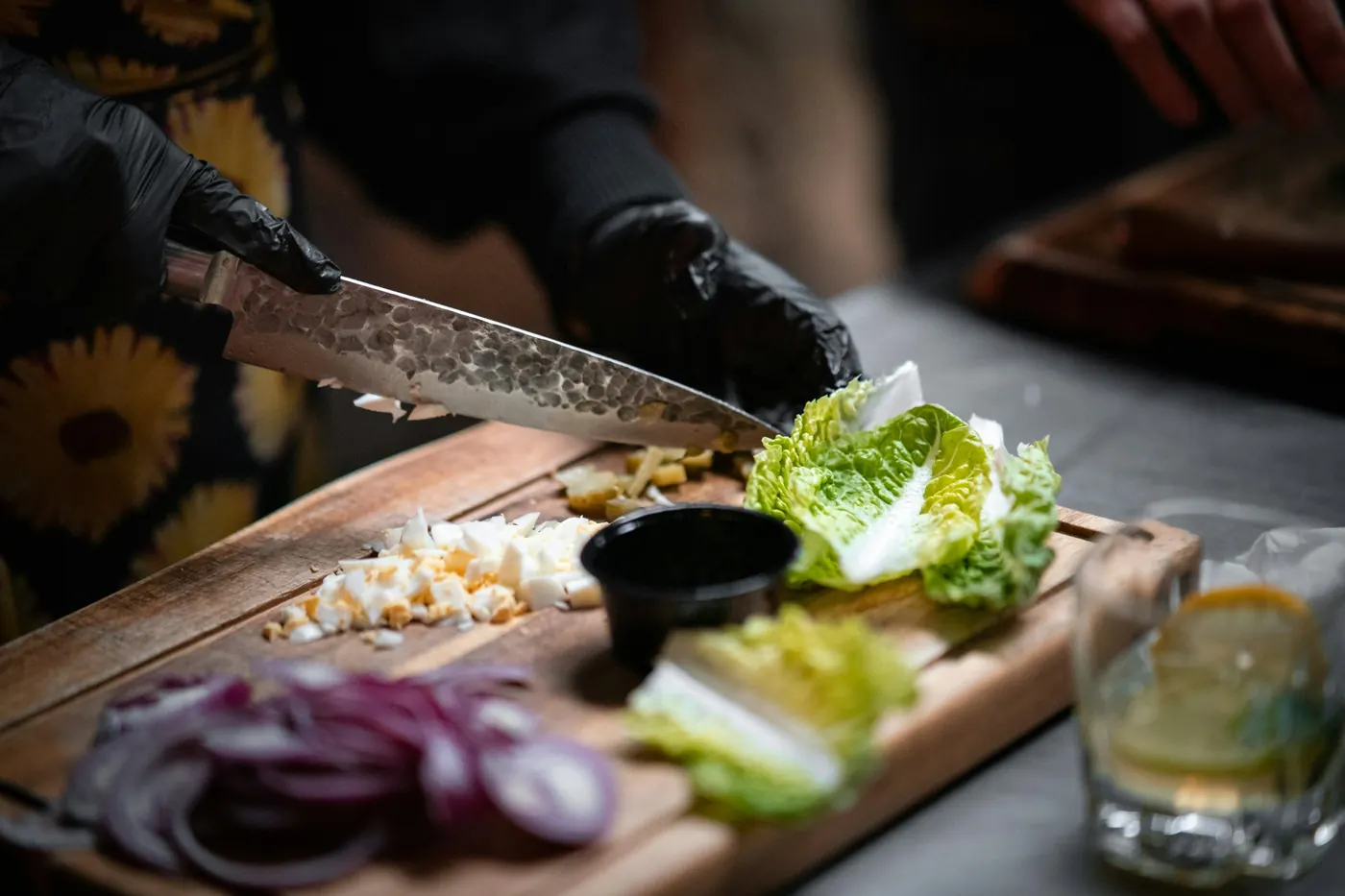
Santokus generally run 5 to 7 inches, according to America’s Test Kitchen, against 8 to 10 inches for chef’s knives. A 6.5- to 7-inch blade is the most useful all-rounder; a 5- or 5.5-inch santoku is easier on a small board but slow on a whole cabbage.
Thickness and weight
Thin blades cut dense vegetables without splitting them. America’s Test Kitchen’s best-performing santokus were all 2 mm or less at the spine and felt “substantial but not bulky”. Light knives are less tiring when you are dicing for a crowd.
Steel and hardness
Harder steel holds an edge longer but is less forgiving. Only some makers publish a figure: Wüsthof states 58 HRC and Zwilling 55 to 58 HRC for the knives here. When a maker does not state it, we say so rather than guess.
Handle
A handle that grips when wet matters more than looks in a busy kitchen. America’s Test Kitchen preferred handles no more than 3 inches around at the widest point. If you are left-handed, check that the handle is symmetrical.
Care
Only the Victorinox and Zwilling knives here are rated dishwasher safe by their makers, and Zwilling still recommends hand washing. Every other pick should be washed by hand and dried straight away.
Santoku or chef’s knife?
America’s Test Kitchen calls it “really a personal choice”: a good santoku can match a chef’s knife, but if you want the extra length and heft of a chef’s knife, keep it and add a santoku rather than replacing it. The santoku’s flatter edge suits an up-and-down chop; the chef’s knife’s curved belly suits rocking through herbs and slicing a whole roast. In a kitchen that breaks down pork shoulder for carnitas and then dices onions for the salsa, both earn their place. Our guide to the best chef knife covers the longer option, and a knife set is worth a look if you need several knives at once.
Why the Misono, Global and Kai santokus are on another page
America’s Test Kitchen’s winning santoku is the Misono UX10 7-inch, and Global and Kai make well-known santokus too. All three are reviewed on our best Japanese knife page, alongside gyuto, nakiri and petty knives. Rather than repeat them here, this guide covers the other santokus most cooks shortlist. If you want the Misono, read that review. Other Global santokus, including the G-48 that America’s Test Kitchen tested, were down to their last few units on Amazon when we checked.
Keeping a santoku sharp
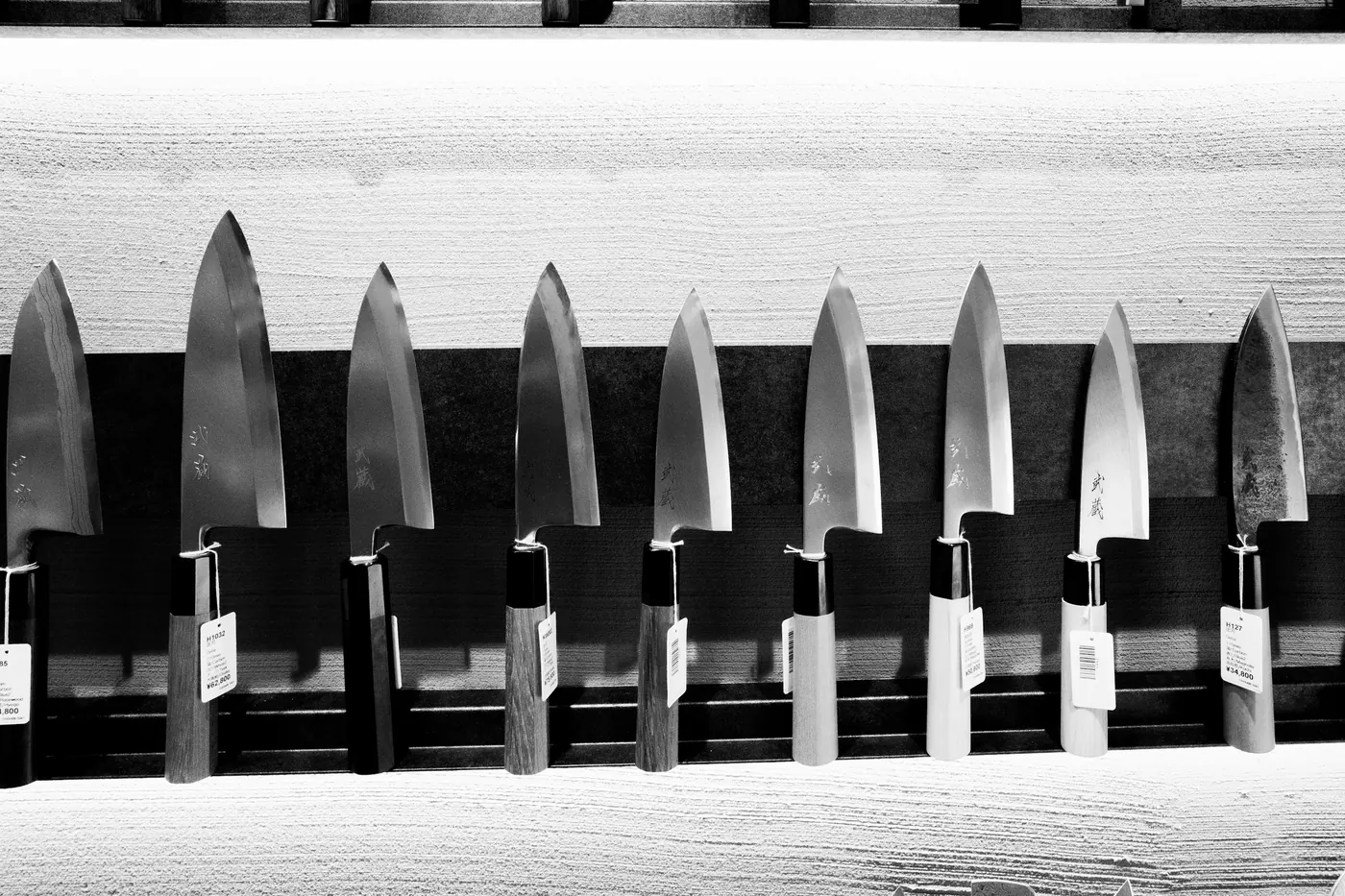
Japanese-style blades are sharpened at a finer angle than older German knives: Shun’s listing gives a 16-degree edge for its Classic santoku and Wüsthof 10 degrees per side for its Asian-style blades. Hone often, sharpen when honing no longer brings the edge back, and use a sharpener set to the right angle. Our knife sharpener guide explains the options, and a wood or plastic cutting board protects the edge between sharpenings. Keep a santoku away from bones and frozen food; that is a cleaver’s job.
How we chose these eight santokus
We started from what a Mexican kitchen asks of a santoku: even dice of onions, chiles and tomatoes, finely chopped cilantro, and clean slices of cooked meat. We then looked for santokus from makers who publish specifications (Mac, Victorinox, Shun, Wüsthof, Zwilling, Mercer, Tojiro and OXO) that were sold on Amazon in the United States and in stock when we checked. Specifications come from the maker’s own product page where we could read it, otherwise from the brand’s Amazon listing, and each review says which. We used America’s Test Kitchen’s santoku knife review for how several of these knives, or their close relatives, perform. Some good knives are missing because they were down to their last few units, including the Zwilling Pro 7-inch, the Mac Superior and the Shun Classic hollow-ground santoku. We left out marketplace brands with unverifiable steel or “Damascus” claims. We have not used these products ourselves; where we describe how a knife performs, we say whose findings those are.
Santoku knife questions, answered
What is the best santoku knife brand?
There is no single best brand, but makers that publish their specifications and stand behind their knives are a safe start: Mac, Misono, Shun, Wüsthof, Zwilling, Victorinox, Mercer and Tojiro among them. Be wary of listings that promise exotic steel and dozens of layers without naming a maker.
Which santoku does America’s Test Kitchen recommend?
Its winner is the Misono UX10 7-inch santoku, with the Zwilling Pro 7-inch rocking santoku as runner-up and the Mac Superior 6.5-inch as its Best Buy. It also recommends the Victorinox Fibrox Pro 7-inch granton santoku. We cover the Misono on our Japanese knife page and the Victorinox here.
What is the best santoku knife for the money?
The Victorinox Fibrox 7-inch granton santoku. Victorinox rates it dishwasher safe, gives it a lifetime warranty against defects, and America’s Test Kitchen recommends it. The Mercer Millennia is the alternative if you want a second, even cheaper knife.
Is a granton edge worth it on a santoku?
It is optional. Makers say the hollows reduce sticking, but America’s Test Kitchen saw no reduction in its santoku testing and called the feature unnecessary. Choose by blade, steel and handle first.
Can a santoku cut meat?
Yes, boneless meat. A santoku slices cooked carne asada or chicken cleanly. It should not be used on bones or frozen food; Global’s care guide, for example, says not to cut through frozen foods or bones. Use a cleaver for bone, and meat claws to shred carnitas.
Can santoku knives go in the dishwasher?
Most should not. Of the knives here, only the Victorinox and the Zwilling are rated dishwasher safe by their makers, and Zwilling still recommends hand washing.
Which santoku to start with
Start with the Mac MSK-65 if you want one quick, light santoku for daily vegetable prep. Choose the Victorinox Fibrox if you want a tough knife that costs little and can go in the dishwasher, and the Shun Classic if you want a keen Japanese edge with a sharpening service behind it. Whichever you buy, keep it sharp and use it on a wood or plastic board.
Want one made in Japan? See our guide to the best Japanese santoku knives.
On a budget? See our guide to the best cheap santoku knives.
Related guide: Santoku vs chef knife.
A good santoku is one piece of a working kitchen. Our guide to Mexican cooking tools covers the rest, and salsa roja vs salsa verde is a good place to put all that diced onion and chile to use. And if you would rather leave the chopping to someone else tonight, see the menu or call to order.