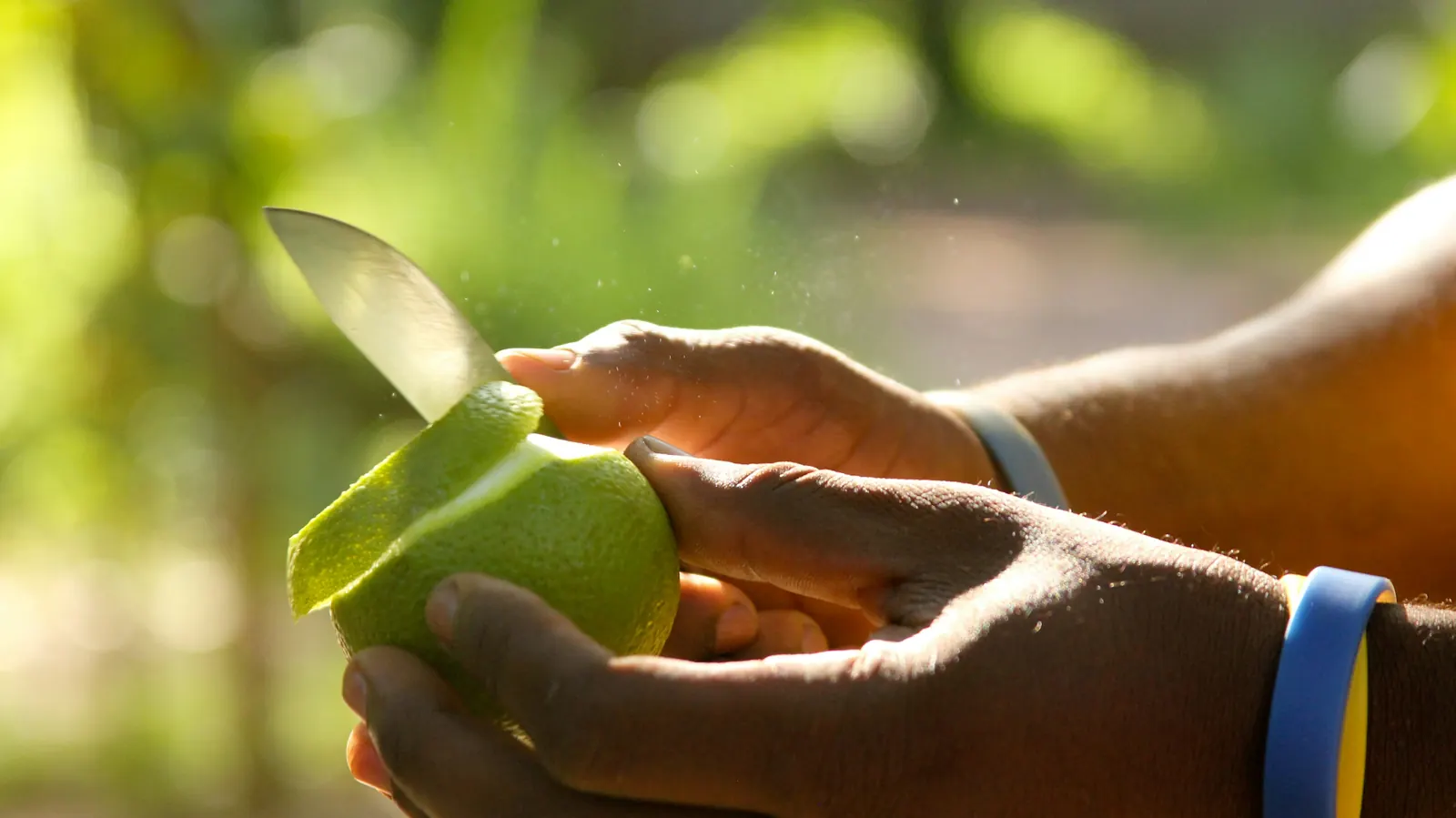
A utility knife is the size between a paring knife and a chef’s knife, usually 5 to 6 inches. It is the knife you reach for when a chef’s knife feels like too much and a paring knife runs out of blade: halving limes, slicing a jalapeño, trimming a chicken thigh, cutting a torta in two.
You do not strictly need one, but once you have one, it tends to stay on the board. This guide compares eight utility knives from established makers, forged and stamped, straight and serrated, German and Japanese. These are kitchen knives, not the box cutters that share the name.
Julia’s earns a commission on purchases made through links on this page, at no cost to you. Recommendations are based on what a working kitchen looks for in a knife, the makers’ own specifications and independent reviews where they exist. We have not used these products ourselves.
Quick verdict: which utility knife to buy
Start with the Wüsthof Classic 6-inch Utility Knife. It is forged, slim and a sensible size for daily prep. For a lower tier, choose the Mercer Culinary Genesis 5-inch. If you mostly cut tomatoes and crusty rolls, buy the Zwilling Pro 5.5-inch Serrated Prep Knife, which won America’s Test Kitchen’s serrated utility knife test.
The table below compares our five standout knives. All eight are reviewed in full after it, followed by how to choose and answers to common questions.
Five utility knives compared
One pick for each kind of cook, with the details each maker or listing states.
| Utility knife | Blade | Edge | Build and care | Buy on Amazon |
|---|---|---|---|---|

Wüsthof Classic 6-inch Utility KnifeBest overall
|
6 in | Straight | Forged; hand wash | View on Amazon |
| 5 in | Straight | Forged; hand wash | View on Amazon | |

Zwilling Pro 5.5-inch Serrated Prep KnifeBest serrated
|
5.5 in | Serrated | Forged; dishwasher safe per listing | View on Amazon |

Henckels Classic 6-inch Utility KnifeEasiest care
|
6 in | Straight | Forged; dishwasher or hand | View on Amazon |
Shun Classic 6-inch Utility KnifeBest Japanese
|
6 in | Straight | VG-MAX core; 16-degree edge | View on Amazon |
Our picks for the best kitchen utility knife
The picks run from the best all-round choice to the more specialized knives. Each one comes from a maker with a long record in cutlery, and each was in stock when we checked.
1. Wüsthof Classic 6-inch Utility Knife – Forged, Slim and Easy to Steer
If you want one knife to sit between your paring knife and your chef’s knife, start here. Wüsthof describes this blade as narrower than a chef’s knife and larger than a paring knife, which is the whole job description. The maker suggests it for chopping shallots, mushrooms and herbs, dicing vegetables and slicing smaller cuts of meat.
It is forged from a single piece of high-carbon stainless steel. The tang runs the full length of the handle, and a full bolster sits where the blade meets the grip. The handle is triple riveted, the classic German pattern, so it will feel familiar if you already own a forged chef’s knife. Wüsthof makes it in Solingen, Germany.
In a Mexican kitchen, this size earns its keep on small jobs that come up all day: seeding a jalapeño, slicing radishes for a taco plate, trimming a chicken thigh, cutting limes for the table. A long chef’s knife feels clumsy on those. The care is simple but strict. The listing says to keep it off glass, ceramic and metal surfaces and to clean it by hand.
Why we like it
- Forged from one piece of high-carbon stainless steel
- Full tang and full bolster for stability
- Made in Solingen, Germany
- A blade size the maker aims squarely at everyday prep
Key specifications
| Model | 1040100716 |
|---|---|
| Blade length | 6 inches |
| Edge | Straight |
| Steel | High-carbon stainless |
| Construction | Forged, full tang, full bolster |
| Handle | Triple riveted |
| Warranty | Not stated on listing |
| Care | Hand clean; avoid hard cutting surfaces |
Why we recommend it
It suits a cook who wants a lasting second knife from a maker with a long record and a shape that does a bit of everything.
Skip it if you want the lightest knife here. A forged knife with a full bolster carries more metal than the stamped Gourmet further down.
Pros and cons
Pros
- Forged construction
- Full tang
- Straight edge is simple to keep sharp
Cons
- Hand care only
- Full bolster can make full-length sharpening harder
- Warranty terms not on the listing
2. Mercer Culinary Genesis 5-inch Utility Knife – Forged Steel in a Shorter Size
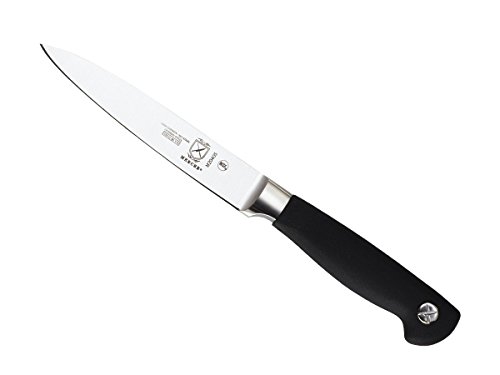
Mercer Culinary sells to professional kitchens and home cooks, and the Genesis line is its forged series. This one has a 5-inch blade, the short end of the utility range. That shorter reach makes it feel closer to a large paring knife than to a small chef’s knife.
The listing calls it precision forged from high-carbon German steel with a taper-ground edge, which means the blade narrows evenly to the edge. Mercer suggests it for slicing pickles, fruit and cheese, peeling apples and cutting sandwiches. The handle is built to stay grippy with wet hands, a real point in favor if you are working through a pile of wet produce.
Choose this one if your hands are small, your cutting board is small or a 6-inch blade feels long. A 5-inch knife is also easier to tuck into a drawer guard. Mercer says to wash it by hand with warm water and mild soap, rinse it and dry it completely. Keep it out of the dishwasher and do not leave it soaking. The maker backs it with a limited lifetime warranty.
Why we like it
- Forged high-carbon German steel
- Taper-ground edge
- Non-slip handle, even with wet hands
- Limited lifetime warranty
Key specifications
| Model | M20405 |
|---|---|
| Blade length | 5 inches |
| Edge | Straight |
| Steel | High-carbon German steel |
| Construction | Forged |
| Handle | Non-slip ergonomic handle |
| Warranty | Limited lifetime |
| Care | Hand wash and dry; no dishwasher |
Why we recommend it
It suits a cook on a tighter budget who still wants a forged blade, or anyone who finds 6 inches a little too long.
Skip it if you need to slice across a wide tomato or a large sandwich. The shorter blade runs out of length quickly.
Pros and cons
Pros
- Forged at a lower tier than the German heritage brands
- Compact and easy to steer
- Clear care guidance
Cons
- Short for larger produce
- Not for the dishwasher
- Not a looker next to a riveted classic
3. Wüsthof Gourmet 6-inch Utility Knife – Lighter, Laser-Cut Blade

The Gourmet line is Wüsthof’s entry tier. These blades are laser cut and stamped from high-carbon stainless steel instead of forged, so there is no heavy bolster. Stamped does not mean flimsy, but it does mean a lighter, plainer knife.
Wüsthof compares this one to a versatile paring knife and suggests it for mincing shallots, onions and herbs, cutting vegetables and slicing small pieces of meat. The handle is synthetic polypropylene that the maker says resists fading, discoloration, heat and impact. The series is German made and carries a limited lifetime warranty.
The main reason to pick this over the Classic is feel. Without the bolster, you can sharpen the whole edge right down to the heel, and the knife asks less of your wrist on long prep jobs. What you give up is the extra weight behind the blade and the solid, forged look. Wüsthof lists these as hand wash only.
Why we like it
- Stamped blade with no heavy bolster
- Polypropylene handle resists heat and fading
- German made
- Limited lifetime warranty
Key specifications
| Model | 1025048816 |
|---|---|
| Blade length | 6 inches |
| Edge | Straight |
| Steel | High-carbon stainless |
| Construction | Laser-cut, stamped |
| Handle | Synthetic polypropylene |
| Warranty | Limited lifetime |
| Care | Hand wash only |
Why we recommend it
It suits a cook who likes a light knife, or who wants the Wüsthof name without paying for forging.
Skip it if you like some weight in the hand. A stamped blade will feel slight next to a forged one.
Pros and cons
Pros
- Light in the hand
- Whole edge is easy to sharpen
- Long-established maker
Cons
- Less heft than forged knives
- Hand wash only
- Plainer handle
4. Zwilling Pro 5.5-inch Serrated Prep Knife – A Top Choice in an Independent Test
Zwilling sells this as a serrated prep knife, but it does the job of a serrated utility knife, and that is how America’s Test Kitchen reviewed it. In its 2020 serrated utility knife test, ATK named this model the winner over knives from Shun, Cangshan, Wüsthof, Global, Mercer, Victorinox and OXO. Testers praised the sharp, stiff blade and the tall heel, which kept knuckles off the board.
That tall heel is why it stands out. Many serrated utility knives are thin and slim, so your fingers end up on the cutting board. ATK’s one complaint was that some testers wanted a slightly longer, wider handle. The knife is forged from a single piece of high-carbon stainless steel, ice hardened and fitted with a curved bolster and a triple-riveted, full-tang handle. The listing says it is made in a German factory owned by the company.
A serrated edge suits tomatoes, crusty bolillos, tortas and firm-skinned fruit, because the teeth bite in without crushing what is underneath. The trade-off is sharpening. Serrations are slow to touch up at home, and a honing steel will not help much. The listing calls it dishwasher safe, though hand washing is the kinder choice for any knife edge.
Why we like it
- Winner of ATK’s 2020 serrated utility knife test
- Tall heel keeps knuckles off the board
- Forged, full tang, triple riveted
- Stiff blade for crusty bread and firm produce
Key specifications
| Model | 38425-143 |
|---|---|
| Blade length | 5.5 inches |
| Edge | Serrated |
| Steel | Special formula high-carbon stainless, ice hardened |
| Construction | Forged, full tang, curved bolster |
| Handle | Triple riveted |
| Warranty | Not stated on listing |
| Care | Dishwasher safe per listing |
Why we recommend it
It suits a cook who cuts a lot of tomatoes and tortas and wants the serrated knife with the strongest independent backing we could find.
Skip it if you want a blade that takes a clean slice through herbs or fish. A serrated edge tears soft greens, so pair it with a straight edge.
Pros and cons
Pros
- Strong independent review
- Tall heel gives finger room
- Forged in Germany
Cons
- Handle may feel short in large hands
- Serrations are hard to sharpen at home
- Called a prep knife by its maker, so the name can confuse
5. Henckels Classic 6-inch Utility Knife – Forged and Fine With the Dishwasher
Most forged knives on this list want hand washing only. The Henckels listing says this one can go in the dishwasher or be washed by hand, which is the main reason it earns a spot. For a busy family kitchen, that small allowance can decide which knife gets used.
The knife is fully forged with a satin-finished blade and a traditional triple-rivet handle. Henckels describes it as a fit for mid-sized fruits and vegetables as well as meats and cheeses, so it covers the same ground as the Wüsthof Classic. It carries a lifetime warranty against manufacturer defects. The listing calls the design German engineered but does not name the country where this knife is made.
Our advice is to use the dishwasher only when you must. Dishwashers can knock an edge against other items, and hot wash cycles are hard on any handle. A quick wash by hand keeps a knife sharp for longer. Still, it is useful to know a slip will not break the terms of care.
Why we like it
- Listing allows dishwasher or hand washing
- Fully forged, satin-finished blade
- Triple-rivet handle
- Lifetime warranty against manufacturer defects
Key specifications
| Model | 31160-161 |
|---|---|
| Blade length | 6 inches |
| Edge | Straight |
| Steel | Stainless; steel grade not stated |
| Construction | Fully forged |
| Handle | Triple riveted |
| Warranty | Lifetime against manufacturer defects |
| Care | Dishwasher or hand wash |
Why we recommend it
It suits a household where knives do not always get washed by hand, or a cook who wants a forged classic from a very familiar brand.
Skip it if you care where a knife is made. The listing does not say, and German engineered is not the same as made in Germany.
Pros and cons
Pros
- Flexible care rules
- Forged build
- Lifetime defect warranty
Cons
- Country of manufacture not stated
- Steel grade not stated
- Hand washing is still better for the edge
6. Shun Classic 6-inch Utility Knife – Thin VG-MAX Edge at 16 Degrees
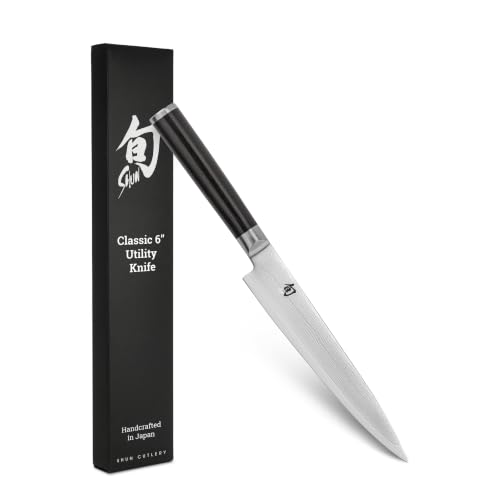
The Shun Classic is the premium pick here. It has a VG-MAX steel core wrapped in 68 layers of Damascus cladding, and the edge is sharpened to 16 degrees. Shun handcrafts it in Japan and fits a D-shaped Pakkawood handle that the listing says works for right- and left-handed cooks.
A thin, hard Japanese edge feels different from a German one. It glides through onions and ripe tomatoes with less pressure, which is the reason to pay more. The same thin edge asks more of you, though. Keep it off bones, frozen food and hard squash, and treat it to a wood or plastic board rather than stone or glass.
The listing mentions free sharpening and honing support from the maker, and a lifetime warranty. Those are useful perks if you do not sharpen at home. ATK also rated the serrated version of this knife second in its serrated utility test, calling the blade stiff and razor sharp, which speaks well of the line, though it did not test this straight-edge model.
Why we like it
- VG-MAX core with 68 layers of Damascus cladding
- 16-degree edge
- Handcrafted in Japan
- Free sharpening and honing support, per the listing
Key specifications
| Model | DM0701 |
|---|---|
| Blade length | 6 inches |
| Edge | Straight |
| Steel | VG-MAX core, Damascus cladding |
| Construction | Handcrafted, clad blade |
| Handle | D-shaped Pakkawood |
| Warranty | Lifetime |
| Care | Not stated on listing |
Why we recommend it
It suits an experienced home cook who enjoys a very sharp knife and is willing to look after it.
Skip it if your knives get thrown in a drawer or asked to pry and twist. A hard, thin edge is less forgiving than softer German steel.
Pros and cons
Pros
- Very acute edge angle
- Attractive layered blade
- Maker sharpening support
Cons
- Premium tier
- Needs careful handling
- Care instructions not on the listing
7. Tojiro DP Damascus 6-inch Utility Knife – VG-10 Core, Micarta Handle

Japanese cooks call a knife of this size a petty, and Tojiro is a Japanese maker. This model has a thick VG-10 core with 37 layers of low- and high-carbon stainless steel folded around it. The listing says that layering forms the Damascus pattern on each blade.
A bolster adds heft and balance while the blade stays thin at the edge. The handle is Micarta with three stainless rivets, which gives it a more Western feel than a traditional Japanese handle. Tojiro suggests it for paring, peeling and slicing small fruits and vegetables. It is made in Japan and the listing notes a lifetime warranty.
Compared with the Shun, you get a similar idea: a hard core, a thin edge and a layered blade, with a riveted handle in place of a D-shaped one. The same care applies. Keep it away from bones and frozen food, wash it by hand as you would any thin blade and store it in a guard or block.
Why we like it
- VG-10 core steel
- 37-layer Damascus pattern
- Micarta handle with three rivets
- Made in Japan
Key specifications
| Model | F651 |
|---|---|
| Blade length | 6 inches |
| Edge | Straight |
| Steel | VG-10 core, 37-layer cladding |
| Construction | Clad blade with bolster |
| Handle | Micarta, three rivets |
| Warranty | Lifetime |
| Care | Not stated on listing |
Why we recommend it
It suits a cook who wants a Japanese petty but prefers the shape of a riveted Western handle.
Skip it if you want a low-fuss knife. Thin, hard steel chips more easily than softer German steel if it is twisted or misused.
Pros and cons
Pros
- Premium core steel
- Western-style handle
- Made in Japan
Cons
- Care not stated on the listing
- Less forgiving edge
- Listing gives little detail on the edge angle
8. Global 6-inch Flexible Utility Knife – All-Steel, Seamless and Light

Global knives look unlike anything else here. The handle and blade form one smooth stainless piece, with no rivets or seams for food to collect in. Global calls this model the GS-11 and describes it as a flexible utility knife, which sets it apart from the stiffer knives above.
That flex suits slicing work such as easing the skin off a piece of fish, trimming a tenderloin or taking the membrane off a pork rib, more than it suits hard chopping. The listing calls it lightweight, with Japanese stainless steel and a sure-grip handle. It is made in Japan and carries a limited lifetime guarantee.
The handle is a matter of taste, and it is the reason to think twice. ATK tested a different Global 6-inch knife, a serrated one, and its testers found the slick metal handle hard to hold. The GS-11 has its own sure-grip handle, but if your hands are often wet or oily, try to hold one in a store first. The listing does not give care instructions. Hand washing is the safe choice.
Why we like it
- One-piece, seamless stainless build
- Flexible blade for slicing and trimming
- Made in Japan
- Limited lifetime guarantee
Key specifications
| Model | GS-11 |
|---|---|
| Blade length | 6 inches |
| Edge | Straight |
| Steel | Japanese stainless |
| Construction | Seamless stainless steel |
| Handle | All-metal sure-grip |
| Warranty | Limited lifetime guarantee |
| Care | Not stated on listing |
Why we recommend it
It suits a cook who trims meat and fish often and likes a light, modern knife with no seams to clean.
Skip it if you want a stiff blade for firm vegetables. Flex is a drawback on a carrot or a chayote.
Pros and cons
Pros
- No seams or rivets
- Flexible blade
- Light, per the listing
Cons
- Metal handle can feel slick
- Not the best for hard vegetables
- Listing is thin on specifics
How to choose a utility knife for your kitchen
Length. A 6-inch blade reaches across a tomato or a sandwich. A 5-inch blade feels nimbler and suits smaller hands. If your paring knife is on the long side, a 6-inch fills the gap better. If your chef’s knife is a short 7-inch, a 5-inch does.
Straight or serrated. A straight edge is the better all-round choice. It slices herbs cleanly, trims meat and can be kept keen with a honing steel. A serrated edge handles tomatoes, bolillos and salami with little pressure, but it tears soft greens and is hard to sharpen at home.
Blade height. Many utility knives are slim, which means your knuckles meet the board on a downward cut. ATK singled out a tall heel as a key feature in the knife it preferred. If you chop more than you slice, look for a taller blade.
Forged or stamped. Forged knives have more weight at the bolster and feel solid. Stamped knives are lighter and easier to sharpen along the whole edge. Neither is automatically better, so choose by how you like a knife to feel.
German or Japanese steel. German-style knives tend to use softer steel and thicker edges, so they forgive rough use and touch up easily. Japanese knives such as the Shun and Tojiro use harder core steel and thinner edges. They cut with less effort but need more care.
Care. Most makers here ask for hand washing. Dry the knife right away and store it in a block, on a strip or in a guard. Use a wood or plastic cutting board, since glass and stone dull an edge quickly.
How we picked these eight utility knives
We did not use these knives ourselves. We started with the 5- to 6-inch range and kept only knives their makers sell as utility knives, plus one serrated prep knife that America’s Test Kitchen reviewed as a serrated utility knife. Paring knives, mini chef’s knives and box cutters were left out.
Specifications come from the makers’ Amazon listings. Independent evidence is limited. ATK’s 2020 serrated utility knife test is the one rigorous review we could find, and it covers serrated knives only. We found no comparable test of straight-edge utility knives, so those picks rest on maker specifications, construction and each maker’s long record. We left out newer online-only brands with no independent review, because a sharp knife is not the place to take a chance on an unknown name.
We also searched the U.S. Consumer Product Safety Commission recall database by brand on October 31, 2026. It showed no recall of a knife from Wüsthof, Mercer, Henckels, Zwilling, Shun, Tojiro or Global. The one result for these makers is a May 2026 Zwilling recall of Enfinigy electric kettles, which does not involve knives.
Utility knife questions, answered
What is a utility knife used for in the kitchen?
It handles jobs too big for a paring knife and too small for a chef’s knife, such as slicing shallots, cutting citrus, trimming small cuts of meat and cutting sandwiches.
Is a utility knife the same as a petty knife?
Close to it. Petty is the Japanese word for this size of knife, borrowed from the French word for small. A petty usually has a thinner, harder blade than a German utility knife, but it does the same jobs.
Do I need a utility knife if I own a chef’s knife and a paring knife?
Need, no. Many cooks manage well with those two. A utility knife is a comfort on small jobs, and it is often the knife people reach for when making a quick snack or lunch.
Should a utility knife be serrated?
Choose straight first if you are buying one. Add a serrated knife if you often slice tomatoes, rolls or salami and do not want to reach for a long bread knife.
Can a utility knife go in the dishwasher?
Follow the maker. The Henckels and Zwilling listings here allow it, while Wüsthof and Mercer ask for hand washing. Hand washing is better for any edge.
Our final pick for everyday prep
For most kitchens, the best kitchen utility knife is the Wüsthof Classic 6-inch: a straight, forged blade that covers the small jobs a chef’s knife does not. Add the Zwilling Pro serrated knife if tomatoes and tortas are a regular part of your week.
To build out the rest of your kit, see our guide to the best knife set and our list of Mexican cooking tools. If all this has you thinking about a plate of fresh salsa roja or salsa verde that somebody else cut up, see the menu at Julia’s or call to order.