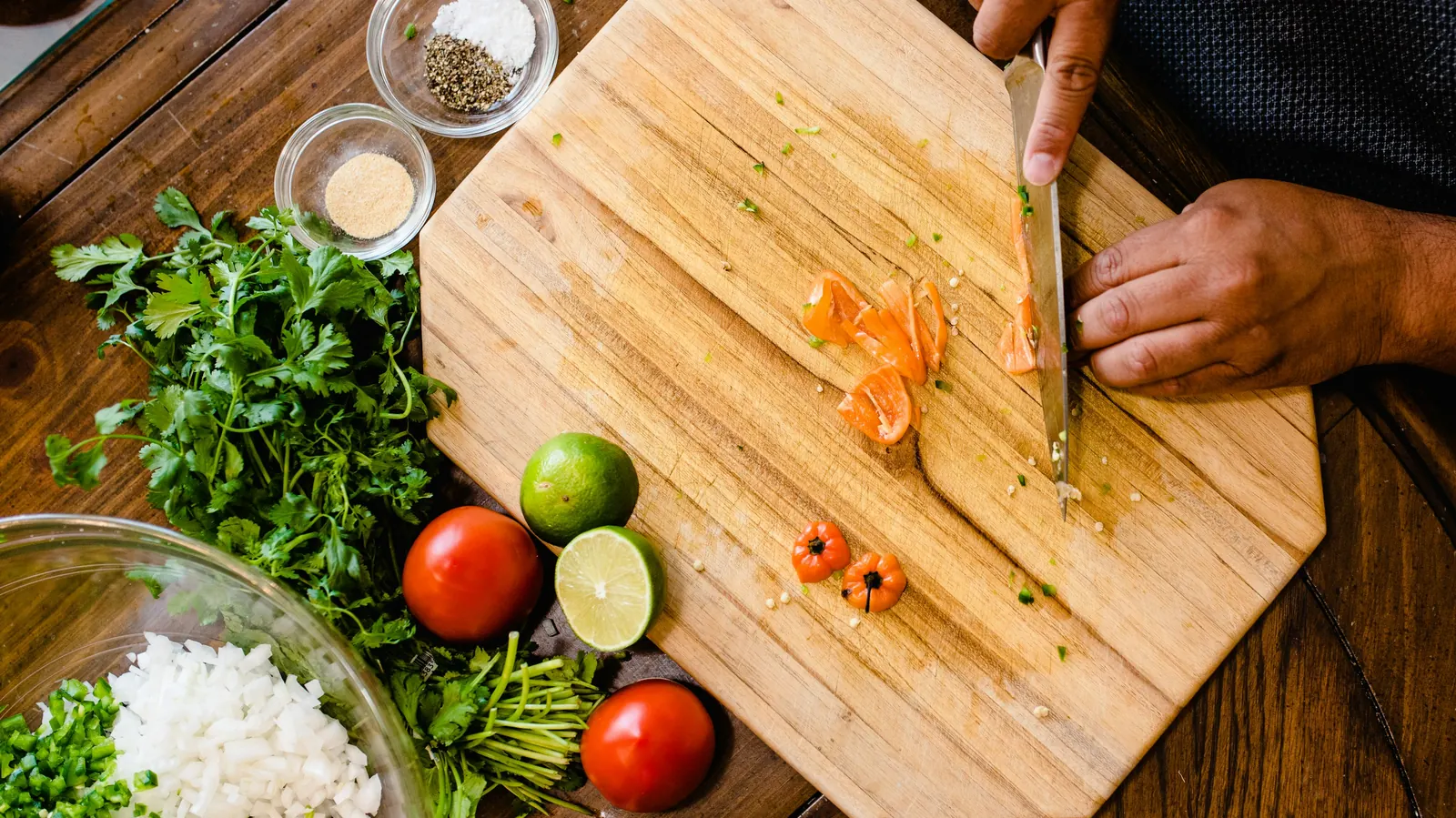
The gyuto is the Japanese chef’s knife: a long, thin, double-bevel blade with a flatter heel than a German chef’s knife and a fine point. It was built for the same jobs as a Western chef’s knife, meat, fish and vegetables, and in a Mexican kitchen that means slicing skirt steak for tacos, dicing a pile of white onion and tomato for pico de gallo, and chopping cilantro fine without bruising it.
This guide is narrower than our main best Japanese knife roundup, which covers santokus, nakiris and petty knives as well. Here we look only at gyutos of about 210 to 240 mm (8 to 9.5 inches), and we explain the two choices that matter most once you have settled on the shape: which steel, and whether you want a Japanese wa handle or a Western yo handle. None of that guide’s picks are repeated, and neither are the picks on our Japanese knife set, nakiri and paring knife pages.
Julia’s earns a commission on purchases made through links on this page, at no cost to you. Recommendations are based on what a restaurant kitchen looks for, product specifications and verified buyer reports.
Quick verdict: which gyuto to buy
For most home cooks, the best Japanese knife gyuto here is the Yaxell Mon 8-inch: a VG10 core clad in stainless, 61 HRC, an approximately 12-degree edge and a tough micarta Western handle, made in Seki. If you want a traditional octagonal handle and a lighter, blade-forward feel, choose the Yoshihiro AUS10 Wa Gyuto, 210 mm. If you will look after carbon steel and want a longer 240 mm blade, the Misono Swedish Steel Gyuto No. 113 is the one.
Below, five gyutos side by side, then all seven in full, then how to choose steel, length and handle.
Five gyutos compared
Our five standout gyutos, one per kind of cook, with the steel, length and handle style each maker or listing states. All seven are reviewed below.
| Gyuto | Best for | Steel & length | Handle | Buy on Amazon |
|---|---|---|---|---|

Yaxell Mon 8-inch GyutoBest overall
|
Most home cooks | Clad VG10, 61 HRC, 8 in | Yo, canvas micarta | View on Amazon |

Yoshihiro AUS10 Wa Gyuto, 210 mmBest wa handle
|
A light, traditional feel | AUS10 stainless, 61 HRC, 210 mm | Wa, octagonal ebony | View on Amazon |

Misono Swedish Steel Gyuto No. 113, 240 mmBest carbon steel
|
Big prep, cooks who maintain carbon | High-carbon tool steel, 240 mm | Yo, black reinforced wood | View on Amazon |

Yoshihiro Kurouchi SLD Stainless-Clad Gyuto, 210 mmBest wear-resistant steel
|
Long edge life with stain resistance | SLD core, stainless clad, 210 mm | Wa, octagonal | View on Amazon |

Shun Kanso 8-inch Chef’s KnifeMost rugged handle
|
Busy kitchens, simple care | AUS10A stainless, 8 in | Yo, tagayasan wood | View on Amazon |
Product images from Amazon. Steel, hardness, angle and length are listed only where the maker or its Amazon listing states them; check the listing before you buy.
Our picks for the best Japanese knife gyuto for a home kitchen
These seven gyutos run from 8 inches (about 200 mm) to 240 mm. They cover stainless, stainless-clad and carbon steels, wa and yo handles, and one all-steel handle, from established Japanese makers with model lines you can look up. Each review says who the knife suits, what its maker states, and one honest reason to pass.
1. Yaxell Mon 8-inch Gyuto – Clad VG10 With a Tough Micarta Handle
The Yaxell Mon is a plain-looking gyuto with a careful build underneath. Yaxell’s listing describes a 3-layer blade: a core of VG10, a cobalt-molybdenum-vanadium stainless steel, clad on both sides with stainless steel. That is the san-mai construction most good Japanese knives use; the harder core forms the edge, and the softer outer layers support it and make sharpening easier. Yaxell gives the core 61 Rockwell and grinds the edge to approximately 12 degrees.
The finish is sand-blasted, with a visible wavy line where the core meets the cladding, which Yaxell likens to a katana. It is a useful reminder that a good gyuto does not need a Damascus pattern. The handle is a Western yo style in black resin and linen canvas micarta with two stainless rivets, a material that copes well with wet hands and a damp kitchen towel.
In practice this is an all-round gyuto: thin enough to slice a ripe tomato without pressure, long enough to cut across a white onion, with a point for scoring jalapeños. Yaxell asks for washing with warm water and mild detergent. It is handcrafted in Seki City, Japan, with a limited lifetime warranty against manufacturing defects.
Why we like it
- VG10 core clad in stainless, per Yaxell
- Stated 61 HRC and about 12 degrees
- Water-tolerant canvas micarta handle
- Made in Seki City with a limited lifetime warranty
Key specifications
| Model | Mon 8-inch chef’s knife |
|---|---|
| Blade length | 8 inches |
| Steel | VG10 core |
| Construction | 3-layer, stainless clad |
| Hardness (stated) | 61 HRC |
| Edge angle | About 12 degrees |
| Handle style | Yo, canvas micarta, two rivets |
| Made in | Seki City, Japan |
Why we recommend it
It suits the cook moving from a German chef’s knife to a gyuto who wants a familiar Western handle, a stainless edge that does not need babying, and published specifications.
Skip it if you want a full 210 mm or longer blade; this is an 8-inch knife, at the short end of the gyuto range.
Pros and cons
Pros
- Complete published specifications
- Stainless throughout
- Durable handle material
Cons
- Fine 12-degree edge needs a gentle hand
- No model number on the listing
2. Yoshihiro AUS10 Wa Gyuto, 210 mm – Octagonal Ebony Handle and a Saya
This is a full 210 mm gyuto with a traditional wa handle: octagonal ebony with a triple ring, fitted on a hidden tang. Wa handles are lighter than riveted Western handles, so the balance sits farther toward the blade. Cooks who use a pinch grip, thumb and forefinger on the blade, often find that makes fine work like mincing garlic or slicing serranos into rings feel more precise.
Yoshihiro’s listing says the blade is forged from a single piece of high-carbon AUS10 stainless steel and ice hardened to 61 HRC, a process Yoshihiro says draws out hardness while keeping enough resilience. It describes a thin, light, double-edged blade, and the gyuto shape as a curved blade that rocks with an extended tip for quick chopping. A magnetic wood saya, the blade cover, is included.
Care is strict: Yoshihiro says to sharpen and hone only on water whetstones, hand wash and dry, immediately after acidic ingredients, and keep it away from bones, nutshells and frozen food. Lime and tomato are acidic, so that drying step matters in a salsa kitchen. The listing does not state the edge angle or warranty.
Why we like it
- Traditional octagonal ebony wa handle
- AUS10 stainless at a stated 61 HRC
- Magnetic wood saya included
- True 210 mm length
Key specifications
| Model | WP-PCNR-BNLX |
|---|---|
| Blade length | 210 mm (8.25 inches) |
| Steel | AUS10 stainless, ice hardened |
| Construction | Single piece of steel |
| Hardness (stated) | 61 HRC |
| Edge angle | Not stated (double-edged) |
| Handle style | Wa, octagonal ebony, triple ring |
| Made in | Not stated on listing |
Why we recommend it
It suits the cook who wants the traditional Japanese feel, a light knife with forward balance, in stainless steel that will not rust if a wet blade waits a few minutes.
Skip it if you like a defined finger position and a heavier handle; a wa handle feels very different from a riveted Western one.
Pros and cons
Pros
- Light, blade-forward balance
- Stainless, easier care than carbon
- Blade cover included
Cons
- Strict care rules from the maker
- Edge angle, warranty and origin not stated on the listing
3. Misono Swedish Steel Gyuto No. 113, 240 mm – Carbon Steel for Big Prep
Misono is a Japanese knife maker, and its Swedish steel line is its carbon-steel option. The listing for the No. 113 describes high-carbon, high-purity tool steel, a 9.4-inch (24 cm) blade, an overall length of 14.6 inches, a spine 2.3 mm thick and a weight of 8.5 ounces (240 g). The handle is black reinforced wood in a Western yo shape, and the knife is made in Japan.
A 240 mm blade earns its place when you prep in volume: slicing a whole flank steak for fajitas in long strokes, halving a big cabbage for curtido, or cutting a tray of tomatoes. It needs a large board, at least 18 inches long, and a little more confidence than a 210 mm knife.
Carbon steel is the choice for cooks who like an edge that takes a keen polish on a stone, and it comes with a responsibility. Misono’s listing for the same Swedish carbon line says plainly that carbon knives are not stain resistant. Lime juice, tomato and onion will darken the blade; that gray patina is normal, but red rust is not. Wipe the blade between ingredients, wash and dry it straight after use, and never leave it wet. The listing does not state the hardness, edge angle or construction.
Why we like it
- High-purity Swedish carbon steel, per Misono
- Full 240 mm length for volume prep
- Weight and spine thickness published
- Made in Japan
Key specifications
| Model | No. 113 |
|---|---|
| Blade length | 9.4 inches (24 cm) |
| Steel | High-carbon high-purity tool steel |
| Construction | Not stated on listing |
| Hardness (stated) | Not stated |
| Edge angle | Not stated |
| Handle style | Yo, black reinforced wood |
| Made in | Japan |
Why we recommend it
It suits the experienced cook who preps in volume, sharpens on stones and is happy to dry a knife after every lime.
Skip it if your knife ever sits wet in the sink or rack; carbon steel will rust where stainless would not.
Pros and cons
Pros
- Long blade for big batches
- Carbon steel that takes a fine edge on stones
- Western handle many cooks find familiar
Cons
- Not stain resistant; needs drying every time
- Hardness and angle not stated
- Too long for a small board
4. Yoshihiro Kurouchi SLD Stainless-Clad Gyuto, 210 mm – Hard-Wearing Core, Rustic Finish
This gyuto shows what the newer Japanese steels offer. Its core is High Performance SLD, which Yoshihiro describes as highly wear resistant, with hardness that rivals carbon steel and a high level of stain resistance. The core is clad in two layers of stainless steel, so the sides of the blade stay protected while the core forms the edge.
The upper blade has a kurouchi finish, the dark, rough forge scale left on traditional Japanese blades, which gives it a rustic look and, by contrast, makes the bright ground edge easy to see. The handle is a traditional octagonal wa handle, and Yoshihiro says the knife is made in Japan and not mass produced. The title includes a saya; the description calls the saya optional, so check what the listing includes when you order.
Yoshihiro gives the same care rules as for its AUS10 knife: water whetstones only, hand wash and dry, especially after acidic ingredients, and no bones, nutshells or frozen food. The listing does not state the hardness figure or edge angle.
Why we like it
- SLD core described as highly wear resistant and stain resistant
- Stainless cladding on both sides
- Traditional kurouchi finish and wa handle
- Made in Japan, per Yoshihiro
Key specifications
| Model | SLKUGY210EHMS |
|---|---|
| Blade length | 210 mm (8.25 inches) |
| Steel | High Performance SLD core |
| Construction | Clad in 2 layers of stainless, kurouchi finish |
| Hardness (stated) | Not stated |
| Edge angle | Not stated |
| Handle style | Wa, octagonal |
| Made in | Japan |
Why we recommend it
It suits the cook who wants a long-lasting edge closer to carbon steel without the rust worries, and who likes a traditional wa handle and rustic finish.
Skip it if you want a hardness figure and a clear accessory list before you buy; the listing leaves both unclear.
Pros and cons
Pros
- Wear-resistant core with stain resistance
- Protective stainless cladding
- Light wa handle
Cons
- Hardness and angle not stated
- Saya listed as both included and optional
- Strict care rules
5. Shun Kanso 8-inch Chef’s Knife – Plain Steel and an Iron-Wood Handle
Shun’s Kanso line strips the gyuto back to essentials. The listing describes a narrow, gyuto-style blade of AUS10A high-carbon stainless steel refined with vanadium, sharpened to a 16-degree edge. There is no Damascus pattern and no hammering, just a plain blade, which keeps it simpler to clean and to sharpen.
The handle is contoured tagayasan, a dense wood Shun calls “iron sword wood”, on a full tang. It is a Western-style yo handle, and Shun says it works for both left- and right-handed cooks. The butt doubles as a bottle opener and a hanging hook, a small detail that suits a cook who keeps the knife on a hook near the stove or takes it to a carne asada.
Like other Shun knives, it is handcrafted in Japan and comes with Shun’s free sharpening and honing service. The listing does not state a hardness figure. Keep it on wood or soft plastic boards and away from bones and frozen food, as with any thin Japanese blade.
Why we like it
- AUS10A stainless with a 16-degree edge
- Dense tagayasan handle on a full tang
- Free sharpening and honing from Shun
- Plain finish that is easy to keep clean
Key specifications
| Model | SWT0706 |
|---|---|
| Blade length | 8 inches |
| Steel | AUS10A high-carbon stainless |
| Construction | Full tang, plain finish |
| Hardness (stated) | Not stated on listing |
| Edge angle | 16 degrees |
| Handle style | Yo, contoured tagayasan |
| Made in | Japan |
Why we recommend it
It suits a busy home kitchen that wants a sturdy, no-fuss gyuto with a handle that shrugs off daily use and a maker who will sharpen it for you.
Skip it if you want a longer blade or a stated hardness; this is an 8-inch knife and the listing gives no HRC figure.
Pros and cons
Pros
- Simple, easy-care blade
- Dense, durable handle
- Free sharpening service
Cons
- Hardness not stated on the listing
- Short end of the gyuto range
6. Mac Chef Series 8-inch Chef’s Knife – A Thin, Light Gyuto Profile
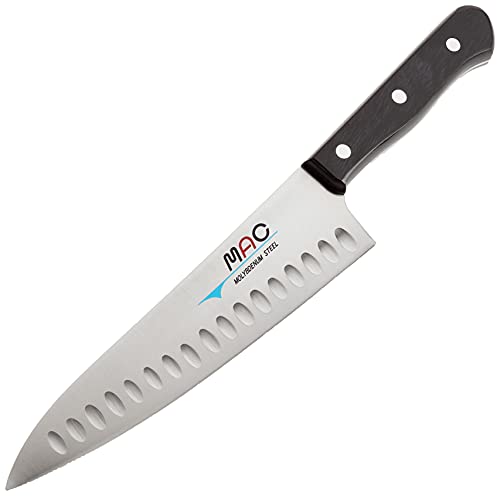
Mac’s Professional MTH-80 is the top pick on our main Japanese knife page. The Chef series TH-80 is a different knife: Mac describes it as similar to the MTH-80 but without the bolster and without the sub-zero tempered steel, with a gradual taper from heel to tip in the style of a gyuto. Mac’s own figures give a 7.88-inch blade, 2.0 mm thick, and a weight of 6.0 ounces, thinner and lighter than the Professional version’s 2.5 mm and 6.5 ounces.
A thin, light blade like this is what makes a gyuto feel quick: it falls through onions and peppers with little effort and does not tire the wrist over a long session of chopping for salsa. The Amazon listing describes Mac’s original molybdenum steel, which it says is rust resistant with good edge retention, a hollow edge with dimples, and a Pakka wood Western handle. It is made in Japan.
Mac recommends hand washing; it is not dishwasher safe. The listing does not state hardness or edge angle.
Why we like it
- 2.0 mm blade and 6.0-ounce weight, per Mac
- Gyuto-style taper from heel to tip
- Dimpled hollow edge, per the listing
- Made in Japan
Key specifications
| Model | TH-80 |
|---|---|
| Blade length | 7.88 inches (Mac); sold as 8-inch |
| Steel | Molybdenum steel |
| Construction | No bolster, 2.0 mm blade, dimpled |
| Hardness (stated) | Not stated |
| Edge angle | Not stated |
| Handle style | Yo, Pakka wood |
| Made in | Japan |
Why we recommend it
It suits the cook who wants the lightest, thinnest gyuto here with a familiar Western handle, and who values a nimble knife over a long one.
Skip it if you want the bolster and harder tempered steel of the Professional series; this is the simpler line.
Pros and cons
Pros
- Very thin and light
- Dimpled blade
- Established Japanese maker
Cons
- Under 200 mm, the shortest blade here
- Hardness and angle not stated
7. Global Model X 8-inch Chef’s Knife – All-Steel, Weighted Handle
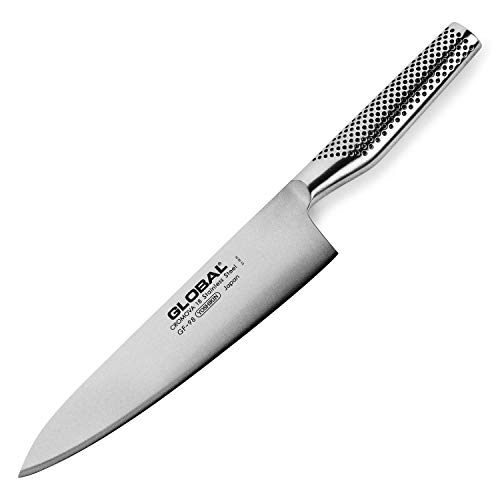
Global knives are the third handle style: neither wa nor wood yo, but stainless steel. The Model X has a wider blade of Cromova 18, a chromium-molybdenum-vanadium stainless steel made for Global, ice tempered and hardened to 56 to 58 Rockwell. That is softer than the other knives here, which makes it a little more forgiving of a twist and quicker to hone, at the cost of edge life.
The hollow stainless handle is filled with sand to set the weight and balance, and it carries Global’s signature dimples for grip. The listing gives a 2-inch blade height, a 4 mm spine, a 13.25-inch overall length and a weight of 9.2 ounces (262 g), heavier than any other gyuto on this list. That heft suits cooks who like the knife to do some of the work through a firm chayote or a bunch of carrots for escabeche.
It is made in Japan with a lifetime warranty. A smooth steel handle can feel slick with wet or oily hands, so dry your hands after rinsing produce. The listing does not state the edge angle beyond calling it a fine edge.
Why we like it
- One-material stainless build, no wood to crack
- Sand-weighted handle for balance, per Global
- Full dimensions and weight published
- Lifetime warranty
Key specifications
| Model | Model X (listed as Global Forged series) |
|---|---|
| Blade length | 8 inches |
| Steel | Cromova 18 stainless |
| Construction | 4 mm spine, hollow sand-filled handle |
| Hardness (stated) | 56–58 HRC |
| Edge angle | Not stated (“fine edge”) |
| Handle style | Stainless steel, dimpled |
| Made in | Japan |
Why we recommend it
It suits the cook who wants a heavier, all-steel gyuto that is easy to keep clean and a little more tolerant of rough use than the harder knives here.
Skip it if you want a light, thin gyuto; at 262 g with a 4 mm spine this is the heaviest knife on the list.
Pros and cons
Pros
- Seamless, hygienic handle
- More forgiving steel
- Lifetime warranty
Cons
- Heaviest and thickest here
- Steel handle can be slick when wet
- Softer steel needs honing more often
Gyuto steels, explained without the marketing
Almost every gyuto listing leads with its steel. Here is what the names on this page mean for a home cook.
Stainless: VG10, AUS10 and AUS10A
These are the common Japanese stainless steels. They hold a good edge at around 60 to 61 HRC, resist rust from lime, tomato and onion, and sharpen without much fuss on a stone. The Yaxell Mon, the Yoshihiro AUS10 and the Shun Kanso use them, and they are the sensible default for a first gyuto.
Newer wear-resistant steels: SLD
Steels such as the SLD in the Yoshihiro Kurouchi are engineered for wear resistance, so the edge lasts longer, while staying largely stain resistant. They take a little longer to sharpen.
Carbon steel
Carbon steels such as Misono’s Swedish steel take a very keen edge and are easy to sharpen, but they are not stain resistant. They darken with use and will rust if left wet. They reward cooks who wipe and dry the blade as they work.
Softer stainless: Cromova 18
Global’s steel sits at 56 to 58 HRC. It is more forgiving and quicker to hone, but it needs honing more often than harder steels.
Monosteel or clad
Some gyutos are one steel throughout (the Yoshihiro AUS10 is forged from a single piece). Others, like the Yaxell Mon and the Yoshihiro SLD, are clad: a hard core between softer stainless layers. Cladding supports the hard core and, with a carbon or semi-stainless core, protects the sides from rust. If you want a layered Damascus pattern on top of that, our main best chef knife guide includes a Damascus-clad option.
Wa or yo: choosing a gyuto handle
The handle changes how a gyuto feels more than almost anything else.
Wa handles
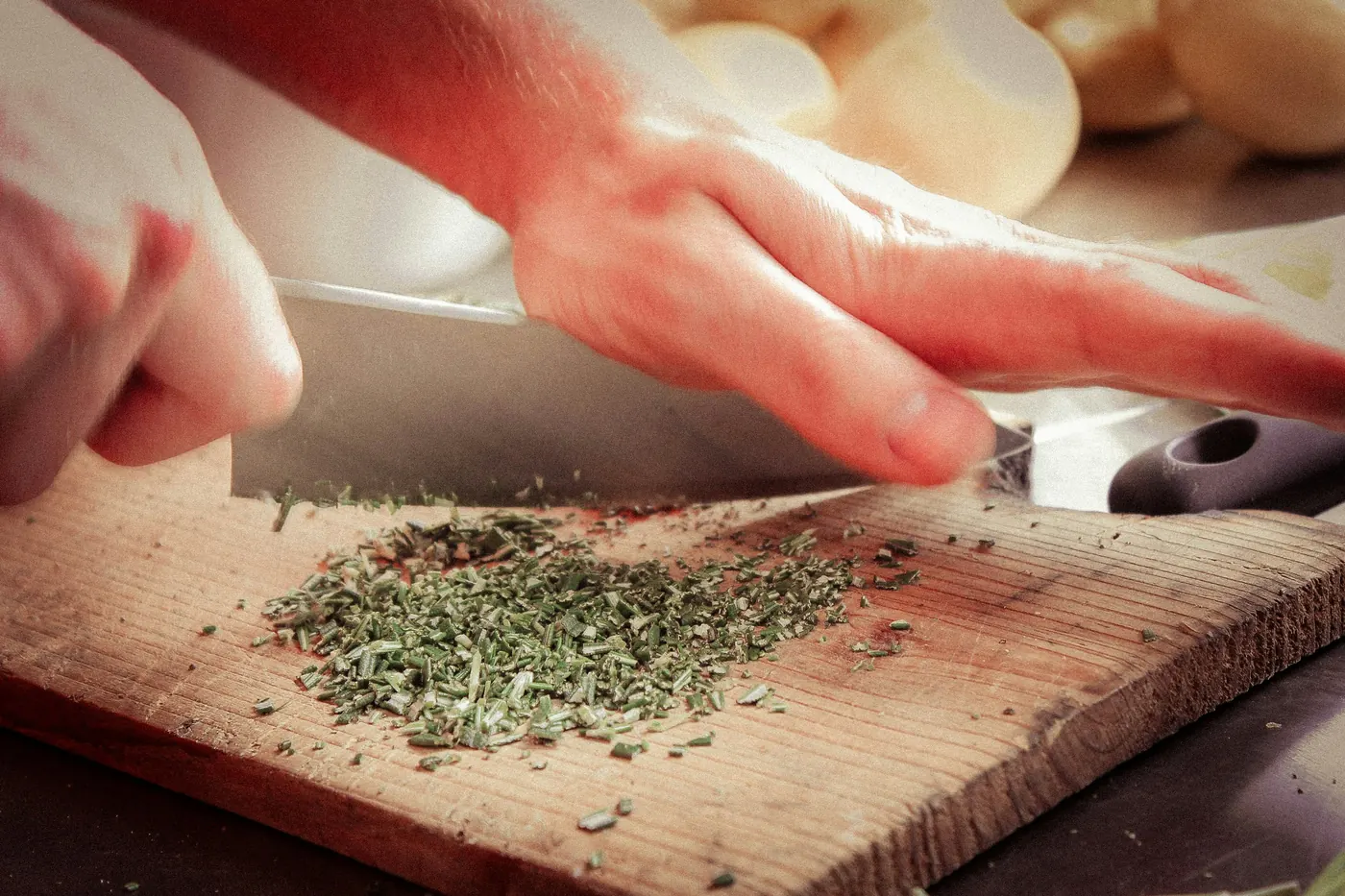
The traditional Japanese wa handle is usually octagonal or D-shaped wood, fitted over a hidden tang without rivets. It is light, so the balance point moves toward the blade. Knife retailers who sell both styles describe this as suiting the pinch grip and fine, controlled cuts. Octagonal wa handles are symmetrical, so they work for either hand. Both Yoshihiro knives here have one.
Yo handles
The Western yo handle is the riveted, full-tang handle you know from German knives, often in micarta, Pakka wood or another composite. It is heavier, moves the balance back toward your hand and gives your fingers a fixed resting place. Most cooks coming from a Western chef’s knife find it familiar straight away. The Yaxell Mon, Misono, Shun Kanso and Mac use yo handles.
All-steel handles
Global’s welded stainless handles are seamless and easy to clean, with dimples for grip. Some cooks love them; others find them slippery when wet.
How to choose a gyuto for your kitchen
1. Pick 210 mm unless you prep in volume
Japanese knife retailer Chef Knives To Go calls 210 mm the gyuto’s most versatile size and the one most cooks prefer, and 240 mm the go-to for serious home cooks and professionals. Western “8-inch” gyutos land at about 200 to 210 mm. A 240 mm knife needs a large board and pays off when you slice whole flank steaks or prep for a party.
2. Match the steel to how you clean up
If knives sometimes sit wet by the sink, buy stainless (Yaxell, Yoshihiro AUS10, Shun, Mac, Global). If you always wash and dry straight away, carbon or wear-resistant steels are worth considering.
3. Choose a handle you can hold wet
Micarta and dense wood grip well with wet hands. Try to hold a knife before you buy if you are unsure between wa and yo.
4. Plan for sharpening and honing
Thin Japanese edges are best kept on whetstones and a fine ceramic rod. See our guides to the best whetstone and the best honing steel for Japanese knives. Shun’s free sharpening service is a real help if you would rather not.
5. Keep it to the right jobs
A gyuto is for slicing, dicing and chopping on a wood or soft plastic board. Use a cleaver or heavier knife for chicken bones, frozen food and very hard squash.
How we chose these seven gyutos
We began with what a gyuto has to do in a Mexican kitchen, from fine-chopped cilantro and diced onion to thin-sliced beef, and looked for double-bevel gyutos of about 200 to 240 mm from established Japanese makers, sold on Amazon in the United States and in stock when we checked them with the Amazon Creators API. Specifications come from each maker’s Amazon listing and, for the Mac, Mac’s own product page; each review says what is stated and what is not. We used Chef Knives To Go’s gyuto guide for sizes and knife retailers’ guides for wa and yo handle balance. We checked the U.S. Consumer Product Safety Commission’s recall list for each brand and found no kitchen-knife recalls. To keep this page distinct, we left out every knife on our main Japanese knife guide and on our Japanese knife set, nakiri and paring knife pages, so the Mac Professional, Misono UX10, Miyabi Kaizen and the Shun Sora (part of a set we cover) are not here. Several fine gyutos from Masamoto, Sakai Takayuki and Tojiro were left out only because they were out of stock or in short supply when we checked, so this list stops at seven rather than padding with unknown brands. We have not cut with these knives ourselves; where we describe performance, we say whose description it is.
Gyuto questions, answered
What is the best Japanese gyuto knife brand?
There is no single best brand. Yaxell, Yoshihiro, Misono, Shun, Mac and Global all make well-regarded gyutos in Japan. Choose by steel, length and handle first, then pick the maker whose knife fits those choices.
Is a gyuto better than a German chef’s knife?
Not better, different. A gyuto is usually thinner and harder, with a flatter profile and finer edge, so it slices more cleanly but chips more easily if twisted or used on bone. A German knife is heavier and more forgiving.
Should I buy a 210 mm or 240 mm gyuto?
For most home cooks, 210 mm. Choose 240 mm if you have a large board and often prep in volume.
Which is better, a wa or yo handle?
Neither. A wa handle is lighter with forward balance; a yo handle is heavier and more familiar to Western cooks. If you have only used German knives, a yo-handled gyuto is the easier switch.
Which of the best Japanese knives gyuto buyers can choose needs the least care?
A stainless gyuto with a synthetic or dense-wood handle, such as the Yaxell Mon or Shun Kanso. Even these should be hand washed and dried; none of the gyutos here is described as dishwasher safe.
Our final pick for a gyuto
Buy the Yaxell Mon if you want a stainless, well-specified gyuto with a Western handle, the Yoshihiro AUS10 if you want a traditional wa handle at a full 210 mm, and the Misono Swedish steel if you prep in volume and will look after carbon steel. For a gyuto in a set, see the best Japanese knife set; for the other Japanese shapes, start with our main best Japanese knife guide, then the best Japanese nakiri and the best Japanese paring knife.
A sharp gyuto makes short work of a salsa base; our guide to salsa roja and salsa verde explains what goes into each. And if you would rather leave the chopping to us tonight, see the menu or call to order.