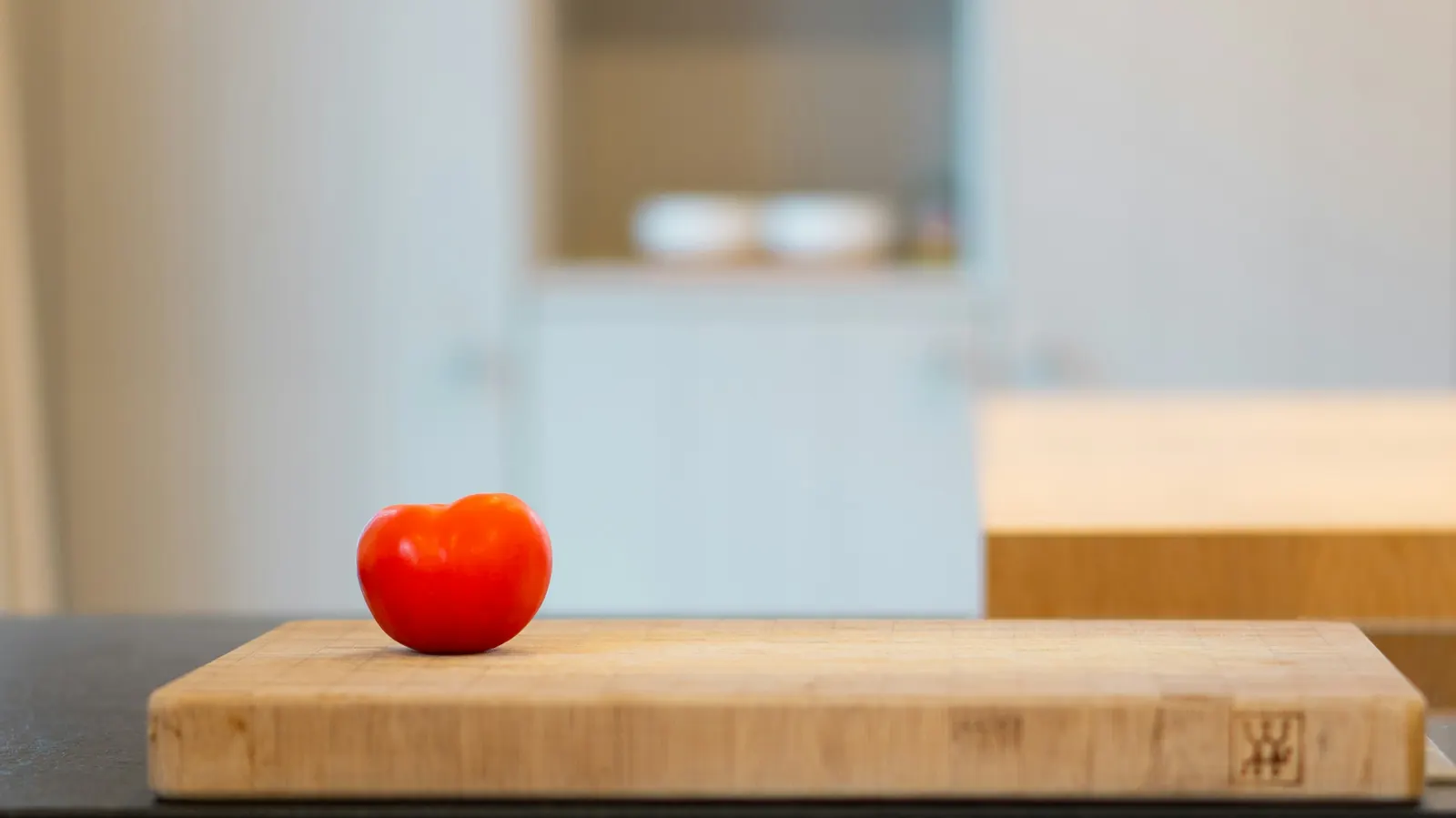
End-grain boards are the ones built like a checkerboard, from short blocks of wood standing on end. Makers say the knife edge slips between the wood fibers instead of slicing across them, which is kinder to sharp knives and hides cut marks. They are also slower to make, use more wood and usually cost a good deal more than an ordinary edge-grain board.
This guide looks for the cheapest honest way into end grain: the entry board in each identifiable maker’s end-grain range, whether that means a less expensive wood, a smaller size or a simpler design. We name seven boards, explain where each one saves money and what that costs you, and set out the care end grain needs, which is more than most people expect.
Julia’s earns a commission on purchases made through links on this page, at no cost to you. Recommendations are based on what a restaurant kitchen looks for, product specifications and verified buyer reports.
Quick verdict: which budget end-grain board to buy
For most kitchens, the best cheap end grain cutting board is the Ironwood Gourmet Oslo End Grain Board, 16 x 14 inch: 100% end-grain acacia at a useful prep size, with clear care instructions from the maker. If you want a handmade board with non-slip feet, choose the Larch Wood Canada End Grain Small Board; if you want American maple from the best-known butcher-block maker, the John Boos CCB End Grain Block, 12 x 12 inch.
Below, the five standouts side by side, then all seven boards in full.
Five budget end-grain boards at a glance
Our five standout picks, one for each kind of cook, with the wood, size and thickness each maker or listing states. All seven boards are reviewed in full below.
| End-grain board | Best for | Wood & size | Thickness | Buy on Amazon |
|---|---|---|---|---|
| First end-grain board | Acacia, 15.75 x 14 in | 1 in | View on Amazon | |
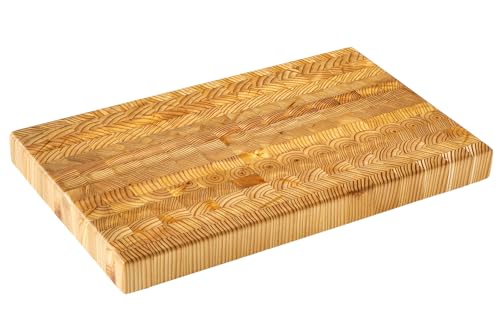
Larch Wood Canada End Grain Small BoardBest handmade
|
Daily chopping, good knives | Larch, 17.75 x 11 in | 1.5 in | View on Amazon |
| American maple butcher block | Maple, 12 x 12 in | 3 in | View on Amazon | |
| Big batches of prep | Acacia, 20 x 14 in | 1.25 in | View on Amazon | |

Ziruma Acacia End Grain Board, 16 x 11 inchNo mineral oil
|
Beeswax-finished board | Acacia, 16 x 11 in | 1.5 in | View on Amazon |
Product images from Amazon. Woods, sizes and thicknesses are as stated by each maker or listing; check the listing before you buy.
Our picks for the best cheap end grain cutting board
These seven boards are the entry points of their makers’ end-grain ranges. Most save money with acacia instead of maple or walnut; the others are the smallest size their maker sells, or come from newer brands. Two boards are smaller sizes of boards we recommend elsewhere: the Larch Wood Canada Small (its Medium is on our main wood guide) and the 12-inch John Boos CCB block (its 20 by 15 inch sibling leads our end-grain guide). We include them because they are those makers’ entry points into end grain. For the full-size end-grain boards these come down from, see our guide to the best wood cutting board end grain.
1. Ironwood Gourmet Oslo End Grain Board, 16 x 14 inch – Simple End Grain at a Useful Size

Ironwood Gourmet is the brand most people meet first when they look for affordable end grain, and its acacia boards appear in several of our cutting board guides. The Oslo is its plain utility board: 100% end-grain acacia, 15.75 by 14 inches and one inch thick, according to the listing.
That size is the sweet spot for a first end-grain board. It is big enough for an onion, a couple of tomatoes and a handful of chiles for a batch of salsa, and at an inch thick it is light enough to lift into the sink, which is not true of most end-grain blocks. Ironwood says end grain minimizes wear on both the knife and the board, and pitches the Oslo as a prep station, cutting block and serving board.
Care is spelled out on the listing: hand wash in warm soapy water, dry immediately, do not soak it or store it somewhere humid, and periodically apply butcher block oil to keep the luster and minimize cracking. That last point matters with a one-inch board, which has less wood to absorb swings in moisture than a thick block.
Why we like it
- 100% end-grain acacia, per the listing
- Prep-sized surface at a liftable thickness
- Clear care instructions from the maker
- Doubles as a serving board
Key specifications
| Model | 28734 |
|---|---|
| Wood | Acacia |
| Size | 15.75 x 14 in |
| Thickness | 1 in |
| Weight | Not stated |
| Feet or groove | Not stated |
| Made in | Not stated |
| Care | Hand wash, dry at once, oil periodically |
Why we recommend it
It suits cooks who want to try end grain for everyday prep without buying a heavy, thick block.
Skip it if you want a heavy board that never moves: at one inch thick it is lighter than most end grain, so it may need a damp towel underneath.
Pros and cons
Pros
- True end grain at a useful size
- Easy to wash
- Published care routine
Cons
- Thin for end grain
- Weight and origin not stated
- Needs regular oiling
2. Larch Wood Canada End Grain Small Board – Handmade, on Rubber Feet
Larch Wood makes end-grain boards by hand in Margaree, Nova Scotia, from eastern Canadian larch, according to the listing. Its Standard Line is the less expensive of its two lines, and the Small board is that line’s way in. It measures 17.75 by 11 inches, 1.5 inches thick, and weighs 6.5 pounds.
The narrower width is the saving: it is the same length as the Medium board on our main wood guide, which is why we have included a different size from the same line. A long, narrow board still gives you room to dice down its length, and Larch Wood says the end grain gives a smooth, impact-resistant surface that is kind to knives, suitable for busy commercial kitchens and daily home use.
Soft rubber feet, fixed with stainless steel screws, keep the board from slipping and lift it so you can get your fingers underneath. The Standard Line shows more of the wood’s character than the premium line: small knots and colors from pink to green and gray to dark brown. The listing does not give care instructions; hand wash it, dry it standing up and oil it when it looks dry.
Why we like it
- Handmade in Nova Scotia, per the listing
- Rubber feet on stainless steel screws
- 1.5 inches thick at 6.5 pounds
- Designed for commercial and home kitchens, per the maker
Key specifications
| Model | SM2 |
|---|---|
| Wood | Eastern Canadian larch |
| Size | 17.75 x 11 in |
| Thickness | 1.5 in |
| Weight | 6.5 lb |
| Feet or groove | Rubber feet |
| Made in | Nova Scotia, Canada |
| Care | Not stated on listing |
Why we recommend it
It suits cooks with good knives who want a handmade end-grain board that stays put but is light enough to move.
Skip it if you want a reversible board: the feet mean only one side is for cutting.
Pros and cons
Pros
- Handmade end grain
- Non-slip feet
- Stated size and weight
Cons
- One cutting side
- Knots and color variation on this line
- No care guidance on the listing
3. John Boos CCB End Grain Block, 12 x 12 inch – Boos Maple in Its Smallest Size
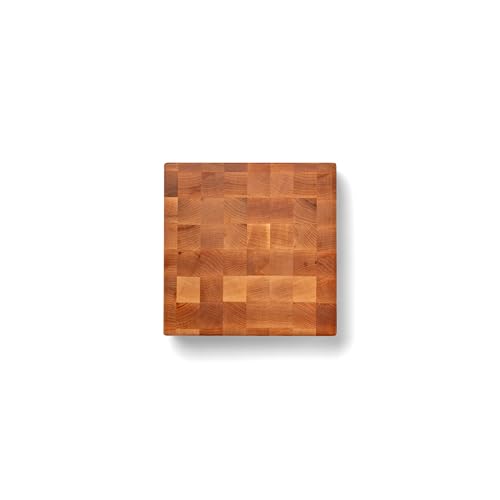
John Boos has made butcher blocks since 1887, according to its listings, and its CCB end-grain maple blocks are the classic American chopping block. The large 20 by 15 inch CCB board leads our end-grain guide. This is the same series in its smallest size: 12 by 12 inches and a full three inches thick.
The small footprint is where the saving comes from, and it changes how you use the board. It is a chopping block rather than a prep board: the place to mince garlic and chiles, chop a bunch of cilantro, break down a chicken thigh or smash a clove of garlic under a cleaver, with three inches of maple taking the blows. It is reversible, with recessed finger grips and an oil finish, and Boos says the level surface suits your finest cutlery.
Care follows the Boos routine: hand wash only, then Boos Block Mystery Oil and Board Cream, sold separately. Boos’s care page asks for oil at least once a month. The listing calls the products American-made.
Why we like it
- End-grain maple from a maker in business since 1887
- Three inches thick: built for heavy chopping
- Reversible, with recessed finger grips
- American-made, per the listing
Key specifications
| Model | CCB121203 |
|---|---|
| Wood | Maple |
| Size | 12 x 12 in |
| Thickness | 3 in |
| Weight | Not stated |
| Feet or groove | Neither; recessed finger grips |
| Made in | USA |
| Care | Hand wash; oil at least monthly |
Why we recommend it
It suits cooks who want real Boos end-grain maple and mostly need a block for mincing, chopping and small butchery jobs.
Skip it if you want one board for all your prep: 12 inches square is too small for a full batch of salsa.
Pros and cons
Pros
- Very thick, stable block
- Made in the USA
- Reversible
Cons
- Small surface
- Monthly oiling
- Oil and cream sold separately
4. Ironwood Gourmet End Grain Prep Station, 20 x 14 inch – Full-Size End Grain in Acacia

If you want a full-size end-grain board and do not want to pay for maple or walnut, this is the one. Ironwood’s large end grain prep station is 20 by 14 inches and 1.25 inches thick, made from 100% acacia, according to the listing, and this listing bundles it with an 8-ounce bottle of Ironwood’s food-grade mineral oil. That is the biggest surface on this page.
Twenty inches of length gives each ingredient its own space: onion at one end, tomato and chile in the middle, cilantro at the other, with room left to slice a rested steak. Ironwood describes this one as a prep station, cutting board and serving board in one, sized for carving a cut of meat. The listing does not mention a juice groove, so use it for prep rather than carving very juicy meat.
Care, per Ironwood: hand wash in warm soapy water, dry immediately, do not soak it or store it somewhere humid, and oil it periodically, with the included oil, to keep the luster and avoid cracking. A board this size is awkward in a small sink, so measure before you buy.
Why we like it
- 20 x 14 inches of end grain
- 1.25 inches thick
- Acacia keeps the cost down
- Mineral oil included
Key specifications
| Model | 28408 (board with 8 oz oil) |
|---|---|
| Wood | Acacia |
| Size | 20 x 14 in |
| Thickness | 1.25 in |
| Weight | Not stated |
| Feet or groove | Not stated |
| Made in | Not stated |
| Care | Hand wash, dry at once, oil periodically |
Why we recommend it
It suits cooks who prep in volume and want end grain across a full-size board.
Skip it if your sink is small: a 20-inch board is hard to wash in one.
Pros and cons
Pros
- Largest surface here
- Full-size end grain without maple’s cost
- Doubles as a serving board
Cons
- No groove stated
- Bulky to wash
- Weight not stated
5. Ziruma Acacia End Grain Board, 16 x 11 inch – Thick Board, Beeswax Finish
Ziruma is a newer brand that sells mainly on Amazon, and it makes a point of finishing its boards without mineral oil. This end-grain board is FSC-certified acacia, 16 by 11 inches and 1.5 inches thick, and it arrives pre-seasoned with a blend of beeswax, flaxseed oil and lemon oil, according to the listing.
At 1.5 inches it is half an inch thicker than the Ironwood Oslo, and Ziruma says that thickness helps it stay flat and steady under heavy chopping. The 16 by 11 inch surface is a good everyday size for a cutting board you will reach for most days.
Ziruma’s listing argues hard against mineral oil, calling it a petroleum byproduct. Be aware that the University of Maine Cooperative Extension recommends food-safe mineral oil or beeswax for wooden boards, so this is a preference rather than a safety issue. If you like the idea of a plant-and-beeswax finish, keep it up with a beeswax board cream; if not, any food-safe board oil will do. The listing does not state origin, weight, warranty or detailed care.
Why we like it
- FSC-certified acacia, per Ziruma
- 1.5 inches thick
- Pre-seasoned with beeswax and plant oils
- Everyday 16 x 11 inch size
Key specifications
| Model | ZAWDEGMAGL1 |
|---|---|
| Wood | FSC-certified acacia |
| Size | 16 x 11 in |
| Thickness | 1.5 in |
| Weight | Not stated |
| Feet or groove | Not stated |
| Made in | Not stated |
| Care | Not stated; pre-seasoned |
Why we recommend it
It suits cooks who want a thick end-grain board with a beeswax and plant-oil finish rather than mineral oil.
Skip it if you want a long-established maker: Ziruma is a newer, Amazon-focused brand and its listing leaves out warranty and origin.
Pros and cons
Pros
- Thick for the price tier
- No mineral oil in the finish
- FSC-certified wood
Cons
- Warranty and origin not stated
- Marketing overstates the case against mineral oil
- No care guide on the listing
6. Larch Wood Canada End Grain Round Board, 14.5 inch – Round Board for Small Counters

This is the second Larch Wood board here, a different model from the rectangular boards, and we include it because a round shape makes end grain work in a small kitchen. The Round Board Classic in the Standard Line is 14.5 inches across, 1.6 inches thick and weighs 6.5 pounds, handmade in Margaree, Nova Scotia, from eastern Canadian larch.
Larch Wood says the large surface handles most chopping jobs while still fitting kitchens with limited counter space, and a round board tucks into a corner where a rectangle will not. It is also a natural serving board for a stack of warm tortillas, sliced carne asada and a bowl of salsa in the middle of the table.
As with the Small board, the end-grain construction is described as smooth, impact-resistant and kind to knives, and the Standard Line shows knots and color variation. The listing does not say whether it has feet or give care instructions.
Why we like it
- Handmade end grain, per the listing
- Round shape for small counters
- 1.6 inches thick at 6.5 pounds
- Works as a serving board
Key specifications
| Model | RD2 |
|---|---|
| Wood | Eastern Canadian larch |
| Size | 14.5 in round |
| Thickness | 1.6 in |
| Weight | 6.5 lb |
| Feet or groove | Not stated |
| Made in | Nova Scotia, Canada |
| Care | Not stated on listing |
Why we recommend it
It suits cooks with a small counter who want a handmade end-grain board that also serves at the table.
Skip it if you dice long rows of vegetables: a round board has less usable length than a rectangle.
Pros and cons
Pros
- Fits tight spaces
- Handmade in Canada
- Stated weight and thickness
Cons
- Less length for dicing
- Feet not stated
- No care guidance on the listing
7. BABILONIA Walnut End Grain Board, 16 x 10 inch – American Walnut With a Scraping Notch

End-grain walnut boards are usually the most expensive kind. BABILONIA, a brand that sells mainly on Amazon and describes itself as created in Italy, offers this smaller one: black walnut grown in the USA, end grain, about 15.7 by 10.2 inches and 1.7 inches thick, according to the listing.
Its design has a notch at one end with a plate, so you can slide chopped onion or chiles straight into a pot or bowl without lifting the board. The board is reversible, with a hidden handle, so the back can be used as a serving tray. A bottle of oil comes in the box, and the board arrives seasoned and pre-oiled.
BABILONIA says to hand wash with mild soap and warm water, keep it out of the dishwasher and store it somewhere cool and dry. The listing states a two-year warranty and a money-back guarantee. It does not say where the board is made, only where the walnut is grown.
Why we like it
- End-grain black walnut, grown in the USA, per the listing
- 1.7 inches thick
- Notch and plate for sliding food into a pot
- Two-year warranty stated
Key specifications
| Model | BABWSM2301 |
|---|---|
| Wood | American black walnut |
| Size | 15.7 x 10.2 in |
| Thickness | 1.7 in |
| Weight | Not stated |
| Feet or groove | Notch with plate; hidden handle |
| Made in | Not stated (walnut grown in USA) |
| Care | Hand wash, mild soap; store cool and dry |
Why we recommend it
It suits cooks who want end-grain walnut without paying for a large workshop board.
Skip it if you prefer an established maker: BABILONIA is an Amazon-focused brand and the listing does not state where the board is made.
Pros and cons
Pros
- Walnut end grain at a smaller size
- Thick and steady
- Oil included
Cons
- Country of manufacture not stated
- Notch takes some cutting space
- Newer brand
What a lower price gives up in an end-grain board
End grain is expensive because it takes more wood and more labor: John Boos says end-grain boards are more labor intensive to build and can be more costly. When a board in this style costs less, the saving has to come from somewhere.
- The wood. Acacia replaces maple and walnut in the Ironwood and Ziruma boards. It is a hardwood and makes a perfectly good end-grain board, but it does not carry maple’s reputation.
- Thickness. Several premium boards in our main end-grain guide are two inches thick or more. The Ironwood Oslo is one inch. A thin end-grain board is lighter and easier to wash, but it has less mass to stay put and less wood to absorb changes in moisture, which is why Ironwood stresses oiling to prevent cracking.
- Size. The John Boos and Larch Wood boards here are their makers’ smallest. You get the full-quality product in less of it.
- Extras. Feet, deep grooves and sorting wells add cost. Most boards here have none; the Larch Wood Small board is the exception with feet.
- Warranty and published detail. BABILONIA states two years; most others here state none on the listing. Established makers such as Boos and Larch Wood publish weights and origins; newer brands often do not.
How to choose a budget end-grain board
1. Decide whether you need end grain at all
Makers say end grain is kinder to knives and hides cut marks. It also needs more oil and is heavier. If you mainly want a reliable wooden board, a good edge-grain board costs less and asks less of you; see our guide to the best cutting board wood.
2. Choose the wood
Acacia is the usual budget end grain. Maple is the classic and the most expensive per inch here. Larch is unusual, handmade in Canada by a specialist. Walnut is darker and softer and normally the dearest, so expect a smaller board for the money.
3. Thickness against weight
Around 1.5 inches is a good balance for a home end-grain board: steady, but liftable. One-inch boards are easier to wash; three-inch blocks are for heavy chopping and stay on the counter.
4. Feet or reversible
Feet stop a board sliding and let air under it to dry, but you only get one cutting side. Reversible boards give you two surfaces and rely on weight, or a damp towel, to stay put.
5. Make sure it really is end grain
A true end-grain board shows a checkerboard of small blocks with ring patterns on the cutting face. Some listings use “butcher block” for any thick board; look at the photos, and at the maker’s own description, before you buy.
End-grain care and food safety
End grain drinks oil. John Boos says end-grain boards may need more oiling to keep their appearance and to stop them drying out over repeated washing, and its care page asks for oil at least once a month. The University of Maine Cooperative Extension recommends food-safe mineral oil or beeswax about once a month, advises against olive or vegetable oil because they can turn sticky and rancid, and notes that wooden boards may warp in a dishwasher. For which oil to buy, see our guide to the best cutting board oil.
For cleaning, the USDA Meat and Poultry Hotline’s tips, published by the University of Wisconsin Extension, say to wash boards with hot, soapy water after each use, keep one board for raw meat, poultry and seafood, sanitize with 1 tablespoon of regular chlorine bleach per gallon of water left for at least a minute, and replace boards with cracks, chips or grooves. Maine’s extension guide gives a gentler wood method: half a teaspoon of unscented bleach per quart of water, one minute, then wipe dry. Ironwood adds: never soak the board.
How we chose these seven end-grain boards
We looked for the entry board in each identifiable maker’s end-grain range sold on Amazon in the United States, checked stock with Amazon’s product data before writing, and read each listing for wood, size, thickness, weight, feet, origin, warranty and care; where a listing says nothing, we write “not stated”. John Boos’s end grain vs edge grain article supplied the construction and care background, and food-safety advice comes from the University of Maine Cooperative Extension and the USDA hotline tips published by the University of Wisconsin Extension. We left out every board already recommended on our other cutting board guides, Lipper International’s acacia end-grain boards (limited stock when we checked), Catskill Craftsmen (no end-grain boards in stock on Amazon), Teakhaus (its in-stock end-grain boards are full-size models, not an entry tier), bamboo boards, and sellers we could not identify. We searched the U.S. Consumer Product Safety Commission’s recall database for each brand and found no cutting board recalls. We have not used these boards ourselves.
Budget end-grain questions, answered
What is the best affordable end grain cutting board?
For most kitchens, the Ironwood Gourmet Oslo: true end-grain acacia at a useful 15.75 by 14 inch size, with clear care instructions from the maker.
Is a cheap end-grain board worth it over edge grain?
If you have good knives and chop a lot, yes; makers say end grain is gentler on edges. If you mostly want a low-fuss board, edge grain is cheaper and needs less oil.
What is the best budget end grain cutting board for heavy chopping?
The John Boos CCB block. At three inches thick it is built for cleaver work, though at 12 inches square it is small.
Is acacia good for an end-grain board?
It is the most common wood for lower-cost end-grain boards. Care is the same as any end grain: hand wash, dry at once, oil often.
Why do end-grain boards crack?
Mostly from water and drying out. Ironwood says not to soak its boards or store them somewhere humid, and to oil them periodically to minimize cracking.
Our final pick for end grain on a budget
Buy the Ironwood Gourmet Oslo if you want a simple first end-grain board. Choose the Larch Wood Small board for a handmade board on feet, the John Boos CCB block for American maple at its smallest, and the Ironwood Prep Station if you need room. For the full-size premium boards, see the best wood cutting board end grain guide; for plastic and lighter wooden boards, our best cutting board budget picks.
For what to do with a board full of chopped tomatoes and chiles, see salsa roja vs salsa verde. And if you would rather leave the chopping to us tonight, see the menu or call to order.