A dull knife is the most common problem in a home kitchen, and the cheapest fix is a small manual sharpener that lives in a drawer. You draw the blade through a slot a few times, rinse it, and the onion for your pico de gallo stops sliding away from the edge. No plug, no water bath, no hour with a stone.
This guide sticks to manual sharpeners at the entry tier of each maker’s range: pull-through slots, handheld carbide tools and one small wheel sharpener, from Work Sharp, KitchenIQ, Chef’sChoice, Lansky, AccuSharp, Smith’s, Mercer, KitchenAid and Rada. We do not quote prices, because they change daily. Instead, for each sharpener we say what the abrasive is, what angle the maker states and what you give up against the electric machines and stones in our main guide. Every sharpener was in stock on Amazon when we checked.
Julia’s earns a commission on purchases made through links on this page, at no cost to you. Recommendations are based on what a restaurant kitchen looks for, product specifications and verified buyer reports.
Quick verdict: which cheap knife sharpener to buy
Buy the Work Sharp Pull Through Kitchen Sharpener: diamond for the coarse stage rather than carbide, a 20-degree guide, serrated blades and shears covered, and a three-year warranty from the maker. If you want the plainest tool that still does the job, the KitchenIQ Edge Grip 2-Stage hooks over the edge of the counter and carries a one-year warranty. For Japanese knives sharpened at 15 degrees, choose the AccuSharp Gourmet 15-Degree.
Below are five standout sharpeners side by side, all nine in detail, what you give up by buying a cheap manual sharpener and how to judge value without looking at a price tag.
Five budget sharpeners compared
One sharpener for each kind of cook, with the abrasive and angle each maker or listing states. All nine are reviewed in full below.
| Sharpener | Best for | Abrasive | Angle | Buy on Amazon |
|---|---|---|---|---|

Work Sharp Pull Through Kitchen SharpenerBest overall
|
Most home knife blocks | Diamond, ceramic hone | 20 degrees | View on Amazon |

KitchenIQ Edge Grip 2-Stage SharpenerSimplest pick
|
Quick touch-ups | Carbide, ceramic rods | Preset, not stated | View on Amazon |
Chef’sChoice 478 Diamond Hone Manual SharpenerBest all-diamond
|
German-style knives | Diamond, both stages | 20 degrees | View on Amazon |

Lansky QuadSharp 4-Angle SharpenerBest for mixed knives
|
Kitchen and outdoor blades | Carbide, ceramic stone | 17, 20, 25, 30 degrees | View on Amazon |

AccuSharp Gourmet 15-Degree SharpenerBest for 15-degree knives
|
Thin Japanese edges | Diamond-honed carbide | 15 degrees | View on Amazon |
Product images from Amazon. Abrasives, angles and warranties are as stated by the maker, a named retailer or the Amazon listing; “not stated” means we could not find the figure. Check the listing before you buy.

Our picks for the best knife sharpener cheap enough for any drawer
The first five are the comparison picks; the last four cover particular needs, from replaceable parts to a sharpener made in the United States. None repeats a sharpener from our other sharpening guides.
1. Work Sharp Pull Through Kitchen Sharpener – Diamond Coarse Stage at 20 Degrees
Work Sharp is better known for its belt and guided sharpeners, two of which appear in our main best knife sharpener guide. This pull-through (model WSKTNPTS) is the entry point to the same maker’s kitchen range: a small countertop body with a coarse slot to bring back a dull edge and a fine slot to refine it.
The point Work Sharp makes on the listing is the abrasive. Many cheap pull-throughs use crossed carbide blades, which scrape metal off the edge. Work Sharp uses diamond for the coarse stage and says it grinds the edge evenly instead of tearing it. On its own product page, the maker lists a 320-grit diamond sharpening wheel, a fine ceramic honing wheel and a fine diamond plate for scissors. Several retailers give the guide angle as 20 degrees, which matches most German and American kitchen knives.
The listing names chef’s, paring, utility and serrated kitchen knives and shears. In a Mexican kitchen that covers the chef’s knife for onions and chiles, the paring knife for limes and the serrated knife for tomatoes. Work Sharp advertises a three-year warranty on its page, the longest stated here except Rada’s lifetime guarantee. What you give up against the electric Work Sharp in our main guide is angle choice and speed on a badly damaged edge.
Why we like it
- Diamond coarse stage, not carbide, per the listing
- Ceramic honing wheel for the fine stage, per Work Sharp
- Serrated knives and shears covered
- Three-year warranty on the maker’s page
Key specifications
| Model | WSKTNPTS |
|---|---|
| Type | Countertop pull-through |
| Stages | 2 (coarse, fine) plus scissor plate |
| Abrasive | 320-grit diamond, fine ceramic |
| Angle | 20 degrees (retailer listings) |
| Serrated blades | Yes, per the listing |
| Size | Not stated |
| Warranty | 3 years (Work Sharp) |
Why we recommend it
It suits a home cook with a block of ordinary Western knives who wants one small tool for everything, including serrated blades and shears.
Skip it if most of your knives are Japanese and sharpened at 15 degrees; a 20-degree guide will put a wider edge on them.
Pros and cons
Pros
- Diamond rather than carbide
- Handles serrated knives and scissors
- Long stated warranty
Cons
- One fixed angle
- Dimensions not on the listing
2. KitchenIQ Edge Grip 2-Stage Sharpener – Hooks Over the Counter Edge
KitchenIQ’s Edge Grip (model 50009) is the kind of sharpener that sits in a utensil drawer for years. It has two slots: a carbide coarse stage for dull or damaged knives and ceramic rods for polishing and quick touch-ups on knives that are already fairly sharp.
The detail that sets it apart is the patented V-shaped notch on the base. KitchenIQ says you set it over the edge of a table or counter, so the tip of a long chef’s knife hangs past the edge instead of dragging across the countertop. The bottom is non-slip, and the angles are preset, though the listing does not say what they are.
The listing covers straight and serrated knives and states a one-year limited warranty. Used gently, the ceramic slot is a quick way to bring back a knife before you slice skirt steak for tacos. The carbide slot removes metal fast, so use it only when the ceramic slot no longer brings the edge back. Against the parent guide’s picks, you give up a stated angle, any choice of finish and the diamond abrasives of the Chef’sChoice machines.
Why we like it
- Edge grip keeps long blades off the counter
- Ceramic stage for light touch-ups
- Straight and serrated knives, per the listing
- One-year limited warranty stated
Key specifications
| Model | 50009 |
|---|---|
| Type | Countertop pull-through with edge grip |
| Stages | 2 (coarse, fine) |
| Abrasive | Carbide, ceramic rods |
| Angle | Preset; degree not stated |
| Serrated blades | Yes, per the listing |
| Size | Not stated; “compact” |
| Warranty | 1-year limited |
Why we recommend it
It suits a cook who wants a no-thought touch-up tool and has a long chef’s knife whose tip would otherwise hit the counter.
Skip it if you want to know the exact angle you are putting on your knives.
Pros and cons
Pros
- Clever counter-edge base
- Gentle ceramic slot
- Stated warranty
Cons
- Carbide slot is aggressive
- Angle not published
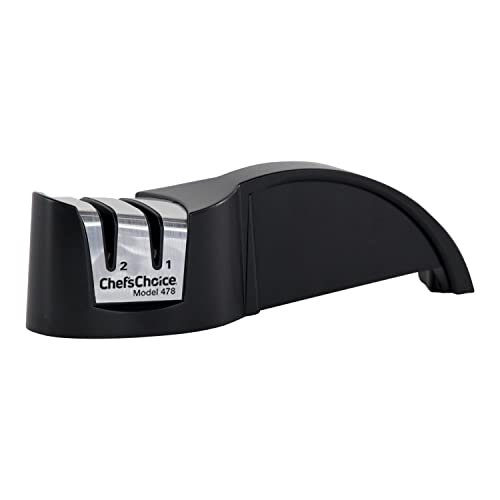
3. Chef’sChoice 478 Diamond Hone Manual Sharpener – Diamond in Both Stages
Chef’sChoice makes the electric Trizor XV that leads our main guide; the Model 478 (part 4780100) is the plain manual version of the same idea. Two slots with angle guides, a sharpening stage and a honing stage, and no motor.
The listing calls it a Diamond Hone for 20-degree straight-edge kitchen, santoku, sports and pocket knives. Retailers add the details: Chef’s Supplies says both stages use 100% diamond abrasives, Gofoodservice describes a 20-degree double-bevel, arch-shaped edge, and Macy’s lists the body at about 7 by 2 by 2 inches. Chef’s Supplies also lists it as made in the USA with a one-year limited warranty.
A 20-degree edge is right for most German knives and the stamped knives in many home blocks. Diamond cuts steel quickly, so a few light pulls are enough; heavy pressure is the usual mistake with any pull-through. Chef’sChoice’s two-angle ProntoPro is in our knife sharpener for beginners guide and its 15-degree Pronto is on our Japanese-knife page; the 478 is the single-angle, lower-cost model for Western knives.
Why we like it
- Diamond abrasives in both stages, per Chef’s Supplies
- Angle guides set at 20 degrees
- Small enough for a drawer
- Made in the USA, per Chef’s Supplies
Key specifications
| Model | 478 (4780100) |
|---|---|
| Type | Countertop pull-through |
| Stages | 2 (sharpen, hone) |
| Abrasive | 100% diamond (retailer) |
| Angle | 20 degrees |
| Serrated blades | Not stated on the listing |
| Size | About 7 x 2 x 2 in (Macy’s) |
| Warranty | 1-year limited (retailer) |
Why we recommend it
It suits a cook with German or American knives who wants diamond abrasives from the best-known sharpener maker, without the size of an electric machine.
Skip it if you need a sharpener for serrated knives; the Amazon listing names only straight edges.
Pros and cons
Pros
- All-diamond stages
- Established sharpener maker
- Compact
Cons
- 20 degrees only
- Most details come from retailers, not the listing
4. Lansky QuadSharp 4-Angle Sharpener – Four Angles and a Ceramic Stone
Lansky is best known for its clamp-and-hone systems, one of which is in our beginner guide. The QuadSharp (QSHARP) is its small, low-cost tool: a metal body with four carbide slots and a ceramic bench stone for polishing.
The four slots are set at 17, 20, 25 and 30 degrees, according to the listing. That matters if your drawer is a mix: a thinner kitchen knife at 17 or 20, a heavy cleaver or a camp knife at 25 or 30. Lansky says the carbide slots sharpen in three to four strokes, and the ceramic stone gives a finer finish afterward. Most budget pull-throughs give you one angle; this one gives you four.
The listing describes rugged metal construction and a limited one-year manufacturer warranty, and does not say whether it handles serrated blades. Because it is a handheld tool, you hold it in one hand and draw the knife with the other, so work slowly and keep your fingers behind the guard area. For a household that sharpens kitchen knives, a machete for the yard and a fishing knife, it is the most flexible tool here.
Why we like it
- Four angles: 17, 20, 25 and 30 degrees
- Ceramic stone for a finer finish
- Metal body, per the listing
- Limited one-year warranty
Key specifications
| Model | QSHARP |
|---|---|
| Type | Handheld multi-angle |
| Stages | 4 carbide slots plus ceramic stone |
| Abrasive | Carbide, ceramic |
| Angle | 17, 20, 25, 30 degrees |
| Serrated blades | Not stated |
| Size | Not stated |
| Warranty | Limited 1-year |
Why we recommend it
It suits a household with kitchen, garden and outdoor knives that each want a different angle.
Skip it if you want a sharpener that sits flat on the counter; this one is held in the hand.
Pros and cons
Pros
- More angles than any other pick
- Durable metal body
- Polishing stone included
Cons
- Carbide removes metal quickly
- Handheld, not countertop
5. AccuSharp Gourmet 15-Degree Sharpener – Made for Thin Japanese Edges
The original AccuSharp, a white handheld tool with a finger guard, is in our beginner guide. The Gourmet Series version (model AS129C) uses the same shape but sets the carbide at 15 degrees, which is the angle many Japanese knives and some newer German knives use.
AccuSharp describes diamond-honed tungsten carbide blades that can be reversed when one side wears, which doubles their life. The listing gives the body as about 2.4 by 0.75 by 5.5 inches, with an ergonomic handle and a full-length finger guard. You can hold the knife still on a cutting board and draw the sharpener along the edge, or hold the sharpener and draw the knife; follow the maker’s directions.
The listing says it handles straight and serrated knives. A warranty is not stated on the listing. If you own a gyuto or santoku and a 20-degree sharpener would undo its thin factory edge, this is the cheapest way here to keep the original angle. You give up the finer finish of a stone or the 15-degree electric Trizor in our main guide.
Why we like it
- Set at 15 degrees for thin edges
- Reversible carbide blades
- Full-length finger guard
- Straight and serrated knives, per the listing
Key specifications
| Model | AS129C |
|---|---|
| Type | Handheld with finger guard |
| Stages | 1 |
| Abrasive | Diamond-honed tungsten carbide |
| Angle | 15 degrees |
| Serrated blades | Yes, per the listing |
| Size | 2.38 x 0.75 x 5.5 in |
| Warranty | Not stated |
Why we recommend it
It suits a cook with a Japanese-style chef’s knife or santoku who wants a quick touch-up tool at the right angle.
Skip it if your knives are mostly heavy German blades at 20 degrees; pick the Work Sharp or Chef’sChoice instead.
Pros and cons
Pros
- Right angle for thin knives
- Blades can be flipped
- Very small
Cons
- Single stage, no fine slot
- Warranty not stated
- Carbide, not diamond
6. Smith’s Pull-Thru Knife Sharpener – Replaceable Carbide and Ceramic

Smith’s is a sharpening company with a long list of small tools, many of them aimed at hunters and anglers. The Pull-Thru (model SP-50348, part 50090) is its plain kitchen-friendly version: a soft-grip handle, a non-slip rubber base and two slots.
The coarse slot uses carbide for dull or damaged straight-edge knives, and the fine slot uses ceramic rods for final honing. Smith’s says the ceramic slot can lightly hone straight or serrated blades, and both slots have preset angles, though the listing does not give the number.
The reason to choose it over similar pull-throughs is in the listing: both the carbide and ceramic parts are replaceable. Carbide edges wear, and on most cheap sharpeners that means throwing the whole tool away. Here you can replace the worn part instead, which is the kind of value that matters more than the purchase price. The listing describes a manufacturer warranty without giving its length.
Why we like it
- Replaceable carbide and ceramic parts
- Non-slip rubber base
- Ceramic slot hones serrated blades lightly
- Soft-grip handle
Key specifications
| Model | SP-50348 (part 50090) |
|---|---|
| Type | Countertop pull-through |
| Stages | 2 (coarse, fine) |
| Abrasive | Carbide, ceramic rods |
| Angle | Preset; degree not stated |
| Serrated blades | Light honing in the ceramic slot |
| Size | Not stated |
| Warranty | Manufacturer warranty; term not stated |
Why we recommend it
It suits a cook who wants a sharpener that can be repaired rather than replaced when the abrasive wears.
Skip it if you want a stated angle or a warranty term on the listing.
Pros and cons
Pros
- Spare parts available
- Stable base
- Simple two-slot design
Cons
- Angle not published
- Carbide coarse stage
7. Mercer Culinary Double Diamond Manual Sharpener – A Foodservice Maker’s Diamond Slots

Mercer Culinary makes knives and tools for foodservice kitchens, and its Double Diamond (M10200) is the manual sharpener in that range. The listing describes two stages, sharpening and honing, both with 100% diamond abrasives, and precision guides that control the angle.
Mercer says the two stages produce an arch-shaped edge that is strong and durable, and that it sharpens straight and serrated knives. The handle is textured for a secure hold. A Canadian retailer, Chef’s Supplies, lists the body at 8.5 by 2.25 by 2.75 inches, which makes it the largest manual sharpener here and more stable on a counter.
Mercer does not publish the angle in the listing data we saw, and a warranty is not stated. If your kitchen already runs on Mercer knives, it makes sense to keep the sharpener from the same supplier; on its own merits, it is a diamond pull-through very close in design to the Chef’sChoice 478.
Why we like it
- Diamond abrasives in both stages
- Straight and serrated knives, per the listing
- Textured handle
- Larger, steadier body
Key specifications
| Model | M10200 |
|---|---|
| Type | Countertop pull-through |
| Stages | 2 (sharpen, hone) |
| Abrasive | 100% diamond |
| Angle | Guided; degree not stated |
| Serrated blades | Yes, per the listing |
| Size | 8.5 x 2.25 x 2.75 in (Chef’s Supplies) |
| Warranty | Not stated |
Why we recommend it
It suits a cook who wants diamond stages, serrated support and a body big enough to hold steady with one hand.
Skip it if drawer space is tight; it is the bulkiest pick on this page.
Pros and cons
Pros
- All-diamond stages
- Commercial kitchen supplier
- Serrated knives covered
Cons
- Angle not published
- Warranty not stated
8. KitchenAid 2-Stage Handheld Knife Sharpener – Diamond and Ceramic Rods

KitchenAid’s handheld sharpener (model KESHBOHBAA) uses rods rather than flat carbide slots. There are two stages: diamond-coated rods that the listing says restore and realign dull edges, and ceramic rods that refine and polish them.
A soft handle gives you something to hold and a rubber base keeps it steady on the counter. The listing is clear that it is for straight-edge kitchen knives only, not serrated blades or scissors, and it does not state an angle or a warranty. It is wipe-clean only, not for the dishwasher.
For an apartment, a rental or a second kitchen, it covers the basic job: bring a chef’s knife back before you cut onions and cilantro for salsa. The listing doesn’t give a size, so we can’t say how small it stores. We found no independent review of this one, so this pick rests on the listing.
Why we like it
- Diamond-coated rods for the first stage
- Ceramic rods to refine the edge
- Soft-grip handle
- Non-slip rubber base
Key specifications
| Model | KESHBOHBAA |
|---|---|
| Type | Handheld with soft-grip handle |
| Stages | 2 (restore, refine) |
| Abrasive | Diamond-coated rods, ceramic rods |
| Angle | Not stated |
| Serrated blades | No |
| Size | Not stated |
| Warranty | Not stated on the listing |
Why we recommend it
It suits a small kitchen with straight-edged knives and a cook who wants diamond in the first stage from a familiar brand.
Skip it if you need to touch up a serrated bread or tomato knife.
Pros and cons
Pros
- Diamond and ceramic stages
- Firm grip and non-slip base
- Familiar maker
Cons
- Not for serrated blades
- Angle and warranty not stated
- No independent review found
9. Rada Quick Edge Knife Sharpener – Steel Wheels, Made in the USA
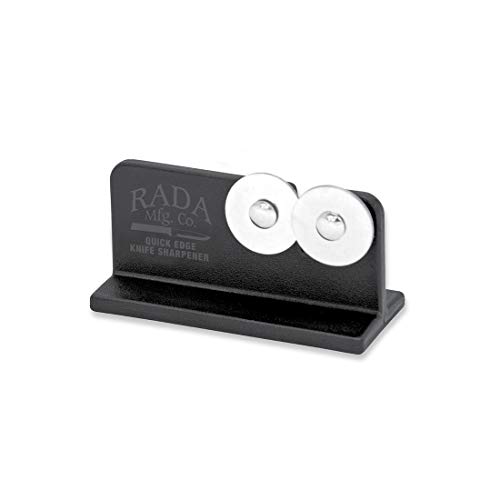
Rada Cutlery is an American knife maker that says its products are made in the USA, and the Quick Edge (R119) is the small sharpener it sells alongside its knives. It is the simplest tool here: a nylon handle holding two crossed wheels of T420 high-carbon stainless steel, about 3.5 by 2 inches.
Rada explains that the wheels intersect so they work on both sides of the blade in one pass. You hold the base, draw the knife through the wheels at a slight upward angle and repeat; Rada’s current page says one or two quick passes are enough. Rada presents it for its own non-serrated knives, and the Amazon listing describes it for any straight-edge knife.
The value case is the guarantee: Rada backs it with a lifetime guarantee on materials and workmanship, the longest on this page. What you give up is control. There is no stated angle and no fine stage, so it is best for keeping inexpensive straight knives working rather than for refining a good chef’s knife.
Why we like it
- Made in the USA, per Rada
- Lifetime guarantee on materials and workmanship
- Very small, about 3.5 x 2 in
- Nothing to soak, plug in or adjust
Key specifications
| Model | R119 |
|---|---|
| Type | Handheld wheel sharpener |
| Stages | 1 |
| Abrasive | T420 stainless steel wheels |
| Angle | Not stated |
| Serrated blades | No |
| Size | 3.5 x 2 in |
| Warranty | Lifetime guarantee |
Why we recommend it
It suits a cook with a drawer of everyday straight knives, especially Rada’s own, who values a lifetime guarantee and American manufacture.
Skip it if you want a fine finish or a known angle for a good chef’s knife.
Pros and cons
Pros
- Longest stated guarantee
- US-made
- Tiny and simple
Cons
- One stage, no honing slot
- No serrated support
- Angle not stated
What you give up with a cheap manual sharpener
The sharpeners in our main best knife sharpener guide cost more for real reasons. Knowing what those reasons are tells you where saving makes sense.
Control over the angle. Electric machines with several stages, guided systems and whetstones let you choose or hold an angle. Most pull-throughs give you one fixed slot. Only the Lansky QuadSharp here offers a real choice. If your knives are a mix of German and Japanese, a single fixed angle will suit some of them better than others.
Finish. A three-stage electric sharpener or a pair of stones takes the edge from coarse to fine. A two-slot manual sharpener has one coarse and one fine stage, and some tools here have only one. The edge cuts well, but it will not be as refined as a stone-finished edge.
How much metal comes off. Carbide slots work by scraping. They are quick, but used with heavy pressure or too often they remove more steel than a knife needs. Work Sharp makes this point when it explains why it chose diamond. Use the fine slot for routine touch-ups and the coarse slot only when the knife is truly dull.
Repairs. A badly chipped edge or a broken tip needs a stone, a powered sharpener or a professional. A cheap pull-through will not grind out a chip in reasonable time.
Warranty and parts. This is the part we would not compromise on. Work Sharp states three years, KitchenIQ and Lansky one year, Rada a lifetime guarantee, and Smith’s sells replacement abrasives. Several others do not state a warranty term on the listing at all.
How to judge a budget knife sharpener
Match the angle to your knives. Most German and American kitchen knives are sharpened near 20 degrees; many Japanese knives are closer to 15. Check your knife maker’s page, then choose a sharpener with that angle. If you do not know, 20 degrees is the safer default for an ordinary home block.
Prefer diamond or ceramic for routine work. Diamond cuts quickly and evenly; ceramic is gentle and good for touch-ups. Carbide is fine for reviving a very dull knife, but it is the most aggressive option.
Check serrated support. A bread knife or a serrated tomato knife needs a slot that is designed for it. The Work Sharp, KitchenIQ, AccuSharp and Mercer listings say they handle serrated knives; the KitchenAid and Rada do not.
Look at the base and the grip. A pull-through that slides on the counter is the main safety problem with these tools. A non-slip base, a handle you can hold firmly and, for handheld types, a finger guard all matter more than the number of stages.
Keep a honing steel as well. A sharpener removes metal; a steel straightens the edge between sharpenings, so you sharpen less often. Our best cheap honing steel guide covers inexpensive steels and ceramic rods.
Value the warranty and spare parts. When you cannot hold the tool first, a stated warranty or replaceable abrasives is the simplest proof that the maker expects it to last.
How we picked these nine sharpeners
We searched Amazon’s product data for manual sharpeners at the entry tier of established makers’ ranges, kept only those listed as in stock, and left out anything already reviewed in our main sharpener guide or its companion pages on beginner, electric and Japanese-knife sharpeners, cheap whetstones and cheap honing steels. Where we chose a different model from a maker that appears elsewhere, we say so. Abrasives, angles and warranties come from the Amazon listings, the makers’ own pages and named retailers, and we write “not stated” where we could not find a figure. We also searched the U.S. Consumer Product Safety Commission’s recall pages and found no knife sharpener recall for these brands. We did not use these sharpeners for this guide, and we stopped at nine rather than pad the list with near-identical tools.
Budget sharpener questions, answered
What is the best knife sharpener on a budget?
For most home knife blocks, the Work Sharp Pull Through: diamond rather than carbide in the coarse stage, a 20-degree guide, serrated support and a three-year warranty from the maker. For thin Japanese knives, the AccuSharp Gourmet 15-degree tool keeps the original angle.
Are cheap pull-through sharpeners bad for knives?
Not if you use them lightly. The risk is heavy pressure in a carbide slot, which removes more steel than needed. Use a few gentle pulls, start with the fine slot and save the coarse slot for knives that are truly dull.
Can a very inexpensive sharpener give good value?
Yes, if it comes from a known maker, matches your knives’ angle and has a stated warranty or spare parts. The Smith’s Pull-Thru, with replaceable abrasives, and the Rada Quick Edge, with a lifetime guarantee, are good examples of value that is not just a low price.
Is a manual sharpener better than a whetstone?
It is faster and easier to learn; a whetstone gives more control and a finer edge. Our knife sharpener vs whetstone comparison explains the trade-off, and our best cheap whetstone guide covers low-cost stones.
How often should I use a budget sharpener?
Only when honing no longer brings the edge back, which for a home cook is often every few weeks to every few months. Daily use of a coarse slot wears a knife down quickly.

Our final word on cheap knife sharpeners
Buy the Work Sharp Pull Through for an ordinary block of knives, the KitchenIQ Edge Grip for the simplest touch-up, the Chef’sChoice 478 or Mercer Double Diamond if you want diamond in both slots, the AccuSharp Gourmet for 15-degree Japanese knives and the Lansky QuadSharp if your knives need different angles. Whatever you choose, light pressure and a honing steel will make it last.
For powered sharpeners and stones, start with our best knife sharpener guide, see the easiest tools in our knife sharpener for beginners picks, or compare machines in our best electric knife sharpener guide.
And if you would rather leave the knife work to us tonight, see the menu or call to order.