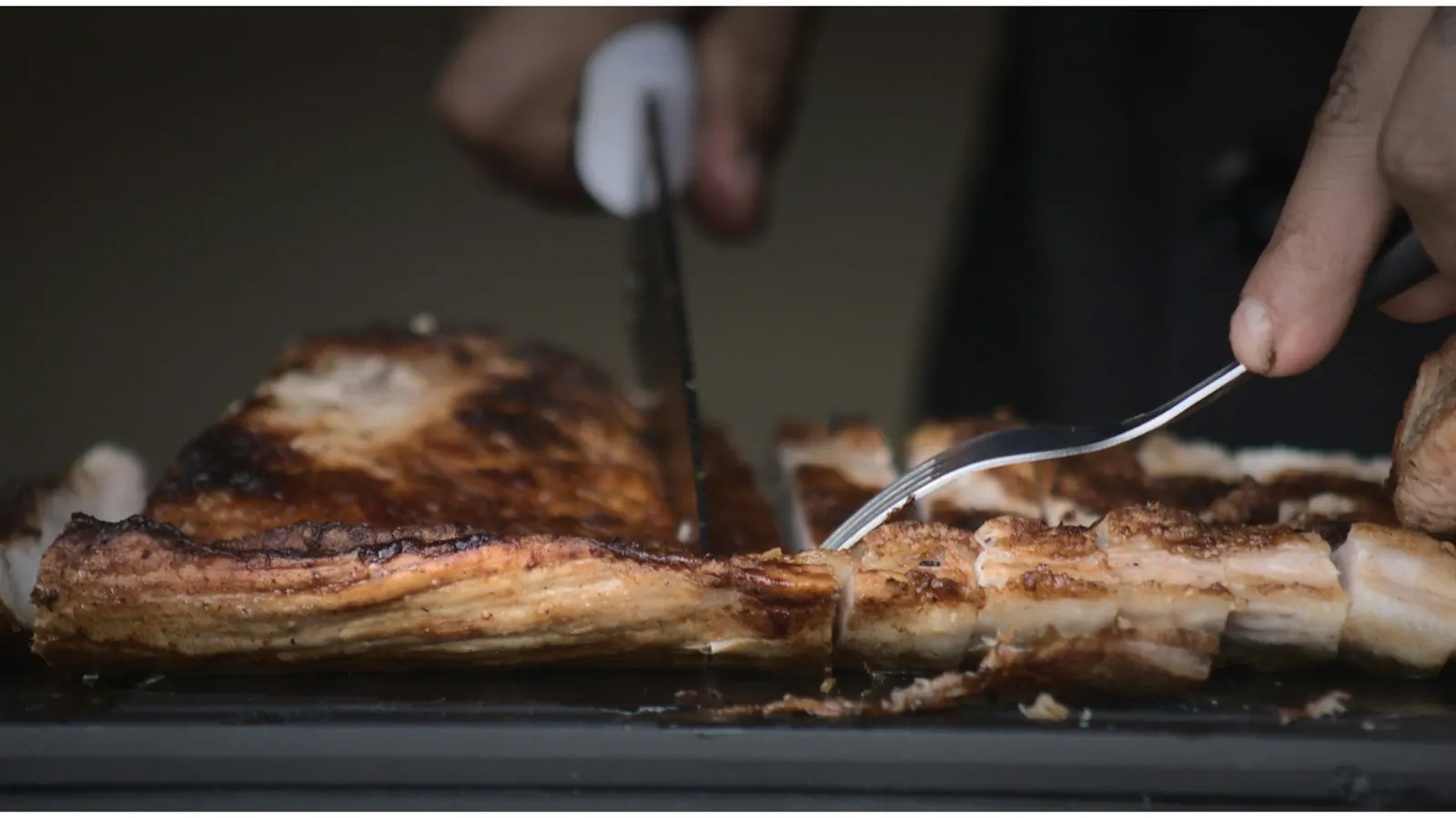
Most home cooks buy an 8-inch chef’s knife and never think about it again. Then the day comes to split a watermelon, slice a whole brisket, or chop enough onion and cilantro for forty tacos, and the short blade starts to feel like a paring knife. Each cut takes two strokes, the tip runs out before the food does, and big vegetables get sawed instead of sliced.
A large chef’s knife, 10 inches and up or a 240 to 300 mm gyuto, fixes that. The longer edge covers more food per stroke and reaches across wide cuts in one pull. It also asks more of you: a bigger cutting board, a longer storage slot and a bit more control. This guide is for cooks deciding whether that trade is worth it, and which long knife to buy if it is.
Julia’s earns a commission on purchases made through links on this page, at no cost to you. Recommendations are based on what a restaurant kitchen looks for, product specifications and verified buyer reports.
Quick verdict: which long knife to buy
For most cooks, the best large chef knife is the Victorinox Swiss Classic 10-inch Chef’s Knife: it is light for its length (about 7.4 ounces, per Knife Country USA), Swiss made and dishwasher safe, so moving up from 8 inches costs little and asks little. For precise slicing, the Shun Premier 10-inch adds a VG-MAX Damascus blade at 8.9 ounces. If you want real length, the Aritsugu 300 mm gyuto gives you nearly 12 inches of AUS-10 steel and comes with a scabbard.
Every knife below has a blade of 9.5 inches or longer. We set aside the 10-inch knives already reviewed on our big-hands guide and picked long blades that cover the rest of the range, from a light 10-inch to a 12-inch commercial knife.
Five long chef’s knives side by side
Our five standout picks, one for each kind of cook, with the lengths and weights the maker or a named retailer publishes. All seven knives are reviewed in full below.
| Large chef’s knife | Best for | Length | Build | Buy on Amazon |
|---|---|---|---|---|

Victorinox Swiss Classic 10-inch Chef’s KnifeBest overall
|
Moving up from 8 inches | 10-inch blade, 15 1/4 in overall | Stamped, Swiss made, dishwasher safe | View on Amazon |
Shun Premier 10-inch Chef’s KnifeBest premium
|
Precise slicing, fine prep | 10-inch blade, 8.9 oz | VG-MAX Damascus, made in Japan | View on Amazon |

Kai Magoroku Gyuto, 270 mmBest long gyuto
|
A long Japanese blade | 10.6-inch blade | High-carbon stainless, made in Japan | View on Amazon |

Aritsugu AUS-10 Gyuto, 300 mmLongest gyuto
|
Large cuts and crowd cooking | About 11.8-inch blade; overall not stated | AUS-10 steel; scabbard included | View on Amazon |

Mercer Ultimate White 12-inch Chef’s KnifeBudget 12-inch
|
Trying 12 inches cheaply | 12-inch blade, 17 in overall | Stamped, NSF certified per retailers | View on Amazon |
Product images from Amazon. Lengths and weights are as published by the maker or the retailer named in each review; “Not stated” means we could not find a published figure.
Our picks for the best large chef knife
These seven knives were chosen for reach. Each has a blade of at least 9.5 inches, comes from an established cutlery maker and was in stock on Amazon when we wrote this. Where a knife is the longer size of a line recommended on another of our guides, we say so in the review and explain why the longer size earns its place here.
1. Victorinox Swiss Classic 10-inch Chef’s Knife – Light Reach, Easy Care
If you have never owned a knife longer than 8 inches, this is the gentlest way to find out whether a long blade suits you. The Swiss Classic 10-inch is a plain, stamped chef’s knife with a 10-inch stainless blade and a black synthetic handle, and Victorinox lists it as Swiss made and dishwasher safe.
Its main virtue for this job is weight. Knife Country USA lists the black-handled version (6.8003.25B) at 0.46 pounds, about 7.4 ounces, and 15 1/4 inches long overall. That is lighter than most 8-inch forged German knives, so the extra two inches of blade do not come with a heavier wrist load. On a long blade, a light knife is what lets you keep rocking through a pile of onions without the tip dragging.
The extra length pays off on wide food: a whole cabbage for curtido, a watermelon, a pork shoulder that needs to be split before it goes in the pot for carnitas. A 10-inch edge goes through these in one stroke instead of a saw.
It is a different line from the Fibrox Pro knives on our other chef knife guides; the Swiss Classic has a smooth, slimmer handle rather than the textured Fibrox grip.
Why we like it
- 10-inch blade at about 7.4 ounces (Knife Country USA)
- Swiss made, per the listing
- Dishwasher safe, per Victorinox
- Plain stamped blade is easy to sharpen
Key specifications
| Model | 6.8003.25B |
|---|---|
| Blade length | 10 inches |
| Overall length | 15 1/4 inches (Knife Country USA) |
| Weight | About 7.4 oz / 0.46 lb (Knife Country USA) |
| Steel | Stainless steel |
| Handle | Black synthetic, ergonomic |
| Made in | Switzerland |
| Care | Dishwasher safe; hand washing keeps the edge longer |
Why we recommend it
It suits a home cook moving up from an 8-inch knife who wants more reach for big vegetables and roasts without paying for a forged or Japanese blade.
Skip it if you want a heavy knife that does the work by weight, such as for splitting squash; this one is light and flexible by comparison.
Pros and cons
Pros
- Light for its length
- Dishwasher safe
- Simple to sharpen and replace
Cons
- Smooth handle is less grippy when wet than textured handles
- Weight figures differ between retailers (0.46 to 0.58 lb)
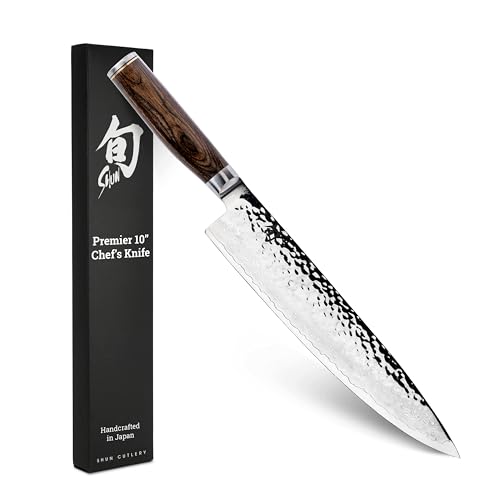
2. Shun Premier 10-inch Chef’s Knife – Hammered Damascus at Full Length
The Shun Premier 10-inch is the long version of a knife many cooks already know. Shun lists a VG-MAX steel core clad in 68 layers of Damascus stainless, a 16-degree edge and a hammered tsuchime finish meant to reduce drag and keep slices from sticking to the blade. The handle is contoured Pakkawood that Shun says suits both left- and right-handed cooks.
Cutlery and More lists the blade at 10 inches, the overall length at 15 1/2 inches, the blade height at 2 inches and the weight at 8.9 ounces. That is still lighter than most forged German 10-inch knives, which matters when you are slicing a brisket or a whole tray of skirt steak for fajitas.
The hammered finish earns its place on a long blade. The more blade that touches the food, the more potato or cucumber wants to cling to it; the dimpled surface helps those slices fall away.
Shun’s listing says the knife is handcrafted in Japan and covered by free sharpening and honing. That service is worth knowing about because the thin, hard edge should be sharpened on whetstones, not pulled through a cheap pull-through sharpener.
Why we like it
- VG-MAX core with 68-layer Damascus cladding (Shun)
- 16-degree edge (Shun)
- 8.9 ounces for a 10-inch blade (Cutlery and More)
- Free sharpening and honing from Shun (listing)
Key specifications
| Model | TDM0707 |
|---|---|
| Blade length | 10 inches |
| Overall length | 15 1/2 inches (Cutlery and More) |
| Weight | 8.9 oz (Cutlery and More) |
| Steel | VG-MAX core, 68-layer Damascus cladding |
| Handle | Contoured Pakkawood |
| Made in | Japan |
| Care | Hand wash; lifetime warranty (listing) |
Why we recommend it
It suits an experienced cook who wants one long, precise knife for slicing and fine prep and is willing to hand wash and sharpen it properly.
Skip it if you cut through bone, frozen food or hard squash; a thin, hard Japanese edge can chip on those jobs.
Pros and cons
Pros
- Very thin, sharp edge
- Hammered finish releases food
- Light for a 10-inch knife
Cons
- Hand wash only
- Hard edge can chip if twisted or used on bone
- Retailers differ slightly on weight and blade length
3. Kai Magoroku Gyuto, 270 mm – A Long Japanese Blade
A 270 mm gyuto is what many Japanese restaurant cooks reach for when the prep list is long. This one is Kai’s AB-5443, in its Magoroku line, with a 10.6-inch (270 mm) blade.
Gyutos are usually ground thinner than German chef’s knives, which is why a long one tends to slide through onions and tomatoes rather than wedge them apart. The listing gives no weight or spine thickness for this one, so we cannot put numbers on that here.
The blade is high-carbon stainless steel, according to the listing, the handle is brown laminated reinforced wood, and it is made in Japan. The listing is short and comes from a third-party seller, ComLogical, so check the shipping estimate and seller details before you buy.
Why we like it
- 10.6-inch blade (listing)
- High-carbon stainless steel (listing)
- Laminated reinforced wood handle
- Made in Japan
Key specifications
| Model | AB-5443 |
|---|---|
| Blade length | 10.6 inches (270 mm) |
| Overall length | Not clearly stated |
| Weight | Not stated |
| Steel | High-carbon stainless |
| Handle | Brown laminated reinforced wood |
| Made in | Japan |
| Care | Not stated on listing; hand wash and dry is the norm for Japanese blades |
Why we recommend it
It suits a cook who already likes Japanese knives and wants the reach of a long blade for slicing proteins and big vegetable prep.
Skip it if your cutting board is shorter than about 18 inches, or if you want a full spec sheet before you buy; this listing is thin.
Pros and cons
Pros
- Long Japanese blade
- Stainless, so less fuss than carbon steel
- Made in Japan
Cons
- Needs a large board and storage slot
- Weight and care not stated on the listing
- Third-party seller
4. Aritsugu AUS-10 Gyuto, 300 mm – Nearly a Foot of Japanese Steel
Along with the 12-inch Mercer Ultimate White, this is the longest knife in the guide. The listing, under the Tsukiji Aritsugu brand, gives the blade as about 300 mm (11.81 inches) and includes a scabbard.
The listing is short. It gives the blade as AUS-10 steel and the use as meat, fish and vegetables, but not the overall length, weight, handle material or tang, so treat those as unknown.
A 300 mm blade is a specialist size. It is at its best breaking down long cuts, slicing a whole brisket or a pork loin in one pull, or chopping a mountain of cilantro and onion for a party’s worth of tacos. For everyday dinner prep it is more knife than most home kitchens need.
The listing gives no care instructions, so treat it like any thin Japanese blade: hand wash it, dry it and keep it in its scabbard. Most standard blocks will not take a 12-inch blade.
Why we like it
- About 11.8-inch (300 mm) blade (listing)
- AUS-10 steel (listing)
- Scabbard included (listing)
- Listed for meat, fish and vegetables
Key specifications
| Model | AT155ds |
|---|---|
| Blade length | About 11.8 inches (300 mm) |
| Overall length | Not stated |
| Weight | Not stated |
| Steel | AUS-10 |
| Handle | Not stated |
| Made in | Not stated |
| Care | Not stated; scabbard included |
Why we recommend it
It suits a cook who regularly breaks down large cuts or cooks for crowds and wants the longest gyuto in this guide.
Skip it if you mainly cook for two; a 12-inch blade is awkward on a small board and in a small kitchen.
Pros and cons
Pros
- Nearly a foot of reach
- AUS-10 steel
- Comes with a scabbard
Cons
- Weight and overall length not published
- Too long for most knife blocks and drawers
- Country of manufacture not stated
5. Mercer Ultimate White 12-inch Chef’s Knife – A Full Foot for Little Money
If you want to try a 12-inch chef’s knife before spending real money, this is the place to start. WebstaurantStore lists the M18150 at 17 inches overall, with a 12-inch blade and a 5-inch handle. It is a stamped knife in high-carbon Japanese steel with a white polypropylene handle that has textured finger points for grip.
Restaurant-supply retailers Chefsdeal and PartsSource list it as NSF certified, which means it was made for commercial kitchens where knives are washed, sanitized and handled wet all day. PartsSource gives the country of origin as Taiwan, and Mercer’s warranty is a limited lifetime.
A long, inexpensive blade like this is useful for jobs where you would not want to risk a fine knife: splitting a watermelon, slicing a big slab of cooked carnitas, cutting a sheet of rice-crispy treats for a party.
Our chef knife for big hands guide picks the 10-inch Ultimate White. This is the same line two inches longer; we include it because it is the only in-stock 12-inch chef’s knife from an established commercial maker we found. Mercer says to hand wash it and keep it out of the dishwasher.
Why we like it
- 12-inch blade, 5-inch handle (WebstaurantStore)
- NSF certified (Chefsdeal, PartsSource)
- Textured finger points on the handle (Mercer)
- Limited lifetime warranty (Mercer)
Key specifications
| Model | M18150 |
|---|---|
| Blade length | 12 inches |
| Overall length | 17 inches (WebstaurantStore) |
| Weight | Not stated |
| Steel | High-carbon Japanese steel, stamped |
| Handle | White polypropylene, textured |
| Made in | Taiwan (PartsSource) |
| Care | Hand wash only; NSF certified |
Why we recommend it
It suits a cook who needs a very long blade now and then and wants a cheap, tough knife for it.
Skip it if you want a refined slicing edge; this is a stamped workhorse, not a fine knife.
Pros and cons
Pros
- Very long blade at a budget level
- Grippy commercial handle
- NSF certified per retailers
Cons
- Not dishwasher safe
- Plain look
- Weight not published
6. Mercer Praxis 10-inch Chef’s Knife – Rosewood Handle, Commercial Blade

Some cooks simply prefer the feel of wood. The Praxis 10-inch puts a one-piece, high-carbon Japanese steel blade on a natural rosewood handle, and Mercer says the triple-riveted design is secure and prevents separating. KaTom notes the rivets are brass and the knife is full tang.
The blade is 10 inches long. Mercer and the retailers we checked do not publish an overall length or weight, so we cannot compare those to the other knives here; expect the general proportions of a standard 10-inch Western chef’s knife.
Mercer is a restaurant-supply brand, and Praxis is its wood-handled line, described by Mercer as suited to professional use or the home cook. It shares the same basic blade approach as Mercer’s plastic-handled lines: easy to sharpen, forgiving, and inexpensive to replace if you damage it.
Wood needs a bit more care than plastic. Mercer says to wash by hand with warm water and mild soap, rinse, dry completely and never put the knife in the dishwasher or leave it soaking.
Why we like it
- Rosewood handle, triple riveted (Mercer)
- Full tang with brass rivets (KaTom)
- One-piece high-carbon Japanese steel (Mercer)
- Restaurant-supply maker
Key specifications
| Model | M26050 |
|---|---|
| Blade length | 10 inches |
| Overall length | Not stated |
| Weight | Not stated |
| Steel | High-carbon Japanese steel, one piece |
| Handle | Rosewood, triple brass rivets |
| Made in | Not stated |
| Care | Hand wash only; do not soak |
Why we recommend it
It suits a cook who wants a long, traditional-looking knife with a wood handle at a commercial-knife price.
Skip it if you want a knife you can put in the dishwasher; wood handles crack and dull with that treatment.
Pros and cons
Pros
- Warm, traditional wood handle
- Full tang
- Easy-to-sharpen blade
Cons
- Overall length and weight not published
- Wood handle needs drying and occasional oil
7. Yoshihiro VG10 16-Layer Hammered Damascus Gyuto, 240 mm – A Hand-Finished Long Gyuto
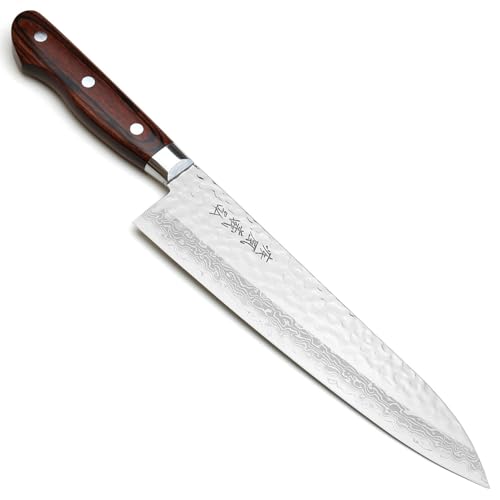
A 240 mm gyuto is the long knife many Japanese-knife fans settle on: noticeably longer than a 210 mm, but still manageable on a home board. Yoshihiro’s version has a VG-10 core forged with 16 layers of Damascus steel and a hammered finish that the listing says reduces friction and keeps food from sticking.
eChefKnife, Yoshihiro’s US retailer, lists the blade at 9.5 inches (240 mm), hardness at HRC 60 and the handle as mahogany in a Western shape on a full tang. The listing says it is made in Japan and handcrafted.
Yoshihiro is clear about care: sharpen and hone only on water whetstones, hand wash and dry it at once, especially after acidic food like lime or tomatillo, and do not use it on bones, nut shells or frozen food.
It is a different line from the 46-layer Yoshihiro on our Damascus guide. At 240 mm it is the shortest knife here, included for cooks who want more length than a 210 mm gyuto without going to 270 mm.
Why we like it
- VG-10 core with 16 Damascus layers (listing)
- HRC 60 (eChefKnife)
- Hammered finish to cut drag (listing)
- Western-style mahogany handle on a full tang (listing)
Key specifications
| Model | HDGY240 |
|---|---|
| Blade length | 9.5 inches (240 mm) |
| Overall length | Not stated |
| Weight | Not stated |
| Steel | VG-10 core, 16-layer Damascus |
| Handle | Mahogany, Western style, full tang |
| Made in | Japan |
| Care | Hand wash and dry; whetstones only; no bones or frozen food |
Why we recommend it
It suits a cook who wants a hand-finished Japanese blade a step longer than the usual 8-inch, mainly for vegetables, fish and boneless meat.
Skip it if you want to do rough work like splitting chicken backs; the maker says to keep it off bone.
Pros and cons
Pros
- Hard, thin VG-10 edge
- Hammered surface releases food
- Western handle is familiar to hold
Cons
- Strict care rules
- Overall length and weight not published
- Only 9.5 inches; not a true 10-inch
Who actually needs a large chef’s knife
A long blade is not automatically better. It is better for certain jobs and certain cooks. You are likely to benefit if one or more of these sounds like your kitchen.
You cook for a crowd
Party prep is where a long knife pays for itself. Chopping a full bunch of cilantro, three onions and a tray of tomatoes for pico de gallo goes faster when each rocking pass covers more of the pile. The same goes for slicing a big batch of skirt steak or chicken for fajitas.
You cut wide or long food
Watermelon, cabbage, pineapple, a whole pork shoulder, a brisket, a large squash: anything wider than about 6 inches is easier to cut in one stroke with a 10-inch or longer blade. With an 8-inch knife you end up sawing, which tears the food and is less safe.
You have the space for it
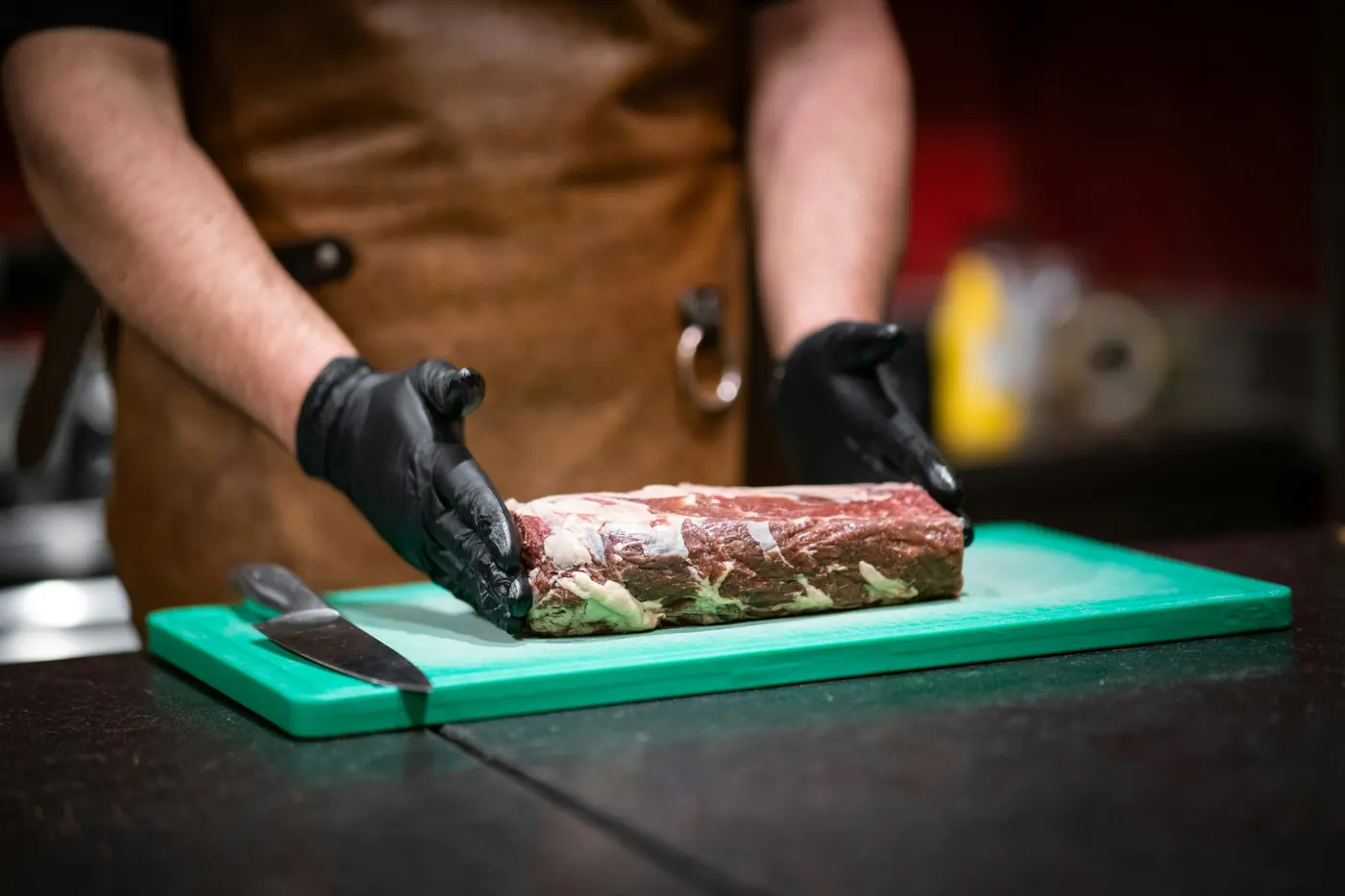
A 10-inch knife is around 15 inches long overall, and a 12-inch one is about 17. As a rule of thumb, your board should be longer than the whole knife, so 18 inches or more for the bigger blades. You also need somewhere to keep it: many standard blocks will not take a blade over 10 inches, so plan on a magnetic strip, a long drawer insert or a blade guard.
When to stay at 8 inches
If your kitchen is small, you mostly cook for one or two, or most of your cutting is garlic, chiles and herbs, an 8-inch knife is the better everyday tool. Our best chef knife guide covers the standard size, and our beginner chef knife guide covers first knives.
How to choose a long chef’s knife
Once you know you want the length, these are the points that separate one long knife from another.
Length: 10 inches, 240 mm, 270 mm or 12 inches
A 10-inch Western knife or a 240 mm gyuto is the usual step up and still works for everyday cooking. At 270 mm (about 10.6 inches) and 12 inches, the knife becomes a specialist for big prep and big cuts. If you are unsure, start at 10 inches.
Weight
Length adds weight, and weight adds up over a long prep session. Light knives like the Victorinox (about 7.4 ounces) are easier to control at the tip. Heavier forged knives do more of the work on hard vegetables but tire the wrist sooner. Many makers do not publish weights, so we list them only where a source does.
Blade style: Western or gyuto
Western chef’s knives have more curve along the edge for rocking and usually softer, tougher steel. Japanese gyutos are flatter toward the heel, thinner and harder, so they slice cleanly but are less forgiving of twisting and bone. Our Japanese gyuto guide goes deeper on that style.
Handle and balance
On a long knife, the handle has to counter more blade out front. Full-tang knives such as the Mercer Praxis carry steel through the handle for balance. If you have large hands, our chef knife for big hands guide compares handle lengths.
Care and storage
Only the Victorinox is listed as dishwasher safe. Everything else here should be washed by hand and dried at once. Plan storage before you buy: a long blade rattling loose in a drawer is a danger to both the edge and your fingers.
How we chose these seven long knives
We did not handle or use these knives. We began with long chef’s knives and gyutos from established makers, checked each one with Amazon’s product data for stock, model number and listed features, and kept only those in stock when we wrote. Specifications come from the maker’s Amazon listing, the maker’s catalog or named restaurant-supply and cutlery retailers (Cutlery and More, WebstaurantStore, KaTom, Knife Country USA, eChefKnife). Where a figure is missing or sources disagree, we say so.
We avoided repeating knives already recommended on our other chef knife guides. One pick is the longer size of a line picked elsewhere (the Mercer Ultimate White), and its review explains why. Popular long knives we left out because Amazon listed them as scarce or unavailable when we checked include the Victorinox Fibrox 12-inch, the Tojiro DP 240 mm and 270 mm, the Global 10-inch and the Dexter-Russell 12-inch cook’s knives. Misono’s 270 mm Molybdenum gyuto came off this page because its listing showed a long ship time.
Long chef’s knife questions, answered
Is a 10-inch chef’s knife too big for a home cook?
Not for most adults with a decent-sized cutting board. It takes a few days to get used to the extra tip, and then it handles everything an 8-inch knife does plus larger food. In a very small kitchen, or for cooks with small hands, 8 inches is usually more comfortable.
What is the difference between a 240 mm and a 270 mm gyuto?
About 1.2 inches of edge. The 240 mm is the all-round long gyuto; the 270 mm is mainly for slicing proteins and large-scale prep, and needs a board at least 18 inches long.
Does a longer knife need a different sharpener?
No, but a whetstone or a guided system makes it easier to sharpen the full length evenly. Our knife sharpener guide covers the options; the Japanese knives here should go on whetstones.
Can a large chef’s knife replace a slicing knife?
For most home cooks, yes. A 10-inch or longer chef’s knife slices roasts and brisket well. A dedicated slicer has a narrower blade that drags less, so it is worth adding only if you carve often.
How do I store a 12-inch knife?
On a magnetic strip long enough to hold the whole blade, in a long in-drawer knife holder, or with a fitted blade guard. Many countertop blocks have slots that are too short.
Our final word on long chef’s knives
Start with the Victorinox Swiss Classic 10-inch if you simply want more reach without more weight or fuss. Choose the Shun Premier or the Kai 270 mm for a long Japanese blade, and the Aritsugu 300 mm or Mercer Ultimate White if you really need 12 inches. For the standard size and more choices, go back to our best chef knife guide. And if the party is tonight and the prep list is too long, call Julia’s at (346) 546-8283 to order.