A wooden cutting board does not have to be a heavy, thick slab from a premium workshop to be useful. Most of the work on a board at home is ordinary: an onion diced for pico de gallo, a bunch of cilantro chopped fine, a few limes cut into wedges, a rested skirt steak sliced across the grain for tacos. A thinner, smaller board from a known maker handles all of that, as long as you understand what you are giving up and look after it.
This guide looks at the entry tier of each maker’s range: the plainest, thinnest or smallest wooden board a brand sells, rather than its flagship. We name seven edge-grain and face-grain boards from makers who publish their specifications, explain where the savings come from, and set out the care each maker asks for. End-grain boards have their own guide, linked below.
Julia’s earns a commission on purchases made through links on this page, at no cost to you. Recommendations are based on what a restaurant kitchen looks for, product specifications and verified buyer reports.
Quick verdict: which affordable wooden board to buy
Our pick is the J.K. Adams Maple Prep Board, 17 x 14 inch: a plain, reversible hard maple board made in Vermont, with a five-year warranty against defects stated on the listing. If you carve meat on your board, choose the Sonder Los Angeles Winsome Acacia Board for its deep juice groove; if you want teak’s easy care in a thin, light board, the Teakhaus Marine Teak Board, 18 x 14 inch.
Below, the five standouts side by side, then all seven boards in full.
Five budget wooden boards compared
Our five standout picks, one for each kind of cook, with the specifications each maker or listing states. All seven boards are reviewed in full below.
| Wooden board | Best for | Wood & size | Warranty | Buy on Amazon |
|---|---|---|---|---|

J.K. Adams Maple Prep Board, 17 x 14 inchBest overall
|
Everyday vegetable prep | Maple, 17 x 14 x 0.75 in | 5 years, defects | View on Amazon |

Sonder Los Angeles Winsome Acacia Board, 16 x 12 inchBest for carving
|
Slicing meat, serving | Acacia, 16 x 12 x 1.5 in | 1 year, replacement | View on Amazon |
| Low upkeep, light lifting | Teak, 18 x 14 x 0.75 in | Limited, 30 days | View on Amazon | |
Cuisinart Maple Wood Cutting Board, 17 inchMaple with a groove
|
One board, two jobs | Maple, 17.8 x 13.7 in | Not stated | View on Amazon |

KitchenAid Classic Rubberwood Board, 10 x 8 inchBest small board
|
A small second board | Rubberwood, 10 x 8.1 in | Lifetime limited | View on Amazon |
Product images from Amazon. Woods, sizes and warranties are as stated by each maker or listing; check the listing before you buy.
Seven picks for the best wood cutting board budget shoppers can trust
Each board here is the entry point of a maker’s wooden range: thinner stock, a smaller footprint, a less expensive wood such as acacia or rubberwood, or fewer extras than the same brand’s flagship. They cover hard maple, teak, acacia and rubberwood, all in edge-grain or face-grain construction, with and without juice grooves. Every pick explains who it suits and one honest reason to skip it. For the full-size, heavier boards these come down from, see our guide to the best cutting board wood.
1. J.K. Adams Maple Prep Board, 17 x 14 inch – Vermont Maple With a Long Warranty
J.K. Adams is a Vermont woodworker, and the listing describes the company as having more than 80 years of experience. This is its plain kitchen prep board: sustainably grown North American maple, 17 by 14 inches and three-quarters of an inch thick. Hard maple is the traditional American cutting-board wood, and this board gives you it without the thickness, weight or price of a butcher block.
The size is what makes it our top budget pick. Seventeen by fourteen inches is enough room to dice an onion, a couple of tomatoes and a jalapeño for salsa and keep each pile separate, yet a three-quarter-inch board is easy to lift into the sink. Both faces are usable, so you can keep one side for onions and garlic and the other for fruit and bread.
The listing states a five-year warranty against defects, the longest on this page. Care, per J.K. Adams, is hand washing and regular conditioning with mineral oil, which the maker says helps the tight maple grain resist warping and deep knife tracking. The listing does not state the grain construction or whether there is a groove; the photos show a flat board.
Why we like it
- Hard maple, crafted in Vermont, per the listing
- Five-year warranty against defects
- 17 x 14 inches of reversible surface
- Light enough to wash easily at three-quarters of an inch
Key specifications
| Model | KITCH-1714 |
|---|---|
| Wood | Maple |
| Size | 17 x 14 in |
| Thickness | 0.75 in |
| Grain | Not stated; reversible |
| Juice groove | Not stated |
| Made in | Vermont, USA |
| Warranty | 5 years against defects |
Why we recommend it
It suits a cook who wants one honest maple board for daily vegetable prep from a long-established American maker, with a warranty that outlasts most budget boards.
Skip it if you carve a lot of meat: there is no stated juice groove, and a thinner board moves more under heavy chopping than a 1.5-inch slab.
Pros and cons
Pros
- Longest warranty on this page
- Made in the USA
- Generous size for its weight
Cons
- No groove stated
- Thin compared with premium maple boards
- Needs regular oiling
2. Sonder Los Angeles Winsome Acacia Board, 16 x 12 inch – Deep Groove and a Cracker Well
Sonder Los Angeles makes some of the more expensive boards on Amazon, including the walnut end-grain boards on our main wood guide. The Winsome in acacia is its way in: an edge-grain acacia board, 16 by 12 inches and a full 1.5 inches thick. Choosing acacia instead of walnut or American maple is where most of the saving comes from; the board keeps Sonder’s features and thickness.
Sonder gives it a deep juice groove that it rates at 3.5 fluid ounces and a separate cracker well along one side. On taco night that means you can slice a rested piece of carne asada with the juices caught in the groove and keep the lime wedges or sliced radishes in the well. Sonder describes acacia as naturally water-resistant, and the edge-grain surface as the classic choice for daily use.
The trade-off is care. The warranty note on the listing says the wood needs oiling every three weeks so it does not dry out, more often than teak. Sonder will replace a board with a manufacturing defect within a year of the order if you fill out the warranty registration. The listing does not say where the acacia version is made; Sonder states “Made in USA” only for some other boards in the line.
Why we like it
- 3.5 fl oz juice groove, per Sonder
- Cracker well for garnishes or sides
- Full 1.5-inch thickness at an entry price for the brand
- One-year replacement warranty with registration
Key specifications
| Model | Winsome (acacia) |
|---|---|
| Wood | Acacia |
| Size | 16 x 12 in |
| Thickness | 1.5 in |
| Grain | Edge grain |
| Juice groove | Yes, 3.5 fl oz, plus cracker well |
| Made in | Not stated |
| Warranty | 1 year, defect replacement |
Why we recommend it
It suits cooks who slice cooked meat and serve on the same board, and who want a thick board without paying for walnut.
Skip it if you dislike an oiling routine: Sonder’s own note asks for oil every three weeks.
Pros and cons
Pros
- Thick, steady board
- Groove and well built in
- Arrives in a gift box
Cons
- Frequent oiling
- Well reduces the flat cutting area
- Origin not stated
3. Teakhaus Marine Teak Board, 18 x 14 inch – Thin, Light Teak With a Groove

Teakhaus’s flagship boards are 1.5 inches thick and weigh around twelve pounds. The Marine board is the brand’s lighter option: FSC-certified teak in edge grain, 18 by 14 inches and only three-quarters of an inch thick. You get teak’s reputation for low upkeep in a board you can lift with one hand.
It is reversible, with a juice groove and a hole in one corner for hanging, according to the listing. At this size there is room for a full round of salsa prep, and a thin board slides easily into a dish rack or a narrow cupboard. Teakhaus describes teak as durable and moisture resistant, and the edge-grain surface as gentle on knives.
Care is the simplest on this page: Teakhaus says to hand wash with regular dish soap, keep it out of the dishwasher and give it a few drops of oil to keep it looking new. The catch is the warranty. The listing states a limited 30-day warranty, far shorter than J.K. Adams’s five years or Sonder’s one, so inspect the board when it arrives.
Why we like it
- FSC-certified teak, per Teakhaus
- Light at three-quarters of an inch thick
- Juice groove and a hanging hole
- Minimal care routine
Key specifications
| Model | 517 |
|---|---|
| Wood | FSC-certified teak |
| Size | 18 x 14 in |
| Thickness | 0.75 in |
| Grain | Edge grain, reversible |
| Juice groove | Yes |
| Made in | Not stated |
| Warranty | Limited, 30 days |
Why we recommend it
It suits cooks who want a full-size wooden board that is easy to lift and asks for little more than a wash and a few drops of oil.
Skip it if a long warranty matters to you: 30 days is the shortest on this page.
Pros and cons
Pros
- Teak at a lighter weight
- Groove for carving
- Easy care, per Teakhaus
Cons
- Short stated warranty
- Thin board can shift on the counter
- Origin not stated
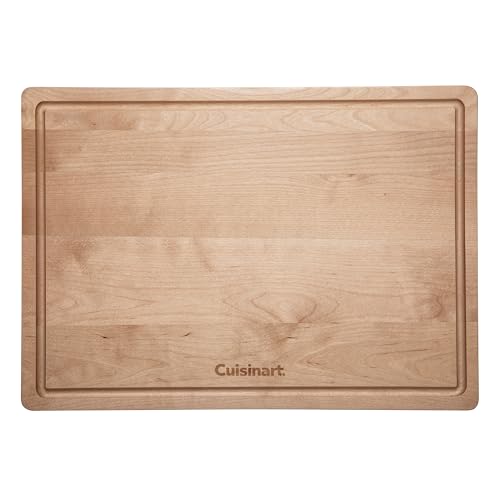
4. Cuisinart Maple Wood Cutting Board, 17 inch – Grooved Side and a Flat Side
Cuisinart is better known for appliances and cookware, but it sells a short line of wooden boards, and this 17-inch maple board is the one most kitchens would want. The listing gives its size as 17.8 by 13.7 inches, close to the J.K. Adams board, and describes it as double-sided maple.
The two sides do different jobs. One has a deep grooved well to catch juices when you slice meat, fruit or tomatoes; the other is smooth, for chopping and for serving. That makes it a sensible single board for a small kitchen: groove side up for a roast chicken or a pile of sliced tomatoes, flat side up for dicing onion and chiles.
The listing is thin on detail. It does not state the thickness, grain construction, country of manufacture, warranty or care instructions, so those appear as not stated below. Treat it like any maple board: hand wash, dry it standing up and oil it when it looks dry.
Why we like it
- Maple, from a widely sold kitchen brand
- Deep juice well on one side
- Smooth reverse for chopping and serving
- About 17.8 x 13.7 inches of surface
Key specifications
| Model | CWB-17M |
|---|---|
| Wood | Maple |
| Size | 17.8 x 13.7 in |
| Thickness | Not stated |
| Grain | Not stated; reversible |
| Juice groove | Yes, one side |
| Made in | Not stated |
| Warranty | Not stated |
Why we recommend it
It suits a cook who wants one maple board that can carve on one face and chop on the other.
Skip it if you like to know exactly what you are buying: the listing leaves out thickness, origin and warranty.
Pros and cons
Pros
- Two surfaces for two jobs
- Full-size maple board
- Known brand
Cons
- Sparse listing details
- No care guide on the listing
- Warranty not stated
5. Ironwood Gourmet Acacia Cutting Board, 16 x 14 inch – Light Acacia for Prep and Serving

Ironwood Gourmet is best known for affordable acacia end-grain boards, several of which appear in our other cutting board guides. This one is simpler: a one-inch acacia board, 16 by 14 inches, that the listing says weighs 3.2 pounds. That makes it the lightest full-size board on this page.
Acacia has strong contrasting light and dark streaks, so every board looks different, and Ironwood pitches this one as both a cutting board and a serving board for cheese, meats and bread. At this weight it is easy to carry from the counter to the table with a plate of sliced carne asada and tortillas.
Care, per the listing: wash in warm soapy water and air dry, and it can be stored upright out of the way. The listing does not state the grain construction, origin or warranty. A light one-inch board will slide more than a heavy one, so put a damp towel under it for serious chopping.
Why we like it
- 3.2 pounds at 16 x 14 inches, per the listing
- Acacia with a distinctive two-tone grain
- Doubles as a serving board
- Simple wash-and-dry care
Key specifications
| Model | 28735 |
|---|---|
| Wood | Acacia |
| Size | 16 x 14 in (3.2 lb) |
| Thickness | 1 in |
| Grain | Not stated |
| Juice groove | Not stated |
| Made in | Not stated |
| Warranty | Not stated |
Why we recommend it
It suits cooks who want a light, good-looking wooden board that moves easily between prep and the table.
Skip it if you want a board that stays put on its own weight: at 3.2 pounds it will need something underneath to stop it sliding.
Pros and cons
Pros
- Very light for its size
- Serves as well as it cuts
- Stores upright
Cons
- Can slide during chopping
- Grain and origin not stated
- No stated warranty
6. GoodCook Gripperwood Acacia Cutting Board, 16 x 12 inch – Non-Slip Feet Built In

GoodCook is a kitchen-tool brand, and its Gripperwood acacia board is a plain, practical piece. It measures 16 by 12 inches and sits on what GoodCook calls patented Gripper feet, according to the listing.
Built-in feet answer the usual complaint about a cheaper wooden board: it slides, and you end up folding a damp towel underneath it. It is the board to reach for when you dice onions for pico de gallo or chop a bunch of cilantro. GoodCook says the acacia is naturally water repellent and will not absorb odors; those are maker claims, so keep the board dry between uses anyway.
The listing does not give thickness, grain construction, origin, warranty or care, and it does not mention a juice groove. Treat it as a hand-wash board and oil it when it looks pale or dry.
Why we like it
- Gripper feet to hold it in place, per GoodCook
- Acacia hardwood, per GoodCook
- 16 x 12 inches: room for real prep
- Identifiable brand and model number
Key specifications
| Model | 20580 |
|---|---|
| Wood | Acacia |
| Size | 16 x 12 in |
| Thickness | Not stated |
| Grain | Not stated |
| Juice groove | Not stated |
| Made in | Not stated |
| Warranty | Not stated |
Why we recommend it
It suits cooks who want a no-fuss acacia board that stays put without a towel underneath.
Skip it if you carve meat: the listing mentions no groove to catch juices, and feet usually mean only one working side.
Pros and cons
Pros
- Non-slip Gripper feet
- Useful mid size
- Identifiable brand and model number
Cons
- Very little published detail
- No care guide on the listing
- Warranty not stated
7. KitchenAid Classic Rubberwood Board, 10 x 8 inch – Small Board, Lifetime Limited Warranty
KitchenAid’s Classic board, made from rubberwood, is the smallest and simplest on this page: about 10 by 8 inches, reversible, with a trench around the edge to catch liquid, according to the listing.
This is a utility board, not a main prep board. It is the size for halving limes for margaritas, slicing a jalapeño, cutting a block of queso fresco or mincing a few garlic cloves, and it keeps those small jobs off your big board. KitchenAid describes rubberwood as engineered to keep its shape over time and gentle on knives.
The warranty is unusually good for a board this size: the listing states a one-year hassle-free replacement plus a lifetime limited warranty. KitchenAid recommends hand washing with warm water and a mild detergent.
Why we like it
- Lifetime limited warranty, per the listing
- Perimeter trench for juices
- Reversible
- Small enough to keep by the stove
Key specifications
| Model | KE701ROSA |
|---|---|
| Wood | Rubberwood |
| Size | 10 x 8.1 in |
| Thickness | Not stated |
| Grain | Not stated; reversible |
| Juice groove | Yes, perimeter trench |
| Made in | Not stated |
| Warranty | 1-year replacement plus lifetime limited |
Why we recommend it
It suits anyone who wants a small wooden board for garnishes and quick jobs, backed by a long warranty.
Skip it if you need a main board: at about 10 by 8 inches it is for small tasks only.
Pros and cons
Pros
- Long stated warranty
- Trench catches lime juice
- Easy to store
Cons
- Too small for main prep
- Thickness not stated
- Rubberwood is softer looking than maple or walnut
Where the savings come from in a cheaper wooden board
An entry-level wooden board costs less for a handful of reasons. Knowing which ones apply helps you decide what you can live with.
- Thinner stock. The J.K. Adams and Teakhaus boards here are three-quarters of an inch thick, half the thickness of the 1.5-inch flagships on our main wood guide. Less wood means less weight and less cost, but a thin board can shift on the counter and has less material to sand back if it gets badly scored.
- A less expensive wood. Acacia and rubberwood cost less than American black walnut or hard maple. Both are hardwoods, and makers describe them as durable; they simply do not carry the same name.
- Smaller sizes. The KitchenAid board is cheaper mainly because it is small. A small board of a good wood is a fine second board, a poor only board.
- Fewer extras. Feet, sorting wells and handles add cost. Most boards here are plain and reversible, which is no loss for vegetable prep.
- Shorter warranties and thinner listings. This is the real difference. J.K. Adams states five years and KitchenAid a lifetime limited warranty, but Teakhaus states 30 days, and Cuisinart, GoodCook and Ironwood state none on these listings. Where a maker publishes thickness, origin and warranty, you know what you are buying.
How to choose a wooden board on a budget
1. Pick the wood first
Maple is the classic, pale and hard. Teak is oily and moisture resistant by its maker’s account, so it needs the least care. Walnut is darker and slightly softer. Acacia is the common budget hardwood, with strong two-tone grain. Rubberwood is the least expensive and suits small utility boards.
2. Edge grain is the budget construction
Edge-grain and face-grain boards are made from long strips or planks, so the knife cuts along the wood fibers. They are lighter, simpler to make and cheaper than end-grain boards, where short blocks stand on end like a checkerboard. If you want end grain without the premium, see our guide to the best wood cutting board end grain for what the extra cost buys.
3. Size it for your main job
A main board should be at least 16 or 17 inches long so diced onion, tomato, chile and cilantro each get their own space. Anything around 14 by 9 inches or smaller is a second board for garnishes, limes and garlic.
4. Decide on a groove
A groove catches juice when you slice rested meat, tomatoes or pineapple; it gets in the way when you sweep chopped vegetables off the edge. The Cuisinart board puts a groove on one side only, which gives you both.
5. Read the warranty and the listing
At this level the warranty and the completeness of the listing are the best signs of what a maker stands behind. A board with stated dimensions, wood, origin and a multi-year warranty is a safer buy than one with none of those.
What about bamboo?
Bamboo is a grass, not a wood, so we have left bamboo boards out of this guide even though they are often sold as wooden boards. The University of Maine Cooperative Extension says bamboo is harder and less porous than most wood but can dull knives over time. If you want a light, inexpensive bamboo board anyway, our guide to the best cutting board budget picks includes one, alongside plastic and composite boards.
Keeping a wooden board clean and food safe
Every maker here says to hand wash. The USDA Meat and Poultry Hotline’s tips, as reproduced by the University of Wisconsin Extension, say to wash cutting boards with hot, soapy water after each use, to keep one board for raw meat, poultry and seafood and another for ready-to-eat foods, and to sanitize with 1 tablespoon of regular chlorine bleach per gallon of water, left for at least a minute before rinsing. The hotline adds that boards with cracks, crevices, chips or grooves should be replaced.
The University of Maine Cooperative Extension gives a wood-specific method: half a teaspoon of unscented liquid chlorine bleach per quart of water, left for one minute, then wiped dry. It recommends food-safe mineral oil or beeswax about once a month and advises against olive or vegetable oil, which can turn sticky and rancid. It also notes that wooden boards can warp in a dishwasher, and the makers here all say to keep them out. For which oil to buy, see our guide to the best cutting board oil.
Many cooks keep a wooden board for vegetables, bread and cooked meat and use a plastic one for raw chicken; a budget wooden board and a cheap plastic board together cost less than one premium block.
How we chose these seven wooden boards
We started from what a home cook asks of a wooden board: enough room for real prep, a hardwood that holds up to daily knife work, a care routine people will follow and a maker who stands behind it. We then looked for the entry board in each identifiable maker’s wooden range, sold on Amazon in the United States, and checked stock with Amazon’s product data before writing. Wood, size, thickness, grain, origin and warranty come from each listing; where it says nothing, we write “not stated”. Food-safety advice comes from the USDA Meat and Poultry Hotline tips published by the University of Wisconsin Extension and from the University of Maine Cooperative Extension. We left out bamboo, every board already recommended on our other cutting board guides (including John Boos’s Chop-N-Slice line), sellers with no identifiable maker, and Lipper International’s acacia boards, which showed limited stock when we checked. We searched the U.S. Consumer Product Safety Commission’s recall database for each brand and found no cutting board recalls. We have not used these boards ourselves.
Cheap wooden board questions, answered
What is the best value wood cutting board?
One with a stated wood, size and warranty from a maker you can identify. On this page that is the J.K. Adams maple board, with a five-year warranty against defects, made in Vermont.
Is a cheap wooden cutting board worth buying?
Yes, if it is a real hardwood from a known maker and you oil it. You give up thickness, weight and sometimes warranty length, not the basic qualities of a wooden board.
Which affordable wood is best for a cutting board?
Maple if you want the classic, teak if you want the least upkeep, acacia if you want the lowest price in a full-size board. Rubberwood suits small utility boards.
Is acacia a good wood for a cutting board?
It is a common choice for lower-cost boards, and makers such as Sonder and GoodCook describe it as naturally resistant to water. Care is the same as any hardwood: hand wash, dry, oil.
How often should I oil a budget wooden board?
Follow the maker: Sonder says every three weeks for its acacia board, Teakhaus says a few drops now and then, and the University of Maine’s guide suggests about once a month.
Our budget wooden board for a busy counter
Buy the J.K. Adams maple board if you want one reliable board with a long warranty. Choose the Sonder Winsome in acacia if you slice meat and serve on the same board, the Teakhaus Marine for light, low-care teak, and the KitchenAid board as a small second board. For heavier, premium boards, see the best cutting board wood guide; for plastic and composite boards, the main best cutting board guide.
For what to make with all those chopped tomatoes and tomatillos, see salsa roja vs salsa verde. And if you would rather leave the chopping to someone else tonight, see the menu or call to order.