
Most people learn to cook with whatever knife came in the drawer, and most of those knives make learning harder: dull, top-heavy or slippery once your hands are wet with lime juice. A new cook in a Mexican kitchen meets the same jobs every day, a white onion diced for pico de gallo, a bunch of cilantro chopped fine, a jalapeño split and seeded, a pound of skirt steak cut into strips, and a good first knife makes each of those safer and quicker to learn.
This guide is narrower than our main best chef knife roundup. It looks only at 8-inch chef’s knives that forgive a beginner’s mistakes: an affordable price you will not mind sharpening a few times, a grippy handle, steel that hones back easily, and a blade that tolerates the odd trip past a hard edge or a damp drying rack. Two knives overlap with that guide, and we explain why they still belong here.
Julia’s earns a commission on purchases made through links on this page, at no cost to you. Recommendations are based on what a restaurant kitchen looks for, product specifications and verified buyer reports.
Quick verdict: which first chef’s knife to buy
For most new cooks, the best chef knife beginner budgets can stretch to is the Mercer Culinary Millennia 8-inch: a light, sharp, inexpensive knife with a textured non-slip handle, and America’s Test Kitchen’s Best Buy among Western chef’s knives. If you know the knife will go in the dishwasher, buy the Victorinox Fibrox Pro 8-inch instead, which Victorinox rates as dishwasher safe. If you want a bit more weight and a bolster to guide your grip, choose the Mercer Renaissance 8-inch.
The rest of this page explains why, and which of the other five suits a different kind of beginner.
Five beginner chef’s knives compared
Our five standout picks for new cooks side by side, with the build and care details each maker or listing states. All eight knives are reviewed in full below.
| Knife | Best for | Blade & build | Care (per maker) | Buy on Amazon |
|---|---|---|---|---|
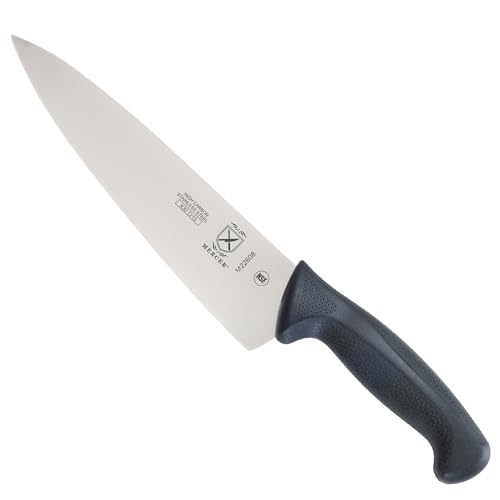
Mercer Culinary Millennia 8-inch Chef’s KnifeBest for beginners
|
Most new cooks on a budget | Western, 8-inch, Japanese high-carbon steel | Hand wash | View on Amazon |

Victorinox Fibrox Pro 8-inch Chef’s KnifeEasiest care
|
Cooks who use the dishwasher | Western, stamped, 7.9-inch | Dishwasher safe | View on Amazon |

Mercer Culinary Renaissance 8-inch Chef’s KnifeBest bolstered starter
|
A heavier, bolstered first knife | Western, short bolster, 8-inch | Not stated on listing | View on Amazon |

Misen 8-inch Chef’s KnifeBest step-up
|
A step up that still forgives | Hybrid, 210 mm, 58 HRC stated | Hand wash advised | View on Amazon |

OXO Good Grips 8-inch Chef’s Knife with Locking SheathSafest storage
|
Drawer storage, younger cooks | Straight edge, rounded tip, 8-inch | Not stated on listing | View on Amazon |
Product images from Amazon. Steel, hardness and care details are listed only where the maker or its listing states them; check the listing before you buy.
Our picks for the best chef knife beginner cooks can learn on
These eight knives are all 8-inch chef’s knives (or within a quarter inch of it), the size that suits a home cutting board and most hands. They cover stamped and bolstered blades, Western and Japanese-leaning profiles, plastic, polymer and steel handles, and a range of prices from very cheap to a moderate step up. Each review says who the knife suits, which specifications its maker states, and one honest reason to pass on it.
1. Mercer Culinary Millennia 8-inch Chef’s Knife – Sharp, Light and Cheap to Learn On
The Millennia is the knife culinary schools and busy kitchens hand to new cooks, and it makes sense at home for the same reasons. Mercer’s listing describes a one-piece blade of high-carbon Japanese steel chosen for easy edge maintenance, which in practice means a few strokes on a honing rod bring it back after a week of onions and tomatoes. The listing names exactly the jobs a beginner will do first: dicing onions, mincing shallots, chopping herbs, crushing garlic and shredding cabbage.
The handle is the feature that matters most for a learner. It is textured, with raised finger points that Mercer says give a non-slip grip, so the knife stays put when your hands are wet from rinsing cilantro or slick with jalapeño seeds. America’s Test Kitchen names it the Best Buy in its review of Western chef’s knives, writing that it is “a great value” and that its blade is nearly identical in sharpness to the more expensive winner. Its one complaint is that the bumpy rubber handle can get in the way of moving your hand along it.
Mercer asks for hand washing with warm, soapy water and immediate drying, and says not to put it in the dishwasher or leave it soaking. Its warranty covers defects in material and workmanship but specifically excludes dishwasher damage, so keep it out of the rack.
Why we like it
- America’s Test Kitchen’s Best Buy among Western chef’s knives
- Textured handle with finger points for a non-slip grip, per Mercer
- High-carbon Japanese steel chosen for easy edge maintenance, per the listing
- Low cost, so learning to sharpen on it is no great risk
Key specifications
| Model | M22608 |
|---|---|
| Blade length | 8 inches |
| Construction | One-piece blade (listing) |
| Steel | High-carbon Japanese steel |
| Hardness (stated) | Not stated |
| Handle | Textured, non-slip (material not named on listing) |
| Dishwasher safe | No, hand wash |
| Warranty | Mercer defect warranty; excludes dishwasher damage |
Why we recommend it
It suits the cook buying a first real knife who wants something sharp and light without spending much. It handles the everyday Mexican prep list, from a diced onion to a pile of chopped cilantro, and costs little enough that you can learn to sharpen on it without worrying.
Skip it if you dislike a bumpy, rubbery handle, or you know the knife will end up in the dishwasher; the Victorinox below is the better choice for that kitchen.
Pros and cons
Pros
- Sharp out of the box, per America’s Test Kitchen
- Grippy handle with wet hands
- Inexpensive and easy to hone
Cons
- Textured handle can feel bumpy as you shift your grip
- Not dishwasher safe, and the warranty excludes dishwasher damage
- Plain, utilitarian look
2. Victorinox Fibrox Pro 8-inch Chef’s Knife – Dishwasher Safe and Hard to Get Wrong
This is also the top pick on our main chef’s knife page, and it earns a place here for a different reason: it is the most forgiving knife on this list when it comes to care. Victorinox says the Fibrox Pro is made with dishwasher-safe materials, which almost no other chef’s knife maker will say, and backs it with a lifetime warranty against defects in material and workmanship. For a beginner who has not yet built the habit of washing and drying a knife straight after use, that matters.
The blade is 7.9 inches of stamped stainless steel with a tapered edge, and the handle is thermoplastic elastomer (TPE), which Victorinox says stays non-slip even when wet. America’s Test Kitchen names it the winner of its Western chef’s knife review, saying it “cuts foods of all kinds effortlessly” and noting its light weight, rounded spine and comfortable grip. A rounded spine is kinder to a beginner’s fingers when you learn the pinch grip, with thumb and forefinger on the blade itself.
Hand washing will still keep the edge longer, because a dishwasher knocks blades against racks and cutlery. But if the knife does go in now and then, it will not void anything.
Why we like it
- Rated dishwasher safe by Victorinox
- TPE handle that stays non-slip when wet, per the maker
- America’s Test Kitchen’s winning Western chef’s knife
- Lifetime warranty against defects
Key specifications
| Model | 5.2063.20 (listing model 45520) |
|---|---|
| Blade length | 7.9 inches |
| Construction | Stamped |
| Steel | Stainless steel, tapered edge |
| Hardness (stated) | Not stated |
| Handle | Textured TPE (Fibrox) |
| Dishwasher safe | Yes, per Victorinox |
| Warranty | Lifetime, against defects |
Why we recommend it
It suits a beginner who wants a light, sharp knife and knows that care will sometimes slip, or a household where several people share one knife and it will end up in the dishwasher whatever the label says.
Skip it if you want a knife that feels solid and weighty in the hand; the light stamped blade can feel flimsy to someone used to a heavier knife.
Pros and cons
Pros
- Most forgiving care of any knife here
- Light and easy on the wrist for long prep
- Grippy handle wet or dry
Cons
- Light stamped blade can feel flimsy to some cooks
- Softer steel needs honing often
- Plastic handle looks plain on a magnetic strip
3. Mercer Culinary Renaissance 8-inch Chef’s Knife – A Bolster to Guide the Grip
Some beginners feel more secure with a heavier knife that has a bolster, the thick collar of steel where the blade meets the handle, because it gives the fingers a natural stopping point. The Renaissance has one, but Mercer shortens it so it does not reach the heel of the edge. Mercer’s listing says the shortened bolster makes sharpening easier by exposing the full blade, which is a real advantage for a beginner learning on a pull-through sharpener or stone, since a full bolster eventually leaves a hump in the edge.
The handle is Delrin, a hard, smooth plastic, triple-riveted to the tang, and the edge is taper-ground, which Mercer says increases stability. America’s Test Kitchen rates the Renaissance Highly Recommended in its Western chef’s knife review, saying it “ran a very close race with our winner” thanks to its sharp, gently curved blade. That gentle curve suits the rocking motion most cooks use on herbs: the tip stays on the board while the heel rises and falls through a bunch of cilantro.
The same review warns that the slick plastic handle can feel slippery when wet, so dry your hands after rinsing produce. Mercer lists a lifetime warranty on this listing; it does not state dishwasher suitability, so wash it by hand.
Why we like it
- Short bolster that leaves the whole edge sharpenable, per Mercer
- Highly Recommended by America’s Test Kitchen
- Gently curved blade for rocking through herbs
- Triple-riveted Delrin handle
Key specifications
| Model | M23510 |
|---|---|
| Blade length | 8 inches |
| Construction | Bolstered, taper-ground edge |
| Steel | High-carbon stainless; grade not stated |
| Hardness (stated) | Not stated |
| Handle | Delrin, triple-riveted |
| Dishwasher safe | Not stated; hand wash |
| Warranty | Lifetime |
Why we recommend it
It suits the beginner who likes a bit of heft and a defined place to rest the fingers, and who wants a knife that will grow with their skills without costing much more than the Millennia.
Skip it if your hands are often wet while you cut; the smooth handle is less grippy than the textured Mercer Millennia or Victorinox.
Pros and cons
Pros
- Bolster without the sharpening drawback
- Close to the winner in America’s Test Kitchen’s review
- Classic riveted look at a modest price
Cons
- Handle can feel slippery when wet, per America’s Test Kitchen
- Steel and hardness not stated on the listing
4. Wüsthof Gourmet 8-inch Chef’s Knife – Solingen Steel Without Forging Cost

Wüsthof’s forged Classic is one of the best-known German chef’s knives, and it is on our main roundup. The Gourmet line is the beginner’s way into the same maker: Wüsthof’s listing says these knives are precisely laser-cut and stamped rather than forged, which brings the price down and the weight with it. They still carry the Solingen name, which Wüsthof notes is reserved for products meeting that city’s quality rules, and a limited lifetime warranty.
Wüsthof describes the Gourmet chef’s knife as the kitchen workhorse and says its weight and balance suit heavier work such as thicker vegetables and meat, which for a Mexican kitchen means chayote, jícama, a halved butternut squash for a soup or a pork shoulder trimmed for carnitas. The synthetic polypropylene handle, Wüsthof says, resists fading, discoloration, heat and impact.
The listing calls the blade high-carbon stainless steel but does not state the steel grade, hardness or edge angle, so we have not listed them. Wash it by hand and dry it straight away, as with any German knife.
Why we like it
- Made in Solingen, Germany, per Wüsthof
- Laser-cut stamped blade, lighter and cheaper than forged
- Polypropylene handle that resists heat and impact, per the listing
- Limited lifetime warranty
Key specifications
| Model | 4562/20 |
|---|---|
| Blade length | 8 inches |
| Construction | Laser-cut, stamped |
| Steel | High-carbon stainless; grade not stated |
| Hardness (stated) | Not stated |
| Handle | Synthetic polypropylene |
| Dishwasher safe | Not stated; hand wash |
| Warranty | Limited lifetime |
Why we recommend it
It suits the beginner who wants a German knife from a long-established maker, and the heavier, more traditional feel that comes with it, without paying for a forged blade.
Skip it if you want published steel and hardness figures before you buy; this listing does not give them.
Pros and cons
Pros
- Established German maker at a stamped-knife price
- Workhorse weight for dense vegetables and meat, per Wüsthof
- Durable synthetic handle
Cons
- Steel, hardness and angle not stated on the listing
- Costs more than the Mercer and Victorinox knives
5. Misen 8-inch Chef’s Knife – Harder Steel for a Small Step Up
Misen’s chef’s knife is for the beginner who already knows they will cook every day and wants a blade that holds its edge a little longer. Misen’s listing says this version is forged from Aichi ACUTO440 Japanese high-carbon stainless steel, finished to 58 HRC with a hand-finished edge of 14 degrees per side. The blade is 210 mm (8.26 inches) and the knife weighs about half a pound.
The profile is a hybrid, curved enough to rock and flat enough to push-cut, which suits both a fine chop of cilantro and clean slices through a tomato. Misen describes a rounded spine and a tapered bolster shaped for a pinch grip, with a POM handle and full tang. The listing says the steel is 18 percent chromium for corrosion resistance and recommends hand washing and drying for the best edge retention.
America’s Test Kitchen tested a Misen chef’s knife and rated it Recommended with Reservations: sharp and solidly made, but its thick spine struggled through bone-in chicken parts and wedged in butternut squash. We could not confirm whether this ACUTO440 version changes that spine, so if you cut a lot of squash, keep that in mind. Misen backs it with a lifetime warranty against manufacturing defects.
Why we like it
- Stated 58 HRC hardness and 14-degree-per-side edge
- Hybrid profile for rocking and push cuts
- Sloped bolster shaped for a pinch grip, per Misen
- Lifetime warranty against manufacturing defects
Key specifications
| Model | ACUTO440 8-inch, black |
|---|---|
| Blade length | 8.26 inches (210 mm) |
| Construction | Forged, full tang |
| Steel | Aichi ACUTO440 high-carbon stainless |
| Hardness (stated) | 58 HRC |
| Handle | POM |
| Dishwasher safe | Hand wash advised by Misen |
| Warranty | Lifetime, manufacturing defects |
Why we recommend it
It suits a beginner who plans to cook a lot and wants published specifications, a sharper stated edge and a pinch-grip bolster, without going all the way to a Japanese gyuto.
Skip it if you mostly cut dense squash or break down chicken; America’s Test Kitchen found an earlier Misen spine thick for those jobs.
Pros and cons
Pros
- Clear published hardness and edge angle
- Comfortable pinch-grip bolster
- Lifetime warranty
Cons
- America’s Test Kitchen had reservations about the Misen it tested
- Costs more than the Mercer knives
6. Henckels Solution 8-inch Chef’s Knife – Light, Stamped and Dishwasher Safe
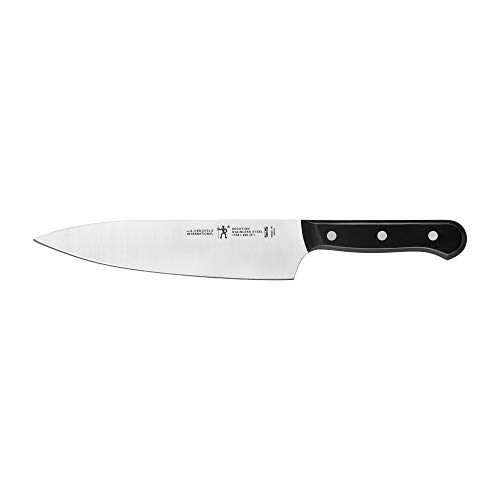
The Henckels Classic on our main chef’s knife page is fully forged; the Solution is its lighter, simpler sibling. Henckels’ listing describes a single-piece, precision-stamped blade with a satin finish, and says the knife is lightweight and easy to use, which suits a new cook who tires quickly with a heavy knife.
Like the Victorinox, the Solution is one of the few chef’s knives whose listing allows the dishwasher: Henckels says cleanup is no-fuss in the dishwasher or by hand, with stain- and rust-free blades. The listing names a wide range of jobs, from slicing and mincing vegetables, fruit and herbs to cutting large pieces of meat, and backs the knife with a lifetime warranty against manufacturer’s defects.
The listing does not name the steel grade, hardness, edge angle or handle material, so those are marked not stated. Expect it to need honing about as often as any stamped German-style knife.
Why we like it
- Dishwasher safe, per the listing
- Light stamped blade for long prep sessions
- Lifetime warranty against manufacturer’s defects
Key specifications
| Model | 17541-203 |
|---|---|
| Blade length | 8 inches |
| Construction | Single-piece, precision-stamped |
| Steel | Stain- and rust-resistant (grade not stated) |
| Hardness (stated) | Not stated |
| Handle | Not stated on listing |
| Dishwasher safe | Yes, per listing |
| Warranty | Lifetime, manufacturer’s defects |
Why we recommend it
It suits a beginner who wants a known German brand name, a light knife and dishwasher-safe care, as an alternative to the Victorinox for someone who prefers a smoother, more traditional handle shape.
Skip it if you want detailed specifications; the listing gives fewer facts than Victorinox or Misen.
Pros and cons
Pros
- Easy care
- Light and simple to handle
- Lifetime warranty
Cons
- Steel, hardness and handle material not stated
- No independent review we could read for this model
7. OXO Good Grips 8-inch Chef’s Knife with Locking Sheath – A Covered Blade for the Drawer
A lot of beginner knife accidents happen away from the board: reaching into a drawer, washing up, or packing a knife for a cookout. The OXO comes with a locking sheath that covers the blade for storage, which makes it the easiest knife here to keep safely in a drawer or a picnic box for a carne asada at the park.
OXO describes a stainless steel blade with a straight edge, a large blade surface and a rounded, non-pointed tip, and a soft non-slip grip shaped for a comfortable hold that will not slip when wet. The rounded tip is a deliberate safety choice, and it is worth understanding the trade: it removes the sharp point you would use to score an onion or pierce a chile, and a straight edge does not rock through herbs the way a curved chef’s knife does. It slices and chops cleanly instead.
The listing does not state construction, steel grade, hardness, dishwasher suitability or warranty terms, so we have marked them not stated.
Why we like it
- Locking sheath for safe storage, per OXO
- Soft non-slip grip that stays secure when wet
- Rounded, non-pointed tip
Key specifications
| Model | 11429100 |
|---|---|
| Blade length | 8 inches |
| Construction | Not stated on listing |
| Steel | Stainless steel |
| Hardness (stated) | Not stated |
| Handle | Soft non-slip grip |
| Dishwasher safe | Not stated |
| Warranty | Not stated on listing |
Why we recommend it
It suits a household where a nervous new cook, an older child learning to help, or a knife kept in a drawer makes a covered blade and a blunt tip worth more than a classic profile.
Skip it if you want to learn the classic rocking cut or need a point for scoring onions and coring tomatoes; the straight edge and rounded tip work against both.
Pros and cons
Pros
- Sheath included
- Grippy handle
- Blunt tip reduces stab risk
Cons
- No point for detail work
- Straight edge is poor for rocking
- Few specifications on the listing
8. Global 8-inch Chef’s Knife – A Light Japanese Blade for Learners

Many beginners want a Japanese knife from the start. Most hard, thin gyuto blades are a poor first choice because they chip if twisted, used on bone or left to rattle in a drawer. Global’s G-2 is the gentlest way in: a light, all-stainless knife whose listing describes it as precisely balanced, with a blade of molybdenum/vanadium stainless steel that retains its edge well.
The handle is part of the same steel, hollow and dimpled for grip, with no wood or rivets to loosen or crack. Global offers a lifetime warranty against defects and breakage. The blade is 8 inches (20 cm), the same size as the Western knives here, so it fits a standard board and a standard knife block.
Treat it as a precise knife rather than a tough one. Use a push cut through onions and peppers rather than twisting the blade, keep it off chicken bones and frozen food, and use a wood or plastic board. A smooth steel handle can also feel slick with wet hands, so dry them first. The listing does not state hardness, edge angle or dishwasher suitability.
Why we like it
- Light, balanced 8-inch blade, per Global
- Molybdenum/vanadium stainless steel
- One-piece stainless handle with dimpled grip
- Lifetime warranty against defects and breakage
Key specifications
| Model | G-2 |
|---|---|
| Blade length | 8 inches (20 cm) |
| Construction | All stainless, one-piece look |
| Steel | Molybdenum/vanadium stainless |
| Hardness (stated) | Not stated |
| Handle | Stainless steel, dimpled |
| Dishwasher safe | Not stated; hand wash |
| Warranty | Lifetime, defects and breakage |
Why we recommend it
It suits the beginner set on a Japanese-style knife who will treat it gently, and who likes a very light knife for fine dicing and slicing.
Skip it if you want the most forgiving knife on the list; a thinner Japanese edge is less tolerant of twisting and bones than the Mercer or Victorinox.
Pros and cons
Pros
- Very light for fine work
- No handle to crack or loosen
- Lifetime warranty including breakage
Cons
- Steel handle can be slick when wet
- Less tolerant of rough use than a Western knife
- Costs several times more than the Mercer Millennia
What makes a chef’s knife forgiving for a new cook
A beginner’s knife does not need the hardest steel or the thinnest edge. It needs to survive the mistakes everyone makes while learning: scraping chopped onion off the board with the edge, a twist of the wrist halfway through a squash, a night in a wet sink. Softer Western steel tends to roll or bend a little rather than chip, and a honing rod brings it back in a few strokes. Very hard Japanese steel stays sharp longer but chips more easily, which is why Japanese knives sit at the end of this list.
Weight is personal. A light stamped knife such as the Mercer Millennia or Victorinox tires the hand less over a big batch of salsa; a heavier bolstered knife such as the Mercer Renaissance or Wüsthof Gourmet feels steadier to some cooks. If you are unsure, start light: most new cooks grip too hard, and a heavy knife makes that worse.
How to choose a beginner chef’s knife
1. Stick with 8 inches
Eight inches is long enough to slice across a large onion or a skirt steak in one stroke and short enough to control on a home board. A 10-inch knife is harder to manage while learning, and a 6-inch knife runs out of blade on a whole cabbage.
2. Choose a handle that stays put when wet
Textured plastic or TPE, as on the Mercer Millennia and Victorinox, is the grippiest. Smooth plastic, polymer and steel handles look neater but slip more when your hands are wet from washing cilantro or seeding tomatoes.
3. Favor easy sharpening over edge retention
Every knife goes dull. A beginner is better served by steel that hones back quickly than by a hard edge that needs a stone. Pair your first knife with a honing rod and a simple sharpener; our guides to the best honing steel and the best knife sharpener cover both.
4. Be honest about care
If the knife will go in the dishwasher, buy one whose maker allows it (Victorinox or the Henckels Solution) rather than voiding a warranty. Otherwise, wash by hand and dry straight away, especially after lime, tomato and tomatillo.
5. Spend modestly
Your first knife is where you learn the claw grip, the pinch grip and sharpening. A knife you are not afraid to sharpen badly once or twice is a better teacher than one you are afraid to use.
How we chose these eight knives
We began with the jobs a beginner meets in a Mexican kitchen: dicing onion and tomato, chopping cilantro, seeding and mincing jalapeños and serranos, and slicing meat for fajitas or carne asada. We then looked for 8-inch chef’s knives from established makers that are sold on Amazon in the United States and were in stock when we checked, with specifications we could confirm from the maker’s Amazon listing (each review says what is stated and what is not). To keep this page distinct from our main roundup, we left out most of its picks, keeping only the Victorinox for its care rating and adding the Global G-2 as a gentler Japanese option. We read America’s Test Kitchen’s review of Western chef’s knives for how the Mercer, Victorinox and Misen knives perform, and quote it where we use it. We left out unbranded “Damascus” knives with unverifiable steel claims and the Tojiro DP, whose hard VG10 core is less forgiving of a learner’s mistakes. We have not used these products ourselves; where we describe performance, we say whose findings they are.
Beginner chef’s knife questions, answered
What is the best chef knife for beginners?
For most new cooks, the Mercer Culinary Millennia 8-inch: sharp, light, grippy and inexpensive, and America’s Test Kitchen’s Best Buy. If the knife will go in the dishwasher, choose the Victorinox Fibrox Pro, which Victorinox rates as dishwasher safe.
Should a beginner buy a Japanese or a German knife?
Most beginners do better with a Western (German or Swiss style) knife first. The softer steel tolerates twisting and scraping and hones back quickly. If you want a Japanese knife from the start, choose a light, well-supported option such as the Global G-2 and use a gentle push cut.
Is a knife set better than one chef’s knife for a beginner?
Usually not. One good chef’s knife does most of the work, and a cheap paring knife and a bread knife cover the rest. Sets often include knives you will rarely use. Our guide to the best paring knife covers the second knife most cooks need.
How often should a beginner sharpen a chef’s knife?
Hone it with a rod every time you use it, or at least every few uses, and sharpen it when honing no longer brings back a clean cut through a tomato skin. For most home cooks that is every few months.
What cutting board should I use with my first knife?
Wood or plastic. Glass, stone and ceramic boards dull an edge quickly. Our guide to the best cutting board compares wood, plastic, rubber and composite boards.
Our choice for a first chef’s knife
Buy the Mercer Culinary Millennia if you want the best value for learning, the Victorinox Fibrox Pro if dishwasher-safe care matters most, and the Mercer Renaissance if you like a little weight and a bolster. When you are ready for a step up with published hardness, the Misen is the next knife to consider, and our main best chef knife guide covers the forged and Japanese knives beyond that.
Related guide: Best cookbook for beginners.
Once the knife is sharp and the board is steady, the rest is practice. Our guides to Mexican herbs and Mexican chiles explain what you will be chopping. And if you would rather leave the chopping to someone else tonight, see the menu or call to order.