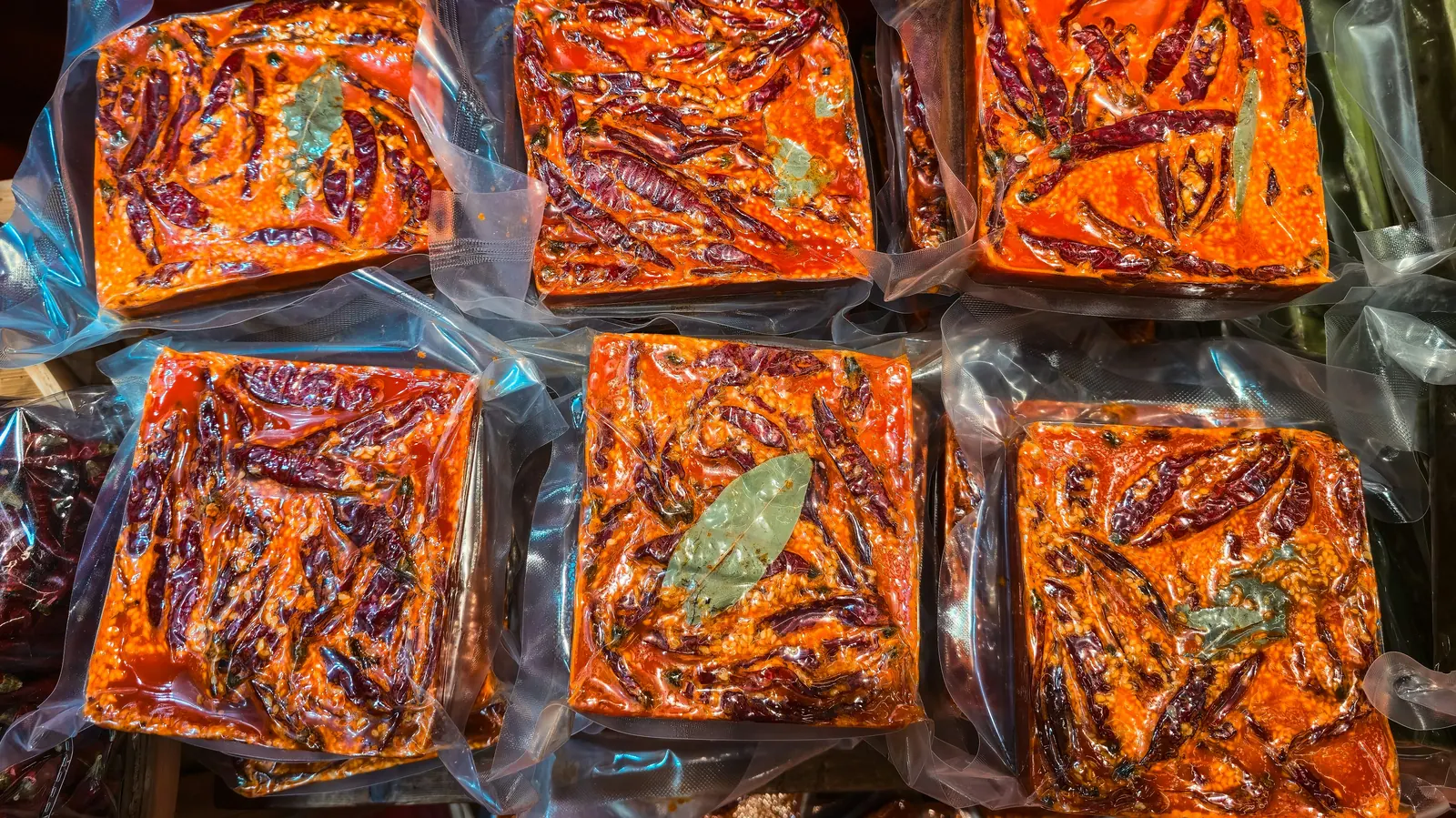
A restaurant kitchen lives on prep done ahead. Carne asada goes into its marinade the day before, a pot of mole simmers for hours and gets portioned for the week, and a big tamalada leaves dozens of tamales to freeze for later. A vacuum sealer pulls the air out of the bag before it closes, which helps keep frozen food from drying out and lets you stack flat, labeled packs in a freezer instead of a jumble of containers.
The hard part is choosing between two kinds of machine. Most home sealers are external, or suction, sealers: the open end of a bag goes in, the machine draws out the air and heat-seals it. Chamber sealers put the whole bag inside a box and remove the air from the box, which is why they can seal soups and sauces. This guide explains the difference, sets out eight sealers sold on Amazon, and covers what a sealer can and cannot do for food safety.
Julia’s earns a commission on purchases made through links on this page, at no cost to you. Recommendations are based on what a restaurant kitchen looks for in a vacuum sealer, the makers’ own specifications and the details on each Amazon listing.
Quick verdict: which vacuum sealer to buy
For most home kitchens, the best vacuum sealer is the FoodSaver FM2100: dry and moist settings, a built-in roll holder and cutter, an accessory port, and a five-year limited warranty. If you seal a lot of marinated meat, the Anova Precision Vacuum Sealer Pro adds a wet mode and one-hand operation. If you want to seal mole, caldo and other liquids without freezing them first, step up to a chamber sealer such as the Avid Armor USV1.
The rest of this page explains why, and which type of sealer fits the way you cook.
Five vacuum sealers side by side
One pick for each kind of kitchen, with the type, bag size and warranty each maker or listing states. All eight sealers are reviewed in full below.
| Vacuum sealer | Best for | Type & max bag | Warranty (stated) | Buy on Amazon |
|---|---|---|---|---|

FoodSaver FM2100 Vacuum SealerBest overall
|
Everyday freezer prep | External, 11-inch rolls | 5-year limited | View on Amazon |

Anova Precision Vacuum Sealer ProBest for marinades
|
Marinated meat, sous vide | External, 11-inch rolls | 2-year limited, per Anova | View on Amazon |

Avid Armor USV1 Chamber Vacuum SealerBest chamber sealer
|
Soups, sauces, mole | Chamber, 10 x 10-inch pouches | 1-year, per Avid Armor | View on Amazon |

Weston Pro-2300 Vacuum SealerBest for big batches
|
Bulk meat, back-to-back sealing | External, bags up to 15 inches | 2-year limited, per Weston | View on Amazon |

Nesco Deluxe VS-12 Vacuum SealerBest value
|
Full features for less | External, bags up to 11.8 inches | 1-year limited | View on Amazon |
Product images from Amazon. Bag sizes, modes and warranties are as stated by each maker or listing; check the listing before you buy.
Our picks for the best vacuum sealer
These eight sealers cover the three ways to vacuum seal at home: external countertop sealers for everyday freezer bags, chamber sealers for liquids and heavy use, and a cordless handheld for zipper bags and containers. Each pick says who it suits, what the maker or listing states, and one honest reason to skip it.
1. FoodSaver FM2100 Vacuum Sealer – Roll, Cut and Seal in One Machine
FoodSaver is the name most people know, and the FM2100 is its straightforward countertop model. It holds a roll of bag material inside and has a built-in cutter, so you can make a bag sized to a single steak, a pound of shredded barbacoa or a flat pack of rice without wasting plastic. FoodSaver describes dual heat-sealing strips and one-touch sealing, with settings for dry and moist food.
The moist setting is the one you will use for marinated carne asada or chicken in adobo. Liquid near the opening is the enemy of a good seal on any external sealer, so leave a few inches of headroom and let the bag rest flat. For loose sauces, freeze them flat in a bag or container first and seal once solid.
An accessory port and hose come in the box, which lets the FM2100 work with FoodSaver’s handheld sealer, zipper bags and containers. The starter kit includes an 11-inch by 10-foot roll and a few pre-cut quart and gallon bags. FoodSaver backs it with a five-year limited warranty, the longest stated on this list along with its Elite model.
Why we like it
- Built-in roll storage and cutter for custom bags
- Dry and moist settings
- Accessory port and hose included
- 5-year limited warranty, per the listing
Key specifications
| Model | FM2100-000 |
|---|---|
| Type | External (edge) suction sealer |
| Max bag width | 11 in roll included; wider not stated |
| Built-in cutter/roll storage | Yes, both |
| Moist/dry modes | Yes, dry and moist |
| Accessory port | Yes, with hose |
| Warranty | 5-year limited |
Why we recommend it
It suits a household that buys meat in bulk, cooks ahead and wants one sealer that handles everyday freezer prep without fuss.
Skip it if you want to seal soups and sauces as liquids; no external sealer does that well, and a chamber model is the answer.
Pros and cons
Pros
- Custom-size bags from the roll
- Long stated warranty
- Works with FoodSaver accessories
Cons
- Not for liquids
- Bags limited to 11-inch rolls
2. Anova Precision Vacuum Sealer Pro – One-Hand Sealing With a Wet Mode
Anova makes sous vide circulators, and its Pro sealer is built with wet food in mind. Switch it to the wet function and, Anova says, it uses a lower-pressure suction and a double seal so juicy foods seal without trouble. For a kitchen that bags arrachera in a citrus marinade or pork in a red chile adobo, that setting is the reason to choose it.
Anova designed it to work with one hand: clamping the bag, vacuuming and sealing all happen without a second hand to hold the lid. Open the hinge and a full roll of bags sits inside with a sliding cutter; the listing includes a 19-foot roll. Turn it over and the cord wraps into the base. An accessory port and hose let you seal canning-jar lids and vacuum containers.
Anova lists the modes as vacuum and seal, moist, dry, seal only, pulse vacuum and external pulse vacuum, and gives a 110-watt rating. Anova’s own warranty page gives two years for its vacuum sealers; the Amazon listing title also says two years, though one field on the listing says five, so rely on Anova’s terms. It does not state a maximum bag width; Anova’s own rolls are 11 inches wide.
Why we like it
- Wet mode with low-pressure suction, per Anova
- One-hand clamp, vacuum and seal
- Roll storage and sliding cutter built in
- Accessory port for jars and containers
Key specifications
| Model | ANVS02-US00 |
|---|---|
| Type | External (edge) suction sealer |
| Max bag width | Not stated; Anova rolls are 11 in |
| Built-in cutter/roll storage | Yes, both |
| Moist/dry modes | Yes, moist and dry, plus pulse |
| Accessory port | Yes, with hose |
| Warranty | 2-year limited, per Anova |
Why we recommend it
It suits cooks who marinate meat for the grill, cook sous vide or simply want sealing that needs only one hand.
Skip it if the longest warranty matters most; FoodSaver states five years against Anova’s two.
Pros and cons
Pros
- Designed for wet foods
- Compact with hidden cord storage
- Pulse control for delicate foods
Cons
- Max bag width not stated
- Shorter warranty than FoodSaver
3. Avid Armor USV1 Chamber Vacuum Sealer – Seals Liquids Without the Mess
A chamber sealer works differently from everything above. You set the whole bag inside the chamber, close the lid, and the machine removes the air from the chamber itself, so the liquid in the bag stays put instead of being pulled toward the pump. Avid Armor sells the USV1 as its entry-level chamber model for people moving up from edge sealers, and says it handles liquids, soups and juicy meats.
That changes what you can put up. A batch of mole poblano, a pot of pozole broth or a quart of salsa roja can go into a pouch and seal as it is, once cooled. Avid Armor lists a 12 by 12 inch footprint and a 6.25-inch height, a 10-inch removable seal bar, pouches up to 10 by 10 inches, three vacuum levels and three seal-time settings, with a maintenance-free dry pump.
The limits are the bag and the cost. Pouches top out at 10 by 10 inches, smaller than a gallon bag, and chamber machines cost more than most edge sealers. There is no roll or cutter; chamber pouches come pre-cut. The listing also mentions an accessory port for jars and canisters. Avid Armor’s product page gives a one-year warranty.
Why we like it
- Seals soups, sauces and marinades as liquids, per Avid Armor
- Compact 12 x 12 inch footprint
- Three vacuum levels and three seal times
- Maintenance-free dry pump
Key specifications
| Model | USV1 (Ultra SeriesONE) |
|---|---|
| Type | Chamber sealer, dry pump |
| Max bag width | 10 in seal bar; pouches up to 10 x 10 in |
| Built-in cutter/roll storage | No; uses pre-cut chamber pouches |
| Moist/dry modes | Three vacuum levels; seals liquids |
| Accessory port | Yes |
| Warranty | 1-year, per Avid Armor |
Why we recommend it
It suits cooks who batch soups, stews, moles and salsas and want to freeze them in flat pouches without pre-freezing.
Skip it if you mostly seal whole cuts of meat or large portions; the 10-inch pouch limit is small.
Pros and cons
Pros
- Handles liquids
- Small for a chamber sealer
- No pump oil to change
Cons
- 10 x 10 inch pouch limit
- No roll or cutter
- One-year warranty
4. Weston Pro-2300 Vacuum Sealer – Wide Bags, Bag After Bag
Weston sells its Pro series as commercial-grade sealers, and the Pro-2300 is the one to consider if you buy a whole brisket, a case of chicken thighs or a big family pack of skirt steak. The listing describes a fan-cooled motor designed for continuous, repetitive use, so you can seal bag after bag without waiting for it to cool down.
Its other strength is width. An extra-long seal bar takes bags up to 15 inches across, the widest of the edge sealers here, and the 5-millimeter bar lays down a broad seal. Weston lists 1,020 watts, a double-piston pump that draws up to 28 inches of mercury, a tinted see-through lid for lining up bags, LED lights for each stage, and a manual mode for delicate foods.
It is big, stainless and built for volume rather than a small kitchen. The listing does not mention a built-in roll holder, cutter or accessory port, and it has no dedicated moist setting; for marinated meat, use the manual mode and stop the vacuum before liquid reaches the seal. Weston’s product page advertises a two-year limited warranty.
Why we like it
- Fan-cooled motor for continuous use, per Weston
- Bags up to 15 inches wide
- Wide 5 mm seal bar
- Manual mode for delicate foods
Key specifications
| Model | 65-0220-W |
|---|---|
| Type | External (edge) suction sealer, fan-cooled |
| Max bag width | 15 in |
| Built-in cutter/roll storage | Not stated |
| Moist/dry modes | Automatic and manual; no moist mode stated |
| Accessory port | Not stated |
| Warranty | 2-year limited, per Weston |
Why we recommend it
It suits big families and anyone who processes bulk meat and needs a sealer that keeps going.
Skip it if you seal a few bags a week; it is large and more machine than an everyday kitchen needs.
Pros and cons
Pros
- Built for continuous sealing
- Widest bags of the edge sealers here
- Strong stated vacuum
Cons
- Large for a small counter
- No moist mode or cutter stated
5. Nesco Deluxe VS-12 Vacuum Sealer – Double Pump and Gentle Mode
Nesco’s VS-12 packs a long feature list into a mid-priced machine. The listing describes a 130-watt double vacuum pump, dry, moist and double-seal settings, and a gentle vacuum option for soft foods such as bread or berries that would crush under full suction. That gentle setting also helps with fresh masa or soft tortillas you want to freeze without flattening.
A roll storage compartment and sliding cutter are built in, and Nesco includes two starter rolls. Nesco’s product page says it takes bags up to 11.8 inches wide. The easy-lock handle closes the lid with one hand, and a viewing window shows whether the bag sits square on the seal bar before you press start, which saves wasted bags.
Nesco’s manual shows a port and canister hose for sealing and marinating in canisters, which are sold separately. Nesco lists the machine at 10 pounds, and the warranty is one year, shorter than FoodSaver’s. For a household that wants moist, dry and gentle settings without paying for a premium brand, it is a sensible middle ground.
Why we like it
- Double vacuum pump, per Nesco
- Dry, moist, double-seal and gentle settings
- Roll storage and sliding cutter
- Viewing window for lining up bags
Key specifications
| Model | VS-12 |
|---|---|
| Type | External (edge) suction sealer |
| Max bag width | 11.8 in, per Nesco |
| Built-in cutter/roll storage | Yes, both |
| Moist/dry modes | Yes, dry and moist, plus gentle and double seal |
| Accessory port | Yes, canister hose (canisters sold separately) |
| Warranty | 1-year limited |
Why we recommend it
It suits a household that wants a full set of settings, including a gentle mode for soft foods, at a moderate cost.
Skip it if you want the longest warranty; FoodSaver’s five years beats Nesco’s one.
Pros and cons
Pros
- Many settings for the cost
- Slightly wider bags than FoodSaver’s rolls
- Viewing window
Cons
- One-year warranty
- Canisters cost extra
6. FoodSaver Elite All-in-One Liquid+ Vacuum Sealer – A Liquid Mode on an Edge Sealer
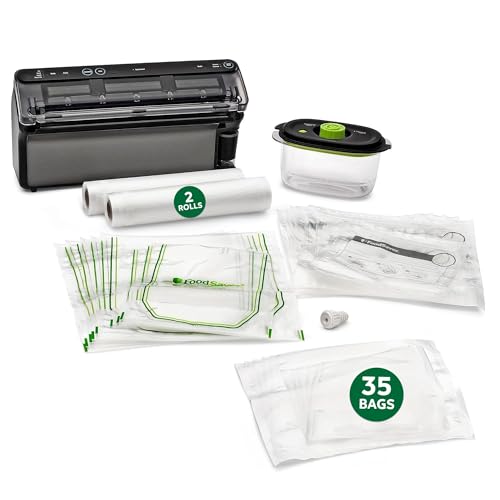
FoodSaver’s Elite All-in-One is its answer to the liquid problem on an edge sealer. The listing says it can seal liquids such as soups, sauces and salsas, with a footnote: liquids need a viscosity of at least 1.39 mPa·s, which is thicker than water. Treat that as help with thick sauces like mole or refried beans, not a promise that a thin consommé will seal cleanly.
It has six settings: dry, moist, liquid, sous vide, marinate and pulse. Automatic bag detection senses the bag, closes and locks the lid, and LED lights on the seal button show progress. A cutter bar and roll storage are built in, a dishwasher-safe drip tray catches spills, and a retractable handheld sealer pulls out for zipper bags and containers.
The box is generous: two 11-inch by 10-foot rolls, pre-cut and Easy Fill bags, zipper bags, a 5-cup marinate container and a wine stopper. FoodSaver gives it a five-year limited warranty. It is bigger and more complex than the FM2100, so buy it if you will use the extra modes and the handheld; otherwise the simpler model does the core job.
Why we like it
- Liquid mode for thicker liquids, per FoodSaver
- Six settings including marinate and sous vide
- Built-in retractable handheld sealer
- Dishwasher-safe drip tray
Key specifications
| Model | VS5960 |
|---|---|
| Type | External (edge) suction sealer with handheld |
| Max bag width | 11 in rolls included; wider not stated |
| Built-in cutter/roll storage | Yes, both |
| Moist/dry modes | Dry, moist, liquid, sous vide, marinate, pulse |
| Accessory port | Retractable handheld accessory |
| Warranty | 5-year limited, per FoodSaver |
Why we recommend it
It suits a kitchen that wants one edge sealer for meat, thick sauces, marinating and zipper bags, with a long warranty.
Skip it if you need to seal thin broths and soups regularly; a chamber sealer is more reliable for those.
Pros and cons
Pros
- Most settings of the edge sealers here
- Handheld built in
- Five-year limited warranty
Cons
- Liquid mode has a stated thickness limit
- Larger and more complex
7. VacMaster VP230 Chamber Vacuum Sealer – Commercial Build for Serious Prep

The VP230 is the kind of chamber sealer you find in butcher shops and restaurant prep rooms. VacMaster lists a half-horsepower oil pump, a 12.25-inch seal bar, a chamber of 12.5 by 15 by 5 inches and bags up to 12 by 15 inches, with a double seal on every bag. The listing says it is built for prolonged, continuous operation.
Like any chamber sealer, it seals liquids and liquid-rich foods, so soups, moles, salsas and marinades go in as they are. The larger chamber takes portions the Avid Armor cannot. A pressure indicator shows the vacuum level, and a stop button seals early if you want a lighter vacuum for something soft.
It is a serious commitment. VacMaster lists the weight at 89 pounds and the footprint at 15.5 by 19 inches, so it needs a permanent spot. An oil pump also needs oil changes; VacMaster’s maintenance guide gives intervals in cycles and months. The Amazon listing does not state the warranty term, so check it before you buy.
Why we like it
- Half-horsepower oil pump, per VacMaster
- Bags up to 12 x 15 inches
- Double seal on every bag
- Built for continuous use
Key specifications
| Model | VP230 |
|---|---|
| Type | Chamber sealer, oil pump |
| Max bag width | 12.25 in seal bar; bags up to 12 x 15 in |
| Built-in cutter/roll storage | No; uses pre-cut chamber pouches |
| Moist/dry modes | Adjustable vacuum; seals liquids |
| Accessory port | Not stated |
| Warranty | Not stated |
Why we recommend it
It suits caterers, home cooks who batch on a restaurant scale and anyone who seals liquids every week.
Skip it if you lack a permanent spot for an 89-pound machine or do not want to change pump oil.
Pros and cons
Pros
- Large chamber and bags
- Seals liquids as they are
- Commercial build
Cons
- Very heavy at 89 pounds
- Oil changes required
- Warranty not stated on the listing
8. FoodSaver Mini Handheld Vacuum Sealer – Cordless for Zipper Bags
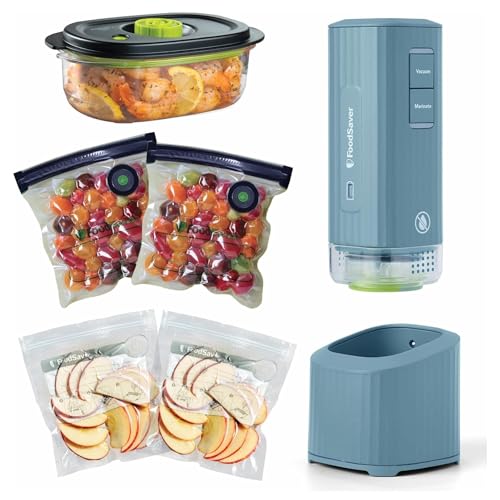
A handheld sealer is a different tool. Instead of heat-sealing plastic, it draws air out through a valve on FoodSaver’s zipper bags and containers. That makes it handy for food you open and close often, such as a bag of dried chiles, a block of queso or half a package of tortillas, and it takes up almost no space.
The listing gives a rechargeable battery that charges fully in about 2.5 hours and seals up to 35 quart bags per charge, with a charging dock and LED lights for progress, charge and battery level. An Auto Marinate mode works inside FoodSaver’s Marinate Container, which the listing says is the only place it should be used with liquids.
It will not replace a countertop sealer for long-term freezer storage of meat, because zipper bags and a handheld pump are not the same as a heat seal. Think of it as a companion for the pantry and fridge. The listing does not state a warranty term.
Why we like it
- Cordless, up to 35 quart bags per charge, per the listing
- Auto Marinate mode in the Marinate Container
- Small enough for a drawer
- Reusable zipper bags
Key specifications
| Model | 2217129 |
|---|---|
| Type | Cordless handheld, for valve zipper bags and containers |
| Max bag width | Not applicable; uses FoodSaver zipper bags |
| Built-in cutter/roll storage | No |
| Moist/dry modes | Vacuum and Auto Marinate |
| Accessory port | Not applicable |
| Warranty | Not stated |
Why we recommend it
It suits small kitchens and anyone who wants to reseal pantry goods and leftovers quickly without a countertop machine.
Skip it if you want long-term freezer storage of meat; a heat-sealing countertop model does that job better.
Pros and cons
Pros
- Cordless and compact
- Reusable bags
- Quick marinating in the container
Cons
- Needs FoodSaver zipper bags or containers
- No heat seal
What a vacuum sealer does, and does not do, for food safety
A vacuum sealer protects quality. It helps prevent freezer burn and lets you portion food neatly. It does not make perishable food safe at room temperature, and the guidance on this is clear.
Oregon State University Extension’s publication Should I Vacuum Package Food at Home? says vacuum packaging is not a substitute for the heat processing of home-canned foods, and that some illness-causing bacteria like low-oxygen environments. It states that refrigeration at 38 to 40°F is a critical step for storing low-acid vacuum-packaged foods, that perishable food being packaged should spend no more than two hours in total above 40°F, and, in its own words, that food that needs to be refrigerated without vacuum packing still needs to be refrigerated. OSU Extension’s refrigeration guidelines add that Clostridium botulinum can grow in vacuum-sealed meat, seafood and vegetables at room temperature, and that refrigeration slows growth and toxin production.
In practice, that means sealed carne asada goes into the refrigerator or freezer straight away, mole and beans are cooled before sealing and then kept cold, and frozen packs thaw in the refrigerator. The same publication notes that a package kept closed while it thaws is still a vacuum environment, so do not thaw sealed food on the counter.
How to choose a vacuum sealer for your kitchen
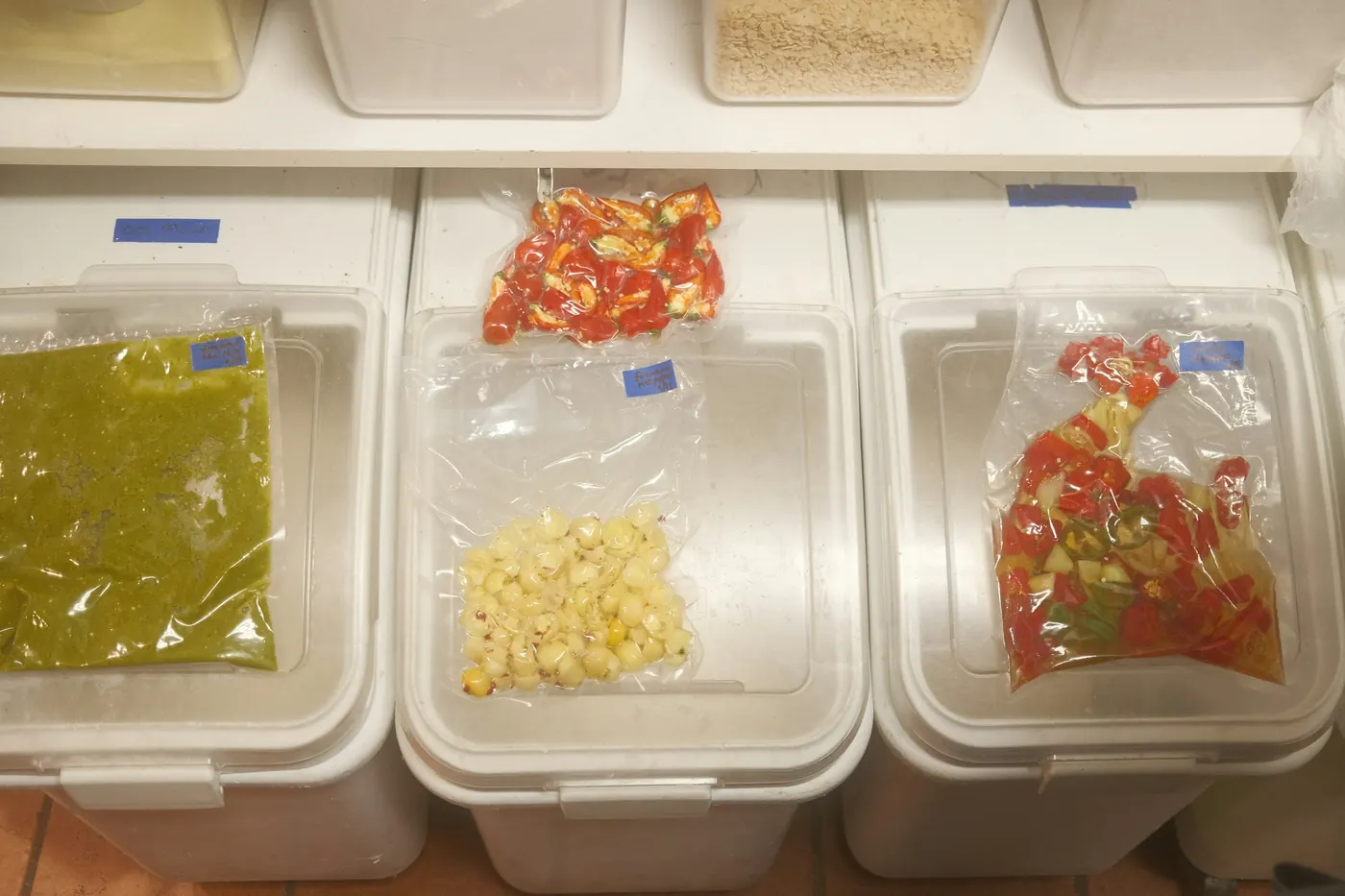
Decide whether you need to seal liquids. This is the big fork in the road. External sealers handle solid food, meat and marinated meat with care, and thick sauces with a liquid mode. If you want to put up soups, broths and mole as they are, buy a chamber sealer. Otherwise, freeze liquids flat first and seal them solid.
Look at the bag width and roll storage. Most edge sealers take 11- to 12-inch rolls; the Weston takes 15 inches. A built-in roll holder and cutter mean you make each bag to size, which saves plastic and money over pre-cut bags. Chamber sealers use pre-cut pouches.
Check for moist and gentle settings. A moist mode adjusts the vacuum and seal for wet food; a gentle or pulse control stops before soft food is crushed. Both matter for marinated meat, fresh tortillas, bread and berries.
Think about volume. A home sealer used a few times a week can be compact. If you seal dozens of bags in one session, look for a fan-cooled motor or a chamber machine built for continuous use. Portion meat with a kitchen scale first so every pack is the same weight.
Consider the extras. An accessory port lets you seal canisters and jar lids, a handy way to keep coffee, nuts and dried chiles. Warranty terms vary widely here, from one year to five, which is worth weighing on a machine with a pump and heating element.
How we chose these eight sealers
We started from the jobs a vacuum sealer does in a kitchen that cooks Mexican food: portioning and freezing meat for the grill, sealing marinated cuts, putting up batches of mole, beans and salsa, and freezing tamales and tortillas. We then looked at sealers sold on Amazon in the United States by identifiable makers, across external, chamber and handheld types, and checked each one’s stock with Amazon’s product data before writing.
Bag sizes, modes, ports and warranties come from each Amazon listing and, where we could reach them, from FoodSaver, Anova, Avid Armor, Weston, Nesco and VacMaster. We did not use these sealers ourselves, and we say “not stated” wherever a maker gives no figure. Food-safety guidance comes from Oregon State University Extension, linked above. We also checked the U.S. Consumer Product Safety Commission’s recall listings and found no recall covering these vacuum sealer models.
Vacuum sealer questions, answered
What is the best vacuum sealer for home use?
For most kitchens, an external sealer with a roll holder, cutter and moist mode, such as the FoodSaver FM2100. Step up to a chamber sealer only if you plan to seal liquids often.
Is a chamber vacuum sealer worth it for a home kitchen?
If you batch soups, stews, moles or salsas, yes: it seals them as liquids, as they are. If you mostly freeze meat and leftovers, an external sealer is smaller, lighter and costs less.
Can you vacuum seal marinated meat?
Yes. Use a moist or wet setting on an external sealer, leave headroom in the bag and lay it flat, or use a chamber sealer. Keep the sealed meat in the refrigerator while it marinates. For thinner cuts, our guide to the best meat tenderizer covers the step before the marinade.
How do I vacuum seal mole or soup?
With a chamber sealer, cool it and seal it in a pouch as it is. With an external sealer, cool it, freeze it flat in a bag or container until solid, then seal. Our guide to what mole is explains why a big batch is worth making.
Does vacuum sealing mean food can stay out of the refrigerator?
No. Oregon State University Extension says food that needs refrigeration still needs it after vacuum packing, and that some harmful bacteria grow well without oxygen. Refrigerate or freeze sealed perishable food right away.
Which vacuum sealer brands are worth considering?
FoodSaver for everyday edge sealers and long warranties, Anova for wet food and sous vide, Nesco for value, Weston for volume, and Avid Armor and VacMaster for chamber sealers.
Our pick for a cook-ahead kitchen
Buy the FoodSaver FM2100 if you want one dependable sealer for meat, leftovers and freezer prep. Choose the Anova Pro for marinades, the Avid Armor USV1 or VacMaster VP230 for liquids, the Weston Pro-2300 for bulk meat and the Nesco VS-12 for a full set of settings at a moderate cost.
More specific guides: the best chamber vacuum sealers and the best vacuum sealers for wet foods.
Prefer rigid containers to bags? See our guide to the best vacuum seal containers.
On a budget? See our guide to the best budget vacuum sealers.
Want something small and cordless? See our guide to the best handheld vacuum sealers for food.
Related guide: Best vacuum sealer for heavy use.
When the frozen packs come back out, our guide to reheating Mexican leftovers covers tamales, enchiladas and more. And if you would rather someone else did the cooking tonight, see the menu or call to order.