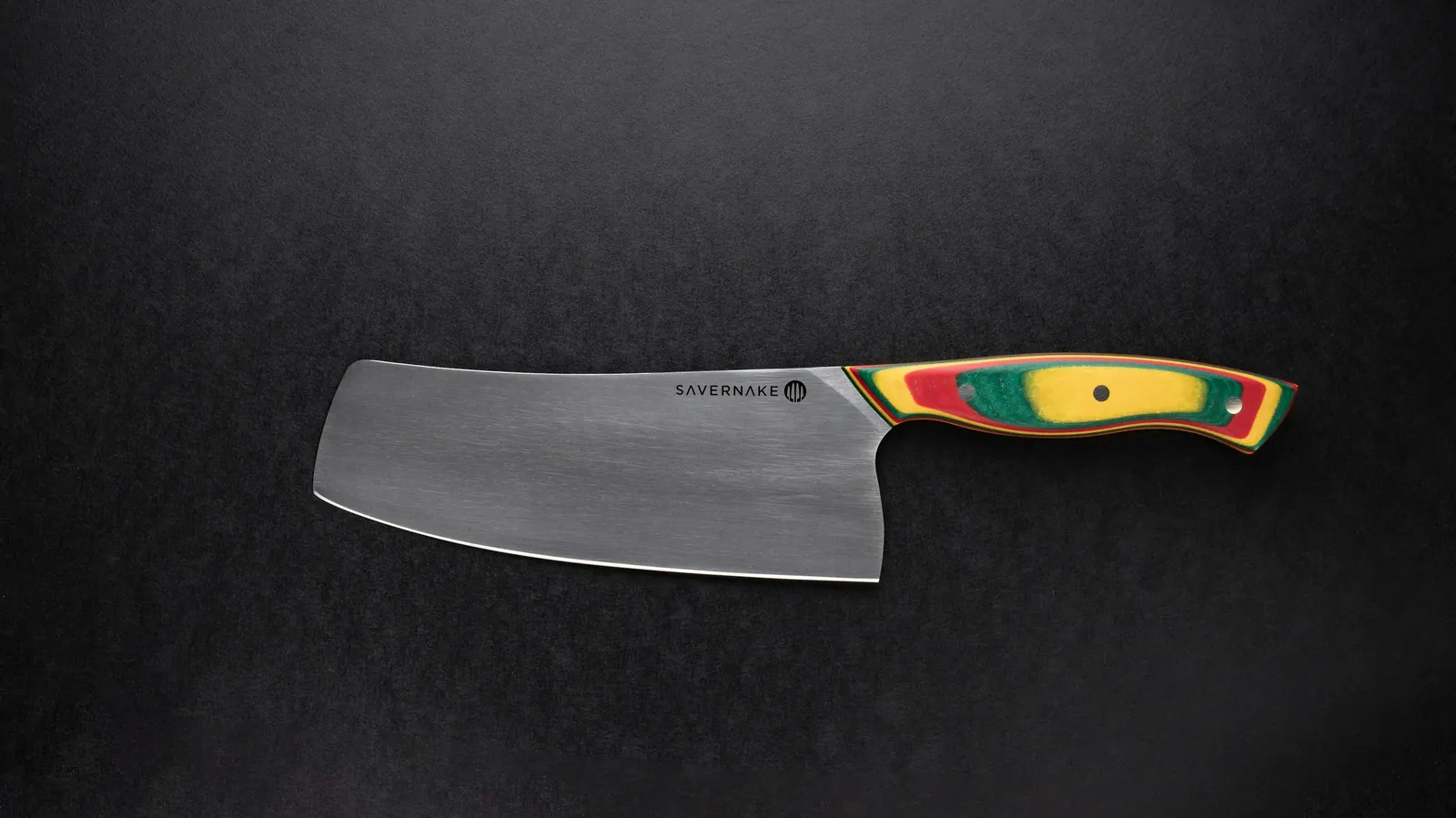
Most home cooks own a chef’s knife and wonder whether they need a cleaver at all. The two look like rivals, but they are built for different kinds of force. A chef’s knife slices and rocks with a thin, sharp edge. A meat cleaver is swung, and its weight drives a thicker edge through joints and bone. The question is less “which is better” than “what are you cutting.”
In a Mexican kitchen that question comes up often: a whole chicken cut up for caldo or tinga, pork ribs for chile verde, bone-in shoulder for carnitas. This guide compares a chef’s knife with a cleaver on weight, edge, the jobs each one does well, and the damage each one can suffer. It also explains where the thin Chinese cleaver fits, and names one knife for each side.
Julia’s earns a commission on purchases made through links on this page, at no cost to you. Recommendations are based on what a restaurant kitchen looks for, product specifications and verified buyer reports.
Quick verdict: cleaver or chef’s knife for meat and bones?
Buy a chef’s knife first. It handles nearly all everyday prep, including boneless meat and breaking down a chicken at the joints. Add a meat cleaver only if you regularly chop through bone, such as ribs, chicken backs or bone-in pieces for stews. America’s Test Kitchen says a cleaver’s heft suits jobs that would otherwise damage or wear down your chef’s knife, and it warns against cutting bone with a hard-steel chef’s knife. A thin Chinese cleaver is a different tool: a tall chef’s knife for vegetables and boneless meat, not a bone chopper.
The table sets out the differences; the sections after it explain each one.
Cleaver vs chef knife, side by side
| Chef’s knife | Meat cleaver | Chinese cleaver | |
|---|---|---|---|
| Main motion | Slicing, rocking, push cuts | Chopping: a short swing from the wrist (ATK) | Push cuts and chopping; scoops food on the wide blade |
| Blade shape | Pointed, curved edge, about 8 inches | Rectangular, tall; ATK prefers 6.75 to 7.25 inches long, at least 3 inches tall | Rectangular, tall, thinner |
| Weight | Light enough for long prep sessions | ATK’s preferred range: 14 to 15 ounces | Lighter than a meat cleaver (ATK) |
| Spine | Thin | Most 3 to 6 mm; ATK prefers about 2.5 to 3.3 mm | Thin |
| Bone | Avoid on hard-steel blades (ATK); fine for working around joints | Built for it (Zwilling, Wüsthof, Mercer) | Light bone at most, and only if the maker says so |
| Best jobs | Onions, chiles, herbs, boneless meat, breaking down a chicken | Ribs, chicken backs and wings, bone-in stew pieces, hard squash | Vegetables, boneless meat, crushing garlic |
| Main risk | Chipping if used on bone or frozen food (ATK) | Hard to control for fine work; heavy to lift repeatedly | Chipping on bone (ATK on two Chinese-style cleavers) |
What each knife is built to do
Zwilling’s guide to knife types puts it simply. A chef’s knife “is suitable for cutting meat, fish and vegetables and for cradle-cutting and chopping herbs.” A cleaver “can be used to mince meat and bones, but can also be used for vegetables or herbs.” The overlap is real, but each knife has one thing the other can’t do well.
America’s Test Kitchen’s chef’s knife review, by Kate Shannon Levine and Miye Bromberg, calls the chef’s knife an all-purpose blade that does everything from small, precise tasks like mincing garlic to “minor butchery (breaking down a chicken, filleting a fish).” That covers most of what a home cook does with meat. Cutting a chicken into pieces means cutting through joints and cartilage, not bone, and a sharp chef’s knife does that well.
ATK’s cleaver review, by Miye Bromberg, says a cleaver “is made for rough use,” and that its “heft and size make it ideal for jobs that might otherwise damage or wear down your chef’s knife.” Wüsthof says the same of its 8-inch cleaver, which it describes as making easy work of “ribs, racks, bones and also extremely hard-skinned fruit.”
Weight and blade: why the cleaver hits harder
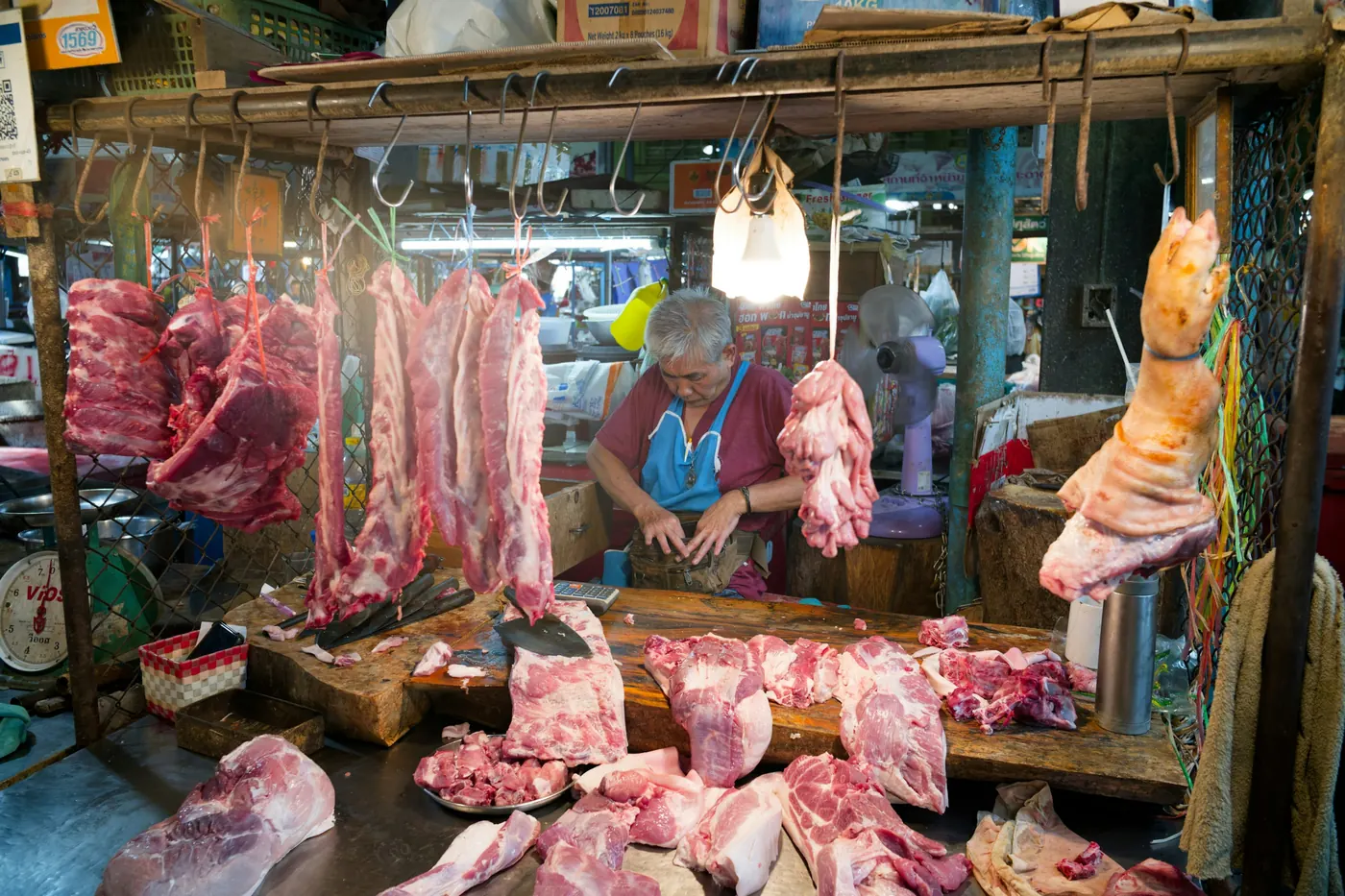
A cleaver works by mass. ATK says meat cleavers “need to have some heft to them in order to power through flesh and bone.” Its editors liked blades that weighed 14 or 15 ounces best. Heavier ones, over a pound, were harder to lift again and again, and lighter ones “didn’t always have enough power.”
The blade is thick too. ATK says most meat cleavers measure 3 to 6 mm at the spine, and its editors preferred a moderate 2.5 to 3.3 mm, because the thickest blades felt like axes and thinner ones were more fragile. It favors a blade about 6.75 to 7.25 inches long and at least 3 inches tall, with a slight curve so you can rock the blade to finish a cut.
A chef’s knife goes the other way: a thin blade and a fine edge made for control, not impact. That thin edge is what makes it so good at dicing onions and chiles, and it is also why it should stay away from bone.
Bones: where a chef’s knife can get hurt
ATK’s chef’s knife review is direct about hard-steel blades: “you’ll want to avoid using these blades to cut through bone or frozen and other especially hard or dense foods,” and “That hard steel is prone to chipping.” Softer German steel is more forgiving, but a chef’s knife is still not designed to be swung into bone. As general kitchen sense, a chipped or rolled edge means a trip to the sharpener and a shorter life for the knife.
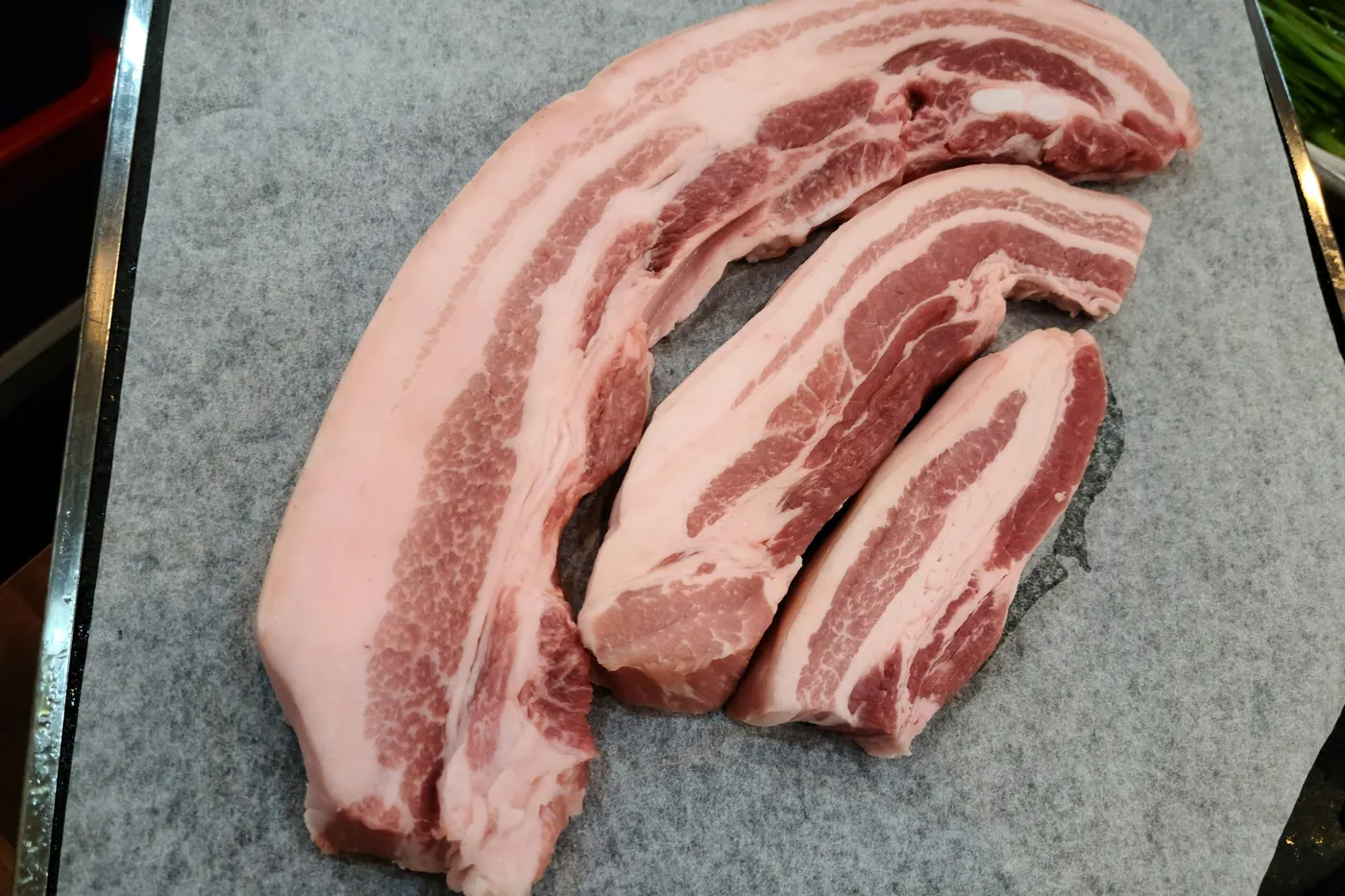
So the dividing line is the bone itself. If your cut goes between bones or through a joint, a chef’s knife is fine. If it goes through the bone, such as splitting a backbone, chopping ribs into short pieces or cutting a chicken through the bone into small pieces for a stew, use a cleaver.
Technique: slicing with one, chopping with the other
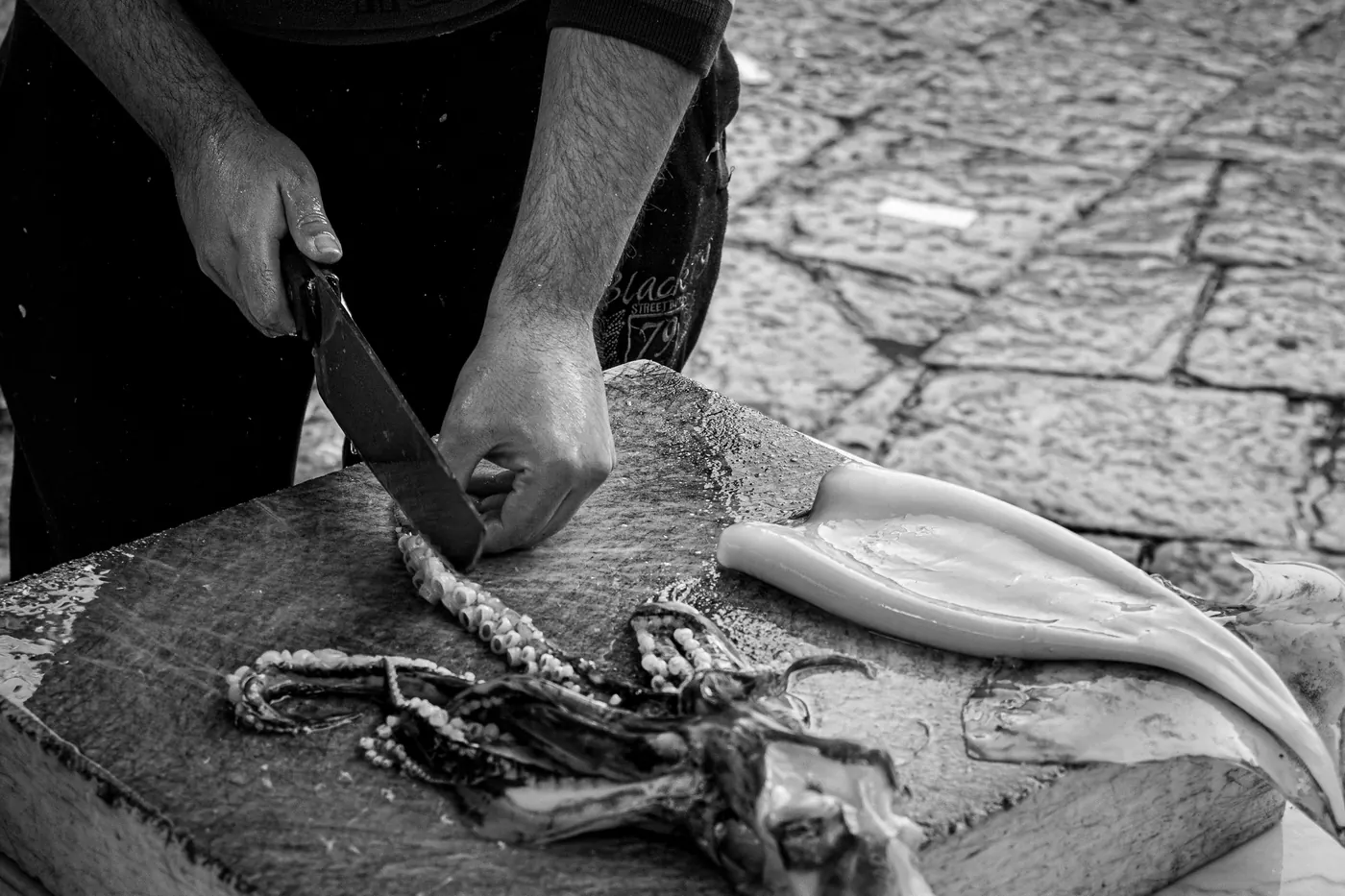
The chef’s knife rewards a smooth motion: rock the curved edge through herbs, or push the blade forward and down through an onion. The cleaver rewards a short, controlled swing. In ATK’s guide to using a meat cleaver, Bromberg advises letting “the weight of the cleaver do much of the work for you,” with the motion coming from your wrist, and says there’s “no need to wind up.” Strike with the top third of the blade, keep your other hand “well out of chopping range,” and use a board that won’t slide. On a wooden board, ATK says to cut across or at a slight angle to the grain so the board doesn’t split.
ATK also notes that it isn’t always best to hack. For some jobs you can use a cleaver as you would a chef’s knife, using its weight and leverage to slice or split. That flexibility is why some cooks reach for a cleaver for more than bone.
Where the Chinese cleaver fits
The word “cleaver” covers two different knives, which is the source of most confusion. ATK describes Chinese-style cleavers as “lighter-weight knives with thinner, more rectangular blades” than Western meat cleavers. Zwilling describes its Chinese chef’s knife as suited to vegetables, meat and fish, but “not good for chopping due to its thinly ground edge.” ATK found that two Chinese-style cleavers it reviewed were more prone to chipping, one of them easily dulled as well.
Think of a Chinese cleaver as a tall chef’s knife. It slices and scoops vegetables well, and it is a fair alternative to a chef’s knife if you like the shape, but don’t use it for bone unless its maker says it can take it. Our best vegetable cleaver guide covers the thin kind in detail, and our best bone cleaver guide covers heavy blades for serious bone work.
Choose a chef’s knife if… / Choose a cleaver if…
Choose a chef’s knife if…
- You want one knife for nearly all prep: vegetables, herbs, boneless meat and fish.
- Your meat work is mostly boneless cuts, or cutting a chicken at the joints.
- You value control and speed for dicing salsa and pico de gallo.
- You own only one good knife and want it to do the most.
Choose a meat cleaver if…
- You regularly cut through bone: ribs, chicken backs, bone-in stew meat.
- You want to protect your chef’s knife from rough jobs.
- You split hard squash such as calabaza often.
- You are adding a second knife and already own a good chef’s knife.
Our cleaver vs chef knife picks
One chef’s knife, one meat cleaver, and one Chinese cleaver for cooks who want the tall shape without a bone chopper. All three were in stock with a new offer when we checked, and none of these listings appears on our other pages. The Mercer cleaver is the 7-inch size of the 6-inch Mercer cleaver in our best chef knife cleaver guide; we chose the 7-inch here because it is the size America’s Test Kitchen reviewed for bone work. For more choices, see our best chef knife and best cleaver guides.
1. Wüsthof Performer 8-inch Chef’s Knife – Forged All-Rounder
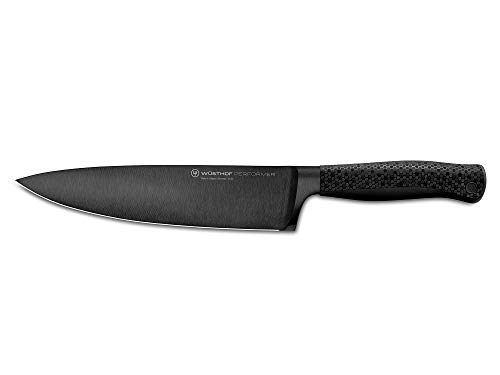
This is the knife to buy first. Wüsthof’s Performer 8-inch chef’s knife is forged in Solingen, Germany, according to the listing, and Wüsthof calls the 8-inch chef’s knife a real all-round knife for large ingredients, meat and herbs. The blade has a diamond-like carbon (DLC) finish, a hard black coating that Wüsthof says raises the surface hardness of the stainless steel and reduces friction.
The handle uses what Wüsthof calls a Hexagon Power Grip, a textured, non-slip pattern, and the forged bolster between blade and handle is meant to balance the knife. It carries a limited lifetime warranty, per the listing.
Use it for everything up to the bone: dicing onions and chiles, slicing flank steak for fajitas, trimming pork shoulder and cutting a chicken into pieces at the joints. Keep it off bone and frozen food, as ATK advises for chef’s knives in general. The listing doesn’t state a weight or care instructions; hand washing and drying is the safe routine for any good knife.
Why we like it
- Forged in Solingen, Germany (listing)
- DLC-coated blade to reduce friction (Wüsthof)
- Non-slip textured handle (listing)
- Limited lifetime warranty (listing)
Key specifications
| Model | 1061200120 |
|---|---|
| Type | Chef’s knife |
| Blade length | 8 inches |
| Steel | Stainless steel with DLC finish |
| Bone use | Not for bone (general guidance) |
| Handle | Synthetic, Hexagon Power Grip |
| Made in | Germany (Solingen) |
| Warranty | Limited lifetime |
Why we recommend it
It suits a cook who wants one well-made German knife for nearly all prep, and who will add a cleaver later only if bone work demands it.
Skip it if you prefer a plain steel blade; the black coating is a style choice, and our best chef knife guide has uncoated options.
Pros and cons
Pros
- Forged German build
- Low-friction coated blade
- Sold by Amazon
Cons
- Weight not stated
- Not for bone or frozen food
- Coating durability not stated
2. Mercer Culinary BPX 7-inch Kitchen Cleaver – Heavy and Built to Last

This 7-inch cleaver from Mercer Culinary’s BPX line is made of high-carbon, stain-resistant German steel with a triple-riveted handle, and Mercer says to use it “for cutting through thin or soft bones, or through hard vegetables such as squash.” That is exactly the home cook’s bone list: chicken backs and wings, pork ribs and bone-in pieces for stews.
America’s Test Kitchen included this model, the M14707, in its 2026 cleaver review and rated it “Recommended with Reservations.” ATK says it was “Built like a battle ax,” the heaviest cleaver in its lineup, with most of its weight in the blade, and that it “seemed superdurable—meant to last.” The reservations matter too: ATK found it tended to crack butternut squash and maul delicate roast duck, and its handle was “too thick for many hands.”
So this is a cleaver for power, not finesse. If you have large hands and want a cleaver that will take years of bone work, it fits. Mercer recommends hand washing and backs it with a limited lifetime warranty.
Why we like it
- Mercer names thin and soft bones and hard squash
- ATK found it very durable
- Heavy blade does the work
- Limited lifetime warranty (listing)
Key specifications
| Model | M14707 |
|---|---|
| Type | Meat cleaver |
| Blade length | 7 inches |
| Steel | High-carbon, stain-resistant German steel |
| Bone use | Thin or soft bones (Mercer) |
| Handle | Triple-riveted POM |
| Made in | Not stated |
| Warranty | Limited lifetime |
Why we recommend it
It suits a cook who chops ribs, chicken backs and bone-in stew meat often and wants a tough cleaver that keeps the chef’s knife out of that work.
Skip it if you have small hands or want a lighter, more agile cleaver; ATK found the handle thick and the blade heavy-handed on delicate food.
Pros and cons
Pros
- Built for bone
- Very durable (ATK)
- Mercer states which bones it suits
Cons
- Heaviest in ATK’s lineup
- Thick handle (ATK)
- Can crack squash and tear delicate meat (ATK)
3. Zhang Xiao Quan 7.3-inch Chinese Cleaver – Slice Up Front, Chop at the Heel

Zhang Xiao Quan is a Hangzhou scissor and knife maker whose history goes back to about 1628, according to Wikipedia. This is one of its Chinese cleavers. The listing describes a blade that is thin at the front half for slicing and thicker toward the back for chopping, in 40Cr13 stainless steel with a wooden handle. The blade is 7.3 inches long.
It is the pick for a cook who likes the tall, flat cleaver shape for vegetables and boneless meat, and wants to scoop chopped onion and cilantro straight off the board. The listing title calls it a meat cleaver and butcher knife, but it doesn’t say which bones it can take. Given ATK’s finding that lighter Chinese-style cleavers chip more easily, treat it as a vegetable and boneless-meat knife, and use a meat cleaver for bone.
Zhang Xiao Quan recommends hand washing and wiping the blade after use, and warns that the heat and pressure of a dishwasher can make the coating peel.
Why we like it
- Thin front for slicing, thicker heel for chopping (listing)
- Stainless 40Cr13 steel (listing)
- Wide blade scoops food off the board
- Long-established Chinese knife maker
Key specifications
| Model | D101201 |
|---|---|
| Type | Chinese cleaver |
| Blade length | 7.3 inches |
| Steel | 40Cr13 stainless steel, coated |
| Bone use | Not stated; avoid hard bone |
| Handle | Wood (Shabili) |
| Made in | Not stated |
| Warranty | Not stated |
Why we recommend it
It suits a cook who wants a cleaver-shaped knife for daily vegetable prep and boneless meat, as an alternative to a chef’s knife.
Skip it if you need to chop through bone; the Mercer cleaver is the tool for that.
Pros and cons
Pros
- Versatile blade profile
- Stain-resistant steel
- Known maker
Cons
- Bone limits not stated
- Coating can peel in a dishwasher (maker)
- Warranty not stated
How we compared these knives
We did not cut anything for this page. The comparison draws on America’s Test Kitchen’s 2026 cleaver review and its guide to using a meat cleaver, both by Miye Bromberg; ATK’s 2026 chef’s knife review by Kate Shannon Levine and Miye Bromberg; Zwilling’s guide to knife types; and Wüsthof’s description of its 8-inch cleaver. Product details come from the Amazon listings and the makers’ statements quoted there. We checked that each pick was in stock with a new offer, and where a listing leaves something out, the page says “Not stated.”
Cleaver and chef’s knife questions, answered
Can I use a chef’s knife to cut through bone?
It’s best not to. ATK advises against using hard-steel chef’s knives on bone or frozen food because the steel can chip. A chef’s knife is fine for working around bones and cutting through joints, but use a cleaver to cut through bone itself.
Can a cleaver replace a chef’s knife?
Partly. ATK says you can use a cleaver as you would a chef’s knife for some tasks, but a heavy meat cleaver is tiring and clumsy for fine dicing. A thin Chinese cleaver comes closer to replacing a chef’s knife, as long as it stays off bone.
What weight should a meat cleaver be?
ATK’s editors preferred meat cleavers of 14 to 15 ounces. Lighter ones lacked power, and those over a pound were harder to lift repeatedly.
Which knife is better for cutting up a whole chicken?
A chef’s knife handles the joints, which is most of the job, and ATK lists breaking down a chicken among a chef’s knife’s tasks. Use a cleaver if you want to split the backbone or chop pieces through the bone for soups and stews. Our best boning knife for chicken guide covers a third option for trimming meat off the bone.
Is a Chinese cleaver a meat cleaver?
No. ATK describes Chinese-style cleavers as lighter, with thinner blades, and found some of them prone to chipping. They are tall chef’s knives for vegetables and boneless meat. Use a heavier meat cleaver for bone.
Our final word on cleavers and chef’s knives
A chef’s knife is the knife to own first, and for most cooks it is enough. Add a meat cleaver when bone work becomes routine, because it does those jobs better and keeps your chef’s knife’s edge out of harm’s way. If you prefer a cleaver’s shape for everyday prep, a Chinese cleaver is a fine choice, but keep it away from bone. For another knife comparison, see santoku vs chef knife. And if you’d rather leave the butchery to us, call Julia’s to order at (346) 546-8283.