
Ask two cooks what a cleaver is for and you can get two different answers. To a butcher, a cleaver is a heavy, thick-spined blade that drops through chicken backbones and pork ribs. To a cook trained in a Chinese kitchen, the cleaver is a thin, tall, everyday knife, the cai dao, that slices cabbage, minces garlic and carries the whole pile of chopped scallions to the wok on its flat side. Both are called cleavers, and buying the wrong one is the most common mistake people make with this knife.
In a Mexican kitchen both kinds earn a place. A meat cleaver splits a bone-in pork shoulder before it goes into the carnitas pot and cuts chicken into pieces for a caldo. A vegetable cleaver moves through a mountain of cebolla, cilantro and tomato for pico de gallo faster than most chef’s knives, and scoops it all into the bowl at the end. This guide explains the difference, then names the dedicated cleavers worth buying on each side.
Julia’s earns a commission on purchases made through links on this page, at no cost to you. Recommendations are based on what a restaurant kitchen looks for, product specifications and verified buyer reports.
Quick verdict: which cleaver to buy
For meat and poultry bones, the best cleaver for most home kitchens is the Global G-12 meat cleaver: America’s Test Kitchen named it the winner of its meat cleaver review, and at about 15 ounces it has enough weight to chop chicken without wearing out your arm. For vegetables, choose the Shun Premier 7-inch vegetable cleaver, a thin, tall Chinese-style blade that Shun says is not meant for bone. On a budget, the Mercer Asian Collection Chinese chef’s knife covers vegetables and, according to Mercer, thin or soft bones.
If you want one knife that does a little of both, read the section on telling the two kinds apart first. A thin cai dao used on bone chips; a heavy meat cleaver used on onions is tiring and clumsy.
Five cleavers side by side
Our five standout picks, one for each kind of cook, with the specifications each maker or listing states. All nine cleavers are reviewed in full below.
| Cleaver | Best for | Type & blade | Bone use (per maker) | Buy on Amazon |
|---|---|---|---|---|

Global G-12 Meat Cleaver, 6.5-inchBest meat cleaver
|
Chicken, ribs, everyday meat work | Meat cleaver, 6.5-inch, all stainless | Listing: designed to cut through bones | View on Amazon |

Shun Premier 7-inch Vegetable CleaverBest vegetable cleaver
|
Onions, cabbage, big vegetable prep | Chinese vegetable cleaver, 7-inch, VG-MAX | No: not for joints or bones | View on Amazon |

Wüsthof 6-inch CleaverBest German meat cleaver
|
Ribs, racks, hard-skinned squash | Meat cleaver, 6-inch, 56 HRC | Yes: ribs, racks, bones | View on Amazon |

Shi Ba Zi Zuo 8-inch Chinese CleaverBest traditional cai dao
|
Slicing, mincing, scooping | Chinese cleaver, 8-inch, clad 80Cr13 | Not stated: treat as boneless only | View on Amazon |
| Vegetables and light meat work, small budget | Chinese chef’s knife, 8-inch, German steel | Thin or soft bones only | View on Amazon |
Product images from Amazon. Bone use is as each maker or its listing states it; check before you chop.
Our picks for the best cleaver
The nine cleavers below are dedicated cleavers, not chef’s knives with a cleaver profile. The first is a meat cleaver; then the list alternates through vegetable cleavers and meat cleavers so you can compare like with like. Each pick says plainly whether its maker allows bone, because that one fact decides more than any other spec. If you mostly want a cleaver-shaped knife to replace your chef’s knife, our guide to the best chef knife cleaver covers that angle in more detail.
1. Global G-12 Meat Cleaver, 6.5-inch – Light Enough to Use All Day
The meat cleaver to buy if you want one that a home cook can actually control. America’s Test Kitchen tested meat cleavers on chicken wings, leg quarters, butternut squash and a whole roast duck, and chose the Global G-12 as its winner, calling it “a stellar performer”. ATK weighed it at 15 ounces with a 3.3 mm spine, right in the 14 to 15 ounce range its testers preferred: heavy enough to do the work, light enough that the arm does not tire.
The construction is classic Global. The listing describes it as constructed entirely of stainless steel with a bolsterless design, so the whole edge reaches the board, and Global makes its blades from its own CROMOVA 18 high-carbon stainless steel. The handle is part of the same steel body, dimpled for grip, which is easy to wipe clean between raw chicken and the next job.
In a Mexican kitchen it suits the jobs where a chef’s knife hesitates: cutting a whole chicken into pieces for caldo de pollo or tinga, separating pork ribs between the bones, or splitting a chicken backbone for stock. Its square blade also flattens chicken breasts for milanesa with the flat side.
One honest caution. The Amazon listing says this cleaver is “designed to butcher and cut through bones”, but Global’s general care page tells owners not to cut through frozen foods or bones with its knives. Keep it to poultry and smaller pork bones, never frozen meat or big beef bones, and wash and dry it by hand, as Global advises.
Why we like it
- Winner of America’s Test Kitchen’s meat cleaver review
- About 15 oz, the weight range ATK’s testers preferred
- All-stainless, seamless body that is easy to clean
- Bolsterless, so the full edge meets the board
- Limited lifetime warranty, per the listing
Key specifications
| Model | G-12 (listing part number 812445) |
|---|---|
| Type | Meat cleaver |
| Blade length | 6.5 in (16 cm) per listing; ATK measured 6.25 in |
| Steel | CROMOVA 18 high-carbon stainless (Global) |
| Weight | 15 oz (America’s Test Kitchen) |
| Handle | Stainless steel, part of the one-piece body |
| Dishwasher-safe (maker) | No: Global says hand wash |
| Warranty | Limited lifetime (listing) |
Why we recommend it
Choose it if you cut up whole chickens, separate ribs or break down bone-in cuts a few times a month and want a cleaver that does not feel like an axe. ATK’s verdict, a balanced weight and a sharp, tall blade, matches what a home cook needs most from a meat cleaver.
Skip it if you want to chop through beef shank or frozen meat. ATK found the blade a little shorter than ideal, and Global’s own care advice warns against bones in general, so for heavy bone work look at our best bone cleaver picks instead.
Pros and cons
Pros
- Top pick in ATK’s meat cleaver review
- Comfortable weight for home cooks
- Hygienic one-piece steel design
- Sharp, tall blade
Cons
- Blade shorter than ATK prefers
- Global’s care page advises against bones
- Metal handle can feel slick when wet
2. Shun Premier 7-inch Vegetable Cleaver – A Thin Blade for Big Vegetables
This is the other kind of cleaver: a Chinese-style vegetable cleaver, which Shun describes as a multi-purpose knife for cutting, slicing and dicing large vegetables. The blade is 7 inches long, with a VG-MAX steel cutting core clad in Damascus layers and a hammered tsuchime finish that Shun says reduces drag and stops food sticking to the blade.
Shun lists it at 13.6 ounces, so it has some weight behind each stroke without the heft of a meat cleaver, and sharpens it to 16 degrees per side, much finer than a bone cleaver’s edge. That combination is why a vegetable cleaver goes through a head of cabbage for curtido, a pile of white onions or a bunch of cilantro so quickly: a tall, thin blade that falls straight down and leaves clean cuts.
The tall blade is also the most useful tool on the board after the cut. Turn it flat, slide it under the diced onion and tomato, and carry the lot to the bowl or the pan. The contoured Pakkawood handle is shaped for both left- and right-handed cooks, according to the listing, and Shun supports the knife with free sharpening and honing.
Read the warning on Shun’s own product page before you buy: “this cleaver is not intended for use on joints or bones; a Meat Cleaver is recommended for those tasks.” Treat it as a big, fast vegetable knife and it will keep that fine edge for a long time.
Why we like it
- VG-MAX core with Damascus cladding, handcrafted in Japan
- Fine 16-degree edge on each side, per Shun
- Hammered finish to reduce food sticking
- Tall blade scoops chopped food to the pan
- Free sharpening and honing from Shun
Key specifications
| Model | TDM0712 |
|---|---|
| Type | Vegetable (Chinese) cleaver |
| Blade length | 7 in (178 mm) |
| Steel | VG-MAX core, Damascus stainless cladding |
| Weight | 13.6 oz (Shun) |
| Handle | Contoured Pakkawood, walnut finish |
| Dishwasher-safe (maker) | Not stated on the product page |
| Warranty | Limited lifetime (Shun) |
Why we recommend it
Choose it if most of your cutting is vegetables and herbs and you want a single knife that slices, minces and transfers food. It suits cooks who make salsas, slaws and stir-fries in volume and like a straight up-and-down chop rather than a rocking motion.
Skip it if you need to cut through chicken bones or ribs, which Shun rules out, or if you want a low-maintenance knife you can leave in a drying rack. A hard, thin Japanese edge rewards careful hand washing and drying.
Pros and cons
Pros
- Very fine, sharp edge
- Food releases from the hammered blade
- Comfortable for either hand
- Free sharpening service
Cons
- Not for joints or bones
- Thin edge needs careful handling
- Premium choice compared with Chinese-made cleavers
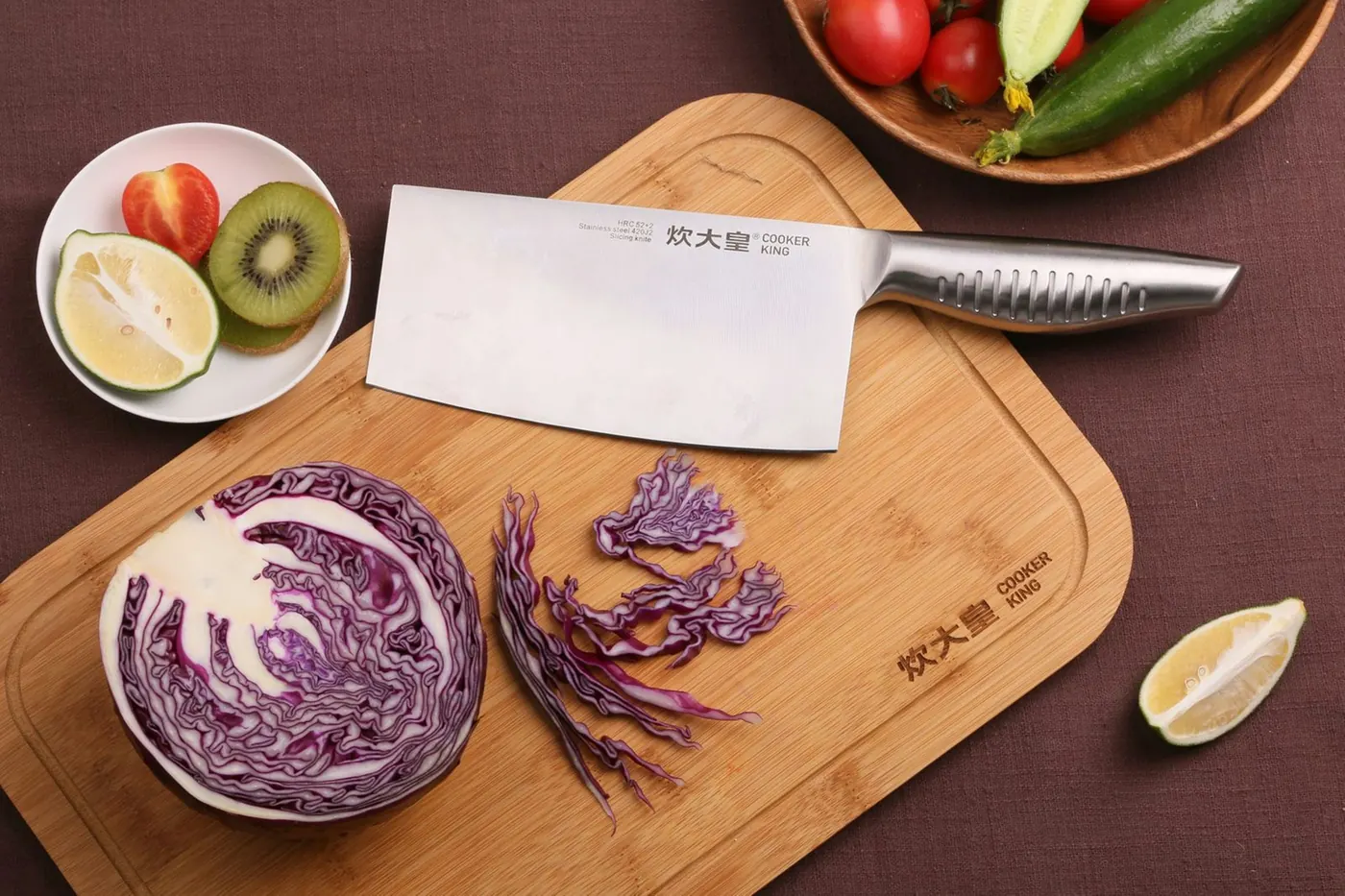
3. Wüsthof 6-inch Cleaver – Built for Ribs and Racks
Wüsthof is clear about what this cleaver is for: its product page says it makes it easy to cut “ribs, racks, bones and also extremely hard-skinned fruit – such as coconuts”. That is a Western meat cleaver in the traditional sense, a large, rigid rectangle of steel with a hole for hanging and a three-rivet handle.
Wüsthof lists the blade at 16 cm (about 6 inches) long and 7.07 cm tall, hardened to 56 HRC. That hardness is a little softer than Wüsthof’s chef’s knives, which is the right choice for a blade that meets bone: a slightly softer edge rolls rather than chips. The listing describes the blade as high-carbon stainless steel and the knife as made in Solingen, Germany.
For a cook making costillas en salsa verde, this is the cleaver that portions a rack of pork spare ribs into individual pieces, splits chicken thighs, or trims the knuckle off a pork shoulder before braising. Its squared-off blade also cracks a coconut, as Wüsthof suggests, and halves a hard calabaza.
Care is the usual German routine: hand wash only, according to the listing, and dry straight away. Wüsthof’s care advice for its cleavers also warns against cutting on hard surfaces such as metal, glass or bamboo, so give it a thick wood or plastic board.
Why we like it
- Wüsthof names ribs, racks and bones as its job
- Made in Solingen, Germany
- 56 HRC blade, softer than its chef’s knives for bone work
- Rigid, tall blade with a hanging hole
- Limited lifetime warranty, per the listing
Key specifications
| Model | 1129500916 |
|---|---|
| Type | Meat cleaver |
| Blade length | 6 in (16 cm), 7.07 cm tall |
| Steel | High-carbon stainless, 56 HRC (Wüsthof) |
| Weight | Not stated |
| Handle | Black synthetic, three rivets |
| Dishwasher-safe (maker) | No: hand wash only (listing) |
| Warranty | Limited lifetime (listing) |
Why we recommend it
Choose it if you want a maker that explicitly rates its cleaver for bone, from a German company with a long track record and a lifetime warranty. It suits cooks who portion ribs and poultry regularly and want a compact blade that is easy to aim.
Skip it if you want a heavier blade for beef or pork leg bones: at 6 inches it is the smaller of Wüsthof’s cleavers, and the listing does not give its weight. Our bone cleaver guide covers the larger 8-inch model.
Pros and cons
Pros
- Rated for bones by the maker
- Made in Germany
- Edge hardness suited to impact
- Lifetime warranty
Cons
- Weight not published
- Hand wash only
- Too short for big beef bones
4. Shi Ba Zi Zuo 8-inch Chinese Cleaver – The Traditional Cai Dao
Shi Ba Zi Zuo (often written Shibazi) is based in Yangjiang, Guangdong, a city known for knife and scissor making, and Chinese cleavers are the company’s signature product. This 8-inch model is the closest thing on this list to the knife a Cantonese cook uses for almost everything: a long, tall, fairly thin rectangle with a round wooden handle.
The listing describes three-layer clad stainless steel with an 80Cr13 high-carbon core, softer low-carbon steel on the outside for toughness and corrosion resistance, vacuum heat treatment, a non-stick coating and a full-tang blade. The handle is rosewood. At 8 inches, it is the longest blade in this guide, so a long cabbage leaf or a whole bunch of green onions can be cut in one stroke.
Shibazi sells it for cutting, slicing, dicing and mincing meat and vegetables, and points out that the wide blade smashes garlic. That is exactly how a cai dao earns its keep: crush a few cloves under the flat for a salsa, mince them, then slice boneless pork shoulder thin for al pastor-style tacos, all with one knife.
The listing does not mention bone, and a thin Chinese slicing cleaver should not be used on it. Hand wash and dry it, and keep a separate meat cleaver for anything with a joint.
Why we like it
- From a Yangjiang maker known for Chinese cleavers
- Three-layer clad blade with an 80Cr13 core, per the listing
- Long 8-inch edge for big vegetables
- Non-stick coating and rosewood handle
Key specifications
| Model | SBZ002 |
|---|---|
| Type | Vegetable (Chinese) cleaver |
| Blade length | 8 in (listing size 8.1 in) |
| Steel | Three-layer clad stainless, 80Cr13 core |
| Weight | Not stated |
| Handle | Rosewood |
| Dishwasher-safe (maker) | Not stated |
| Warranty | Not stated |
Why we recommend it
Choose it if you want the real thing, a traditional Chinese cleaver from a Chinese maker, for daily vegetable and boneless meat prep. It suits cooks who already like a tall blade and want more length than the 7-inch Japanese and German versions.
Skip it if you need published weight, hardness or warranty terms: the listing gives none of them, and it says nothing about bone, so assume boneless work only.
Pros and cons
Pros
- Authentic cai dao shape
- Long blade for big produce
- Clad steel construction
Cons
- No weight or warranty published
- Not rated for bone
- Coating can wear with heavy use
5. Mercer Asian Collection Chinese Chef’s Knife, 8-inch – A Workhorse on a Budget

This is the practical, inexpensive member of the list. The blade is high-carbon German steel, taper ground with a fine stone finish, and the handle is grippy Santoprene that Mercer says stays secure even with wet hands.
It sits between the two families in this guide. The shape is a Chinese cleaver, tall and rectangular, and Mercer describes it as perfect for cutting through thin or soft bones, or through hard vegetables such as squash. That makes it the most flexible budget choice here: it will cut a chicken wing at the joint, split a soft rib or halve a butternut squash, then go straight back to dicing onions and tomatoes.
The Santoprene handle matters more than it sounds. When you are working through raw chicken or a tray of wet vegetables, a slick handle is a safety problem, and America’s Test Kitchen also notes that grippy handles count when handling slippery raw meat.
Mercer’s care instructions are firm: wash by hand with warm water and mild soap, rinse and dry with a soft towel, never in the dishwasher, and do not leave it to soak.
Why we like it
- High-carbon German steel, taper ground
- Rated by Mercer for thin or soft bones and hard squash
- Non-slip Santoprene handle for wet hands
Key specifications
| Model | M21020 |
|---|---|
| Type | Chinese chef’s knife (vegetable cleaver, light meat) |
| Blade length | 8 in (listing) |
| Steel | High-carbon German steel |
| Weight | Not stated |
| Handle | Santoprene, non-slip |
| Dishwasher-safe (maker) | No: hand wash only |
| Warranty | Not stated on the listing |
Why we recommend it
Choose it if you want to try a cleaver without spending much, or need one sturdy knife for vegetables and small poultry bones. It suits busy kitchens where grip and easy maintenance matter more than looks.
Skip it if you want a fine, thin slicing edge like the Shun, or a true meat cleaver for pork and beef bones: Mercer limits it to thin or soft bones.
Pros and cons
Pros
- Budget friendly
- Handles squash and soft bones
- Secure grip when wet
Cons
- Weight and warranty not on the listing
- Plastic-feel handle
- Not for heavy bones
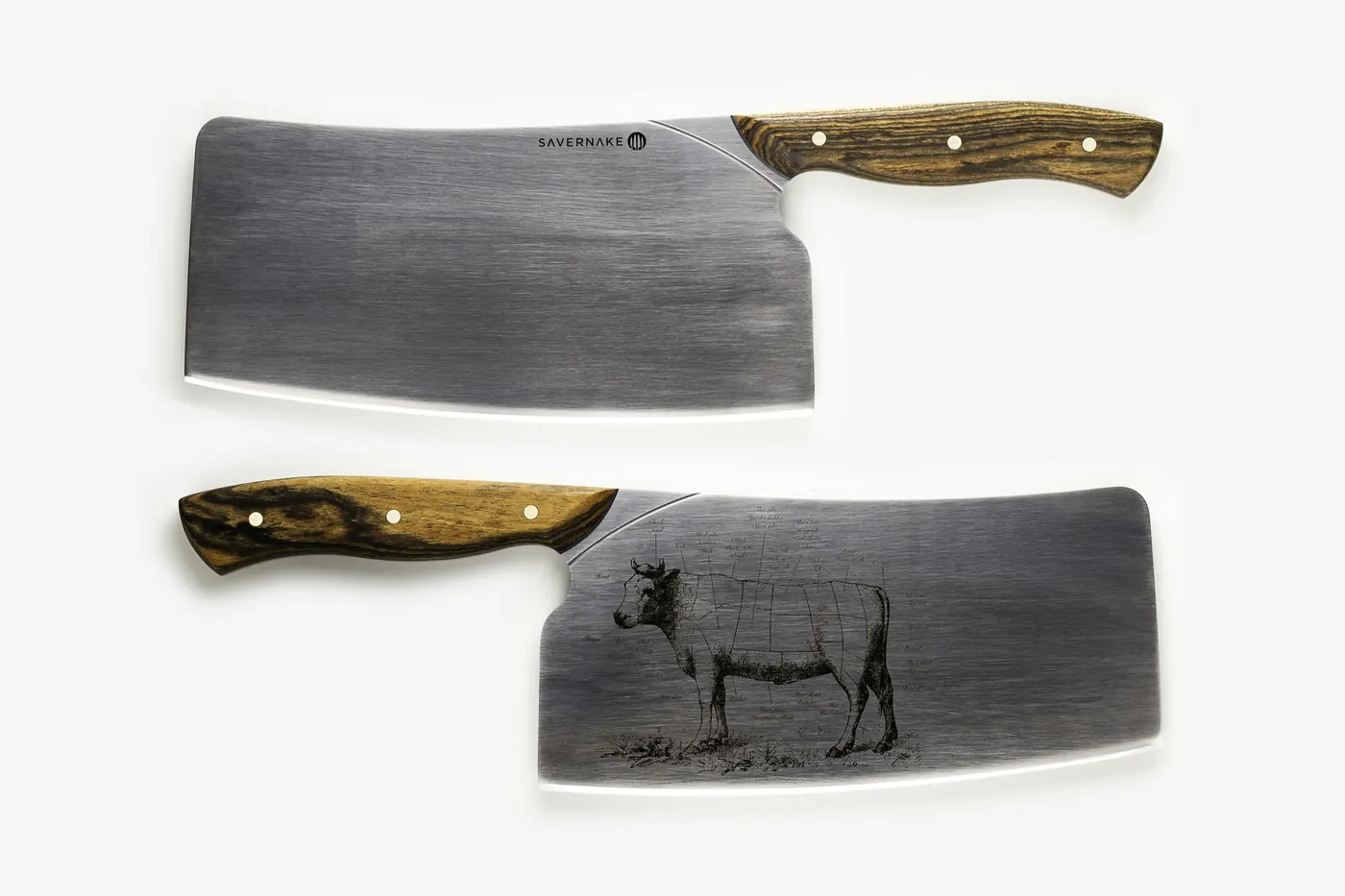
6. Zwilling Twin Pollux 7-inch Chinese Chef’s Knife – A Heavier German Cai Dao

Zwilling’s Twin Pollux Chinese chef’s knife is a German take on the cai dao: a large, rectangular 7-inch blade that the listing says is made for processing vegetables, meat and fish in the traditional Chinese way, and for carrying chopped food from board to pot. The blade is Zwilling’s special stainless steel, ice-hardened by its FRIODUR process, with a seamless transition into a triple-riveted plastic handle. It is made in Germany.
The number that sets it apart is weight. The listing gives 532 grams, about 18.8 ounces, well above the Shun vegetable cleaver’s 13.6 ounces. That extra mass helps it drop through a head of cabbage, a pile of white onions for pico de gallo or a stack of chiles with little effort, but it is more than America’s Test Kitchen’s testers liked to swing for long sessions, so it suits shorter, heavier prep jobs better than hours of fine dicing.
Zwilling recommends cleaning it by hand. The listing makes no claim about bone, so treat it as a knife for produce, boneless meat and fish, not for splitting joints.
Why we like it
- Made in Germany by Zwilling
- FRIODUR ice-hardened stainless blade
- Heavy blade that drops through dense vegetables
- Triple-riveted handle with a seamless join
Key specifications
| Model | 30795-180 |
|---|---|
| Type | Chinese chef’s knife (vegetable cleaver shape) |
| Blade length | 7 in |
| Steel | Special stainless steel, FRIODUR ice-hardened; HRC not stated |
| Weight | 532 g, about 18.8 oz (listing) |
| Handle | Plastic, three rivets |
| Dishwasher-safe (maker) | Hand cleaning recommended |
| Warranty | Not stated on the listing |
Why we recommend it
Choose it if you want a German-made Chinese chef’s knife with real heft for cabbage, squash and big batches of onions, and you like a riveted Western handle.
Skip it if you want a light blade for long prep sessions; the Shun Premier or a nakiri is easier on the arm.
Pros and cons
Pros
- Heft for dense produce
- Made in Germany
- Corrosion-resistant steel
Cons
- Heavy for long sessions
- Not for bones
- Hand washing recommended
7. Wüsthof 7-inch Chinese Chef’s Knife – A Tall Blade That Scoops

Wüsthof’s Chinese chef’s knife is the vegetable-cleaver partner to its meat cleaver above, and the maker is careful to separate the two. Its product page says this knife “should not be used on bones or very hard fruits (such as coconuts)” and suggests a cleaver or butcher’s knife for those jobs instead.
The blade is 18 cm (7 inches) long and 7.7 cm tall, a little taller than the meat cleaver, at 56 HRC, with a 12.1 cm riveted synthetic handle. Wüsthof lists it for cutting fish, fruit, herbs, meat and vegetables, and points to the wide blade as ideal for scooping up prepped ingredients. It is made in Solingen.
That height is the point. When you are building a big batch of salsa fresca, the blade pushes diced tomato, onion and jalapeño into one pile, then carries it to the bowl without a bench scraper. The straight edge suits an up-and-down chop rather than a rock, which is the technique a cleaver teaches.
A small caution on the details: Wüsthof’s international page lists the method as non-forged while its description mentions forging, and its US page lists a different weight and method. We use the international specifications for this model number and leave weight as not stated. Hand wash and dry it.
Why we like it
- Tall 7.7 cm blade for scooping
- Made in Solingen, Germany
- Maker is clear about what not to cut
- Limited lifetime warranty, per the listing
Key specifications
| Model | 1129500218 |
|---|---|
| Type | Vegetable (Chinese) cleaver |
| Blade length | 7 in (18 cm), 7.7 cm tall |
| Steel | Wüsthof stainless, 56 HRC |
| Weight | Not stated (maker’s pages conflict) |
| Handle | Synthetic, riveted, 12.1 cm |
| Dishwasher-safe (maker) | Not stated; hand wash advised for Wüsthof knives |
| Warranty | Limited lifetime (listing) |
Why we recommend it
Choose it if you already own German knives and want a vegetable cleaver that sharpens the same way, or if you want a tall blade for big prep sessions.
Skip it if you want one cleaver for meat and vegetables together. Wüsthof rules out bones for this knife, so pair it with a meat cleaver or choose the Mercer.
Pros and cons
Pros
- Very tall blade
- German edge is easy to sharpen
- Made in Germany
Cons
- Not for bones or coconuts
- Weight figures inconsistent
- Hand wash only
8. Dalstrong Gladiator 7-inch Meat Cleaver – Medium-Heavy With a Sheath

Dalstrong describes this as a versatile, multi-purpose, medium-heavy duty cleaver for chopping meat, chicken and fish, mincing aromatics and cutting fruit and vegetables. It is a Western-style meat cleaver with a 7-inch blade, forged according to the listing from German X50CrMoV15 high-carbon steel and heat treated to 56 Rockwell, a common hardness for blades that have to take impact.
The handle is G10 Garolite, a laminated fiberglass material that does not absorb water, and the listing says the cleaver is full tang and NSF certified for sanitary build. It comes with a fitted sheath, which is genuinely useful for a cleaver: a big, sharp blade loose in a drawer is a hazard, and many cleavers will not fit a standard knife block.
In practice it sits between the Global and a true bone cleaver. Use it for cutting a chicken into eight pieces, chopping pork belly into chicharrón-sized cubes, or splitting a rack of pork ribs. Dalstrong backs its knives with a limited lifetime warranty against defects and a 70-day money-back guarantee.
Dalstrong does not publish this model’s weight or blade thickness on the listing, and the listing does not cover dishwasher use, so treat it as hand wash only like any carbon-rich steel.
Why we like it
- German X50CrMoV15 steel at 56 HRC, per the listing
- Water-resistant G10 handle, full tang
- Includes a sheath for safe storage
- Limited lifetime warranty against defects (Dalstrong)
Key specifications
| Model | Gladiator Series 7-inch Butcher Meat Cleaver |
|---|---|
| Type | Meat cleaver (medium-heavy) |
| Blade length | 7 in |
| Steel | X50CrMoV15 high-carbon German steel, 56 HRC |
| Weight | Not stated |
| Handle | G10 Garolite, NSF certified |
| Dishwasher-safe (maker) | Not stated |
| Warranty | Limited lifetime against defects (Dalstrong) |
Why we recommend it
Choose it if you want a meat cleaver with a tougher German steel than the Global, a sheath for drawer or grill-side storage, and a longer 7-inch blade, the length ATK’s testers preferred.
Skip it if you want independent testing behind your choice: we found no review from America’s Test Kitchen or a similar source for this model, and Dalstrong publishes fewer hard numbers than Wüsthof or Global.
Pros and cons
Pros
- Sheath included
- Grippy, water-resistant handle
- Longer 7-inch blade
Cons
- Weight and thickness not published
- No independent review found
- Styling may be more than you need
9. Cuisinart Graphix 7-inch Cleaver – Low-Cost Cleaver for Occasional Use
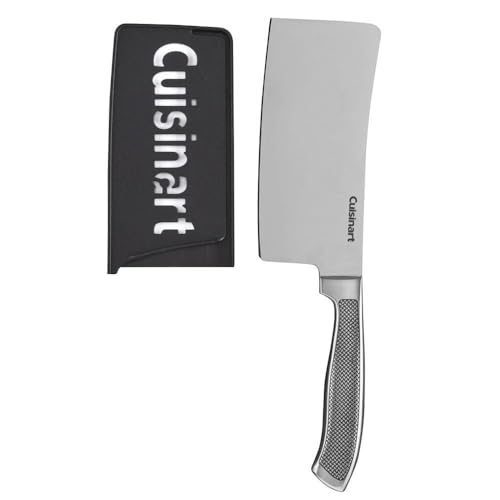
If you need a meat cleaver a few times a year, for a holiday turkey or a batch of chicken stock, this is a sensible place to start. Cuisinart’s Graphix cleaver has a 7-inch stainless steel blade and a textured, ergonomic handle, and the listing says it “easily chops through soft poultry and meat bones, as well as hard winter squash”.
That wording is the honest limit: soft poultry and meat bones, not beef shank. For chicken backs, wing tips and thighs, or for cutting a calabaza into wedges for a dulce de calabaza, it has the weight and blade length to do the job. Cuisinart’s own product page also lists a matching blade guard for storage.
The listing gives no steel grade, hardness or weight, so this is a cleaver chosen on the maker’s name and its lifetime warranty rather than detailed specifications. Wash it by hand and dry it; the listing does not address the dishwasher.
Why we like it
- Rated by Cuisinart for soft poultry and meat bones
- Also chops hard winter squash
- 7-inch blade with a textured handle
- Lifetime warranty, per the listing
Key specifications
| Model | C77SS-CLV |
|---|---|
| Type | Meat cleaver (light duty) |
| Blade length | 7 in |
| Steel | Stainless steel (grade not stated) |
| Weight | Not stated |
| Handle | Textured ergonomic handle |
| Dishwasher-safe (maker) | Not stated |
| Warranty | Lifetime (listing; listed as limited) |
Why we recommend it
Choose it if a cleaver will live in a drawer most of the year and come out for poultry, stock bones and squash. It is the lowest-commitment way to stop forcing a chef’s knife through joints.
Skip it if you cut bone often or want to know what steel you are buying. The listing publishes almost nothing beyond the blade length and intended uses.
Pros and cons
Pros
- Inexpensive
- Rated for soft bones and squash
- Lifetime warranty
Cons
- Steel and weight not stated
- Soft bones only
- Few published details
Meat cleaver or vegetable cleaver: how to tell them apart
The two kinds look alike in a photo and behave nothing alike on a board. America’s Test Kitchen sums up the difference in its meat cleaver review: Western cleavers are heavy and axe-shaped, while Chinese-style cleavers are lighter, with thinner, more rectangular blades that are easier to maneuver but more prone to chipping. Three details give each one away.
- Spine thickness. ATK measured spines from about 2.3 mm to over 4 mm among the cleavers it tested, and its testers preferred roughly 2.5 to 3.3 mm for an all-round meat cleaver. Vegetable cleavers sit at the thin end; dedicated bone cleavers go well beyond it.
- Edge angle. ATK notes that Western cleavers often have edges of 20 degrees or more to resist chipping. Shun sharpens its vegetable cleaver to 16 degrees per side, which is why it slices so cleanly and why it should never meet bone.
- What the maker says. The fastest test of all. Shun and Wüsthof both state that their vegetable cleavers are not for bones; Wüsthof’s meat cleaver page names ribs, racks and bones. If a listing says nothing about bone, assume the answer is no.
Weight follows from all of this. ATK’s testers liked meat cleavers of 14 to 15 ounces and found anything over a pound tiring for long sessions. Shun’s vegetable cleaver weighs 13.6 ounces, close to the meat cleavers, while Zwilling’s Twin Pollux Chinese chef’s knife is heavier at about 18.8 ounces, so the two families overlap on the scale; what differs is where that weight sits and how thick the edge is behind it.
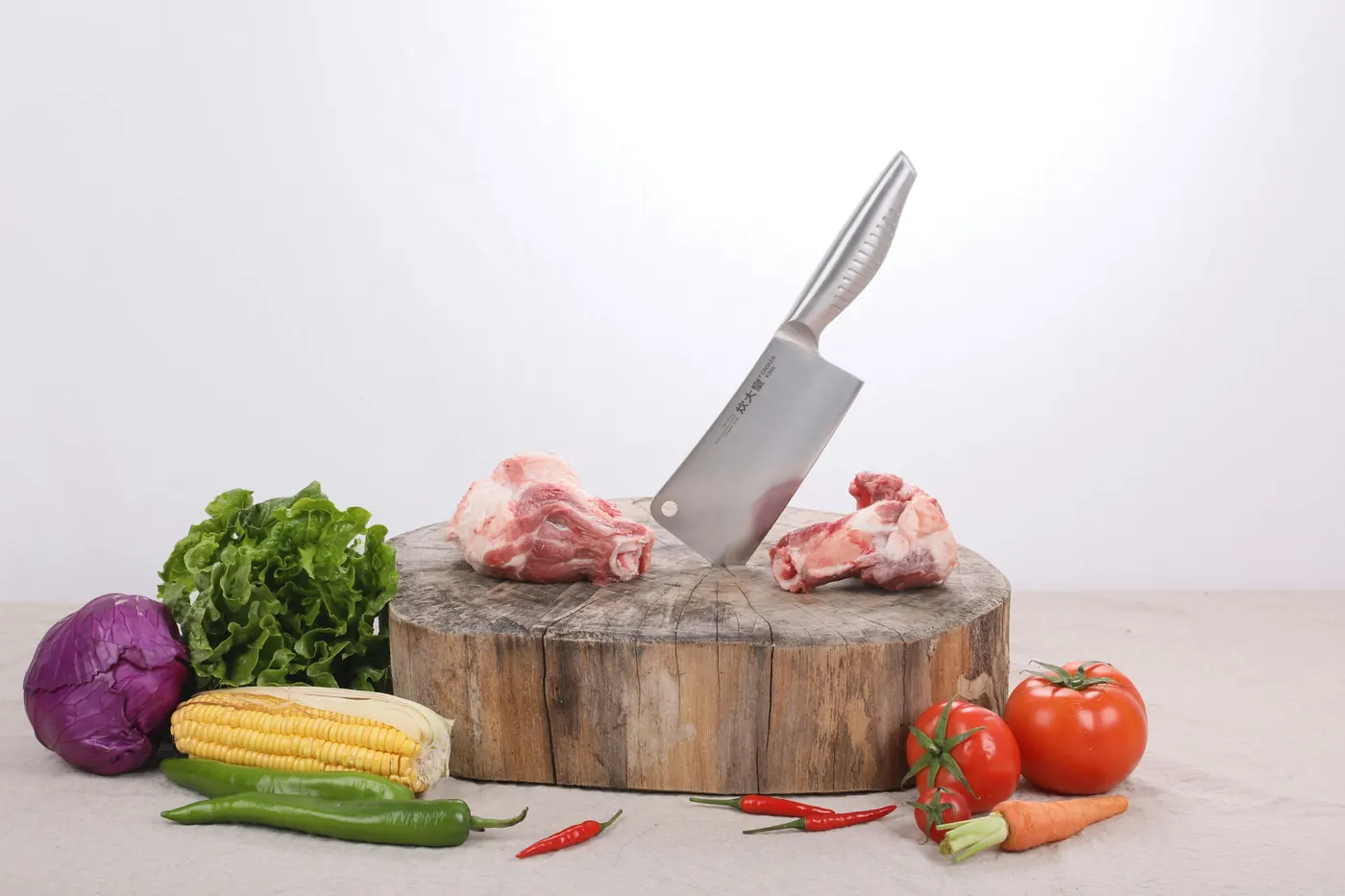
Where a cleaver earns its place in a Mexican kitchen
A good chef’s knife does most of the cutting in any kitchen, and if you do not own one yet, start with our best chef knife guide. A cleaver takes over in a handful of jobs that a chef’s knife does badly or should not be doing at all.
Breaking down pork for carnitas and pozole. A bone-in pork shoulder has a flat blade bone and a knuckle. A meat cleaver cuts around and through the smaller pieces so the meat fits the pot and browns evenly. For pozole, a cleaver portions pork neck bones and spare ribs into pieces that fit a spoon.
Chicken for caldo, tinga and mole. Cutting a whole bird into pieces means cutting through the backbone and separating joints. A meat cleaver does it in a few clean strokes; a chef’s knife used for the same job risks a chipped edge.
Cebolla, cilantro and pico de gallo. A vegetable cleaver’s tall, straight blade dices a white onion fast, chops a whole bunch of cilantro stems and all, and carries the pile to the bowl. It is the same work a nakiri does, on a bigger blade; see our guide to the best nakiri knife if you would rather have a lighter Japanese vegetable knife. Our guide to Mexican herbs covers what to do with all that cilantro.
Garlic and squash. The flat of any cleaver crushes garlic cloves for salsa in one press, and a meat cleaver or the Mercer can split a hard calabaza or butternut squash that would trap a thinner blade.
How to choose a cleaver
Decide what you will cut first
If you mostly cut vegetables and boneless meat, buy a vegetable cleaver. If you cut poultry and pork bones, buy a meat cleaver. If you regularly cut beef shank, oxtail or large pork bones, you need a heavier bone cleaver, which we cover in our best bone cleaver guide. Trying to make one thin knife do all three is how cleavers get chipped.
Weight
For a meat cleaver, aim for about 14 to 15 ounces, the range America’s Test Kitchen’s testers preferred. Lighter blades lack power through joints; heavier ones are tiring and harder to aim. For a vegetable cleaver, around 13 ounces, like the Shun, gives momentum without strain; a heavier blade such as the Zwilling Twin Pollux suits shorter jobs on dense produce.
Blade length and height
ATK’s testers preferred meat cleaver blades of about 6.75 to 7.25 inches and at least 3 inches tall, which helps guide each cut and scoop food afterward. Vegetable cleavers run 7 to 8 inches; the longer blade suits cabbage and long bunches of herbs.
Steel and hardness
Meat cleavers use slightly softer, tougher steel, around 56 HRC on the Wüsthof and Dalstrong, so the edge rolls rather than chips on bone. Vegetable cleavers can be harder and thinner, which keeps a finer edge but makes them more fragile. Whatever the steel, keep the edge sharp; our best knife sharpener guide covers tools that handle wide blades.
Handle and care
Choose a handle you can grip securely with wet or greasy hands: textured synthetic, Santoprene or G10 are the safest when working with raw chicken. Wash every cleaver here by hand and dry it straight away; several makers here say hand wash only, and none recommends the dishwasher.
A board that can take it
A cleaver needs a thick, stable board. ATK’s guide to using a meat cleaver recommends a sturdy, unwarped board with a wet towel or gripper mat underneath, and Wüsthof warns against cutting on hard surfaces such as glass, metal or bamboo. A thick end-grain or edge-grain wood board is ideal; see our best wood cutting board guide.
Using a cleaver safely
America’s Test Kitchen’s guide to using a meat cleaver is the clearest advice we found, and it is worth following exactly.
- Steady the board. Put a wet towel or gripper mat under a sturdy board so it cannot slide.
- Use a power grip. Wrap your fingers around the handle as if shaking hands. You can rest your thumb on the spine for control.
- Keep your other hand clear. ATK says to keep it well out of chopping range, and only steady the far end of long pieces like a rack of ribs.
- Do not wind up. Lift from the elbow and let the blade’s weight do the work, aiming with the top third of the blade.
- Do not re-hack. If the blade sticks in a bone, press down on the spine with your other hand rather than striking the same spot again, which ATK notes is hard to hit twice and mangles the meat.
- Not every job needs a chop. ATK points out that a cleaver can also be used like a chef’s knife, with a pinch grip and a slight rock, for jobs such as halving a roast duck.
For vegetable cleavers, the safety rule is simpler: let the blade fall straight down through the food, keep your guiding hand’s fingertips curled, and never drag the edge sideways across the board to scrape food up, which ATK notes dulls it. Use the spine side or a bench scraper instead.
How we picked these nine cleavers
We started from what a restaurant kitchen asks of a cleaver: a clear job (bone or vegetables), a weight and blade length that can be controlled for a full prep session, a handle that stays secure when wet, and a maker who says plainly what the blade can and cannot cut. We then narrowed the field to dedicated cleavers sold on Amazon in the United States and in stock when we checked, and confirmed specifications on the maker’s own website where one exists (Global, Shun, Wüsthof, Zwilling, Dalstrong’s warranty page) or on the brand’s Amazon listing, saying which in each review. For how cleavers behave, we relied on America’s Test Kitchen’s meat cleaver review and its guide to using a meat cleaver, which we read and cite. We did not use cleavers ourselves for this guide. We left out Dexter-Russell, Victorinox’s Fibrox cleaver, Zwilling’s own-brand meat cleaver and several Global and Wüsthof Chinese cleavers because they were out of stock or down to their last units, and passed over marketplace brands whose steel and “Damascus” claims we could not verify.
Cleaver questions, answered
What is the best cleaver for the kitchen?
It depends on the job. For meat and poultry, the Global G-12 was America’s Test Kitchen’s top meat cleaver. For vegetables, a Chinese-style vegetable cleaver such as the Shun Premier is faster and finer. If you can only have one, the Mercer Chinese chef’s knife handles vegetables and, according to Mercer, thin or soft bones.
Which cleaver brands are worth buying?
For meat cleavers, Global, Wüsthof and Victorinox all have models recommended by America’s Test Kitchen or rated for bone by the maker. For vegetable cleavers, Shun, Zwilling and Wüsthof make well-documented Western-market versions, and Shi Ba Zi Zuo is a Yangjiang maker known for traditional Chinese cleavers.
Can a Chinese vegetable cleaver cut through bone?
Not safely. Shun and Wüsthof both state that their vegetable cleavers are not intended for bones, and ATK found thin Chinese-style blades more prone to chipping. Use a meat cleaver for joints and bones.
Is a cleaver a good everyday knife?
A vegetable cleaver can be: the Chinese cai dao is traditionally an all-purpose knife, and makers such as Shibazi sell theirs for slicing, dicing and mincing both meat and vegetables. A meat cleaver is too heavy and thick for daily slicing and dicing; it is a specialist for bone and tough jobs.
Is a meat cleaver the same as a butcher knife?
No. A butcher or breaking knife has a long, curved blade for slicing through meat and trimming fat. A meat cleaver has a short, tall, heavy rectangular blade for chopping through joints and small bones.
Which cleaver to start with
If you cook with bone-in chicken and pork, start with the Global G-12 meat cleaver, or the Wüsthof 6-inch if you want a maker that names ribs and bones on its own page. If you cut more onions, cilantro and cabbage than anything else, start with the Shun Premier or, for a heavier German blade, the Zwilling Twin Pollux. On a budget, the Mercer Chinese chef’s knife bridges the two. For the heaviest jobs, from beef shank for caldo de res to oxtail, see our best bone cleaver guide, and for a lighter vegetable knife, our best nakiri knife picks. If you are building a full set, our best knife set and best Japanese knife guides cover the rest of the block.
On a budget? See our guide to the best value cleavers.
Related guide: Best vegetable cleaver.
Related guide: Cleaver vs chef knife.
And if you would rather leave the chopping to someone else tonight, see the menu or call to order.