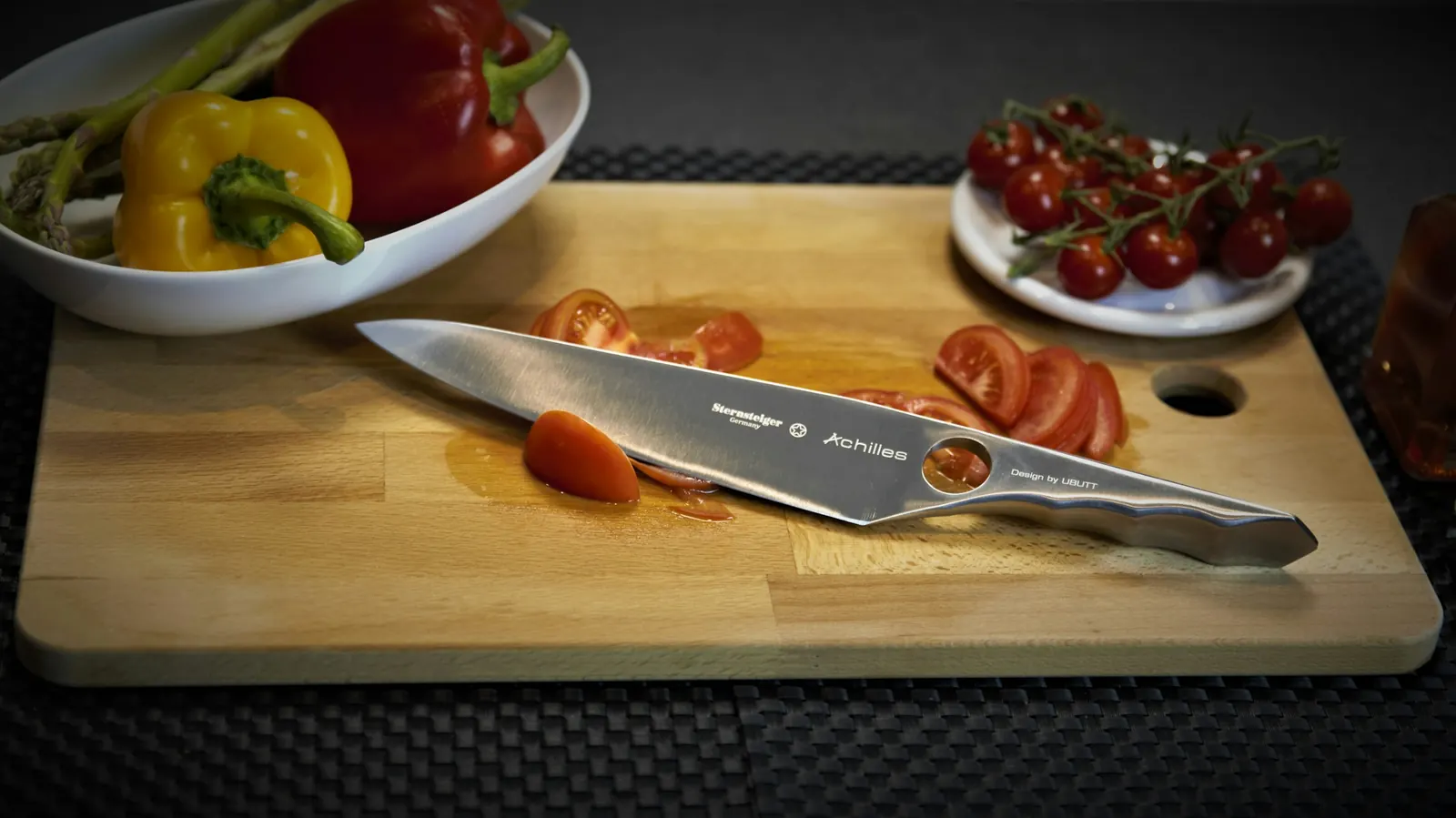
Shun and Global are the two Japanese knife brands most American cooks meet first. Both are made in Japan, both are thin and sharp next to a German chef’s knife, and both cost enough that you want to choose once. Yet they feel nothing alike in the hand. A Shun Classic has a layered Damascus blade and a wooden D-shaped handle. A Global is steel from tip to end cap, with a dimpled metal grip that looks like nothing else in the knife block.
On a prep line the knife that wins is the one a cook can hold for an hour without thinking about it, keep sharp without fuss and trust on a wet board. This guide compares Shun and Global on steel and hardness, edge, handle, weight, care, sharpening and warranty, says which suits which cook, and names two picks from each brand.
Julia’s earns a commission on purchases made through links on this page, at no cost to you. Recommendations are based on what a restaurant kitchen looks for, product specifications and verified buyer reports.
Quick verdict: Shun or Global?
For most home cooks buying a first Japanese knife, Shun Classic is the safer choice. Its harder VG-MAX steel holds a keen edge, Shun sharpens it free for life, and the wooden handle is easier to hold when your hands are wet. Choose Global if you have small or slender hands, want a very light knife, prefer an all-steel knife with no wood to look after, or worry about chips: Global’s softer steel is less brittle than Shun’s, though it needs sharpening more often.
The table sums up the differences. Each figure says where it comes from, because the two makers publish different details.
Shun vs Global knives, side by side
| Shun Classic | Global (G series) | |
|---|---|---|
| Blade steel | VG-MAX core, 68 layers of Damascus cladding (Shun’s listing) | CROMOVA 18 high-carbon stainless (Global’s US distributor) |
| Hardness | Rockwell 61 (Prudent Reviews) | 56 to 58 HRC (Nothing But Knives) |
| Factory edge | 16 degrees per side (Shun) | 10 to 15 degrees (Global’s distributor) |
| Handle | D-shaped PakkaWood | Hollow stainless steel, sand-filled for balance, dimpled for grip (Nothing But Knives) |
| Main weak point | Edges can chip | Steel handle slippery when wet; needs sharpening more often |
| Dishwasher | Never (Shun) | No (Global’s distributor) |
| Free sharpening | Yes, for life (Shun) | Not stated |
| Warranty | Limited, lifetime of the original owner, authorized dealers only (Shun) | Against defects, original purchaser, authorized dealers only (Global’s distributor) |
| Made in | Japan | Japan |
Steel and hardness: sharpness against toughness
This is the difference that drives the others. Shun’s Classic and Premier lines use VG-MAX steel, a version of the VG10 that goes into its Sora line. Prudent Reviews lists Shun knives at 61 on the Rockwell scale, near the top of the 55 to 62 range it considers normal for good kitchen knives. Harder steel can be ground thinner and holds a fine edge longer.
Global uses its own CROMOVA 18, which its US distributor calls a high-carbon stainless steel. Nothing But Knives, in a long review of the Global G-2 chef’s knife, puts it at 56 to 58 HRC and says it is similar in make-up to 440B steel. That is softer than Shun, harder than most German knives, and a deliberate middle ground.
The trade-off is simple. Prudent Reviews says the most common complaint about Shun is that the edges chip easily because the steel is so hard. Global’s softer steel bends a little before it chips, but it dulls sooner. Nothing But Knives rated the G-2’s edge retention below popular Japanese gyutos. If you cook carefully on a wooden board, Shun’s hardness is a plus. If your knife sometimes meets a squash rind or a chicken joint, Global forgives more.
The edge: both thin, Global a little steeper
Both knives arrive far sharper than a typical Western chef’s knife. Shun says its blades are sharpened to 16 degrees per side. Global’s distributor says its knives are sharpened at between 10 and 15 degrees. Nothing But Knives describes the G-2 edge as a convex grind starting at about 12 degrees, with no separate micro-bevel.
Both are very sharp out of the box. Either will slice a tomato or chiffonade cilantro without crushing it. The real difference shows after a few months: the Shun keeps its first edge longer, and the Global needs touching up sooner, but takes that edge back without much trouble.
Handles: wood D-shape against dimpled steel
Most buyers decide here, and it is worth holding both in a store if you can. The Shun Classic has a D-shaped PakkaWood handle. Shun says it suits both left- and right-handed cooks, but Prudent Reviews notes that some left-handers find the D-shape awkward and that the polished finish can get slippery when wet. Pakkawood is a resin-impregnated wood, and it feels warm and familiar.
Global’s handle is the brand’s signature. Nothing But Knives describes it as hollow steel, filled with sand for balance and covered in dimples for grip. It also corrects a common belief: the knife is not one solid piece. It is three welded pieces, the blade, the handle and the end cap. The reviewer found the G-2 light, about 172 grams, and well balanced. They also found the steel handle slippery when wet, said the dimples hold water and gripped harder to compensate, which caused cramping over long sessions. The same reviewer suggests Global suits cooks with smaller or slender hands.
Our kitchen sense, not a sourced claim: a cook who wipes the handle dry as they work will be fine with either. A cook who preps fast with wet hands, or rinses the knife between onions and limes, is usually happier with wood.
Care: hand wash both, and use a soft board
Neither knife belongs in a dishwasher. Shun says never to put Japanese knives in one, because of the moisture, heat and knocking against other utensils. Global’s distributor says the same and asks for hand washing in warm soapy water, then rinsing and drying thoroughly with a towel. Shun adds that you should dry its knives completely before storing them, not leave them to air-dry, because stainless steel resists rust but is not rust-proof.
Shun lists the habits that damage its edges: cutting bones, frozen foods or very hard rinds, and twisting the blade during a cut. Prudent Reviews recommends wooden boards and avoiding glass, ceramic and marble. Global’s warranty page names the same misuse, frozen foods, bones, hard nuts and hard cheese, and says chips and broken tips are not covered. For a board that is kind to both, see our guide to the best cutting board for Japanese knives.
Sharpening and warranty: Shun’s clear advantage
This is where Shun wins most clearly. Shun says its knives come with free lifetime sharpening, using a request form on its site. Its warranty is a limited one for the lifetime of the original owner, does not cover normal wear, rust or misuse, and applies only to knives bought from authorized dealers in the USA, Canada or Mexico.
Global’s US distributor guarantees its knives against defects in material, construction or workmanship under normal use. That guarantee covers only the original purchaser and only knives bought from an authorized Global dealer. We found no free sharpening service on its pages. It recommends sharpening with a waterstone or ceramic stone at 10 to 15 degrees, soaking a waterstone for 10 to 15 minutes first. Nothing But Knives found the G-2 hard to sharpen. If you plan to learn the stone, our best whetstone for Japanese knives guide helps.
One buying note matters for both. Each brand ties its warranty to authorized dealers. On Amazon, the Shun picks below are sold by Amazon.com. Every new Global listing we checked was sold by a third-party seller, and we could not confirm whether any of them is an authorized Global dealer. If the warranty matters to you, check the seller with Global’s distributor before you buy.

Which cook each brand suits
Choose Shun if…
- You want the sharpest edge that lasts longest between sharpenings.
- You like a wooden handle and often work with wet hands.
- You would rather send a knife away for free sharpening than learn a whetstone.
- You cut on wood or soft plastic and keep the knife away from bones and frozen food.
Choose Global if…
- You have small or slender hands and want a very light knife.
- You like a sleek all-steel knife with no wood to oil or crack.
- You are a little rough on knives and would rather sharpen more often than repair chips.
- You are happy to learn a whetstone or have a sharpener do it.
If you use a knife hard on joints, bones and winter squash, consider neither. Our German vs Japanese knives guide explains why a softer, heavier German blade may suit you better.
Our picks for the Shun vs Global knives decision
Two picks per brand, chosen so each side has a full-size chef’s knife option. All four were in stock with a new lead offer when we checked, and none of these exact listings appears on our other pages. The Shun 2-piece set includes the Classic 8-inch chef’s knife that our Damascus chef’s knife guide lists on its own. We use the set here because the paring knife comes with it, and it is a different listing.
1. Shun Classic 2-Piece Starter Set – 8-Inch Chef’s Knife Plus a Paring Knife

This is the easiest way into Shun. The set pairs the Classic 8-inch chef’s knife with a 3.5-inch paring knife, which together cover most home prep. The listing gives the Classic line’s construction: a VG-MAX steel core, 68 layers of Damascus cladding, a 16-degree edge and a D-shaped Pakkawood handle. It says each knife is handcrafted in Japan and that Shun supports it with free sharpening and honing.
The 8-inch length suits most boards and most hands. It is long enough for onions and a whole pineapple, yet still easy to control on herbs. The paring knife takes the small jobs, like seeding jalapeños or trimming tomatillos, that you would not want to do with a hard, thin chef’s knife. Keep it on wood or soft plastic. Prudent Reviews’ warning about chipping applies to every Classic.
Why we like it
- Chef’s and paring knife in one box
- VG-MAX core, 16-degree edge (listing)
- Free lifetime sharpening from Shun
- Sold by Amazon.com
Key specifications
| Model | DMS0220 |
|---|---|
| Pieces | 8-inch chef’s knife, 3.5-inch paring knife |
| Steel | VG-MAX core, 68-layer Damascus cladding |
| Edge | 16 degrees |
| Handle | D-shaped Pakkawood |
| Made in | Japan |
Why we recommend it
It suits a cook buying a first Japanese knife who wants a sharp, long-lasting edge and free sharpening.
Skip it if you are left-handed and dislike D-shaped handles; Global’s round steel handle has no left or right.
Pros and cons
Pros
- Hard steel holds an edge longer
- Two useful knives together
- Warranty and sharpening from the maker
Cons
- Edge can chip if misused
- Hand wash only
- D-shape may not suit left-handers
2. Shun Classic 10-Inch Chef’s Knife – Longer Blade for Big Boards

The same Classic construction in a longer blade. The listing gives model DM0707, a VG-MAX core with 68 layers of Damascus cladding, a 16-degree edge and the D-shaped Pakkawood handle, handcrafted in Japan, with a lifetime warranty listed.
A 10-inch blade makes sense if you have a large board and often break down big batches: a sack of onions for pico, a pile of cabbage for slaw or a whole watermelon. It is a lot of hard, thin steel to control, so it is not the size to start with unless you are used to long knives. Most home cooks will be better served by the 8-inch in the set above.
Why we like it
- Long blade for batch prep
- Same VG-MAX steel as the 8-inch
- Lifetime warranty listed
- Sold by Amazon.com
Key specifications
| Model | DM0707 |
|---|---|
| Blade length | 10 inches |
| Steel | VG-MAX core, 68-layer Damascus cladding |
| Edge | 16 degrees |
| Handle | D-shaped Pakkawood |
| Made in | Japan |
Why we recommend it
It suits an experienced cook with a large board who preps in volume and wants Shun’s edge.
Skip it if this is your first good knife or your board is small; take the 8-inch instead.
Pros and cons
Pros
- Covers big jobs in fewer strokes
- Same edge and care as the Classic line
- Free sharpening from Shun
Cons
- Long, thin blade takes practice
- Edge can chip if misused
- Weight not stated
3. Global G-78 and GSF-46 2-Piece Cook’s Set – Hollow-Edge Chef’s Knife Plus Paring Knife
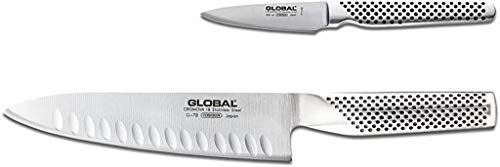
Global’s answer to the Shun starter set. The listing says it holds a 7.5-inch hollow-edge chef’s knife, the G-78, and a 3-inch paring knife, the GSF-46, and gives a weight of 0.86 pound for the pair. The hollow edge has shallow scallops along the blade, which are meant to help slices of potato or cucumber fall away instead of sticking.
The listing itself says little more, so the brand facts come from Global’s distributor: CROMOVA 18 steel, factory sharpened at 10 to 15 degrees, hand wash only, made in Japan. A 7.5-inch blade is slightly shorter than a standard 8-inch chef’s knife, which suits the smaller hands Nothing But Knives says Global fits best. The steel handle has no left or right, so it suits left-handed cooks too.
Why we like it
- Chef’s and paring knife together
- Hollow edge helps food release
- All-steel, no wood to maintain
- Works for either hand
Key specifications
| Model | G-78 and GSF-46 |
|---|---|
| Pieces | 7.5-inch hollow-edge chef’s knife, 3-inch paring knife |
| Steel | CROMOVA 18 (Global’s distributor) |
| Edge | 10 to 15 degrees (Global’s distributor) |
| Handle | Stainless steel |
| Weight | 0.86 lb for the pair (listing) |
Why we recommend it
It suits a cook with smaller hands who wants a light, all-steel Japanese starter pair that works in either hand.
Skip it if you want the maker’s warranty for certain; it is sold by Hour Loop, a third-party seller we could not confirm as an authorized Global dealer.
Pros and cons
Pros
- Light and well balanced, by review
- Steel less prone to chipping than Shun’s
- Left-hand friendly
Cons
- Steel handle slippery when wet
- Thin listing
- Third-party seller
4. Global G-58 6-Inch Chef’s Knife – Small, Light Everyday Knife

A short chef’s knife for cooks who find an 8-inch blade too much. The listing gives the model as G-58, a stainless seamless design it calls easy to keep clean, an item weight of about a third of a pound, and a limited lifetime guarantee. A 6-inch chef’s knife works well on a small board and in a small kitchen, for an onion, a few chiles and a bunch of cilantro at a time.
The same Global facts apply: CROMOVA 18 steel, a 10 to 15-degree factory edge and hand washing only. It will need sharpening more often than a Shun. A light knife this size is easy to keep sharp on a fine stone, and Global’s distributor says a waterstone or ceramic stone is the way to do it.
Why we like it
- Compact 6-inch blade
- Seamless steel build (listing)
- Very light, about a third of a pound (listing)
- Limited lifetime guarantee listed
Key specifications
| Model | G-58 |
|---|---|
| Blade length | 6 inches |
| Steel | CROMOVA 18 (Global’s distributor) |
| Edge | 10 to 15 degrees (Global’s distributor) |
| Handle | Stainless steel |
| Weight | About 0.32 lb (listing) |
Why we recommend it
It suits a cook with small hands or a small kitchen who wants a nimble everyday knife.
Skip it if you prep in volume; a 6-inch blade means more strokes on big jobs. The Shun 10-inch is the other end of the scale.
Pros and cons
Pros
- Easy to control
- No wood to look after
- Left-hand friendly
Cons
- Short for big jobs
- Needs regular sharpening
- Third-party seller (Hour Loop)
Shun and Global questions, answered
Is Shun better than Global?
For edge retention and after-sale service, yes: harder steel, free lifetime sharpening and a warranty you can count on through Amazon.com. Global is the better fit for small hands, left-handers and cooks who are hard on edges. Neither is better for every cook.
Do Global knives chip less than Shun?
Generally, yes. Global’s steel is softer, 56 to 58 HRC according to Nothing But Knives, against Shun’s Rockwell 61 according to Prudent Reviews. Softer steel tends to bend or roll before it chips. Both makers still say not to cut bones or frozen food.
Is the Global handle really slippery?
It can be. Nothing But Knives found the G-2 handle slippery when wet, and Prudent Reviews says the same of Shun’s polished handle. Keep a towel handy and dry your hands, whichever you buy.
Can either go in the dishwasher?
No. Both makers say to hand wash and dry the knife straight away.
Which is easier to sharpen at home?
Neither is a beginner’s job on a whetstone, and Nothing But Knives found the Global G-2 hard to sharpen. Shun sharpens its knives free for life, so you can skip the stone. With a Global you will sharpen more often, by stone or through a sharpening service.
The knife we would hand most cooks
For most cooks, start with the Shun Classic 8-inch in the starter set. It stays sharp longest, Shun sharpens it free, and the wooden handle is easier to hold with wet hands. Pick Global instead if your hands are small, you are left-handed, or you would rather sharpen more often than worry about chips. For more Shun models, see our best Shun knives guide. For other Japanese makers, see the best Japanese knife roundup. And when you would rather leave the chopping to us, see the menu or call to order.