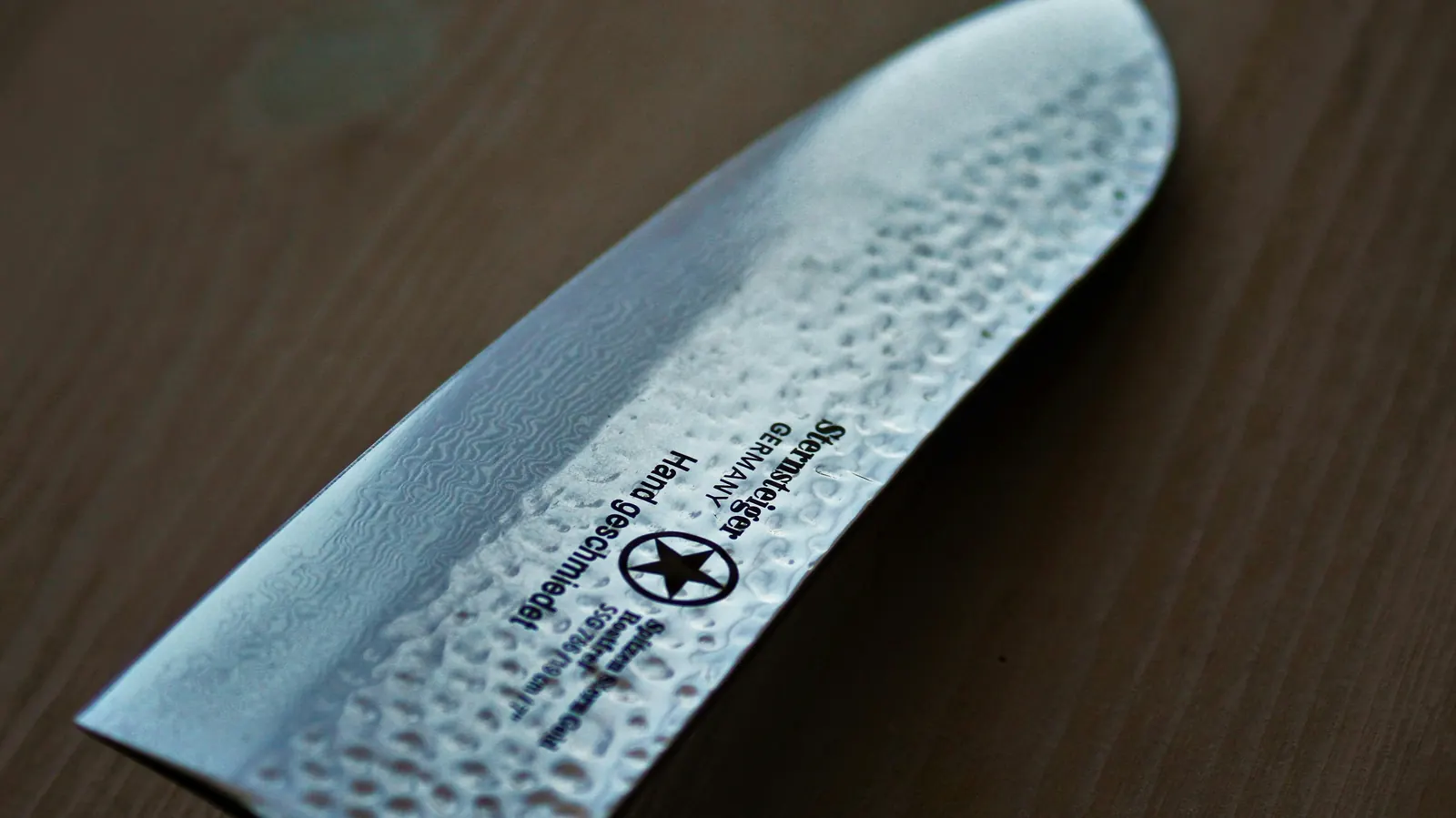
A good Japanese knife deserves a stone, and buying one is more confusing than it should be. Every kit promises a razor edge, and few of them tell you which grit does what or how the steel in your knife changes the answer.
This guide narrows our wider sharpening pages to water stones for Japanese knives, sorted by the job each grit does and the kind of steel it suits best. None of these listings appears on those pages. Where we are giving kitchen judgment and not a maker’s statement, we say so, because the makers themselves rarely publish this.
Julia’s earns a commission on purchases made through links on this page, at no cost to you. Recommendations are based on what a restaurant kitchen looks for, product specifications and maker details.
Quick verdict: the best whetstone Japanese knife owners should start with
For most stainless Japanese knives, buy the Shun Combination Whetstone 1000/6000: one stone for sharpening and finishing, from a Japanese knife maker. For carbon steel and a working edge, choose the Suehiro Cerax 1000/3000. For chips and lost edges, add the hard Shapton Kuromaku #320.
Five of the seven are compared below, then a full look at each stone and how to match grit to your knife.
Five whetstones at a glance
Five standout stones, one for each kind of knife owner, with what each listing states.
| Stone | Best for | Grit | Buy on Amazon |
|---|---|---|---|

Shun Combination Whetstone, 1000/6000Best overall
|
Stainless Japanese knives, routine care | #1000 and #6000 | View on Amazon |

King 1000/6000 Whetstone Starter SetBest for beginners
|
First-timers who want an angle holder | #1000 / #6000 | View on Amazon |

Suehiro Cerax Combination Stone, 1000/3000Best for carbon steel
|
Carbon steel, kitchen-toothy edges | #1000 and #3000 | View on Amazon |

Shapton Kuromaku Ceramic Stone #320Best chip repair
|
Fixing chips and bad bevels | #320 | View on Amazon |
Yoshihiro Toishi Whetstone Set, 1000/3000/6000Best complete set
|
Owners of several knives | #1000, #3000, #6000 | View on Amazon |
Our picks for the best whetstone Japanese knife cooks can use
Everyday stones come first, then a finisher and a repair stone, and last the sets for people who want everything in one order.
1. Shun Combination Whetstone, 1000/6000 – One Stone for Most Stainless Knives
Shun’s knives are made in Japan by Kai, and this stone comes from the same manufacturer, so it is the simplest answer for an owner of a stainless Japanese knife. It has 1000 grit on one side for sharpening and 6000 on the other for finishing, the same pairing Kasumi recommends: a 1000-grit stone for routine sharpening and 3000 to 6000 for fine polishing.
Shun says to soak the stone in water before use and includes a rubber tray that holds it in place. The listing notes it is meant for maintaining Shun knives, but a 1000/6000 stone is a general tool and we see no reason to keep it to one brand. A warranty field lists limited lifetime. Note that a two-sided stone wears on two faces, so you will flatten it now and then with a leveling stone or plate.
Why we like it
- 1000 and 6000 grit in one stone
- Rubber tray holds the stone in place
- Made for Shun’s own knives
- Sold and shipped by Amazon when we checked
Key specifications
| Model | SSM0600 |
|---|---|
| Grit | #1000 / #6000 |
| Job | Sharpen and finish |
| Soak or splash | Soak |
| Size | 7.5 in. |
| Base or extras | Rubber tray |
| Made in | Not stated |
| Sold by (when checked) | Amazon.com |
Why we recommend it
Buy this if you own one or two stainless Japanese knives and want one stone that handles routine sharpening and finishing. It is a safe first stone from a knife maker that has a reason to get it right.
Skip it if you need to repair chips. Pair it with a coarser stone.
Pros and cons
Pros
- Both common grits in one stone
- Stable tray
- Maker understands thin edges
Cons
- Needs soaking
- No chip-repair grit
- Two faces to keep flat
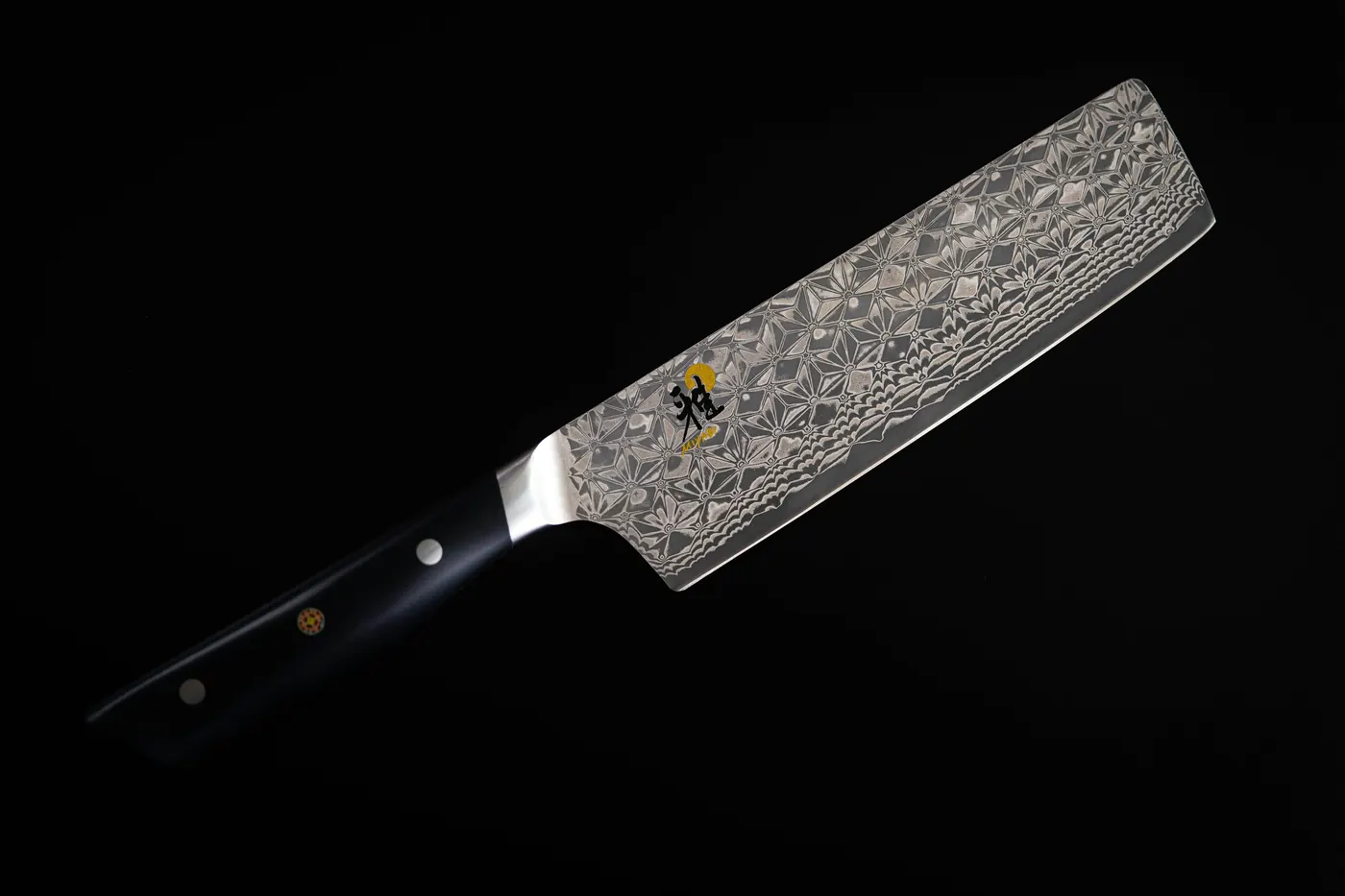
2. Suehiro Cerax Combination Stone, 1000/3000 – A Gentler Finish for Carbon Steel
Carbon steels such as Shirogami and Aogami generally take an edge easily, and many cooks want a slightly toothy finish on them rather than a mirror polish. That is why a 3000 finish is useful: it sits at the low end of Kasumi’s fine-polishing range and leaves an edge that still bites a tomato skin. Suehiro’s combination stone gives you #1000 and #3000 in one block, and its listing calls it fast cutting and durable.
It is a soaking stone, so plan ahead. It includes a cleaning stone, a plastic storage case and instructions. Fine-tools says Suehiro stones are harder than classic Japanese water stones and wear more slowly, though it does not mention this exact model. At 7 1/4 by 2 1/2 inches, it is a little shorter than a standard bench stone, so a long gyuto takes a few more passes.
Why we like it
- #1000 and #3000 in one block
- Cleaning stone and case included
- Fast cutting, per the listing
- Suehiro stones wear slowly, per fine-tools
Key specifications
| Model | CR-3800 |
|---|---|
| Grit | #1000 / #3000 |
| Job | Sharpen and refine |
| Soak or splash | Soak |
| Size | 7.25 x 2.5 in. |
| Base or extras | Cleaning stone, plastic case |
| Made in | Not stated |
| Sold by (when checked) | ALTWAYS.LLC |
Why we recommend it
This suits a cook with a carbon steel or stainless clad gyuto who likes a working edge and has no interest in polishing. It is a sensible main stone at home.
Skip it if you dislike soaking, or you want a higher polish.
Pros and cons
Pros
- Useful grit pairing
- Accessories included
- Named Japanese maker
Cons
- Must be soaked
- Slightly short for long knives
- Third-party seller
3. Naniwa Chosera #3000 Stone With Base – A Refined Finishing Stone
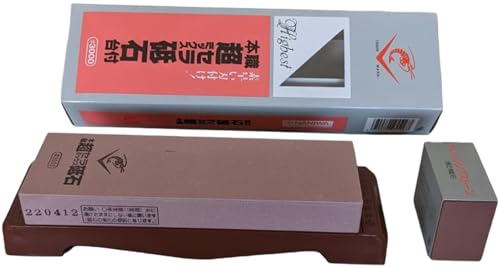
If you already own a #1000 stone, a finisher is the next purchase, and this is a thick Japanese stone made for that job. The listing gives 210 by 70 by 25 millimeters, with a dressing stone for cleaning, on a base. It states a 3000 grit for finishing and says it is made in Japan. Fine-tools says Naniwa’s main strength is in its fine stones.
There is one thing to check. The listing’s manufacturer field reads Naniwa Abrasive, but its brand field reads Sanelli Ambrogio, another company’s name, and it is sold by a third party. We are confident in the product description, but look at the photos and the box when it arrives. It costs more than a basic stone, and it only pays off once you can hold a steady angle on a #1000.
Why we like it
- 3000 grit, made in Japan, per the listing
- Dressing stone included
- 25 mm thick, per the listing
- Naniwa known for fine stones, per fine-tools
Key specifications
| Model | 05-0228-0406 |
|---|---|
| Grit | #3000 |
| Job | Finish |
| Soak or splash | Not stated |
| Size | 210 x 70 x 25 mm |
| Base or extras | Base and dressing stone |
| Made in | Japan |
| Sold by (when checked) | OTTO GROUP |
Why we recommend it
Buy this as a second stone when you are ready to refine what a #1000 leaves behind. It suits stainless and carbon knives alike.
Skip it if you are just starting out. Master a #1000 stone first.
Pros and cons
Pros
- Clear single job
- Thick stone
- Made in Japan
Cons
- Odd brand field in the listing
- Third-party seller
- Not a beginner’s first stone
4. Shapton Kuromaku Ceramic Stone #320 – For Chips and Lost Edges
Hard Japanese edges chip more easily than softer German ones, and a #1000 stone takes a long time to fix a chip. Fine-tools places roughing work at grits of 120 to 400, for nicks and very dull tools, and this Shapton stone sits at the upper end of that range. It weighs about 17.6 ounces and measures 210 by 70 millimeters, a common size for holders.
Use it sparingly. A coarse stone takes off steel fast, and on a thin knife it is easy to take off more than you meant to. Keep it for the times you need it, then go back up to a #1000 before you cut food. This listing was sold by a third party, and it gives little beyond the grit and its use for rough grinding.
Why we like it
- #320, within fine-tools’ roughing range
- Same footprint as the #1000 stone
- Listed for rough grinding
- Weighs about 17.6 ounces
Key specifications
| Model | K0709 |
|---|---|
| Grit | #320 |
| Job | Repair |
| Soak or splash | Follow the box |
| Size | 8.3 x 2.8 x 0.6 in. |
| Base or extras | Not stated |
| Made in | Not stated |
| Sold by (when checked) | OSTFAM |
Why we recommend it
This belongs in the kit of someone who has already chipped a knife, or who buys old Japanese knives to restore. Most other cooks can do without it.
Skip it if your knives have no chips. Coarse stones take off steel you may want to keep.
Pros and cons
Pros
- Fast material removal
- Same size as siblings
- Clear single job
Cons
- Easy to overuse
- Very brief listing
- Third-party seller
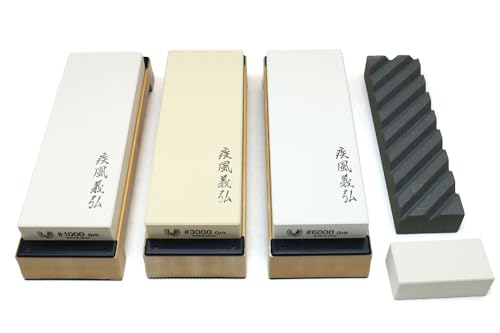
5. Yoshihiro Toishi Whetstone Set, 1000/3000/6000 – Three Grits From a Knife Maker
Yoshihiro Cutlery sells Japanese knives in the U.S. and, here, a full set of stones for them. You get #1000, #3000 and #6000, each 8 by 2.9 by 0.9 inches, plus a stone fixer and a nagura conditioning stone. The listing says they are made in Japan. That covers everything in the fine range that Kasumi recommends, in one order, and lets you stop at 3000 for a working edge or carry on to 6000 for a polished one.
It is a substantial purchase for one knife, and three stones take time to learn and keep flat. If you own several Japanese knives in different steels, though, it is the most flexible option here: use the 3000 finish on a carbon steel gyuto and go to 6000 on a stainless slicer. The 2.9-inch width gives you more room for a wide blade than the standard-size stones above.
Why we like it
- Three grits in one set
- Stone fixer and nagura included
- 2.9-inch width, per the listing
- Sold by Yoshihiro Cutlery when we checked
Key specifications
| Model | YCSET |
|---|---|
| Grit | #1000 / #3000 / #6000 |
| Job | Sharpen, refine, finish |
| Soak or splash | Not stated |
| Size | 8 x 2.9 x 0.9 in. |
| Base or extras | Stone fixer, nagura |
| Made in | Japan |
| Sold by (when checked) | Yoshihiro Cutlery |
Why we recommend it
Choose this if you own several Japanese knives and plan to keep sharpening for years. It saves working out which stones go together.
Skip it if you own one knife and will sharpen it twice a year.
Pros and cons
Pros
- Full progression
- Wide stones
- Sold directly by the knife maker
Cons
- Large commitment
- More stones to keep flat
- Soak guidance not in the listing
6. King 1000/6000 Whetstone Starter Set – An Angle Holder for First-Timers
King stones have been standard Japanese sharpening stones for a long time, and this starter set wraps one in the extras a nervous beginner wants. You get a 1000/6000 combination stone, an angle holder with two ceramic protective rods, a plastic base and a wiping cloth. The listing says the stone is made in Japan and carries the King trademark.
The set is put together by B&B Japan and sold by a third party, so the bundle is theirs and the stone is King’s. The angle holder is the reason to pick it. Japanese knives are often sharpened at a shallower angle than German knives, and the holder gives you a steady reference while you build the habit. Check that its angle suits your knife, and stop using it once your hands have learned the movement.
Why we like it
- Angle holder included
- Stone made in Japan, per the listing
- 1000 and 6000 grit
- Plastic base and wiping cloth
Key specifications
| Model | Not stated |
|---|---|
| Grit | #1000 / #6000 |
| Job | Sharpen and finish |
| Soak or splash | Not stated |
| Size | Not stated |
| Base or extras | Angle holder, base, cloth |
| Made in | Japan (stone) |
| Sold by (when checked) | OTTO GROUP |
Why we recommend it
Buy this if you have never used a stone and want help holding the angle. It is a gentle way in, with a name that many cooks already know.
Skip it if you are comfortable freehand. The extras add little for you.
Pros and cons
Pros
- Angle guide
- Both common grits
- Trusted stone maker
Cons
- Bundled by a third party
- Stone size not stated
- Angle guide can become a crutch
7. Sharp Pebble 1000/6000 Whetstone Kit – A Simple Base and Angle Guide

Sharp Pebble is the one Amazon-first brand here. It is on this list because many beginners shop this way and because the kit is complete: a two-sided 1000/6000 stone, a non-slip bamboo base, an angle guide, instructions and an ebook. Water is all it needs. The grit pairing matches the same advice we use for the Shun.
We would ignore the marketing. The listing claims it stays flat three times longer than cheap stones and calls the guide foolproof, and we have seen no evidence for either claim. On a hard Japanese knife, a guide may also be set at an angle that does not match your blade, so check before you trust it. For a first stone to learn on, before you risk a more expensive one, it does the basic job on paper.
Why we like it
- 1000 and 6000 grit
- Bamboo non-slip base
- Angle guide and instructions
- Water-based, no oil
Key specifications
| Model | 8541909078 |
|---|---|
| Grit | #1000 / #6000 |
| Job | Sharpen and finish |
| Soak or splash | Water |
| Size | Not stated |
| Base or extras | Bamboo base, angle guide |
| Made in | Not stated |
| Sold by (when checked) | MIGHTY DREAMS |
Why we recommend it
This suits someone who is not yet sure they will keep sharpening by hand and wants a complete setup to try. Graduate to one of the Japanese makers if you stick with it.
Skip it if you own an expensive knife and want a stone from a Japanese maker.
Pros and cons
Pros
- Complete kit
- Clear instructions
- Common grit pairing
Cons
- Amazon-first brand
- Overstated marketing
- Maker’s origin not stated
How to match a whetstone to your Japanese knife
Most stone makers do not publish a table matching grit to steel, and we will not pretend they do. What follows is the way a kitchen would think about it, using the general grit ranges from Kasumi and fine-tools.
Start with the job, not the steel
Fine-tools lays out roughing at 120 to 400 grit, normal sharpening at 700 to 2000 and honing at 3000 to 6000 for beginners. Kasumi recommends a 1000-grit stone for routine sharpening and a 3000 to 6000 stone for fine polishing. That holds for almost any kitchen knife. Everything else is fine tuning.
Carbon steel: white and blue
Traditional carbon steels are often easier to sharpen and can feel responsive on the stone. A #1000 plus a #3000 gives a working edge that still has some grip on tomato skins. Dry the knife quickly after sharpening, since carbon steel rusts.
Stainless and clad stainless, such as VG-10
These are common on factory Japanese knives, and they are the knives most home cooks own. A 1000/6000 stone like the Shun handles them well, and many cooks like the smoother finish on a slicing knife.
Very hard powder steels
Harder steels generally take longer on any stone, and some cooks like a hard stone that keeps its shape, which is why we point to the Shapton line. Go gently and with patience. Fine-tools describes Shapton stones as very hard and slow to lose their shape, and it also lists separate stones for high-alloy steels. Heavy pressure is not the answer on a thin, hard edge.
Single-bevel knives
A yanagiba or deba has its own technique, and a flat stone matters more than usual. Our Japanese knife sharpener guide covers tools that handle single-bevel edges, including non-stone options.
Soak or splash
Some stones need soaking before use and some only need water on the surface. Shun and Suehiro’s listings say soak. Fine-tools warns that Japanese water stones only work with water, never oil. Follow the box for your own stone, and keep a flattening plate or stone close by, since any water stone slowly hollows with use.
How we picked these seven whetstones
We have not used these stones for this guide, and we make no claim that Julia’s uses them. We read each listing through Amazon’s product data for stock, seller, grit and size, and counted only stones in stock and offered new. We picked stones from Japanese makers first and allowed one Amazon-first brand. None of these listings appears on our other sharpening pages, which is why a few well-known stones are missing. For grit ranges and maker character we read the guidance from Kasumi and the catalog text from fine-tools, both knife or tool sellers rather than independent testers. Our search for independent tests on specific steels found forum posts and affiliate lists we did not rely on. The steel notes above are general kitchen guidance, not test results. We also searched the U.S. Consumer Product Safety Commission’s recall data by brand and found nothing covering these stones.
Japanese knife whetstone questions, answered
What grit whetstone do I need for a Japanese knife?
Start with a #1000, as Kasumi recommends for routine sharpening, and add a stone between #3000 and #6000 for polishing. Only buy a #320 or similar if you have chips to repair.
What is the best whetstone for Japanese knives if I only buy one?
A two-sided 1000/6000 stone such as the Shun does both main jobs. If you have a carbon steel knife, the Suehiro Cerax 1000/3000 may suit you better.
Can I use a pull-through sharpener instead?
You can, but a stone gives you more control over the angle. Read our knife sharpener vs whetstone comparison before you decide.
How often should I sharpen?
It depends on how much you cook. Many home cooks need the stone only a few times a year, with a honing or stropping step in between. If the knife slides on a tomato skin, it is time.
Do I need a Japanese stone for a Japanese knife?
No. Grit and flatness matter more than origin. Our main whetstone guide includes German and American stones that can work on any kitchen knife, and our budget whetstone guide covers entry-level options.
Our final pick for Japanese edges
The best whetstone Japanese knife owners can start with is the Shun 1000/6000, because it covers routine sharpening and finishing on one stone. Add the Shapton #320 if you chip a blade, and consider the Yoshihiro set if you collect knives. Learn on something cheap before you risk a favorite, and start with our Japanese knife guide if you are still choosing the knife. When the edge is ready and you still would rather not cook, call to order or look over Julia’s menu.