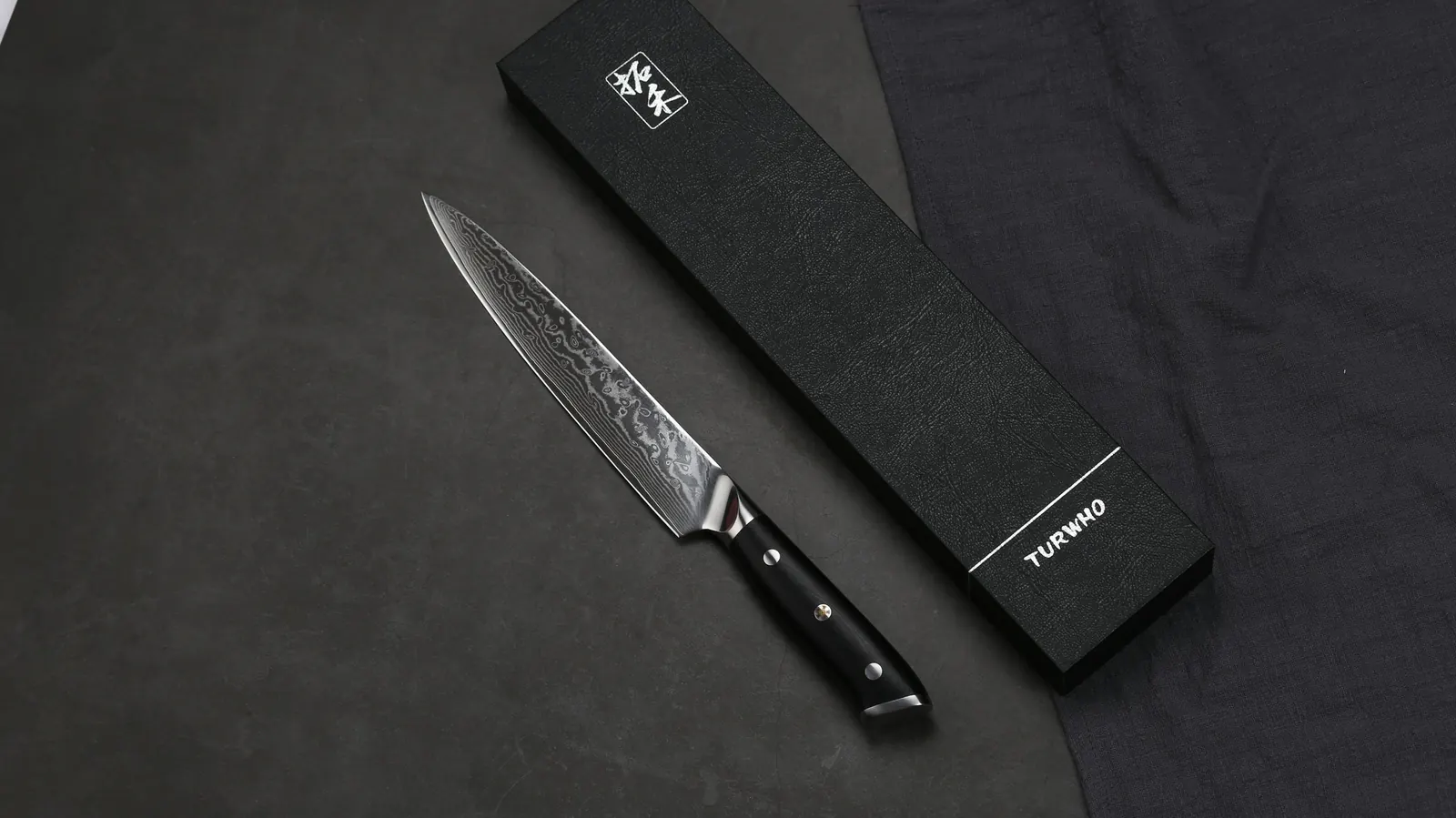
Shun knives are thin, hard and very sharp, and they ask more of you than a German knife does. If you have decided you want one, the choice comes down to line, knife shape and how gently you plan to use it.
This page compares lines and knife types, not handle colors. It says who each one suits and explains where the brand falls short, including the chipping that reviewers warn about.
Julia’s earns a commission on purchases made through links on this page, at no cost to you. Recommendations are based on what a restaurant kitchen looks for, product specifications, makers’ statements and the independent sources we name. We have not used these products ourselves.
Quick verdict: which Shun knife to buy
Most cooks should start with the Shun Classic, the line America’s Test Kitchen tested and named an Upgrade Pick in its 8-inch size. Choose Sora to spend less, and Premier if you prefer a round handle. Thin, hard edges can chip, so skip Shun if you cut bones or are rough with knives.
Five Shun knives at a glance
| Shun knife | Steel | Blade | Best for | Buy on Amazon |
|---|---|---|---|---|

Shun Classic Chef’s Knife, 6-inchBest overall
|
VG-MAX | 6 in. | A first Japanese knife | View on Amazon |

Shun Premier Chef’s Knife, 6-inchBest step up from Classic
|
VG-MAX | 6 in. | Experienced cooks | View on Amazon |

Shun Sora Chef’s Knife, 6-inchBest low-cost Shun
|
VG10 edge | 6 in. | First-time Shun buyers | View on Amazon |

Shun Kanso Asian Utility Knife, 7-inchBest for stir-fry prep
|
AUS10A | 7 in. | Plain-look cooks | View on Amazon |

Shun Classic Nakiri, 6.5-inchBest vegetable knife
|
VG-MAX | 6.5 in. | Vegetable-heavy cooks | View on Amazon |
Our picks for the best Shun knives
1. Shun Classic Chef’s Knife, 6-inch – The Line That Started It
Shun Classic is the line most people mean when they say Shun. It has a VG-MAX core inside 68 layers of Damascus cladding, a 16-degree edge and a D-shaped Pakkawood handle, handcrafted in Japan by the listing. The 6-inch is short and easy to steer for a cook who is new to very thin Japanese steel.
America’s Test Kitchen tested the 8-inch Western cook’s knife from this line, named it an Upgrade Pick, and said it sliced dense squash “as if it were butter,” though the handle was “a bit slippery and quite long.” That is a different size, so we are extending that finding only to the line. If you want a full-length blade, see the 8-inch in our Japanese knife guide.
Why we like it
- Very keen edge in America’s Test Kitchen’s test of the line’s 8-inch
- Free sharpening from Shun, per the maker
- Shorter blade gives more control
Key specifications
| Model | DM0723 |
|---|---|
| Line | Classic |
| Knife type | Chef’s |
| Blade length | 6 in. |
| Steel | VG-MAX core, 68 layers |
| Stated edge | 16 degrees |
| Handle | D-shaped Pakkawood |
| Sold by | Amazon.com |
Why we recommend it
A careful home cook who wants a first Japanese knife for vegetables and boneless meat.
Skip it if you cut through bones, squash stems or frozen food. Hard edges can chip.
Pros and cons
Pros
- Test evidence for the line
- Sold by Amazon
- Free sharpening, per the maker
Cons
- Handle a bit slippery, per testers of the 8-inch
- Short for large produce
- Hard edge can chip
2. Shun Premier Chef’s Knife, 6-inch – Hammered Finish, Rounder Handle
Premier has the same VG-MAX core and 16-degree edge as Classic, and Prudent Reviews says the notable differences are finish, handle and cost, with Premier about 25 percent higher. The blade has a hammered tsuchime finish that the maker says reduces drag, and the walnut Pakkawood handle is round and symmetrical rather than D-shaped.
Nothing But Knives tried the 8-inch and wrote that it had the best out-of-the-box sharpness of any knife reviewed in a long time, or possibly ever. It also warned that the thin, hard edge is fragile and “this thing will absolutely chip” if used roughly, and it found food release poor despite the hammered finish. That reviewer recommended it for experienced users, not casual cooks.
Why we like it
- Round handle suits either hand
- Exceptional sharpness on the 8-inch, per Nothing But Knives
- Hammered finish, per the maker
Key specifications
| Model | TDM0723 |
|---|---|
| Line | Premier |
| Knife type | Chef’s |
| Blade length | 6 in. |
| Steel | VG-MAX core, 68 layers |
| Stated edge | 16 degrees |
| Handle | Contoured walnut Pakkawood |
| Sold by | Amazon.com |
Why we recommend it
An experienced cook who likes the look and the rounder handle, and treats a thin blade gently.
Skip it if you are hard on knives. Sora or a German knife will forgive more.
Pros and cons
Pros
- Round handle
- Very sharp when new, per reviewers
- Sold by Amazon
Cons
- Fragile edge, per Nothing But Knives
- Poor food release, per Nothing But Knives
- Costs more than Classic
3. Shun Sora Chef’s Knife, 6-inch – The Entry Point
Sora gets you a Shun edge for less. It uses VG10 steel at the edge and softer 420J stainless above it, joined in what the maker calls a Composite Blade, and the handle is a textured polymer blend, not wood. The narrow gyuto-style blade is listed at 16 degrees, like the other Shun lines here.
Prudent Reviews calls Sora the entry-level, most affordable line, with a harder edge that can still be brittle and a handle that lacks the look of wood. For a kitchen where several people use the knife, that easy-care grip is an advantage. If you are not sure whether you will like Japanese steel, start here.
Why we like it
- VG10 edge at a lower cost, per Prudent Reviews
- Textured grip for wet hands
- Full tang, per the listing
Key specifications
| Model | VB0723 |
|---|---|
| Line | Sora |
| Knife type | Chef’s |
| Blade length | 6 in. |
| Steel | VG10 edge, 420J upper |
| Stated edge | 16 degrees |
| Handle | PP/TPE polymer |
| Sold by | Amazon.com |
Why we recommend it
A first-time Shun buyer who wants to keep the cost down and wants a grippy handle.
Skip it if you want the Damascus look. This blade is plainer.
Pros and cons
Pros
- Lowest-priced line here, per Prudent Reviews
- Easy-care handle
- Sold by Amazon
Cons
- Edge can still chip
- Plainer look
4. Shun Kanso Asian Utility Knife, 7-inch – A Plain, Wide Blade
Kanso strips things back. The blade is plain AUS10A high-carbon stainless with vanadium and no Damascus layers, and the handle is contoured tagayasan wood. This 7-inch Asian utility shape has a wide, straighter blade that the maker says uses every part of the edge, and the butt of the handle doubles as a bottle opener.
Prudent Reviews flags that the tang can dig into the hand and the wood handle needs regular care, so try how it feels and return it if it bothers you. It is a good knife for slicing stacks of peppers, onions and meat for a stir-fry or fajitas. The wide blade also scoops food off the board.
Why we like it
- Wide blade scoops up prep
- AUS10A steel, per the listing
- Full-tang wood handle
Key specifications
| Model | SWT0767 |
|---|---|
| Line | Kanso |
| Knife type | Asian utility |
| Blade length | 7 in. |
| Steel | AUS10A stainless |
| Stated edge | 16 degrees |
| Handle | Tagayasan wood |
| Sold by | Amazon.com |
Why we recommend it
Someone who cuts a lot of vegetables and meat in thin slices and prefers a plain look.
Skip it if you have sensitive hands. Prudent Reviews reports the tang digging in.
Pros and cons
Pros
- Wide useful blade
- Simple look
- Sold by Amazon
Cons
- Tang can dig in, per Prudent Reviews
- Wood needs care
5. Shun Classic Nakiri, 6.5-inch – Made for Vegetables
A nakiri is a flat, square-ended vegetable knife, with a straight edge that meets the board along its whole length. There is no pointed tip, so it is not for boning or piercing. This one has the same VG-MAX core, 68 Damascus layers and 16-degree edge as the Classic chef’s knife, with the ebony Pakkawood handle.
For a kitchen that goes through bunches of cilantro, onions, chiles and cabbage, a nakiri is a pleasant specialist. It does not rock the way a chef’s knife does, so it suits an up-and-down motion. Compare it with others in our Japanese nakiri guide. Keep it strictly for vegetables, since bones and frozen food can chip it.
Why we like it
- Flat edge meets the board fully
- Same VG-MAX core as Classic
- Free sharpening, per the maker
Key specifications
| Model | DM0728 |
|---|---|
| Line | Classic |
| Knife type | Nakiri |
| Blade length | 6.5 in. |
| Steel | VG-MAX core, 68 layers |
| Stated edge | 16 degrees |
| Handle | D-shaped Pakkawood |
| Sold by | Amazon.com |
Why we recommend it
A vegetable-heavy cook who already owns a chef’s knife and wants a specialist.
Skip it if you only own one knife. A nakiri cannot do meat work or pierce.
Pros and cons
Pros
- Excellent shape for vegetables
- Same core steel as Classic
- Sold by Amazon
Cons
- No tip for piercing
- Specialist knife
6. Shun Dual Core Kiritsuke, 8-inch – The Top of the Range

Dual Core is the most expensive of the Shun lines that Prudent Reviews compares. It has 71 alternating micro-layers of VG10 and VG2, carried right to the edge, an octagon Pakkawood handle and a sheath for storage. The kiritsuke is a long, angled blade, suited to julienned vegetables and to slicing boneless meat, by the listing.
It suits someone who already knows what they like in a knife. An octagon handle feels unlike a Western one, and the flat, long edge is not for rocking. We did not read an independent test of this exact knife. A first-time buyer does not need it and would probably be happier with Classic.
Why we like it
- 71 micro-layers of VG10 and VG2, per the listing
- Octagon handle, per the listing
- Sheath included
Key specifications
| Model | VG0017 |
|---|---|
| Line | Dual Core |
| Knife type | Kiritsuke |
| Blade length | 8 in. |
| Steel | VG10 and VG2, 71 layers |
| Stated edge | 16 degrees |
| Handle | Octagon Pakkawood |
| Sold by | Amazon.com |
Why we recommend it
An experienced cook who wants a special blade for vegetables and boneless meat.
Skip it if this is your first good knife. Spend less and learn on Classic or Sora.
Pros and cons
Pros
- Layered right through the edge
- Sheath included
- Sold by Amazon
Cons
- Most expensive line, per Prudent Reviews
- No independent test read
- Not a rocking knife
7. Shun Narukami Chef’s Knife, 8-inch – A Carbon Steel Core

Narukami is the odd one out: its core is Blue II carbon steel, with San Mai stainless cladding, a bead-blasted finish and a riveted Micarta handle. The maker says a natural patina forms over time and that the handle stays secure when wet. Note that carbon steel reacts with acids, so wipe it clean after limes and tomatoes rather than leaving it wet.
This is the one line here for someone who wants carbon steel’s character and does not mind the upkeep. It is the only full 8-inch chef’s knife on this page. The seller is Cutlery and More, not Amazon. Kai says warranty and free sharpening apply only through authorized dealers, so confirm that before paying. We read no independent test of it.
Why we like it
- Blue II carbon core, per the listing
- Micarta handle holds well when wet, per the maker
- Full 8-inch length
Key specifications
| Model | VSC0707 |
|---|---|
| Line | Narukami |
| Knife type | Chef’s |
| Blade length | 8 in. |
| Steel | Blue II carbon, San Mai stainless |
| Stated edge | Not stated |
| Handle | Riveted Micarta |
| Sold by | Cutlery and More |
Why we recommend it
A cook who enjoys carbon steel and will dry the blade after each use.
Skip it if you leave knives in the sink. Carbon steel can stain and rust.
Pros and cons
Pros
- Develops a natural patina
- Handles wet hands, per the maker
- Full-length blade
Cons
- Needs drying right away
- Third-party seller
- No independent test read
8. Shun Shiranami Santoku, 7-inch – A Newer Art-Led Line

Shiranami is a newer line built around appearance: the maker says it is inspired by the white-capped waves of Japanese art, with a Prussian blue jute Micarta handle. Under the look is the same 71-layer VG10 and VG2 construction as Dual Core and a 16-degree edge. This 7-inch santoku is an all-purpose shape, with a straighter edge than a chef’s knife.
Buy this if you want a beautiful knife and a Micarta handle, which the maker describes as secure. There is little independent writing about the line yet, and we read none. For comparison with santokus from other Japanese makers, see our Japanese santoku guide.
Why we like it
- 71-layer VG10 and VG2, per the listing
- Jute Micarta handle
- Santoku suits up-and-down chopping
Key specifications
| Model | FRD0702 |
|---|---|
| Line | Shiranami |
| Knife type | Santoku |
| Blade length | 7 in. |
| Steel | VG10 and VG2, 71 layers |
| Stated edge | 16 degrees |
| Handle | Jute Micarta |
| Sold by | Amazon.com |
Why we recommend it
Someone buying a showpiece santoku, or a gift for a serious cook.
Skip it if you want a knife with a long review history. This line is new.
Pros and cons
Pros
- Striking design
- Micarta handle
- Sold by Amazon
Cons
- No independent test read
- Mostly a looks-led purchase
Shun Classic vs Premier in plain terms
Prudent Reviews sums it up: both use VG-MAX steel, both have a 16-degree edge per side, and the real differences are the finish, the handle and the cost. Classic has a subtle Damascus look and a D-shaped handle, in ebony or blonde. Premier has a hammered top half and a round walnut handle. The D-shape can suit right-handers better, though the listings say both suit either hand, and Prudent Reviews calls the D-shape a poor fit for left-handers. So a left-handed cook should try Premier, or Sora with its symmetrical grip.
Which Shun suits which cook
New to Japanese knives: start with Sora or Classic. Want a rounder handle or the hammered look: Premier. Vegetable-heavy kitchen: the Classic nakiri. Lots of thin slicing for stir-fries and fajitas: the Kanso Asian utility. Carbon steel fan: Narukami. Collector or gift: Dual Core or Shiranami. All of these except Narukami are in a stainless family, but none is a knife for bones.
Why Shun edges chip, and how to avoid it
Prudent Reviews lists Shun’s Classic and Premier steel at 60 to 61 on the Rockwell scale, against 57 to 58 for German makers. Thin, hard edges cut very cleanly and are less forgiving. Shun’s own care guide says never to put these knives in the dishwasher, to use wood boards rather than glass, marble or ceramic, not to cut bones, frozen food or very hard rinds, and not to twist the blade during a cut. It also says to dry the knife fully after washing.
Shun’s warranty page says its knives come with free lifetime sharpening at 16 degrees, including small chip repairs, and it applies only to knives from authorized dealers bought in the US, Canada or Mexico. Keep your receipt, and see our cutting board guide for Japanese knives.
Where Shun falls short
A Shun is not an all-purpose, no-thought knife. Nothing But Knives wrote that the Premier “will absolutely chip” if used roughly. If you tend to bang through squash or use a knife on chicken bones, look at Wüsthof Classic in our chef’s knife guide, which uses softer steel, or at the MAC MTH-80, which America’s Test Kitchen lists as Highly Recommended among gyuto knives. Food also clung to the Premier in that review despite the hammered finish, so don’t buy that finish for release alone.
How we picked these eight knives
We pulled the range from Amazon’s listing data and kept different lines and knife types, not handle colors, in stock with a new lead offer. Exact listings on our other pages were left out, and the nakiri repeats a model in a different handle, with the reason noted in our records. We read America’s Test Kitchen’s chef’s knife review, Nothing But Knives on the Premier chef’s knife, Prudent Reviews on Classic vs Premier and on the wider range, and Shun’s care and warranty pages. Those reviews covered other sizes, so we apply them to the line rather than to each knife. We searched the US Consumer Product Safety Commission recall database by brand: the one match was an unrelated crib item, not Shun knives. We have not used these knives ourselves.
Shun questions, answered
What is the difference between Shun Classic and Premier?
Same VG-MAX steel and 16-degree edge, by Prudent Reviews. The differences are finish, handle shape and cost, with Premier about 25 percent higher.
Do Shun knives chip easily?
Their thin, hard edges can chip with rough use. Keep them away from bone, frozen food and hard rinds, as Shun advises, and use a wood board.
Will Shun sharpen my knife for free?
Shun’s warranty page says yes, with lifetime sharpening at 16 degrees and small chip repair for authorized purchases. Keep your receipt.
Are Shun knives good for left-handed cooks?
Listings say the handles suit either hand, while Prudent Reviews says the Classic’s D-shape is a poor fit for left-handers. Try a round or symmetrical handle first.
Which Shun should a beginner buy?
Sora costs least, by Prudent Reviews, and Classic is a sensible step up. Both are less suited to rough use than a softer German knife.
Our final pick for a first Shun
Related guide: Shun vs global knives.
Buy Classic if you want the line with the strongest test behind it, Sora if you want to spend less, and Premier if you like the handle and treat knives gently. Compare other makers in our best Japanese knife guide and gyuto guide. And if you would rather put the knife down tonight, see Julia’s menu and call to order.