Walk into any knife shop and the chef’s knives split into two camps. On one side are the heavy, forged German blades from Solingen. On the other are the thin, light Japanese knives with their harder steel and finer edges. Both make a good chef’s knife. The real differences are in the metal, the edge, the weight and how much care each one asks of you.
This guide is about those differences, not the blade shape. (Choosing between a santoku and a chef’s knife is a separate question about shape.) Here we compare German and Japanese chef’s knives on steel hardness, edge angle, weight, chipping, washing and sharpening, using what the makers and America’s Test Kitchen state, then name one German and two Japanese knives worth buying.
Julia’s earns a commission on purchases made through links on this page, at no cost to you. Recommendations are based on what a restaurant kitchen looks for, product specifications and verified buyer reports.
Quick verdict: German or Japanese?
For most home cooks, a German chef’s knife is the better first knife. Its softer steel is more forgiving, it shrugs off the odd chicken joint or hard squash, and a simple steel rod keeps it going. Choose a Japanese knife if you want a lighter, thinner blade with harder steel that holds a fine edge longer, and you’re happy to wash it by hand, dry it at once and keep it away from bones and frozen food.
The table sums up the differences. The sections after it explain each one.
German vs Japanese knives, side by side
| German | Japanese | |
|---|---|---|
| Steel hardness | About 55 to 58 HRC (ATK); Wüsthof states 58 | About 58 to 65 HRC (ATK) |
| Edge angle per side | Wüsthof: 14.5 degrees | Shun: 16 degrees; Global: 10 to 15 |
| Blade | Thicker, broader | Thinner, narrower (ATK) |
| Weight in ATK’s tests | About 4 to 9 ounces | About 3 to 6 ounces |
| Bolster | Common on forged German knives | Most gyuto have none (ATK) |
| When pushed too far | Edge rolls; a steel brings it back | Can chip easily (ATK) |
| Off-limits | Dishwasher, soaking | Dishwasher, bones, frozen food, twisting |
| Honing tool | Steel rod | Ceramic or fine rod (Global) |
Steel hardness: the root of every other difference
Knife hardness is measured on the Rockwell C scale (HRC). In its gyuto review, America’s Test Kitchen’s Miye Bromberg writes that Japanese chef’s knives are usually made from harder steels than Western-style chef’s knives, at roughly 58 to 65 HRC against about 55 to 58. Wüsthof, the Solingen maker, says its Classic Ikon knives are tempered to 58 HRC, the top of the German range. Shun says its steels are harder than those used in most Western-style knives.
Hardness cuts both ways. A harder steel can be ground thinner and holds a fine edge longer. But it is less tough. ATK says that because gyuto blades are thinner and made from harder metal, they are less forgiving and can chip easily. A softer German blade tends to bend its edge over instead, and as general kitchen sense that is a much easier problem to fix: a few strokes on a honing steel and it is back in line.
Edge angle: closer than you might think
The old rule was that German knives had thick 20-degree edges and Japanese knives had keen 15-degree ones. The makers’ own figures tell a more nuanced story today. Wüsthof says most kitchen knives from other makers have an edge of about 20 degrees per side, but that its PEtec process, which uses lasers and robots to sharpen each blade, gives its knives an edge of 14.5 degrees per side. Shun says its blades are sharpened to 16 degrees per side. Global says its knives are factory sharpened at 10 to 15 degrees.
So a modern German knife from a top maker can leave the factory with an edge as fine as many Japanese knives. Where the Japanese knife pulls ahead is in what is behind the edge. ATK says gyuto blades are typically thinner from spine to edge and narrower than Western chef’s knives, so they slip through food with less wedging. The harder steel also keeps that fine edge for longer between sharpenings.
One detail matters for left-handed cooks. ATK notes that the bevel on many gyuto is asymmetrical rather than symmetrical as on Western knives, and that lefties will have the most success with gyuto that have symmetrical edges. Check the listing before you buy.
Weight, thickness and the bolster
In ATK’s lineups, the Japanese knives ranged from about 3 to about 6 ounces, while Western chef’s knives ran about 4 to 9 ounces. Much of the German weight sits in the bolster, the thick collar of steel where blade meets handle. ATK says most gyuto lack a bolster. Wüsthof’s Classic Ikon uses a half bolster at the heel, which Wüsthof says reduces weight and makes sharpening easier, with a second bolster at the end of the handle for balance.
As general kitchen sense, weight helps when you’re pushing through a butternut squash or splitting a chicken through the joints, and it tires the hand over a long session of dicing onions for pico de gallo. A light Japanese knife is quicker and more precise for fine cuts and thin slices of grilled steak, but it does less of the work for you on dense food.
What each knife can and can’t cut
This is the practical difference that matters most in a busy home kitchen. ATK’s guidance for gyuto is blunt: no scraping, no twisting, no cutting through frozen foods or bone. Shun says the same about its knives: avoid cutting bones, frozen foods or very hard rinds, and don’t twist the blade. Global adds frozen food and bones to its own list, along with hard surfaces like marble, stone, tile or glass.
A German chef’s knife is not a cleaver either, but as general kitchen sense it tolerates the jobs a thin Japanese edge won’t: working around chicken joints, scraping chopped onions across the board with the edge, or pushing through a hard winter squash. If several people share the knife, or it has to take whatever the kitchen throws at it, the German knife is the safer bet.
Washing, drying and boards
Neither kind belongs in the dishwasher. Wüsthof says to wash its Classic Ikon by hand, dry it immediately and not to soak it. Shun says never to put Japanese knives in the dishwasher and not to leave them to air-dry: wash by hand with warm water and mild soap and dry completely with a towel. Global says its knives should not go in the dishwasher, because it can damage the edges, and to avoid harsh detergents or bleach. ATK adds that carbon-steel gyuto must be wiped dry from time to time during use to prevent rust.
Board choice matters more for the Japanese knife. Shun recommends wood, which gives slightly under the blade, and says glass, marble, granite and ceramic should always be avoided. Our best cutting board for Japanese knives guide covers that choice.
Honing and sharpening
Here the two families need different tools. A German knife is the classic partner for a honing steel. Global, by contrast, tells owners to keep its edges aligned with a fine ceramic or diamond rod, and says traditional steels made of other materials are likely to damage its knives. As general kitchen sense, the rule behind that advice is that a rod should be harder than the knife, which is why hard Japanese blades usually get a ceramic rod. Our best honing steel guide covers both kinds.
For sharpening, Global recommends a waterstone or ceramic stone. Shun says that for most home cooks, sharpening once or twice a year is enough, and that honing in between does not remove steel. Shun also offers free sharpening for its knives. A German knife can go on a stone too, and its softer steel is quicker to sharpen; our best whetstone guide covers stones for both.
Choose German if… / Choose Japanese if…
Choose a German knife if…
- You want one tough knife for everything, including chicken and squash.
- Several people share the knife, or it gets handled roughly.
- You’d rather fix the edge with a quick pass on a steel.
- You like a heavier knife that does some of the work.
Choose a Japanese knife if…
- You want a lighter, thinner blade for fine dicing and slicing.
- You want an edge that stays keen longer between sharpenings.
- You’ll always wash by hand and dry at once.
- You’ll keep a cleaver or a tougher knife for bones and frozen food.
Our picks on each side of the German vs Japanese knives question
All three were in stock with a new lead offer when we checked. The German pick is a Wüsthof Classic Ikon, the Solingen maker’s forged line. The Japanese picks show the two directions Japanese makers take: Shun’s layered, hard-steel knife and Global’s light, all-steel one. The Shun is a hollow-ground listing of the Shun Classic chef’s knife on our best chef knife guide; it is here because it is the clearest example of the hard-steel, 16-degree Japanese edge and adds hollow-ground sides. For more Japanese knives, see our best Japanese knife guide.
1. Wüsthof Classic Ikon 8-inch Chef’s Knife, Crème – Forged Solingen Steel

The Classic Ikon is Wüsthof’s forged line with a curved, ergonomic handle. Wüsthof says it is forged from a single piece of its own stainless steel, tempered to 58 HRC, and made in Solingen, Germany. The blade is 8 inches long, and Wüsthof’s PEtec process gives Wüsthof knives an edge of 14.5 degrees per side, which is close to many Japanese edges.
It has the German build in full. There is a half bolster at the heel, which Wüsthof says reduces weight and makes the whole edge easy to sharpen, and a second bolster at the end of the handle; the listing calls this a double bolster for balance. The handle is synthetic, and this crème version is a lighter color than the usual black.
Care is simple: wash by hand, dry at once and don’t soak, according to Wüsthof. Keep it lined up with a honing steel. The listing gives a limited lifetime warranty. Wüsthof does not state a weight. The lead offer was New, sold by Cutlery and More, a third-party seller, when we checked.
Why we like it
- Forged and tempered to 58 HRC (Wüsthof)
- Fine 14.5-degree edge per side (Wüsthof)
- Half bolster lets you sharpen the full edge
- Made in Solingen; limited lifetime warranty
Key specifications
| Model | 1040430120 |
|---|---|
| Blade length | 8 inches |
| Steel | Wüsthof stainless, forged |
| Stated hardness | 58 HRC |
| Edge angle | 14.5 degrees per side (Wüsthof) |
| Bolster | Half bolster plus rear bolster |
| Handle | Synthetic, crème |
| Made in | Solingen, Germany |
Why we recommend it
It suits a cook who wants one forgiving, well-made chef’s knife for every job, from breaking down a chicken to dicing onions, and is happy to hone it with a steel.
Skip it if you want a very light knife; the forged build and bolsters make it heavier than the Japanese picks.
Pros and cons
Pros
- Tough, forgiving steel
- Fine factory edge
- Easy to keep with a steel
Cons
- Heavier than Japanese knives
- Weight not stated
- Hand wash only
2. Shun Classic 8-inch Hollow Ground Chef’s Knife – Hard Core, 16-Degree Edge
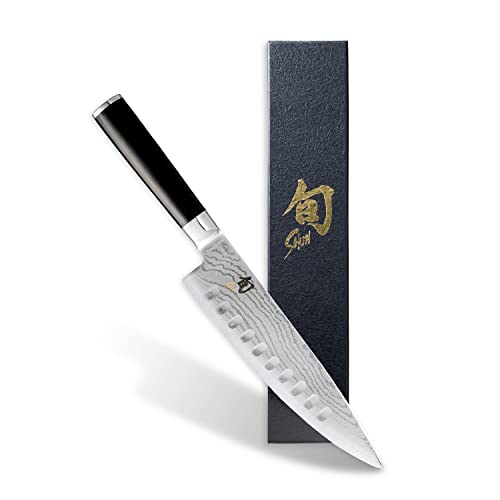
The listing calls Shun’s Classic series the original Japanese cutlery line introduced to the United States, and this chef’s knife shows what a Japanese blade offers. The listing describes a core of VG-MAX steel clad in 68 layers of Damascus stainless, sharpened to a 16-degree edge. Shun says its steels are harder than those in most Western-style knives. The sides have hollow-ground dimples, which the listing says help food release and cut friction.
The shape is a Western chef’s knife, so it rocks and chops like one, but the blade is the Japanese kind: hard, fine and less forgiving. Shun says not to cut bones, frozen food or very hard rinds with its knives, and not to twist the blade. That makes it a slicing and dicing knife for onions, tomatoes, herbs and cooked meat.
The handle is D-shaped Pakkawood, which the listing says suits left and right hands. Shun says to wash by hand and dry it completely, never in the dishwasher. The listing gives a lifetime warranty and says Shun knives are supported by free sharpening. The lead offer was New, sold by Amazon.com, when we checked.
Why we like it
- VG-MAX core in 68-layer cladding (listing)
- 16-degree edge per side (Shun)
- Hollow-ground sides for food release
- Free sharpening and lifetime warranty (listing)
Key specifications
| Model | DM0719 |
|---|---|
| Blade length | 8 inches |
| Steel | VG-MAX core, 68-layer Damascus cladding |
| Stated hardness | Not stated on listing; harder than most Western knives (Shun) |
| Edge angle | 16 degrees per side |
| Bolster | Not stated |
| Handle | D-shaped Pakkawood |
| Made in | Japan |
Why we recommend it
It suits a careful cook who wants a hard, keen Japanese edge in a familiar chef’s-knife shape, and who will keep a tougher knife for bones.
Skip it if the knife will be shared, rushed or washed in the dishwasher; a chipped edge is the likely result.
Pros and cons
Pros
- Hard steel holds a fine edge
- Familiar chef’s-knife shape
- Free sharpening offered
Cons
- Can chip on bone or frozen food
- Must be dried by hand at once
- Hardness figure not on listing
3. Global 7-inch Chef’s Knife – Light, All-Steel Japanese Blade

Global takes the Japanese idea in a different direction: a stainless-steel blade and a stainless-steel handle, molded with dimples for grip. The listing gives the blade as CROMOVA 18 high-carbon stainless steel, 7 inches long, ground on each side to a straight, sharp edge. Global says its knives are factory sharpened at 10 to 15 degrees.
At 7 inches it is a little shorter than the other picks, which suits a smaller board or a cook who finds an 8-inch knife long. It is a good choice for fine dice and thin slices. Global does not state a hardness on the listing or its care page, so we don’t compare it on that point; buy it for the light, all-steel design and fine edge rather than for the hardest steel.
Global’s care rules are clear: no dishwasher, hand wash with warm soapy water and dry at once, no frozen food or bones, and no hard surfaces like glass or stone. It recommends a fine ceramic or diamond rod for honing, not a traditional steel. The listing says it is made in Japan with a lifetime warranty. The lead offer was New, sold by Cutlery and More, when we checked.
Why we like it
- Fine 10 to 15-degree factory edge (Global)
- Stainless-steel blade and handle
- Dimpled steel handle for grip (listing)
- Made in Japan; lifetime warranty (listing)
Key specifications
| Model | G-55 |
|---|---|
| Blade length | 7 inches |
| Steel | CROMOVA 18 high-carbon stainless |
| Stated hardness | Not stated |
| Edge angle | 10 to 15 degrees (Global) |
| Bolster | Not stated |
| Handle | Stainless steel, dimpled |
| Made in | Japan |
Why we recommend it
It suits a cook who wants a light, nimble Japanese knife with a very fine edge for vegetables, herbs and cooked meat.
Skip it if you dislike a metal handle or want a full 8-inch blade; the Shun or the Wüsthof will suit you better.
Pros and cons
Pros
- Very fine stated edge
- Easy-to-clean steel handle
- Compact 7-inch length
Cons
- Hardness not stated
- Needs a ceramic or diamond rod
- Steel handle can feel slick to some
German and Japanese knife questions, answered
Are Japanese knives sharper than German knives?
Usually a little, and they stay sharp longer. Shun gives 16 degrees per side and Global 10 to 15, but Wüsthof’s 14.5-degree edge shows the gap is smaller than it used to be. The bigger difference is the harder steel and thinner blade behind the edge, which ATK describes.
Do Japanese knives chip more?
Yes. ATK says gyuto are thinner and made from harder metal, so they are less forgiving and can chip easily. Keep them away from bones, frozen food and twisting cuts.
Can I use a honing steel on a Japanese knife?
Check the maker. Global recommends a fine ceramic or diamond rod and warns that traditional steels are likely to damage its knives. A ceramic rod is the safe choice for hard Japanese blades.
Which is better for a beginner?
A German knife. It tolerates more mistakes, and a quick pass on a steel fixes a rolled edge. Our best chef knife for beginners guide has more options.
Can either go in the dishwasher?
No. Wüsthof, Shun and Global all say to wash by hand and dry straight away.
Which knife family to start with
If you’re buying one chef’s knife to do everything, start German: it forgives more and asks less. If you already cook a lot, keep your boards wooden and enjoy looking after your tools, a Japanese knife rewards that care with a lighter, finer, longer-lasting edge. Many cooks end up with one of each, using the German knife for chicken and squash and the Japanese knife for onions, tomatoes and cilantro. For a lighter take on the Japanese side, see our best Japanese knife gyuto guide. And when you’d rather someone else did the chopping, see the menu or call to order.