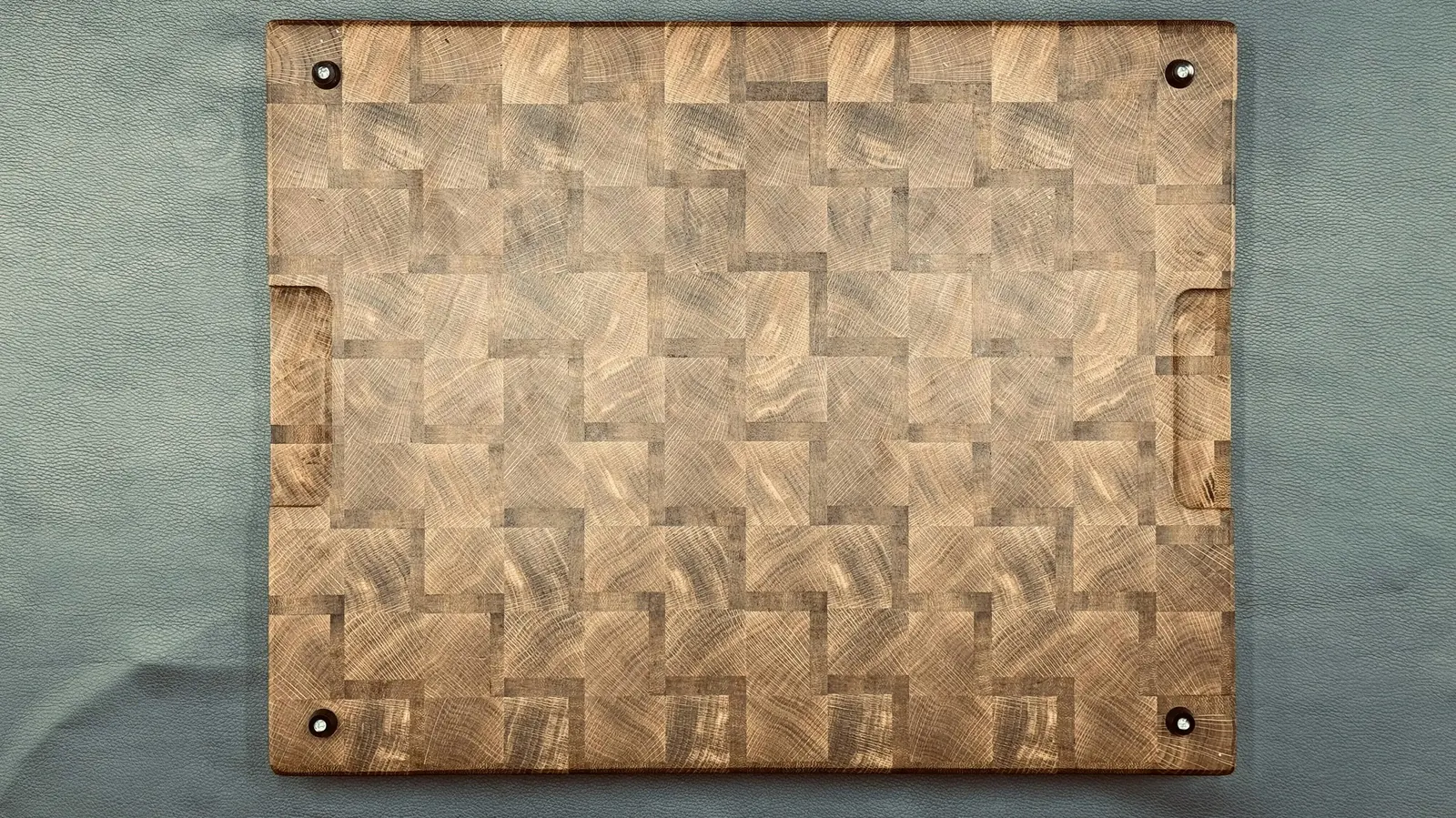
Once you’ve decided on a wooden cutting board, there’s one more choice: end grain or edge grain. Both can be the same wood, from the same maker, in the same size. The difference is how the pieces of wood are turned before they’re glued together, and that changes how the board treats your knife, how much care it needs, how heavy it is and what it costs.
Restaurant prep stations tend to have both kinds: a thick end-grain block where the heavy chopping happens, and lighter edge-grain boards that are easy to move and wash. This guide compares the two on knife wear, knife marks, oiling, cracking, weight and cost, using what the makers state, then names one maple board for each side, both from John Boos.
Julia’s earns a commission on purchases made through links on this page, at no cost to you. Recommendations are based on what a restaurant kitchen looks for, product specifications and verified buyer reports.
Quick verdict: end grain or edge grain?
For most home cooks, an edge-grain board is the better buy: it’s cheaper, lighter, flatter, needs less oil and is still kind to a sharp knife. Choose end grain if you own good knives you want to keep sharp longer, chop heavily every day, and are happy to oil the board often and leave a heavy block on the counter. John Boos, which makes both, says the two are equally good for food safety and durability.
The table sums up the differences. The sections after it explain each one.
End grain vs edge grain cutting board, side by side
| End grain | Edge grain | |
|---|---|---|
| How it’s built | Short blocks glued with the fibers standing upright | Long strips glued side by side, fibers running lengthwise |
| What the knife does | Slips between the fibers, which close back up (John Boos) | Cuts across the long fibers |
| Knife wear | Gentler; edge stays sharper longer (John Boos) | Knife-friendly next to plastic or glass |
| Knife marks | Fibers close up, so marks hide | Visible marks over time; can be sanded |
| Oiling | May need more oil (John Boos) | At least monthly, like any wood board |
| Thickness of our picks | 3 inches | 1.5 inches |
| Cost class | Higher; more labor to make | Lower; most common and affordable (John Boos) |
| Pattern | Checkerboard of block ends | Parallel stripes |
How each board is built
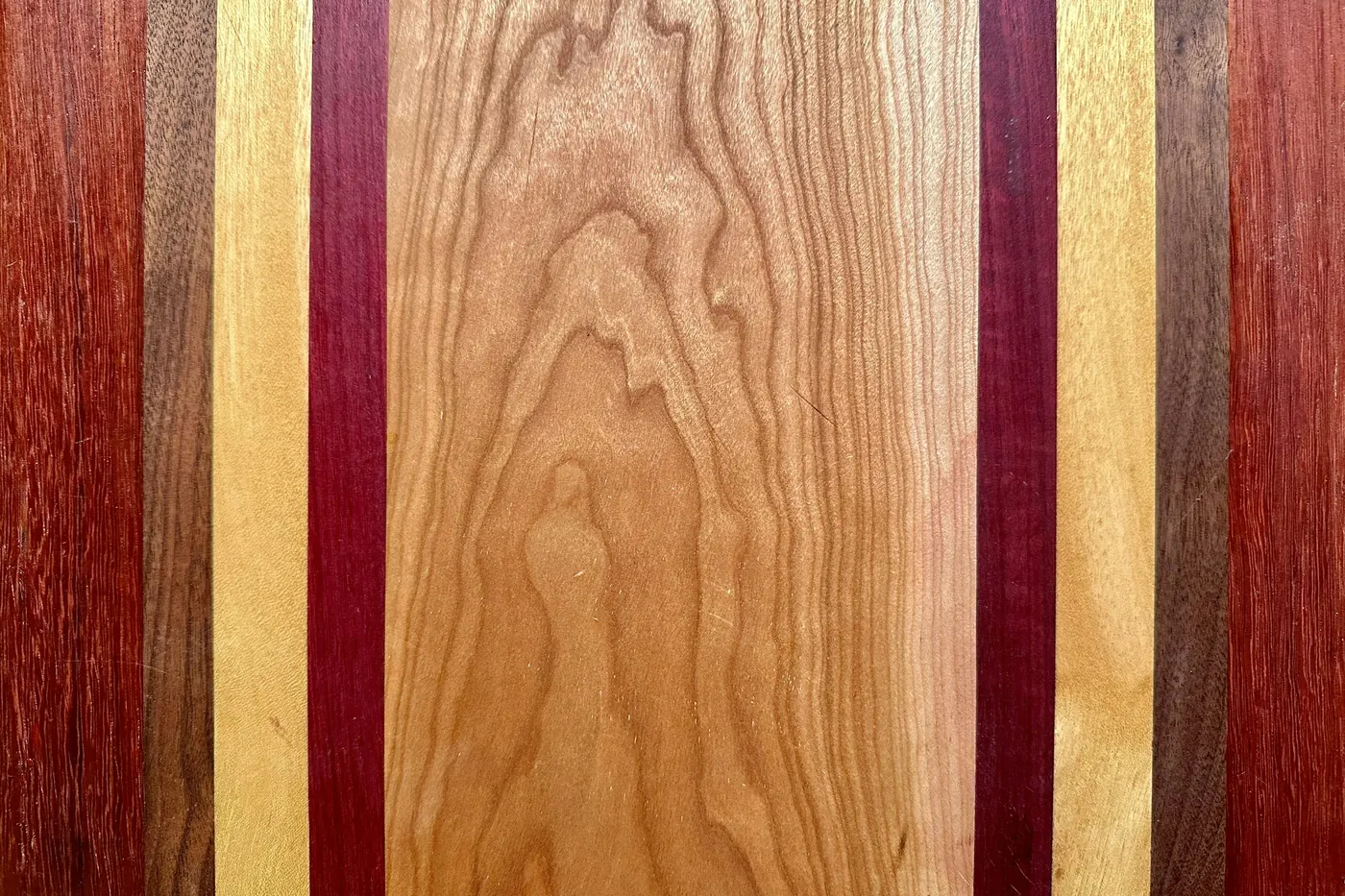
Think of wood as a bundle of straws. An edge-grain board is made from long rails of hardwood glued side by side, so the straws lie flat and run the length of the board. John Boos describes edge grain this way: the fibers run horizontally. An end-grain board is made by cutting short square pieces of maple, cherry or walnut and gluing them with the straws standing on end, which gives the checkerboard look.
That turn of the wood is the whole story. Everything else in this comparison, from knife wear to oiling to price, follows from which way the fibers face the blade.
Knife wear: end grain is gentler
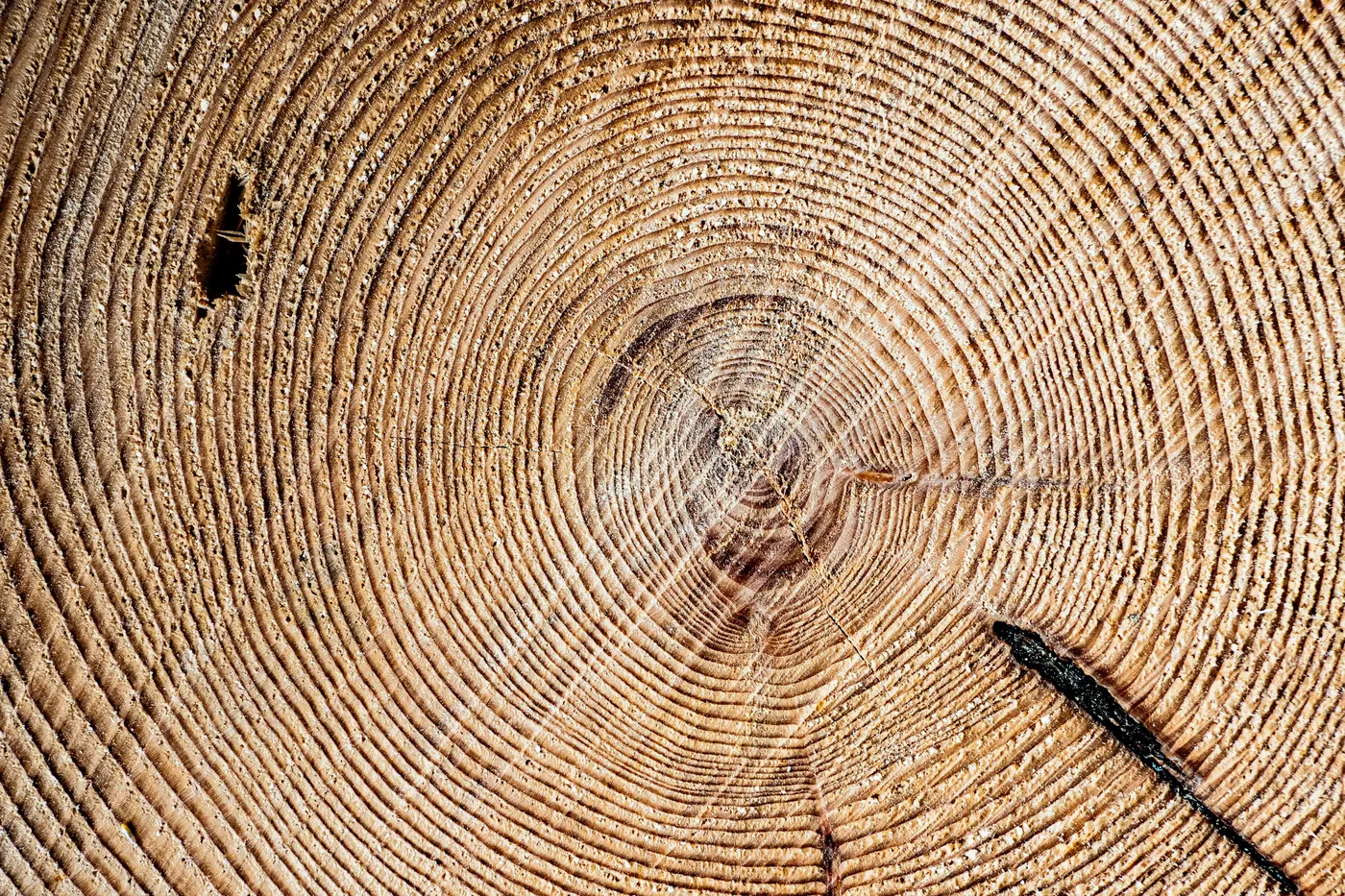
On end grain, John Boos says, the knife slides in between the wood fibers, the fibers separate, and then they close back up. The maker says this keeps your knife sharper for longer, and its FAQ adds that end-grain fibers absorb the impact of the blade. Its product pages say the same thing more simply: end grain saves wear on your knives.
Edge grain is not hard on knives either. John Boos calls edge-grain surfaces knife-friendly compared with plastic or glass, and as general kitchen sense, any good hardwood board is far kinder to an edge than glass. The gap between end and edge grain is real, but it’s smaller than the gap between either one and a hard surface. As general kitchen sense: if you hone your knife often and sharpen it now and then, an edge-grain board won’t hold you back. If you own thin, hard Japanese blades, end grain is the kinder surface; our best cutting board for Japanese knives guide covers that choice.
Knife marks and resurfacing
Because end-grain fibers close up after the cut, the surface stays smoother for longer, according to John Boos. An edge-grain board shows its history. John Boos says that over time you may see visible knife marks, and that sanding with the grain and oiling can refresh the surface.
That makes edge grain the easier board to bring back. A flat, long-grain surface sands evenly by hand. End grain can be refreshed too, but its short fibers sand differently and a thick block is harder to handle. In practice, few home cooks sand either board often.
Oiling and everyday care
Both boards follow the same rules. John Boos says wood cutting boards are not dishwasher safe, that you shouldn’t soak or submerge them, and that you should wash them with hot soapy water after each use and dry them. It recommends oiling at least once a month, depending on use and conditions, and again whenever the board looks dry and lighter in color.
The difference is how much oil each board takes. John Boos says end grain may need more oiling to keep its appearance and stop it drying out over repeated use and washing. As general kitchen sense, that fits how the board is built: on end grain, the open ends of the fibers face up, and they draw in water and oil more readily than the closed sides of the fibers on edge grain. Plan on oiling an end-grain block more often than the monthly minimum, especially in a dry kitchen. Our best cutting board oil guide covers what to use.
Cracking and warping
John Boos says soaking a board disrupts its moisture content and can cause the rails to split, that proper storage is crucial to prevent warping, and that boards should be stored on edge, away from direct sunlight. It also warns that a board left flat on a cold stone counter for long periods can develop a moisture imbalance. Its board cream, it says, protects against drying out, cracking and splitting.
None of that is specific to one construction, and John Boos does not say either type warps more. As general kitchen sense, an end-grain block that dries out is the one more likely to show open seams, because its fibers lose and gain water faster. A thick block also stays put and resists flexing. Either way, the care routine above is what keeps a board flat and sound.
Weight and size
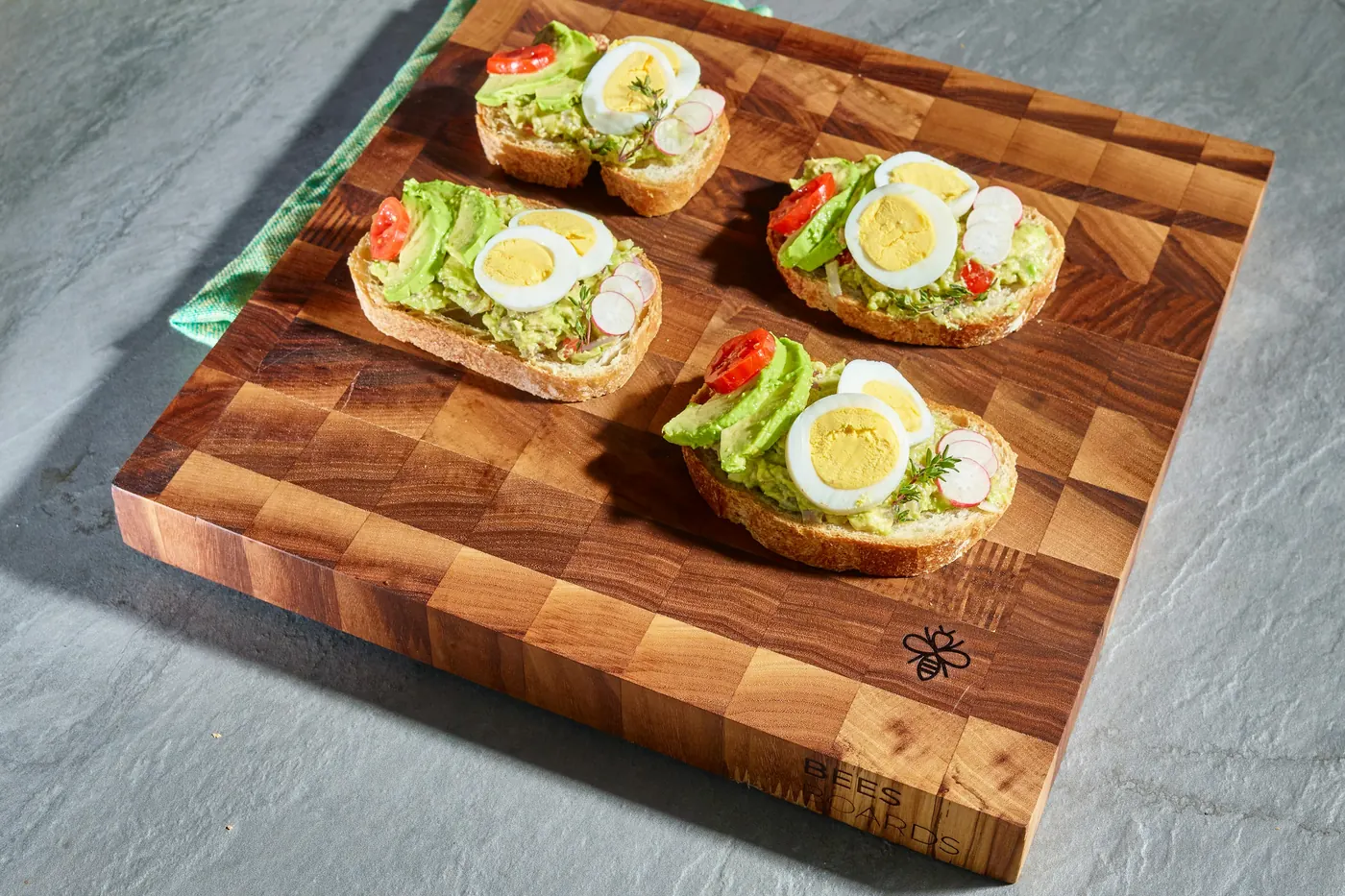
End-grain boards are usually thicker, because the short blocks need depth to be strong. Our end-grain pick is 3 inches thick. The edge-grain pick is 1.5 inches thick, and John Boos lists it at 18 pounds at 24 by 18 inches. The maker doesn’t state a weight for the end-grain block, but at twice the thickness it is the heavier board to lift.
Weight is good on the counter, because a heavy board doesn’t slide. It’s a nuisance at the sink. If your board has to move from counter to sink every day, an edge-grain board is easier to live with. If it can stay put and be wiped, washed and dried in place, a thick end-grain block is the steadier surface.
Cost and value
We don’t quote prices, but the order is clear. John Boos says end-grain construction is more labor-intensive than edge grain and can cost more for that reason, while edge-grain boards are the most common and affordable. Value comes down to how much you cut: if you chop for a family every day and own good knives, an end-grain block earns its keep. If you cut a few onions a week, edge grain gives you most of the benefit for less money. For a lower-cost end-grain board, see our best cheap end grain cutting board guide.
Choose end grain if… / Choose edge grain if…
Choose end grain if…
- You own good knives and want the edge to last as long as possible.
- You chop a lot, every day, and want a heavy board that stays put.
- The board can live on the counter instead of moving to the sink.
- You don’t mind oiling it more often than once a month.
Choose edge grain if…
- You want a lighter, thinner board that is easy to wash.
- You’d rather oil once a month and be done.
- You want the lower-cost option that is still kind to knives.
- You don’t mind some visible knife marks, or are happy to sand them out.

One maple board on each side of the end grain vs edge grain cutting board question
Both picks are hard maple from John Boos, which has made boards in the US since 1887, so the comparison comes down to construction alone. Both were in stock when we checked. Neither listing appears on our other pages, but each comes from a Boos line we cover elsewhere: the end-grain block is from the same CCB end-grain family as the Boos blocks in our best wood cutting board end grain guide, chosen here for its square 18-inch size, and the edge-grain board is a larger size of the R-Board on our gift pages, chosen because it is the classic edge-grain board at full prep size.
1. John Boos Classic Maple End-Grain Chopping Block, 18 x 18 inch – Thick, Reversible Block
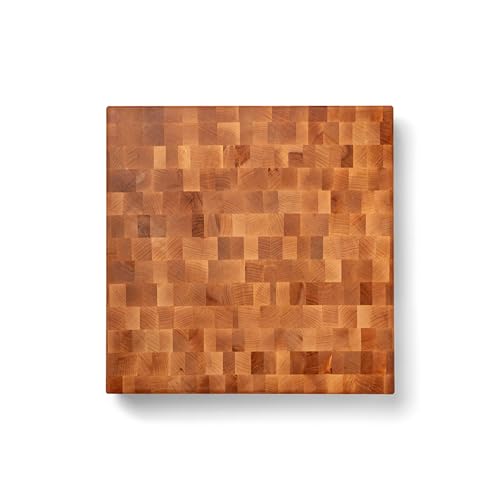
This is end grain in its classic form: a 3-inch-thick square of maple blocks with the grain standing upright. John Boos’s listing says it is reversible, with recessed finger grips on the sides, an oil finish and a level cutting surface suitable for fine cutlery.
At 18 by 18 inches it gives plenty of room to break down a chicken or chop a pile of onions for a pot of beans, and the 3-inch depth means it stays put. It is also the board John Boos describes in its end-grain notes, where the knife slips between the fibers and they close up again.
The listing says hand-wash only and suggests Boos Mystery Oil and Board Cream, which are sold separately. Follow the maker’s care routine: wash, dry, store on edge and oil it at least monthly, more often if it looks pale. The listing does not state a weight, and a 3-inch maple block of this size is one to leave on the counter. The lead offer was New, sold by Spreetail rather than Amazon, when we checked.
Why we like it
- End-grain maple, 3 inches thick
- Reversible, with two cutting faces
- Recessed finger grips for lifting
- American-made maker since 1887 (John Boos)
Key specifications
| Model | CCB183-S |
|---|---|
| Construction | End grain |
| Wood | Maple |
| Size | 18 x 18 inches |
| Thickness | 3 inches |
| Weight | Not stated |
| Reversible | Yes |
| Care | Hand-wash only; oil and board cream |
Why we recommend it
It suits a cook with good knives and a permanent spot on the counter who chops every day and wants the kindest wooden surface for an edge.
Skip it if the board has to go to the sink every day; at 3 inches thick it is heavy to move.
Pros and cons
Pros
- Gentle on knife edges
- Very stable on the counter
- Two usable faces
Cons
- Heavy; weight not stated
- Needs frequent oiling
- Higher cost class
2. John Boos R-Board Maple Edge-Grain Cutting Board, 24 x 18 inch – Full-Size Prep Board

The R-Board is the edge-grain counterpart: long rails of maple glued side by side into a flat, 1.5-inch-thick board. The listing gives the size as 24 by 18 inches and the weight as 18 pounds, and says it is reversible, with finger grips, and made in the USA.
The large surface is the reason to choose it. There’s room to slice a brisket, cut a stack of tortillas into chips and keep a pile of chopped cilantro to one side. At half the thickness of the end-grain block it’s easier to handle, though 18 pounds is still a two-handed lift at the sink.
Care is the same as any Boos board: hot soapy water, dry it, store it on edge and oil it at least once a month. Expect visible knife marks over time; John Boos says sanding with the grain and oiling will refresh the surface. The listing gives a one-year guarantee against defects in workmanship and material. The lead offer was New, sold by Spreetail, when we checked.
Why we like it
- Large 24 x 18-inch surface
- Weight stated: 18 pounds
- Reversible, with finger grips
- Made in the USA (listing)
Key specifications
| Model | R02 |
|---|---|
| Construction | Edge grain |
| Wood | Maple |
| Size | 24 x 18 inches |
| Thickness | 1.5 inches |
| Weight | 18 pounds |
| Reversible | Yes |
| Care | Hand-wash, dry, oil monthly (John Boos) |
Why we recommend it
It suits a cook who wants one large, flat maple board for everyday prep that is kind to knives and simpler to look after than end grain.
Skip it if your sink is small; a 24 by 18-inch board won’t fit many home sinks, so measure first.
Pros and cons
Pros
- Big prep surface
- Thinner and easier to handle than end grain
- Lower-maintenance construction
Cons
- Shows knife marks over time
- Still heavy at 18 pounds
- Too large for many sinks
End and edge grain questions, answered
Is end grain really better for knives?
It’s gentler. John Boos says the blade slips between the upright fibers, which close up again, so the edge stays sharper longer. Edge grain is still knife-friendly compared with plastic or glass, so the difference matters most to owners of good, thin knives.
Is an end-grain board more sanitary than edge grain?
John Boos says both constructions are equally good for food safety and durability. What matters is washing the board with hot soapy water after each use and drying it, whichever kind you own. Our best cutting board plastic guide covers the plastic boards many cooks keep for raw meat.
How often should you oil an end-grain board?
John Boos recommends at least once a month for any board, and again whenever it looks dry and lighter in color. It says end grain may need more oil than edge grain, so check it more often.
Can either type go in the dishwasher?
No. John Boos says wood cutting boards are not dishwasher safe and should never be soaked, because that upsets the moisture balance and can split the wood.
Which is easier to resurface?
Edge grain. John Boos says sanding with the grain and oiling will refresh an edge-grain board’s surface. End grain hides marks better in the first place, so it needs resurfacing less often.
Our take: edge grain for most, end grain for keen cooks
Most kitchens will be well served by a good edge-grain maple board: it’s affordable, kind enough to knives and easy to keep. If you cook every day with knives you care about, and the board can stay on the counter, an end-grain block is the upgrade worth making. Either way, buy a dense hardwood, keep it out of the dishwasher and keep it oiled. For more boards, see our best cutting board wood guide. And when you would rather someone else did the chopping, see the menu or call to order.